


 by Tom Gurney
Tom Gurney BSc (Hons) is an art history expert with over 20 years experience
Email: tomgurney1@gmail.com / Phone: +44 7429 011000
Käthe Kollwitz in Berlin: Introduction
On the back of Käthe Kollwitz’s 1909 drawing Out of Work, an inscription gives her address as “Berlin / Weissenburger str. 25”. On the front, a man props his chin on his fists beside a woman and two sleeping children. Kollwitz signed and dated the drawing and called it Arbeitslosigkeit, or Unemployment. The title identifies the predicament. The address leads to the building in Prenzlauer Berg where she lived, drew and, in the early years of her marriage, shared a flat with her husband’s medical practice. [1] [2]
Kollwitz came to Berlin to study and spent most of her working life there. Across the city, a women artists’ association offered her training and later teaching work, a Charlottenburg printer pulled impressions from her plates, and public collections began preserving her working proofs. The Prussian Academy of Arts eventually gave her a studio and a vote in its affairs. After the Nazis forced her out, she rented a room in Mitte, where the courtyard doubled as a place for carving and her own rooms became an exhibition space. These places help explain how she made her work and how people came to see it. [2] [3] [4] [5]
At a Glance
- Home and practiceKäthe and Karl Kollwitz moved to Weißenburger Straße 25 in Prenzlauer Berg in 1891. Their upper-floor flat initially housed his medical practice and her workspace. The site is now Kollwitzstraße 56a. [2] [6]
- Public breakthroughThe Great Berlin Art Exhibition showed Ein Weberaufstand (A Weavers’ Revolt) in 1898. Kollwitz exhibited regularly with the Berlin Secession, and the Berlin Kupferstichkabinett acquired the cycle in 1902. [3] [7] [8]
- AcademyKollwitz was elected to full membership of the Prussian Academy of Arts in 1919, took charge of the master studio for graphic art in 1928 and was forced to resign in 1933. [9] [4]
- Later studioShe worked at the Ateliergemeinschaft Klosterstraße, a shared studio complex in Mitte, from autumn 1934 to 1940, then returned to working at home. [2] [5]
- Public memorialsGustav Seitz’s bronze portrait sits on Kollwitzplatz. An enlargement of Kollwitz’s own Mutter mit totem Sohn (Mother with Her Dead Son) stands inside the Neue Wache. [10] [11] [12]
Contents
- Learning and teaching at the Verein Berliner Künstlerinnen
- Weißenburger Straße and the doctor’s practice
- The theatre, the printer and the exhibition hall
- Posters in the city
- Election, leadership and forced resignation
- A working room at Klosterstraße
- Kollwitzplatz and the collections that preserve her work
Learning and teaching at the Verein Berliner Künstlerinnen
Kollwitz first studied in Berlin under her birth name, Käthe Schmidt. In 1886–87 she attended Karl Stauffer-Bern’s painting class at the school run by the Verein Berliner Künstlerinnen, the association of Berlin women artists. Stauffer-Bern started her on portraiture and repeatedly directed her back to drawing. In a letter dated 28 July 1927, Kollwitz credited that winter with laying the foundations of her training. She also met Beate Jeep at the school. As Beate Bonus-Jeep, she remained a close friend and an adviser on work in progress. Letters and photographs associated with that friendship eventually entered the Academy’s Kollwitz archive. [4] [13]
The association’s school, known as the Damenakademie, offered professional instruction while Berlin’s state fine-art school excluded women. Kollwitz returned to the association to teach drawing and etching from 1898 to 1903, the years in which her own prints were attracting public attention. In 1904 she joined Sabine Lepsius, Julie Wolfthorn and other women in petitioning the state school’s director, Anton von Werner, to admit women. The petition made access to training a public issue. The exclusion ended after the political changes of 1918, and the first women students began in spring 1919. That same year Kollwitz entered the Prussian Academy of Arts as a full member, a separate development in the institution that elected artists and organised exhibitions. [3] [9] [14]
Weißenburger Straße and the doctor’s practice
When the Kollwitzes moved to Prenzlauer Berg in 1891, Karl took on patients insured through the tailors’ health insurance fund. At first his practice and Käthe’s working area occupied the same upper-floor flat. The family later rented additional rooms in the building. Their sons Hans and Peter were born in 1892 and 1896, and relatives and lodgers also spent extended periods in the household. The building remained the family address even as Kollwitz began renting studios elsewhere. [2] [3] [6]
Looking back in 1941, Kollwitz described Karl’s practice as especially important to her understanding of working-class life. Through him she learned more about the difficulties that patients and their families faced. She singled out unemployment and prostitution as problems that troubled her and kept drawing her back to these subjects. The address on Out of Work places the artist within reach of those experiences. The people in the drawing remain unidentified. Where a model can be named, it changes what we can say about the image. A surviving study for the second sheet of the Weavers cycle, for instance, shows her young son Hans holding a candle. A figure in a scene of industrial hardship could begin with someone posing at home. [1] [3] [15]
The Washington drawing shows how much Kollwitz could do with the space between people. The man’s dark coat anchors the lower left, and his elbows and fists fold his body in on itself. Behind him the woman stretches across the sheet, both hands resting near the head of the child in her lap. The adults face the same way, but the angle of his body gives little sense that they are looking together. Opaque white watercolour picks out the pillow and clothing, while grey-brown paper remains visible around them. The room feels crowded and the adults absorbed in separate thoughts. [1]
From 1908 Kollwitz sent drawings to the Munich satirical weekly Simplicissimus. The editors gave her scope to choose subjects and sometimes supplied titles or captions. On 19 July 1909 they published a simplified drawn version of the unemployment composition as Das einzige Glück (The Only Happiness), with a caption linking the cost of raising children to the state’s need for soldiers. Berlin’s first-state proof of the etching Arbeitslosigkeit identifies another drawing as the basis for the print and traces the seated man to the version published in the weekly. MoMA’s 2024 checklist records the Washington drawing and an intaglio impression from the Ute Kahl collection separately on the same page. The drawing, the magazine page and the etching show how a figure could travel between media while the arrangement around him and the words a reader encountered changed. The social criticism page follows those changes across her work for the weekly. [1] [15] [16] [17]
The theatre, the printer and the exhibition hall
In 1893 Kollwitz saw Gerhart Hauptmann’s Die Weber (The Weavers) at the Freie Bühne. The play drew on the Silesian weavers’ uprising of 1844. She set aside a projected series after Émile Zola’s Germinal and began Ein Weberaufstand. She dressed the figures in clothes familiar from a later industrial world and built her own sequence. The first sheets bring the viewer into the rooms where families bear the consequences of deprivation. A gathering turns private distress into a shared grievance, then the march and assault take the action outdoors. The final sheet brings the dead back inside. The first three sheets are lithographs and the last three use etching. The change in process comes as the uprising moves into the open. [3] [7]
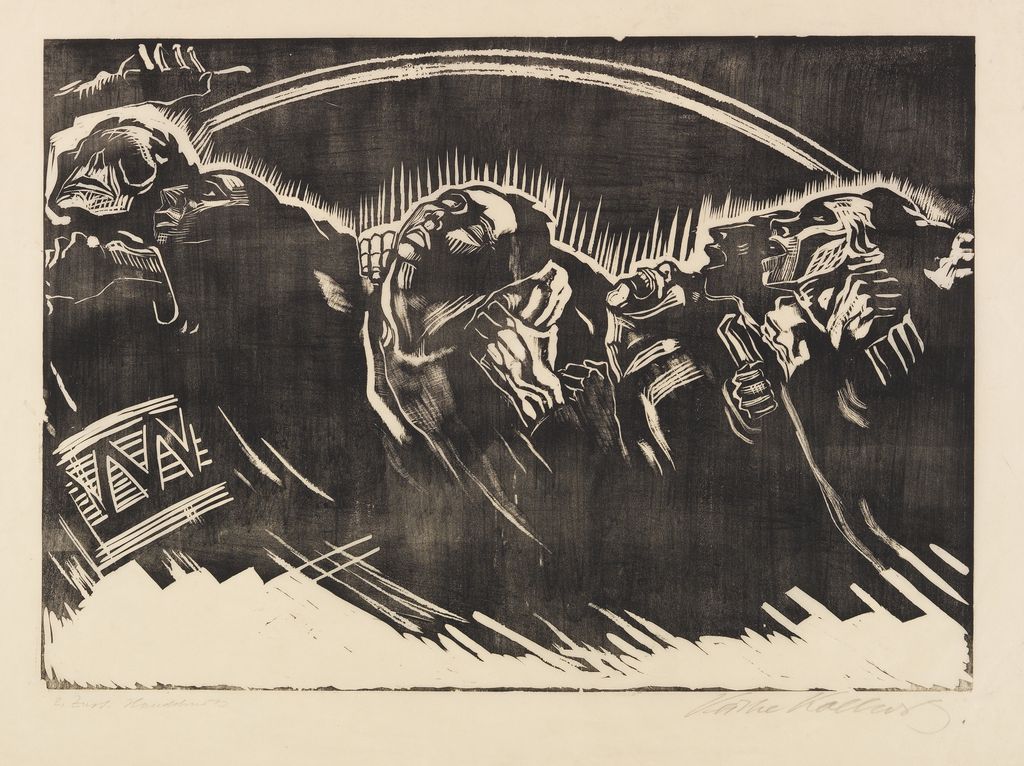
The Germinal etchings had already brought Kollwitz into contact with the Hofkupferei Felsing in Charlottenburg. Wilhelm Felsing ran the family firm from 1892 to 1940. According to the Kollwitz Museum Köln, the workshop printed almost all the etchings produced during her lifetime. Its customers included Stauffer-Bern, Max Klinger, Max Liebermann and Heinrich Zille. The artist could develop and revise a plate in one place, while the shop supplied the press and the expertise to print it. MoMA’s impression of Weberzug (March of the Weavers), accession 223.1997, gives that division of work a precise record. Its design belongs to 1893–97, while the museum dates publication of this impression to about 1931 and names Felsing as printer and Alexander von der Becke as publisher. [3] [18]
At the Große Berliner Kunstausstellung in 1898, Liebermann helped secure a jury recommendation that Kollwitz receive a medal for the Weavers cycle. Kaiser Wilhelm II prevented the award. The show still brought the work before a large audience and helped secure the support of Max Lehrs, who began acquiring her prints for Dresden’s Kupferstich-Kabinett. Dresden’s German Art Exhibition recognised her the following year. The contemporary awards notice in the Deutscher Reichsanzeiger lists her among the recipients of a silver plaque. The two exhibitions gave the same work distinct outcomes, one an unfulfilled recommendation and the other an award she received. [3] [7] [19]
The Berlin Secession offered another route to an audience. Its exhibitions gave graphic work dedicated space, and Kollwitz participated regularly. The surviving poster for the third exhibition advertises a separate black-and-white exhibition, making visible how the Secession presented work on paper as a category in its own right. In Vienna, the Albertina’s impression of Ende (End), the sixth sheet of the Weavers cycle, has an 1899 Hofbibliothek provenance. Cologne traces the acquisition to the fifth Vienna Secession exhibition. [3] [20] [21]
Berlin’s own Kupferstichkabinett began acquiring her work under Friedrich Lippmann, who bought the Weavers cycle and several individual prints in 1902. Two acquisitions in 1906 show what the print room could preserve beyond a finished series. The museum bought Selbstbildnis. Dreiviertelprofil nach rechts (Self-Portrait, Three-Quarter Profile to the Right), made by drawing on textured transfer paper and transferring the design to lithographic stone. It also preserves the transfer drawing, so the mark on the prepared paper and the mark printed from stone can be studied together. That same year Kollwitz gave the collection a third-state impression of her 1903 lithograph Pietà. Its dark brown and black-blue inks preserve one of the colour combinations she tried. Hans Kollwitz’s gift of 120 drawings in 1964 later added depth to a collection that had begun buying her prints during her lifetime. [22] [23] [8]
MoMA’s 2024 exhibition brought some of this working material together again. Its checklist records a Berlin impression of Zwei Selbstbildnisse (Two Self-Portraits) from 1891 alongside a Dresden impression dated 1892. The second record adds sandpaper to the etching and drypoint listed for the earlier sheet. The exhibition also borrowed a steelfaced copper plate for Zertretene (The Downtrodden) from the Berlin Academy and showed a printed version from the Getty. An exhibition built around working process could draw on the objects that print rooms and archives had kept for separate reasons over more than a century. [17] [24]
Posters in the city
The 1906 Deutsche Heimarbeit-Ausstellung (German Home-Industry Exhibition) brought the conditions of home workers to Unter den Linden. Trade unionists and social reformers used a prominent street to reach visitors who might seldom enter the rooms where garments and other goods were made. Kollwitz’s poster places an exhausted woman’s face under hard light. The pale forehead and cheeks make the shadows around her eyes legible at a glance. Cologne records the claim that the Empress threatened to stay away while the poster was displayed as a story that circulated from the 1920s. The Berlin museum also records Kollwitz returning to the conditions of women home workers in 1925, nearly twenty years after the exhibition. [25] [26]
In 1912 Für Groß Berlin (For Greater Berlin) made a more specific appeal. A committee of architects and planners commissioned the poster for a meeting about housing. The lettering claimed that 600,000 residents of Greater Berlin lived in dwellings with at least five people to a room and that hundreds of thousands of children lacked playgrounds. Alongside those figures, an older girl holds a small child in a courtyard where a notice forbids play in the yard and on the stairs. The campaign’s numbers describe the scale of the problem. The notice and the two girls show what overcrowding could mean for children who had to find somewhere to spend the day. [26] [27]
The police president had the poster removed on the grounds that it incited class hatred. Kollwitz’s own criticism concerned its legibility. In a letter to Hans on 3 March 1912, she complained that the lettering hemmed in the drawing and that the poster lacked impact at a distance. A letter from Lehrs dated 19 December 1913 documents differences between impressions, including the length of the older girl’s legs and a change in the names printed for the meeting. The wording, layout and version of a poster all mattered when it was designed for someone to read in passing. Greater Berlin was established in 1920, and Kollwitz continued to address urban hardship in work such as Städtisches Obdach (Municipal Shelter) in 1926. [26] [27] [28]
Election, leadership and forced resignation
The revolution of 1918 opened a period of reform at the Prussian Academy of Arts, which had its rooms on Pariser Platz. On Liebermann’s proposal, Kollwitz was elected a full member on 24 January 1919. The Academy identifies her as the first woman elected to full membership since 1833. She heard the news at a Secession meeting and recorded mixed feelings in her diary. She regarded the election as an honour but questioned whether an institution she found old-fashioned could serve a new political order. The sculptor August Gaul argued that its newly won independence gave it a chance to revive. Kollwitz took part in exhibition committees and used her position to put forward women for election. [2] [9] [4]
For her sixtieth birthday in 1927 the Academy devoted two rooms of its autumn exhibition to about a hundred of her works. Visitors could see drawings connected to the Weavers and Peasants’ War cycles alongside campaign posters, including Helft Rußland (Help Russia) and her appeal against the law criminalising abortion. In 1928 Kollwitz became the first woman to lead one of the visual arts section’s six master studios. As head of the master studio for graphic art she joined the academic senate and gained two working rooms at the art school near Hardenbergplatz. She had first rented a separate studio in 1912 at the Künstlerhaus Siegmundshof in the Hansaviertel. The rooms at the art school now tied her workspace to a teaching post. [2] [4] [29]
In June 1932 Kollwitz signed the Dringender Appell! (Urgent Appeal!), which asked the Social Democratic and Communist parties to put forward a joint slate against the Nazis in the Reichstag election of 31 July. The Bundesarchiv preserves the poster, and the text also appeared in the Internationaler Sozialistischer Kampfbund’s newspaper Der Funke on 25 June. It called on people who opposed fascism to act together despite disagreements on principle. After Hitler became chancellor in January 1933, the campaign was renewed ahead of the 5 March election. The 12 February issue of Der Funke carries the renewed appeal and lists both Käthe and Karl Kollwitz among the signatories, alongside Heinrich Mann. The Academy describes her as a socialist without party affiliation and identifies this second campaign as the immediate cause of her removal. [4] [5] [30] [31] [32]
On 15 February 1933 the Nazis forced Kollwitz and Mann to resign. The Academy’s archival account identifies the writer Alfred Döblin and Berlin’s city planning councillor Martin Wagner as the two members who openly defended them at the extraordinary meeting. Wagner then resigned from the Academy in solidarity. Kollwitz lost the leadership of the master class in February, remained in state employment until her scheduled retirement in September, and retained use of the Hardenbergstraße studio into early 1934. The Käthe Kollwitz timeline places the appeals and her departure alongside the works she was making at the time. [4] [5]
A working room at Klosterstraße
In autumn 1934 Kollwitz rented a room at the Ateliergemeinschaft Klosterstraße in Berlin-Mitte. She had begun the lithographs for Tod (Death) that spring, and five sheets appeared at the Academy’s autumn exhibition. In October she interrupted the cycle to return to Mutter mit zwei Kindern (Mother with Two Children). The sculpture gathers the three bodies into a low, compact group. The mother’s arms enclose the children, and their weight presses into her rather than balancing separately on the ground. MoMA’s 2024 checklist records the Krefeld bronze as a 1958 cast of a work modelled in 1932–36. A shell-limestone version belonged to the history of the studio itself. The painter Leo von König put up the money, and the sculptor Erich Geiseler carved it in the courtyard at Klosterstraße. That stone version was lost during the war. [5] [17]
Kollwitz participated in the studio community’s annual exhibitions from 1935 to 1938, sometimes replacing works that drew official objections. Other venues were harder to secure. In 1935 her work was removed from Berliner Kunst (Berlin Art) in Munich. In 1936 works by Kollwitz and Ernst Barlach were removed on the eve of the Academy’s anniversary exhibition, Berliner Bildhauer von Schlüter bis zur Gegenwart (Berlin Sculptors from Schlüter to the Present). The closure of the upper floor of the Kronprinzenpalais, where two of her sculptures stood, was a separate incident. In her November diary Kollwitz wrote of the silence that followed the removals. She had expected people to visit or at least write. [5] [33]
Plans for a seventieth-birthday exhibition at Galerie Nierendorf fell through in 1937, and the Reich Chamber prevented the Karl Buchholz bookshop from taking over the show. Kollwitz eventually displayed about sixty graphic works in her rooms at Klosterstraße. At the same time, galleries in New York and Los Angeles showed her work in 1937–38. In a letter of 6 May 1937 to Dr Löhnberg, Kollwitz set her pleasure at finding an audience in America against the experience of being passed over in Germany. [5]
In 1940 she gave up the Klosterstraße studio for health reasons and moved her workspace back to the flat. She left Berlin in 1943, before bombing destroyed the family building in November. Works and much of the correspondence sent to her were lost. The biography of Käthe Kollwitz follows her movements after leaving the city. [2] [9] [5]
Kollwitzplatz and the collections that preserve her work
During Kollwitz’s lifetime the square opposite the family home was called Wörtherplatz, after the site of a battle in the Franco-Prussian War. In 1947 it became Kollwitzplatz, and Weißenburger Straße was renamed for Käthe and Karl Kollwitz. Pankow’s site history follows a stone version of Mother with Two Children, executed in shell limestone by Fritz Diederich after Kollwitz’s model. It was placed on the square in 1950 and moved in 1959 to the former house site across the street. After the site was rebuilt, it went to the district offices on Fröbelstraße in 1996. Since 2016 it has stood in the courtyard of the Sebastian Haffner cultural and education centre on Prenzlauer Allee. [34] [6]
Gustav Seitz took a self-portrait by Kollwitz as the starting point for the seated bronze on the square. The monument register dates its design to 1955–58. The Käthe-Kollwitz-Museum Berlin identifies Seiler und Siebert as the foundry for the first bronze and dates its placement to 1960. The Gustav Seitz Museum gives 1961, and Pankow’s sculpture caption gives 1960/61. The figure sits at a scale that makes it a landmark, with the head turned and one arm resting on the seat. The site puts the sculptor’s portrait of Kollwitz across from the address she wrote on her drawing. [10] [34] [35] [36] [37]
A second cast grew out of a different part of Berlin’s cultural history. The painter, dealer and collector Hans Pels-Leusden began showing Kollwitz’s work in the 1960s from his West Berlin gallery. The collection he built became the basis of the Käthe-Kollwitz-Museum, which opened on Fasanenstraße in 1986. Luise Seitz, the sculptor’s widow, gave the museum the second bronze, cast by Hermann Noack, for its opening. The museum moved to the theatre building at Schloss Charlottenburg in 2022. The bronze joined it in the palace grounds in 2024. [2] [35] [36] [37] [38]
The two postwar academies developed their own ways of presenting Kollwitz. The East Berlin Academy mounted a survey in 1951, with her friend Otto Nagel an important advocate in the institution. In West Berlin, the Academy’s 1967 centenary exhibition prompted the establishment of its Kollwitz archive. Hans placed the surviving diaries and family correspondence there on permanent loan, and the collection grew through further loans and acquisitions. Notebook 8 preserves the entry for 11 January 1924, with two sketches on pages 68–69 for the memorial that became The Grieving Parents. The pages show the figures while their form and relationship were still open to revision, years before the finished sculptures were installed in Belgium. [9] [4]
Early exhibitions and acquisitions also preserved parts of Kollwitz’s working life outside Berlin. INHA records her exhibition at the Galerie Hessèle in Paris in 1901 and at the Salon des Indépendants in 1905. In the passage INHA transcribes from the Gazette des Beaux-Arts, Noël Clément-Janin discusses the bite of the etching and Kollwitz’s handling of grain and varnish in Die Carmagnole and the Weavers prints. In 1911 Lehrs offered to select impressions for Jacques Doucet’s library because they were difficult to obtain in Paris. Strasbourg had already received Schlachtfeld (Battlefield), plate six of Peasants’ War, as a gift on 27 June 1908. Its 2019–20 exhibition with the Cologne museum brought that early French collecting history into a chronological survey of her work. [39] [40] [41]
Kollwitz also exhibited in London in 1901 with the International Society of Sculptors, Painters and Gravers. Cologne identifies that exhibition as a possible early encounter for Campbell Dodgson. His later purchases are documented more firmly. The British Museum credits Lehrs with encouraging Dodgson to buy her prints in Germany before the First World War. The 1924 Self-Portrait that Dodgson bought for the Contemporary Art Society entered the museum as the Society’s gift in 1930, while works from his private collection arrived through his 1948 bequest. The parallel with Doucet’s library lies in the curator’s role. Lehrs helped people working in other cities see what was available and recognise why a particular impression was worth acquiring. [42] [8] [40] [43]
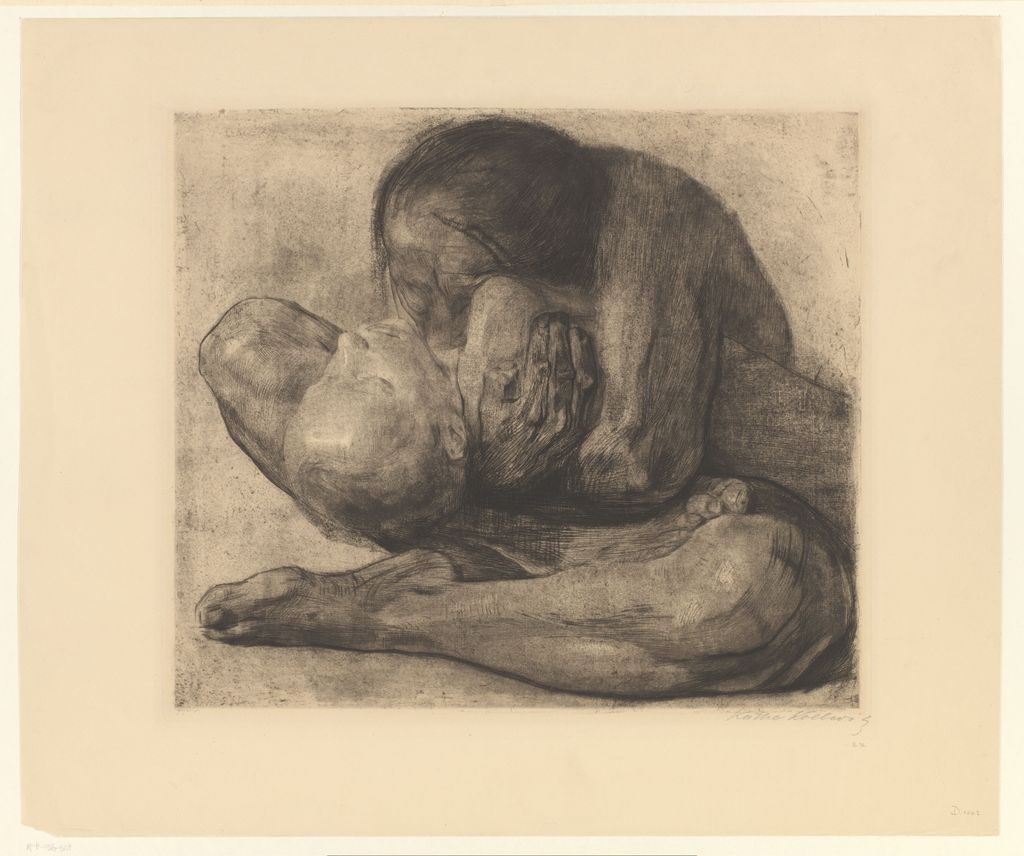
The Neue Wache on Unter den Linden brings Kollwitz into another kind of public setting. In 1993 the Federal Republic dedicated the building as its central memorial to the victims of war and tyranny. The bronze inside is Harald Haacke’s enlargement of Pietà (Mutter mit totem Sohn), modelled by Kollwitz in 1937–39. Visitors encounter the sculpture alone beneath the opening in the roof. A work small enough to turn in the hands had become the centre of a room designed for national commemoration. The essay on Mother with Her Dead Son follows the original sculpture, its relationship to the Pietà tradition and the debate over the 1993 dedication. [11] [12]
Käthe Kollwitz artworks directory
Selected documented works, including the complete published sequences of the five cycles discussed here. Catalogue links identify the specific record behind each row.
Frequently Asked Questions
Gustav Seitz made the seated bronze portrait of Kollwitz. Fritz Diederich executed a separate shell-limestone copy after her Mother with Two Children. That sculpture stood first on the square and then at the former house site opposite it. Its present location is the courtyard of the Sebastian Haffner cultural and education centre. [10] [34]
Discussion
Look again at the images and ideas explored in Käthe Kollwitz in Berlin. These editorial prompts invite your observations.
Reader Insights
How did the flat, doctor’s practice, printer’s workshop and Academy each shape Kollwitz’s work?
How do the surviving sites and later monuments help reconstruct a working life in Berlin?
What can the surviving studio records tell us about the gap between resignation and relocation?
Join the Conversation
Share a detail, comparison or question about Käthe Kollwitz in Berlin below.
References
- National Gallery of Art, Washington, Out of Work, 1909, accession 1943.3.5218, Nagel 545. See “Inscriptions & Marks” and the 2024 catalogue entry, p. 146, no. 67. View source.
- Käthe-Kollwitz-Museum Berlin, Käthe Kollwitz in Berlin. See “Wohnhaus”, “Atelier”, “Akademie”, “Museum” and “Neue Wache”. View source.
- Kollwitz Museum Köln, chronology for 1891–1900. See the entries for the medical practice, Hofkupferei Felsing, the Weavers cycle and the exhibitions of 1898–99. View source.
- Werner Heegewaldt, Akademie der Künste, Zur Person Käthe Kollwitz. See the sections on Academy membership, the forced resignation and postwar reception. View source.
- Kollwitz Museum Köln, chronology for 1933–45. See 1933–40 and 1943, including the November 1936 diary passage and letters to Anni Karbe of 13 February 1937 and Dr Löhnberg of 6 May 1937. View source.
- Museum Pankow, Kollwitzplatz historical site panel, pp. 1–2. View source.
- Kollwitz Museum Köln, A Weavers’ Revolt, 1893–97, cycle overview and individual sheets. View source.
- Kollwitz Museum Köln, chronology for 1901–13. See the 1901 London exhibition and the 1902 entry on Friedrich Lippmann and the Berlin print room. View source.
- Akademie der Künste, Zur Person Käthe Kollwitz, “Das Käthe-Kollwitz-Archiv”. Käthe-Kollwitz-Archiv no. 8, notebook for 1922–25, pp. 68–69, entry of 11 January 1924. View source.
- Landesdenkmalamt Berlin, Denkmal für Käthe Kollwitz, monument record 09070144. View source.
- Kollwitz Museum Köln, Pietà (Mutter mit totem Sohn), Seeler 37. View source.
- German Federal Government, Chancellor’s statement on the dedication of the Neue Wache memorial, November 1993. View source.
- Kollwitz Museum Köln, chronology for 1867–90, 1886–87 entry and Kollwitz’s letter of 28 July 1927. View source.
- Universität der Künste Berlin, Das Frauenstudium in der Bildenden Kunst, on the Damenakademie, the 1904 petition and admission in 1919. View source.
- Kollwitz Museum Köln, Sozialkritik, including Kollwitz’s 1941 retrospective account and the discussion of Simplicissimus. View source.
- Kupferstichkabinett, Staatliche Museen zu Berlin, Arbeitslosigkeit, first state, accession 233-1912. See the discussion of Das einzige Glück, Simplicissimus, vol. 14, 19 July 1909, p. 267. View source.
- Museum of Modern Art, Käthe Kollwitz, 2024 exhibition checklist, pp. 1–2 for Two Self-Portraits, pp. 6–7 for The Downtrodden, p. 23 for the two Unemployment entries and p. 35 for the Krefeld cast of Mother with Two Children. View source.
- Museum of Modern Art, March of the Weavers, accession 223.1997, Knesebeck IV, with printer and publisher credits. View source.
- Deutscher Reichsanzeiger und Königlich Preußischer Staatsanzeiger, 8 May 1899, p. 3302, Dresden exhibition awards notice. View source.
- Staatliche Museen zu Berlin, poster for the third Berlin Secession exhibition, object 923286. View source.
- Albertina, Ende, plate 6 of Ein Weberaufstand, DGNF5771, Knesebeck 38 II.a, Klipstein 37 II. View source.
- Kupferstichkabinett, Staatliche Museen zu Berlin, Selbstbildnis. Dreiviertelprofil nach rechts, accession 80-1906, with transfer drawing Nagel/Timm 387a. View source.
- Kupferstichkabinett, Staatliche Museen zu Berlin, Pietà, third state, accession 97-1906. View source.
- Museum of Modern Art, Käthe Kollwitz, 31 March–20 July 2024, exhibition overview and curatorial scope. View source.
- Kollwitz Museum Köln, Deutsche Heimarbeit-Ausstellung Berlin 1906, Kn 95 III, accession 00300/88002. View source.
- Käthe-Kollwitz-Museum Berlin, 100 Jahre Groß-Berlin, exhibition account of the 1906 and 1925 work on home industry, housing reform and Städtisches Obdach. View source.
- Kollwitz Museum Köln, Für Groß Berlin, Kn 122 I, accession 70300/88003, with Kollwitz’s letter to Hans of 3 March 1912. View source.
- Staatliche Kunstsammlungen Dresden, Briefwechsel zwischen Käthe Kollwitz und Max Lehrs, 1898–1929, p. 66, Lehrs to Kollwitz, 19 December 1913. View source.
- Kollwitz Museum Köln, chronology for 1927–32, Academy exhibition and master-studio appointment. View source.
- Bundesarchiv, Dringender Appell!, June 1932, Plak 002-037-024, facsimile published by German History in Documents and Images. View source.
- Der Funke, 25 June 1932, p. 2, Dringender Appell für die Einheit, digitised by the Friedrich-Ebert-Stiftung. View source.
- Der Funke, 12 February 1933, Reichsausgabe, pp. 1–2, Dringender Appell!, including the signatories on p. 2. View source.
- Akademie der Künste, register of Prussian Academy exhibition catalogues, series D, 1936, catalogue 196, Berliner Bildhauer von Schlüter bis zur Gegenwart. View source.
- Bezirksamt Pankow, Der Kollwitzplatz, site history and caption to the Diederich sculpture. View source.
- Käthe-Kollwitz-Museum Berlin, Willkommen, Käthe Kollwitz, on the Seitz casts and the Charlottenburg installation. View source.
- Gustav Seitz Museum, Verehrtes Vorbild – Käthe Kollwitz bei Seitz, including its installation dates for Prenzlauer Berg and Charlottenburg. View source.
- Käthe-Kollwitz-Museum Berlin, Auf Wiedersehen, Käthe Kollwitz, on the first cast’s placement and Luise Seitz’s gift of the Noack cast. View source.
- Käthe-Kollwitz-Museum Berlin, Geschichte, on Hans Pels-Leusden’s gallery and the formation of the collection. View source.
- Ministère de la Culture, Joconde, Strasbourg record for Schlachtfeld, accession 5.916, notice 00160010900. See acquisition date and exhibition history. View source.
- Institut national d’histoire de l’art, Käthe Kollwitz (1867–1945), part two, with its transcription of Clément-Janin’s review and account of the 1911 Lehrs–Doucet correspondence in the Archives Clément-Janin. View source.
- Musée d’Art moderne et contemporain de Strasbourg, Käthe Kollwitz « Je veux agir dans ce temps », 2019–20 press dossier, pp. 2–4 on the partnership and exhibition plan. View source.
- British Museum, Portrait of the Artist: Käthe Kollwitz, exhibition press dossier, on Dodgson’s purchases and bequest. View source.
- Contemporary Art Society, Self Portrait (1924), purchase through the Prints and Drawings Fund and 1930 gift to the British Museum, accession 1930,0111.41. View source.
More KOLLWITZ Works
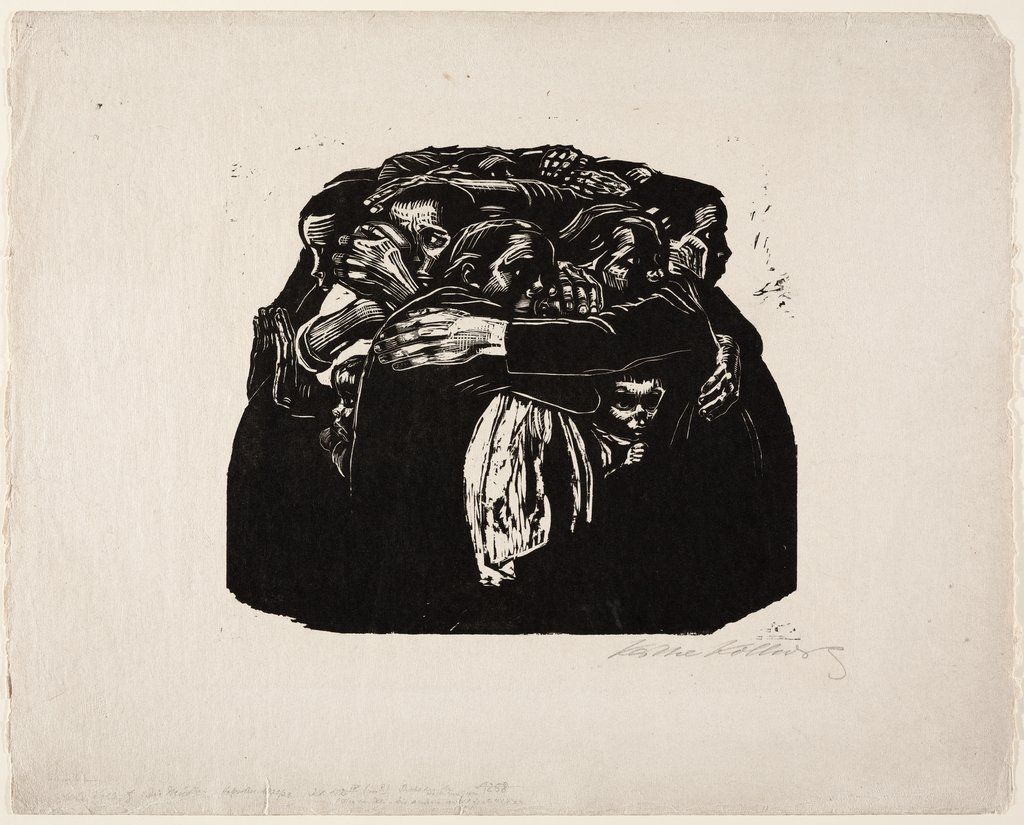
The Mothers
The Mothers, 1921–22. Städel Museum, Frankfurt am Main, SG 4289A D. Image source. Public domain. Resized and exported as JPEG.
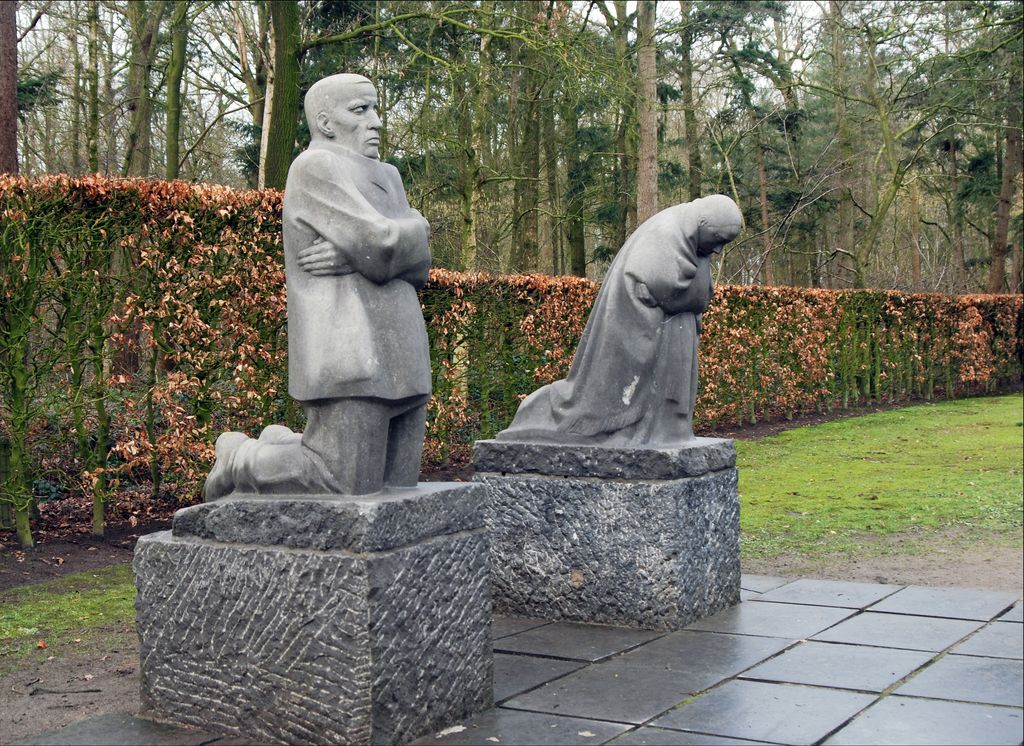
The Grieving Parents
The Grieving Parents at Vladslo, the memorial’s location since 1956. Photograph by Bva, resized. Image source. CC BY-SA 3.0. Resized and exported as JPEG.
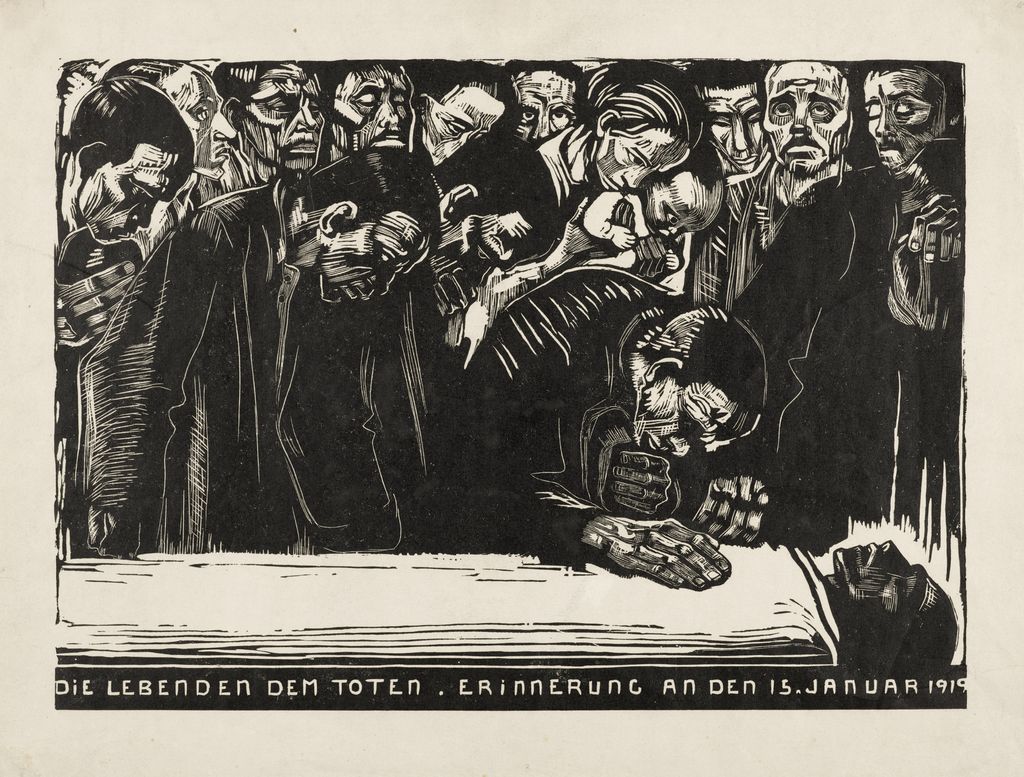
Memorial for Karl Liebknecht
Memorial for Karl Liebknecht, 1920. Kunstsammlungen Chemnitz, 86-47, Kn 159 VI. Photo: Kunstsammlungen Chemnitz/PUNCTUM/Bertram Kober. Image source. Public domain. Resized and exported as JPEG.