


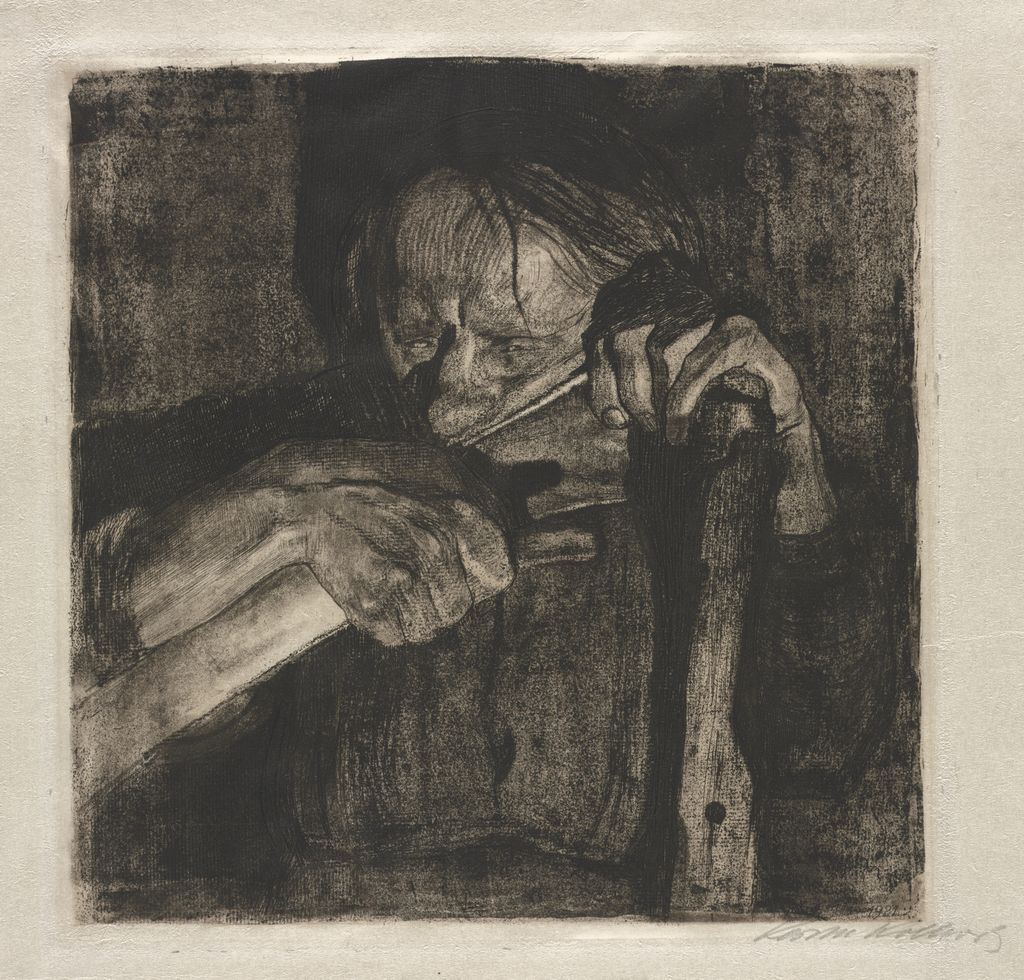
Sharpening the Scythe, 1905. Cleveland Museum of Art, 1950.205, Klipstein 90, state XII/XII. Image source. CC0 / Public domain. Resized and exported as JPEG.
 by Tom Gurney
Tom Gurney BSc (Hons) is an art history expert with over 20 years experience
Email: tomgurney1@gmail.com / Phone: +44 7429 011000
Sharpening the Scythe: Introduction
An older woman bends so close to the scythe that her cheek almost meets the blade. One hand curls around the upright shaft near the right edge of the print. The blade sweeps down towards the lower left, where her other hand holds a sharpening stone. Kollwitz brings all of this into a square. The shaft disappears at the bottom, the blade runs out of the picture to the left, and the woman’s bent body fills much of the space behind them. There is scarcely room to imagine the sweep of a scythe in a field. There is just enough to see how she holds it, where the light catches it and how little her narrowed eyes give away. [1] [2] [3]
At a Glance
- ArtistKäthe Kollwitz
- German titleBeim Dengeln
- Alternative English titleWhetting the Scythe. [4]
- DateSquare plate developed in 1905 and published in the Peasants’ War portfolio in 1908. [1] [5] [6]
- SeriesPlate 3 of 7 in Peasants’ War (Bauernkrieg). [6]
- Catalogue numbersKnesebeck 88 and Klipstein 90. The two catalogues use different state numbers. [7] [3]
- Medium of the Cologne impressionLine etching, drypoint, sandpaper work, aquatint, needle lines and soft-ground etching with imprints of laid paper and Ziegler transfer paper. [1]
- ExampleKollwitz Museum Köln, Kn 88 X b, inventory 70300/23007, 297 × 297 mm as catalogued. [1]
This work across Käthe Kollwitz’s career
A Weavers’ Revolt
1893–97The six sheets take a revolt from household distress to collective action and its aftermath. [8]
Separate impressions and hand-worked proofs show how Kollwitz developed the image. [9]
Peasants’ War
1901–08The seven plates combine the revolt with the aftermath in Battlefield and The Prisoners. [6]
War
1921–22, published 1923The woodcuts give sustained attention to the experience of those left behind. [10]
The Grieving Parents
1932 installationTwo kneeling figures face the graves in the memorial’s later location at Vladslo. [11]
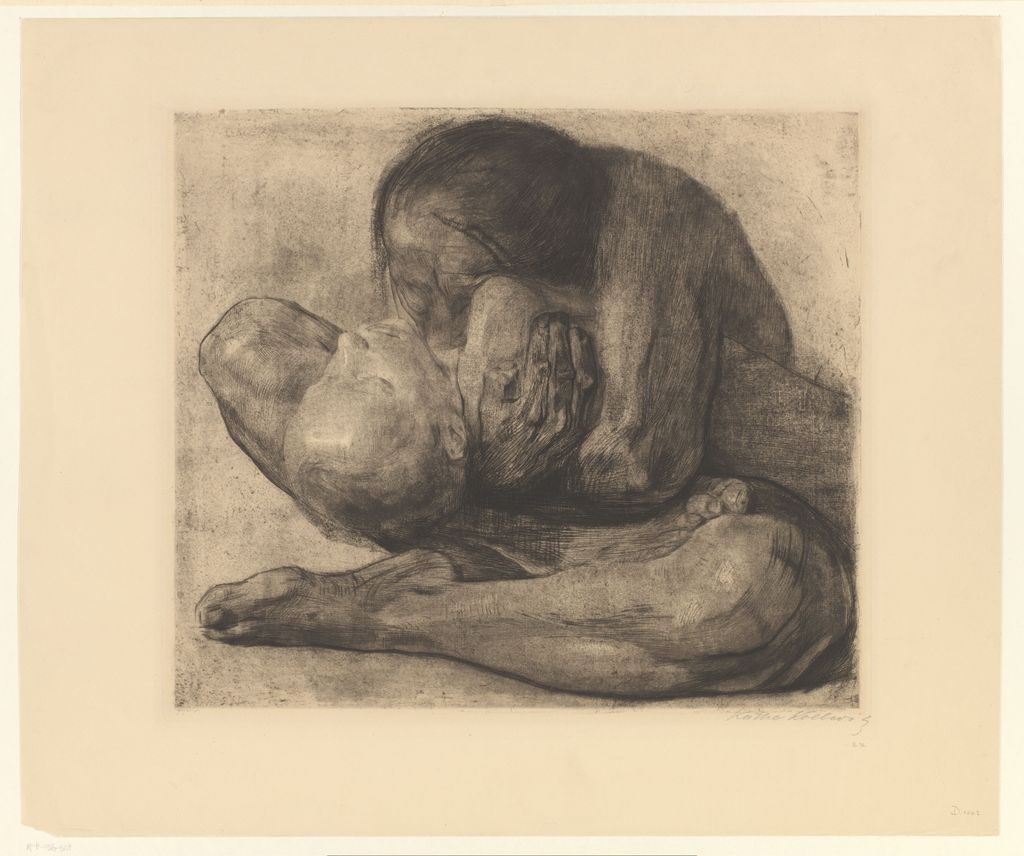
Mother with Her Dead Son
1937–39 modelThe small sculpture precedes the 1993 enlargement at the Neue Wache. [13]
Contents
- The woman and the blade
- Two rejected designs
- What the drawings isolate
- What changed on the square plate
- From the proofs to the portfolio
- A pause before the revolt
- Annotated details
The woman and the blade
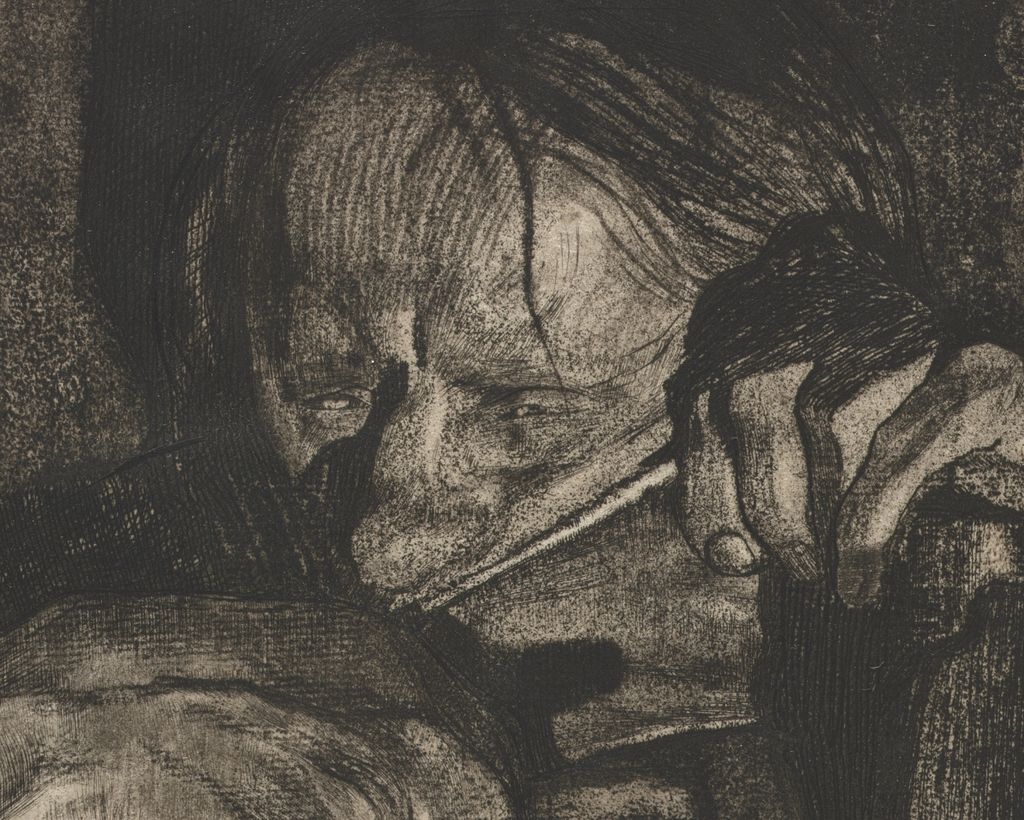
In the Cleveland Museum of Art’s impression, 1950.205, the brightest stretch of the blade widens towards the lower left. Follow it back towards the shaft and the light contracts to a thin ridge beneath the woman’s cheek. The face is built out of much smaller contrasts. Short dark strokes bunch between the eyebrows. The lids almost close over two flecks of light, and the shadow beside the nose runs into the darkness of the shoulder. A curved line drops from the hair across the forehead, cutting across finer marks that follow the shape of the brow. The closer one looks, the more the expression depends on those tiny openings around the eyes. The blade is much easier to read than the face above it. [3]
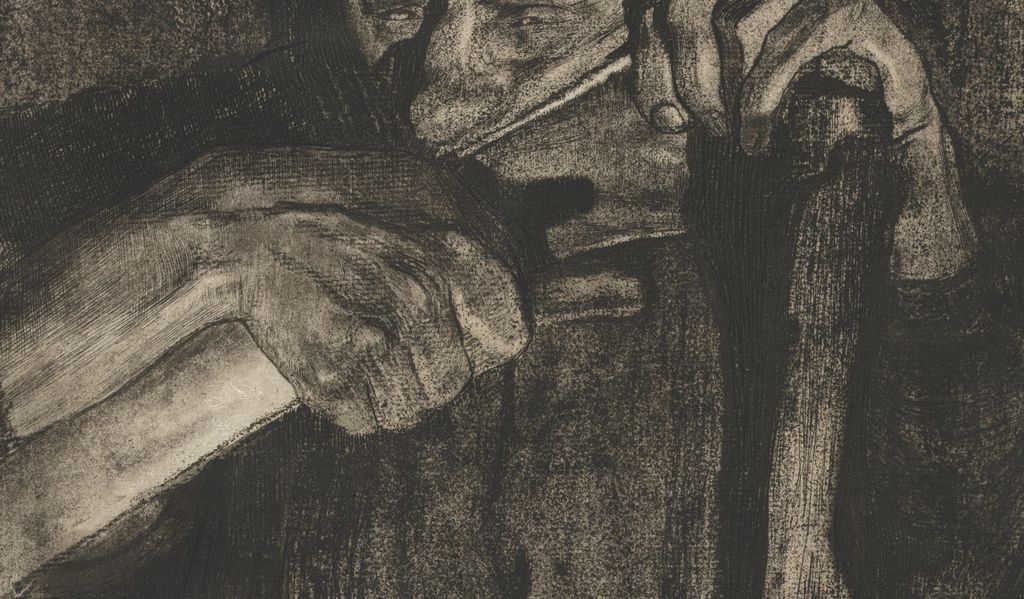
The hands offer a second way through the image. At the right, the fingers hook around the shaft, their pale surfaces interrupted by bands of shadow. The lengthwise marks on the wood continue below the hand and hold the right side of the picture steady. At the left, the forearm comes in low and the wrist bends sharply into the hand. The stone projects from the grip towards the middle of the print. A small dark shape falls across the metal beyond it. Stephanie Gehring reads that shape as the whetstone’s shadow and takes the gap it implies as evidence of an interrupted stroke. The Cologne museum also describes the woman as pausing. The hand still has the shape of a working grip, and the other hand continues to brace the tool. That tension gives the pause its duration. She could resume the stroke at any moment. [1] [14] [3]
A scythe needed regular attention at harvest. The University of Reading’s Museum of English Rural Life describes the whetstone as something a worker would carry to keep the edge sharp. That practical detail helps explain what the hands are doing even when the figure’s purpose remains uncertain. She has brought the blade within reach and secured the shaft so that the stone can travel along the edge. The familiarity of the gesture makes the face more disquieting. A worker can pause with her hands still in position while her thoughts move beyond the job. In the sequence of the portfolio, the edge she is tending will have a use beyond the harvest. [1] [15] [16]
Annotated Details from Sharpening the Scythe
The numbered points identify visible features discussed in this article. Return from each detail to the numbered overview. Sharpening the Scythe, 1905. Cleveland Museum of Art, 1950.205, Klipstein 90, state XII/XII. Image source. CC0 / Public domain. Resized and exported as JPEG.
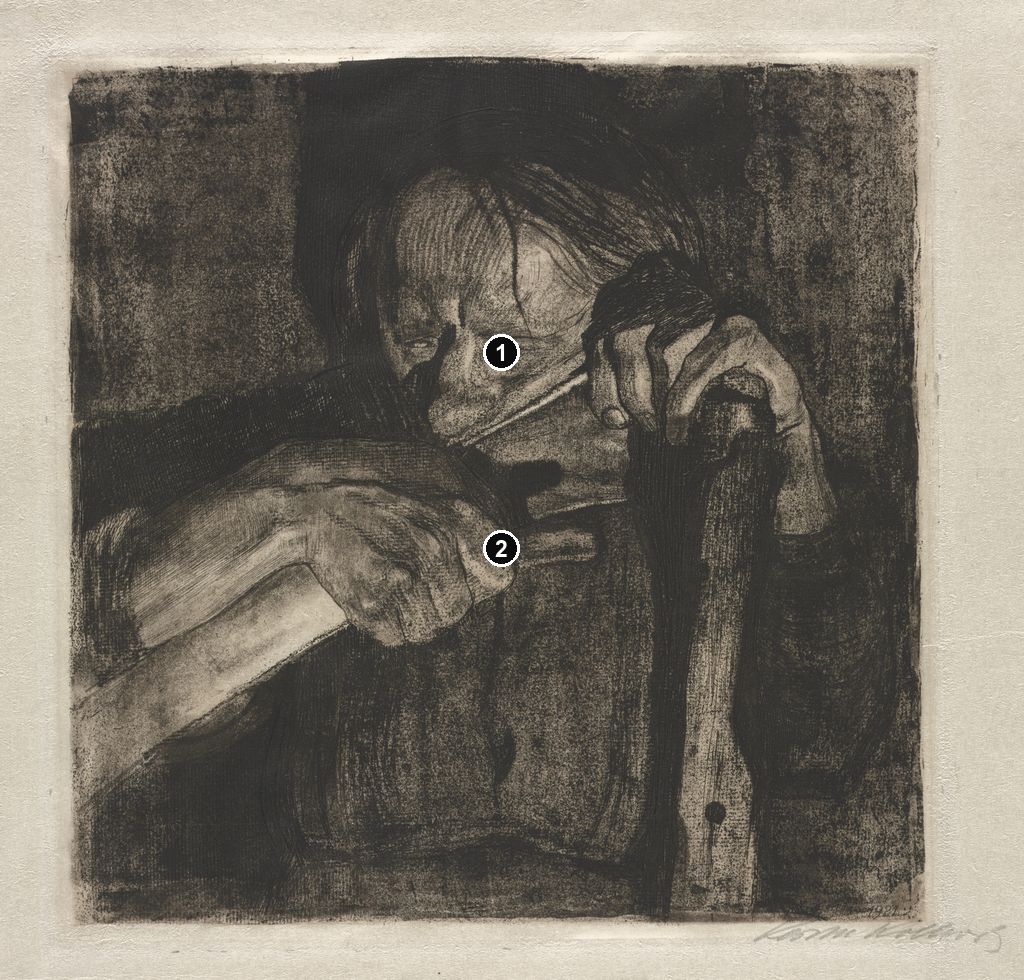
Details from SHARPENING THE SCYTHE
Compare the cropped details with the source images above. Notice how their colours, shapes and positions contribute to the larger compositions.
Face
The woman lowers her face toward the blade. The surrounding shadows keep her expression partially concealed.
Hands
Her hands stretch across the composition. The hand at right grips the upright handle while the other reaches along the blade.
Two rejected designs
Kollwitz first made that change of purpose visible through a second figure. In Inspiration, Kn 86, a winged man crouches behind the woman, his face close to her ear. In Cologne’s impression, Kn 86 VII d, his body occupies the space just above and behind hers. One hand bears on her shoulder and the other meets her hand at the shaft. The wings identify him as a personification, while the closeness of the two faces suggests a whisper. The meeting of the hands makes that suggestion almost physical. The image gives the impulse to revolt a source that the viewer can point to. Cologne dates this impression to 1904. MoMA and the Getty allow 1904 or 1905 for the examples in their respective exhibitions. [5] [17] [18]
There are drawings as well as prints of Inspiration. MoMA exhibited a charcoal, pencil and white chalk sheet from the Fritsch Collection. Cologne records two preparatory drawings, NT 296 in charcoal on Ingres paper and NT 297 in black crayon. The print went through revisions of its own. MoMA showed two impressions of state IV, one from Berlin’s Kupferstichkabinett and one from the Mayer Family, both from a plate recorded as 564 × 297 mm. The Mayer sheet carries additional charcoal, white chalk and ink. The Getty’s state IV is another hand-worked proof, with Conté crayon, charcoal and white and brownish chalk over a print in brown ink. Even at the same numbered stage of the plate, the surviving sheets preserve different decisions made on paper. [5] [17] [18]
In Woman with Scythe (Frau mit Sense, Kn 87), Kollwitz removes the winged figure and keeps an upright format. There is still room for the body to bend into the implement and for the shaft to extend well below the face. Cologne’s state I, inventory 70300/17004, measures 374 × 234 mm as catalogued. It has black ink applied with brush and pen over the printed image. The Basel state III lent to MoMA includes aquatint and has additions in black ink, opaque white and pencil. Both records identify a fabric imprint in the soft ground. The two sheets show that the solitary figure had a sustained trial of her own. Kollwitz could change the distribution of light, the relation of body to tool and the weight of a contour before committing to a different format. [1] [18]
The three plates change their proportions in a revealing way. Inspiration is almost twice as tall as it is wide. Woman with Scythe brings the sides in and reduces the height. The square plate then opens out to roughly the width of Inspiration while giving up nearly half its height. That last change brings the two hands into a strong lateral relation. The upright shaft checks the sweep of the blade, and the face occupies the space where those directions meet. In Sarah Cowan’s animation for MoMA’s 2024 exhibition, the progressive concentration on the woman is read as a shift towards her own agency. The surviving designs show how Kollwitz gave that shift a physical form. With the space behind the woman taken up by her own shoulder and shadow, the viewer looks to her grip and expression for the impulse previously embodied by the figure at her ear. [1] [17] [18] [19]
What the drawings isolate
In 1905 Kollwitz made a charcoal study of the forearm and hand at the cutting edge. The Germanisches Nationalmuseum in Nuremberg catalogues it as Hz10494, rubbed charcoal on laid paper, on a sheet measuring 48.5 × 32.7 cm. The drawing gives the hand room to show its work. Pale knuckles emerge where the fingers tighten, and swelling veins run back towards the wrist. Charcoal builds up around the blade so that its brightness seems to come from the paper itself. With the face outside the study, the turn of the wrist and the pressure of the grip carry the expression. [20]
In the Cleveland print, the bend of the wrist remains conspicuous even as the surfaces grow more complicated. Dense parallel marks run up the forearm. The joints of the curled fingers catch patches of light, while smaller marks model the uneven skin around them. The hand interrupts the broad light on the blade. One can follow the metal towards it, lose the edge behind the fingers, and pick up a thinner gleam on the far side. The print also brings into view what the drawing sets aside. The firm grip can now be read alongside the nearly closed eyes and the head lowered almost to the steel. Physical effort and absorbed thought occupy the same small area. [20] [3]
Other studies address the disposition of the figure as a whole. Cologne lists a black and white chalk and pencil drawing, NT (396a), inventory 70200/09008, at 473 × 309 mm. MoMA’s checklist gives 441 × 304 mm for a Cologne loan in the same media and supplies no inventory number in that entry. The dimensions belong to their respective records. The published information leaves the reason for the discrepancy open. The Städel’s 2024 digital exhibition also illustrates a sheet of three studies of a woman with a scythe. Seen alongside the Nuremberg arm study, such sheets show the different scales on which Kollwitz’s drawings could work. She could test the arrangement of the whole figure or enlarge a single gesture enough to see what made it credible. [1] [18] [20] [21]
What changed on the square plate
A state records a stage in the working of the plate. An impression is an individual sheet printed from it. Kollwitz often used an impression to try a change by hand before deciding how to revise the metal. In the Museum of Fine Arts, Boston’s state I, shown at MoMA in 2024, the square composition is already established. MoMA lists line etching, drypoint and soft-ground etching with imprints of laid paper and Ziegler transfer paper. The graphite is overwork on the sheet. That sheet, measuring 295 × 295 mm, has been trimmed to the plate mark. Its lack of margins makes the object feel even more tightly bounded. The crop of the woman and scythe belongs to the composition and survives on impressions with ample paper around it. [7] [18]
The Fine Arts Museums of San Francisco’s state IV preserves a more elaborate trial. The printed image includes sandpaper work and aquatint. Pencil, charcoal and black and white chalk were applied by hand, and the checklist records that a reworked paper section was glued on at the lower left. At just the point where the viewer needs to understand the woman’s contact with the blade, Kollwitz could try out a different arrangement directly on the proof. A forearm draped over the scythe allows the weight of the body to settle on the implement. Curling the hand around a stone gives the same interval of stillness the character of a task suspended midway. The glued section belongs to this particular proof. The change in the printed gesture can be followed through later states. [14] [18]
In Cologne’s state V, inventory 70300/91011, the arm still lies over the scythe. Gehring locates the decisive change between states V and VI, when the more active grip and the whetstone become explicit. The Getty’s state VI is a working proof with charcoal and black chalk added to that impression. The William Benton Museum of Art’s state VII, lent to MoMA, has further pencil work on its sheet. The Getty dates its states V, VI and IX to before mid-May 1905. By that point the square plate had undergone several substantial revisions. The shared dating gives an upper bound for those proofs, while their state numbers establish the order of the recorded stages of the plate. [1] [5] [14] [18]
The techniques let Kollwitz control how abruptly one form gives way to another. Line etching supplies incisive marks, and a drypoint needle cuts directly into the metal, raising a burr that can hold extra ink. Aquatint gives an area tone through a fine pattern of bitten marks. Sandpaper introduces another kind of irregular grain. In soft-ground etching, contact with a textured material leaves a pattern in a yielding ground on the plate, exposing metal that can then be bitten. The laid paper and Ziegler transfer paper named in the Getty’s state V describe textures introduced into the printed image. The support for that impression is separately recorded as copperplate paper. The surface effects in Kollwitz’s prints often depend on this interplay between the texture transferred to the metal and the paper that receives the ink. [1] [5] [18]
The blade benefits from the variety of surrounding marks. In the Cleveland impression, a short length under the cheek appears almost polished against the grain of the face. Farther down, even the light metal has a faintly mottled surface. The coat nearby absorbs detail until a few parallel strokes bring an edge or fold into view. One can see the transitions in the reproduction, although assigning every passage to an individual tool would require more evidence than the image supplies. Cleveland catalogues the medium broadly as etching. Cologne’s fuller technique list belongs to its own X b impression and gives a clearer sense of the processes that could produce such changes in density. [1] [3]
From the proofs to the portfolio
The Cologne entry heads the work with 1908 and captions both its state V proof and its X b impression with 1905. The Getty’s proof dates show work well under way in 1905. The 1908 date marks the publication of the seven-sheet portfolio by the Association of Historical Art with the Dresden dealer Emil Richter. Kollwitz had approached the association for support in 1904, with the backing of Max Lehrs, then director of the Dresden Print Room. The portfolio brought together plates made over several years. The third plate was already in advanced proof before some of the scenes that precede it in the published sequence had reached their definitive form. [1] [5] [6]
The Städel’s impression 65135 D connects the composition to a particular edition. Its acquisition record says the association commissioned the work for its members in 1908 and gave the impression to the museum in 1909. The edition field describes it as one of approximately 200. The 297 × 297 mm plate sits on a 598 × 438 mm sheet. Under the image, Kollwitz’s pencil signature and O. Felsing’s printer’s credit, which is recorded as part of the plate, have space of their own. The museum distinguishes those marks from the pencilled title entered under later inscriptions. A tightly framed reproduction shows how close the woman is to the blade. The full sheet shows how that image was presented to its first recipients. [7]
The Städel also holds SG 4223 D, another impression with the same Knesebeck and Klipstein state designations and the same printer’s credit. It came to the museum in 1964 from the Helmut and Hedwig Goedeckemeyer collection and carries that collection’s marks. The two sheets can be associated through the state and printer, while their inscriptions and acquisition records identify separate objects. Farther along in the plate’s printing history, Syracuse University Art Museum dates its 2011.0278 as a 1921 restrike of the 1905 work. That printing date is specific to the Syracuse record. [7] [22] [23]
The catalogue numbers need similar care. The Städel lists 65135 D as Knesebeck 88 X b, in a sequence of fourteen states, and Klipstein 90 IX, in a sequence of twelve. Both labels describe the same impression. Cleveland lists 1950.205 as Klipstein 90 XII/XII and dates the work 1905. Its online entry gives no separate printing year or edition for that sheet. MoMA’s checklist, meanwhile, leaves the state unstated for the Basel impression of the square design that it exhibited after state VII. The clearest comparisons start with the museum and accession, then follow the state number within the catalogue that supplies it. [7] [18] [3] [23]
A pause before the revolt
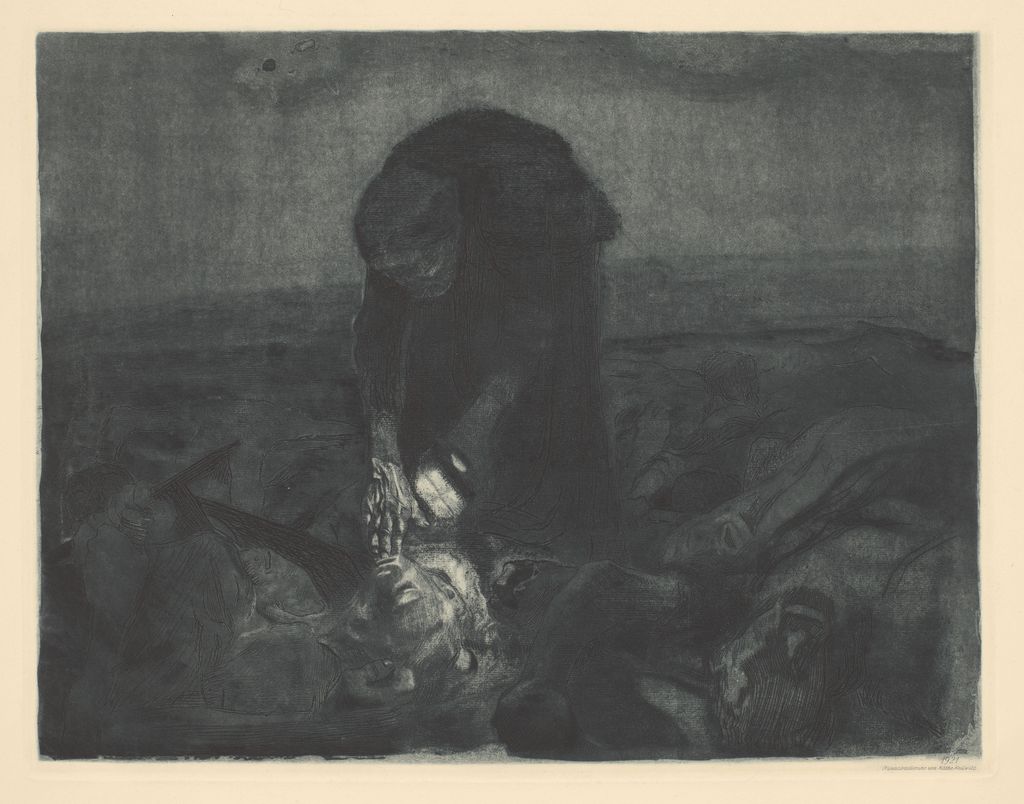
In Peasants’ War, the third plate follows The Ploughmen and Raped. The first shows labourers bent into the work of pulling a plough. The second leaves a woman lying in a devastated garden after an assault. The scythe returns to the world of agricultural labour, but the woman holding it now has a moment in which to decide how she will use what she knows. In Arming in a Vault, the fourth plate, preparation becomes collective. Figures climb through the dark with weapons and torches. The single face and the brief glint on a blade give way to movement through a space crowded with bodies. [1] [6] [15]
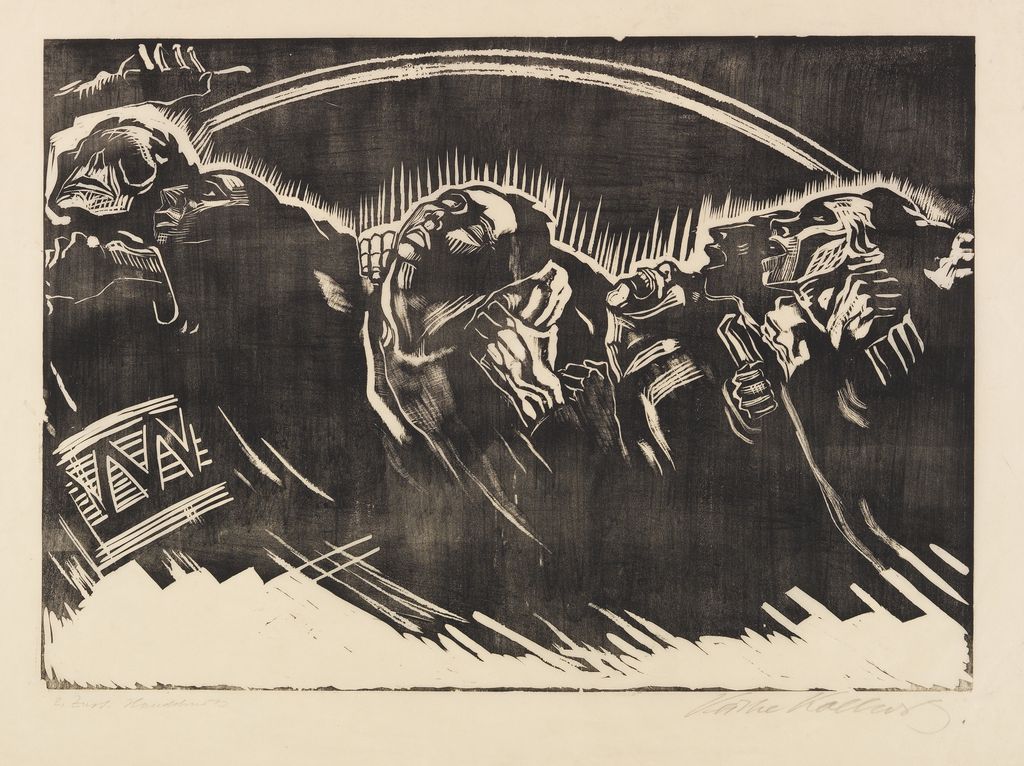
That sequence was assembled out of a different order of invention. Charge, the fifth plate, was already taking shape in 1902–03, and the Getty records an early proof exhibited in 1902. Kollwitz had therefore worked out an image of the revolt breaking into motion before arriving at the square composition that would show its possibility gathering in one person. As Jennifer Leach observes in her study of Kollwitz’s early work, the scythe designs give the figure a markedly unspecific setting. The absence of a clearly described place in the square print makes the peasant woman’s relationship to the tool carry more of the historical drama. The published sequence supplies the social conditions and what follows. The individual print gives those events an interval in which to become imaginable. [6] [15] [24]
The Bibliothèque de l’Institut national d’histoire de l’art in Paris holds an impression, EM KOLLWITZ 9, which its essay identifies as Femme aiguisant sa faux. The INHA asks whether the face’s almost animal compression suggests degradation imposed on the peasants or the strength needed to survive. In Cleveland’s impression, the deep furrows and hooded eyes can sustain either reading. The hands give the question practical weight. Each is doing something necessary to hold the scythe in place. The viewer can see that the woman knows the tool and that she has paused with it in her control. What she will do when she lifts her head remains suspended until the next sheet. [1] [25] [3]
Käthe Kollwitz artworks directory
Selected documented works, including the complete published sequences of the five cycles discussed here. Catalogue links identify the specific record behind each row.
Frequently Asked Questions
Kollwitz developed the square plate in 1905. The Getty dates its proofs of states V, VI and IX to before mid-May of that year. The image appeared as plate three of the published Peasants’ War portfolio in 1908. Individual impressions can have later printing dates, as in the 1921 restrike catalogued by Syracuse University Art Museum. [5] [6] [22]
Cologne identifies the figure in Sharpening the Scythe as an older peasant woman. The documented identification with Black Anna belongs to Charge, the fifth plate, for which the Getty records a preparatory drawing titled The Black Anna. The two figures are connected by their roles in the cycle’s movement towards revolt. The evidence for the name belongs to the work on Charge. [1] [5] [15]
Discussion
Look again at the images and ideas explored in Sharpening the Scythe. These editorial prompts invite your observations.
Reader Insights
What does the hand study make clearer about the gesture in the published plate?
How does cropping the woman and the tool change the sense of anticipation?
Which part of the sharpening motion would be most difficult to convey in a cropped composition?
Join the Conversation
Share a detail, comparison or question about Sharpening the Scythe below.
References
- Kollwitz Museum Köln, Sharpening the Scythe, Kn 88, main caption for 70300/23007 and “Studies, preparatory drawings, Proofs” entries for 70300/17004, 70200/09008 and 70300/91011 View source.
- Kunsthalle Bielefeld, Taking a Stand. Käthe Kollwitz, Mona Hatoum, exhibition media guide entry for Beim Dengeln View source.
- Cleveland Museum of Art, Sharpening the Scythe, 1950.205, digitised impression and “Catalogue raisonné” and “State” fields View source.
- National Gallery of Art, Käthe Kollwitz, annotated checklist, p. 156, cat. 60, Whetting the Scythe View source.
- Getty Research Institute, Käthe Kollwitz: Prints, Process, Politics, object checklist, pp. 4–6, entries for Inspiration, Sharpening the Scythe and The Black Anna View source.
- Kollwitz Museum Köln, The Peasants’ War Cycle, 1901–1908, publication history and seven-sheet register View source.
- Städel Museum, Sharpening the Scythe, 65135 D, dimensions, “Acquisition,” “Edition,” inscription fields and “Work Catalogues” View source.
- Kollwitz Museum Köln, A Weavers’ Revolt, cycle catalogue. View source.
- Museum of Modern Art, Woman with Dead Child, state VIII/X, 1903. View source.
- Museum of Modern Art, Käthe Kollwitz, 2024 extended gallery labels. View source.
- Flemish Heritage Inventory, Treurend ouderpaar (Vladslo – WOI). View source.
- Kollwitz Museum Köln, Death, series catalogue. View source.
- Kollwitz Museum Köln, Pietà (Mutter mit totem Sohn), Seeler 37, with the Neue Wache enlargement. View source.
- Stephanie Gehring, Duke University dissertation, p. 46 and notes 37–38, on states V and VI, the whetstone and the pause View source.
- Getty Research Institute, Käthe Kollwitz: Prints, Process, Politics, wall texts, pp. 3–8, Peasants’ War through Charge View source.
- Museum of English Rural Life, University of Reading, “Scythe,” object feature on harvesting and the whetstone View source.
- Kollwitz Museum Köln, Inspiration, Kn 86 VII d, main caption and preparatory drawing entries NT 296 and NT 297 View source.
- Museum of Modern Art, Käthe Kollwitz, 2024 exhibition checklist, pp. 16–19, rejected designs, Cologne drawing loan and impressions of Kn 88 View source.
- Sarah Cowan, “Käthe Kollwitz Sharpens Her Tools,” MoMA Magazine, 27 March 2024, process animation and accompanying essay View source.
- Germanisches Nationalmuseum, Hz10494, study of the arm and hand for Beim Dengeln, “Material und Technik,” dimensions and “Beschreibung” View source.
- Städel Museum, Kollwitz digital exhibition, sequence featuring Beim Dengeln (Drei Studien zu einer Frau mit Sense) View source.
- Syracuse University Art Museum, Sharpening the Scythe, 2011.0278, “Date” field for the 1921 restrike View source.
- Städel Museum, Beim Dengeln, SG 4223 D, “Erwerbung,” inscription fields and “Werkverzeichnis” View source.
- Jennifer Leach, Early Developments in the Work of Kaethe Kollwitz, University of St Andrews, M.Litt. thesis, p. 95, discussion of Woman with Scythe and Whetting the Scythe View source.
- Institut national d’histoire de l’art, Käthe Kollwitz (1867–1945), part 2, “Œuvres,” caption for EM KOLLWITZ 9 and discussion of the face View source.
More KOLLWITZ Works
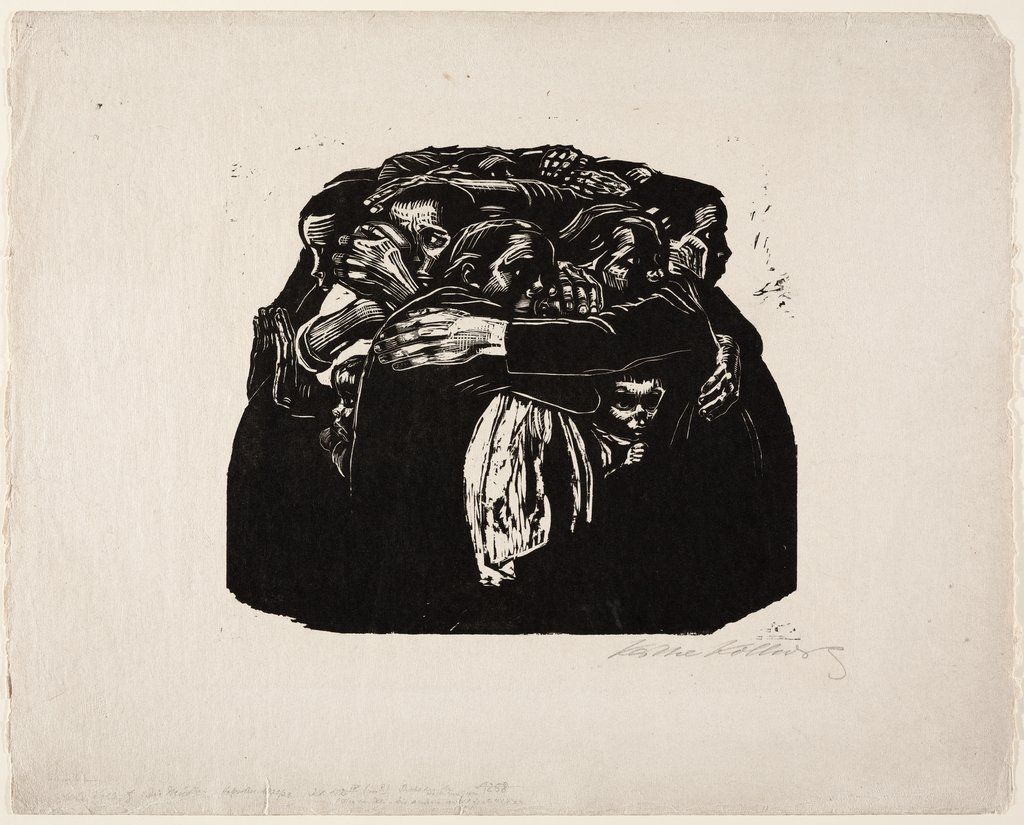
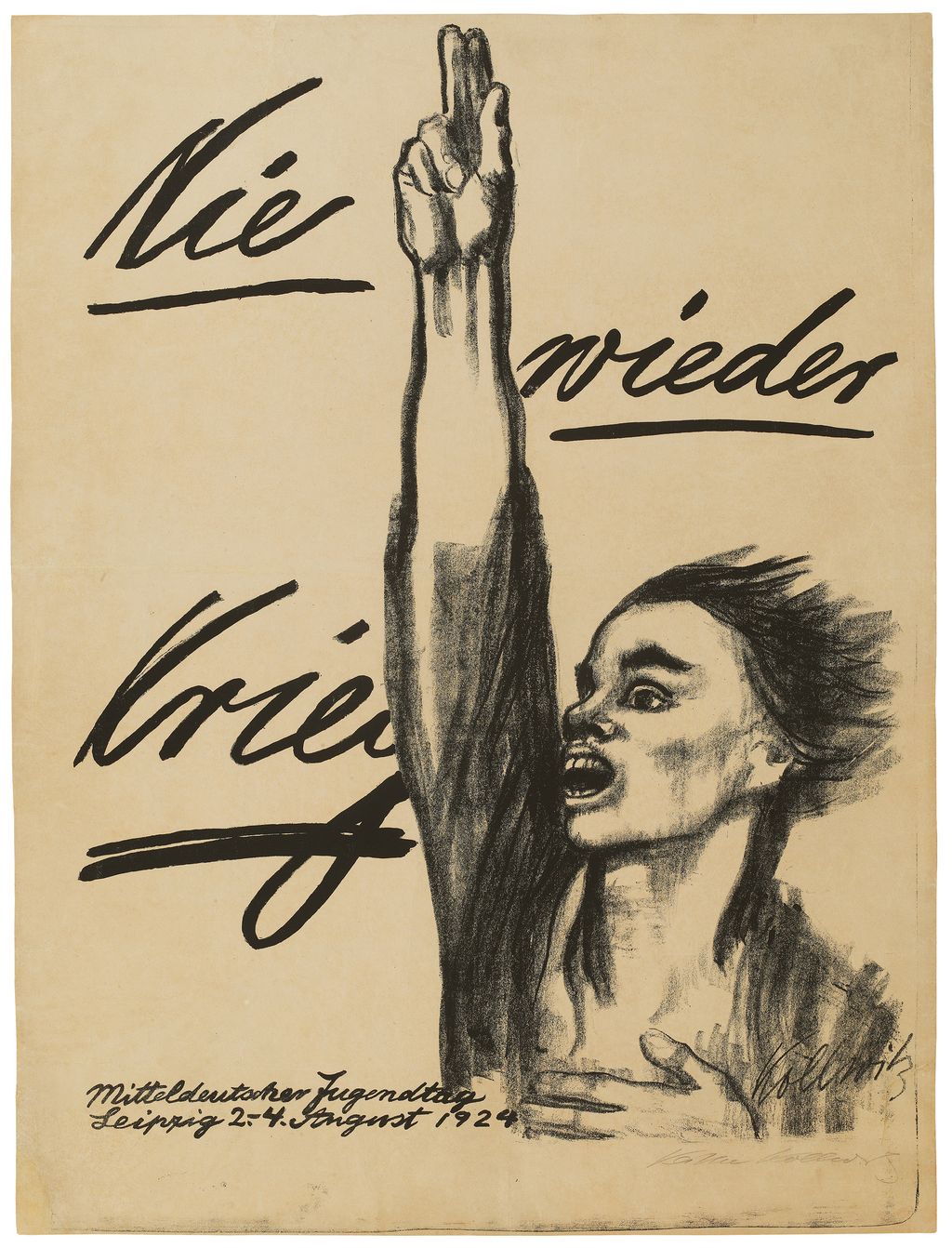
The Mothers
The Mothers, 1921–22. Städel Museum, Frankfurt am Main, SG 4289A D. Image source. Public domain. Resized and exported as JPEG.
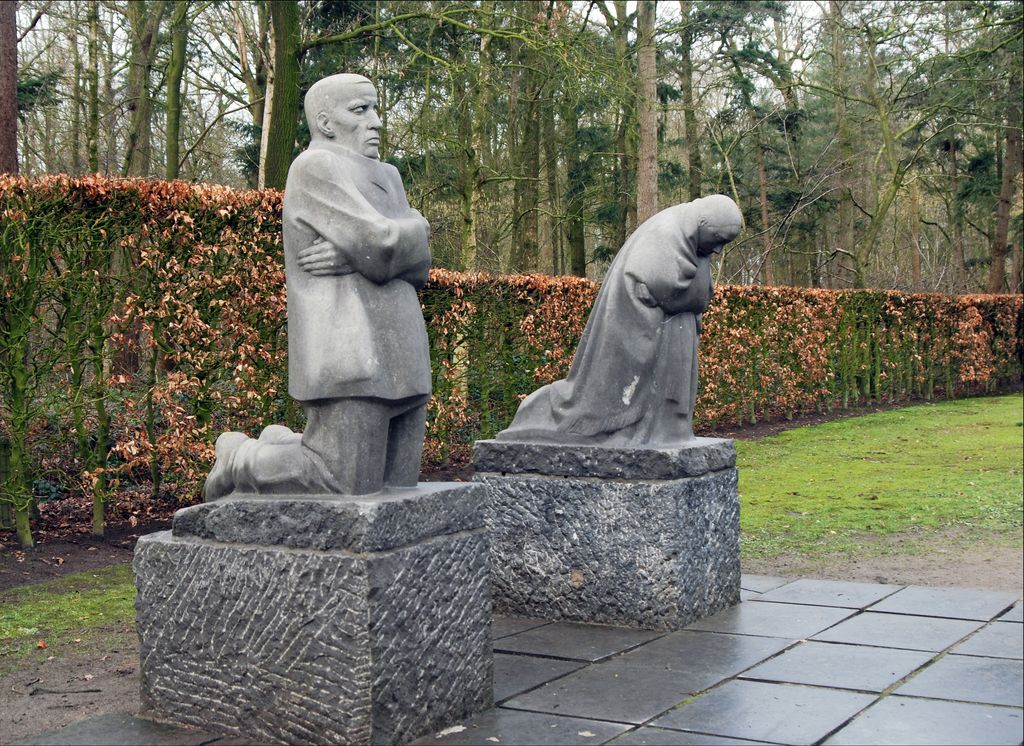
The Grieving Parents
The Grieving Parents at Vladslo, the memorial’s location since 1956. Photograph by Bva, resized. Image source. CC BY-SA 3.0. Resized and exported as JPEG.
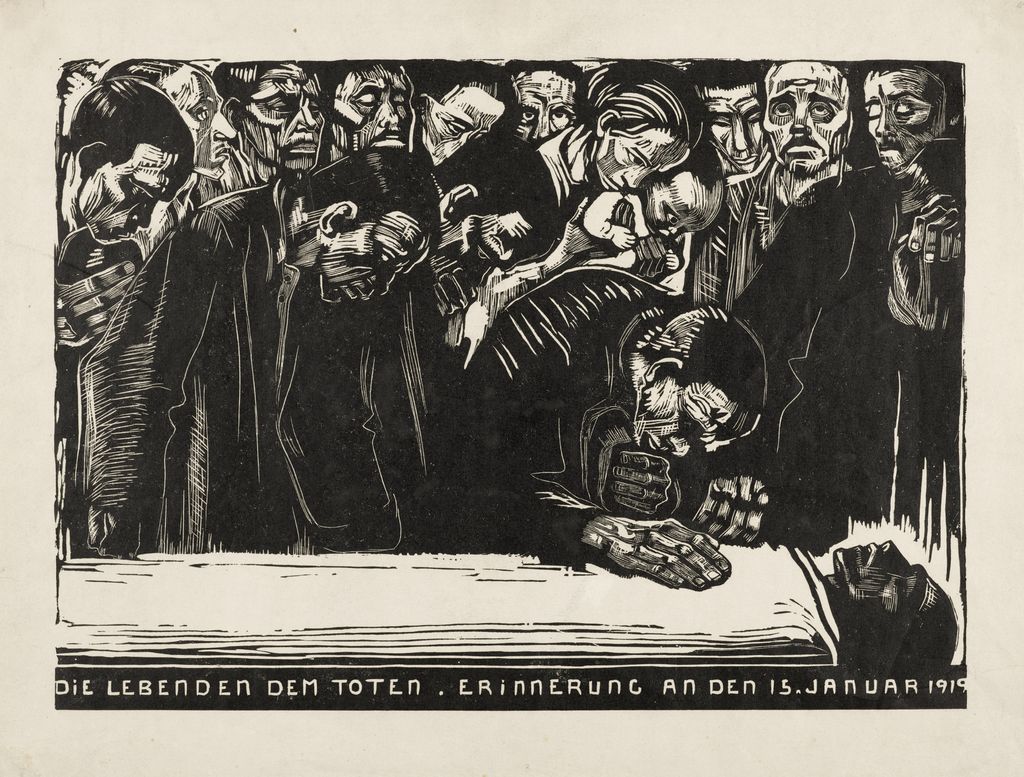
Memorial for Karl Liebknecht
Memorial for Karl Liebknecht, 1920. Kunstsammlungen Chemnitz, 86-47, Kn 159 VI. Photo: Kunstsammlungen Chemnitz/PUNCTUM/Bertram Kober. Image source. Public domain. Resized and exported as JPEG.