


 by Tom Gurney
Tom Gurney BSc (Hons) is an art history expert with over 20 years experience
Email: tomgurney1@gmail.com / Phone: +44 7429 011000
Käthe Kollwitz’s Reception in Exhibitions, Collections and Public Memory: Introduction
At a Glance
- Berlin and Dresden, 1898–99Ein Weberaufstand (A Weavers’ Revolt) brought Kollwitz to public attention in Berlin. Wilhelm II blocked a medal recommended by the exhibition jury. Dresden’s print room acquired the cycle and working proofs, and the jury of the following year’s German Art Exhibition in Dresden awarded her a silver plaque. [1] [2] [3] [4]
- France and BritainParis critics attended to how Kollwitz made her prints. Strasbourg received Battlefield in 1908, while Jacques Doucet’s library bought prints through Dresden dealers. Campbell Dodgson helped build the British Museum’s holdings through a Contemporary Art Society purchase and his own later bequest. [5] [6] [7] [8]
- Divided GermanyThe East German Academy made Kollwitz the namesake of a prize for contemporary artists. In Frankfurt, a municipal acquisition brought a major private collection into public ownership, and a West Berlin centenary exhibition led to the creation of an archive. [9] [10] [11]
- Modern exhibitionsThe British Museum and Ikon organised a touring portrait of the artist, and Strasbourg used its collection as a basis for a career retrospective. In 2024 the Städel examined her reception in divided Germany, while MoMA assembled studies and proofs that showed how she developed individual images. [12] [13] [14] [15] [16]
Contents
- Berlin’s exhibition and Dresden’s print room
- French critics, a Strasbourg gift and the Doucet collection
- Campbell Dodgson and two routes into the British Museum
- From Academy recognition to removal from exhibitions
- Post-war Germany and the uses of her name
- A touring portrait in Britain and a retrospective in Strasbourg
- Frankfurt and New York in 2024
Berlin’s exhibition and Dresden’s print room
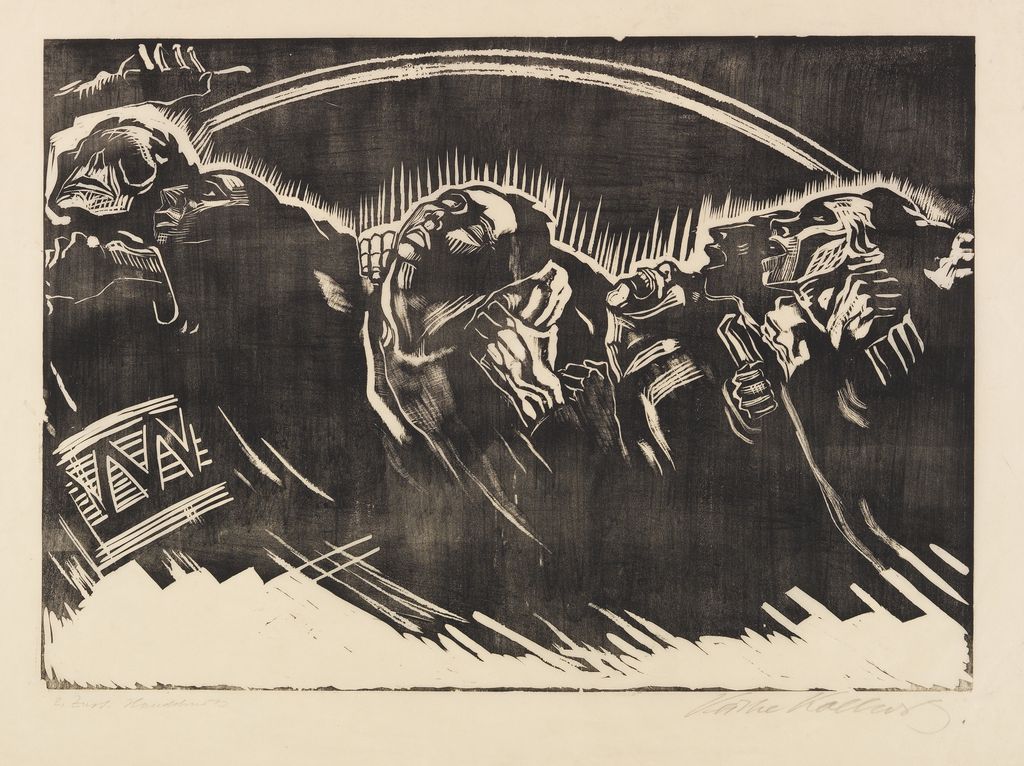
At the Große Berliner Kunstausstellung (Great Berlin Art Exhibition) in 1898, visitors encountered Käthe Kollwitz through six sheets that asked to be read in sequence. In Ein Weberaufstand (A Weavers’ Revolt), the distress of a household leads to a meeting, a march and an attack. The final sheet returns indoors, where the bodies of the dead are brought in. Gerhart Hauptmann’s play Die Weber (The Weavers) had prompted the cycle, but Kollwitz gave the figures clothing familiar from her own day. A famine among Silesian weavers in 1891–92 had drawn widespread press attention. The sequence made an uprising from 1844 legible to viewers who had recently read about hunger in the same region. [1] [2]
Max Liebermann supported the exhibition jury’s recommendation for a medal, which Kaiser Wilhelm II prevented Kollwitz from receiving. Her own response to the exhibition survives in a letter to the Dresden curator Max Lehrs on 5 July 1898. She had hoped the work would attract notice from the critics and the public, she told him, and was surprised by the extent of the recognition. The next spring, Lehrs reported that Max Klinger, his fellow juror for graphic art at the German Art Exhibition in Dresden, was delighted by the cycle. The Deutscher Reichsanzeiger of 8 May 1899 lists Kollwitz among the recipients of a silver plaque. The letter records a juror’s enthusiasm while the proceedings were under way, and the newspaper identifies the distinction the jury actually awarded. [2] [3] [4]
Lehrs had already secured the cycle for Dresden’s Kupferstich-Kabinett. In June 1898 he agreed to pay 200 marks for the set, now recorded under accessions A 1899-156 to A 1899-161. He asked about earlier work and invited Kollwitz to give the cabinet unfinished proofs of the sort that might otherwise be discarded in a workshop. She sent two, now A 1899-165 and A 1899-166. In the accompanying letter she explained that she had remade the first three sheets as lithographs after her attempts at etching them had failed. Lehrs also bought three early prints she had sent for inspection. She thought most of the material technically deficient. His decisions gave the cabinet evidence of a practice still taking shape, including sheets the artist herself had been reluctant to put forward for purchase. [5] [4]
Lehrs’s support also reveals an assumption a woman artist had to contend with. In his letter of 24 June 1898, he praised the cycle for capturing the spirit of Hauptmann’s drama independently of theatrical illustration, then characterised the strength he admired in the work as masculine. His enthusiasm could open a museum door while relying on a narrow idea of what women typically made. He went on to publish an account of Kollwitz and a list of fifty graphic works in Die Graphischen Künste in 1903. By then Friedrich Lippmann had bought the Weavers cycle and other prints for Berlin’s Kupferstichkabinett in 1902. A work first encountered as a sequence on an exhibition wall could now be requested, compared with other impressions and traced through a published inventory. Dresden returned to that early history in Käthe Kollwitz in Dresden in 2017–18, exhibiting work from across her career while showing how the cabinet’s collection had begun. [17] [4] [18] [19]
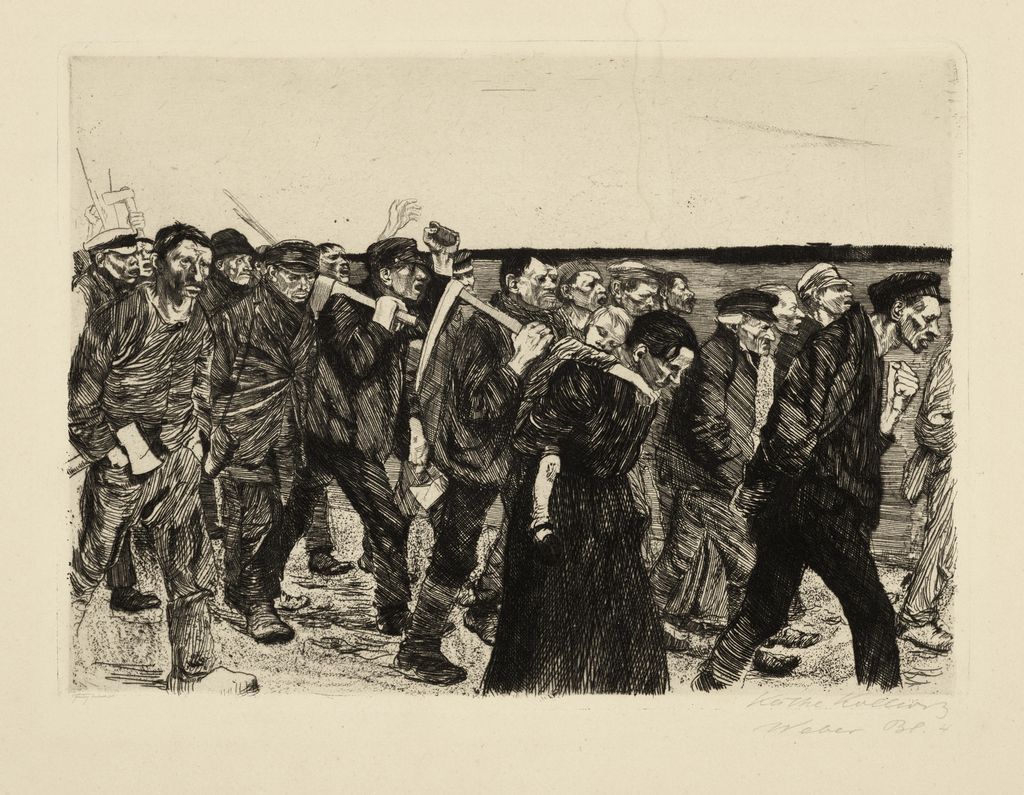
March of Weavers, sheet 4 of A Weavers’ Revolt. Kunstsammlungen Chemnitz, 86-50. Photo: Kunstsammlungen Chemnitz/PUNCTUM/Bertram Kober. Image source. Public domain. Resized and exported as JPEG.
French critics, a Strasbourg gift and the Doucet collection
In Paris in 1901, Kollwitz exhibited at Charles Hessèle’s gallery alongside printmakers including Klinger and Karl Stauffer-Bern. Among the works Noël Clément-Janin discussed were the Weavers prints and Die Carmagnole (The Carmagnole). The latter takes its starting point from a scene of revolutionary dancing in Charles Dickens’s A Tale of Two Cities. Kollwitz places the dance in the confined streets of a German city of her own time. The review, as transcribed by the Institut national d’histoire de l’art (INHA) from the Gazette des Beaux-Arts, attends to the bite of the etched line and to her handling of grain and varnish. For this reviewer, the way darkness and texture built up on the sheet was part of what gave the crowd its force. [5] [20]
Kollwitz subsequently exhibited at the Salon des Indépendants in 1905. INHA also records a favourable response from Arsène Alexandre to her work at the Salon de l’Union internationale des beaux-arts et des lettres in 1910, and a showing of her etchings at the Bibliothèque nationale in the 1929 exhibition Peintres graveurs allemands contemporains (Contemporary German Painter-Printmakers). Her work circulated beyond the gallery and print room. INHA traces the reproduction of her interwar lithographs and woodcuts in French publications including L’Humanité, Clarté and Monde. A newspaper reader encountered the image beside the paper’s headlines and arguments, while an exhibition visitor could see it in relation to other prints and study the marks on a particular impression. [5] [17] [21]
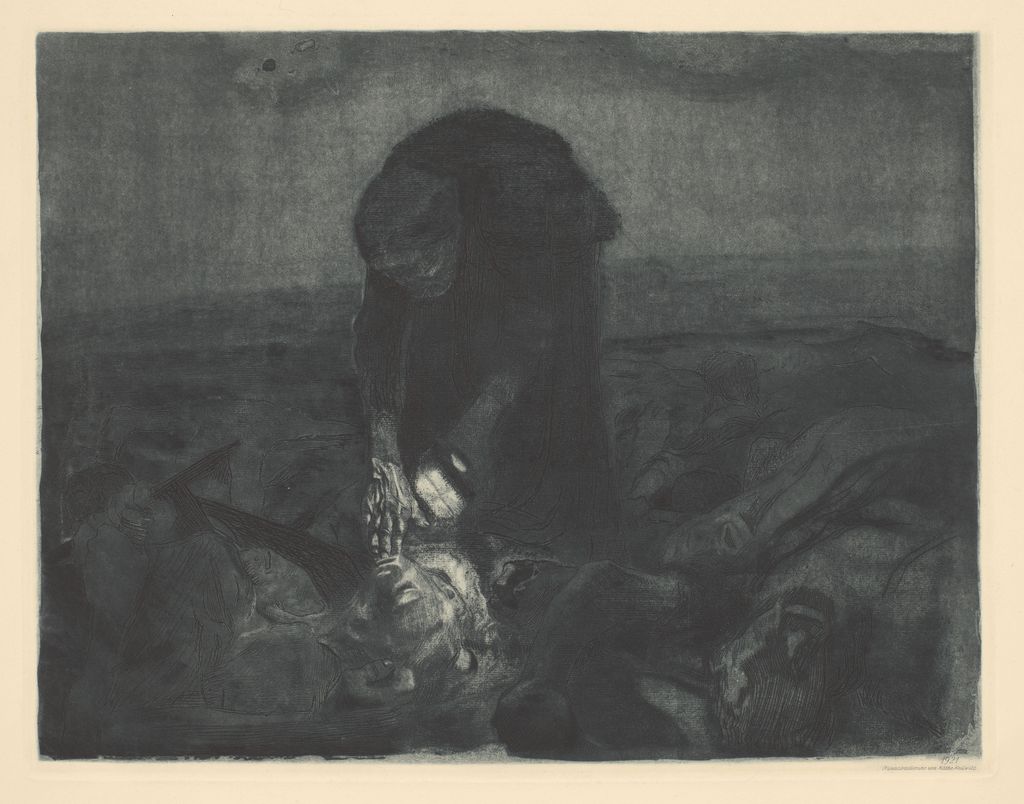
Strasbourg’s acquisition of Schlachtfeld (Battlefield, catalogued in French as Le champ de bataille) gives this reception a precise object and date. The city received the impression as a gift on 27 June 1908. Accession 5.916 is dated 1907 and is plate six of Bauernkrieg (Peasants’ War). A woman bends over the fallen, holding a lantern close to one of the bodies. The face she examines emerges from a field that is barely legible beyond the light. The French national museum catalogue identifies etching, drypoint, aquatint, sandpaper work and soft-ground impressions, including textures from laid paper and Ziegler transfer paper. The sheet puts a particular object alongside Clément-Janin’s account of Kollwitz’s technique. The textures he valued in earlier work have a counterpart here in the means she used to make the ground, clothes and bodies register at different depths of shadow. [5] [6]
A group of prints reached Jacques Doucet’s Bibliothèque d’art et d’archéologie by another route in 1911–12. INHA traces the purchases through correspondence and invoices in the Clément-Janin archive. Lehrs put the library in touch with the Dresden dealers Ernst Arnold and Emil Richter and offered to choose impressions because they were difficult to obtain in Paris. Clément-Janin was by then in charge of Doucet’s print collection. The critic who had described the surface of Kollwitz’s etchings was now working in a library where readers could examine such surfaces at first hand. Among the holdings INHA discusses is Arbeiterfrau (Working Woman), EM KOLLWITZ 17, whose thin Japanese support can be studied from both sides. Another route into the collection was the published portfolio. Brustbild einer Arbeiterfrau mit blauem Tuch (Bust of a Working Woman with a Blue Shawl), composed in 1903, appeared in an annual portfolio in 1906. Dealers, publishers and the library each had a hand in determining which examples of Kollwitz’s early work a reader in Paris could see. [5] [22]
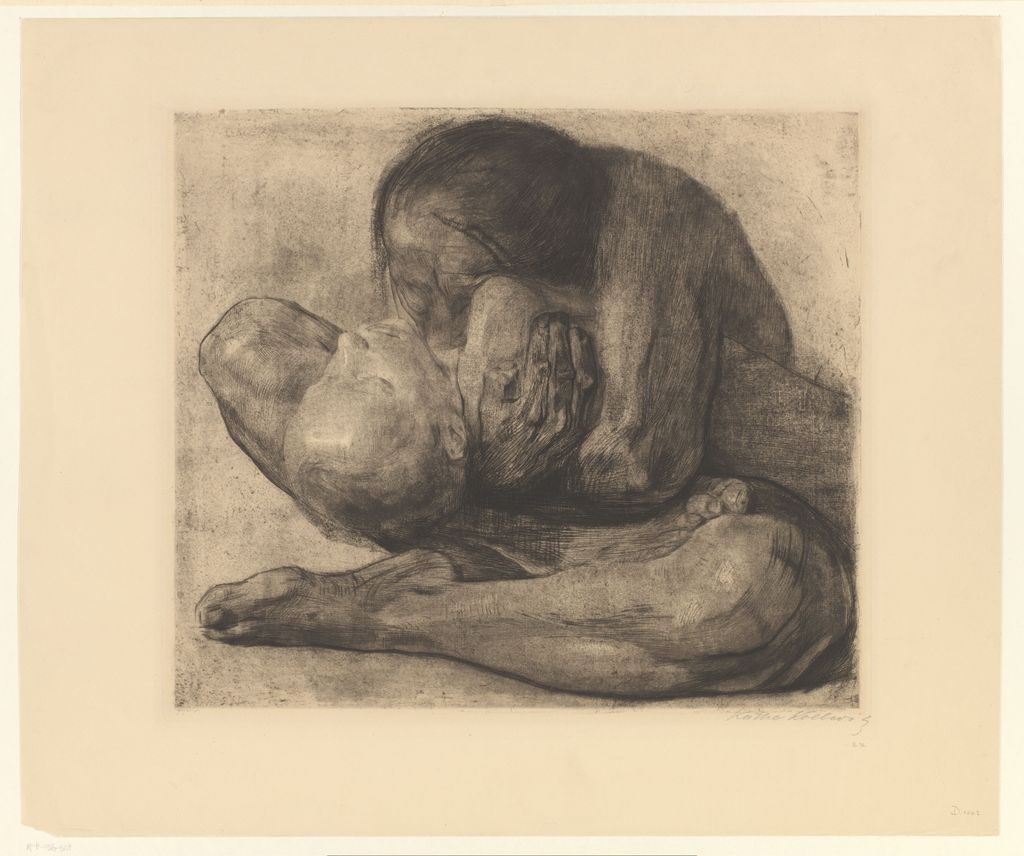
Woman with Dead Child, 1903. Rijksmuseum, RP-P-1916-507. Image source. CC0 / Public domain. Resized and exported as JPEG.
Campbell Dodgson and two routes into the British Museum
Kollwitz exhibited in London in 1901 with the International Society of Sculptors, Painters and Gravers. The Kollwitz Museum in Cologne identifies that exhibition as a possible occasion for Campbell Dodgson to have first encountered her work. His later collecting is better documented. Dodgson, who went on to lead the British Museum’s Department of Prints and Drawings, knew Lehrs. The British Museum credits that relationship with encouraging Dodgson to buy Kollwitz prints in Germany before the First World War. His private collection passed to the museum by bequest in 1948 and supplied much of the material for its later Kollwitz exhibition. Lehrs thus helped shape two holdings abroad through different relationships. For Doucet’s library he advised an institution trying to find impressions in the German trade. In Dodgson’s case he encouraged a fellow print specialist whose own collection would eventually enter a museum. [5] [17] [7]
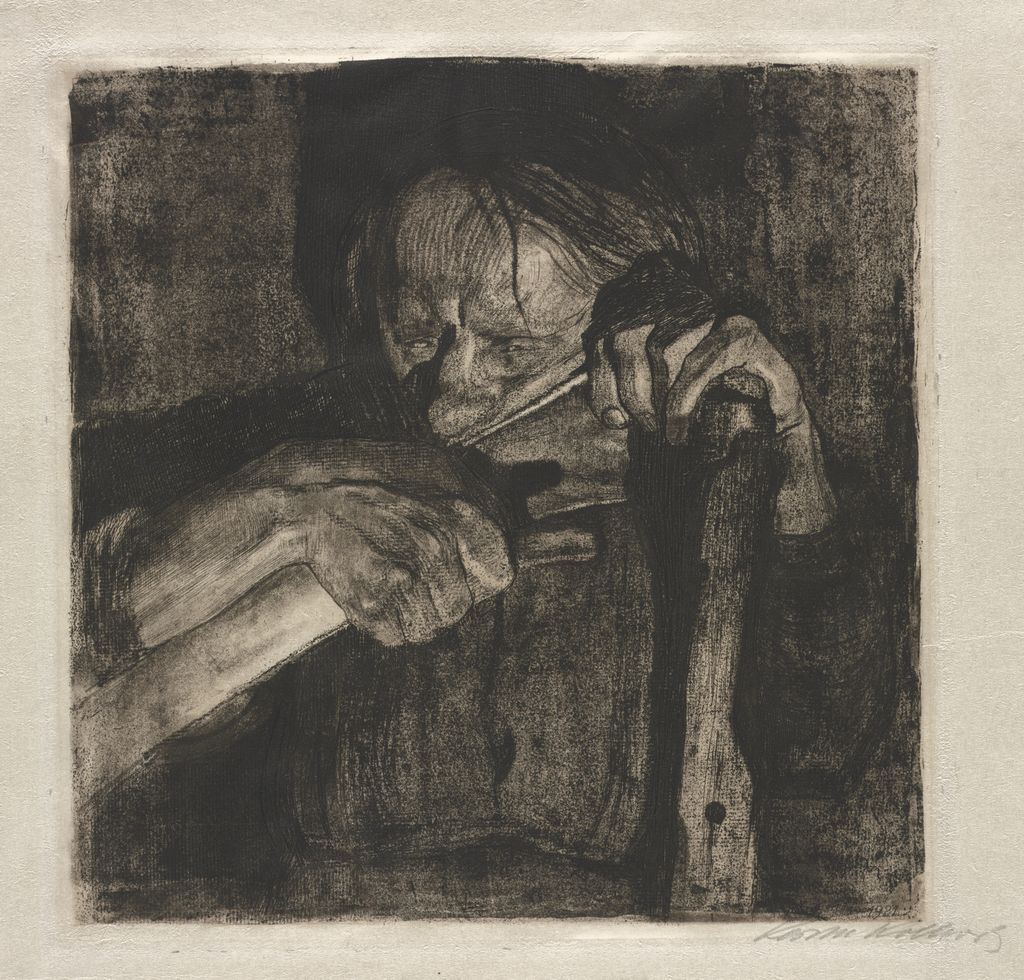
A 1924 lithographic Selbstbildnis (Self Portrait) reached the British Museum during Kollwitz’s lifetime. Dodgson bought it for the Contemporary Art Society with its Prints and Drawings Fund, and the Society presented it to the museum in 1930. The accession number is 1930,0111.41, and the Society’s stamp is on the back. On the front, Kollwitz gives much of the image to her face in three-quarter view. The closeness of the face and the relative spareness of its surroundings give the viewer time to register how small shifts of tone build the cheek and brow. This sheet’s ownership history shows how Dodgson could shape a public collection while acting on behalf of a purchasing society, years before the museum received the prints he had collected for himself. [7] [8]
From Academy recognition to removal from exhibitions
Kollwitz’s public standing in Berlin changed substantially during the years covered by the timeline. After the reforms that followed the revolution of 1918, Liebermann proposed her for membership of the Prussian Academy of Arts. On 24 January 1919 she became the first woman elected to full membership since 1833. The Academy marked her sixtieth birthday in 1927 with an exhibition that gave space to early print cycles and to campaign work, including her opposition to Paragraph 218, the law criminalising abortion. In 1928 she became the first woman to lead one of the visual arts section’s six master studios. Election, exhibition and appointment each gave her a different position within the institution. The birthday display also changed how a campaign image could be read. In the gallery, viewers could consider it alongside the prints through which Kollwitz had first made her reputation. [9] [23]
In June 1932 she signed Dringender Appell! (Urgent Appeal!), which called for the Social Democrats and Communists to put forward a common list against the Nazis in the July Reichstag election. The Bundesarchiv preserves a copy of the poster. After the Nazi takeover she supported a further appeal for cooperation ahead of the election of 5 March 1933. In February she and Heinrich Mann were forced to resign from the Academy under threat that the institution would be closed. Martin Wagner resigned from the Academy in solidarity. Kollwitz retained access to her Academy studio into early 1934, then rented a workspace at the Ateliergemeinschaft Klosterstraße from autumn 1934. That sequence separates the loss of her position from the later loss of her workplace. [9] [24] [25]
Pressure on exhibitions followed a course that can be traced venue by venue. Her work was removed from Berliner Kunst in Munich in 1935. In 1936, works by Kollwitz and Ernst Barlach were taken out before the opening of the Academy anniversary exhibition Berliner Bildhauer von Schlüter bis zur Gegenwart (Berlin Sculptors from Schlüter to the Present). In a separate episode that year, the upper floor of the Kronprinzenpalais, where two of her sculptures stood, was closed, although interested visitors could still gain access. In November Kollwitz recorded in her diary how little she had heard from people after the two episodes. The studio association’s annual exhibitions still included her work from 1935 to 1938, although she sometimes had to substitute pieces that drew objections from the Reich Chamber of Culture. When plans for public displays marking her seventieth birthday fell through in 1937, she showed about sixty prints in her own rooms at Klosterstraße. The audience she could reach depended increasingly on where a work was shown and who could get in. [25]
Post-war Germany and the uses of her name
The East German Academy claimed a connection to the reform-era Prussian Academy when it was re-established in 1950. Kollwitz, who had joined the earlier Academy after the revolution and been forced out in 1933, gave that claim a personal history. The institution held a Kollwitz exhibition in East Berlin in 1951. At the first Käthe Kollwitz Prize ceremony on 26 March 1960, it used her name to endorse realist art tied to the life of the people. The recipient, Karl Erich Müller, was commended for his commitment to socialist progress and peace. Revised statutes in 1962 required nominations to be confirmed by the culture minister, and the Academy’s historical account records intervention in proposed lists. The prize survived the merger of the East and West Berlin academies. Since 1993 a rotating independent jury drawn from the visual arts section has selected the recipient. The same name has served successive institutions with different rules about who decides which art merits recognition. [9] [10]
The centenary of Kollwitz’s birth in 1967 makes the contrast between the two Berlin academies particularly concrete. In July, the East German Academy opened Käthe Kollwitz und ihre Zeitgenossen (Käthe Kollwitz and Her Contemporaries). Neues Deutschland reported the opening as part of its coverage of the anniversary. The West Berlin Academy’s memorial exhibition ran from 10 December 1967 to 7 January 1968. The Academy identifies the centenary as a turning point for exhibitions in the Federal Republic, which increasingly considered the politics of Kollwitz’s work alongside its aesthetic qualities. The West Berlin exhibition also prompted the creation of the Käthe Kollwitz Archive. Her son Hans placed her surviving papers on long-term loan, including the diaries from 1908 to 1943 and extensive family correspondence. One item, notebook 8, pp. 68–69, preserves two sketches for a soldiers’ cemetery memorial beside the entry of 11 January 1924. The archive made it possible to study that decision in the artist’s own working record and connect it to the eventual Trauernde Eltern (Grieving Parents). [9] [26] [27]
Frankfurt’s collection grew through a municipal purchase. Helmut Goedeckemeyer began assembling Kollwitz prints after the First World War, and the City of Frankfurt acquired the Kollwitz collection of Helmut and Hedwig Goedeckemeyer for its municipal gallery in 1964. The Städel records its Proletariat as set 22 of 100, with all three woodcuts on Japanese paper. Kollwitz made the series in 1924–25, and Emil Richter published the edition in Dresden in 1926. In the collection, Erwerbslos (Unemployment), Hunger and Kindersterben (Child Mortality) can be read in their intended sequence, with the numbered set and its paper documented together. The national memorial dedicated at the Neue Wache in reunified Berlin in 1993 gave a single work a different kind of visibility. An enlarged version of Mutter mit totem Sohn (Mother with Her Dead Son) became the central image in a memorial to the victims of war and tyranny. [11] [28] [29]
A touring portrait in Britain and a retrospective in Strasbourg
Portrait of the Artist: Käthe Kollwitz, organised by Ikon and the British Museum, opened in Birmingham in September 2017 and travelled to Salisbury, Swansea and Hull before its London run from 12 September 2019 to 12 January 2020. The exhibition used self-portraits and portraits of working women to introduce the artist. This juxtaposition gave the visitor two ways into the same body of work. A self-portrait could be read for the choices Kollwitz made when she turned her attention on herself, while a portrait of a working woman gave comparable weight to a face whose name the viewer might never know. The tour then moved through A Weavers’ Revolt, Peasants’ War, and images of death and maternal grief. Its treatment of war and remembrance brought the Krieg (War) woodcuts together with the memorial sheet for Karl Liebknecht. The woodcuts follow bereavement through several figures and situations. The Liebknecht sheet concentrates on the people who have come to pay their respects to one dead man. [7] [12]
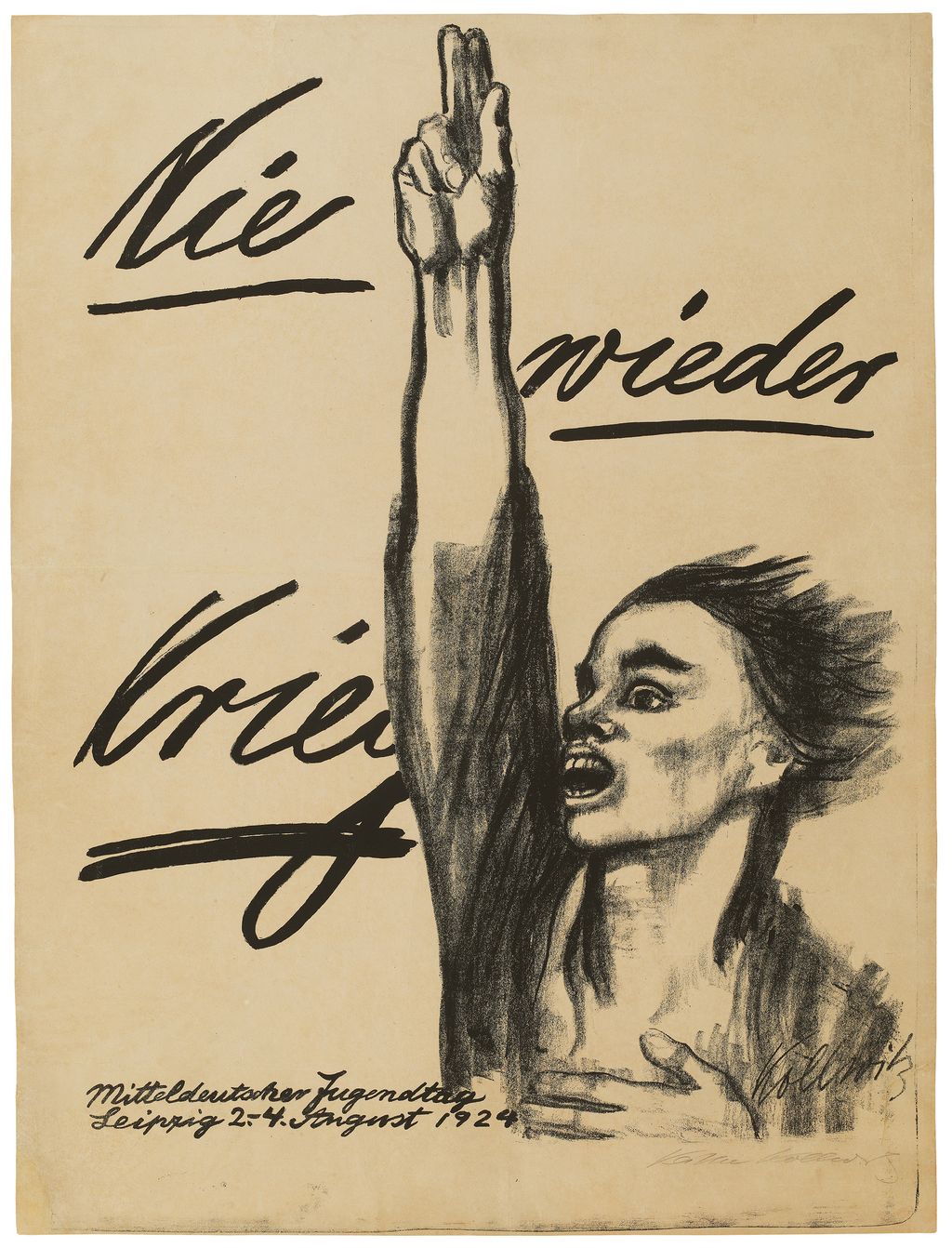
During the London run, the Musée d’Art moderne et contemporain de Strasbourg staged Käthe Kollwitz. Je veux agir dans ce temps (I Want to Make a Difference in These Times), from 4 October 2019 to 12 January 2020. Organised with the Kollwitz Museum in Cologne, it combined the local collection with loans and arranged prints, drawings and sculpture chronologically. Its title drew on Kollwitz’s November 1922 diary entry about what she wanted her art to do. A room on the First World War and pacifism set the War woodcuts within that history, while the following room addressed the Weimar years through work including relief posters. In that arrangement, a campaign appeal could be read in relation to the recent hunger or political emergency that brought it into being. The accompanying publication and French–German study day gave the exhibition a research life beyond the galleries. [9] [13] [30]
The Académie de Strasbourg described the exhibition as France’s first retrospective devoted to Kollwitz. The exhibition history of Battlefield records several earlier occasions on which a French audience could see her work. Strasbourg had shown that impression in De Klinger à Arp in 1998–99, in a Kollwitz exhibition-dossier in 2002 and in a display of German prints in 2006. By 2019 the same local holding could anchor a career survey assembled with international loans. Where the British tour used a portrait of the artist to connect work from different moments, Strasbourg gave visitors a sequence of rooms through which they could follow changes in medium and public purpose across her working life. [6] [12] [13] [31]
Frankfurt and New York in 2024
The Städel’s Kollwitz, held from 20 March to 9 June 2024, started from the museum’s own holdings and the history of her reputation in Germany. More than 110 works on paper, sculptures and early paintings were shown, including loans from German and American collections. The early paintings allowed visitors to see something of the work Kollwitz made before choosing to concentrate on drawing and printmaking. The museum’s digital companion reproduces her Munich beer-garden paintings of 1888–89 and places them in the context of her training. Later in the exhibition, the Städel addressed the political readings that had attached themselves to her work after 1945. The same career could be claimed for socialist realism, Christian feeling or German reconstruction. By placing that reception history within a wider survey of her work, the museum gave visitors a chance to see how much any one public image of Kollwitz depended on the selection of works around it. [14]
American audiences had seen her work in her lifetime. As her exhibition opportunities narrowed in Germany, galleries in New York and Los Angeles showed her work in 1937–38. The print dealer and cataloguer August Klipstein enlisted Hudson Walker in New York, and the bookseller and gallerist Jake Zeitlin organised a small travelling exhibition from Los Angeles. In a letter of 6 May 1937 to Dr Löhnberg, Kollwitz welcomed the prospect of an audience in America after experiencing the silence surrounding her work in Germany. MoMA described its exhibition of 31 March to 20 July 2024 as the first major Kollwitz retrospective at a New York museum and the largest exhibition of her work in the United States in more than thirty years. Its loans from North America and Europe made it possible to bring together related sheets now held far apart. [25] [15]
The group assembled around Beim Dengeln (Sharpening the Scythe), plate three of Peasants’ War, shows what those loans made visible. The checklist records two impressions of the fourth state of Inspiration, a rejected first version of the plate. The Berlin impression and the Mayer family impression came from the same state, but Kollwitz worked over the latter with charcoal, white chalk and ink. A second rejected composition, Frau mit Sense (Woman with Scythe), came from Basel, and a chalk and pencil study for the final design came from Cologne. The grouping let viewers distinguish a decision to abandon a composition from the smaller decisions she continued to make within a composition she kept. [16]
The checklist then follows the final design through several impressions. Boston’s first-state example carries graphite additions. A fourth-state impression from San Francisco combines additional printing techniques with pencil, charcoal and chalk. Even the lower left corner had been reworked and glued back on. A seventh-state impression from the University of Connecticut carries pencil additions, and the Basel impression gives a further point of comparison. In 1898 Lehrs had asked for the proofs that might disappear beneath a workshop table. In New York, those kinds of sheets occupied sustained space in a retrospective. Frankfurt’s exhibition asked how institutions had made certain images stand for Kollwitz. The sheets assembled in New York let viewers see the sequence of choices through which one of those images came into being. [14] [16] [4]
Käthe Kollwitz artworks directory
Selected documented works, including the complete published sequences of the five cycles discussed here. Catalogue links identify the specific record behind each row.
Frequently Asked Questions
Strasbourg received Schlachtfeld (Battlefield), plate six of Peasants’ War, as a gift on 27 June 1908. Its accession number is 5.916. The French museum catalogue lists it as Le champ de bataille, planche 6. [6]
Discussion
Look again at the images and ideas explored in Käthe Kollwitz’s Reception in Exhibitions, Collections and Public Memory. These editorial prompts invite your observations.
Reader Insights
How did collectors in Dresden, Paris and London acquire different views of Kollwitz’s career?
What did the Frankfurt and MoMA retrospectives each make visible through their selection of works?
What did the French, British and American exhibitions each make easier to compare?
Join the Conversation
Share a detail, comparison or question about Käthe Kollwitz’s Reception in Exhibitions, Collections and Public Memory below.
References
- Kollwitz Museum Köln, A Weavers’ Revolt, 1893–1897, cycle overview and individual sheets. View source.
- Kollwitz Museum Köln, Zeitstrahl 1891–1900, entries for the 1898 Berlin exhibition and the 1899 Dresden award. View source.
- Deutscher Reichsanzeiger, Deutsche Kunstausstellung in Dresden, no. 101, 8 May 1899, p. 3302, under Die silberne Plakette. View source.
- Staatliche Kunstsammlungen Dresden, Briefwechsel zwischen Käthe Kollwitz und Max Lehrs, 1898–1929, pp. 8–12 and 15, letters of 13 and 24 June, 5 and 8 July 1898, and 22 April 1899. Archive 01/KK 04, Bd. 4, nos. 538–546 and 774. View source.
- Institut national d’histoire de l’art, Käthe Kollwitz (1867–1945), part two, sections on the library holdings and reception, including EM KOLLWITZ 17, the Clément-Janin transcription and the illustrated Arnold and Richter records. View source.
- French Ministry of Culture, Joconde, Schlachtfeld / Le champ de bataille, planche 6, Strasbourg accession 5.916, notice 00160010900, fields for technique, acquisition and exhibition history. View source.
- British Museum, Portrait of the Artist: Käthe Kollwitz, 2019 exhibition press release, collection history and exhibition themes. View source.
- Contemporary Art Society, Self Portrait (1924), British Museum accession 1930,0111.41, purchase and presentation history. View source.
- Akademie der Künste, Zur Person Käthe Kollwitz and extended institutional history, Academy membership, studio leadership and reception, notes 6–7 for the 1951 and 1967 exhibitions, and Käthe-Kollwitz-Archiv no. 8, pp. 68–69. View source 1. View source 2.
- Anke Hervol, Akademie der Künste, Geschichte des Käthe-Kollwitz-Preises, sections on the founding statutes, awards and merger, with the first award citation at Historisches Archiv AdK-O 0583. View source.
- Städel Museum, Proletariat, set 22/100, SG 4308, SG 4309 and SG 4355, and About the Acquisition. View source.
- Ikon, Portrait of the Artist: Käthe Kollwitz at The British Museum, London, exhibition description and tour dates. View source.
- Musée d’Art moderne et contemporain de Strasbourg, Käthe Kollwitz. Je veux agir dans ce temps, exhibition dossier, pp. 2–8, especially rooms 6 and 7, and exhibition catalogue record, ISBN 9782351251676. View source 1. View source 2.
- Städel Museum, Kollwitz, exhibition scope and dates, and German digital companion, opening discussion of reception and section 1, Ein Ziel vor Augen. View source 1. View source 2.
- Museum of Modern Art, Käthe Kollwitz, exhibition scope, dates and installation archive. View source.
- Museum of Modern Art, Käthe Kollwitz, exhibition checklist, pp. 16–19, entries for Inspiration, Woman with Scythe, the study and impressions of Sharpening the Scythe. View source.
- Kollwitz Museum Köln, Zeitstrahl 1901–1913, and Biography, entries on London, Friedrich Lippmann, Lehrs’s catalogue and the Salon des Indépendants. View source 1. View source 2.
- Max Lehrs, Käthe Kollwitz, Die Graphischen Künste 26 (1903), and Kollwitz Museum Köln, Werkverzeichnis der Druckgrafik, history of the 1903 inventory. View source 1. View source 2.
- Staatliche Kunstsammlungen Dresden, Jahresbericht 2017, p. 34, Käthe Kollwitz in Dresden. View source.
- Kollwitz Museum Köln, Die Carmagnole, 1901, Kn 51 V b, catalogue entry and source in Dickens. View source.
- Bibliothèque nationale de France, Catalogue de la 21e exposition 1905, Salon des Indépendants, 24 March–30 April 1905, FRBNF35034083. View source.
- Institut national d’histoire de l’art, Buste d’une ouvrière au châle bleu, de Käthe Kollwitz, discussion of the lithograph and its 1906 portfolio publication. View source.
- Kollwitz Museum Köln, Timeline 1927–1932, and Museum of Modern Art, Käthe Kollwitz, extended labels, Paragraph 218 campaign context. View source 1. View source 2.
- Bundesarchiv, Dringender Appell!, June 1932, Plak 002-037-024, facsimile reproduced by German History in Documents and Images. View source.
- Kollwitz Museum Köln, Zeitstrahl 1933–1945, entries for 1933–38, including the November 1936 diary entry and letter to Dr Löhnberg of 6 May 1937. View source.
- Neues Deutschland, issue of 8 July 1967, report on the opening of Käthe Kollwitz und ihre Zeitgenossen. View source.
- Bibliothèque nationale de France, Käthe Kollwitz, West Berlin Academy exhibition catalogue, catalogue by Herta Elisabeth Killy, exhibition dates 10 December 1967–7 January 1968. View source.
- German Federal Government, Chancellor Helmut Kohl’s statement on the dedication of the Neue Wache, 14 November 1993. View source.
- Staatliche Museen zu Berlin, Kupferstichkabinett, Proletariat, object 3573618, Dresden publication and edition. View source.
- Deutsches Forum für Kunstgeschichte Paris, Je veux agir dans ce temps, French–German study-day programme. View source.
- Académie de Strasbourg, Käthe Kollwitz. Je veux agir dans le temps, exhibition notice and scope of the retrospective. View source.
More KOLLWITZ Works
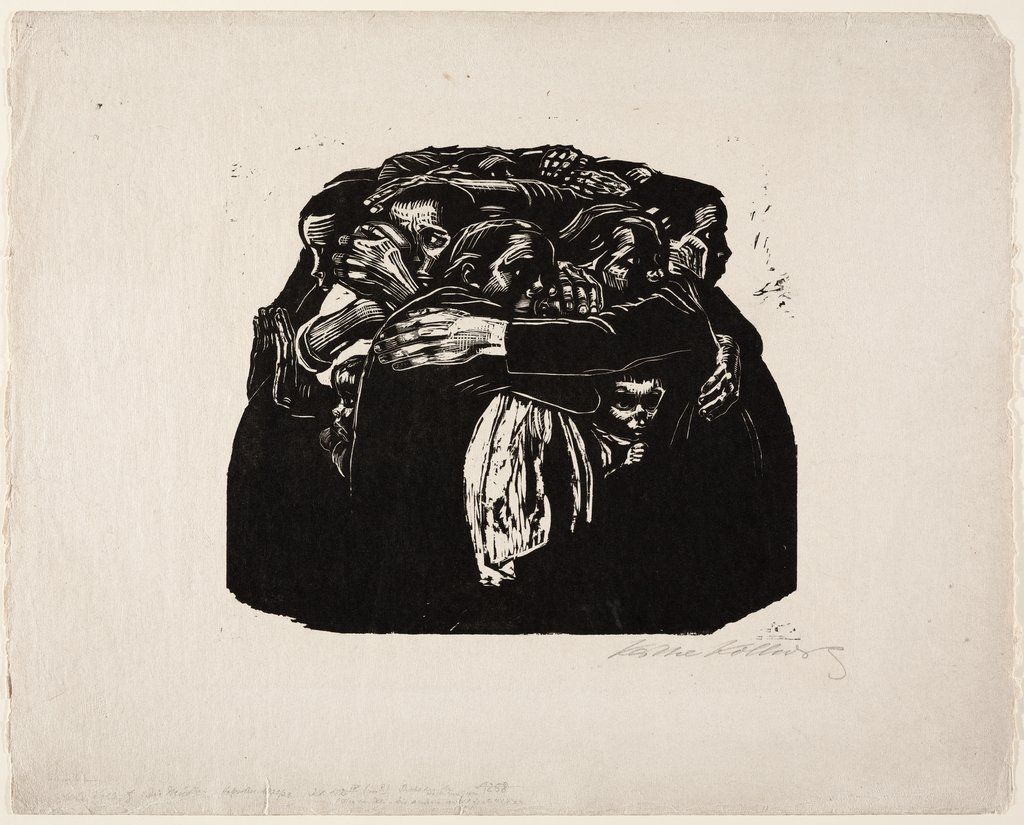
The Mothers
The Mothers, 1921–22. Städel Museum, Frankfurt am Main, SG 4289A D. Image source. Public domain. Resized and exported as JPEG.
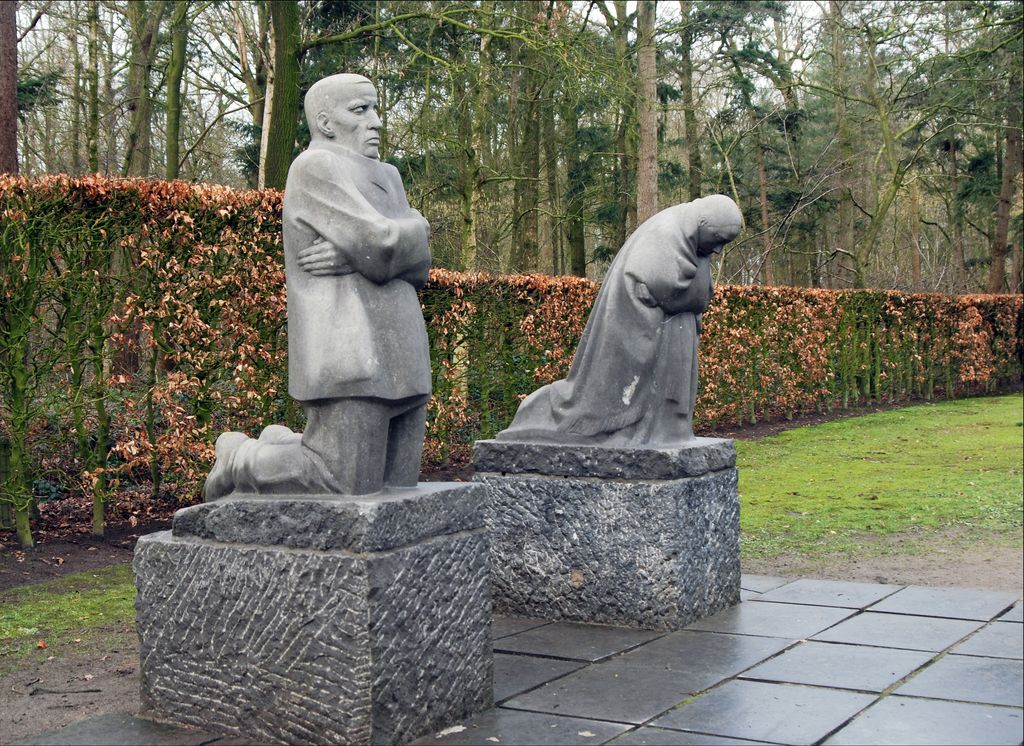
The Grieving Parents
The Grieving Parents at Vladslo, the memorial’s location since 1956. Photograph by Bva, resized. Image source. CC BY-SA 3.0. Resized and exported as JPEG.
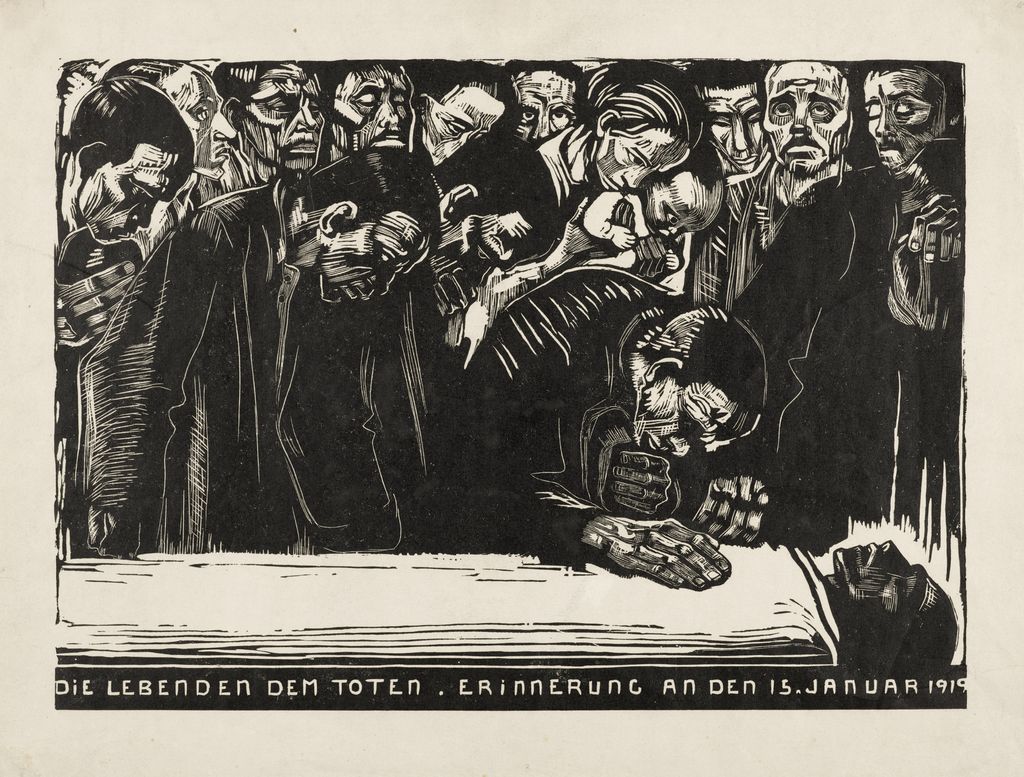
Memorial for Karl Liebknecht
Memorial for Karl Liebknecht, 1920. Kunstsammlungen Chemnitz, 86-47, Kn 159 VI. Photo: Kunstsammlungen Chemnitz/PUNCTUM/Bertram Kober. Image source. Public domain. Resized and exported as JPEG.