


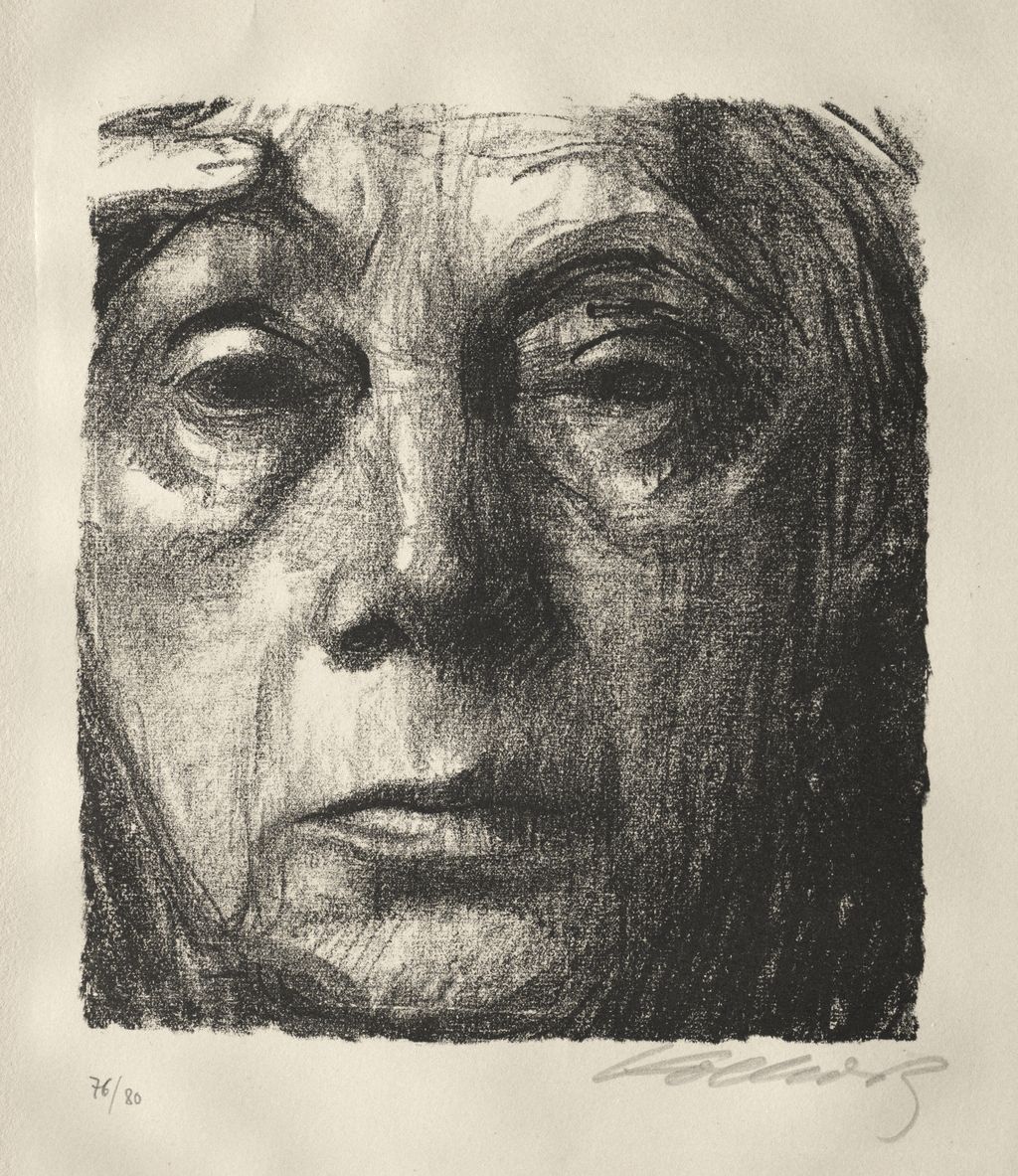
Käthe Kollwitz, Self-Portrait, 1934. Lithograph. Cleveland Museum of Art, 1936.30. Image source. CC0 / Public domain. Resized and exported as JPEG.
 by Tom Gurney
Tom Gurney BSc (Hons) is an art history expert with over 20 years experience
Email: tomgurney1@gmail.com / Phone: +44 7429 011000
Käthe Kollwitz’s Self-Portraits: Introduction
Käthe Kollwitz returned to her own face more than a hundred times in drawings, prints and sculpture. In a small drawing from her student years, her hand bears the weight of her head. In a woodcut of 1924, the head has turned aside and the hand is still raised. In Call of Death, she turns towards a hand that enters from beyond the edge of the picture. The gestures are closely related, but each gives the face a different reason to turn, look up or withdraw. [1] [2] [3] [4]
The same distinctions matter when two impressions carry the same title. In one of the large frontal lithographs from around 1904, the dark around the face is black and the dress pale green. In another, blue sets the terms of the encounter. In the 1924 woodcut, a revision to the block removes nearly half the height of the printed image. Across these works, likeness depends on decisions about how much of the body to show, where to place the light and how closely to bring the viewer to the face. [5] [6] [7] [3]
At a Glance
- Early drawings and etchingsuse ink, wash, pastel and fine incised lines to distinguish the pressure of a supporting hand from the direction of the gaze.
- The lithographs of 1901 and around 1904show two ways of bringing a face out of darkness. Kollwitz scraped highlights into a brown tone stone in the first and varied the colour and paper of the large frontal portrait.
- Two prints from 1924share the title Self-Portrait. Kn 203 is the woodcut revised by shortening the block. Kn 209 is a separate transfer lithograph with a surviving drawing on transfer paper.
- The late portraitsinclude a bronze whose mounting angle affects its expression, a right-facing profile that informed a Berlin monument and a likeness of the artist in the final sheet of Death.
Contents
- The head and the hand in the early portraits
- Scraping light into the stone
- The frontal colour lithograph and its proofs
- Two self-portraits from 1924
- From portfolio to print room
- An upright head, a frontal gaze and a late profile
- The hand in Call of Death
The head and the hand in the early portraits
Kollwitz signed her 1889 Self-Portrait with her birth surname, Schmidt, and dated it ’89. She was studying painting with Ludwig Herterich at the women’s art school in Munich. She used pen in ink and brush in sepia on drawing board. The pen can pick out an edge or a feature, while the brush carries shadow across a broader area. The face has a clear turn, but its volume also depends on the transitions between tones. MoMA’s 2024 retrospective opened its checklist with a closely dated comparison from Dresden, Self-Portrait, Facing Half Right, around 1890, also in pen and brush in ink. A larger Chicago drawing of 1891–92 uses black gouache, grey wash and white heightening on brown paper. On the brown sheet she could add light as a positive mark while retaining the colour of the support between light and shadow. [8] [9]
In the smaller Self-Portrait with Head Supported, dated 1889–91, she used pen and brush in sepia on handmade paper. The place where hand meets head fixes the angle of the face. It gives the viewer a sense of its weight before there is any need to read an expression. A sheet in the Metropolitan Museum, Self-Portrait, Turned Slightly to the Left, around 1893, gives the face volume by another means. According to the Met, Kollwitz loaded the pen with lighter and darker solutions of black ink to distinguish illuminated and shaded passages. The light in these early drawings could come from a wash, from a lighter line or from an opaque mark put down over the colour of the paper. [2] [10]
In Two Self-Portraits, the hand helps distinguish two views on the same tall plate. MoMA’s 2024 checklist records a Berlin impression dated 1891 in line etching and drypoint on chine collé, and a Dresden impression dated 1892 that also records the use of sandpaper. The plate dimensions agree, while the sheets differ in size. The exhibition label describes Kollwitz as pregnant with her first child, Hans, when she made the double portrait. In the upper image, the hand rests high on the chest and the composition makes room for the pregnant body. In the lower image, the hand meets the head and draws attention back to the face. On the audio guide, Sheila Heti interprets that second hand as the artist’s working hand, while curator Starr Figura reads the pairing in light of the expectations placed on women who pursued a profession and raised a family. The two images let the viewer move between these aspects of her life within the same work. [9] [11] [12]
In the large pastel Self-Portrait en Face with Right Hand, face and hand can command attention at the same time. Cologne catalogues the family loan, NT 168, as coloured chalk on olive-brown paper, 63.3 × 48.8 cm, and dates it around 1893–94. MoMA’s checklist and introductory audio date the pastel of the same title and dimensions around 1900. An earlier National Gallery of Art catalogue also places NT 168 around 1900, although it gives different measurements. The dating matters to Figura’s interpretation of the pastel as the likeness of an artist who had recently gained professional recognition. The extended label’s observation about the lit hand is visible whichever dating one follows. Against the dark field, the hand has enough light and scale to hold its own beside the face. The frontal gaze then makes the distance between the two lit forms more apparent. [9] [11] [13] [14] [15]
Scraping light into the stone
In Self-Portrait Looking Left (Selbstbildnis nach links, 1901), the face becomes legible in stages. The illuminated parts register first, while less distinct edges merge into the dark. Cologne connects the lithograph with the stimulus of Kollwitz’s first visit to Paris. Its Kn 52 I impression, inventory 70300/91004, combines brush and pen lithography with work by scraper and scraping needle on the drawing stone and the brown-printing tone stone. She scraped selected areas of the brown stone to make them print lighter. Where the face appears to catch the light, the effect depends in part on material removed from the printing surface. [5] [16]
A Dresden proof reproduced in the National Gallery of Art’s Kollwitz catalogue lets the viewer separate that effect into stages. The catalogue identifies it as an impression of the drawing stone, possibly before the first state, on grey paper with white chalk heightening. Here the printed image on its own lacks the laid pattern visible in the colour impression described in the following entry. The catalogue proposes that the paper texture was transferred to the background stone, which printed in orange-brown. The two sheets also distinguish white chalk applied to one impression from highlights worked into a stone for printing. A mark that looks like a touch of chalk in a reproduction can have a different material history from the one beside it. [15] [5]
The frontal colour lithograph and its proofs
In Self-Portrait en Face, Kn 85, Kollwitz brings the face forward within a dark frame that extends around the head and neck. Cologne dates the work tentatively to around 1904 and relates its almost sculptural modelling to her growing interest in three-dimensional work, which she studied at the Académie Julian in Paris that year. On Cologne’s Kn 85 II A impression, inventory 70300/05006, a dark-brown drawing stone works with separate tone stones for the black framing the face, the pale green of the dress and an ochre tone. The dark surround makes the face appear to project, while the area of green below it gives the eye a way to read the torso beneath the head. Cologne identifies eleven known proofs, each with a different combination of paper and colour. [6] [16]
Berlin’s Kupferstichkabinett also marks the date as uncertain. It records its second-state impression, 197-1911, as a crayon and brush lithograph in grey, black and green, with sprayed work on wove paper. Its catalogue discussion separately identifies the drawing and tone stones. Berlin’s other impression, 110-1906, uses a dark-brown drawing stone with blue and ochre tone stones. The three-colour proof shown in MoMA’s 2024 retrospective and jointly owned by MoMA and Neue Galerie New York is a separate object. MoMA catalogues it as state I/II, a crayon and pen lithograph, and lists Kollwitz as the probable printer. In that proof the dark blue field makes a cooler transition into the lit face than the black and green of the Cologne sheet. The direct gaze holds across the impressions. What changes is how the face and the body below it emerge from the surrounding colour. [9] [6] [7] [17]
A single-colour comparison brings the differences in scale and gesture into focus. The Getty’s Self-Portrait, Hand at the Forehead, Kn 109 II c, tentatively dated before mid-June 1910, is a line etching and drypoint printed by Otto Felsing in black ink on copperplate paper. The plate mark measures 15.5 × 13.8 cm, roughly a third of the height of the large frontal lithograph. In the etching, the hand interrupts the outline of the head and helps define the space the face occupies. In Kn 85, the continuous dark around the head does much of that work. One asks the eye to follow the meeting of two forms at close range. The other gives the face room to project within a broad printed field. [6] [18]
Paper remains a visible part of the image when Kollwitz works in a single ink. Tokyo’s National Museum of Western Art holds a distinct 1915 Self-Portrait, Kn 134 c, G.2020-0174, on beige wove paper. The printed image measures 27.5 × 23.8 cm, within a sheet of 46 × 32 cm. The exposed beige provides the lightest tone within the printed area and continues into the margin. In MoMA’s Small Self-Portrait of 1919, the marks on the drawing itself are lithographic crayon and ink. The Getty records a related transfer lithograph, made from the drawing NT 844a and printed on very thin handmade Japan paper before Richter’s numbered edition. Figura’s 2024 audio commentary draws attention to how much presence the small face has. The drawing and the proof also show how marks made on one kind of paper could be carried onto a sheet with a different surface and weight. [18] [19] [20] [21]
Two self-portraits from 1924
The woodcut and the shortened block
On 14 May 1924, Kollwitz noted in her diary that she was working on a woodcut self-portrait with a raised hand. In the fourth state of Kn 203, the seated figure is visible down to the knee. The right hand rests on the knee and the left remains raised near the head. Cologne reads the pose as the instant after she has turned aside, leaving the left hand in the position from which it might have supported her head. The resting hand gives that gesture a counterpart. One fixes the figure in her seat while the other retains the suggestion of a movement. The Getty’s state III, printed in black on thick, soft Japan paper, already has the 40 × 30 cm image dimensions that Cologne records for state IV. Cologne knows only two impressions of the fourth state. [18] [3]
In the brush study NT 1001, Kollwitz tried out the look of white-line cutting with opaque white on dark green paper and black wash in places. On paper, she could lay down a pale mark and interrupt it with wash. On the block, the raised surface took ink and a cut line left the paper exposed. A pale stroke in the study could therefore stand for wood she would remove. The study rehearses the balance of light marks against dark masses before that balance had to be worked out on the printing surface. [3]
She then shortened the block. Cologne’s state IV measures 400 × 300 mm, while its state VI b, inventory 70300/88020, measures 208 × 300 mm. The width stays the same and nearly half the height goes. The knee and resting right hand disappear. The raised hand survives beside the turned face, but the viewer has less information about the body that supports both. In state IV, the eye can move down from the head and reconstruct the pose. In state VI b, it keeps returning to the gap between the face and the hand. The revision changes how long that suspended gesture holds the viewer’s attention. [3]
The drawing that became a lithograph
The other 1924 Self-Portrait, Kn 209, is a crayon lithograph transferred from a drawing on transparent paper. The National Gallery of Art holds the original transfer sheet, accession 1954.12.34, shown at MoMA in 2024. Its 37 × 29.3 cm sheet carries lithographic crayon and hand-applied tusche. The NGA’s earlier catalogue describes Kollwitz using the side of the crayon to model the planes of the face in tone. In the print, the granular shading under the eyes changes in density across the cheek. Where the woodcut makes the viewer follow the meeting of cut lines and black areas, the lithograph lets a shadow thicken or recede across a continuous surface. [9] [15] [22] [23]
Cologne compares Kn 209 b with NT 988, a separate frontal charcoal drawing of 1923 on browned transparent paper. In the drawing, the frontal pose allows the viewer to compare the shadows beneath both eyes directly. In the lithograph, the turn of the head gives the shadows on the two sides different weight. Cologne reads the work alongside diary entries in which Kollwitz reflects on ageing and diminishing strength and returns to the loss of her son Peter. The shadows belong to that interpretation, and their placement can also be studied as a series of drawing decisions. The transfer sheet shows how deliberately she built the dark around the eyes before the image went to press. [22] [23]
From portfolio to print room
Arndt Beyer published the lithograph in Leipzig in the fourth annual portfolio of the Circle of Graphic Artists and Collectors. The portfolio also included work by Max Beckmann, Otto Dix, Lovis Corinth and Alfred Kubin. Kollwitz was the only contributor to submit a self-portrait. Another impression went directly from the artist to Dresden. On 10 January 1925, Kurt Zoege von Manteuffel wrote that Max Lehrs had shown him the lithograph and asked for an impression for the Kupferstich-Kabinett. Kollwitz replied on 17 January that she would send it, naming 70 marks as her price and leaving the museum room to offer what it could. Manteuffel acknowledged receipt on 23 January. The published correspondence identifies the sheet as A 1924-347 and records it as missing. The letters document a second route into a collection within months of publication. [22] [24]
In Britain, Campbell Dodgson bought a signed and dated impression for the Contemporary Art Society’s Prints and Drawings Fund. The Society presented it to the British Museum in 1930. It records black printing on white laid paper and its stamp on the reverse of accession 1930,0111.41. Dodgson also collected Kollwitz privately and was in touch with Lehrs. Cologne identifies Kollwitz’s participation in a London exhibition in 1901 as a possible point at which he first became aware of her work. His later bequest brought his personal collection to the British Museum by a separate route. [16] [25] [26]
The British Museum and Ikon partnership exhibition Portrait of the Artist: Käthe Kollwitz opened in Birmingham in 2017, travelled to Salisbury, Swansea and Hull, and reached London in 2019–20. It placed the portraits alongside work on labour, social injustice, war and remembrance. Ikon’s Birmingham material captions a British Museum Self Portrait Looking Left of 1901 as lithograph and etching. The caption leaves its accession and state open, so the process details recorded for Cologne’s Kn 52 I apply to the Cologne impression. In Strasbourg, the exhibition Käthe Kollwitz. « Je veux agir dans ce temps », organised with the Cologne museum in 2019–20, brought local holdings together with loans. Its dossier identifies Strasbourg’s own 1934 lithographic Autoportrait and Cologne’s four-colour Kn 85. The two displays offered different ways into the artist’s reception, and Strasbourg’s objects made it possible to compare the scale and colour of the early frontal proof with a late return to the frontal likeness. [26] [27] [28]
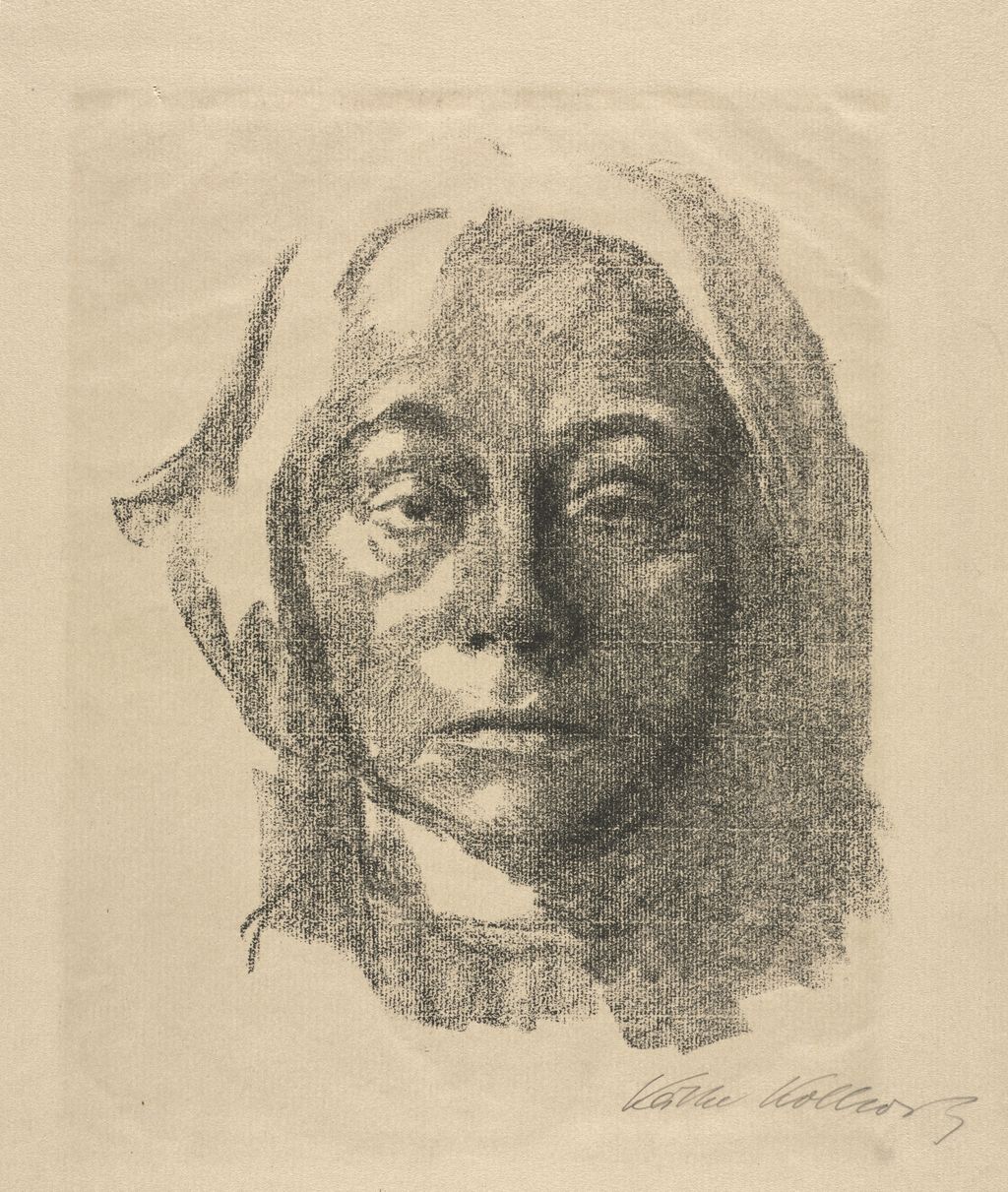
Käthe Kollwitz, Self-Portrait, 1915. Lithograph. Cleveland Museum of Art, 1941.493. Image source. CC0 / Public domain. Resized and exported as JPEG.
An upright head, a frontal gaze and a late profile
Kollwitz worked intermittently on her only sculpted self-portrait from 1926 to 1936. In December 1928 she recorded her frustration at repeatedly returning to the head and finding the previous day’s work unsatisfactory. Cologne’s bronze, Seeler 26 I.B.3, inventory 70100/16002, was cast between 1937 and 1939 and is one of three documented lifetime casts. She supervised its production, including the mounting angle. Cologne contrasts the upright bearing of the early casts with the effect of posthumous casts set at a slight downward angle. With the head upright, the face is more readily available to someone standing in front of it. Tilt it forward and the brow and eyes meet that same viewer at a different angle. In her sculpture, the setting of the head could change the encounter as decisively as the cropping of a print. The Baltimore Museum of Art cast lent to MoMA in 2024 has its own checklist dating, modelled 1926–36 and cast around 1937. [9] [29]
A page in MoMA’s historical 20th Century Portraits catalogue shows how differently a viewer can meet three faces by the same artist. At the top, the hand in a close drawing covers part of the forehead and cheek. Below it, a lithograph faces out and a bronze is photographed in three-quarter view. The catalogue identifies them as a 1930 drawing from Erich Cohn, a 1934 lithograph from Buchholz Gallery and a bronze dated 1936 from Cohn. Those captions establish the identities used for that display. The bronze’s date is the catalogue’s period dating, while Cologne’s modern record separates the model and the casting of its particular example. [29] [30]
The 2024 retrospective offered a further comparison between two frontal portraits dated 1934, MoMA’s lithograph and the Los Angeles County Museum of Art’s charcoal Self-Portrait Facing Forward. In the audio transcript, Figura points to finger smears beneath the eyes of the charcoal portrait. The marks make the shadows in a place Kollwitz had already emphasised in the 1923 and 1924 portraits, but here they retain the trace of a finger moving the charcoal directly on the sheet. The lithograph keeps the viewer’s attention close to the face through the printed distribution of light and dark. In each, the frontal pose gives the two sides of the face a common axis against which small differences in shading become visible. [9] [22] [31] [32]
Cologne identifies the right-facing transfer lithograph Kn 273 as her last graphic self-portrait and tentatively dates it to around 1938. Its Kn 273 III b impression is inventory 70300/89001. The Getty holds a signed state II, catalogued as a chalk transfer lithograph with sprayed work on the stone, and an unsigned state III b from a posthumous group of thirty printed in 1946, with an estate inscription by Hans Kollwitz. The design date and the printing date belong to different parts of the work’s history. In the image, the half-length format gives the curve of the back room to register, while the shaded profile and partly closed eye direct attention to the carriage of the head. Cologne documents Gustav Seitz working with a reproduction while developing his monument to Kollwitz. A posture that she had set within a narrow printed rectangle helped shape the figure later installed in Berlin’s Kollwitzplatz. The timeline places the late graphic work alongside the sculpture and the events of her last years. [1] [18] [33]
The hand in Call of Death
In Call of Death (Ruf des Todes), the final sheet of the Death series, Kollwitz gives the turn of her head an immediate cause. A hand enters from the upper right and touches her shoulder. She turns towards it, the face shaded and her left hand lifted towards her eyes. The pale diagonal of her right forearm carries the eye towards the point of contact. In the 1924 woodcut, the raised hand preserves the trace of a pose the artist has just left. Here her raised hand answers another presence. The composition gives that presence only as much form as it needs to make the touch legible. [3] [4]
Cologne dates its crayon lithograph, Kn 269 b, to 1937. MoMA’s 2024 checklist dates its impression around 1937. Cologne reads the lifted hand as a gesture of letting go. On MoMA’s audio guide, Figura connects the image to Kollwitz’s expressed fear of death and suggests that the artist depicts herself approaching an acceptance of it. The slight contact at the shoulder supports both readings. The hand that arrives from outside the picture has scarcely entered it, yet the turn of the head and the diagonal of the arm give it the power to organise the entire likeness. [9] [4] [34]
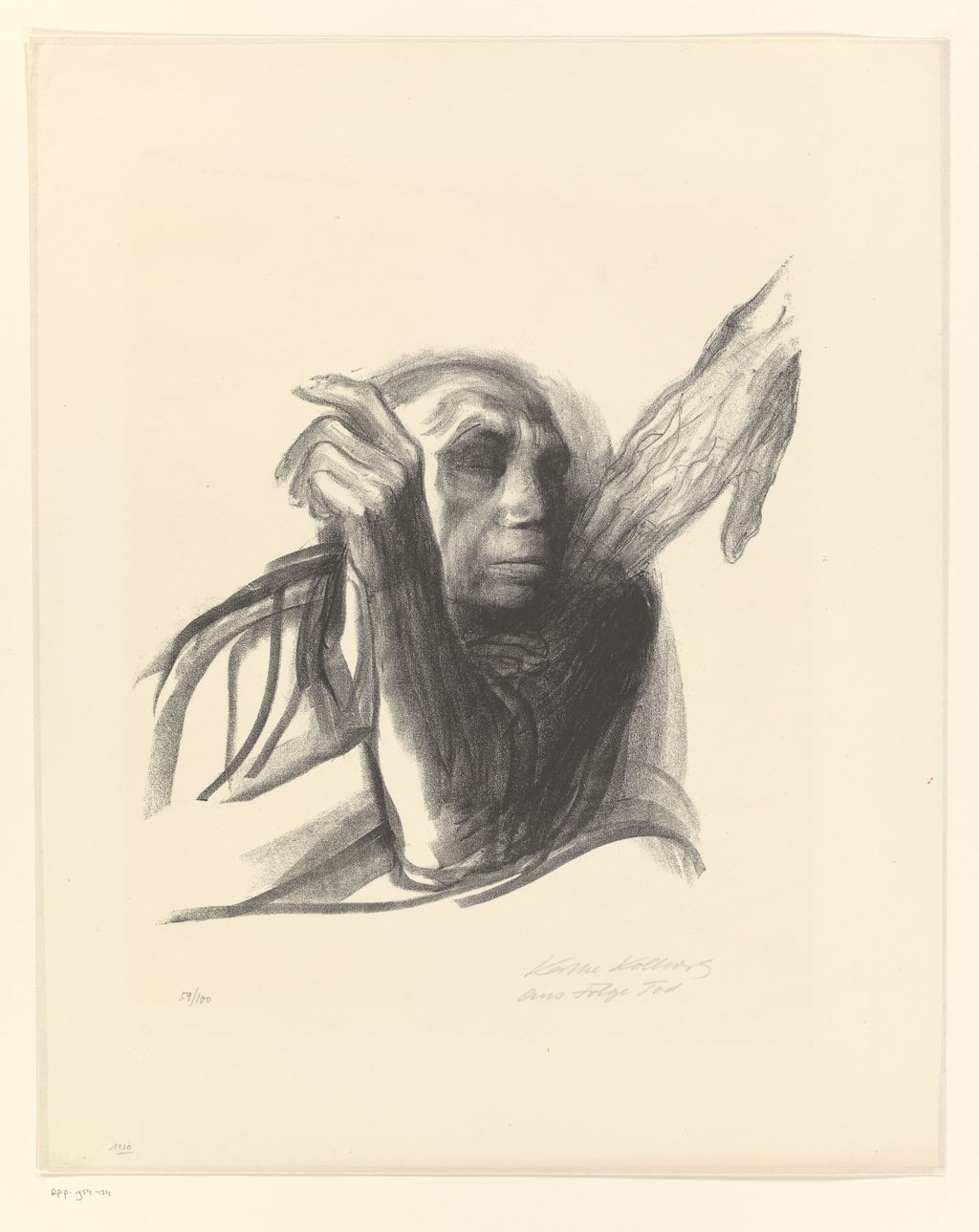
Käthe Kollwitz, Call of Death, sheet 8 of Death. Rijksmuseum, RP-P-1954-124, numbered 59/100. Image source. CC0 / Public domain. Resized and exported as JPEG.
Käthe Kollwitz artworks directory
Selected documented works, including the complete published sequences of the five cycles discussed here. Catalogue links identify the specific record behind each row.
Frequently Asked Questions
The Kollwitz Museum Köln counts more than 100 across different media. Its own collection holds more than 30. [1]
Discussion
Look again at the images and ideas explored in Käthe Kollwitz’s Self-Portraits. These editorial prompts invite your observations.
Reader Insights
How does Kollwitz use her hands to change the terms of a self-portrait?
What becomes more visible when a drawn self-portrait and a print are placed side by side?
Which self-portrait uses the largest contrast between the face and the surrounding paper?
Join the Conversation
Share a detail, comparison or question about Käthe Kollwitz’s Self-Portraits below.
References
- Kollwitz Museum Köln, Self-Portraits. View source.
- Kollwitz Museum Köln, Zeitstrahl 1867–1890, entry for Selbstbildnis mit aufgestütztem Kopf, NT 25, inventory 70200/96008. View source.
- Kollwitz Museum Köln, Selbstbildnis, 1924, Kn 203 IV and VI b, with brush study NT 1001. View source.
- Kollwitz Museum Köln, Call of Death, 1937, sheet 8 of Death, Kn 269 b, inventory 70300/02051. View source.
- Kollwitz Museum Köln, Selbstbildnis nach links, 1901, Kn 52 I, inventory 70300/91004. View source.
- Kollwitz Museum Köln, Selbstbildnis en face, 1904 (?), Kn 85 II A, inventory 70300/05006. View source.
- Staatliche Museen zu Berlin, Kupferstichkabinett, Selbstbildnis en face (2. Zustand), inventory 197-1911, with comparison to 110-1906. View source.
- Kollwitz Museum Köln, Selbstbildnis, 1889, NT 12, inventory 70200/00013. View source.
- The Museum of Modern Art, Käthe Kollwitz, 2024 exhibition checklist. View source.
- The Metropolitan Museum of Art, Self-Portrait, turned slightly to the left, c. 1893. View source.
- The Museum of Modern Art, Käthe Kollwitz, 2024 extended exhibition labels. View source.
- The Museum of Modern Art, Two Self-Portraits, 1892, exhibition audio transcript. View source.
- Kollwitz Museum Köln, Selbstbildnis en face mit rechter Hand, c. 1893–94, NT 168. View source.
- The Museum of Modern Art, Introduction to Käthe Kollwitz, exhibition audio transcript. View source.
- National Gallery of Art, Käthe Kollwitz, exhibition catalogue, entries 32, 39–40 and 89. View source.
- Kollwitz Museum Köln, Timeline 1901–1913. View source.
- The Museum of Modern Art, Self-Portrait en Face, c. 1904, state I/II, jointly owned with Neue Galerie New York. View source.
- Getty Research Institute, Dr. Richard A. Simms Collection of Prints and Drawings by Käthe Kollwitz and Other Artists, finding aid, 2016.PR.34. View source.
- National Museum of Western Art, Tokyo, Self-Portrait, 1915, Kn 134 c, G.2020-0174. View source.
- The Museum of Modern Art, Small Self-Portrait, 1919, object record. View source.
- The Museum of Modern Art, Small Self-Portrait, exhibition audio transcript. View source.
- Kollwitz Museum Köln, Selbstbildnis, 1924, Kn 209 b, with charcoal drawing NT 988. View source.
- National Gallery of Art, Self-Portrait, 1924, transfer sheet, accession 1954.12.34. View source.
- Staatliche Kunstsammlungen Dresden, Kollwitz correspondence, Archiv SKD 01/KK 04 Bd. 26, nos. 340–342. View source.
- Contemporary Art Society, Self Portrait (1924), British Museum accession 1930,0111.41. View source.
- British Museum, Portrait of the Artist: Käthe Kollwitz, exhibition press release. View source.
- Ikon Gallery, Portrait of the Artist: Käthe Kollwitz, Birmingham exhibition press material and London exhibition page. View source 1. View source 2.
- Musées de la Ville de Strasbourg, Käthe Kollwitz. « Je veux agir dans ce temps », exhibition dossier. View source.
- Kollwitz Museum Köln, Self-Portrait, model 1926–36, bronze cast 1937–39, Seeler 26 I.B.3, inventory 70100/16002. View source.
- The Museum of Modern Art, 20th Century Portraits, p. 73. View source.
- The Museum of Modern Art, Self-Portrait, 1934, lithograph. View source.
- Los Angeles County Museum of Art, Self-Portrait Facing Forward, 1934, charcoal, and The Museum of Modern Art, exhibition audio transcript. View source 1. View source 2.
- Kollwitz Museum Köln, Selbstbildnis im Profil nach rechts, 1938 (?), Kn 273 III b, inventory 70300/89001. View source.
- The Museum of Modern Art, Call of Death, exhibition audio transcript. View source.
More KOLLWITZ Works
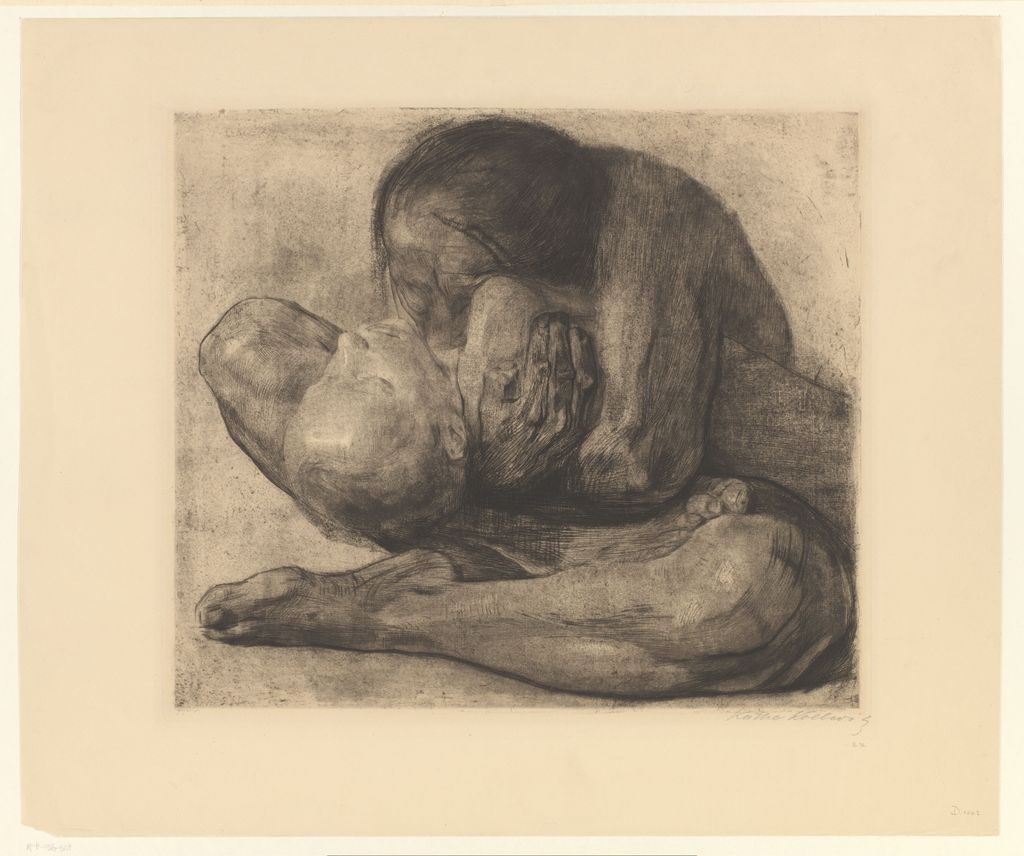
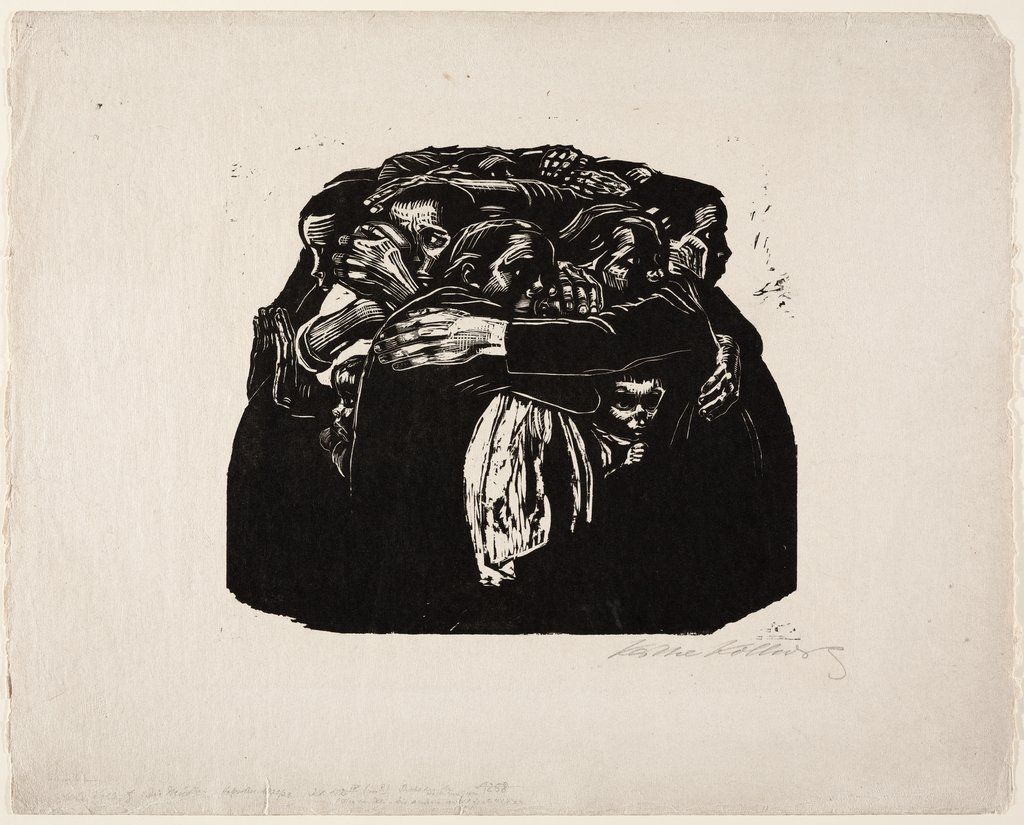
The Mothers
The Mothers, 1921–22. Städel Museum, Frankfurt am Main, SG 4289A D. Image source. Public domain. Resized and exported as JPEG.
The Grieving Parents
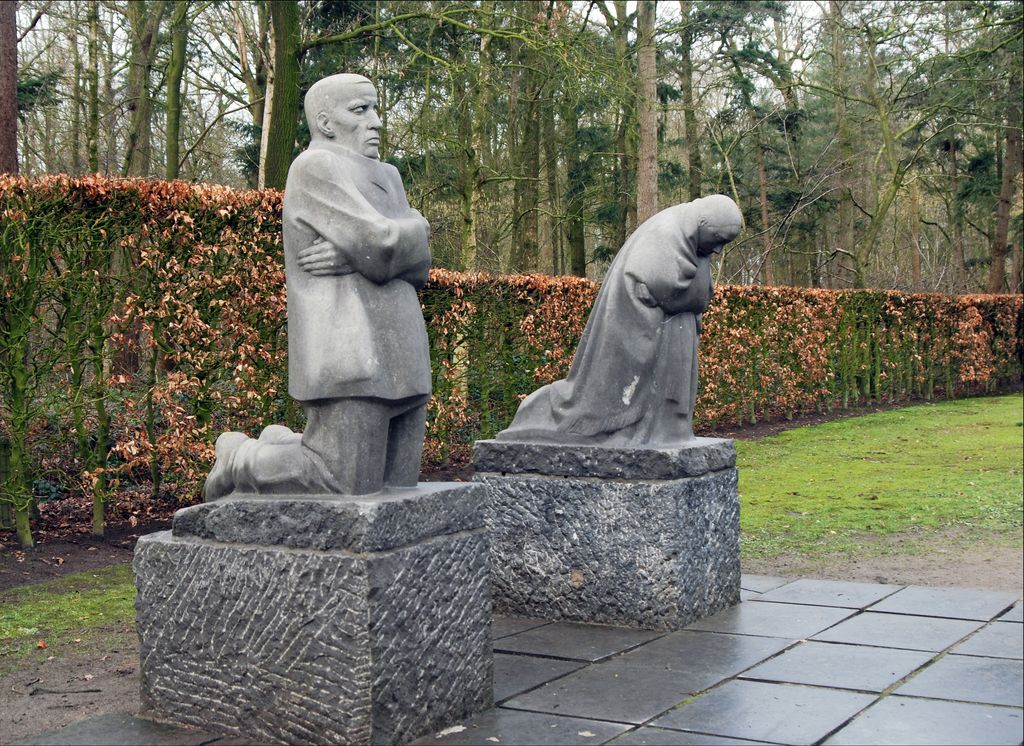
The Grieving Parents at Vladslo, the memorial’s location since 1956. Photograph by Bva, resized. Image source. CC BY-SA 3.0. Resized and exported as JPEG.
Memorial for Karl Liebknecht
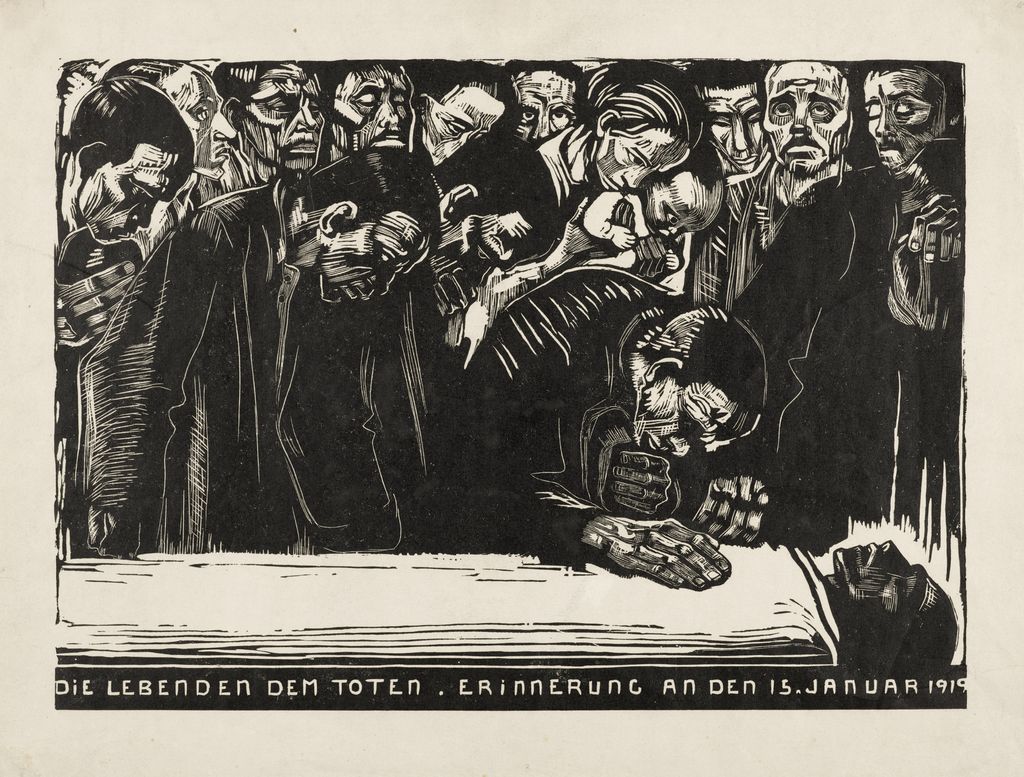
Memorial for Karl Liebknecht, 1920. Kunstsammlungen Chemnitz, 86-47, Kn 159 VI. Photo: Kunstsammlungen Chemnitz/PUNCTUM/Bertram Kober. Image source. Public domain. Resized and exported as JPEG.