


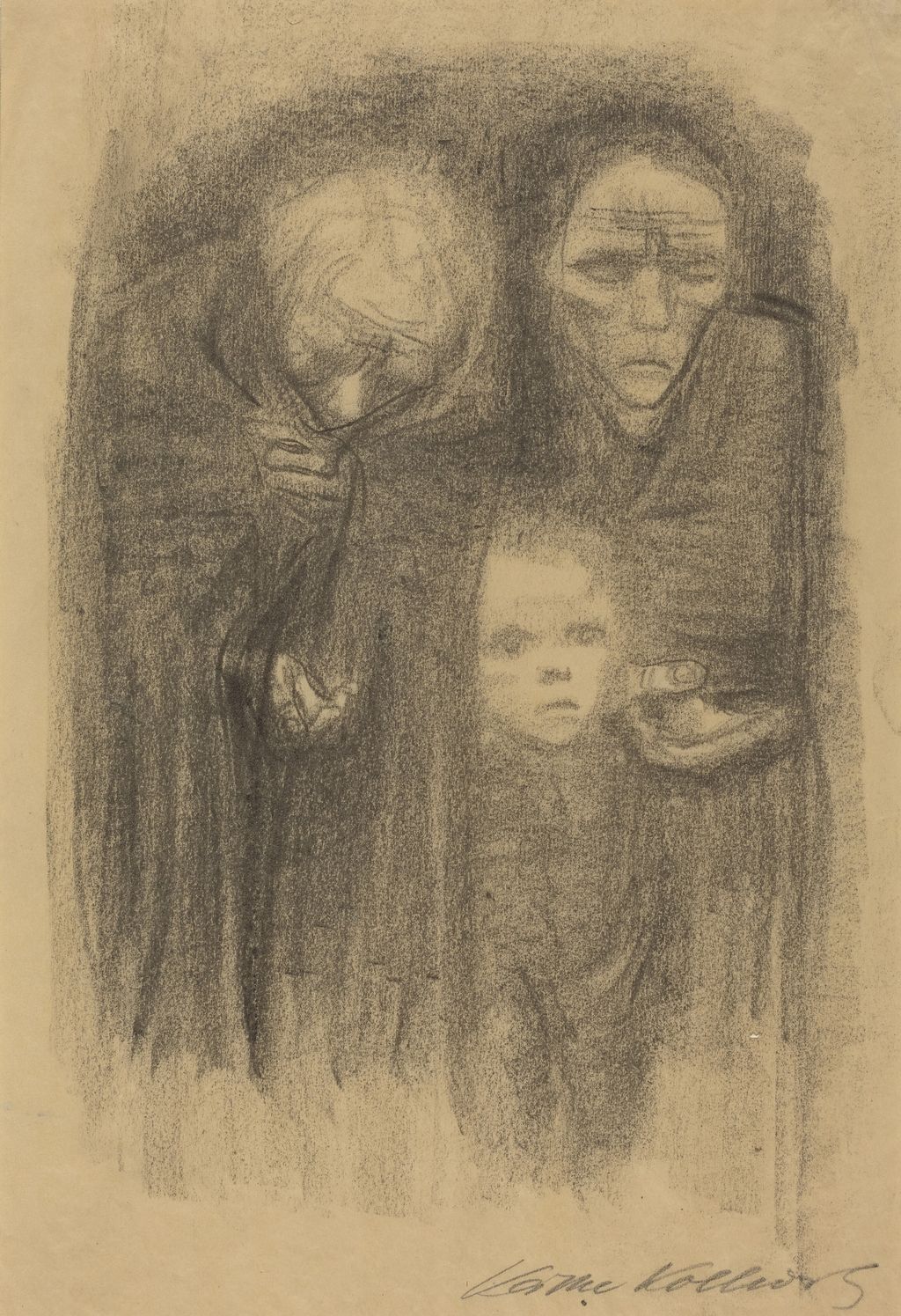
Beggars, 1924. National Gallery of Art, 1943.3.5219. National Gallery of Art, Washington. Image source. Public domain. Resized and exported as JPEG.
 by Tom Gurney
Tom Gurney BSc (Hons) is an art history expert with over 20 years experience
Email: tomgurney1@gmail.com / Phone: +44 7429 011000
Käthe Kollwitz and Social Criticism: Introduction
In Käthe Kollwitz’s 1909 drawing Out of Work, a man sits with his chin sunk into his fists. Behind him, two children sleep against a reclining woman. Kollwitz wrote Arbeitslosigkeit (Unemployment) on the sheet. When the Munich satirical weekly Simplicissimus published a simplified drawn version of the composition, the editors called it Das einzige Glück (The Only Good Fortune) and added a bitter joke about the state’s need for soldiers. The drawing directs attention to a household. The caption asks what value the state places on its children. [1] [2] [3]
That change of title was one of several ways a picture could acquire a different meaning in public. A drawing of people gathered out of the cold faced a banquet across a magazine spread. A pregnant woman at a door occupied an entire page with only a series heading and a Roman numeral. The seated man from Das einzige Glück reappeared in an intaglio print developed from another drawing. The bench, the bed and the closed door made the pressures of city life visible at close quarters. Where those images appeared, and what readers saw beside or beneath them, helped determine how those pressures could be understood. [2] [4] [5] [3]
At a Glance
- SettingWorking-class Berlin, where Kollwitz and her husband Karl, a doctor, lived and worked from 1891. [6] [7]
- PublicationKollwitz began contributing to the Munich weekly Simplicissimus in 1908. The editors supplied titles and captions for some contributions. Her six-part Bilder vom Elend (Images of Misery) appeared on full pages without editorial punchlines. [2] [7] [8]
- Key worksDie Straße (The Street), Wärmehallen (Warm Shelter), Beim Arzt (At the Doctor’s) and the distinct drawings and intaglio print titled Arbeitslosigkeit. [1] [9] [4] [5] [10] [11] [3]
- Later workErwerbslos (Unemployed) opens the three-woodcut series Proletariat, made in 1924–25 and published in 1926. [12] [13]
Contents
- The working city at close quarters
- A park bench and a room out of the cold
- At the Doctor’s and the space of a full page
- Unemployment in chalk, on the page and on the plate
- From the magazine to the public appeal
- Unemployment after the war
The working city at close quarters
In 1891 Käthe and Karl Kollwitz moved into Weißenburger Straße 25 in Prenzlauer Berg. Their flat housed Karl’s medical practice and initially provided Käthe’s working space. Her inscription on the back of the Washington Out of Work drawing gives her name, Berlin and the street number. The address belongs to the history of the sheet itself. It places the artist’s work in the same building where people came to seek medical care. Cologne’s chronology also records diary entries from around 1908 about visits to some of Karl’s patients. [1] [6] [14]
Looking back in 1941, Kollwitz recalled how much she had learnt through her husband about the hardships of working people. She singled out prostitution and unemployment as problems that continued to trouble her. The practice helps explain her knowledge of the difficulties faced by pregnant working women, which Cologne relates to At the Doctor’s. The drawing leaves the woman unnamed and the consultation beyond the door. What Kollwitz makes available to the viewer is the moment of asking for help. [7] [5]
Her earlier print cycles Ein Weberaufstand (A Weavers’ Revolt) and Bauernkrieg (Peasants’ War) had approached labour and exploitation through a play and through historical revolt. In the weekly, the lives of contemporary workers could furnish the entire subject. There was no uprising for the scene to lead towards. A woman falling asleep over paid work or waiting for an answer at a door could carry a page. The Strasbourg retrospective placed this change at the centre of its section on social criticism, between the earlier print cycles and later work. The shift is also visible in the timeline of Kollwitz’s life and work, where her contributions to the magazine overlap with the completion of Peasants’ War. [7] [14] [15] [16]
In a letter to her friend Beate Bonus-Jeep, Kollwitz explained the appeal of working for Simplicissimus. The pace obliged her to finish quickly, and the magazine gave her access to a large audience for the everyday tragedies she saw in the city. In the same letter, she acknowledged an awkward consequence. Her work brought the weekly into her own household, where she sometimes wished to withhold it from her children because of material elsewhere in the issue. The tension mattered to anyone opening the magazine. Kollwitz could choose her subject and design the image, while the editors and other contributors helped create the setting in which it was read. [2] [7] [14]
Getty and MoMA count fourteen works published in Simplicissimus from 1908 to 1911. The Käthe-Kollwitz-Museum Berlin counted sixteen across the longer period from 1908 to 1924 for its 2023 exhibition on the collaboration. The six Images of Misery formed a distinct project within that history, with a recurring heading and a page format of their own. [8] [17] [18]
A park bench and a room out of the cold
Cologne’s Die Straße (The Street, 1908) is a charcoal and ink drawing on laid paper, 35 × 31.5 cm. A variant appeared in Simplicissimus on 28 December 1908 as Jahreswende (Turn of the Year). Two men have fallen asleep on a bench after drinking, and a woman remains awake beside them. The caption gives her a voice. She says she will let her husband sleep instead of waking him to wish him a happy New Year. The words supply both a relationship and an occasion. The bench supplies the difficulty. An ordinary gesture of consideration between spouses takes place in a public space where the men have settled for the night. [2] [9]
The issue date makes the difference between the drawing’s title and the magazine’s title especially clear. The Street names a place, while Turn of the Year asks the reader to measure what happens there against a celebration familiar from home. Kollwitz returned to the bench in a contribution published as Nachtasyl (Night Shelter) on 16 January 1911. Here the editors played on the German word Bank, which can mean a bench or a bank, by giving the woman the voice of a porter demanding a small payment. A seat that people use for shelter is momentarily recast as the entrance to a financial institution. The two captions take the same piece of street furniture in different directions. [2] [9]
Wärmehallen (Warm Shelter, 1908–09) moves the encounter indoors. The Cologne museum identifies the setting as a warming hall, one of the daytime refuges where people could spend a few hours out of the cold and sometimes obtain a free or inexpensive hot drink or meal. Separate shelters offered accommodation at night. The drawing’s title points to a service that addressed an immediate bodily need. It also suggests how much of the day a person without work or a heated room might spend simply trying to stay warm. [4]
The Cologne sheet measures 42.2 × 38.9 cm. Kollwitz used black chalk, ink and sepia on olive-green paper and heightened the background with white. Cologne links the strong areas of ink to a new printing process used by the weekly. The contrast helps hold the figures together in reproduction, where the olive colour of the original sheet no longer does the same work. The printed page gives the scene a different title again. In volume 13, no. 48, dated 1 March 1909, it appears on page 814 as Mißtrauen (Distrust). Its caption imagines that God must own shares in a coal mine, given how bitterly cold it is. The joke asks who might profit from the cold that the figures endure. [2] [4]
Jörg Traeger reads the published figures as miners on a meal break. Cologne’s identification of the drawing as a warming hall and Traeger’s reading of the reproduction give different accounts of the scene. The caption explicitly introduces coal mining, though the figures’ occupations remain open to interpretation. Across the fold, on page 815, Ernst Heilemann’s Festmahl (Banquet) shows a smartly dressed party raising champagne glasses. The same issue’s cover carries Thomas Theodor Heine’s Grubenbesitzer (Mine Owner). Readers who turned from the cover to the interior spread encountered the coal trade again, then a party whose warmth and sociability throw the huddled group into relief. That sequence belongs to the issue, even when the drawing is exhibited on its own. [2] [4]
At the Doctor’s and the space of a full page
Kollwitz proposed Bilder vom Elend herself. Its six instalments ran from 1 November 1909 to 24 January 1910. Getty identifies the opening work by its subject title, Heimarbeit (Home Work), and locates it on page 515 of volume 14, no. 31. The original page carries the series heading, the Roman numeral I and Kollwitz’s name. The individual title identifies the subject in collections and exhibition records. The heading is what a reader of the weekly saw repeated as each new instalment appeared. This was a different arrangement from the one that gave Arbeitslosigkeit the new title Das einzige Glück and a line of satirical dialogue. [2] [8] [17] [15]
In Heimarbeit, a woman has fallen asleep at the table beside her sleeping child. Her head and working hands lie close together on the surface where she has been labouring. The lamplight puts paid work in the hours when the child can sleep and the woman can still use the table. The picture asks the reader to recognise exhaustion through the interruption of a task. The subject had already appeared in another public form. In 1906 Kollwitz made a poster for the Deutsche Heimarbeit-Ausstellung (German Home Work Exhibition) in Berlin, centring it on an exhausted worker. The Berlin museum traces her return to the conditions of women working at home in 1925. Across those appearances, the household was also a workplace, and the cost of the work could be read in the worker’s body. [2] [17] [19] [20]
In the third instalment, published on 29 November 1909, a pregnant woman raises her hand to knock at a door. Cologne holds the drawing as Beim Arzt (At the Doctor’s), NT 475. Its black chalk marks occupy an Ingres laid sheet 70.7 × 56 cm, more than twice the height of the surviving drawing of The Street. The action it contains is small and unfinished. The woman has come far enough to raise her hand, but the viewer has yet to see anyone receive her. The large sheet gives weight to this brief pause. The full magazine page, headed Bilder vom Elend III, gives the reader time to register it before turning the page. [2] [9] [5]
The instalments around At the Doctor’s make its threshold part of a wider sequence. In the second, a mother and child stand outside a tavern where a drunken man can be seen through the open door. In the fourth, a woman clutches her children as she descends stone steps into water. The fifth brings the threat of a drunken man into a room where a woman crouches behind a bed. The sixth shows a heavily pregnant woman feeling her way along a fence with two children. The sequence moves between the street, the home and the edge of the water. Repeated figures of mothers and children give it continuity, while each setting brings a different pressure into view. [2] [5]
The space around a full-page image still mattered. Traeger records that Heimarbeit faced a page carrying aphorisms by Karl Kraus, the last of which makes a cutting comparison between public expressions of humanity and the work of a laundress. He also reproduces the opening on which the second instalment faces Brynolf Wennerberg’s Die Braut (The Bride). One could read the numbered series over several months, or encounter a single instalment opposite a very different image of womanhood. The absence of an editorial punchline gave each scene room to be read on its own. The surrounding pages remained part of the reader’s experience. [2]
Unemployment in chalk, on the page and on the plate
The Washington Out of Work drawing measures 29 × 44.4 cm. Kollwitz used black chalk and opaque white watercolour over blue pencil on grey-brown wove paper. The man’s coat and head form a dark weight low at the left. White brings forward the bedding and the clothing of the figures behind him, while the brown paper remains visible between the worked areas. The children rest against the woman, and the man’s bent head sets him apart even though he is close enough to touch them. Unemployment has entered the home. Its consequences are distributed across the group, whose members sleep, lie still or sit awake. [1]
In volume 14, no. 16, dated 19 July 1909, Simplicissimus published the simplified drawn version on page 267 as Das einzige Glück. Its caption suggests that the authorities would tax people’s children as well if they did not need them as soldiers. With that line, the children appear in two different economies. In the room they depend on the adults. To the authorities imagined by the caption, they are future recruits. The graphic form can remain concentrated on the family while the words introduce a relation between the household and the state. [2] [3]
Kollwitz also developed Arbeitslosigkeit as an intaglio print in 1909. The Städel Museum’s preparatory charcoal drawing, SG 358 Z, supplied the basis for the print. The Berlin Kupferstichkabinett identifies the seated man in the foreground as the motif carried over from the composition published in Simplicissimus. Berlin’s first-state proof, 233-1912, has corrections marked on the sheet. Kollwitz moved a bedpost to the left in the next state, and the annotation Ton points to tonal work subsequently added to the background. The post is a small change with a compositional purpose. It changes where the bed is bounded and how the figures sit within that enclosure. The magazine version and the preparatory drawing each contributed something different to a print that continued to change on the plate. [10] [21] [3]
The Städel’s impression SG 386 D, acquired in 1913, makes the difference between a magazine page and an individually printed sheet tangible. Its image measures 39.5 × 53 cm on a sheet measuring 49.1 × 72.2 cm. The museum records brown ink, line etching, drypoint, aquatint, abrasive work and soft-ground texture transferred using Ziegler paper. Kollwitz signed beneath the image on the right. The printer, O. Felsing of Berlin, signed on the left. Her signature identifies the artist, while Felsing’s records the specialist work of printing the plate. The paper around the image holds those signatures where the magazine page carries its heading and caption. [11] [22]
The 2024 MoMA checklist gives another way to follow these distinctions. Page 22 lists the 1909 issue containing Heimarbeit. Page 23 lists the Washington Arbeitslosigkeit drawing and an intaglio impression of the same title from the Ute Kahl Collection. The Städel’s brown-ink sheet is a separate impression. The checklist thus lets a reader trace three kinds of object across adjoining pages, a printed magazine, an original drawing and an impression pulled from a worked plate. Their proximity recovers some of the comparison that disappears when all three are reproduced at the same size. [1] [11] [15]
For a closer look at how she developed compositions on paper, see Käthe Kollwitz’s Drawings. The relationship between the doctor’s practice, the studio and the neighbourhood is traced in Käthe Kollwitz in Berlin.
From the magazine to the public appeal
The magazine page was one route from a small domestic scene to public debate. The street poster could ask for a more immediate response. In Für Groß Berlin (For Greater Berlin, 1912), a girl holds a younger child in a courtyard beside a sign forbidding play there and on the stairs. The poster announces a meeting on housing conditions. Its lettering gives the courtyard a municipal context by citing crowded rooms and the lack of places to play. Cologne records that Berlin’s police president had the poster removed on the grounds that it incited class hatred. The encounter at the door in At the Doctor’s leaves the viewer to consider what help the woman might find. Here the organisers name a problem and tell passers-by where it can be discussed. [5] [23]
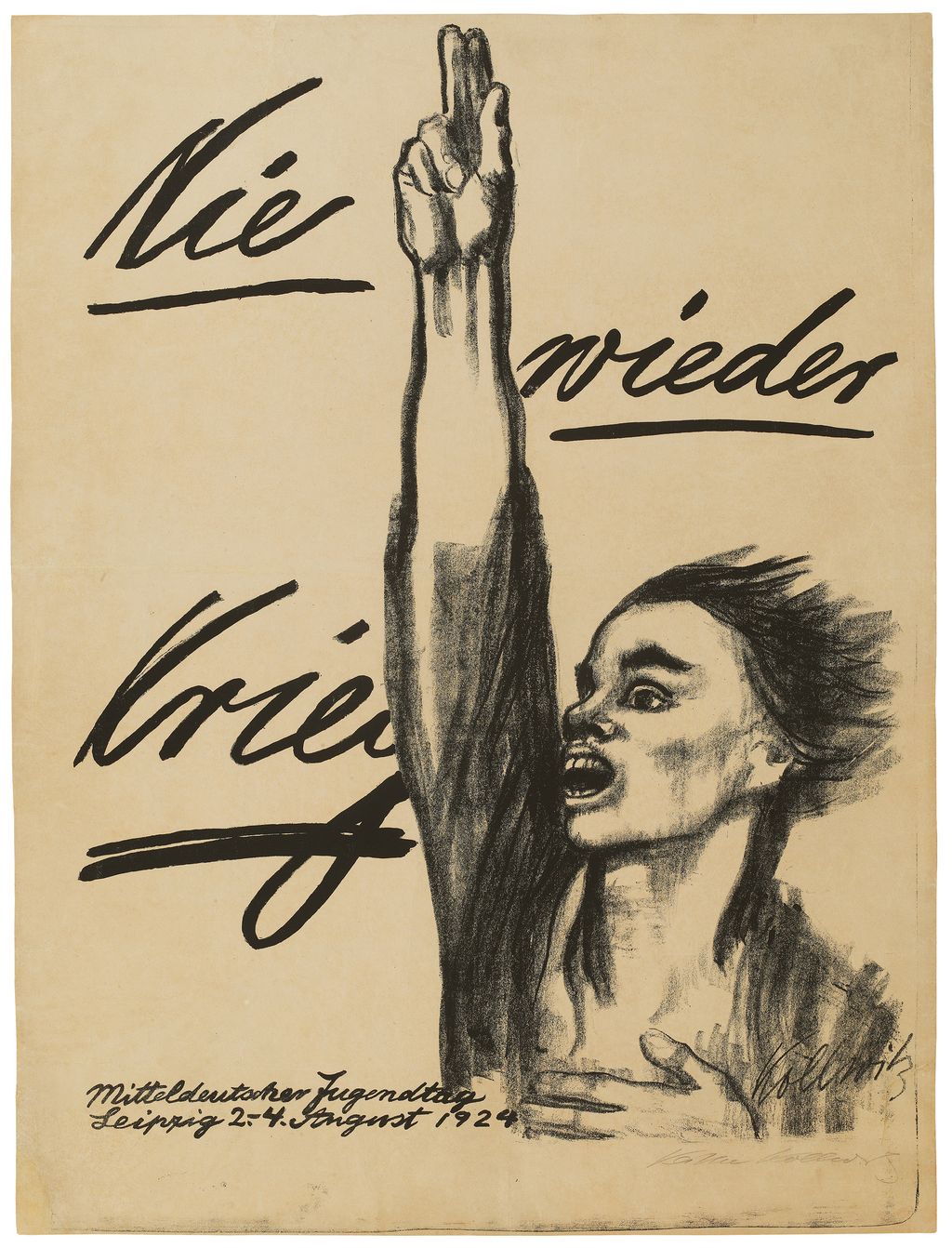
The 1923 campaign poster against Paragraph 218, Germany’s criminal prohibition of abortion, makes the difference in address sharper still. At the Doctor’s presents a pregnant woman waiting for a response in private. The poster uses a related subject to demand a change in the law, with the demand set out in the lettering. Both images bring the effects of unwanted pregnancy into public view. The magazine reader has to interpret the pause at the door, while the campaign’s intended audience is asked to take a position. Kollwitz’s Posters follow that use of image and lettering across housing, relief and political campaigns. [5] [15] [18]
In the 1924 lithograph Brot! (Bread!), the word written into the image names what two children need from the woman they press against. The print appeared in Hunger, a seven-lithograph portfolio issued for International Workers’ Aid on the tenth anniversary of the outbreak of the First World War. Its sales were intended to benefit artists’ relief and the organisation’s children’s homes. The sheet places the demand within the family group, while the circumstances of publication give the purchaser a way to respond. It brings together the intimate scale of the magazine scenes and a specific use for the proceeds. [24]
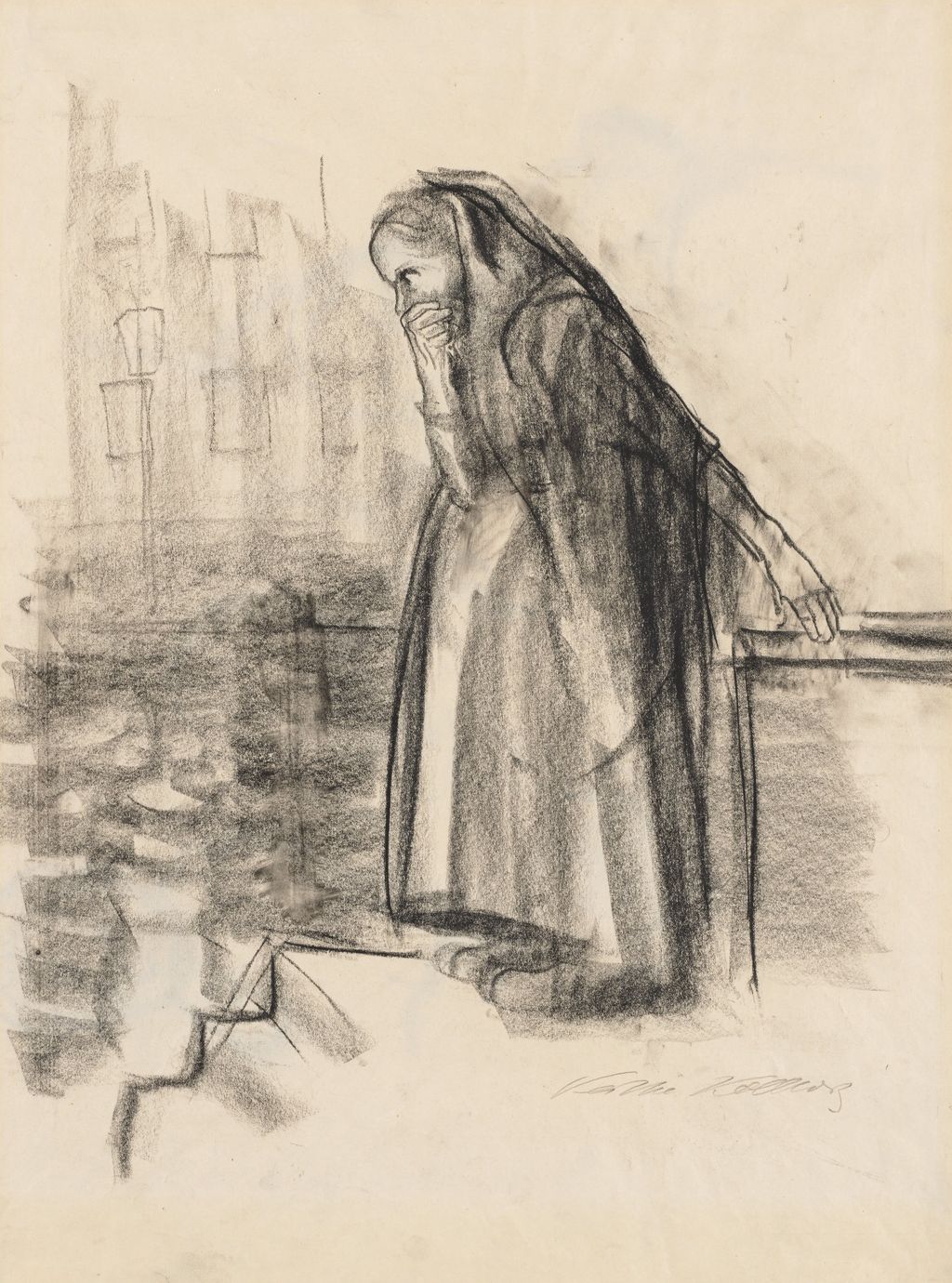
Pregnant Woman Contemplating Suicide (recto), c. 1926. Cleveland Museum of Art, 1962.291.a. Image source. CC0 / Public domain. Resized and exported as JPEG.
Unemployment after the war
Kollwitz returned to unemployment in Erwerbslos (Unemployed), the opening woodcut of Proletariat. The series was made in 1924–25 and issued by Emil Richter in Dresden in 1926 in an edition of 100. The Städel holds set 22, printed on Japanese paper. The Berlin print room holds an unnumbered proof of the opening sheet, with a printed block measuring 36 × 30 cm. The titles establish the order in which the three sheets can be read, from Erwerbslos through Hunger to Kindersterben (Child Mortality). [12] [13] [25]
In the woodcut, faces and a hand emerge in angular white cuts against black. The hand raised towards a face recalls the seated man in the 1909 composition. The room, which Kollwitz had worked out carefully enough to mark the position of a bedpost on an intaglio proof, is harder to recover here. The compact group carries the image. Seen beside the next two prints, it also carries the beginning of a sequence in which lost earnings, hunger and the deaths of children can be understood as connected pressures. The order gives the portfolio a way to argue across sheets, just as the weekly could make an argument across a spread. [1] [12] [13] [3] [25]
The history of how viewers encountered this work extends beyond the original publications. In Paris, the Institut national d’histoire de l’art preserves Max Lehrs’s 1911 correspondence with Jacques Doucet and records from the Dresden dealers Ernst Arnold and Emil Richter. Lehrs offered to select impressions because they were difficult to obtain in Paris. INHA also transcribes Noël Clément-Janin’s response in the Gazette des Beaux-Arts to the earlier Carmagnole and Weavers prints. His attention to etched grain and varnish shows how a periodical could direct its readers towards the physical handling of impressions, just as Simplicissimus had used text to direct its readers’ attention towards the people in a scene. In Britain, the British Museum traces much of its Kollwitz collection to Campbell Dodgson, whose contacts included Lehrs, whose purchases began before the First World War and whose bequest reached the museum in 1948. [26] [27]
Those routes into collections made different comparisons possible. Strasbourg’s 2019–20 exhibition gave the turn towards contemporary urban subjects a room of its own. The British Museum’s Portrait of the Artist presented Kollwitz’s social concerns within a selection drawn substantially from its own holdings. MoMA’s 2024 checklist lets a reader set a copy of the weekly beside the original drawings and intaglio. On the page of Simplicissimus, two sleeping children could lead a reader to think about future soldiers. In Proletariat, the order of three sheets leads from the loss of work to the survival of children. What the reader sees next is part of how each work makes its case. [12] [13] [15] [16] [27] [28]
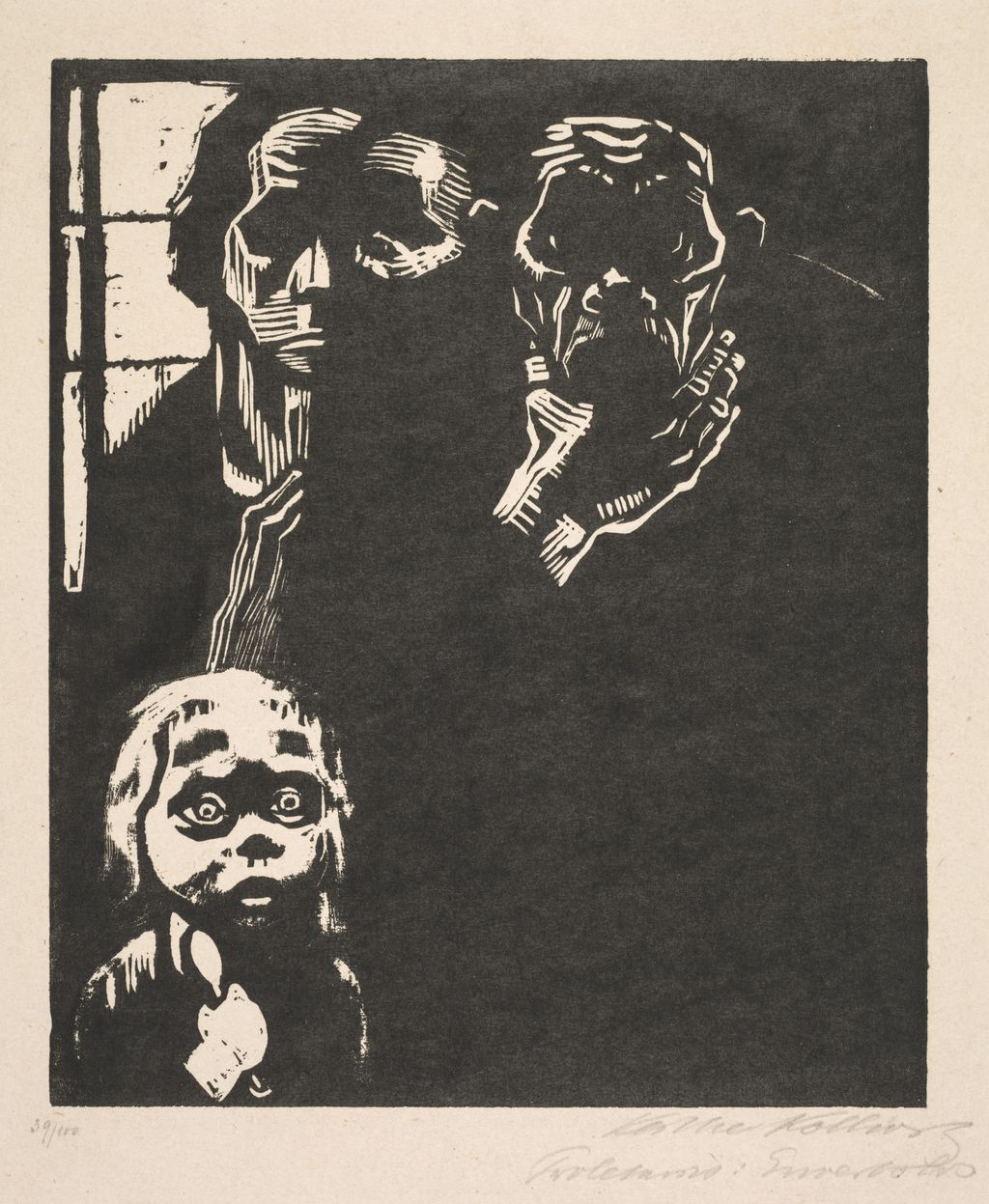
Out of Work, sheet 1 of Proletariat. Cleveland Museum of Art, 1950.206. Image source. CC0 / Public domain. Resized and exported as JPEG.
Käthe Kollwitz artworks directory
Selected documented works, including the complete published sequences of the five cycles discussed here. Catalogue links identify the specific record behind each row.
Frequently Asked Questions
Kollwitz chose her subjects and designed the images. The editors supplied titles and captions for some contributions, including Das einzige Glück, Mißtrauen and Jahreswende. The six works she conceived as Bilder vom Elend appeared under the series heading with Roman numerals and her name, without editorial punchlines. Museum and exhibition records use individual subject titles such as Heimarbeit and Beim Arzt to identify the drawings. [2] [7] [8] [5] [17]
The German title, date and medium identify the work. Arbeitslosigkeit is the title Kollwitz inscribed on the 1909 Washington drawing also known as Out of Work. It also identifies the separate preparatory drawing in Frankfurt and the related 1909 intaglio. Das einzige Glück is the title of the simplified drawn version published by Simplicissimus. Erwerbslos identifies the later woodcut that opens Proletariat. [1] [2] [10] [11] [12] [13] [3]
Discussion
Look again at the images and ideas explored in Käthe Kollwitz and Social Criticism. These editorial prompts invite your observations.
Reader Insights
How does a caption supplied by a magazine change the way you read a drawing?
What becomes more visible when a scene of unemployment moves from a weekly magazine to a woodcut portfolio?
How does a printed caption redirect attention away from the detail that first catches your eye?
Join the Conversation
Share a detail, comparison or question about Käthe Kollwitz and Social Criticism below.
References
- National Gallery of Art, Washington, Out of Work, 1909, accession 1943.3.5218, including recto and verso inscriptions View source.
- Jörg Traeger, Bilder vom Elend. Käthe Kollwitz im Simplicissimus, Bavarian Academy of Sciences and Humanities, 1998, no. 3. See pp. 4–5 and figs. 1–6 for the six instalments, pp. 9–10 and figs. 17–19 for vol. 13, no. 48, including pp. 814–15, pp. 12–13 and figs. 24–26 for Jahreswende, Nachtasyl and Das einzige Glück, fig. 13 for the spread with Die Braut, and pp. 29–30 for the letter to Beate Bonus-Jeep. View source.
- Staatliche Museen zu Berlin, Kupferstichkabinett, Arbeitslosigkeit, first-state proof 233-1912, citing Sigrid Achenbach, 1995, p. 88, cat. 96. The record locates Das einzige Glück in Simplicissimus, vol. 14, no. 16, 19 July 1909, p. 267. View source.
- Kollwitz Museum Köln, Wärmehallen, 1908–09, NT 469a, with the warming-hall context and publication history View source.
- Kollwitz Museum Köln, Beim Arzt, third sheet of Bilder vom Elend, 1908–09, NT 475, inv. 70200/86002 View source.
- Käthe-Kollwitz-Museum Berlin, Käthe Kollwitz in Berlin, section on the family home and medical practice View source.
- Kollwitz Museum Köln, Sozialkritik, including Kollwitz’s 1941 retrospective account View source.
- Käthe-Kollwitz-Museum Berlin, Käthe Kollwitz und der Simplicissimus, exhibition release, 31 October 2023, p. 1 View source.
- Kollwitz Museum Köln, Die Straße, 1908, NT 464, inv. 70200/07001 View source.
- Städel Museum, Arbeitslosigkeit, 1909, preparatory charcoal drawing SG 358 Z View source.
- Städel Museum, Arbeitslosigkeit, 1909, intaglio impression SG 386 D, including printer and inscriptions View source.
- Staatliche Museen zu Berlin, Kupferstichkabinett, Erwerbslos, first sheet of Proletariat, proof 362-1927 View source.
- Städel Museum, Proletariat, 1924–25, set 22 of 100, Kn 215, 216 and 222 View source.
- Kollwitz Museum Köln, Zeitstrahl 1901–1913, entries on the magazine collaboration, Kollwitz’s letter to Beate Bonus-Jeep and the completion of Bauernkrieg View source.
- Museum of Modern Art, Käthe Kollwitz Exhibition Checklist, 2024, pp. 22–23 for Simplicissimus, Heimarbeit and Arbeitslosigkeit, and p. 32 for the Paragraph 218 poster View source.
- Musée d’Art moderne et contemporain de Strasbourg, Käthe Kollwitz. Je veux agir dans ce temps, 2019–20 exhibition dossier, p. 6, “Salle 4” View source.
- Getty Research Institute, study of Kollwitz’s Images of Misery, including the original Simplicissimus reproduction of Bilder vom Elend I, vol. 14, no. 31, 1 November 1909, p. 515, Getty 85-S1389 View source.
- Museum of Modern Art, Käthe Kollwitz extended labels, 2024, entries for Home Worker and the campaign against Paragraph 218 View source.
- Kollwitz Museum Köln, poster for the Deutsche Heimarbeit-Ausstellung Berlin 1906, Kn 95 III, inv. 70300/88003 View source.
- Käthe-Kollwitz-Museum Berlin, 100 Jahre Groß-Berlin, exhibition account of home workers’ conditions and Kollwitz’s work in 1906 and 1925 View source.
- National Gallery of Art, Washington, Käthe Kollwitz, exhibition catalogue, entry 65 View source.
- Kollwitz Museum Köln, Zeitstrahl 1891–1900, entry on the Felsing print workshop View source.
- Kollwitz Museum Köln, Für Groß Berlin, 1912, Kn 122 I, inv. 70300/88003, with the poster’s wording and account of its removal View source.
- Kunstsammlungen Chemnitz, Brot! (Bread!), 1924, Kn 208 III, and its publication in the Hunger portfolio View source.
- National Gallery of Art, Washington, Unemployment (Erwerbslos), 1925 View source.
- Institut national d’histoire de l’art, Käthe Kollwitz (1867–1945), 2/2, including the Lehrs–Doucet letters of 1911 in the Archives Clément-Janin and the transcription of Clément-Janin’s Gazette des Beaux-Arts criticism View source.
- British Museum, Portrait of the Artist: Käthe Kollwitz, 2019 exhibition release, section on Campbell Dodgson’s purchases and bequest View source.
- Ikon, Portrait of the Artist: Käthe Kollwitz at the British Museum, London, exhibition record, 2019–20 View source.
More KOLLWITZ Works
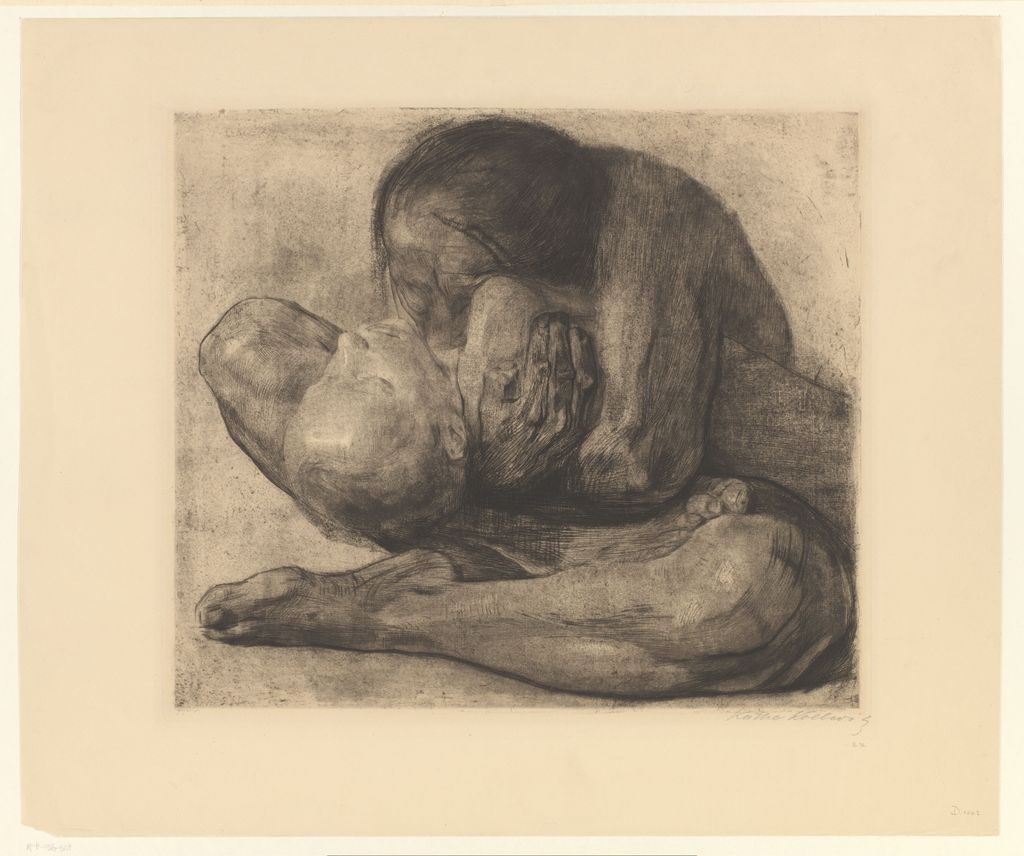
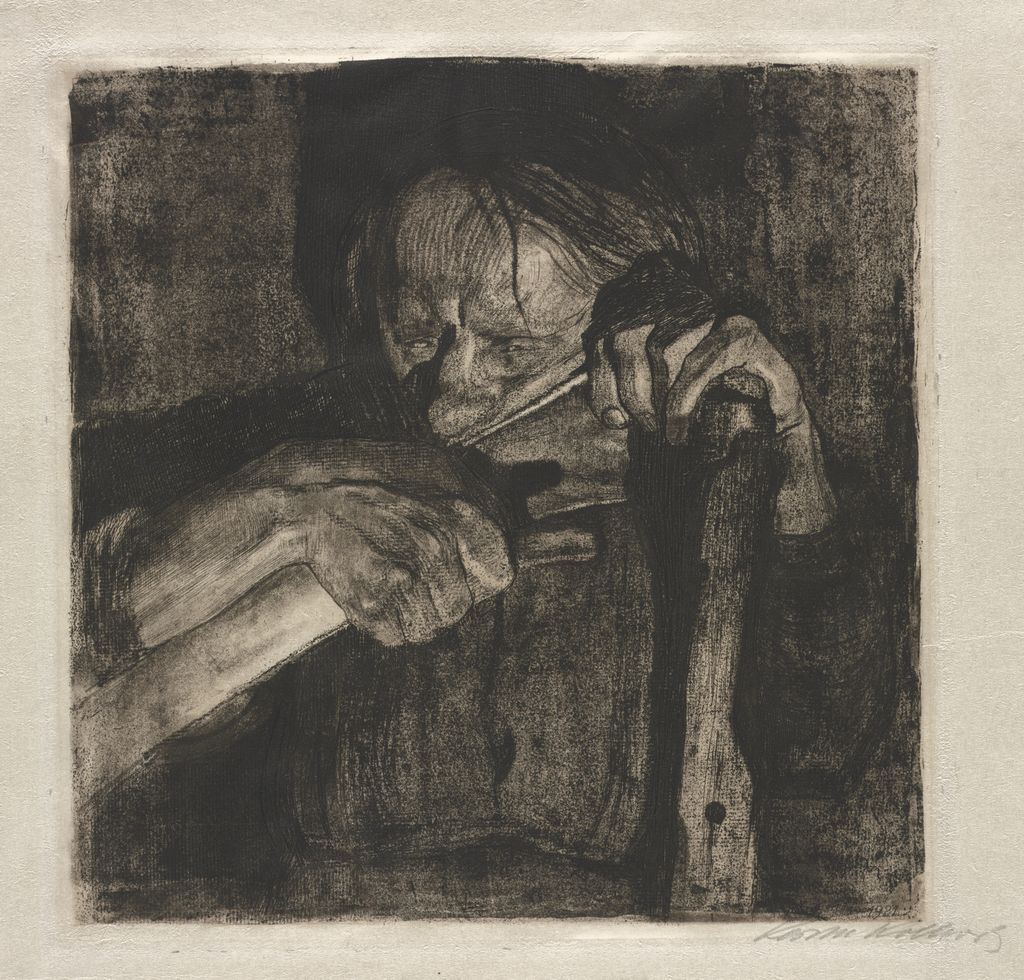
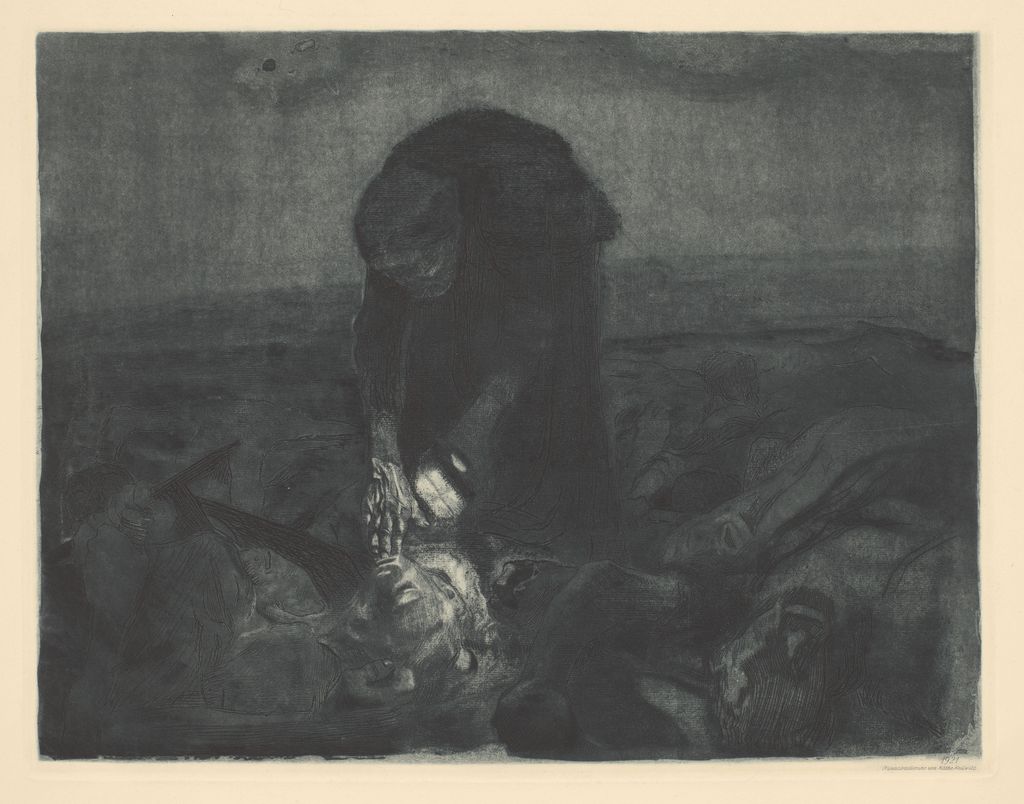
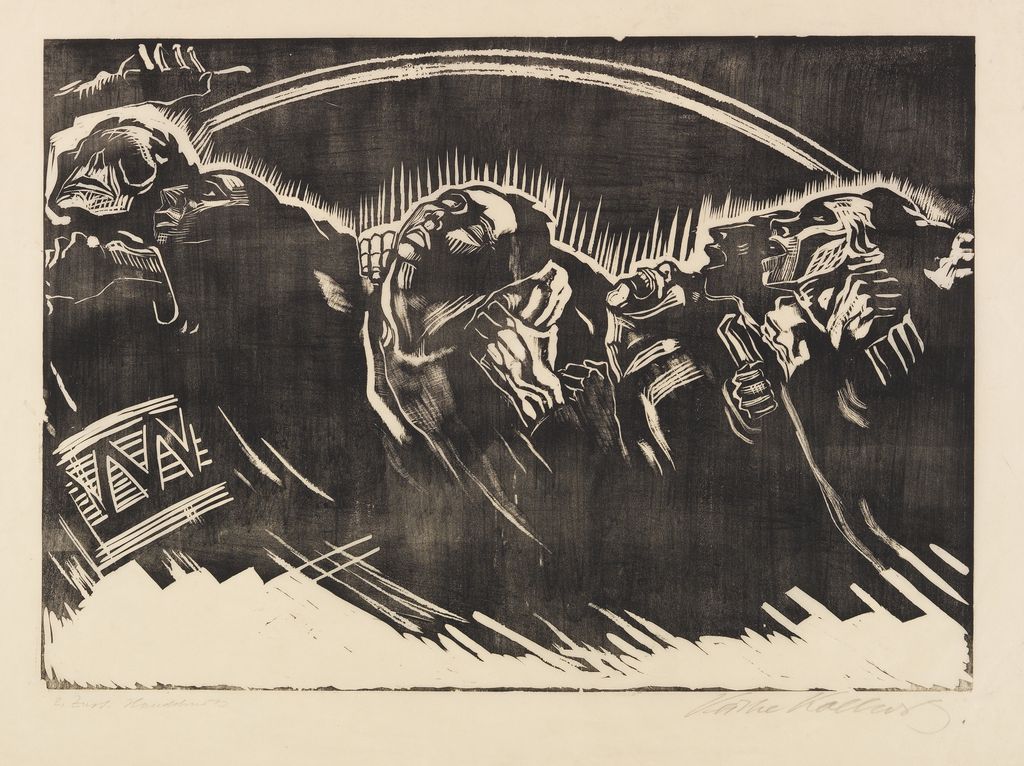
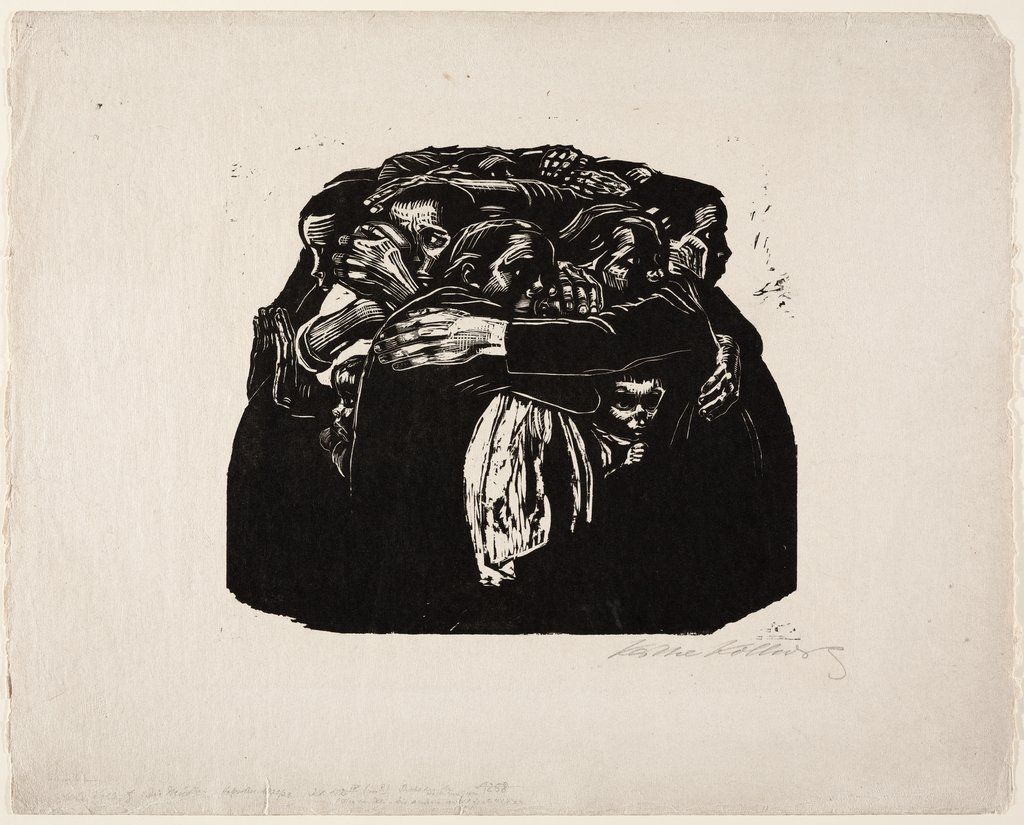
The Mothers
The Mothers, 1921–22. Städel Museum, Frankfurt am Main, SG 4289A D. Image source. Public domain. Resized and exported as JPEG.
The Grieving Parents
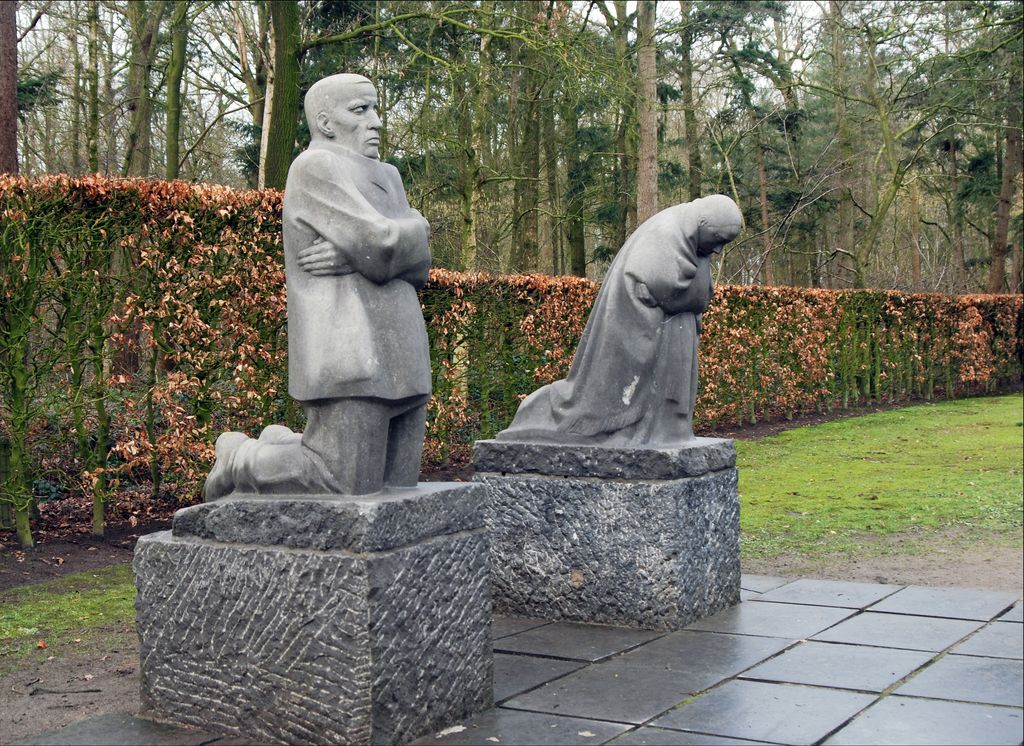
The Grieving Parents at Vladslo, the memorial’s location since 1956. Photograph by Bva, resized. Image source. CC BY-SA 3.0. Resized and exported as JPEG.
Memorial for Karl Liebknecht
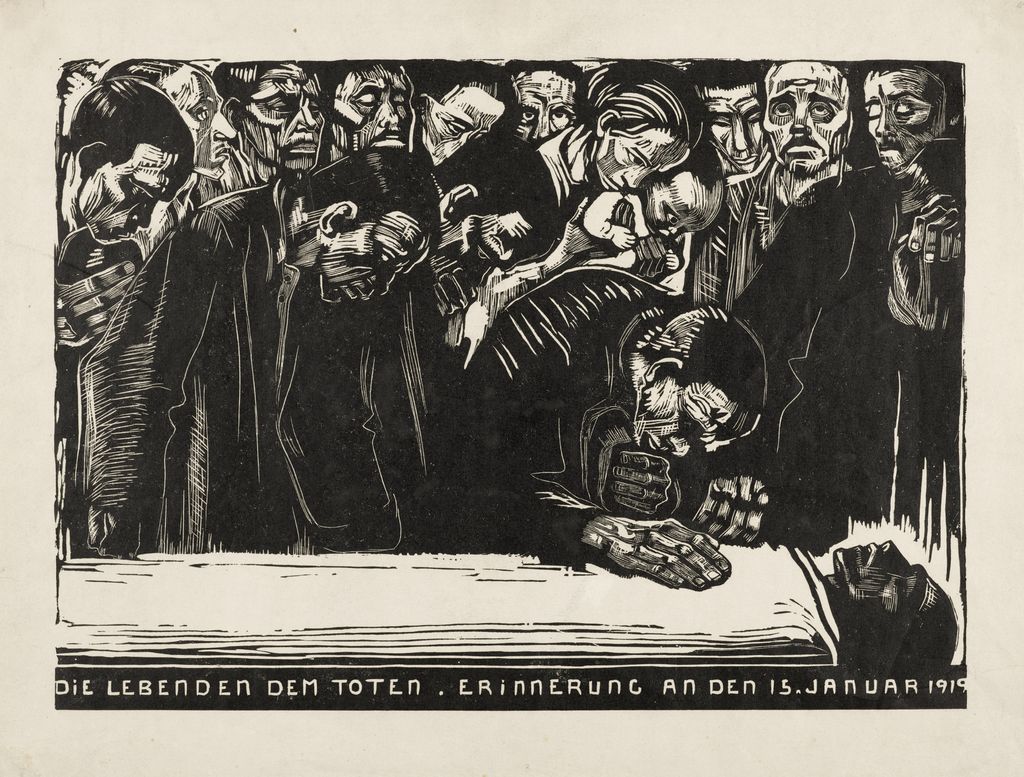
Memorial for Karl Liebknecht, 1920. Kunstsammlungen Chemnitz, 86-47, Kn 159 VI. Photo: Kunstsammlungen Chemnitz/PUNCTUM/Bertram Kober. Image source. Public domain. Resized and exported as JPEG.