


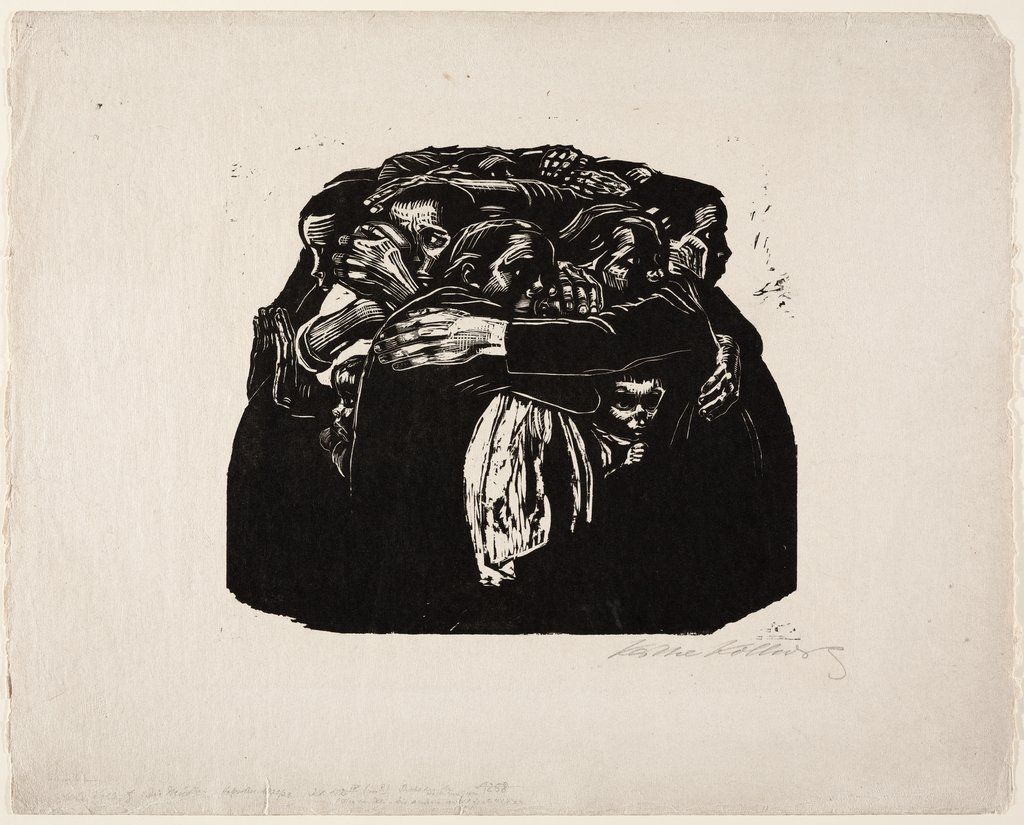
The Mothers, 1921–22. Städel Museum, Frankfurt am Main, SG 4289A D. Image source. Public domain. Resized and exported as JPEG.
 by Tom Gurney
Tom Gurney BSc (Hons) is an art history expert with over 20 years experience
Email: tomgurney1@gmail.com / Phone: +44 7429 011000
The Mothers by Käthe Kollwitz: Introduction
In The Mothers (Die Mütter), Käthe Kollwitz gathers women and children into a dark, tightly fitted group. The women’s heads and shoulders make a broad arc. Below them, children look out through gaps left by sleeves, arms and hands. The adults are close enough for their clothes to merge into a single mass of ink, but a turn of the head or the angle of a wrist still distinguishes one person’s task from another’s. One woman attends to the child she holds. Others keep watch or brace the people beside them. The shelter is made entirely of bodies. [1] [2]
Kollwitz began working on the subject in 1918, tried it again in lithography in 1919 and cut the woodblock in 1921–22. Her earlier designs already showed mothers holding children close. The decisive change was to make those embraces depend on one another. As the sixth sheet of War (Krieg), first published in 1923, the woodcut brings that collective gesture into a sequence that opens with a mother holding an infant forward and passes through the deaths and grief of those left behind. [1] [3] [4]
At a Glance
- ArtistKäthe Kollwitz
- German titleDie Mütter
- MediumWoodcut
- DateBlock made in 1921–22. The portfolio was first published in 1923. [1] [3]
- SeriesSixth of seven numbered sheets in War (Krieg). The portfolio also has a woodcut cover. [3] [2]
- PublisherEmil Richter, Dresden. [3] [2]
- Cologne impressionKollwitz Museum Köln, Kn 176 VII b, inventory 70300/92016. [1]
- Block dimensions340 × 400 mm, as recorded by the Städel Museum for its Kn 176 VII b impression. [5]
This work across Käthe Kollwitz’s career
A Weavers’ Revolt
1893–97The six sheets take a revolt from household distress to collective action and its aftermath. [6]
Separate impressions and hand-worked proofs show how Kollwitz developed the image. [7]
Peasants’ War
1901–08The seven plates combine the revolt with the aftermath in Battlefield and The Prisoners. [8]
War
1921–22, published 1923The woodcuts give sustained attention to the experience of those left behind. [9]
The Grieving Parents
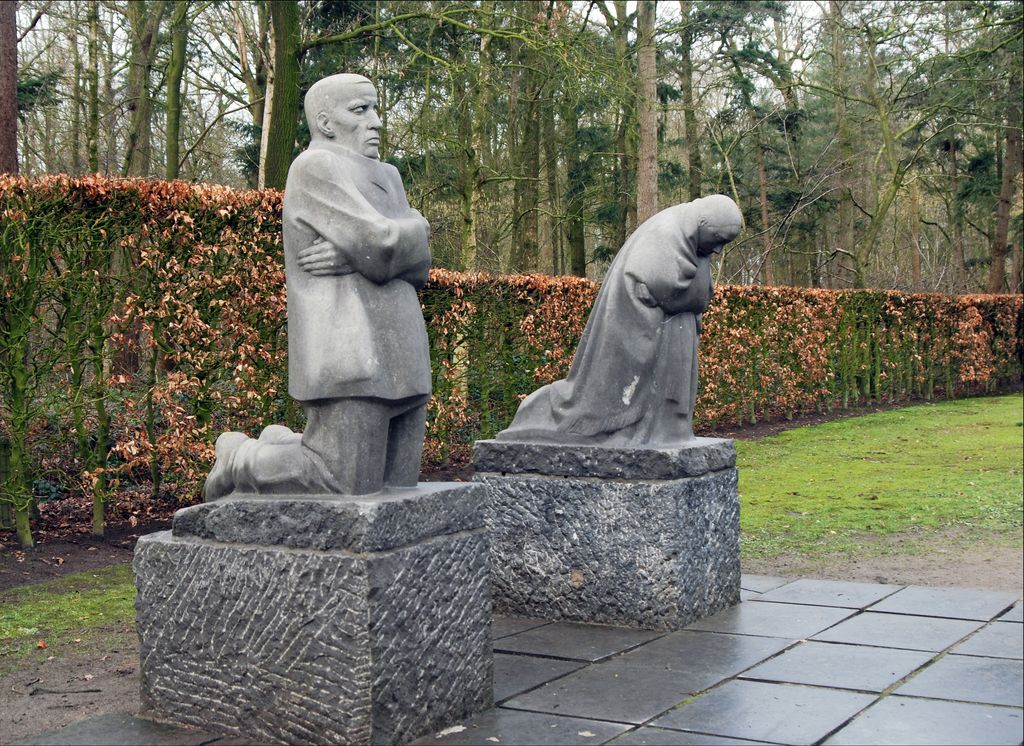
1932 installationTwo kneeling figures face the graves in the memorial’s later location at Vladslo. [10]
Mother with Her Dead Son
1937–39 modelThe small sculpture precedes the 1993 enlargement at the Neue Wache. [12]
Contents
- How the women make a shelter
- The earlier designs and the diary of 1919
- The woodcut in proof and in print
- Between the widows and The People
- The protective gesture in sculpture, posters and film
How the women make a shelter
Start at the outer edge of the Cologne impression. The heads rise and dip across the top, and the shoulders turn that uneven arc down at either side. The black clothes broaden towards the bottom, giving the group a low centre of gravity. The white paper around it makes the outline legible at a glance. There is very little to tell us where the women are standing. Their posture supplies the sense of place. The Kollwitz Museum in Cologne describes the circle as fortress-like, and the 2019 Strasbourg exhibition dossier calls it a human fortress. The comparison comes from the way the women occupy the exposed positions themselves. Their backs and shoulders make the perimeter. [1] [4]
Inside that perimeter, the eye has to adjust. A face may be reduced to the light over a brow or the short white edge of a nose. A child’s features emerge lower down, where the surrounding black initially makes them easy to overlook. One adult bows towards the child close to her body. Elsewhere, a face turns outwards, towards the open paper. These directions matter because the group has two demands on its attention. The women have to see to the children within the circle and remain alert to whatever might approach from outside it. Kollwitz can suggest a threat without giving it a body or a location. [1] [2]
Look next at the hands. Some are so broad that they register before the face of the person to whom they belong. Pale fingers recur across dark sleeves and shoulders, carrying the eye sideways and down into the group. A hand laid across someone else’s clothing makes two bodies easier to distinguish while showing exactly where they meet. The smaller faces change the apparent size and weight of these gestures. A span of fingers is enough to cover much of a child’s face. The bend of an elbow can hold a child in place while the shoulder above it helps complete the outer curve. At that scale, the group’s strength becomes a matter of specific points of contact. [1] [2]
The relief process makes those contacts unusually clear. The raised wood carries ink, allowing adjacent coats and sleeves to join across much of the composition. Cut passages leave the paper exposed. A broad opening can bring a hand forward at once, while short, broken marks let a cheek or fold of cloth emerge gradually from the dark. Along parts of the contour, a rough edge interrupts the impression of one smooth shell. Some of the texture follows the shape of a face or a sleeve. Elsewhere it gives the darkness a worked surface without identifying a particular object. The alternation between solid ink and broken light lets the group register first as a whole, then as a set of people bearing against one another. [1] [5] [2]
MoMA curator Starr Figura reads the enclosure as a refusal of the expectation that German mothers should accept the loss of their sons as an honourable sacrifice and grieve in private. That historical reading has a visible basis. The women turn the physical acts of holding a child, covering a face and gripping a neighbour into an action they perform together. No single figure stands apart to direct it. The outward-facing adults give the group its vigilance, while the inward turns keep its purpose visible. The children’s partly open view of the world makes the shelter feel provisional. It will hold for as long as the women can hold it. [1] [13]
The earlier designs and the diary of 1919
The first rejected design was an etching made in 1918. Cologne’s impression, Kn 137 III, inventory 70300/03011, combines line etching with work using sandpaper, a bundle of needles and soft ground carrying the imprint of laid paper. Those tools offered Kollwitz several ways to build a dark passage, from fine incised lines to textures that spread across an area. The impression lent by the Ute Kahl collection to MoMA in 2024 shows another level of intervention. The checklist records black ink, opaque white, charcoal and pencil worked over the printed image on that particular sheet. The etched design already invited revision on paper, a practice that would recur in the woodcut proofs. [1] [14]
The second rejected design is the 1919 lithograph. Cologne calls its Kn 140 II impression, inventory 70300/97003, a transfer crayon lithograph. The Metropolitan Museum of Art catalogues its own sheet, 28.68.3, as a lithograph dated 1919 and records its acquisition through the Harris Brisbane Dick Fund in 1928. MoMA’s 2024 checklist documents a further impression lent by the William Benton Museum of Art. The institutions are describing separate sheets of the same earlier design. The III in Cologne’s etching entry and the II in its lithograph entry refer to stages of those respective prints. The woodcut has its own sequence under Kn 176. [1] [15] [14] [16]
Across the first two designs, the women are close enough to belong to one scene, yet each embrace has a legible centre of its own. A head inclines towards one child and the next pair makes a different shape. In the lithograph, crayon can build a deep shadow that still allows a shoulder or a cheek to turn gradually into light. The dark passages give the composition weight, but the eye can move from one embrace to the next. In the woodcut, the intervals close and the darkest passages run across the places where one figure meets another. A forearm can belong to one woman, touch the next and shelter a child beneath both. The relationship between the embraces has become as important as any single pair. [1] [2] [16]
The diary fixes one of those earlier embraces to a particular day. On 6 February 1919, Peter’s birthday, Kollwitz wrote that she had decided the previous day to rework the War sheets as lithographs. She recognised herself with her sons Hans and Peter in the mother embracing her children and expressed satisfaction with the work. Peter, the younger son, had been killed as a volunteer on 22 October 1914. The Met essay, in its discussion of the 1919 lithograph and accompanying note 2, traces the family identification to this diary entry, as does the Cologne catalogue. It is an unusually precise account of what Kollwitz saw in the image she was making that day. The later woodcut redistributes that embrace among a group whose individual figures are unnamed in the catalogue. [1] [3] [17]
The 1921 study at the Museum of Fine Arts, Boston, brings the composition closer to the woodcut. MoMA’s 2024 checklist records brush and black ink with opaque white watercolour on paper cut and pasted onto a larger sheet, measuring 45.4 × 58.8 cm. In a study made this way, an edge can be altered with white, and a cut piece can be fitted against another passage. The resulting object gives physical evidence of a composition assembled on paper. Its broad dark shapes and interruptions of white also let Kollwitz test how tightly the figures could come together before their gestures became hard to read. Cologne’s The Mothers, NT 857, is a separate charcoal drawing on brownish laid paper dated 1922. Together the two objects show work on paper continuing around the time Kollwitz was making and revising the woodcut. [1] [13] [14]
The Australian War Memorial’s lithograph, ART50254, shows the lighter passages around the women’s arms and shoulders. Its crayon tones allow neighbouring figures to come forward or recede by degrees. In the final woodcut the surrounding black has a much sharper edge, and the exposed faces look out from inside the group. [18]
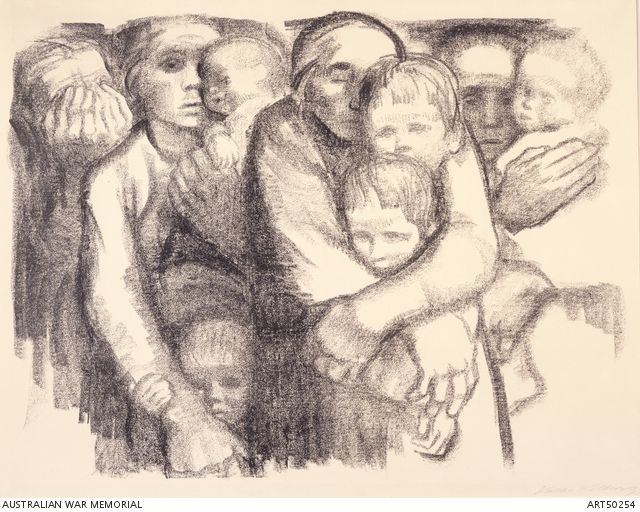
Die Mutter (The Mothers), 1919 lithograph. Australian War Memorial, ART50254. Image source. Public domain. Resized and exported as JPEG.
The woodcut in proof and in print
Two sheets in the Getty Research Institute’s Simms collection document work on the block between mid-October 1921 and early 1922 at the latest. The earlier proof, Kn 176 II, is printed in black on thick, soft, rough Japanese paper. It has a 352 × 400 mm image on a 356 × 435 mm sheet. Kollwitz’s pencil signature is at the upper right, and the Getty transcribes `2. Zust.` at the lower right. In this impression the sheet is only slightly taller than the recorded image. That relationship is specific to the proof and gives it a different presence on the page from a numbered impression with broad margins. [19]
The Getty’s Kn 176 V is a proof pulled by Otto Felsing before the Richter edition. The finding aid records a 340 × 400 mm image on a 470 × 560 mm sheet, with Kollwitz’s pencil signature at lower right and `5. Zustand (Felsing)` at lower left. Its catalogue equivalent in Klipstein is 182 V a. White gouache and black ink were applied to the printed sheet. Those additions matter because they let an artist try an alteration in both directions. White can interrupt a printed dark and black can restore or extend it, while a fresh cut in the block permanently removes a printing surface. The finding aid establishes that this proof was worked over and that its recorded image is 12 mm shorter than the Getty’s second-state image. It leaves the sequence of individual cuts and brushed revisions open. [19]
The Library of Congress records a separate impression credited to Felsing, signed in pencil by both artist and printer and inscribed as a print of the fifth state. Its record uses Klipstein’s catalogue and gives a bracketed date of 1922 or 1923. The Getty gives a narrower interval for its own sheet and explicitly records the gouache and ink additions there. The two descriptions establish Felsing’s involvement in printing proofs of The Mothers. Each date, inscription and description of handwork belongs to the sheet documented by the institution that holds it. [19] [20]
The Cologne impression is catalogued as Kn 176 VII b. The Städel’s SG 4289A D is a separate impression of that same subdivision, printed in black on Japanese paper. The Städel records a 340 × 400 mm block and a 551 × 695 mm sheet. It also distinguishes the pencilled `- 24 -` on the sheet from its catalogue edition field of 24/100. A later pencil annotation calls it a Probedruck, or proof, and reads `Kl. 182 V (von V)`. The museum’s current catalogue entries give Klipstein 182 IV (of V) and Kn 176 VII b. The annotation records an earlier assessment of the sheet. The museum separates that assessment from its present identification and from the number associated with the edition. [1] [5]
MoMA’s 470.1992.6 is another impression of the final state. Its current object title says VII/VII, while the museum’s German Expressionist Digital Archive identifies the same object more specifically as Kn 176 VII b. The museum measures the irregular printed composition at 343 × 400 mm and the irregular sheet at 472 × 664 mm. The Städel’s 340 mm figure describes the height of the block in its record. The small difference between those figures is a reason to retain each museum’s measurement labels. MoMA credits the edition printing probably to Fritz Voigt in Berlin. Its attribution is qualified, while the Getty names Felsing as printer of its particular fifth-state proof. [5] [19] [2] [21]
In October 1922 Kollwitz wrote to the French writer Romain Rolland that she had finally made a series of woodcuts that came close to what she wanted to express. She hoped the sheets would travel internationally and convey what people had endured during the war. Richter published the portfolio in Dresden in 1923. MoMA’s current object record gives an edition of 100 for its impression. The detailed archive entry sets that figure in context. It records 100 hand-printed, signed and numbered sets on imperial Japanese paper, including MoMA’s set, and a further 100 hand-printed, signed and numbered sets on wove paper. Another 200 sets, printed from electrotypes on imitation Japanese paper, were published in 1924. The archive also lists 12 known state proofs for states I–VI and five known proofs before the edition. Those proof counts sit outside the three published groups. [3] [2] [21]
Records for individual collections can be much briefer. In the UK, Art Fund documents its support in 1992 for the acquisition of a woodcut by The Higgins Bedford. The archive lists it as Die Mutter (The Mothers), gives 1922–1923 and identifies it as part of the seven-sheet suite. Its dimensions field gives 40 × 47 cm without saying whether that refers to the image or the sheet. The record establishes the acquisition and the work’s connection to the portfolio. The Städel and MoMA entries supply the fuller evidence needed to discuss their own impressions’ states, measurements and editions. [5] [2] [22]
Between the widows and The People
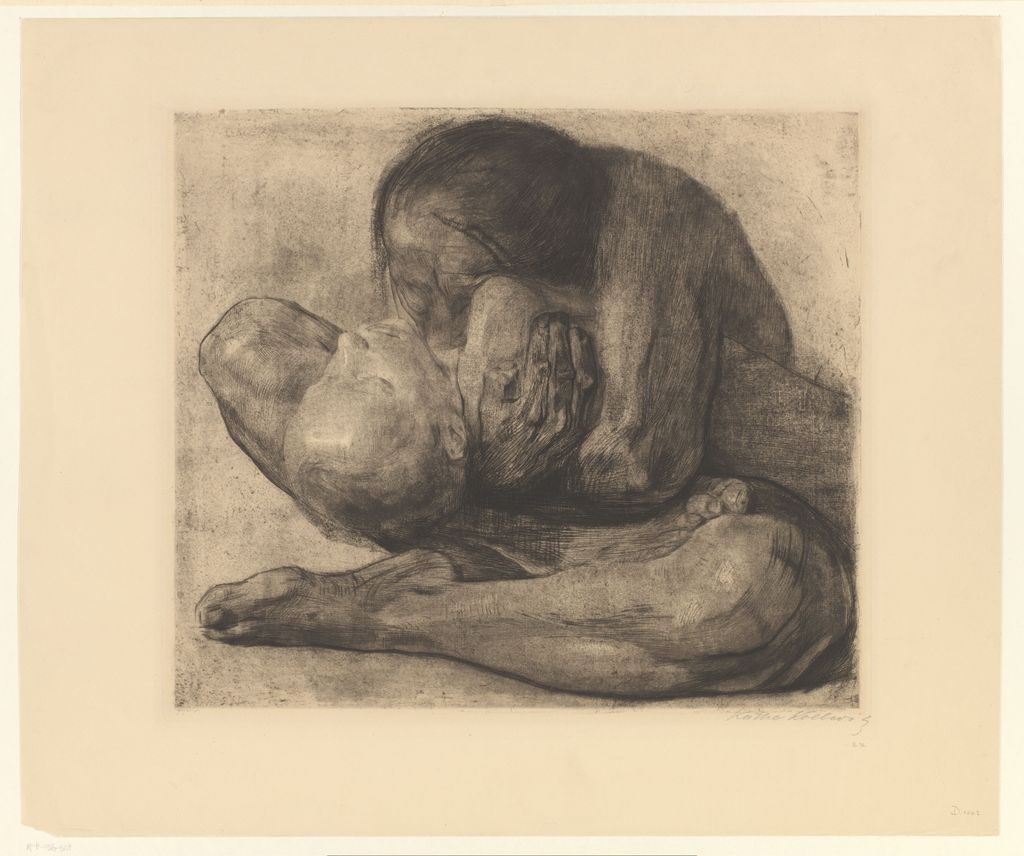
The two widow sheets immediately precede The Mothers in War. In The Widow I, the upright woman turns into herself, her hands gathered at her body. In The Widow II, the long horizontal of a woman lying flat takes over the sheet. An infant lies face down across her chest. Cologne interprets the pair as dead. The adult’s body still supports the child’s weight, but there is no visible movement through that contact. In The Mothers, shoulders and backs lift the mass of figures again. Children are partly hidden here too, but their outward looks and the active hands around them make concealment a form of protection. Moving from the fifth to the sixth sheet, the viewer goes from an isolated pair to several adults able to help carry what one person has had to bear alone. [1] [3] [23] [24]
The first two sheets give the circle a different meaning. In The Sacrifice, a mother holds her infant forward. The Strasbourg dossier reads that opening gesture in relation to the later women’s refusal to surrender their children to war. In The Volunteers, Death leads the young men forward, their crowded faces and overlapping bodies reinforcing the momentum of the procession. The women in The Mothers are packed just as insistently, but the weight circulates within the group. An arm takes up the pressure of a neighbouring shoulder. A lowered face draws the eye back to the interior. The same closeness that helps propel the volunteers becomes a way of holding ground. [1] [4] [25]
In the seventh sheet, The People, a central woman gathers others around her. Cologne compares her to the Virgin of Mercy. A child raises both hands before its face, while other faces press into view behind the woman. The sixth sheet distributes the shelter around several adults, with the upper contour moving from head to head. The seventh gives the gathering a more pronounced centre and extends it to a wider company of survivors. The child’s raised hands also shift the emphasis. In The Mothers, large adult hands catch the eye as they support and shield. In The People, the small hands make the need for shelter visible from within. [1] [3] [26]
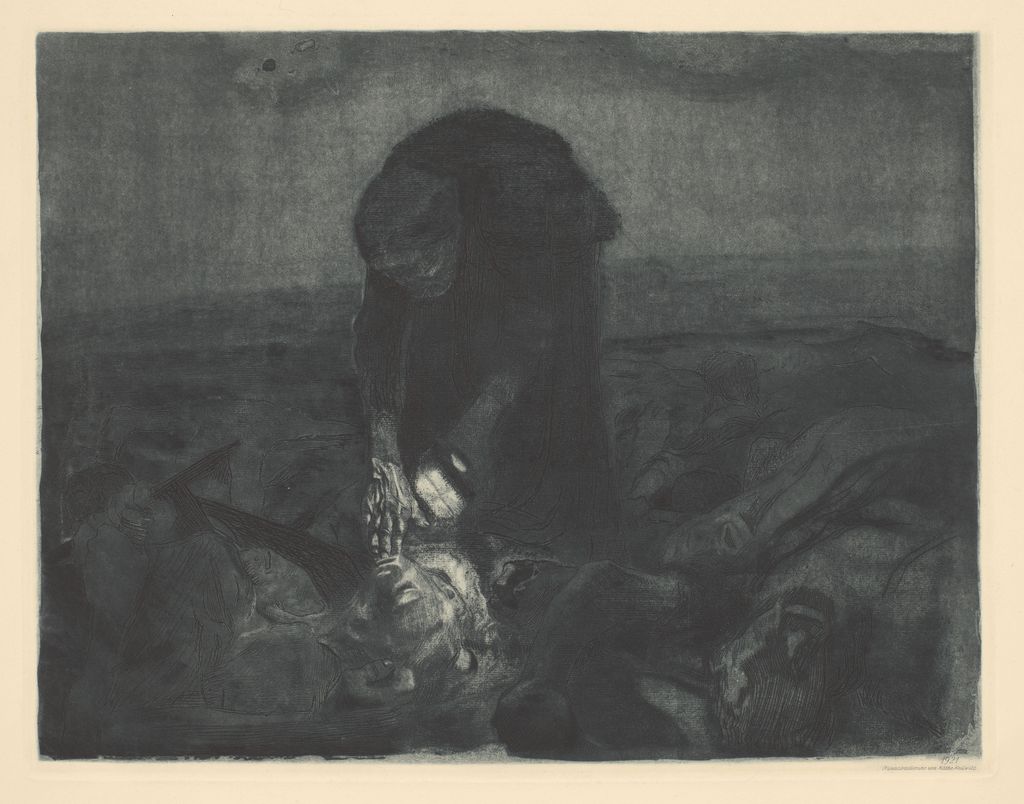
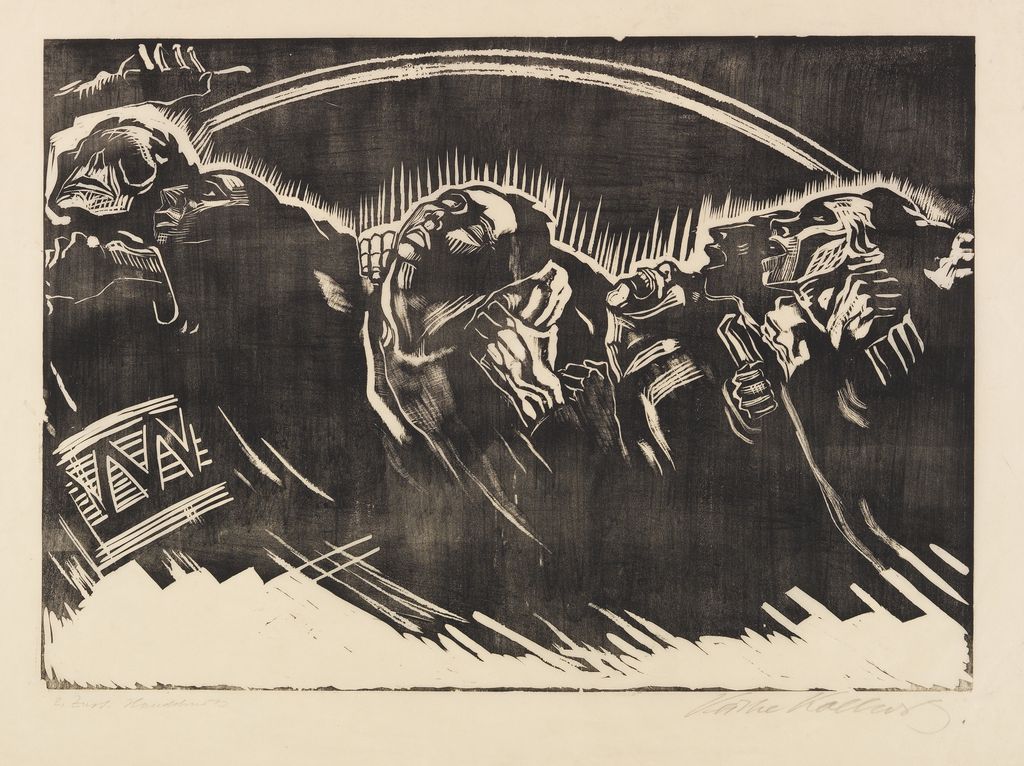
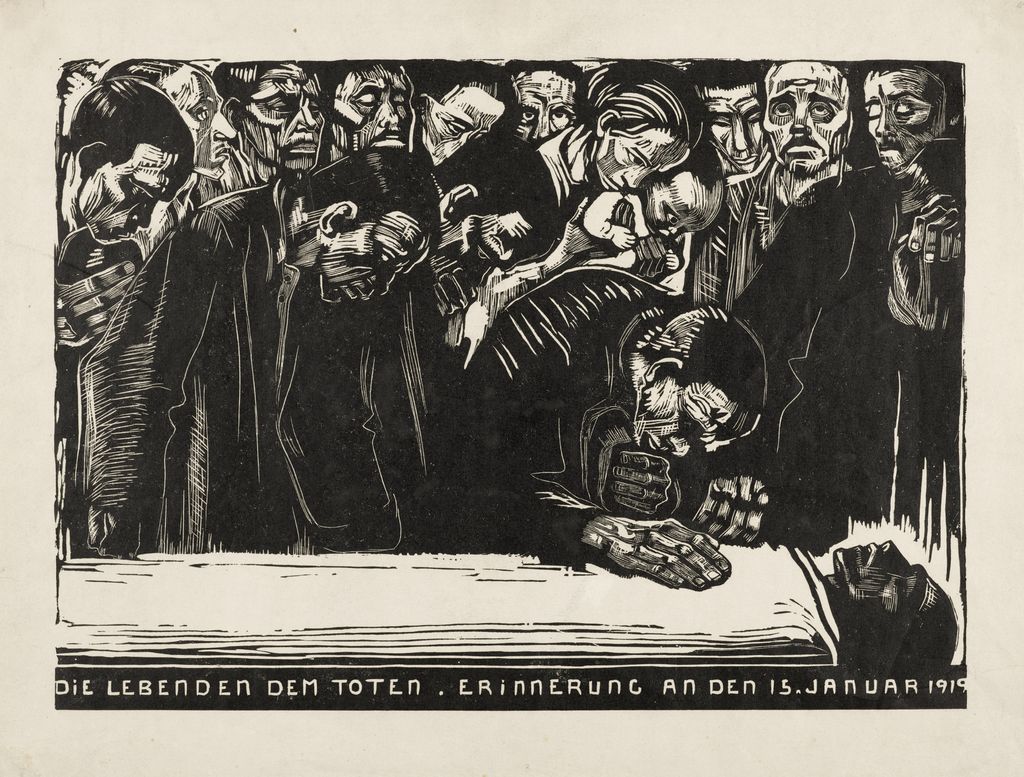
The British Museum placed War in the section on woodcuts, war and remembrance in its 2019 Kollwitz exhibition, alongside her memorial sheet for Karl Liebknecht. Within the portfolio, the arrangement makes remembrance a matter of looking repeatedly at what the living do with their bodies. The parents bend into grief, the widow folds inwards, and the mothers hold one another upright. Kollwitz gives that last action the weight of an event in its own right. [3] [27]
The protective gesture in sculpture, posters and film
In April 1922, while working on the woodcut, Kollwitz noted in her diary that the circle of defending mothers could become a sculpture in the round. She modelled Tower of Mothers in 1937–38. Cologne’s bronze, Seeler 35 II.B.1, inventory 70100/86008, was probably cast in 1946. Its front is marked by a woman who plants her feet apart, leans forward and reaches back towards the others. The reach establishes a connection behind her even as the lean puts her in the most exposed position. A viewer can walk round the bronze and see how that forward posture is sustained by the bodies gathered behind it. The woodcut has to convey comparable depth through overlap and gaps in the black. The bronze gives the gesture a place among Kollwitz’s sculptures as well as in the history of her printmaking. [1] [28]
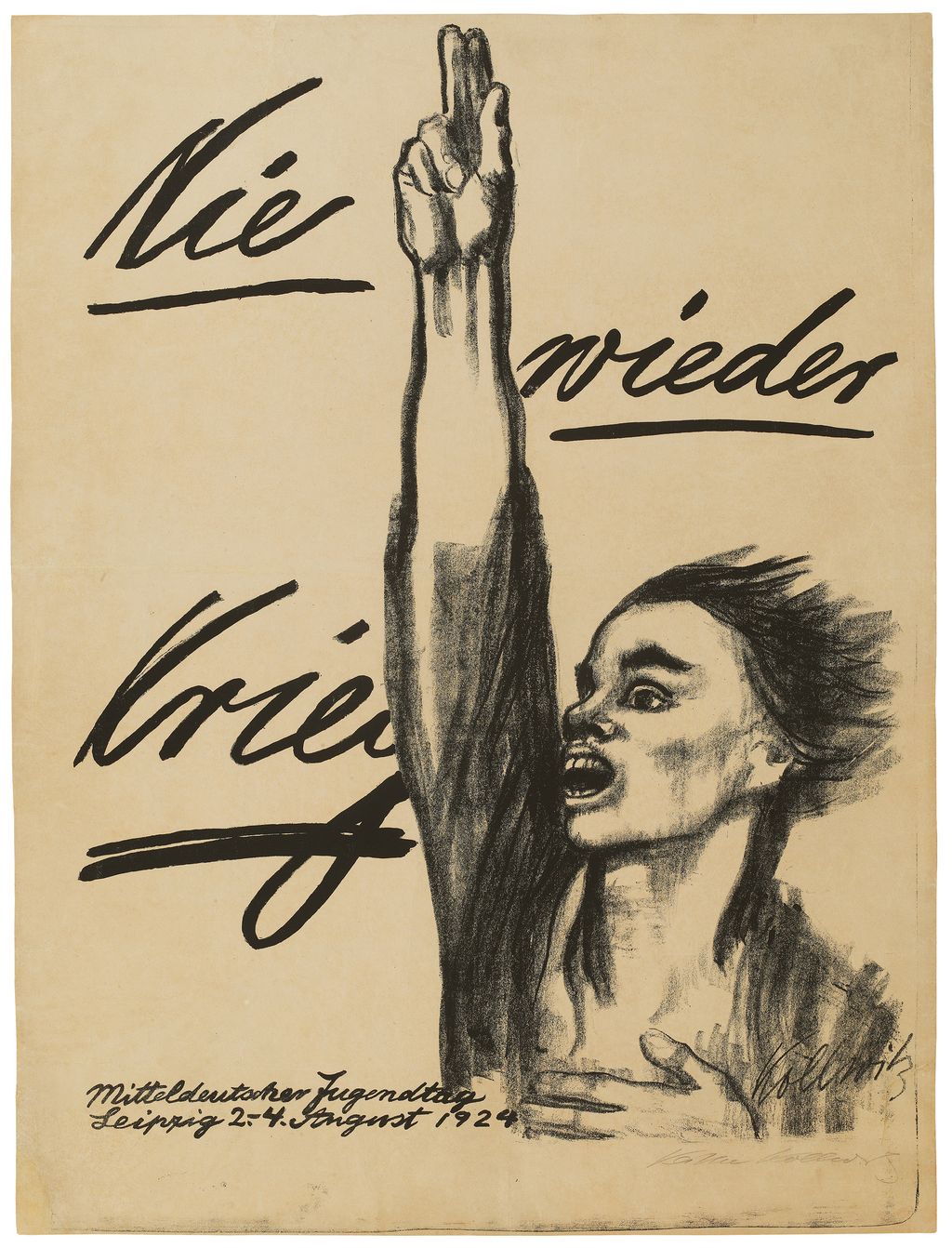
Kollwitz also considered the clustered mothers for the commission that became The Survivors – War against War (Die Überlebenden – Krieg dem Kriege, Kn 197). In a letter to Beate Bonus-Jeep, she described an initial idea for a dark huddle against the large white expanse of a poster. The commissioning trade union organisation asked her to represent survivors, and the finished lithographic poster of 1923 brings parents, widows, blind people and children into the same public address. The proposed huddle would have concentrated attention on the act of protection. In the finished poster the wider gathering shows who has lived through war and must go on living with its effects. [29]
In the separate 1941 lithograph Seed for Sowing Should Not Be Milled (Kn 274), an older woman spreads her arms over boys who push and look outwards. The title recalls the Goethe line Kollwitz had invoked in her 1918 public response to Richard Dehmel’s appeal for a final mobilisation. In the later print, one adult’s outstretched arms have to do much of the work that passes between several women in The Mothers. The boys’ outward energy gives her effort a visible counterforce. The sheltering gesture now has to reckon with the wish of those within it to get out and see. [4] [30]
In 2022, Isaac Chong Wai made a 14-minute, two-channel video with sound, also titled The Mothers. The Kollwitz Museum showed it alongside Kollwitz’s work from 21 January to 15 March 2026. Its account of the choreography connects the protective grouping with grief, resistance and solidarity. Working with moving bodies gives the act of gathering a duration that a printed silhouette can only imply. Seen in that light, the uneven shoulders and overlapping arms in the woodcut can look less like the parts of a fixed monument and more like positions that people have taken up and have to keep adjusting to sustain. [1] [31]
Käthe Kollwitz artworks directory
Selected documented works, including the complete published sequences of the five cycles discussed here. Catalogue links identify the specific record behind each row.
Frequently Asked Questions
Kn refers to Alexandra von dem Knesebeck’s catalogue of Kollwitz’s prints. The number 176 identifies the woodcut, VII identifies the seventh state and the letter specifies a subdivision within that state. Cologne and the Städel hold separate impressions catalogued as Kn 176 VII b. The Städel’s 24/100 identifies the impression’s place within its edition. [1] [5] [15]
Tower of Mothers is a separate sculpture, modelled in 1937–38. It develops the protective circle that Kollwitz considered making in three dimensions while working on the woodcut in 1922. The Cologne bronze was probably cast in 1946. [28]
Discussion
Look again at the images and ideas explored in The Mothers by Käthe Kollwitz. These editorial prompts invite your observations.
Reader Insights
How does the cluster of arms change from the earlier versions to the woodcut?
How does the sequence of War change your reading of the mothers’ protective gesture?
What becomes clearer when you compare the earlier lithograph with the final woodcut?
Join the Conversation
Share a detail, comparison or question about The Mothers by Käthe Kollwitz below.
References
- Kollwitz Museum Köln, Die Mütter, Kn 176 VII b, inventory 70300/92016, with the two rejected designs, charcoal study NT 857 and diary entry of 6 February 1919. English catalogue entry. View source 1. View source 2.
- Museum of Modern Art, German Expressionist Digital Archive, The Mothers, 470.1992.6, Dimensions, Paper, Printer, Edition and Reference fields. View source.
- Kollwitz Museum Köln, The War Series, introduction, October 1922 letter to Romain Rolland and numbered sequence of sheets. View source.
- Musée d’Art moderne et contemporain de Strasbourg, Käthe Kollwitz. Je veux agir dans ce temps, 2019 exhibition dossier, printed p. 7, “Salle 6,” and p. 21, Les Mères image caption. View source.
- Städel Museum, Die Mütter, SG 4289A D, dimensions, Seriennummer / Auflage, original and later inscriptions, and Werkverzeichnisse. View source.
- Kollwitz Museum Köln, A Weavers’ Revolt, cycle catalogue. View source.
- Museum of Modern Art, Woman with Dead Child, state VIII/X, 1903. View source.
- Kollwitz Museum Köln, Peasants’ War, cycle catalogue. View source.
- Museum of Modern Art, Käthe Kollwitz, 2024 extended gallery labels. View source.
- Flemish Heritage Inventory, Treurend ouderpaar (Vladslo – WOI). View source.
- Kollwitz Museum Köln, Death, series catalogue. View source.
- Kollwitz Museum Köln, Pietà (Mutter mit totem Sohn), Seeler 37, with the Neue Wache enlargement. View source.
- Museum of Modern Art, Study for The Mothers, exhibition audio stop 10, Boston study caption and Starr Figura transcript. View source.
- Museum of Modern Art, Käthe Kollwitz, 2024 exhibition checklist, p. 26 for the 1918 and 1919 rejected designs, p. 30 for the final woodcut and p. 31 for the Boston study. View source.
- Kollwitz Museum Köln, Catalogue Raisonné of the Prints, Alexandra von dem Knesebeck catalogue. View source.
- Metropolitan Museum of Art, Mothers, 28.68.3, Artwork Details for the 1919 lithograph. View source.
- Metropolitan Museum of Art, “One Hundred Years of the Great War through the Eyes of Four Female Artists”, discussion of the 1919 Mothers and note 2. The French site serves the English essay. View source.
- Australian War Memorial, Die Mutter (The mothers), ART50254, 1919 lithograph on laid paper, published image and accession record. View source.
- Getty Research Institute, Finding aid for the Dr. Richard A. Simms collection, 2016.PR.34, box 11, printed pp. 88–89, entries for Kn 176 II and Kn 176 V. View source.
- Library of Congress, Die Mütter, LCCN 2009630850, Names, Created / Published and Notes fields. View source.
- Museum of Modern Art, The Mothers, state VII/VII, 470.1992.6, current object record and portfolio identification. View source.
- Art Fund, Die Mutter (The Mothers), The Higgins Bedford, acquisition support and archived object description. View source.
- Kollwitz Museum Köln, The Widow II, Kn 178, interpretation of the woodcut and rejected lithograph. View source.
- Kollwitz Museum Köln, The Widow I, Kn 175, fourth sheet of War. View source.
- Kollwitz Museum Köln, The Volunteers, Kn 173, final impression and early proofs. View source.
- Kollwitz Museum Köln, The People, Kn 190, final impression, Virgin of Mercy comparison and preparatory drawings. View source.
- British Museum, Portrait of the Artist: Käthe Kollwitz, 2019 exhibition release, exhibition sequence and “Woodcuts, War and Remembrance” section. View source.
- Kollwitz Museum Köln, Turm der Mütter, Seeler 35 II.B.1, model and cast dates, April 1922 diary reference and discussion of the sculpture’s orientation. View source.
- Kollwitz Museum Köln, The Survivors, Kn 197, commission history and letter to Beate Bonus-Jeep. View source.
- Kollwitz Museum Köln, Seed for Sowing Should Not Be Milled, Kn 274, lithograph and December 1941 diary entry. View source.
- Kollwitz Museum Köln, Isaac Chong Wai, The Mothers, installation specifications, exhibition dates and “Bildstörung” interpretation. View source.
More KOLLWITZ Works
The Mothers
The Mothers, 1921–22. Städel Museum, Frankfurt am Main, SG 4289A D. Image source. Public domain. Resized and exported as JPEG.
The Grieving Parents
The Grieving Parents at Vladslo, the memorial’s location since 1956. Photograph by Bva, resized. Image source. CC BY-SA 3.0. Resized and exported as JPEG.
Memorial for Karl Liebknecht
Memorial for Karl Liebknecht, 1920. Kunstsammlungen Chemnitz, 86-47, Kn 159 VI. Photo: Kunstsammlungen Chemnitz/PUNCTUM/Bertram Kober. Image source. Public domain. Resized and exported as JPEG.