


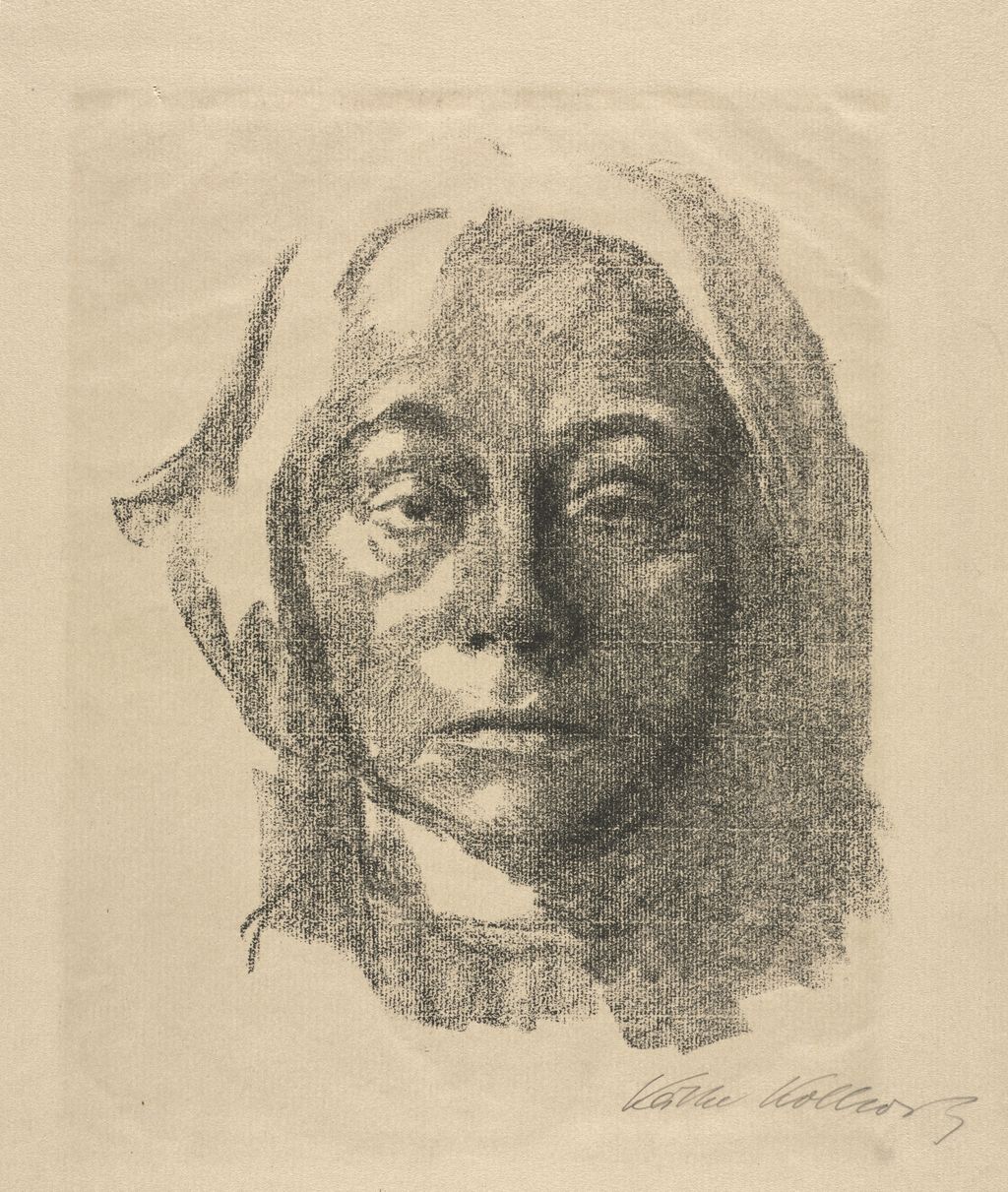
Käthe Kollwitz, Self-Portrait, 1915. Lithograph. Cleveland Museum of Art, 1941.493. Image source. CC0 / Public domain. Resized and exported as JPEG.
 by Tom Gurney
Tom Gurney BSc (Hons) is an art history expert with over 20 years experience
Email: tomgurney1@gmail.com / Phone: +44 7429 011000
Käthe Kollwitz Biography: Introduction
In June 1898, as A Weavers’ Revolt was bringing Käthe Kollwitz to public attention in Berlin, the director of Dresden’s print room wrote to ask her for a particularly good set of impressions. She had a problem. She had run out of satisfactory prints of the final plate and needed to have more made. Her reply catches her at the beginning of a career in which the work of drawing and revising an image went hand in hand with the practical work of printing, selling and getting it seen. [1]
Kollwitz had trained as a painter in schools run by women artists’ associations. She made her name in printmaking, went on to design posters and took up sculpture, working for eighteen years on a memorial to the younger of her two sons. The opportunities available to her changed dramatically over that career. In 1928 she took charge of a master studio at the Prussian Academy of Arts. Five years later she was forced to resign. She continued to make prints and sculpture in rented rooms and, eventually, in her bedroom. [2] [3] [4] [5]
At a Glance
- BornKäthe Schmidt, 8 July 1867, in Königsberg, East Prussia, now Kaliningrad, Russia. [2]
- Worked chiefly inBerlin, where she and the physician Karl Kollwitz settled after marrying in 1891. [6] [7]
- BreakthroughA Weavers’ Revolt at the Great Berlin Art Exhibition in 1898. [8]
- Principal mediaDrawing, etching, lithography, woodcut and sculpture. [9] [10]
- Academy careerElected to the Prussian Academy of Arts in 1919, appointed to lead its master studio for graphic art in 1928 and forced to resign in 1933. [3]
- Died22 April 1945 in Moritzburg, near Dresden. [11]
Käthe Kollwitz in context
Königsberg, Berlin and Munich
Training to 1890Kollwitz studied in several cities before returning to Berlin after her marriage. [9]
Berlin
1891–1943The household in Prenzlauer Berg and later Academy and Klosterstraße studios offered different working conditions. [9]
Roggeveld and Vladslo
1932 and 1956The 1932 memorial moved with the consolidation of military graves in 1956. [13]
Max Lehrs
Print room and exhibition supportThe Dresden print-room director helped place good impressions in an exhibition and collection. [14]
Auguste Rodin
Studio visitsHugo von Tschudi introduced Kollwitz to Rodin, whose sculpture she admired. [12]
Campbell Dodgson
Print collectorHis early purchases and later bequest shaped the British Museum holdings. [15]
Kollwitz and the Prussian Academy
1919–1933Her election and leadership preceded the Academy’s forced resignation in 1933. [3]
A Weavers’ Revolt
1893–97The six sheets take a revolt from household distress to collective action and its aftermath. [8]
Separate impressions and hand-worked proofs show how Kollwitz developed the image. [16]
Peasants’ War
1901–08The seven plates combine the revolt with the aftermath in Battlefield and The Prisoners. [17]
War
1921–22, published 1923The woodcuts give sustained attention to the experience of those left behind. [18]
The Grieving Parents
1932 installationTwo kneeling figures face the graves in the memorial’s later location at Vladslo. [13]
Mother with Her Dead Son
1937–39 modelThe small sculpture precedes the 1993 enlargement at the Neue Wache. [20]
Contents
- Königsberg and the women’s art schools
- Marriage, working Berlin and the Weavers
- The Secession, Paris and the business of making prints
- The Peasants’ War commission and Florence
- Peter’s death and the turn towards pacifism
- The Academy, public campaigns and the journey to Moscow
- The memorial in Belgium
- The appeals against Nazism and the loss of the studio
- The last years, from Berlin to Moritzburg
- How her work survived
Königsberg and the women’s art schools
Käthe Schmidt grew up in a family in which religious independence and social reform were subjects of everyday discussion. Her maternal grandfather, Julius Rupp, founded a Free Protestant congregation. Her father Carl and brother Konrad became active in the socialist movement. When Kollwitz looked back on her early interest in working life, she also recalled the pleasure of exploring Königsberg on her own. She watched ships being loaded and unloaded on the Pregel and observed sailors in the evenings. Long before she made prints about working people, she was looking closely at how people moved and occupied the city. [2]
Her father arranged lessons with the painter Gustav Naujok and the engraver Rudolf Mauer, whose surname also appears as Maurer in the Cologne museum’s records. Her earliest currently known drawing survives from this period. In 1883, aged sixteen, she copied an etched portrait of Arthur Schopenhauer in pencil for her friend Georg Paga. In a note written on the back in 1946, Paga identified the model as an etching in a biography of the philosopher. The drawing resurfaced in a group of archival material bought by Brian McCrindle in 2014 and entered the Cologne museum in 2025. It gives a specific example of what her earliest instruction involved, with a young draughtswoman studying how another artist had constructed a face in print. [2] [21]
Women seeking the prestige and training of Berlin’s state fine-art school were still excluded when Schmidt went there to study in 1886. She enrolled instead at the school of the Association of Berlin Women Artists. Her teacher, the Swiss painter and printmaker Karl Stauffer-Bern, set her to work on portraits and repeatedly directed her back to drawing. In a 1927 letter to Peter Hahn she credited that single winter with laying the foundations of her training. Stauffer-Bern also drew her attention to Max Klinger. Klinger’s etching cycle A Life showed how a sequence of images could follow a woman’s circumstances and their social consequences over time. [2] [22]
From 1888 she spent two years at the women artists’ school in Munich. Ludwig Herterich taught her to build a painting through relationships of colour and tone. She learnt to paint as he expected, although she later recalled that his method sat uneasily with the way she saw colour. At the Alte Pinakothek she was drawn to Rubens. In privately organised evening sessions she could practise composing scenes with several figures, and for one of these she chose a tavern fight from Émile Zola’s Germinal. Back in Königsberg she visited sailors’ taverns to gather material for a painted version, then tried the subject in etching with Mauer’s help. Zola gave her a scene to stage, her observations gave her figures and settings, and etching gave her another way to organise them. As she prepared to marry, she told a friend that etching would also be easier to pursue in a small flat than oil painting. [2]
Four stages of Käthe Kollwitz’s career
The periods group related developments. Prints, sculpture and public work overlap across the boundaries.
Drawing and printmaking
Kollwitz learned drawing and printmaking in Königsberg, Berlin and Munich. Reading Zola and studying Klinger gave her different starting points for making work in series. [9]
Making a name in print
Kollwitz established a working life in Berlin, developed two major print cycles and tried sculpture and colour printing during the years of her Paris visits. [12]
Mourning, relief and resistance
War and bereavement shaped her woodcuts, relief appeals and the long development of the memorial to Peter. [18]
Working under restriction
After her forced departure from the Academy, Kollwitz worked in smaller studios and developed the lithographs of Death and several late sculptures. [19]
Marriage, working Berlin and the Weavers
Käthe and Karl Kollwitz married in June 1891 and moved to Weißenburger Straße 25 in Prenzlauer Berg. The flat initially contained Karl’s practice and Käthe’s workspace as well as their living quarters. Karl treated patients insured through the tailors’ sickness fund. Hans was born in 1892 and Peter in 1896. Relatives and lodgers also lived with them at various times. Kollwitz worked at home until she rented a separate studio in 1912. For much of her early career in Berlin, the place where she made art was also where Karl received patients and the couple raised their children. [6] [7] [23]
Kollwitz later recalled that the people she met through the practice helped her grasp what unemployment and insecurity did to families. The back of her 1909 drawing Out of Work still carries the Weißenburger Straße address. By then she was contributing to the Munich weekly Simplicissimus, which gave her room to choose subjects such as hunger, paid work done at home and child mortality. The editors could supply their own captions. An image made in her Berlin workspace could thus reach a national readership framed by words chosen by someone else. That distinction matters when reading the drawings alongside the published pages of her social criticism. [24] [25] [18]
Her first major print cycle grew out of an evening at the theatre. In 1893 she saw Gerhart Hauptmann’s The Weavers and set aside the series she had envisaged after Germinal. Hauptmann’s play drew on the Silesian uprising of 1844. Kollwitz dressed the figures in A Weavers’ Revolt as workers of a later generation, bringing them closer to an audience that had read about renewed hardship among Silesian weavers in the early 1890s. The six sheets begin inside a household, follow the weavers into collective action and end indoors again, with the dead carried back. Three lithographs precede three etchings. The sequence gave her room to change how she handled darkness, texture and the movement of a crowd as the action unfolded. [7] [8]
At the Great Berlin Art Exhibition of 1898, the jury recommended Kollwitz for a medal with Max Liebermann’s backing. Kaiser Wilhelm II refused to grant it. Dresden offered a different kind of opportunity. On 8 June, Max Lehrs asked her to reserve selected impressions for the following year’s exhibition. His print room had a limited budget, and he proposed buying the set after showing it. Kollwitz wrote back on 13 June that she would have to arrange new impressions of the final plate. She suggested 200 marks in place of 400 and invited him to pay what the collection could afford if that was still too high. The exchange shows what it took to turn a successful exhibition into a sale. She had to supply prints she considered good enough to represent the cycle and agree a price with a buyer whose print room could keep showing them. Dresden became the first public collection to acquire her work. [7] [8] [1]
The years after the exhibition brought paid teaching as well. Between 1898 and 1903 Kollwitz taught drawing and etching at the Berlin women artists’ school where she had studied. In 1904 she joined Sabine Lepsius, Julie Wolfthorn and others in petitioning the director Anton von Werner to admit women to the state fine-art school. The first women began their studies there in spring 1919. By then Kollwitz had taught at an institution women had built for themselves and had spent years exhibiting through artists’ associations outside the state school. [22] [7]
The Secession, Paris and the business of making prints
The Berlin Secession gave Kollwitz a regular place to show work on paper. She took part in its first exhibition in 1899, became a member in 1901 and later exhibited with the Free Secession. Berlin’s print room began buying her work in 1902. Lehrs published an inventory of fifty prints in 1903, and a decade later the Dresden publisher Emil Richter issued a catalogue by Johannes Sievers listing 122 works. Behind that circulation stood specialist printers. Wilhelm Felsing’s Berlin firm printed much of her intaglio work, while Hermann Birkholz printed many of her lithographs, including most of her experiments in lithographic colour. MoMA’s Self-Portrait en Face, made about 1904, is a three-colour lithograph in which the highlights of her face emerge against a deep blue ground. It belongs to the period when she was testing how much colour could do in a print. [9] [7] [23] [26] [27]
On her first visit to Paris in 1901, she sought out Théophile-Alexandre Steinlen, whose images of working people she admired, and showed him a proof of Carmagnole. That year her prints appeared at Charles Hessèle’s gallery alongside work by artists including Stauffer-Bern and Klinger. Reviewing Carmagnole and the Weavers prints, Noël Clément-Janin singled out the depth of the etched marks and her command of grain and varnish. Kollwitz exhibited eight works at the Salon des Indépendants in 1905. By 1911–12, Clément-Janin was overseeing the print collection of Jacques Doucet’s art library, and Lehrs was helping it buy German prints through Dresden dealers. The letters and invoices held by the Institut national d’histoire de l’art document how works that had been difficult to find in Paris entered a French research collection. [23] [26]
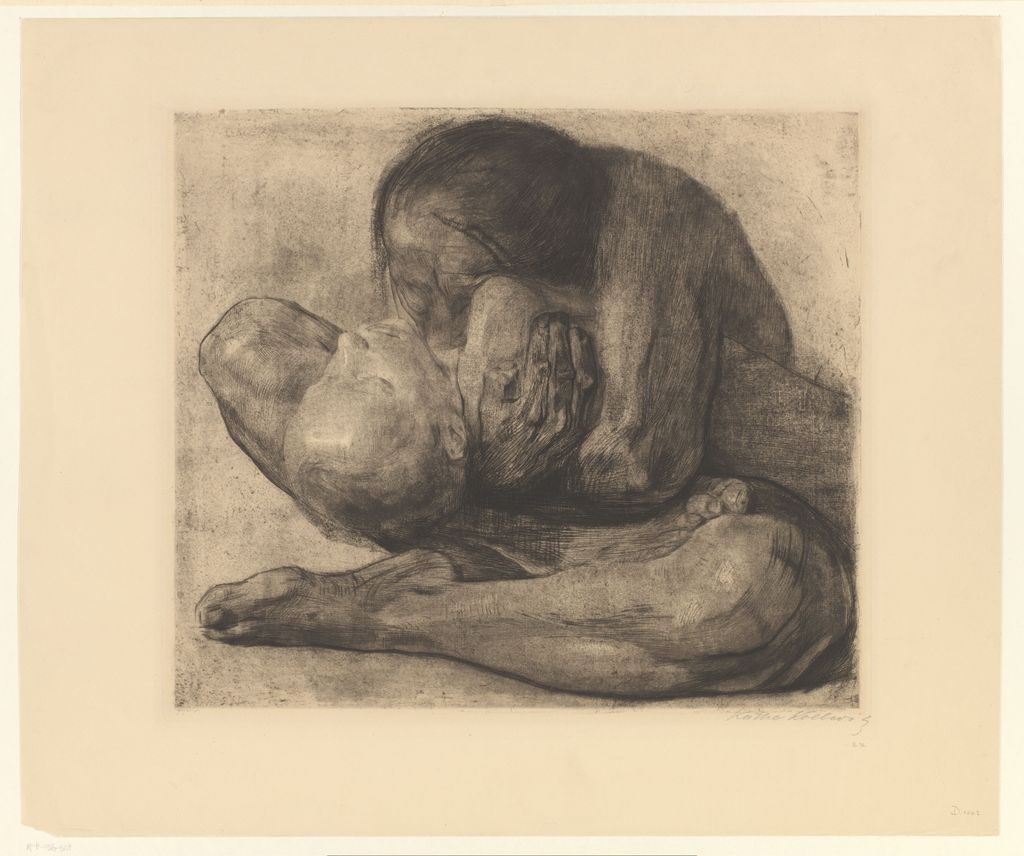
In Britain, her participation in the International Society of Sculptors, Painters and Gravers exhibition in London in 1901 offered another route to an audience. The Cologne museum identifies the exhibition as a possible first encounter with her work for Campbell Dodgson, who later became Keeper of Prints and Drawings at the British Museum. The museum records that Dodgson bought Kollwitz’s work in Germany before the First World War under Lehrs’s influence. His bequest includes two experimental impressions of Woman with Dead Child that later travelled to MoMA’s 2024 retrospective. One carries a gold-coloured wash added by hand. The other was overprinted from a lithographic tone stone sprayed with gold colour. Dodgson’s purchases preserved evidence of two different ways she tested colour on the same image. [23] [10] [15]
Kollwitz returned to Paris in 1904 for two months of sculpture training at the Académie Julian. A letter from Hugo von Tschudi secured visits to Auguste Rodin’s studios in Paris and Meudon. Writing after Rodin’s death in 1917, she recalled the hands in his group of lovers and the conviction with which he gave feeling a sculptural form. Her own The Lovers, shown at the Free Secession in 1916, survives in a 1913 plaster in Boston that MoMA borrowed for its retrospective. MoMA proposed Rodin’s The Kiss as a possible influence and observed that the couple’s embrace can take on the appearance of a Pietà from certain angles. The sculpture took several years to reach an exhibition after her Paris training, while commissions and printmaking remained the centre of her working life. [23] [28] [10] [18]
The Peasants’ War commission and Florence
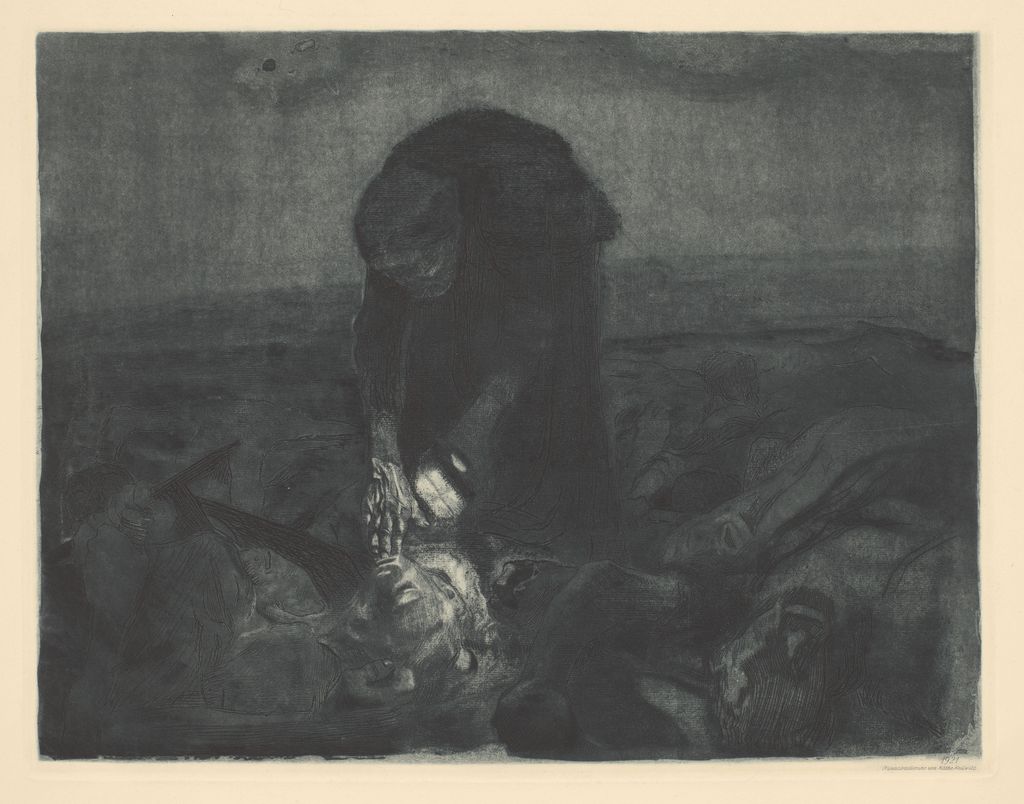
Reading Wilhelm Zimmermann’s history of the German Peasants’ War of 1524–25 gave Kollwitz the subject for a second major cycle. She considered colour lithography before pursuing the series through etching and related processes. To secure support from the Association of Historical Art in 1904, she submitted Charge and the independent print Woman with Dead Child. Lehrs helped secure the commission. The June correspondence shows what that support meant in practice. The association was paying for a plate, while the Dresden print room had been promised impressions. The distinction affected what Kollwitz could charge for the group of sheets Lehrs had already selected. [23] [17] [1]
Kollwitz clarified in her letter of 16 June that Woman with Dead Child was a work in its own right. With the two Peasants’ War proofs taken out of the sale, she asked to receive the proposed 200 marks for the five remaining sheets and said that prompt payment would be particularly welcome. Lehrs was willing to keep the total at 200 marks and proposed booking the trial impressions as gifts from the association. A covering letter records the receipt for the five purchased sheets. Four years later, Kollwitz sent more trial impressions to Emil Richter and offered to give Dresden any it wanted if the print room had no funds for purchases. The letters record her negotiating terms when money was needed and making gifts when she was in a position to do so. [1]
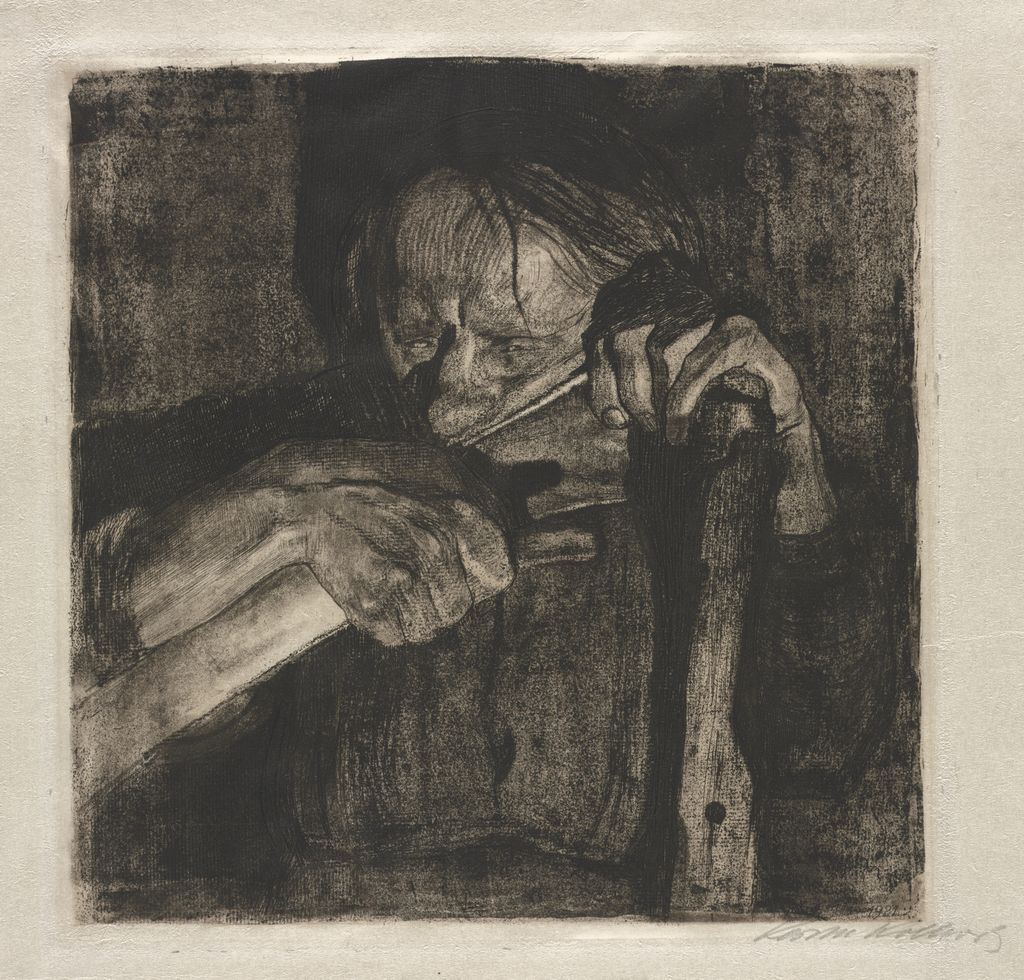
The association published the seven-sheet Peasants’ War with Emil Richter in 1908. The surviving studies for Sharpening the Scythe show why the work took years. In one early composition a man guides a woman in the use of the blade. By the final plate she has the blade in her own hands and occupies the image alone. MoMA’s retrospective brought preparatory drawings and successive impressions together so that viewers could follow the change. The series also travelled in its own time. Strasbourg’s collection records the gift of an impression of Battlefield on 27 June 1908, the year the portfolio appeared. [17] [29] [10] [30]
The Villa Romana Prize took Kollwitz to Florence in 1907 while the cycle was still in progress. In a May letter to her sister Lisbeth she described finding the large galleries overwhelming and having better luck in churches. She sought out frescoes, returned to the galleries and admired Donatello’s sculpture at the Bargello. What stayed with her from Masaccio was the contrast between an exposed, kneeling figure and a group of stiffly standing men. Her letter gives a sense of how she looked at other artists’ work. She picked out a relationship between bodies that could make one person’s predicament visible in a crowded scene. [23]
Peter’s death and the turn towards pacifism
In August 1914 Kollwitz briefly joined the National Women’s Service and helped eighteen-year-old Peter obtain permission to volunteer. Her diary entry of 10 August records Karl’s opposition and her own decision to ask him to let Peter go. She feared what the war might bring and initially accepted the case for taking part. Peter was killed in Belgium in October. Hans served as a medical orderly and returned to Berlin in November 1918. [28]
By October 1918 Kollwitz was publicly challenging the appeals to sacrifice that had helped persuade families like hers. When the poet Richard Dehmel called for a final mobilisation of volunteers, she answered in an open letter published in Vorwärts and the Vossische Zeitung. The young people most likely to respond to an appeal to honour, she argued, would also be the ones sent to their deaths. She turned to Goethe’s image of seed grain that must be saved for sowing. More than twenty years later, in another war, she would use the same image again. [28] [5]
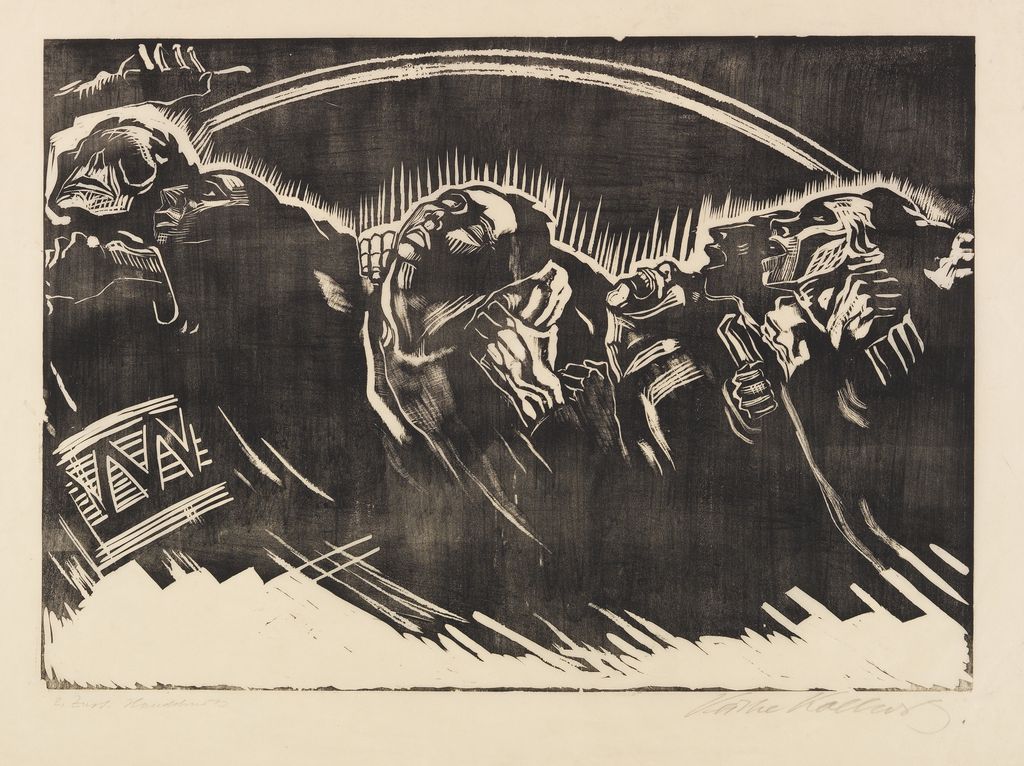
She began work on the War series in 1918. An etched version of The Mothers, worked over by hand, survives from that year, and she tried the subject in lithography in 1919. The woodcuts of Ernst Barlach helped her see what the medium could offer. In the finished series, broad fields of black bring figures into close contact. In The Volunteers, young men follow Death. In The Mothers, adults close ranks around children. Writing to Romain Rolland in October 1922, Kollwitz said she wanted the prints to travel internationally and communicate what people had endured. Emil Richter published the seven woodcuts in 1923. MoMA’s portfolio record documents a signed edition on imperial Japan paper and an additional edition printed from electrotypes in 1924. The work could reach viewers through several editions as well as exhibitions, including a 1924 display at Berlin’s International Anti-War Museum. [31] [10] [32]
The Academy, public campaigns and the journey to Moscow
On 19 January 1919 Kollwitz recorded voting for the first time. She gave her vote to the Majority Social Democrats, although her sympathies reached further left. Five days later she was elected a full member of the Prussian Academy of Arts, the first woman elected since 1833. The same month, after Karl Liebknecht was murdered, his family asked her to draw him in the mortuary. She went on to make the Memorial for Karl Liebknecht, her first woodcut. One surviving preparatory drawing, shown at MoMA, has two portions cut out and replaced where she reworked the figures on the right. Her letter to Annie Karbe in January 1921 distinguishes her political opposition to Liebknecht from what she felt after his death and after reading his letters. In the finished woodcut the workers who came to pay their respects fill the space above his body. [3] [33] [34] [10] [18]
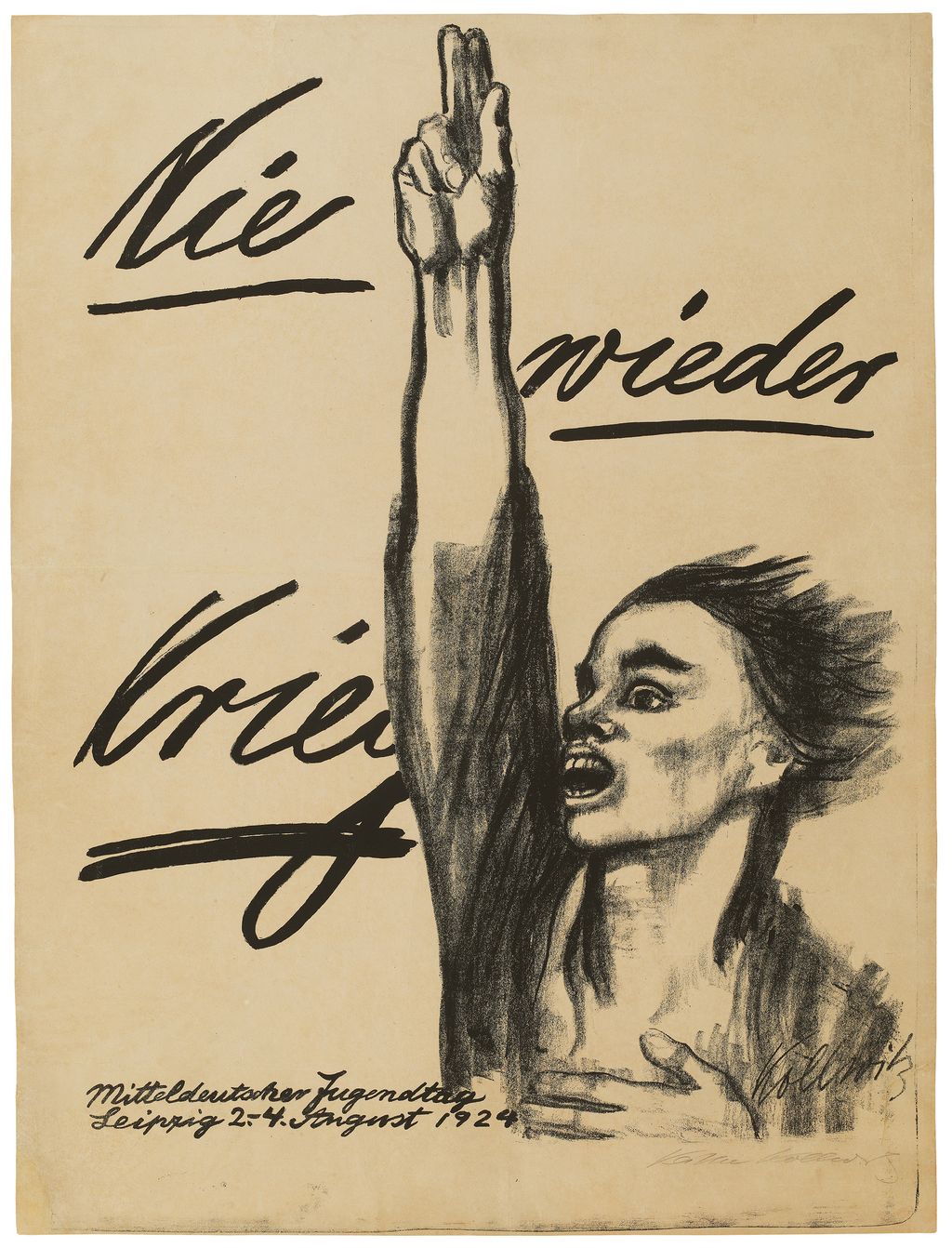
Her posters took that ability to express a shared feeling through a few gestures into the street. In 1924 the Socialist Workers’ Youth in Leipzig commissioned Never Again War!. An open mouth, an upraised arm and hand-drawn lettering turn the words into a public oath. Other campaigns brought different parts of working-class life into public view. For the movement to repeal Paragraph 218, which criminalised abortion, she pictured an exhausted mother with children. The image gave a material setting to a question being argued in law and politics. [35] [18]
Kollwitz turned sixty in 1927. Nearly a hundred prints and drawings were brought together at the Academy’s autumn exhibition, with loans from private and public collections as well as sheets from the artist herself. In November she and Karl travelled to Moscow at the invitation of the Soviet hosts of the tenth anniversary of the October Revolution. Her private letter of 6 November describes the visit as one of the most interesting experiences she and Karl had shared. What excited her was the chance to see the Soviet republic’s political and social arrangements at first hand. In an interview published in a Moscow evening newspaper on 11 November, she compared the scale of the upheaval with the French Revolution and explicitly placed herself outside Communism. [4] [36]
In a memoir fragment written in 1943, Kollwitz remembered having resolved to look at Soviet Russia coolly and finding herself swept up in the experience. She recalled that Karl, who went as a committed Social Democrat, also found much to admire in the new institutions and spoke about the trip on his return. The private letter, published interview and later memoir catch her in different circumstances. The letter conveys the excitement of a visit in progress. The interview makes her political position explicit. The memoir remembers the distance between the critical posture she had intended to take and her response at the time. Her prints had a separate life in the Soviet Union, where exhibitions took place in Moscow and Kazan in 1928. [36] [37]
The memorial in Belgium
In 1928, nine years after her election, Kollwitz became the first woman to direct one of the Academy’s six fine-art master studios. The post gave her a seat in the academic senate and a large workspace. She was already deep into the memorial she had first conceived in late 1914. Two sketches survive in her diary entry for 11 January 1924. In her early scheme the dead soldier lay between his parents. The completed Grieving Parents consists of two kneeling figures, a father upright with folded arms and a mother bowed forwards. The soldiers’ burial ground supplies the presence that she had originally given to the central figure. [28] [3] [4]
A donation from the German Reich and the Prussian state on the occasion of her sixtieth birthday paid for the translation of the plaster models into Belgian granite. The sculptors August Rhades and Fritz Diederich carried out the stonework. Kollwitz supervised the installation at Roggeveld in 1932. The figures were moved to Vladslo in 1956 when the graves were transferred. Bringing the work to completion required years of modelling, public funding and the labour of other sculptors. Its final arrangement depended just as much on where the two figures were placed and what visitors could see in front of them. [4] [13]
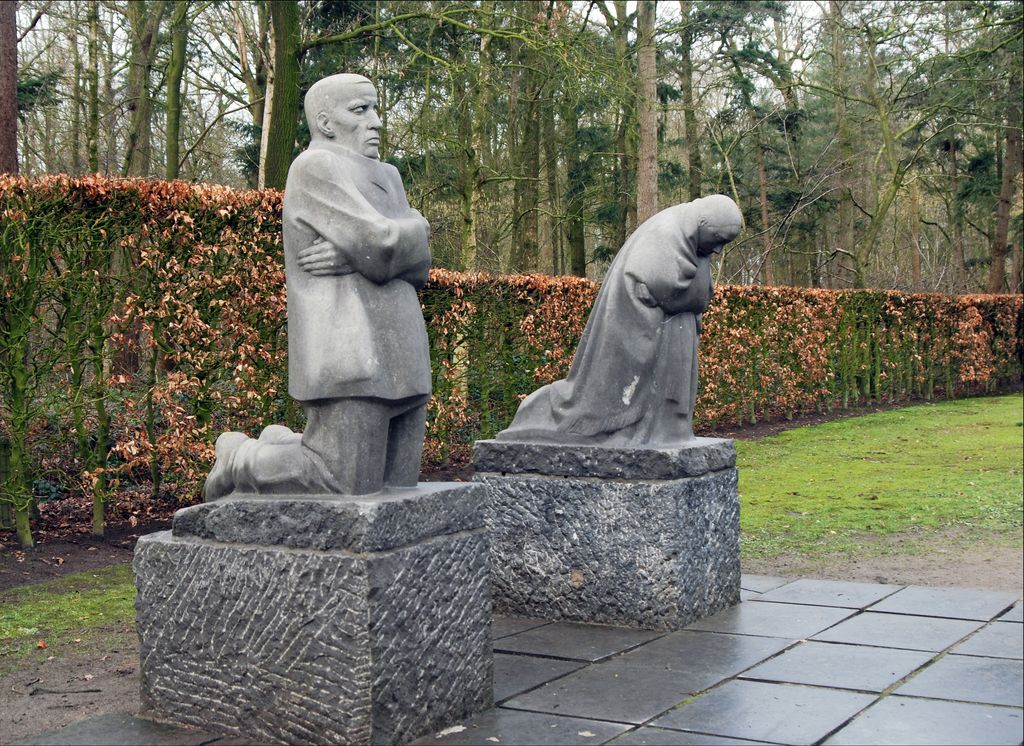
Käthe Kollwitz’s Grieving Parents at Vladslo, the memorial’s location since 1956. Photograph by Bva, resized. Image source. CC BY-SA 3.0. Resized and exported as JPEG.
The appeals against Nazism and the loss of the studio
In June 1932 Käthe and Karl Kollwitz signed the Urgent Appeal, calling on the Social Democratic Party and the Communist Party to cooperate against the Nazis in the Reichstag election of 31 July. The surviving poster proposed a common slate or, failing that, linked lists. After Hitler became chancellor in January 1933, the Kollwitzes and the writer Heinrich Mann backed a renewed appeal ahead of the election on 5 March. Under threat that the Academy would be closed, Kollwitz and Mann were forced to resign in February. She lost her position as head of the master studio, though she could use the workspace into early 1934. [3] [38] [5]
Her diary gives a view of how quickly the pressure reached beyond the Academy. In July 1933 she recorded the forced resignations alongside arrests, searches, the boycott of Jewish businesses and the burning of books. She also noted that doctors who had belonged to the Social Democratic physicians’ association had lost their work with the sickness funds. Karl was among them. In the same entry she recorded that work on Mother with Two Children was going well. The sculpture appears in the diary amid the changes to their income and working conditions, while she still had a room in which she could model it. [39]
From autumn 1934 until 1940 she rented space at the Klosterstraße studio collective. The authorities removed works from exhibitions in Munich in 1935 and Berlin in 1936. Galerie Nierendorf cancelled its planned birthday exhibition in 1937, and the Reich Chamber barred Karl Buchholz’s bookshop from taking it over. That year, the regime confiscated her work from at least eleven German museums while galleries in New York and Los Angeles began showing her prints. At the collective’s exhibitions she sometimes had to substitute works rejected by officials. She also managed to show a substantial group of prints in her own rooms. As dealers grew reluctant to handle her work, those smaller opportunities mattered both for sales and for staying in contact with an audience. [5]
Kollwitz continued to work in several media. In the lithographic Death series, she gave Death markedly different encounters with the living. In Death Seizes a Woman of 1934 the woman twists and raises an arm. In Call of Death, made about 1937, Kollwitz used her own features for the figure who turns towards a hand on her shoulder. Both impressions were shown in MoMA’s retrospective. She also drew herself in profile at work, adding to a body of self-portraits that had begun in her training years. [5] [10] [40] [41]
From 1937 she increasingly favoured small sculptures. They cost less to make, could be worked on in almost any room and suited her declining strength. In October that year she described the work now called Mother with Her Dead Son in her diary. The mother sits with her son between her knees, absorbed in looking at him. Whereas the two figures at Vladslo are separated and face out towards the graves, the mother and son in the small sculpture share a silhouette. Cologne’s zinc cast stands under forty centimetres high. Its scale makes the way the mother gathers the body into her lap visible at close quarters. [5] [20]
The last years, from Berlin to Moritzburg
Kollwitz began the small sculpture Farewell in February 1940 as Karl’s health declined. He died in July. She moved her work back into the flat that autumn and finished the group in April 1941. In May 1941 she wrote to the artist Sella Hasse about the arrangement. Her bedroom doubled as her workspace and she kept everything within reach, so that she could work for half an hour whenever she had the strength. She also kept up friendships with other artists. Letters from 1929 to 1940 preserved by the Institut national d’histoire de l’art document her encouragement of the younger Ukrainian physician and sculptor Opanas Shevchukevich. [5] [42]
In 1941 she returned to the image of seed grain from her 1918 letter. Her lithograph shows a woman using her arms and body to shield children. In her diary Kollwitz treated the work as a testament and described its appeal as a demand. In 1942 her eldest grandson, Peter, was killed in the war in Russia. Before leaving Berlin the following year, she finished her last small sculpture, Two Soldiers’ Wives, Waiting. The women’s shared vigil gives form to an experience that had occupied her since the first war, when people at home could do little but wait for news. [28] [5]
On 27 July 1943 Kollwitz wrote to Hanna Bekker vom Rath that she had doubted whether she was well enough to leave Berlin. The prospect of going with her sister Lisbeth helped her contemplate the journey. On 3 August she accepted the sculptor Margret Böning’s offer of refuge in Nordhausen. The Berlin flat was destroyed in an air raid on 23 November, after her departure. Many drawings and nearly all her early paintings were lost, and a further raid destroyed Hans’s house in December. Böning and Clara Stern had already moved a substantial group of graphic works to safety. [5]
In Nordhausen, Kollwitz went through the rescued sheets, discarded impressions she considered unsuccessful and signed the ones she wanted to preserve. In a letter to Hans on 10 December she explained that she had allowed large editions because she wanted her prints to reach many people. The letter brings two decisions into view. She had wanted the work to circulate widely, and she was still willing to judge individual sheets closely when deciding what should survive. Both choices had been present in her practice since the years when Lehrs wrote to ask for selected impressions. [5] [1]
As air raids intensified around Nordhausen, Kollwitz moved again on 20 July 1944. Invited by Prince Heinrich of Saxony, she took two rooms in the Rüdenhof at Moritzburg, near Dresden. Her granddaughters Jördis and Jutta helped care for her and preserve work she had brought with her. She died in the house on 22 April 1945. A small funeral took place at the local cemetery two days later. She was first buried in Moritzburg and her final resting place is the family grave in Berlin-Friedrichsfelde. [5] [11]
How her work survived
The surviving record reflects decisions made over a lifetime. Print rooms kept working impressions alongside finished prints. Friends and relatives moved work out of Berlin. Her son Hans placed the estate on long-term loan with the Akademie der Künste in 1967. Its holdings include ten diaries from 1908 to 1943, with letters, press cuttings and other papers tucked among the pages. Three charts she made between 1929 and 1934 track the progress of works alongside journeys and productive periods. They preserve something of how Kollwitz herself kept account of her working life. [3] [5] [1]
After her death, her work entered settings of very different scales. An enlargement of her small Pietà was installed at Berlin’s Neue Wache in 1993 as part of Germany’s central memorial to the victims of war and tyranny. The British Museum and Ikon took a selection of her works on paper from Birmingham in 2017 to Salisbury, Swansea and Hull, then to London in 2019. In New York, MoMA’s retrospective, organised by Starr Figura with Maggie Hire, ran from 31 March to 20 July 2024. By bringing drawings, trial impressions and finished works together, it let visitors follow decisions that are often invisible in a single published print. The Käthe Kollwitz timeline brings the dates of her life and work together, and the account of her reception follows the later exhibitions and memorials. [20] [43] [10] [44]
Käthe Kollwitz artworks directory
Selected documented works, including the complete published sequences of the five cycles discussed here. Catalogue links identify the specific record behind each row.
Frequently Asked Questions
Yes. She trained in painting in Berlin and Munich and made early experiments in oils before concentrating on drawing and printmaking. Nearly all her early paintings were lost when the Berlin flat was destroyed in 1943. Her experiments in colour survive in other media, including the three-colour lithograph Self-Portrait en Face at MoMA. [2] [5] [27]
Discussion
Look again at the images and ideas explored in Käthe Kollwitz Biography. These editorial prompts invite your observations.
Reader Insights
How did print-room directors and publishers shape the opportunities available to Kollwitz?
Which parts of her work changed as she moved between studios and institutions?
Which change in Kollwitz’s working space had the clearest effect on what she could make?
Join the Conversation
Share a detail, comparison or question about Käthe Kollwitz Biography below.
References
- Archiv der Staatlichen Kunstsammlungen Dresden, Briefwechsel zwischen Käthe Kollwitz und Max Lehrs, 1898–1929, pp. 8–9 and 39–43. Includes 01/KK 04 Bd. 4, nos. 535–539, Bd. 9, nos. 222–223, 226 and 227–229, and Bd. 13, no. 135. View source.
- Kollwitz Museum Köln, Timeline, 1867–1890, including the letter to Peter Hahn and recollections of her training. View source.
- Akademie der Künste, About Käthe Kollwitz, including diary volume 8, pp. 68–69, 11 January 1924, and the archive history. View source.
- Kollwitz Museum Köln, Timeline, 1927–1932. View source.
- Kollwitz Museum Köln, Timeline, 1933–1945, including letters to Sella Hasse, Hanna Bekker vom Rath and Hans Kollwitz. View source.
- Käthe-Kollwitz-Museum Berlin, Käthe Kollwitz in Berlin. View source.
- Kollwitz Museum Köln, Timeline, 1891–1900. View source.
- Kollwitz Museum Köln, A Weavers’ Revolt, 1893–1897. View source.
- Kollwitz Museum Köln, Käthe Kollwitz: Biografie. View source.
- Museum of Modern Art, Käthe Kollwitz, 2024 exhibition checklist. View source.
- Käthe Kollwitz Haus, Moritzburg, account of the Rüdenhof and Kollwitz’s final months. View source.
- Kollwitz Museum Köln, Parisian Inspirations. View source.
- Hannelore Decoodt and Nele Bogaert, Agentschap Onroerend Erfgoed, Treurend ouderpaar (Vladslo – WOI). View source.
- Staatliche Kunstsammlungen Dresden, Kupferstich-Kabinett, Kollwitz–Lehrs correspondence, letters of 8 and 13 June 1898, 01/KK 04 Bd. 4, nos. 535–539. View source.
- British Museum, Portrait of the Artist: Käthe Kollwitz, exhibition press release and collecting history. View source.
- Museum of Modern Art, Woman with Dead Child, state VIII/X, 1903. View source.
- Kollwitz Museum Köln, The Peasants’ War Cycle. View source.
- Museum of Modern Art, Käthe Kollwitz, 2024 extended gallery labels. View source.
- Kollwitz Museum Köln, Death, series catalogue. View source.
- Kollwitz Museum Köln, Pietà (Mutter mit totem Sohn), Seeler 37, including the diary entry of 22 October 1937. View source.
- Kollwitz Museum Köln, Arthur Schopenhauer, 1883, with Georg Paga’s inscription. View source.
- Universität der Künste Berlin, Das Frauenstudium in der Bildenden Kunst. View source.
- Kollwitz Museum Köln, Timeline, 1901–1913, including the May 1907 letter to Lisbeth Stern and the obituary for Rodin. View source.
- Kollwitz Museum Köln, Sozialkritik, including Kollwitz’s 1941 recollections. View source.
- National Gallery of Art, Washington, Out of Work, 1909, collection record and verso inscription. View source.
- Nathalie Muller, Institut national d’histoire de l’art, Käthe Kollwitz (1867–1945), part 2, with the Lehrs correspondence and Dresden gallery records. View source.
- Museum of Modern Art, Self-Portrait en Face, c. 1904, state I/II. View source.
- Kollwitz Museum Köln, Timeline, 1914–1918, including the diary entry of 10 August 1914 and the October 1918 open letter. View source.
- French Ministry of Culture, Joconde, Schlachtfeld, Blatt 6, Strasbourg accession 5.916. View source.
- Museum of Modern Art, Käthe Kollwitz, 2024 exhibition section texts, including the development of Sharpening the Scythe. View source.
- Kollwitz Museum Köln, The War Series, including letters to Romain Rolland and Erna Krüger, 1922. View source.
- Museum of Modern Art, War (Krieg), 1923, portfolio 470.1992.1–8. View source.
- Kollwitz Museum Köln, Timeline, 1919–1926, including the diary entry of 19 January 1919. View source.
- Kollwitz Museum Köln, Gedenkblatt für Karl Liebknecht, including Kollwitz’s letter to Annie Karbe, 21 January 1921. View source.
- Kollwitz Museum Köln, Never Again War, 1924, Kn 205 III b. View source.
- Käthe Kollwitz, reproduced by German History in Documents and Images, Moscow letter of 6 November 1927, interview of 11 November 1927 and memoir fragment of 1943. View source.
- Käthe-Kollwitz-Museum Berlin, Käthe Kollwitz und Russland – Eine Wahlverwandtschaft, exhibition catalogue record. View source.
- Bundesarchiv, reproduced by German History in Documents and Images, Dringender Appell!, June 1932, poster Plak 002-037-024. View source.
- Käthe Kollwitz, reproduced by German History in Documents and Images, Diary entries on the rise of National Socialism, 1930–1933. View source.
- Museum of Modern Art, Death Seizes a Woman, 1934, plate 4 from Death. View source.
- Museum of Modern Art, Call of Death, c. 1937, plate 8 from Death. View source.
- Nathalie Muller, Institut national d’histoire de l’art, Käthe Kollwitz (1867–1945), part 1, including the Shevchukevich correspondence. View source.
- Ikon, Portrait of the Artist: Käthe Kollwitz at the British Museum, London, exhibition and tour record. View source.
- Museum of Modern Art, Käthe Kollwitz, exhibition record, 31 March–20 July 2024. View source.
More KOLLWITZ Works
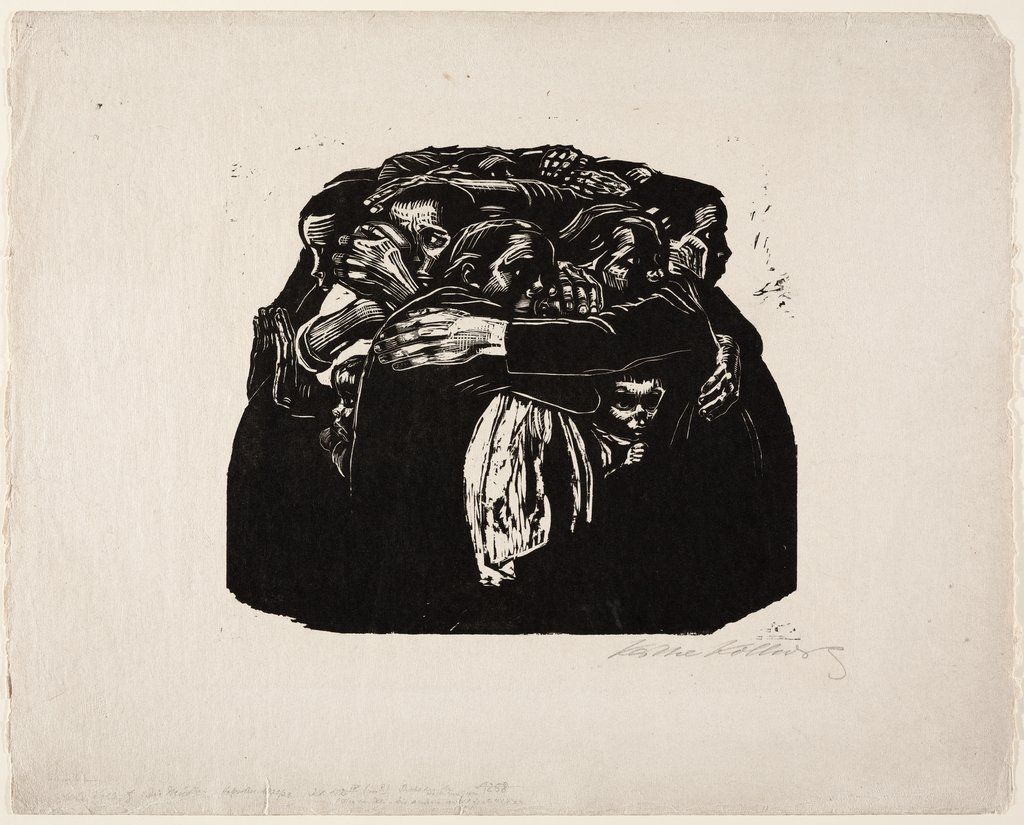
The Mothers
The Mothers, 1921–22. Städel Museum, Frankfurt am Main, SG 4289A D. Image source. Public domain. Resized and exported as JPEG.
The Grieving Parents
The Grieving Parents at Vladslo, the memorial’s location since 1956. Photograph by Bva, resized. Image source. CC BY-SA 3.0. Resized and exported as JPEG.
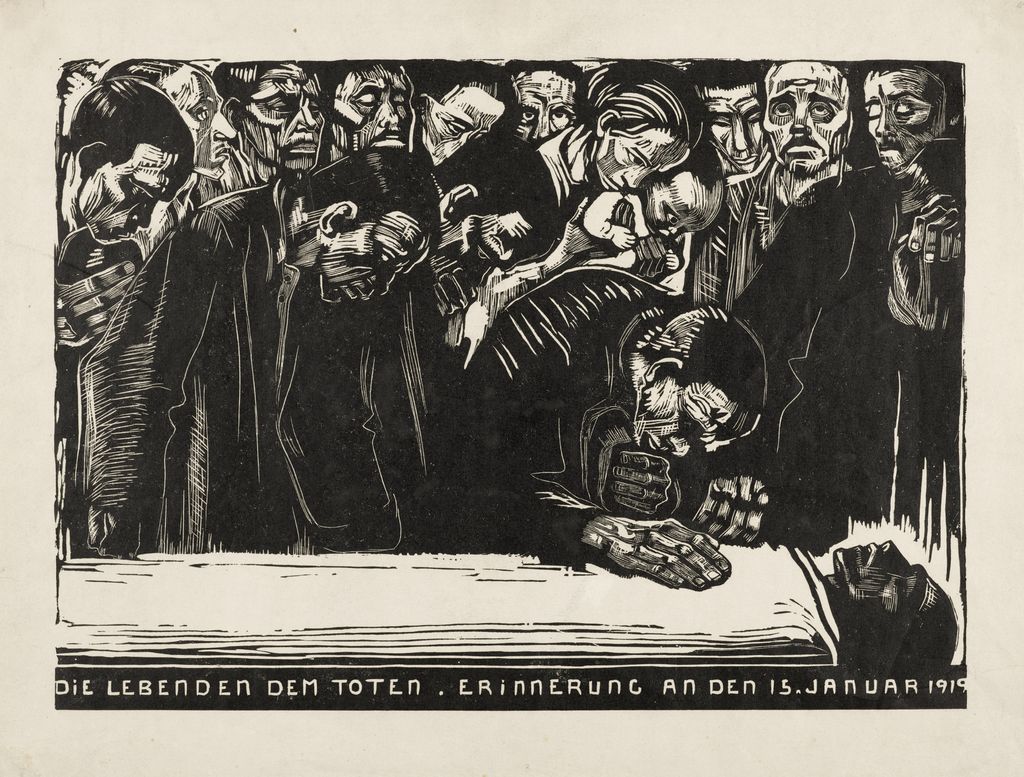
Memorial for Karl Liebknecht
Memorial for Karl Liebknecht, 1920. Kunstsammlungen Chemnitz, 86-47, Kn 159 VI. Photo: Kunstsammlungen Chemnitz/PUNCTUM/Bertram Kober. Image source. Public domain. Resized and exported as JPEG.