


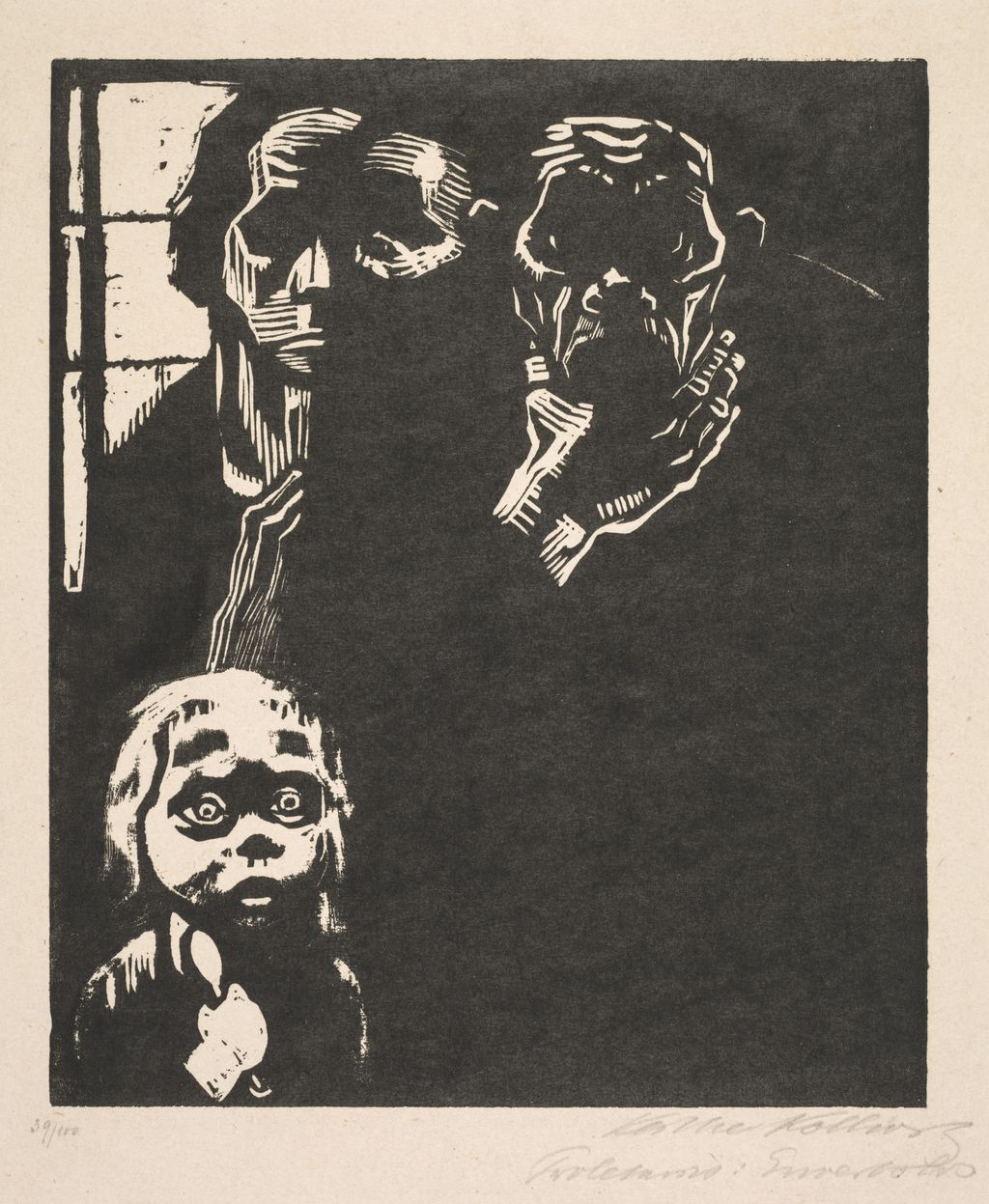
Out of Work, sheet 1 of Proletariat. Cleveland Museum of Art, 1950.206. Image source. CC0 / Public domain. Resized and exported as JPEG.
 by Tom Gurney
Tom Gurney BSc (Hons) is an art history expert with over 20 years experience
Email: tomgurney1@gmail.com / Phone: +44 7429 011000
Proletariat by Käthe Kollwitz: Introduction
Käthe Kollwitz opens Proletariat with three faces emerging from darkness. She gives the largest sheet to a crowd driven forward by a skeletal figure with a whip. In the last woodcut, a woman holds a child’s coffin. The three sheets change the scale at which we see deprivation. The first makes us spend time with people who have no work. The second shows what hunger can do to a multitude. The third gives one person the weight of a loss that the title tells us is repeated across many households. [1] [2] [3] [4]
The portfolio’s title names a social class whose livelihood depends on paid work. Its subjects are what happens when work disappears and what that loss can mean to people who have no wage of their own. Kollwitz gives each sheet a different pace. A head rests on a hand, a whip swings over a crowd, and a woman holds still. Seen together, the prints connect economic insecurity to the daily work of keeping a family alive. [1] [2] [3] [4]
At a Glance
- ArtistKäthe Kollwitz
- MediumThree woodcuts printed in black
- Made1924–25
- Published1926 by Emil Richter, Dresden, in an edition of 100
- First sheetErwerbslos (Out of Work), Kn 215
- Second sheetHunger, Kn 222
- Third sheetKindersterben (Child Mortality), Kn 216
- Complete numbered exampleStädel Museum, Frankfurt, set 22/100 on Japanese paper [1] [2] [3] [4] [5]
Contents
- Out of Work (Erwerbslos)
- Hunger
- Child Mortality (Kindersterben)
- The numbered edition and the surviving proofs
- Urban hardship from the magazine page to the portfolio
The portfolio in published order
2. Hunger
Photo: Kunstsammlungen Chemnitz/PUNCTUM/Bertram Kober. Image source.
3. Child Mortality
Kindersterben. Kn 216.
Out of Work (Erwerbslos)
In the Städel and Cleveland impressions, the faces take shape in short, angular cuts. Two adults occupy the upper part of the image. The figure on the right rests their chin on one hand, and the child’s face appears below. A few faint lines at the left suggest a window or the edge of an interior. Elsewhere the surrounding black absorbs most of the bodies. That economy makes the position of the hand unusually important. The marks that pick out the fingers continue into the face they support, fixing the adult in a posture that could be held for a long time. The child’s more direct gaze draws the eye back out of the darkness. The figures share close quarters, yet their different gazes give each a separate interval of waiting. [2] [6]
The German title Erwerbslos describes the condition of being without gainful employment. Much of the ordinary evidence by which a viewer might identify a particular worker or trade has dropped out of the scene. The child’s presence makes the loss of a livelihood legible at household scale. It matters that the child is placed low in the picture, where the eye may arrive only after studying the adults. The consequences of their situation extend down into a life that depends on them. [1] [2] [6]
Kollwitz had originally given that predicament a tangible centre. In Erwerbslos – Leere Schüssel (Out of Work – Empty Bowl), the rejected design of 1924 or early 1925, a mother shows the man and children an empty bowl. The Getty Research Institute catalogues its impression as Kn 214, or Klipstein 197, and records Kollwitz’s handwritten designation Zustandsdruck, meaning a state proof. The finding aid lists a single catalogued state of this design. Another impression, documented by Galerie Kornfeld, was reworked with Indian ink and opaque white. Those additions are on the paper and describe the treatment of that particular impression. They do not establish another recorded state of the block. [7] [8]
The bowl would have carried the viewer directly from a shortage of work to a shortage of food. The completed design, Kn 215, gives the faces that burden and leaves the second sheet to make hunger explicit. Although both designs have an image area of roughly 360 × 300 mm, they organise attention differently. In one, a person presents an object for the others to see. In the other, the hand holds up a head and the people are left with their thoughts. [2] [6] [7] [8]
The surviving proofs also show revision within the completed design. The National Gallery of Art in Washington catalogues 1943.3.5227 as state II under Klipstein 206. The three faces and the hand at the chin are already in place. The Getty’s state V of Kn 215 has white gouache applied to the printed sheet, evidence of work on an impression after it came off the block. Berlin’s 362-1927 is an unnumbered tenth-state proof for Richter’s edition. The Städel catalogues its numbered impression as Kn 215 X a and Klipstein 206 VIII b. Cleveland gives its own sheet as Klipstein VIII c of VIII c. The Roman numeral needs its catalogue name, since Knesebeck and Klipstein divide the development of the image differently. The accession number then identifies the sheet under discussion. [1] [2] [6] [7] [9] [10]
Berlin and Frankfurt both give 360 × 300 mm for the block, but their sheets measure 693 × 550 mm and 504 × 364 mm respectively. The much larger Berlin sheet carries the same-sized image in a wider expanse of paper. That distinction matters when the prints are reproduced at a common width on a screen. A photograph of the whole sheet can make the image in the broader margins appear smaller, even where the recorded block measurements agree. [1] [2]
Hunger
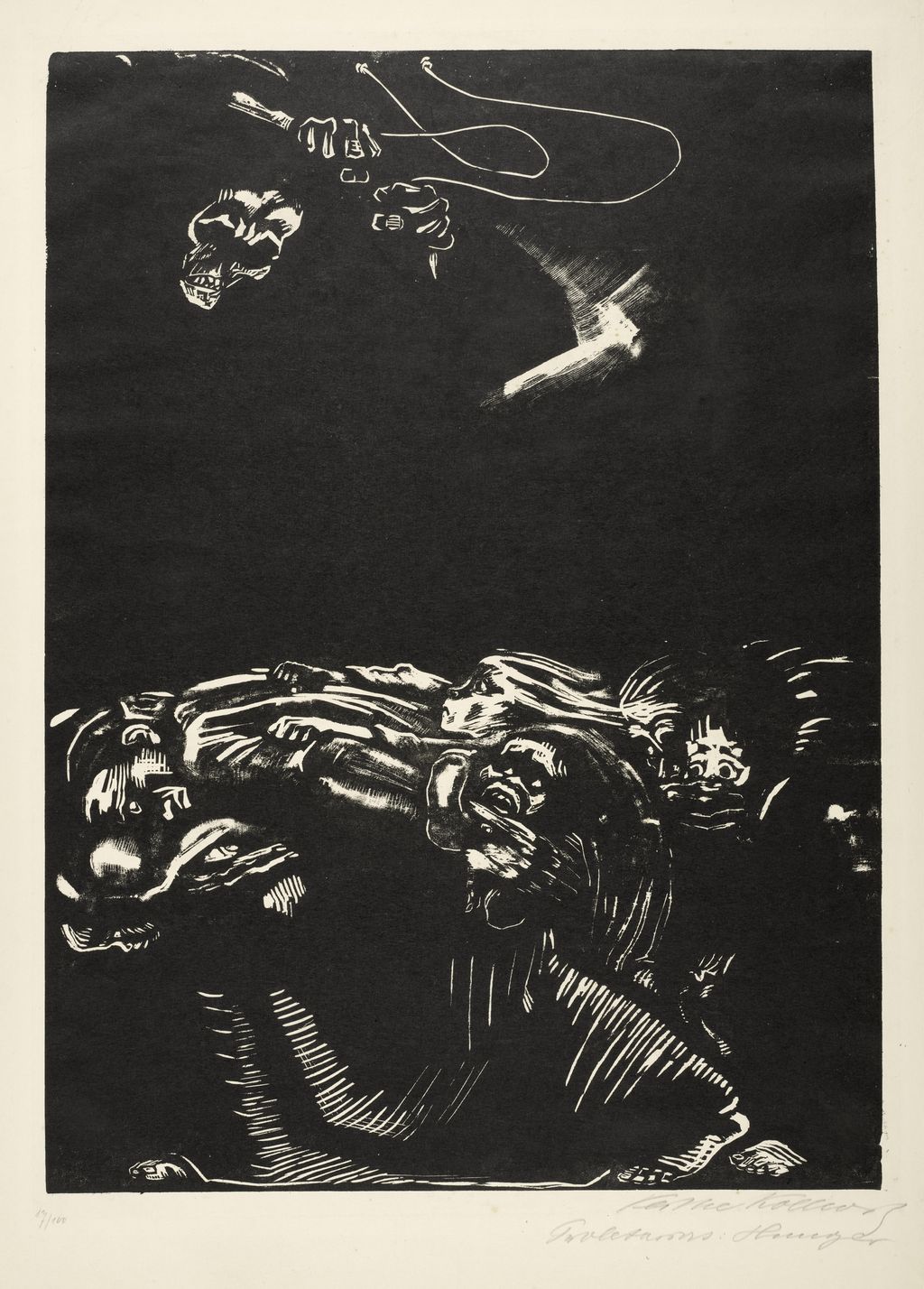
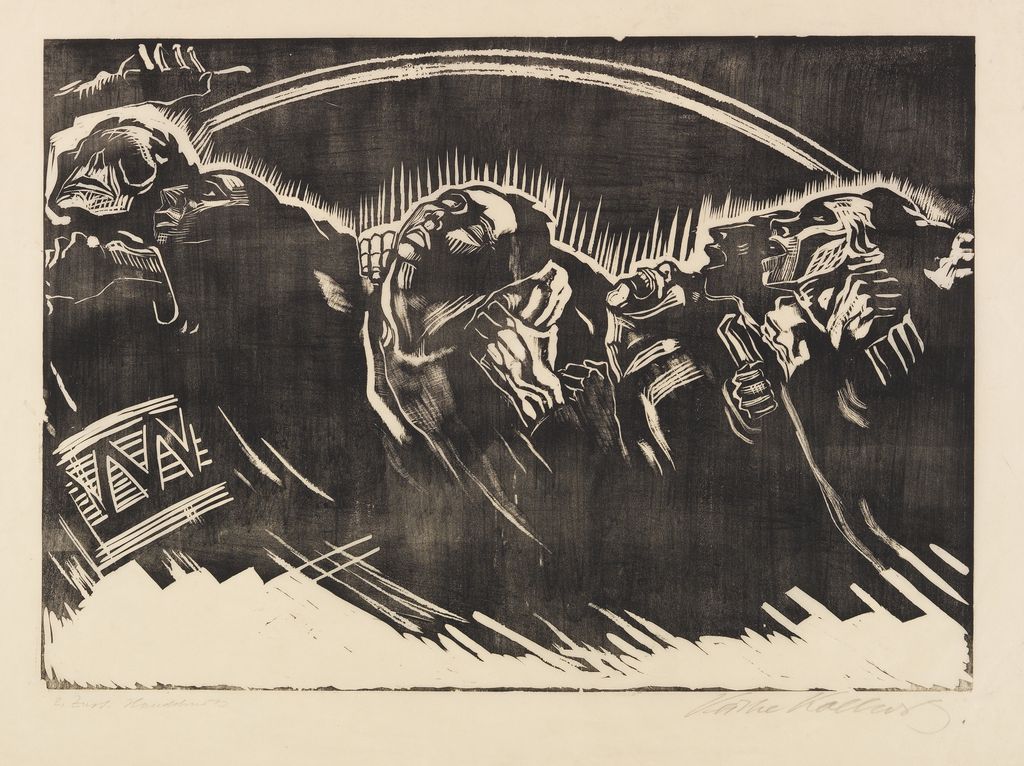
The middle woodcut changes the scale of the encounter. The block of the Städel’s Hunger measures 585 × 430 mm, almost two and a third times the area of the opening block. The extra space is distributed unevenly. In the Chemnitz impression, the people are crowded low in the image, where slashing white cuts bring out mouths, hands, hair and folds of clothing. Several bodies bend into one another. The darkness between the crowd and the skull above it is comparatively open. Across that dark space, the line of the whip can be followed with an ease that the interlocked bodies deny the eye below. [2] [3] [11] [12]
Kollwitz makes the forces acting on the crowd visible through the different kinds of line she gives them. Up top, the loop of the lash is long and thin, and the skull and the hand that grips the whip appear in isolated bursts of light. Below, the marks are often short, parallel and interrupted. A face comes clear for a moment, then gives way to a shoulder or an arm. In the opening print, the dark field lets the eye settle on each face in turn. Here, even a face that catches the eye can be hard to separate from the person next to it. A viewer experiences something of the crowding before making sense of the group as a whole. [2] [3] [12]
The skeleton has a documented precursor in the lithographic poster Wien stirbt! Rettet seine Kinder! (Vienna Is Dying! Save Its Children!), Kn 148. On 5 January 1920 Kollwitz wrote in her diary that she wanted to show Death swinging the whip of hunger as men, women and children passed bent over, crying out. The poster was made for a proposed relief campaign for Vienna. Cologne attributes the failure to put it on public display to the cancellation of the campaign amid worsening hardship in Germany. Berlin confirms that it was never publicly distributed and leaves the reason open. In the poster, the lettering names the city and tells the public whom to save. In the portfolio, the whip has to work within an image titled simply Hunger. Its company is a household without work on one side and a woman with a coffin on the other. [3] [13] [14]
The earlier motif gave Kollwitz a starting point for a long period of work on the block. The Getty dates Kn 222 to May–September 1925 and lists fifteen states. Its exhibition checklist records two fragments from states VI and VII, both worked over in black ink. The finding aid gives image heights of 29.4 and 31.2 cm for the fragments, with widths of about 43 cm. The state XII impression carries the full-height image, 58.5 × 43 cm. The fragments show how Kollwitz could inspect and alter part of the design on paper. Their dimensions measure what survives on those sheets and give no secure basis for reconstructing the block’s dimensions at those stages. The state XII sheet also carries a pencilled designation for the eleventh state. The Getty distinguishes that inscription from the state assigned in both published catalogues. [7] [15]
The surviving impressions of state XV raise a different question. The Städel’s 22/100 is Kn 222 XV a and Klipstein 207 XV b. Washington’s Rosenwald impression, 1943.3.5252, is listed as Klipstein 207 XV c. Chemnitz catalogues KH 26-28 as Kn 222 XV b. Berlin’s 364-1927 is an unnumbered fifteenth-state impression for the Richter edition, and the Getty records a further unnumbered proof as Kn 222 XV a. A final-state number locates the impression in the development of the image. Its place in the numbered issue requires separate evidence, and the letter suffixes have to be read within the catalogue that assigns them. [3] [7] [16] [12] [14]
The full-size photograph of the Chemnitz sheet supplies that separate evidence. The pencilled number at the lower left reads 17/100. Beneath the signature at the lower right, the pencilled title ends in Hunger. The collection’s online transcription gives Erwerblos in that position, but the photographed inscription agrees with the object record’s title, its identification as sheet two and its Knesebeck number. Chemnitz records acquiring this impression from Emil Richter in 1926. LACMA likewise distinguishes the making of its impression’s design in 1925 from publication in 1926. [11] [12]
Kollwitz had also made a separate woodcut called Hunger in 1922, Kn 182. MoMA’s impression, 67.2025, is from the sixth and final state of that design. Its nearly square composition measures 22 × 22.8 cm. The catalogue numbers and dimensions identify two distinct works, both in woodcut, with the same title. [3] [7] [17]
Hunger, sheet 2 of Proletariat. Kunstsammlungen Chemnitz, KH 26-28. Photo: Kunstsammlungen Chemnitz/PUNCTUM/Bertram Kober. Image source. Public domain. Resized and exported as JPEG.
Child Mortality (Kindersterben)
After the middle sheet, the last woodcut brings the eye back to a single face. In the Städel impression the face is gaunt, with dark hollows around the eyes. The woman holds a small coffin in front of her. Its straight edges introduce a hard geometry into an image organised around the irregular lines of a face and body. Looking from the face to the coffin, the eye passes from the effort of a person holding something to an object whose size tells us who has died. The child who appeared at the lower edge of the opening scene gives that scale a particular force, even though the portfolio supplies no named family or continuous plot. [2] [4] [18]
Berlin describes the figure as an embodiment of high child mortality in working-class families. The title makes that reading possible without assigning a medical cause to this death. Child Mortality names a recurring condition, while the image insists on a particular experience of carrying and holding. In Out of Work the adult’s hand supports their own head. In Hunger a hand holds a whip above people bending under its reach. In Kindersterben the woman’s hands have a task that brings the series back to the limits of what one person can do for another. [2] [3] [4] [18]
The block measures 365 × 278 mm, close to the first sheet in height and slightly narrower. Berlin’s third-state impression, 354-1927, is on Japanese paper and is expressly catalogued as outside the edition. Its sheet measures 695 × 547 mm, against 505 × 372 mm for Frankfurt’s numbered Kn 216 III a. Cologne illustrates its own Kn 216 III b, 70300/84042, under the English title Child Mortality. The two lettered catalogue entries and Berlin’s more general third-state description establish how those museums identify their impressions. The public records give firmer grounds for comparing dimensions, paper and issue status than for assigning a visible change in the cutting to each label. [4] [18] [19]
The Berlin Kupferstichkabinett describes Proletariat as a triptych. The relative dimensions make that term concrete. Two compact vertical images flank a centre more than half a metre high. The outer sheets concern the household and the individual, while the central sheet supplies the scale of a public calamity. The last print is easy to read as a consequence of what precedes it, but it also changes the opening retrospectively. The child’s face in Out of Work, initially one of three faces in a dark room, takes on a vulnerability the first title alone leaves implicit. [1] [2] [3] [4]
The numbered edition and the surviving proofs
Cologne dates the making of the cycle to 1924–25. The Institut national d’histoire de l’art in Paris lists it under 1925 in its survey of Kollwitz’s print cycles. Berlin documents the next event, Richter’s publication of the three woodcuts in Dresden in 1926 in an edition of 100. Chemnitz’s purchase from Richter that year shows the edition entering a public collection. Berlin’s three sheets followed another route. The Kupferstichkabinett bought them directly from Kollwitz in 1927 and records the end of her ownership as 21 December. Its first and second sheets are unnumbered examples prepared for the edition, while the third is catalogued as outside it. [1] [12] [18] [19] [20] [14]
This distinction between the date of a design and the date attached to an impression also applies to Kollwitz’s earlier print cycles. The 2024 MoMA checklist dates its Basel loan of Battlefield, sheet six of Peasants’ War, to 1907. The Rijksmuseum dates its own impression, RP-P-2011-36-320, to 1921 in the object’s Dating field. A separate inscription transcribed in the Amsterdam record describes a printing range of 1921–31. The dates belong to different pieces of evidence. In Proletariat, it is the Berlin publication record, the acquisition from Richter and the marks on the numbered sheets that establish how the later date relates to the making of the designs. [1] [12] [21] [22]
Frankfurt’s set came from the collection of Helmut and Hedwig Goedeckemeyer. Helmut began collecting Kollwitz’s prints shortly after the First World War, and the city acquired the Kollwitz collection for the Städtische Galerie in 1964. On each of the three sheets the Städel records a pencil signature and title at the right below the image and the number 22/100 at the left in another hand. It separates these marks from later pencil annotations describing the sheets as among 25 impressions on Japanese paper. Collector and municipal stamps on the backs add evidence of a different kind, recording the sheets’ passage into collections. [2] [3] [4] [5]
The annotations are the source of the figure 25. Berlin’s edition record is the source of the figure 100. Frankfurt documents the paper of its own set, while Berlin and the Getty document Japanese paper on proofs or on an impression outside the edition. The available records leave the complete paper breakdown of Richter’s issue open. A useful description of any one of Kollwitz’s prints therefore keeps the block, the paper, the catalogue state, the edition number and the later marks separate. On the Chemnitz Hunger, for example, the block gives us the crowd, the pencil number connects the sheet to the edition, and the acquisition record connects that particular object to Richter in 1926. [1] [2] [3] [4] [7] [12] [18] [5] [14]
Urban hardship from the magazine page to the portfolio
Unemployment had occupied Kollwitz well before the Weimar Republic. In the 1909 drawing Arbeitslosigkeit, Washington accession 1943.3.5218, a man props his face in his fists while a woman reclines with sleeping children. Black chalk and opaque white watercolour over blue pencil on grey-brown paper give the bedding its pale expanse and the dark foreground figure its weight. Kollwitz wrote her Berlin address, Weißenburger Straße 25, on the reverse. The drawing gives the household depth and room for bodies to lie down. Sixteen years later, the woodcut closes much of that space around the faces. The hand at the head survives as a gesture of strain in a composition that gives the viewer far less room to look away from it. [2] [6] [23]
The separate 1909 intaglio Arbeitslosigkeit, Kn 104, develops the subject through line etching, drypoint, aquatint, sandpaper and soft ground in the Cologne impression. Cologne identifies a woman in childbed with an infant and two older children asleep near the foot of the bed. MoMA’s 2024 checklist records the Washington drawing and an intaglio impression from the Ute Kahl collection as separate exhibits on the same page. Cologne also records that a preparatory drawing appeared in Simplicissimus on 19 July 1909. The magazine gave the scene the title Das einzige Glück (The Only Good Fortune) and a caption to the effect that the state would tax children too if it had no need of them as soldiers. That caption supplies a target and a bitter punchline. In Proletariat, the short titles leave more of the connection to the images and their order. [23] [24] [25] [26] [21]
The living conditions behind the images spanned both periods. In her essay for MoMA’s 2024 exhibition, Maggie Hire describes overcrowding, poverty and unemployment in working-class districts such as Prenzlauer Berg, where the Kollwitz family lived. The Deutsches Historisches Museum’s account of everyday life in the Weimar Republic places unemployment and hunger alongside a severe postwar housing shortage that persisted into 1925. The prints give those conditions a visual form while leaving individual cases unspecified. In the first sheet, the tight grouping suggests how difficult it would be to find privacy within a shared room. In the last, the isolation of the woman brings into view a burden that could recur in many such rooms. [2] [4] [27] [28]
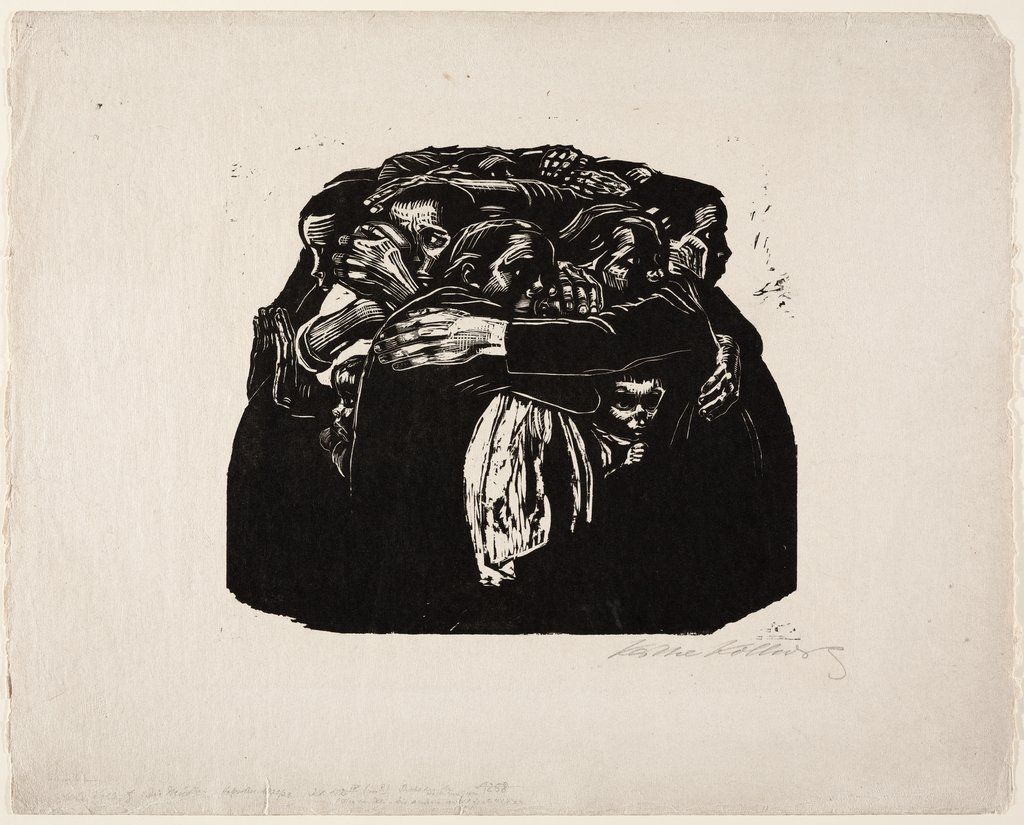
The most immediate precedent for the woodcuts was War, the seven-sheet suite Richter published in 1923. Its sixth sheet, The Mothers, gathers women and children into a compact mass. Arms cross, faces show through openings, and the women’s bodies form the group’s outer boundary. The Art Fund’s record for the impression acquired by The Higgins Bedford places the work in the context of First World War bereavement. MoMA identifies its own final-state woodcut as 470.1992.6, and its 2024 checklist sets the published image alongside a history of revision that includes a rejected 1918 intaglio and a rejected 1919 lithograph. As with Out of Work, the published composition is the result of choices that can be followed across distinct objects. [29] [30] [31] [21] [32]
The comparison sharpens the last sheet of Proletariat. In The Mothers, enclosure offers the children a measure of protection. In Kindersterben, the coffin is the enclosure, and one woman’s arms bear its weight. The altered gesture is where the portfolio’s social criticism becomes most specific. The three titles lead from work to food to survival, while the last image makes the cost of that sequence visible in what the woman is left to carry. [1] [4] [18] [30] [32]
Käthe Kollwitz artworks directory
Selected documented works, including the complete published sequences of the five cycles discussed here. Catalogue links identify the specific record behind each row.
Frequently Asked Questions
Either English title can refer to Erwerbslos, Kn 215, the first woodcut in Proletariat. Both titles also occur in records for Kollwitz’s 1909 Arbeitslosigkeit, including the Washington drawing and the separate intaglio Kn 104. The German title, date, medium and catalogue or accession number identify the work in question. [6] [9] [23] [24] [21]
Discussion
Look again at the images and ideas explored in Proletariat by Käthe Kollwitz. These editorial prompts invite your observations.
Reader Insights
How does the order of the three sheets connect unemployment, hunger and child mortality?
What do the numbered impressions and the unnumbered proof tell us about how the portfolio circulated?
What do the broad margins around the Berlin proof add to its history as a physical object?
Join the Conversation
Share a detail, comparison or question about Proletariat by Käthe Kollwitz below.
References
- Staatliche Museen zu Berlin, Kupferstichkabinett, Erwerbslos, 362-1927, object description, measurements and provenance. Sigrid Achenbach, 1995, p. 138, cat. 168 View source.
- Städel Museum, Erwerbslos, SG 4308 D, dimensions, inscriptions and work catalogues View source.
- Städel Museum, Hunger, SG 4355 D, dimensions, inscriptions and work catalogues View source.
- Städel Museum, Kindersterben, SG 4309 D, dimensions, inscriptions and work catalogues View source.
- Städel Museum, Proletariat, portfolio record, Serial Number / Edition and About the Acquisition View source.
- Cleveland Museum of Art, Proletariat: No. 1 Out of Work, 1950.206, image and catalogue state View source.
- Getty Research Institute, Richard A. Simms collection finding aid, 2016.PR.34, Kn 182, pp. 91 ff., and box 14, Kn 214–215 and Kn 222, pp. 106–107 and 109–111 View source.
- Galerie Kornfeld, Erwerbslos – Leere Schüssel, Kn 214, object entry and photograph of the hand-reworked impression View source.
- National Gallery of Art, Washington, Unemployment (Erwerbslos), 1943.3.5227, image and catalogue raisonné field View source.
- Kollwitz Museum Köln, Catalogue Raisonné of the Prints, Klipstein and Knesebeck catalogue history View source.
- Los Angeles County Museum of Art, Hunger, M.82.288.185, Date Made, Medium and Dimensions View source.
- Kunstsammlungen Chemnitz, Hunger, KH 26-28, catalogue raisonné and acquisition fields, and full-size object photograph, lower-left number and lower-right title View source.
- Kollwitz Museum Köln, Wien stirbt! Rettet seine Kinder!, Kn 148 II, 70300/85026, diary entry for 5 January 1920 and campaign history View source.
- Staatliche Museen zu Berlin, Kupferstichkabinett, Hunger, 364-1927, unnumbered fifteenth-state impression and object description, p. 138, cat. 169 View source.
- Getty Research Institute, Käthe Kollwitz: Prints, Process, Politics, exhibition checklist, p. 7, Unemployed, Vienna poster and Hunger proofs View source.
- National Gallery of Art, Washington, Hunger, 1943.3.5252, series and catalogue raisonné fields View source.
- Museum of Modern Art, Hunger, 1922, 67.2025, Dimensions and Edition View source.
- Staatliche Museen zu Berlin, Kupferstichkabinett, Kindersterben, 354-1927, medium, measurements and object description. Sigrid Achenbach, 1995, p. 138, cat. 170 View source.
- Kollwitz Museum Köln, 1919–26 chronology, entry on the making of Proletariat and caption for Child Mortality, 70300/84042 View source.
- Institut national d’histoire de l’art, Käthe Kollwitz (1867–1945), part 2, catalogue history and “Gravures et affiches” View source.
- Museum of Modern Art, Käthe Kollwitz, 2024 exhibition checklist, pp. 22–23, Battlefield and Unemployment, and pp. 26 and 30, rejected and published versions of The Mothers View source.
- Rijksmuseum, Battlefield, catalogued as Slachtfeld, RP-P-2011-36-320, Dating and Inscriptions / marks View source.
- National Gallery of Art, Washington, Out of Work, 1909, 1943.3.5218, image, medium and inscriptions View source.
- Kollwitz Museum Köln, Unemployment, 1909, Kn 104 VI d, 70300/92009, medium and publication note View source.
- Bayerische Akademie der Wissenschaften, Bilder vom Elend, discussion and reproduction of Das einzige Glück, Simplicissimus, 19 July 1909 View source.
- Kollwitz Museum Köln, Sozialkritik, discussion of Kollwitz’s work for Simplicissimus View source.
- Maggie Hire, “Käthe Kollwitz’s Working-Class Women”, MoMA, excerpt from the 2024 exhibition catalogue, opening discussion of Berlin housing and working conditions View source.
- Deutsches Historisches Museum, LeMO, “Alltagsleben” in the Weimar Republic, discussion of housing shortages and postwar hardship View source.
- Kollwitz Museum Köln, War, cycle history and publication View source.
- Kollwitz Museum Köln, The Mothers, Kn 176 VII b, 70300/92016, image and discussion View source.
- Art Fund, The Mothers, acquisition record for The Higgins Bedford, supported in 1992 View source.
- Museum of Modern Art, The Mothers, state VII/VII, sheet six of War, 470.1992.6, object record and interpretation View source.
More KOLLWITZ Works
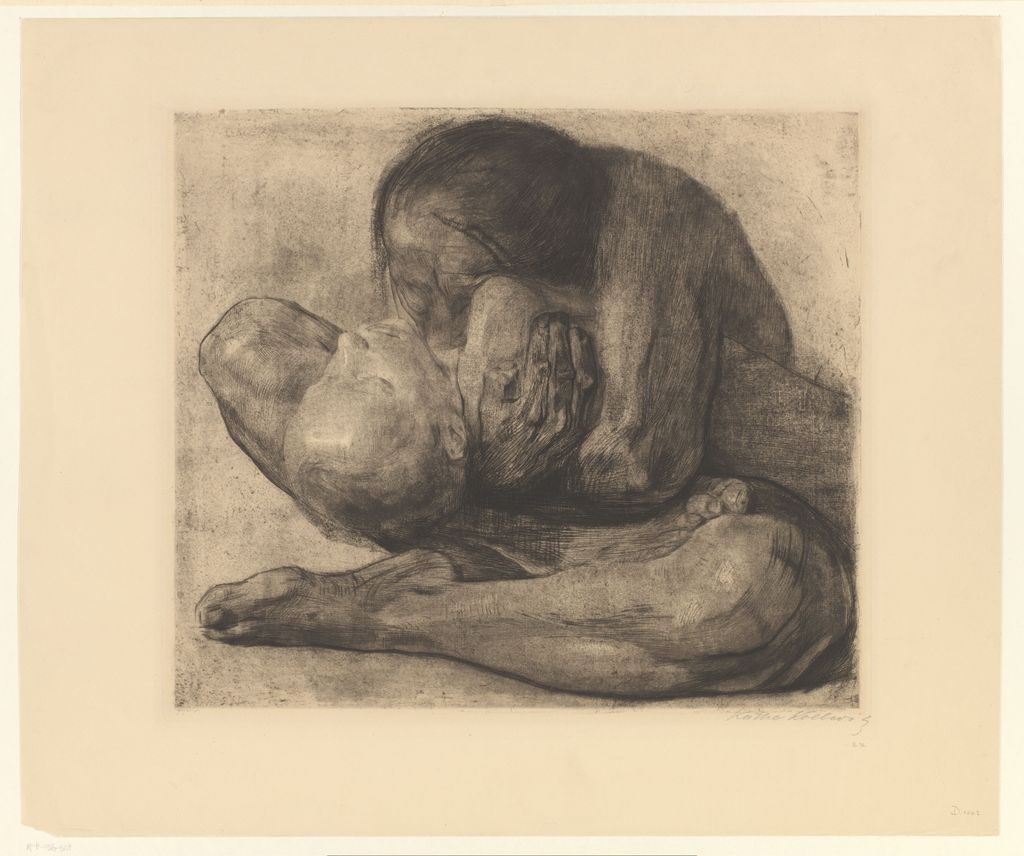
The Mothers
The Mothers, 1921–22. Städel Museum, Frankfurt am Main, SG 4289A D. Image source. Public domain. Resized and exported as JPEG.
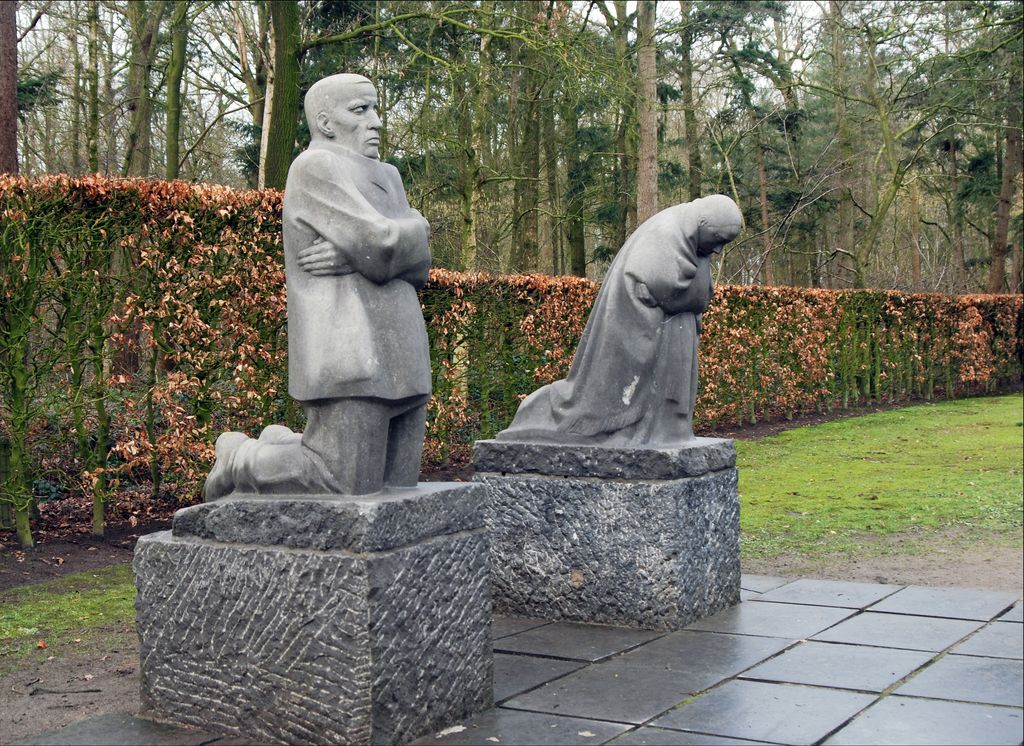
The Grieving Parents
The Grieving Parents at Vladslo, the memorial’s location since 1956. Photograph by Bva, resized. Image source. CC BY-SA 3.0. Resized and exported as JPEG.
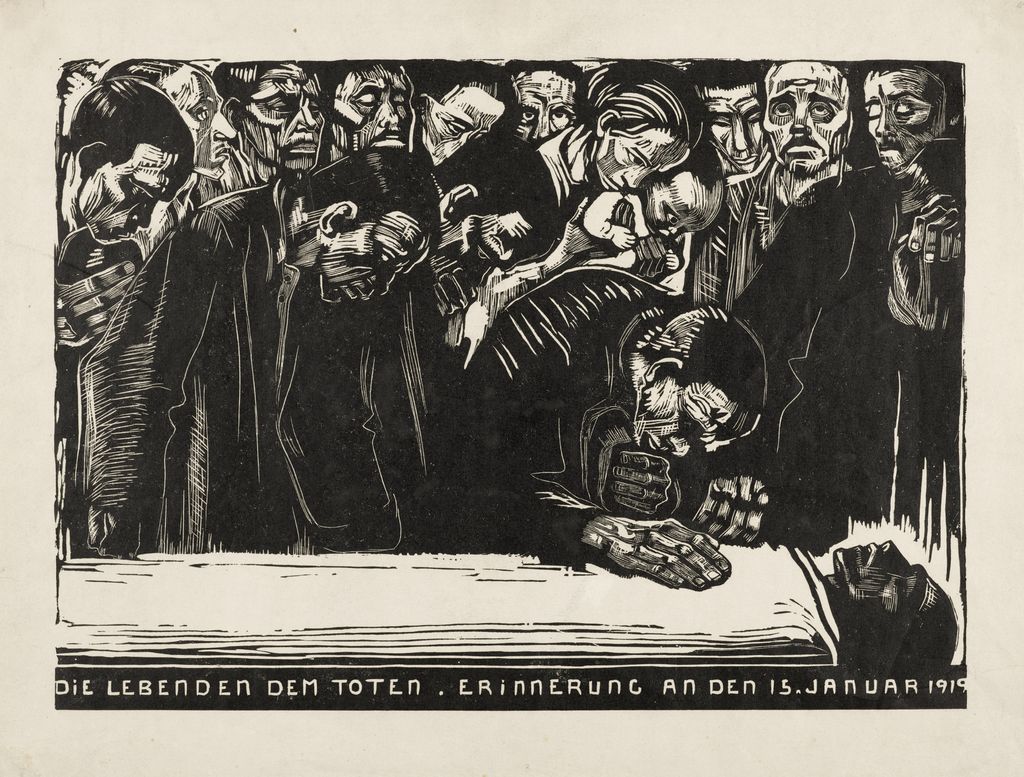
Memorial for Karl Liebknecht
Memorial for Karl Liebknecht, 1920. Kunstsammlungen Chemnitz, 86-47, Kn 159 VI. Photo: Kunstsammlungen Chemnitz/PUNCTUM/Bertram Kober. Image source. Public domain. Resized and exported as JPEG.