


Käthe Kollwitz, The Ploughmen, 1907, Kn 99 IX a. Kunstsammlungen Chemnitz, 2016-7. Photo: Kunstsammlungen Chemnitz/PUNCTUM/Bertram Kober. Image source. Public domain. Resized and exported as JPEG.
 by Tom Gurney
Tom Gurney BSc (Hons) is an art history expert with over 20 years experience
Email: tomgurney1@gmail.com / Phone: +44 7429 011000
Käthe Kollwitz’s Peasants’ War: Introduction
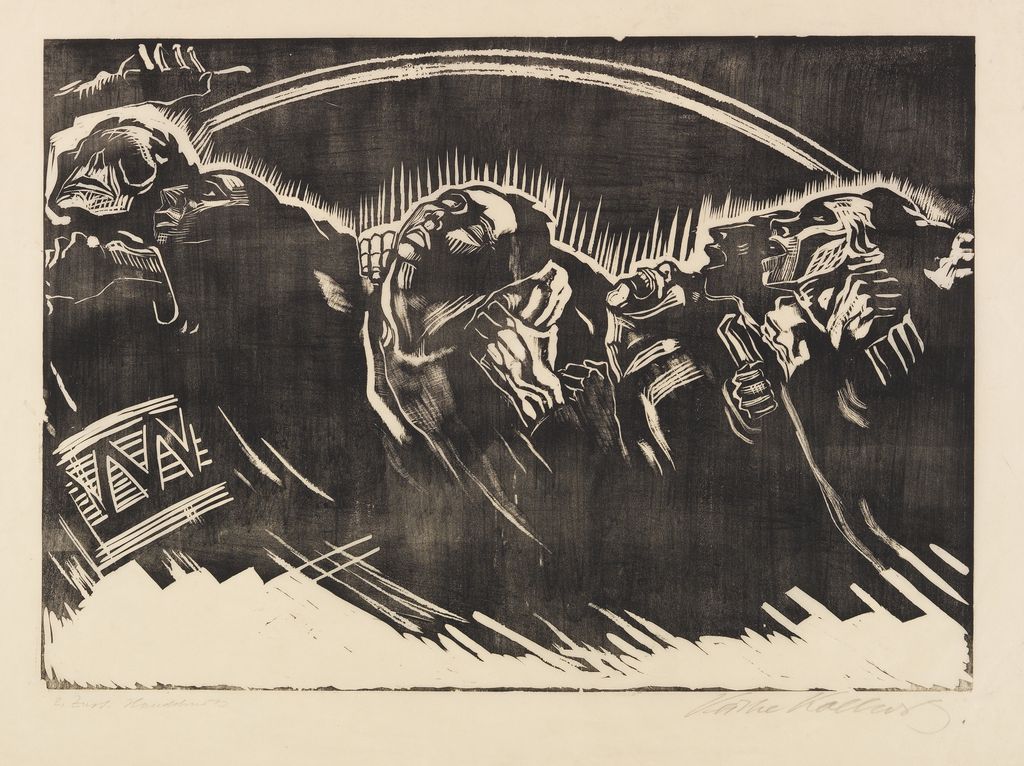
In Käthe Kollwitz’s Peasants’ War, two men pull a plough, an older woman pauses over the blade of a scythe, and a crowd rushes into battle. The fighting takes place between sheets. By the time we turn from Charge to Battlefield, a woman is searching among the fallen. Her lantern lights one face, leaving the eye to adjust to the dark around it. Kollwitz once intended to end the cycle there. In the portfolio published in 1908, one more print follows. Its captives are still alive, and one of them looks directly at us. [1] [2] [3]
At a Glance
- ArtistKäthe Kollwitz
- Original titleBauernkrieg
- DatesDeveloped from 1901 to 1908 and published in 1908 by the Association of Historical Art with the Dresden art dealer Emil Richter. [1] [4]
- MediumSeven prints combining line etching with other intaglio processes. [1] [5]
- SequenceThe Ploughmen, Raped, Sharpening the Scythe, Arming in a Vault, Charge, Battlefield and The Prisoners. [1]
Contents
- From the uprising of 1524–25 to the portfolio of 1908
- What Dresden commissioned and what the print room collected
- The seven prints in order
- From working proofs to museum impressions
The series in published order
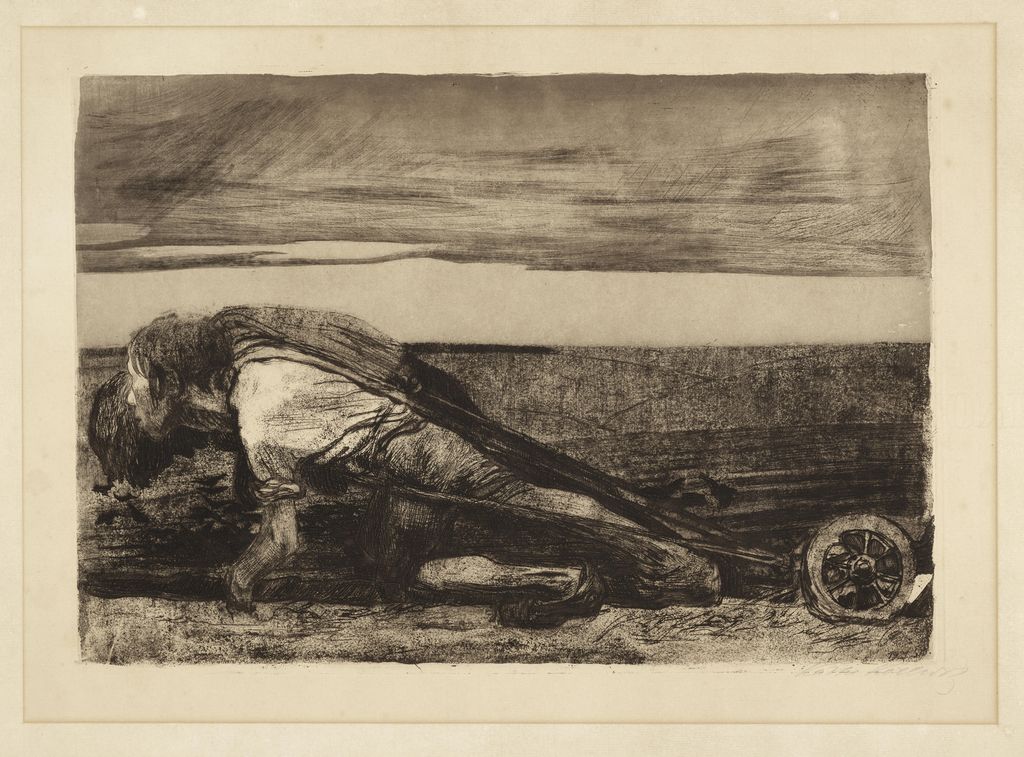
1. The Ploughmen
Photo: Kunstsammlungen Chemnitz/PUNCTUM/Bertram Kober. Image source.
2. Raped
Vergewaltigt. Cologne example Kn 101 V a, 70300/84019.
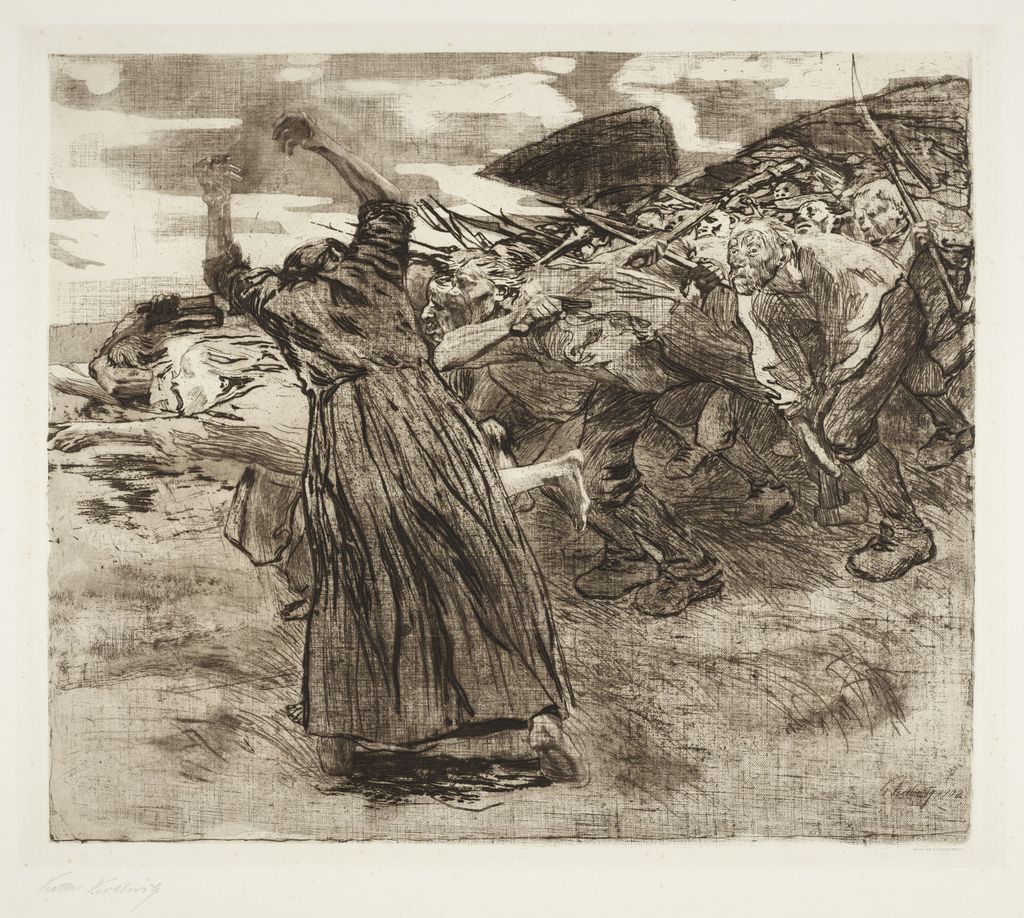
5. Charge
Photo: Kunstsammlungen Chemnitz/PUNCTUM/Bertram Kober. Image source.
7. The Prisoners
Die Gefangenen. Cologne example Kn 102 IX a, 70300/94005.
From the uprising of 1524–25 to the portfolio of 1908
The German Peasants’ War began in 1524 and spread across large parts of the German lands in 1525. The Twelve Articles drawn up by Swabian peasants give a sense of what was at stake. They appealed to Scripture in asking for an end to serfdom, limits on the labour their lords could demand and the restoration of communal rights. Access to woods and waters, the choice of a pastor and the amount of work owed to a lord all belonged to the same question of who could govern everyday life. Kollwitz’s opening print takes one part of that question, the burden of labour, and makes it visible in the angle of two men’s backs. [6] [7] [8]
Kollwitz came to the subject through Wilhelm Zimmermann’s Allgemeine Geschichte des grossen Bauernkrieges, first published in 1841–43. Zimmermann’s history also circulated in German Social Democratic circles. The Cologne museum places the cycle in that context, and MoMA curator Starr Figura draws a parallel between the exploitation of agricultural workers in the sixteenth century and the conditions of industrial workers in Kollwitz’s own time. The parallel helps explain why a historical revolt could feel urgent in Berlin around 1900. In the finished cycle, Kollwitz makes the urgency felt through particular experiences. The field, the garden and the search after the fighting take up more space than the charge itself. [1] [9] [10]
The order in which she made the images tells a different story from the order in which we see them. A chalk composition study for Charge survives from 1901, and Kollwitz exhibited the etching at the Berlin Secession late in 1902. Cologne identifies it as the first finished print for the cycle. In March 1903 she called it her best work to date. In the portfolio it became plate five, with four sheets of labour, injury and preparation before it. The opening prints only reached their final designs in 1907 and 1907–08. Kollwitz had already found a gesture that could propel the crowd into battle. She spent much of the project working out what would give that gesture weight. [11] [8] [12]
What Dresden commissioned and what the print room collected
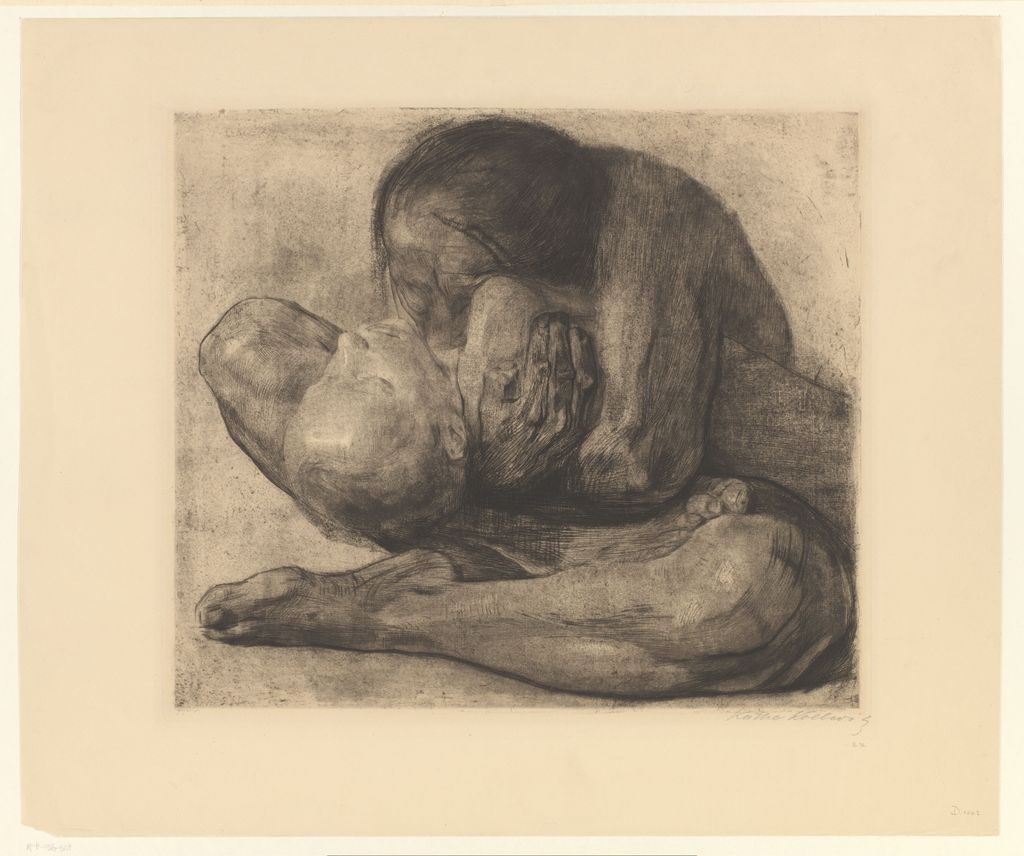
Kollwitz first planned a cycle of colour lithographs, possibly encouraged by what she saw on her first trip to Paris in 1901. Charge had already taken shape as an etching when she sought financial support from the Verbindung für historische Kunst, or Association of Historical Art, in 1904. She submitted Charge and Woman with Dead Child, and Max Lehrs, director of Dresden’s Kupferstich-Kabinett, helped secure the commission. The association commissioned the cycle as its annual gift to members. Kollwitz pursued the rest of the series in etching, bringing some of her experiments with colour into the new medium. [1] [4] [11] [13]
The correspondence shows how closely the commission was tied to the work of making and comparing proofs. In May 1904 Hermann Henrich Meier reported that Kollwitz needed three impressions of each state for her own use so she could compare their quality and make changes. He had asked for a further impression for the Dresden print room and reported that Kollwitz would also give one to his own collection. Each alteration to a plate could therefore produce several trial sheets, with different purposes and destinations even before an edition appeared. [14]
A June exchange shows what happened when those arrangements met the museum’s purchase accounts. Kollwitz initially proposed 200 marks for seven sheets, including two related to the cycle. She wondered whether payment for a Peasants’ War impression could be deducted from what she was to receive for the plate. Lehrs explained that the association paid for the plate and Dresden was already promised an impression. He proposed keeping the total at 200 marks for the other sheets and recording the two cycle proofs formally as gifts from the association. In her letter of 16 June, Kollwitz put Woman with Dead Child among the five works to be purchased and explicitly described it as independent. The two early cycle sheets appear in the archive as A 1904-415 and A 1904-416. The second was then described as a concluding sheet. The independent Woman with Dead Child is A 1904-417. [14]
By 1908 the finished cycle was shown in its entirety at Dresden’s Great Art Exhibition and published with Emil Richter. Dresden was still pursuing working impressions. On 3 June Kollwitz told Lehrs she had sent proofs to Richter and offered to give the print room any it wanted if purchase funds were unavailable. On 16 July Hans Wolfgang Singer acknowledged receipt of three from the dealer. He described them as a dead figure lying in the grass, a woman searching among corpses and a scene at the plough. In August Kollwitz offered the sheets as a gift. On 28 August Lehrs asked the General Directorate to approve the acquisition, valuing the three at about 200 marks and describing them as impressions outside ordinary commercial circulation. Approval followed on 29 August. The edition circulated the finished sequence, while the print room sought sheets that would preserve stages of its making. The Käthe Kollwitz timeline places the commission and exhibition alongside her other work of those years. [4] [14]
The seven prints in order
1. The Ploughmen (Die Pflüger)
Two peasants take the place of draught animals. Cologne suggests that they may be father and son. They are so close to the ground that the diagonal of their bodies barely rises above the horizontal field. The wide space around them makes their effort seem all the more concentrated. They already know how to work together, but here their combined strength goes into dragging a plough. The first image of collective action in the portfolio is an image of work they have to do. [8]
That emphasis emerged through years of revision. In an early lithographic design, a bent woman guides the plough. In another design a standing woman occupies the foreground, giving the viewer a figure from whose position to observe the men. Cologne’s rejected Ploughmen and Woman, Kn 64 I, is a 1902 lithograph with a brown tone stone, extensively worked over in charcoal, chalk and brown coloured pencil. A drawing of around 1904, NT 207, records the standing woman. In the final 1907 design she has disappeared. The viewer faces the strain directly, with the men’s low diagonal carrying much of what the earlier designs distributed among several figures. [8] [15]
The reduction in figures came with an increasingly elaborate printed surface. Cologne’s Kn 99 VIII b, inventory 70300/23005, combines line etching, drypoint, aquatint, lift ground, sandpaper, a bundle of needles and soft ground with the imprint of Ziegler transfer paper. Its earlier Kn 99 IV proof has the same recorded dimensions, 315 × 454 mm, but a different list of processes. The record of the two states gives a sense of how much work went into an image whose principal action is so plain. In MoMA’s audio guide, printmaker Rob Swainston discusses printmaking as a means of reaching people through distribution. Here the economy of the composition and the labour of preparing the plate serve that purpose together. [8] [10]
2. Raped (Vergewaltigt)
The second sheet moves from the field to a garden. A woman lies among crushed plants, and a small figure looks over the fence. The title names the violence. The stillness of the body, the damage to the garden and the child’s position just beyond the fence give that violence a place and an aftermath. Cologne identifies the child as the woman’s daughter and describes the woman as having been killed. The Städel quotes Kollwitz’s own account of an abducted woman left in the herb garden after the farmhouse had been destroyed. Its discussion of the distorted perspective helps explain the first, disorienting sight of the body amid the vegetation. [12] [16]
Cologne preserves a pencil study from about 1901, NT (443a). The final print dates to 1907–08. Its long format gives the damaged garden considerable room around the woman, and the fence separates her from the child while keeping both within the same field of view. MoMA’s extended label reads the rape as a catalyst in the portfolio’s narrative. The placement makes that reading possible. A scene of forced exertion is followed by the consequences of an assault, and then by the woman preparing the scythe. Each scene adds a different reason for the resolve that takes shape in the third print. [5] [12] [9]
3. Sharpening the Scythe (Beim Dengeln)
The first two plates spread low across the page. The third brings the viewer up close to a face, a bent arm and a blade in a square. The woman’s eyes narrow above the scythe. In this pause there is time to register what the tool can become. The plough in the first sheet bound the men to the work of the field. The blade in the third still belongs to that world, but the woman can decide where to direct its edge. Cologne reads her expression and the preparation of the blade as a determination to avenge the wrongs done to the peasants. [8] [17]
The surviving alternatives show how much the decision to crop changed the encounter. MoMA’s 2024 exhibition included Inspiration, the rejected first version, and Woman with Scythe, the rejected second version, as well as proofs from the square plate. Two impressions of Inspiration were both catalogued as state IV. The Mayer family sheet is specifically recorded as worked over in charcoal, white chalk and ink. The Berlin impression has its own record and substantially larger sheet dimensions. The two share a plate state, while the handwork belongs to the individual impression. [5]
MoMA dates its displayed states I, IV and VII of Sharpening the Scythe to 1905. Cologne’s English object caption also gives 1905 for Kn 88 X b, inventory 70300/23007, while the heading dates the cycle sheet to 1908. The work on the square plate and the publication of the portfolio belong to different moments. The closer comparison of the designs and proofs is in Sharpening the Scythe. [1] [5] [17]
4. Arming in a Vault (Bewaffnung in einem Gewölbe)
Armed peasants climb a curving staircase towards the exit. The narrow, upright format makes the ascent feel crowded, with the bodies rising through the space in a packed column. Cologne traces the stair motif to the winter of 1901–02. Kollwitz reversed the diagonal from the early design, so that the ascent in the final print gathers momentum from left to right. The movement is especially striking after the low diagonal of The Ploughmen. Both pictures show bodies working together under pressure, but the staircase directs their effort towards an opening. [8] [13]
Cologne’s 1906 impression, Kn 96 VI, inventory 70300/23008, is a two-colour intaglio print combining line etching, drypoint, aquatint and soft ground with an imprint from Ziegler transfer paper. The museum also holds a first-state impression, Kn 96 I, inventory 70300/16001, worked over by hand in black ink and opaque white. MoMA’s 2024 checklist, on page 20, records a separate two-colour impression lent by Kunstmuseum Basel, with a plate measuring 49.7 × 32.9 cm and a sheet measuring 59.5 × 44.1 cm. Printed colour survived Kollwitz’s change of medium, while the first-state proof records adjustments made directly on paper. The distinction matters across her prints, where a finished passage might have begun in work on the plate or in an experiment on a trial sheet. [5] [13]
5. Charge (Losbruch)
A woman seen from behind flings up her arms as the peasants rush forward. Her position puts the viewer near the point from which the signal is given. The raised hands stand out against the mass of bodies, and the crowd carries their energy across the print. In her later recollection, Kollwitz connected the design to reading in Zimmermann about Black Anna, a peasant woman who spurred the rebels on. Cologne relates her account to the Schwarze Hofmännin, a woman associated with urging on the peasants before their attack at Weinsberg. The historical association comes through that recollection. The print gives the woman’s action its force through her back, arms and hands. [11]
MoMA showed the Berlin Kupferstichkabinett drawing Black Anna, dated about 1902–03, in pencil and black chalk heightened with white on brown paper. Its extended label draws attention to the thrust and rotation of the hands in the preparatory drawings. In the audio guide, Figura discusses the emotional range of Kollwitz’s gestures, and Swainston reads the hands almost as a portrait in themselves, carrying signs of labour as well as authority. In the sequence, the gesture recalls the grip on the scythe while giving the hands a different task. They are directing other people. [5] [9] [18]
In the earlier Uprising (Aufruhr, 1899, Kn 46), a torch-bearing woman flies over the crowd and looks back towards a burning castle. In Charge (Losbruch, Kn 70), the leader is on the same ground as the peasants and faces into their movement. Cologne’s impression is Kn 70 VIII b, inventory 70300/01012. The Basel impression in MoMA’s exhibition has a recorded plate size of 50.7 × 59.2 cm and uses soft-ground imprints from two fabrics and Ziegler transfer paper alongside other techniques. The broad plate gives the movement room to spread, after the tightly funnelled ascent of Arming in a Vault. [11] [5] [13] [19]
6. Battlefield (Schlachtfeld)
The turn from Charge to Battlefield makes the viewer reconstruct the defeat from its effects. The opposing army stays outside the pictures. A woman bends over the bodies and holds a lantern close to one face. The light establishes a small area of certainty, while other bodies gradually come into view around it. After the expansive gesture of Charge, the action here is as narrow as the space the lantern illuminates. [11] [2]
Kollwitz began work on this part of the story in 1903. Cologne describes an early conception in which Black Anna buries her fallen son at night. The museum interprets the finished scene as a mother finding her son among the dead. Moving from burial to discovery brings the action back to the instant of recognition. MoMA’s Mother and Dead Son, object 112.2024, is a separate rejected version of plate six, dated 1903. Its state II/IV impression is worked over in brown ink and gouache, and its plate measures 22.8 × 33.6 cm. The Basel impression of the finished 1907 Battlefield shown at MoMA came from a plate measuring 40.8 × 53 cm. The larger field gives the encounter its surroundings and makes room for the slow recognition of other bodies. The alternatives are explored in Battlefield. [5] [2] [20]
7. The Prisoners (Die Gefangenen)
Kollwitz originally meant Battlefield to close the cycle. In the added seventh sheet the survivors are pressed together. The crowd that had found a way out of the vault and spread across the open ground now has nowhere to go within the image. Just left of centre, a pair of eyes looks out from the second row beneath knitted brows. Cologne reads that look as a sign that the conditions for another revolt remain. The gaze gives the confinement a duration beyond the last sheet. The viewer has seen what led people to rise, and now has to consider what awaits those still alive. [13] [3]
Cologne’s Kn 102 IX a, inventory 70300/94005, dates to 1908. The museum also preserves charcoal studies, including a 1908 drawing made from Kollwitz’s son Peter, NT 436. His role as a model belongs to the making of the print. The action of the finished sheet depends on the relation between one outward gaze and the closely packed group around it. [3]
Cologne also traces two motifs back to an abandoned ending for A Weavers’ Revolt. That design included bound women and a stooping figure reaching towards a dead body. The published Weavers cycle instead brings the dead indoors in End. In Peasants’ War, the bent figure and the captives occupy successive sheets. The first gives time to looking for one person among the dead. The second brings us back to the group and to what defeat means for its survivors. [2] [3] [21]
Käthe Kollwitz, Charge, 1902–03, Kn 70 VIII b. Kunstsammlungen Chemnitz, KH 255/5. Photo: Kunstsammlungen Chemnitz/PUNCTUM/Bertram Kober. Image source. Public domain. Resized and exported as JPEG.
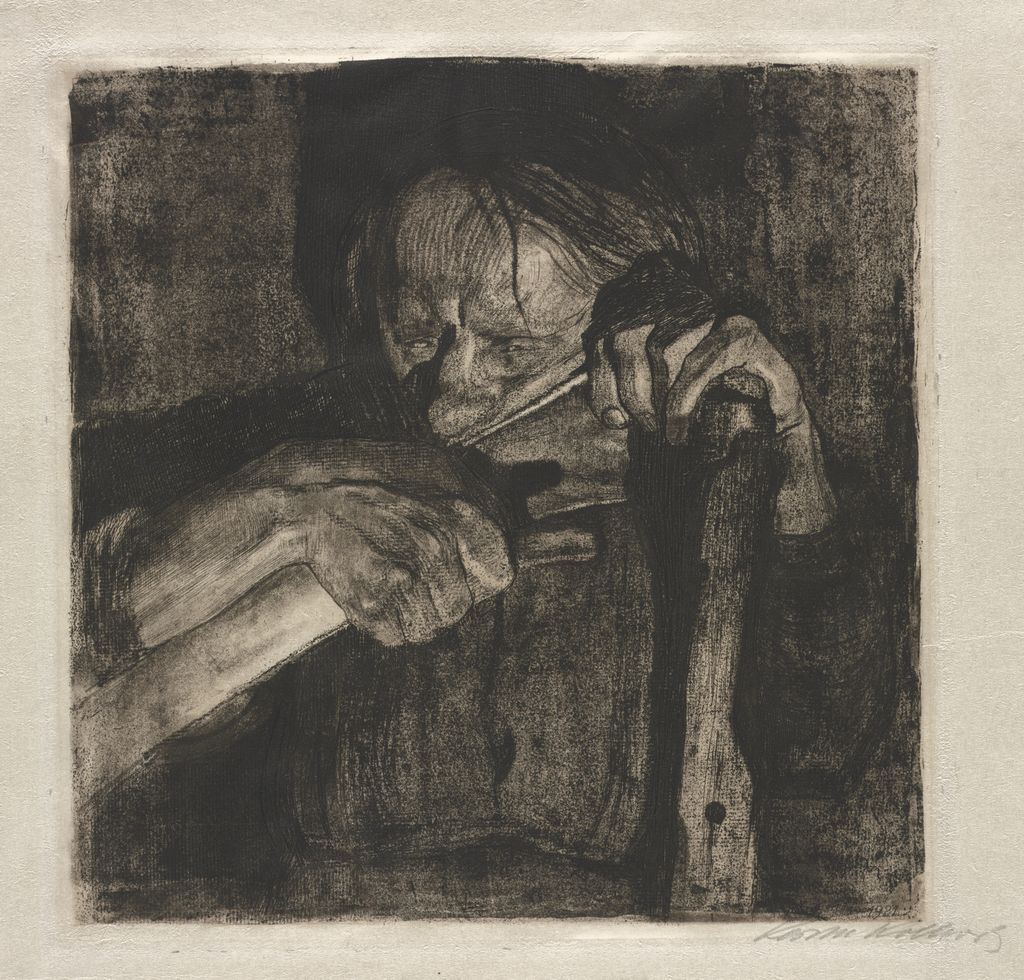
Käthe Kollwitz, Sharpening the Scythe, 1905. Cleveland Museum of Art, 1950.205, Klipstein 90, state XII/XII. Image source. CC0 / Public domain. Resized and exported as JPEG.
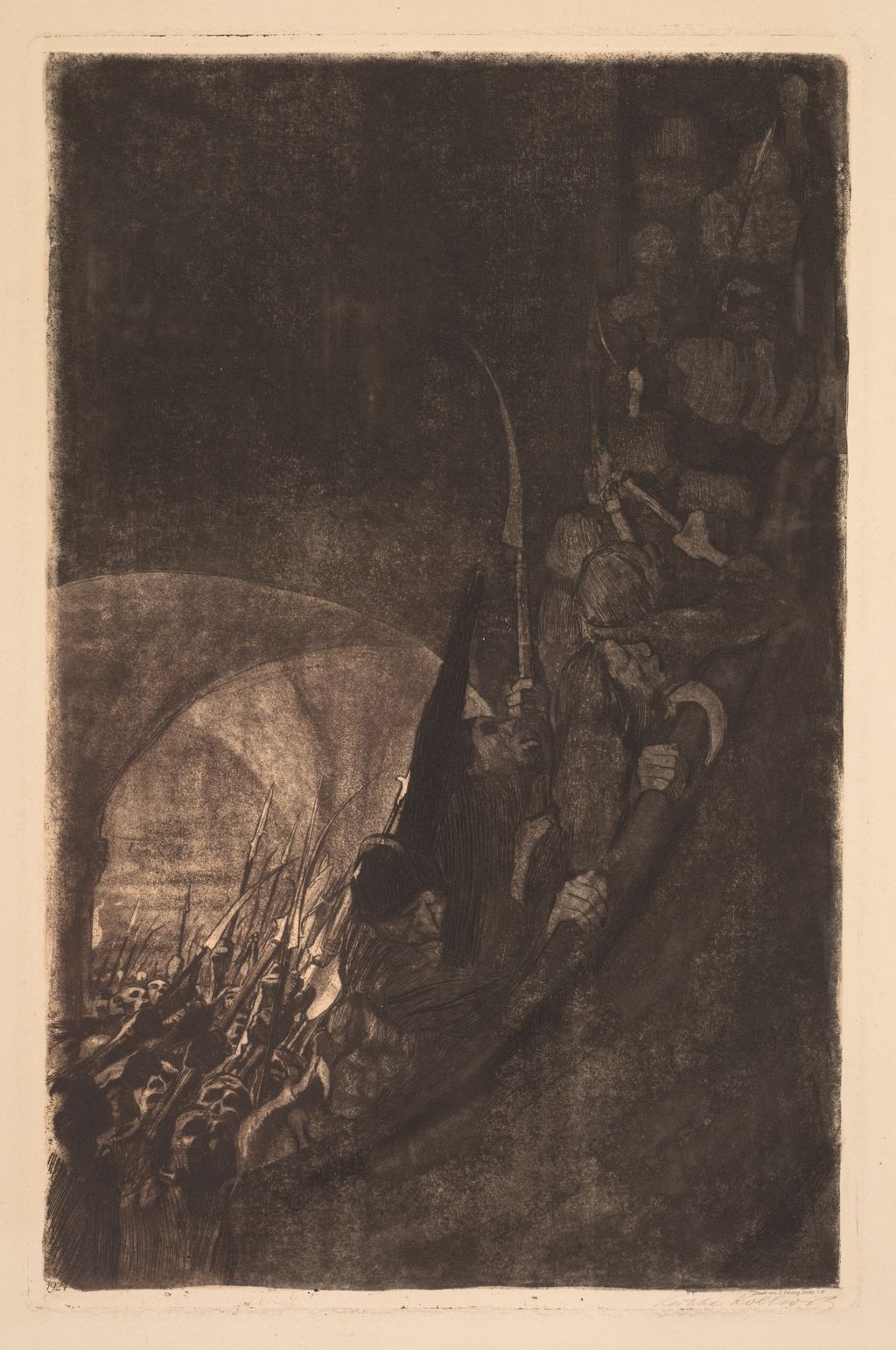
Käthe Kollwitz, Arming in a Vault, sheet 4 of Peasants’ War. Cleveland Museum of Art, 1992.151. Image source. CC0 / Public domain. Resized and exported as JPEG.
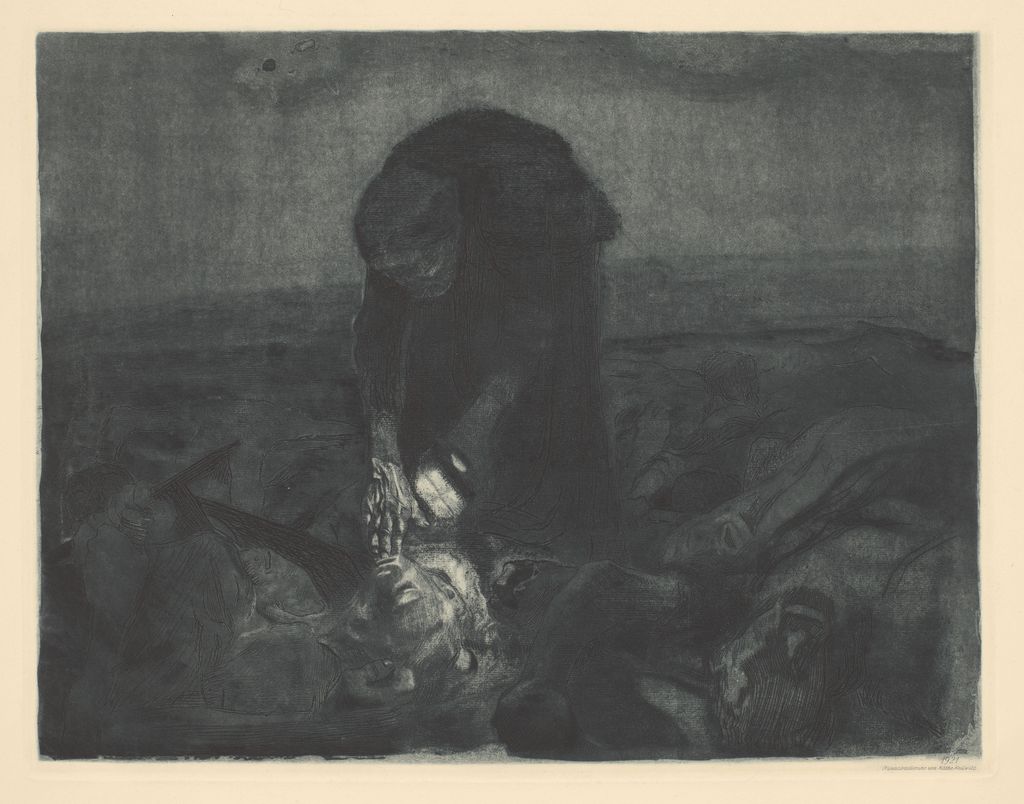
Käthe Kollwitz, Battlefield, plate 6 of Peasants’ War. Rijksmuseum, RP-P-2011-36-320, dated 1921 by the museum. Image source. Public domain. Resized and exported as JPEG.
From working proofs to museum impressions
Strasbourg’s records document how soon impressions entered a public collection. Joconde lists the museum’s Le Laboureur, planche 1 as accession 5.915, Le champ de bataille, planche 6 as 5.916 and Violée, planche 2 as 5.917. All three were acquired by gift on 27 June 1908, the year of publication. The French catalogue dates Battlefield to 1907 and gives 1907 and 1908 for Violée. The German titles and plate numbers connect these sheets to the portfolio. The accession numbers identify the individual Strasbourg impressions. [22] [23] [24]
Cologne’s Battlefield, Kn 100 X b, inventory 70300/23009, is dated 1907 and catalogued at 410 × 531 mm. The Strasbourg entry gives 55.8 × 72.5 without specifying in its measurement field whether that is the sheet or the printed image. MoMA’s checklist makes the distinction explicit for the Basel impression, giving 40.8 × 53 cm for the plate and 48.5 × 64 cm for the sheet. Cologne and Strasbourg both identify drypoint, aquatint, soft ground and imprints of laid paper and Ziegler transfer paper. The techniques connect the records more securely than a comparison of dimensions entered under different cataloguing conventions. Strasbourg subsequently exhibited its impression in 1998–99, 2002 and 2006. [5] [2] [22]
In Britain, the print room connection took another route. The British Museum records that Campbell Dodgson bought Kollwitz prints in Germany before the First World War under the influence of his colleague Lehrs. Much of the museum’s Kollwitz collection came through Dodgson’s 1948 bequest. The British Museum and Ikon later made Peasants’ War a distinct section of Portrait of the Artist: Käthe Kollwitz, alongside A Weavers’ Revolt and work on death and motherhood. The Städel, which catalogues its seven sheets together, draws attention to the shifts between horizontal and upright formats and between rising and falling movement. Seeing those changes across the cycle makes the physical difference between labour, revolt and confinement as legible as the order of the events. [25] [26] [27]
Käthe Kollwitz artworks directory
Selected documented works, including the complete published sequences of the five cycles discussed here. Catalogue links identify the specific record behind each row.
Frequently Asked Questions
Discussion
Look again at the images and ideas explored in Käthe Kollwitz’s Peasants’ War. These editorial prompts invite your observations.
Reader Insights
How does the order of the seven prints shape the way you read the uprising?
What do the rejected designs reveal about Kollwitz’s treatment of the figures?
What changes when a viewer reads the lantern scene before the prisoners rather than as the ending?
Join the Conversation
Share a detail, comparison or question about Käthe Kollwitz’s Peasants’ War below.
References
- Kollwitz Museum Köln, Zyklus Bauernkrieg. View source.
- Kollwitz Museum Köln, Schlachtfeld, Kn 100 X b, and related studies. View source.
- Kollwitz Museum Köln, Die Gefangenen, Kn 102 IX a, and related studies. View source.
- Kollwitz Museum Köln, Timeline 1901–1913. View source.
- The Museum of Modern Art, Käthe Kollwitz Exhibition Checklist, 2024, especially pp. 8–9 and 16–22. View source.
- German Historical Institute, From the Reformations to the Thirty Years’ War, 1500–1648, introduction. View source.
- German Historical Institute, Grievances and Demands: The Twelve Articles of the Swabian Peasants, 1525. View source.
- Kollwitz Museum Köln, Die Pflüger, Kn 99 VIII b, and related works. View source.
- The Museum of Modern Art, Käthe Kollwitz Extended Labels, 2024, pp. 5–6. View source.
- The Museum of Modern Art, The Ploughmen, exhibition audio transcript. View source.
- Kollwitz Museum Köln, Losbruch, Kn 70 VIII b, and related studies. View source.
- Kollwitz Museum Köln, Vergewaltigt, Kn 101 V a, and preparatory study. View source.
- Kollwitz Museum Köln, Bewaffnung in einem Gewölbe, Kn 96 VI, and related works. View source.
- Staatliche Kunstsammlungen Dresden, Briefwechsel zwischen Käthe Kollwitz und Max Lehrs, 1898–1929, 01/KK 04, Bd. 9, nos. 220–229, and Bd. 13, nos. 135–140, pp. 36–47. View source.
- Getty Research Institute, Käthe Kollwitz: Prints, Process, Politics, gallery text for The Ploughmen. View source.
- Städel Museum, Raped, SG 4230 D. View source.
- Kollwitz Museum Köln, Sharpening the Scythe, Kn 88 X b, and related works. View source.
- The Museum of Modern Art, Black Anna, exhibition audio transcript. View source.
- Kollwitz Museum Köln, Uprising, Kn 46 VI d. View source.
- The Museum of Modern Art, Mother and Dead Son, state II/IV, object 112.2024. View source.
- Kollwitz Museum Köln, A Weavers’ Revolt. View source.
- French Ministry of Culture, Joconde, Schlachtfeld, Blatt 6 / Le champ de bataille, planche 6, Strasbourg 5.916. View source.
- French Ministry of Culture, Joconde, Vergewaltigt, Blatt 2 / Violée, planche 2, Strasbourg 5.917. View source.
- French Ministry of Culture, Joconde, Die Pflüger, Blatt 1 / Le Laboureur, planche 1, Strasbourg 5.915. View source.
- British Museum, Portrait of the Artist: Käthe Kollwitz, exhibition press release. View source.
- Ikon Gallery, Portrait of the Artist: Käthe Kollwitz at the British Museum, London. View source.
- Städel Museum, Peasant War, portfolio record. View source.
More KOLLWITZ Works
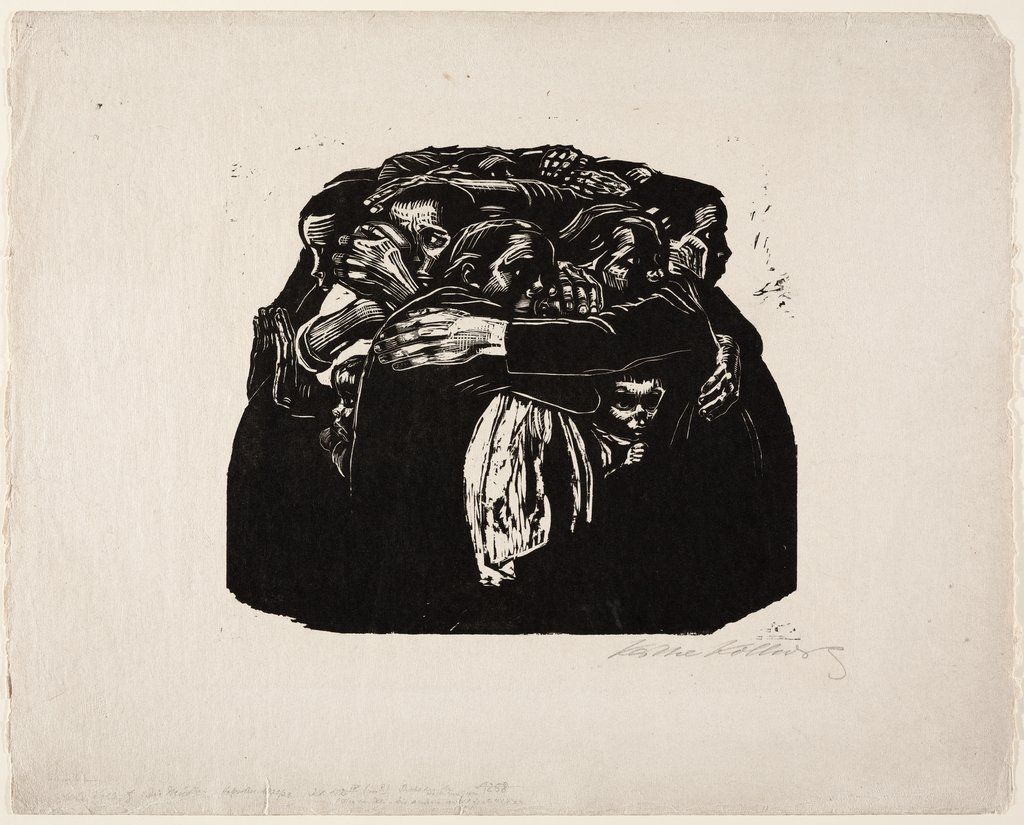
The Mothers
The Mothers, 1921–22. Städel Museum, Frankfurt am Main, SG 4289A D. Image source. Public domain. Resized and exported as JPEG.
The Grieving Parents
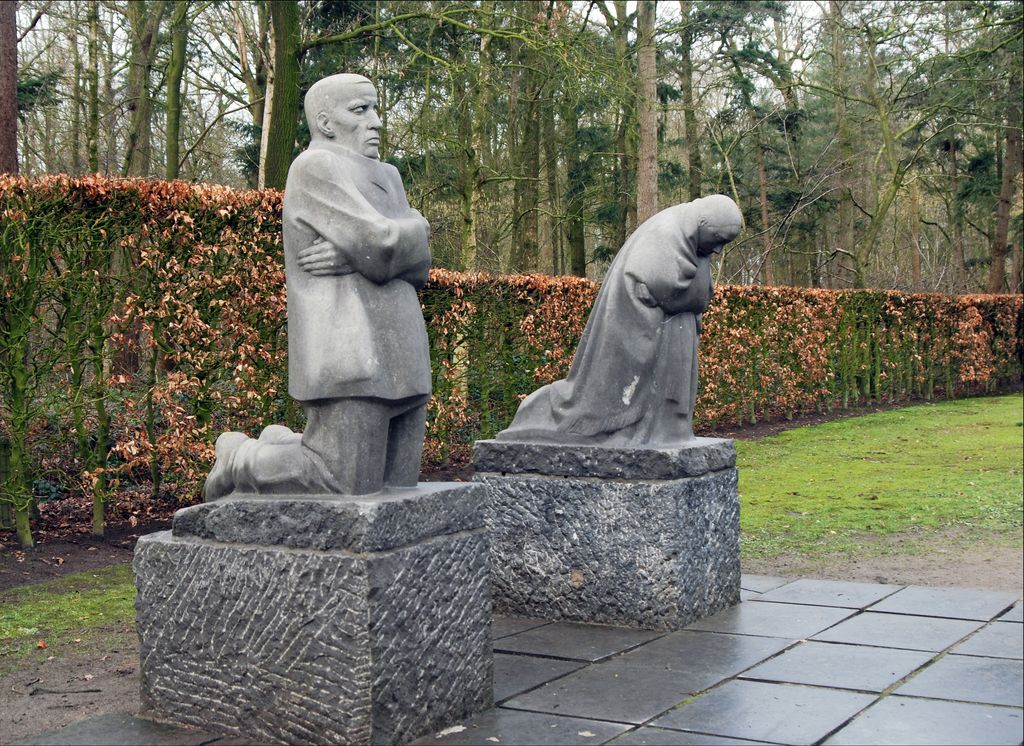
The Grieving Parents at Vladslo, the memorial’s location since 1956. Photograph by Bva, resized. Image source. CC BY-SA 3.0. Resized and exported as JPEG.
Memorial for Karl Liebknecht
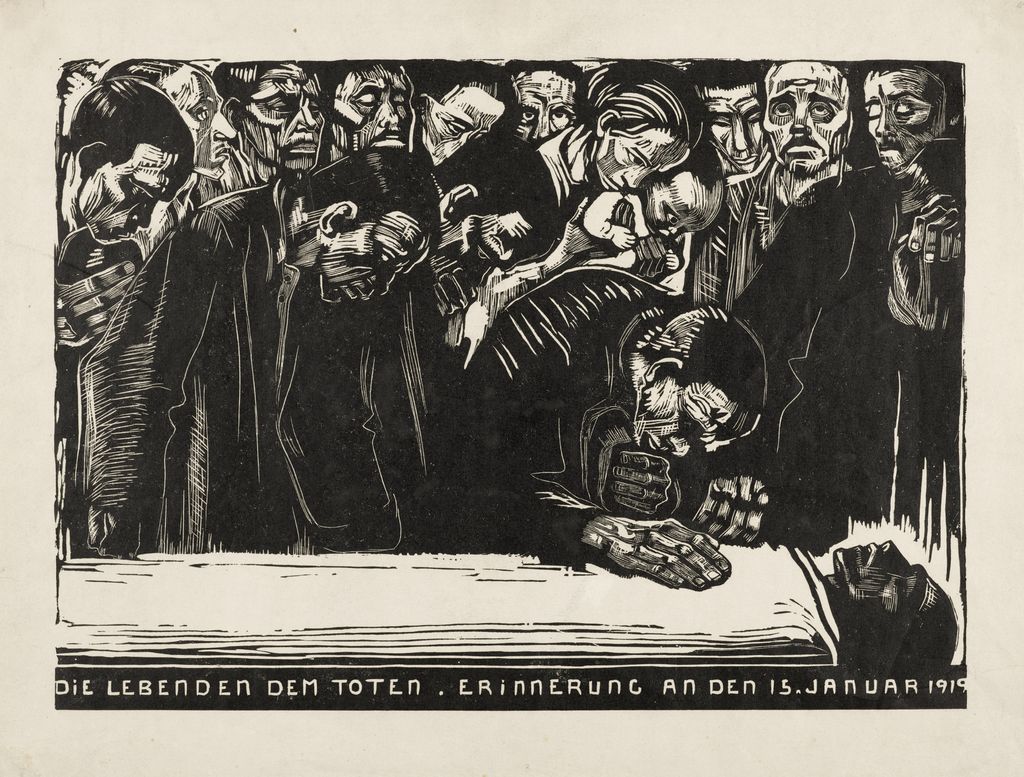
Memorial for Karl Liebknecht, 1920. Kunstsammlungen Chemnitz, 86-47, Kn 159 VI. Photo: Kunstsammlungen Chemnitz/PUNCTUM/Bertram Kober. Image source. Public domain. Resized and exported as JPEG.