


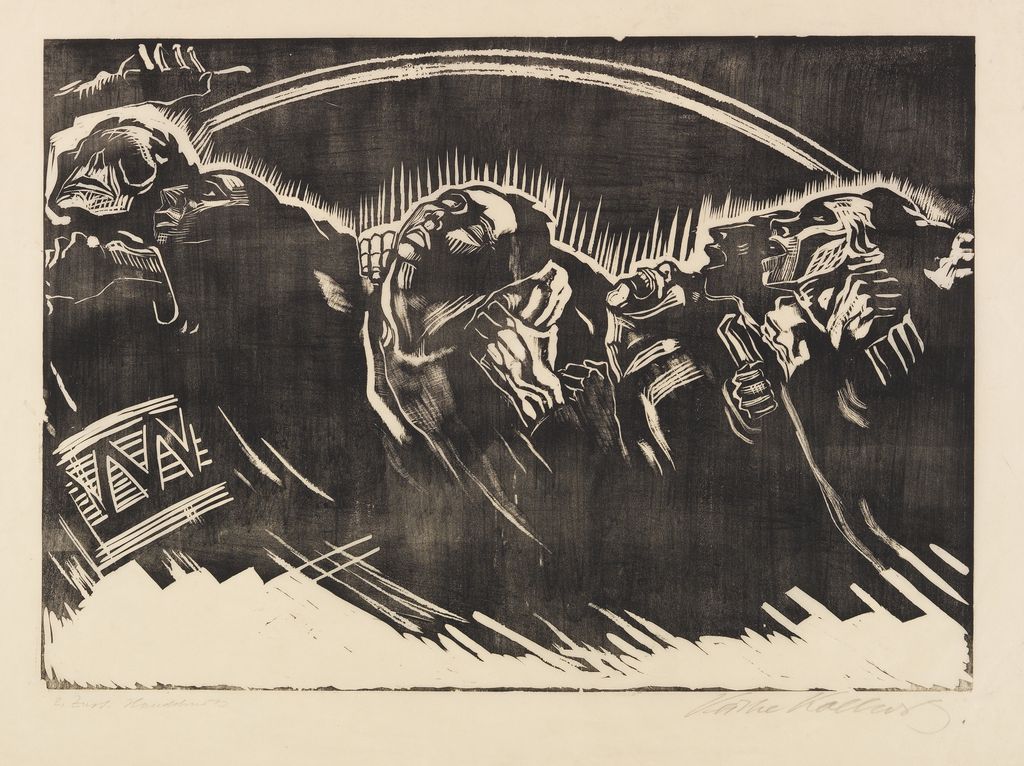
The Volunteers, 1921–22, published 1923. Woodcut, sheet 2 of War. Ketterer Kunst reproduction, impression not identified by accession. Image source. Public domain. Resized and exported as JPEG.
 by Tom Gurney
Tom Gurney BSc (Hons) is an art history expert with over 20 years experience
Email: tomgurney1@gmail.com / Phone: +44 7429 011000
The Volunteers: Introduction
Death raises a drumstick at the left of Käthe Kollwitz’s The Volunteers. His other arm presses a young man against his side, bringing their heads almost together. Four more men crowd behind them. Their heads rise and fall beneath two pale arcs, and their coats merge into a single dark expanse. Kollwitz made the woodcut in 1921–22 as the second sheet of War, published in 1923. The young man Death holds is her son Peter. He volunteered in 1914 and was killed near Dixmuiden in Flanders that autumn, aged eighteen. [1] [2] [3]
At a Glance
- ArtistKäthe Kollwitz
- German titleDie Freiwilligen
- Date1921–22
- MediumWoodcut
- SeriesSheet 2 of 7 in War (Krieg)
- PublicationEmil Richter, Dresden, 1923
- Cologne impressionKn 173 IV b, Kollwitz Museum Köln, inventory 70300/92012
- Image dimensions350 × 496 mm in the Cologne record
This work across Käthe Kollwitz’s career
A Weavers’ Revolt
1893–97The six sheets take a revolt from household distress to collective action and its aftermath. [4]
Separate impressions and hand-worked proofs show how Kollwitz developed the image. [5]
Peasants’ War
1901–08The seven plates combine the revolt with the aftermath in Battlefield and The Prisoners. [6]
War
1921–22, published 1923The woodcuts give sustained attention to the experience of those left behind. [7]
The Grieving Parents
1932 installationTwo kneeling figures face the graves in the memorial’s later location at Vladslo. [8]
Mother with Her Dead Son
1937–39 modelThe small sculpture precedes the 1993 enlargement at the Neue Wache. [10]
Contents
- Death sets the pace
- Peter Kollwitz and the meaning of volunteering
- From drawings and trial blocks to the published woodcut
- After the march
- Annotated details
Death sets the pace
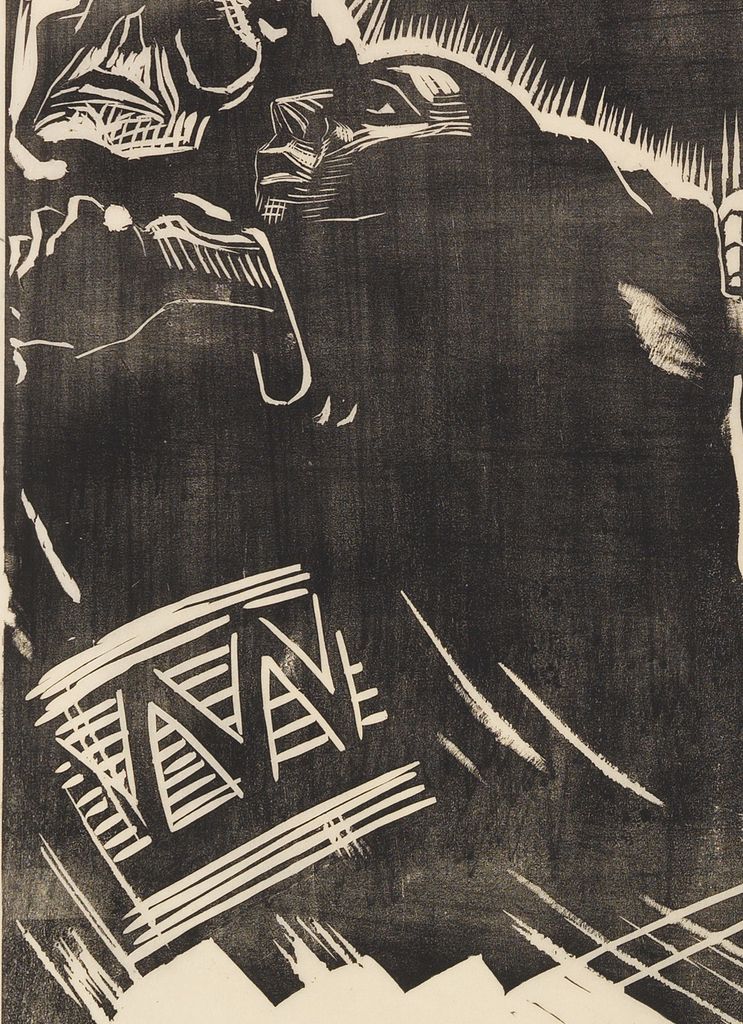
Start with the fist near the upper left corner. The fingers close around a stick whose thin outline is almost lost against the black. Below it, the drum tilts out from Death’s body. Pale bands mark its rims, and the repeated zigzag of its cords makes it one of the most sharply defined objects in the woodcut. The distance between the raised hand and the drum gives the eye an action to complete. The whole group seems to move in the interval before the stick comes down. [1] [11]
The procession advances from right to left, towards the edge Death already occupies. Its movement is unusually hard to locate in the bodies. There are no visible feet to keep time. The mass of clothing breaks up in slanting cuts along the lower part of the image, and the pale area underneath offers little sense of firm ground. One figure is partly cut off at the right, while the skull and drum press close to the left. The crop makes the group feel as if it has entered the frame before we see it and will pass out of it before we can make out all the men. The small number of figures feels like part of a longer procession. [1] [2] [11]
The heads give the movement its uneven pace. Peter’s face is close to the skull, with a narrow strip of light picking out his features. The man near the middle throws his head so far back that his throat and the underside of his chin catch the light. His closed eyes give the face a stillness at odds with the tilt of his body. To his right, one head sits lower, with its mouth turned upward, before the faces rise again towards the outer edge. The uneven spacing matters as much as the expressions. The central face is large and exposed, while the men on the right are so closely packed that a bright cut can seem to belong to one face until the eye finds the contour of another. [1] [2] [11]
The men’s hands offer another way through the image. Near the middle, light catches the knuckles of a grip that is harder to see than the upturned face above it. Following the arms through the dark brings out how much of the group’s movement depends on contact. Bettina Sitter reads the clasping of hands and the arms laid across shoulders as signs of friendship, drawing on the importance of Peter’s circle to his decision to volunteer. The contact can carry that meaning even as the same closeness makes it difficult to imagine anyone pulling clear. Death’s arm is part of this chain. A drummer could set the pace from a distance, but this one holds the first marcher against his body. [1] [2] [11]
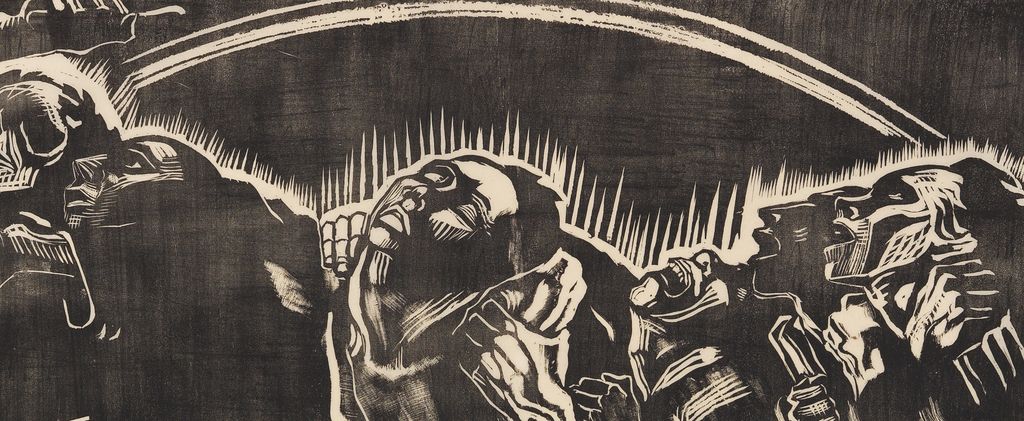
Two kinds of line frame the heads. The long pale arcs carry the eye across the dark above the procession. Below them, short upright cuts rise from the broken outline of heads and shoulders, varying in length as the contour dips and climbs. Cologne relates the rays to the young men’s conviction that they were defending their country. The arcs have a different effect from those local bursts of light. They span the gaps between heads and give a common outline to people whose faces and postures keep breaking the rhythm. Sitter relates their shape to an arch of honour or triumph and asks who can be said to triumph in this procession. The skull under the left end of the arc gives that question a particularly bleak answer. [1] [2] [11]
Cologne places the image in the tradition of the medieval danse macabre and of Death as a military leader. Kollwitz makes the skull legible through a hollow socket, a hard edge at the cheek and a row of teeth picked out by fine cuts. From the neck down, Death has sleeves, hands that grip, and a drum he can strike. The likeness to a living drummer is part of the figure’s force. The skull tells us where the march leads, while the raised arm makes it possible to feel the pull of the beat. [1] [11] [12]
Annotated Details from The Volunteers
The numbered points identify visible features discussed in this article. Return from each detail to the numbered overview. The Volunteers, 1921–22, published 1923. Woodcut, sheet 2 of War. Ketterer Kunst reproduction, impression not identified by accession. Image source. Public domain. Resized and exported as JPEG.
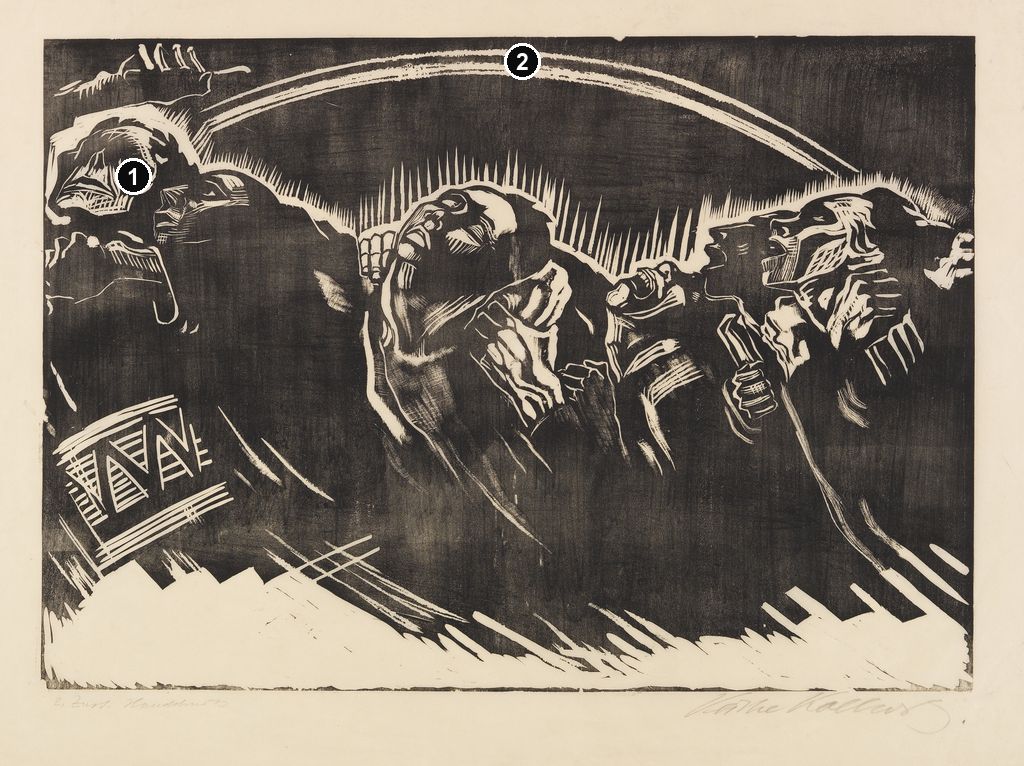
Details from THE VOLUNTEERS
Compare the cropped details with the source images above. Notice how their colours, shapes and positions contribute to the larger compositions.
Death
Death leads the group at the left edge. The drum projects forward from the figure’s body.
Arc
The broad arc sweeps over the marchers, binding the figures together and carrying the eye along the row of faces.
Peter Kollwitz and the meaning of volunteering
Peter’s identification comes from the history of the print as well as from his position in it. The Kollwitz Museum Köln describes a marginal note on one of its proofs linking the group to Peter and friends who fell in the war. The museum identifies Peter as the first volunteer, held by Death’s left arm. Sitter traces the more specific identification of the annotated impression to Alexandra von dem Knesebeck’s catalogue, which cites a note on Cologne’s second-state proof. Cologne lists that proof as 70300/92002. Its public account describes what the note establishes for the group and leaves the wording of the note untranscribed. The strongest identification for a reader looking at the image is the first young man beside the drummer. [1] [2]
The title changed as the image developed. Sitter traces Dixmuiden to Kollwitz’s diary entry of 29 May 1920 and Freiwillige to the entry of 6 February 1921. In the latter, Kollwitz described the work as a memorial for Peter and his comrades. The place name points to the loss from which the work grew. The published title directs attention to a decision the young men made before they reached Flanders. It opens the subject out from one place and one family while the figure at Death’s side keeps the family history present. [2] [3] [13]
Peter wanted to enlist, and Kollwitz helped him secure permission. The diary entries from the first months of the war record both her fear for the young men and the weight she attached to a sacrifice freely undertaken. By October 1916, she was questioning why young people rushed into war and how readily they accepted the reasons offered to them. That change took place during the war itself, before the drawings and the cutting of the block. The later woodcut brings the convictions of 1914 and the knowledge acquired since then into the same picture. A title that names the men’s willingness sits above a scene in which Death controls the pace and already has his arm around the first of them. [2] [12] [14]
Museum and scholarly readings differ over how much of the original excitement survives in the faces. Cologne sees enthusiasm, blind loyalty and despair within the group, and MoMA’s 2024 gallery label stresses the ecstatic momentum of the march. Sitter reads the procession from right to left as a passage through different forms of suffering, with the exposed central figure its most passive member. Look at the open mouths and the sharply lifted chins and both the energy of the group and its physical distress are apparent. The central head supplies a particularly difficult case. The face lifts into the light, but its weight seems to have fallen back onto the people around it. Whatever emotion we attach to that face, the men beside it keep moving. [1] [2] [15]
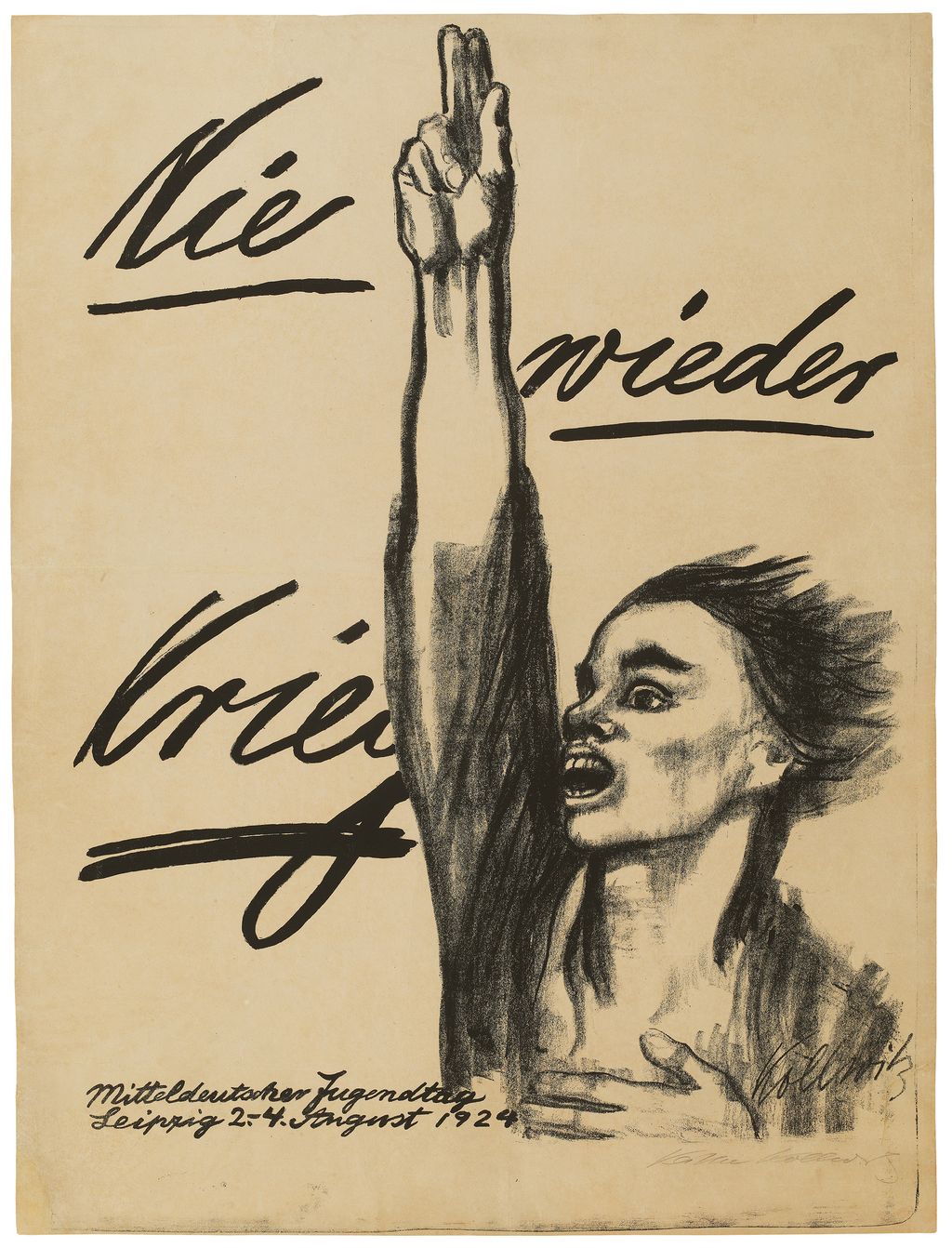
Kollwitz also gave the image a public life beyond the portfolio. In October 1922 she wrote to the French writer Romain Rolland that she wanted the prints to travel widely and convey what people had endured during the war. Ann Murray documents one way The Volunteers reached readers outside the market for signed impressions. It appeared in the West Saxon Socialist Workers’ Youth publication Nie wieder Krieg! in 1924, alongside an essay by the antiwar campaigner Helene Stöcker. In that setting a reader encountered the scene on a printed page with an explicit political argument. The numbered portfolio and the campaign reproduction gave the same procession two quite different settings. [12] [16]
From drawings and trial blocks to the published woodcut
Kollwitz began exploring a print cycle about the war in intaglio in 1918 and worked on lithographic versions from 1919. The move to woodcut came after these attempts. The volunteers and the parents were among the first subjects she developed in woodcut, although The Sacrifice would open the published portfolio. The order in which the reader turns the sheets and the order in which Kollwitz found her way to the compositions belong to different parts of the work’s history. [2] [16]
Two drawings with the title Die Freiwilligen help trace that development. In Paris, the Jeu de Paume’s Soulèvements checklist listed a 1920 drawing from the Fritsch Collection as charcoal and red chalk, 45 × 60 cm. Kornfeld’s 2026 Fritsch Collection catalogue lists a signed and dated drawing, NT 851, measuring 45 × 60.1 cm. It describes the medium as charcoal and brown chalk on beige laid paper, with some passages worked with a stump. The collection, date and nearly identical dimensions strongly suggest that the records refer to the same sheet. The colour of the chalk is described differently by the two catalogues. [17] [18]
The signed study Kornfeld sold in 2024 is a different object. Dated 1921 and catalogued as NT 852, it is a 40.5 × 55.2 cm drawing in brush and pen over pencil, with opaque white heightening and corrections, on two joined sheets. Kornfeld identifies the join at the right and suggests that the extra paper allowed Kollwitz to extend the composition. The join records a practical way of changing the available space as she worked out how to fit the procession into it. Opaque white could also be put down over dark ink while she tested how strongly a face, a hand or an edge should emerge. In the woodcut, those same relationships would depend chiefly on the distribution of ink-bearing wood and cut-away areas. [2] [19]
The studies also show a change in Death’s relation to the group. Sitter describes the drummer in a Stuttgart charcoal study, NT 850, as still recognisably like a comrade. He wears uniform and inclines his face towards the man beside him. In the 1921 ink study, the leader has become skeletal and the grouping of the men is close to the woodcut. Sitter points out that the long bright arcs over the procession are still absent there. The later arcs enlarge the gesture of the raised arm into a movement across the whole composition. They also make the men seem to travel under a single canopy, though their bodies are already beginning to buckle beneath it. [2] [19]
Three separately catalogued woodcut studies followed the subject through trials in the medium. Kn 166 and Kn 167 are rejected designs dated to spring 1921, and Kn 168 is another study from 1921. Sitter identifies Kn 166 as an experiment with the central young man in isolation and describes Kn 168 as a study of Death’s head and the head beside it. She notes that the printed direction of both differs from that of the final composition. For Kn 166, she proposes a possible explanation in the transfer of a design to the block, which would reverse in printing. That is a hypothesis about how the study was made. The separate catalogue numbers establish that these trials are distinct from the successive states of Kn 173. [2]
Cologne lists proofs Kn 173 I, II and III as 70300/92001, 70300/92002 and 70300/92003 respectively, and its IV b impression as 70300/92012. All four captions give an image size of 350 × 496 mm. That is evidence for a consistent recorded image format. The tight framing of the bodies within that rectangle is a separate matter from any physical trimming of a sheet or reduction of a block. The captions establish the order of the states, but give no line-by-line account of the changes between I and II. The reproduction of a second-state hand proof shows that the compressed row of figures, the long arcs and the slanting pale cuts at the bottom were already in place by II. The records support that conclusion more securely than a reconstruction of when individual cuts were made. [1] [11]
The illustrated second-state sheet can be distinguished from Cologne’s annotated proof. The reproduction comes from a sheet catalogued by Ketterer in 2018 as Kn 173 II, a signed hand proof on thin Japanese paper. Its catalogue transcribes the pencil inscription 2. Zust. Handdruck, meaning second state, hand-printed impression, and gives a sheet size of 48 × 66 cm around the 35 × 49.6 cm image. In the reproduction, the pencil writing sits below the printed rectangle. The lower border also preserves pale, jagged passages inside that rectangle. Those passages belong to the image, while the handwriting belongs to the particular sheet. The Cologne accession identifies a different second-state impression. [1] [2] [11]
The Getty Research Institute’s proof makes another distinction visible in the catalogue. Printed in black on thick, soft, rough Japanese paper, it was reworked with black ink after printing. The Getty dates it from 1921 to early 1922 at the latest and describes it as a proof before the Richter edition. Its finding aid records a 35 × 49.6 cm image on a 37 × 56 cm sheet, with a partly erased fourth-state inscription at the lower left. Knesebeck classifies the proof as Kn 173 III. Klipstein’s catalogue classifies the same impression as 178 IV a. The hand-applied ink can alter the balance of dark and light on that proof alone. In comparing Kollwitz’s prints, the distinction matters because both a revision to the printing surface and a mark added to a sheet can change the appearance of a cheek, a fold or a silhouette. [1] [20]
Berlin holds a fourth-state impression on Japanese paper that its Kupferstichkabinett explicitly identifies as a printing before Emil Richter’s edition. Its image measures 35 × 49.6 cm and its irregular sheet 56.1 × 69.7 cm. A fourth-state designation describes the form of the image reached in the development of the woodcut. The separate pre-edition description tells us when that particular impression belongs in the history of its publication. Berlin’s example shows why the state alone cannot place an individual sheet in a numbered edition. [13]
The Städel’s SG 4284 is catalogued as Knesebeck 173 IV b and Klipstein 178 IV b. It is printed on Japanese paper, signed in pencil below the image at the right and numbered 97/100 in another hand. The Städel records the block as 350 × 496 mm and the sheet as 477 × 650 mm. MoMA’s current record for 470.1992.2 calls its impression state IV/IV and gives an edition of 100. Its 2024 exhibition checklist records a composition of 34.9 × 49.5 cm and a sheet of 47.5 × 65.4 cm. The small differences between those image measurements provide no persuasive evidence of a different block size. The much larger differences between image and sheet measurements tell us how much paper surrounded the dark rectangle when the prints were handled as portfolio leaves. [15] [21] [22]
MoMA’s earlier German Expressionism catalogue also identifies its own impression as Kn 173 IV b. Its edition field describes a wider publication history, with 100 hand-printed, signed and numbered sets on imperial Japanese paper, including MoMA’s example, and another 100 on wove paper. It records a further 200 sets printed from electrotype plates on imitation Japanese paper and published in 1924. That broader total combines different printings and materials. The current object entry’s 100 refers to the edition associated with its sheet. The museum’s earlier page also distinguishes the seven numbered compositions from the woodcut cover. A count of eight woodcuts including the cover and a count of seven narrative sheets therefore describe the same portfolio structure. [15] [22] [23]
After the march
In the published sequence, The Volunteers follows The Sacrifice, in which a woman holds out an infant. Her arms carry the child away from her body. Death’s arm in the next sheet draws a grown child close. Reading the two gestures consecutively puts the idea of offering beside the act of being taken. The sequence also changes the scale of the action. The first sheet concentrates on the space between one adult and one child. In the second, the gesture that binds two figures together sets the direction for an entire group. [1] [15] [16] [22]
The Parents brings the movement to a stop. The two mourners bend together until their bodies make one compact shape. The picture is almost the same height as The Volunteers in MoMA’s 2024 checklist, but its image is about seven centimetres narrower. That difference in proportion is felt in the distribution of weight. In The Volunteers, the eye crosses a row of separate faces and catches on pale cuts at intervals. In The Parents, it meets a central mass and has to stay there to distinguish the people within it. Faces recede, and the visible gestures of the hands carry more of the expression. Cologne records that Kollwitz returned to the sheet late in 1922 and that the final version is darker and has less internal detail. The resulting darkness gives the mourners a common shape before their individual postures become clear. [19] [22] [24]
By sheet six, The Mothers gives bodily closeness a different purpose. The adults turn inwards, and their shoulders and arms form much of the group’s outline. Small faces appear where the shelter opens. In The Volunteers, the pale arcs hang above exposed faces and carry the eye over their heads. In The Mothers, the enclosing curve is made by the adults themselves. The hands that cross it help hold the group in place. MoMA curator Starr Figura reads that protective posture as resistance to the expectation that mothers should accept the sacrifice of their children. The placement of the hands makes that reading tangible. In sheet two an arm closes around Peter and brings him into the march. In sheet six the arms close around children to keep them within reach. [1] [15] [25] [26]
Käthe Kollwitz artworks directory
Selected documented works, including the complete published sequences of the five cycles discussed here. Catalogue links identify the specific record behind each row.
Frequently Asked Questions
Peter is the young man immediately beside Death at the left. Death’s left arm holds him close. The Kollwitz Museum Köln identifies him in that position and cites a note connecting the group to Peter and his fallen friends. Sitter traces the note to Cologne’s second-state proof through Knesebeck’s catalogue. [1] [2]
Kollwitz developed the woodcut in 1921–22. Emil Richter published it in Dresden in 1923 as the second sheet of War. The 1920 charcoal-and-chalk drawing exhibited at the Jeu de Paume and the 1921 ink study catalogued by Kornfeld are separate works. The electrotype printing recorded by MoMA appeared in 1924. [16] [17] [19] [23]
Kn refers to Alexandra von dem Knesebeck’s catalogue of Kollwitz’s prints. The number 173 identifies the woodcut and IV b is a subdivision of its fourth state, used in the Cologne and Städel records. Klipstein’s catalogue uses 178 for the same woodcut. A number such as the Städel’s 97/100 identifies a particular impression within an edition. [1] [20] [21]
Discussion
Look again at the images and ideas explored in The Volunteers. These editorial prompts invite your observations.
Reader Insights
How do the faces, drum and overhead arc set the rhythm of the march?
What does the proof annotation add to a reading of the figure next to Death?
How do the bright cuts change the speed at which your eye moves across the marchers?
Join the Conversation
Share a detail, comparison or question about The Volunteers below.
References
- Kollwitz Museum Köln, Die Freiwilligen, main impression Kn 173 IV b and the three impressions under Zustandsdrucke View source.
- Bettina Sitter, Kollwitz: Kunst und Wirklichkeit – Die Hauptwerke zum Ersten Weltkrieg, vol. 2, p. 395 nn. 1207–09, § II.8.2, especially pp. 434–40 and p. 449 n. 1396 View source.
- Mark Connelly and Stefan Goebel, “Forgetting the Great War? The Langemarck Myth between Cultural Oblivion and Critical Memory in (West) Germany, 1945–2014,” Journal of Modern History 94, no. 1, p. 17 View source.
- Kollwitz Museum Köln, A Weavers’ Revolt, cycle catalogue. View source.
- Museum of Modern Art, Woman with Dead Child, state VIII/X, 1903. View source.
- Kollwitz Museum Köln, Peasants’ War, cycle catalogue. View source.
- Museum of Modern Art, Käthe Kollwitz, 2024 extended gallery labels. View source.
- Flemish Heritage Inventory, Treurend ouderpaar (Vladslo – WOI). View source.
- Kollwitz Museum Köln, Death, series catalogue. View source.
- Kollwitz Museum Köln, Pietà (Mutter mit totem Sohn), Seeler 37, with the Neue Wache enlargement. View source.
- Ketterer Kunst, Die Freiwilligen, auction 466, 7 June 2018, lot 77, object description and illustrated second-state hand proof View source.
- Ann Murray, “Käthe Kollwitz: Memorialisation as Anti-Militarist Weapon,” pp. 14–17 and 24–25, including the 1924 Nie wieder Krieg! publication View source.
- Staatliche Museen zu Berlin, Kupferstichkabinett, Die Freiwilligen, AM 2-1958,2, materials, measurements and object description citing Sigrid Achenbach, 1995, p. 133, cat. 161 View source.
- Museum of Modern Art, Käthe Kollwitz exhibition texts, “War and Its Aftermath,” including Kollwitz’s diary excerpts View source.
- Museum of Modern Art, The Volunteers, 470.1992.2, current object title, edition field and 2024 gallery label View source.
- Kollwitz Museum Köln, The War Series, 1918–1922/1923, letters to Romain Rolland and Erna Krüger, technical chronology and portfolio order View source.
- Jeu de Paume, Soulèvements, exhibition checklist, PDF p. 8, Die Freiwilligen (Les Volontaires), 1920, Fritsch Collection View source.
- Galerie Kornfeld, Fritsch Collection catalogue, 2026, lot 920, Die Freiwilligen, 1920, NT 851 View source.
- Galerie Kornfeld, 13 September 2024, lot 170, Die Freiwilligen, 1921, NT 852, medium, inscription, illustration and catalogue commentary View source.
- Getty Research Institute, Dr. Richard A. Simms collection finding aid, 2016.PR.34, printed p. 88, Box 11, The Volunteers, Kn 173 III and Klipstein 178 IV a View source.
- Städel Museum, The Volunteers, SG 4284, dimensions, work catalogues and pencil inscriptions View source.
- Museum of Modern Art, Käthe Kollwitz Exhibition Checklist, 20 March 2024, pp. 29–31, portfolio sheets and their composition and sheet measurements View source.
- Museum of Modern Art, German Expressionism collection catalogue, The Volunteers, 470.1992.2, Paper, Edition and Reference fields View source.
- Kollwitz Museum Köln, The Parents, Kn 174 V b, compositional changes and diary entry of 13 December 1922 View source.
- Kollwitz Museum Köln, The Mothers, Kn 176 VII b, final composition and preparatory works View source.
- Museum of Modern Art, The Mothers, exhibition audio transcript, Starr Figura segment View source.
More KOLLWITZ Works
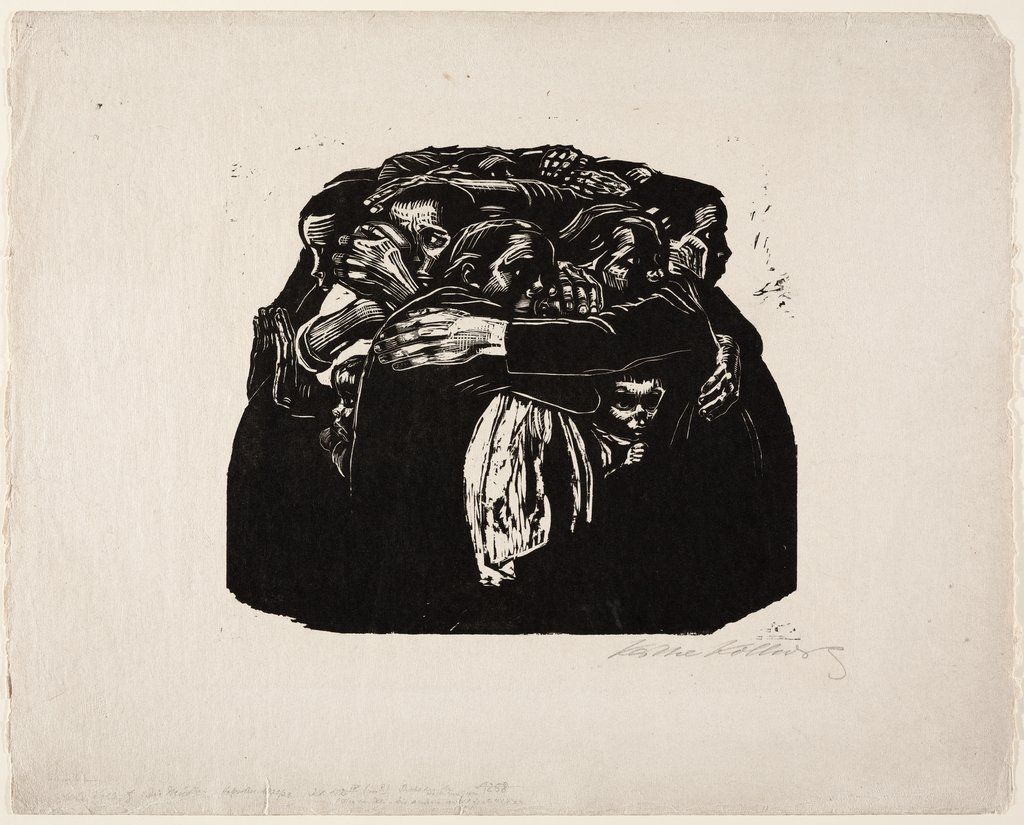
The Mothers
The Mothers, 1921–22. Städel Museum, Frankfurt am Main, SG 4289A D. Image source. Public domain. Resized and exported as JPEG.
The Grieving Parents
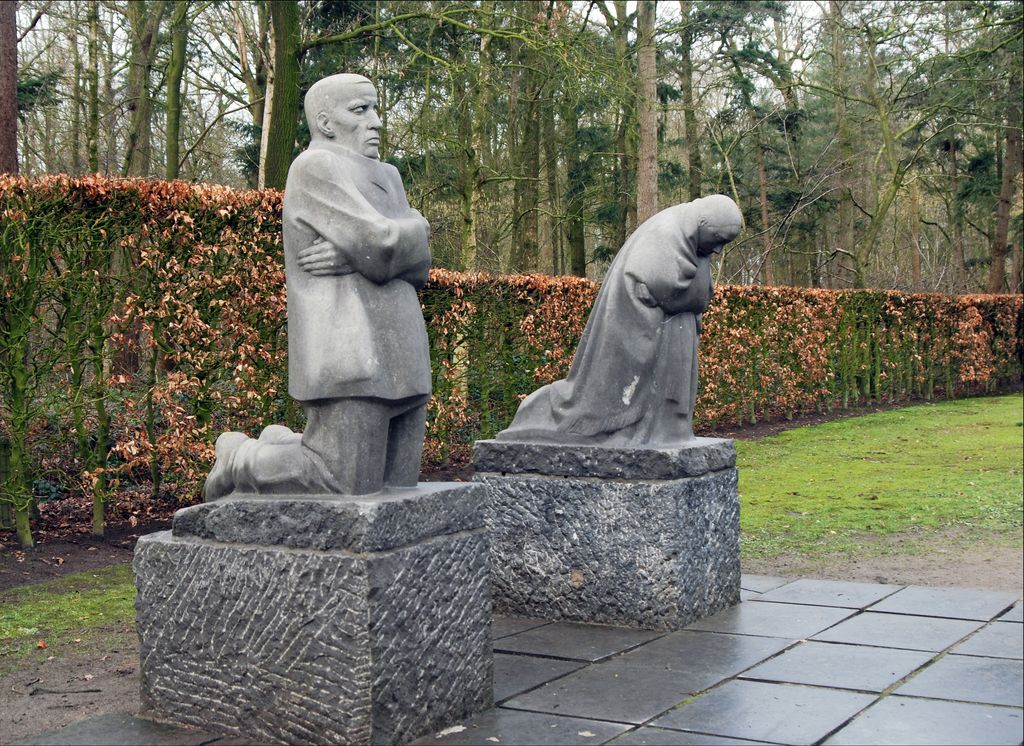
The Grieving Parents at Vladslo, the memorial’s location since 1956. Photograph by Bva, resized. Image source. CC BY-SA 3.0. Resized and exported as JPEG.
Memorial for Karl Liebknecht
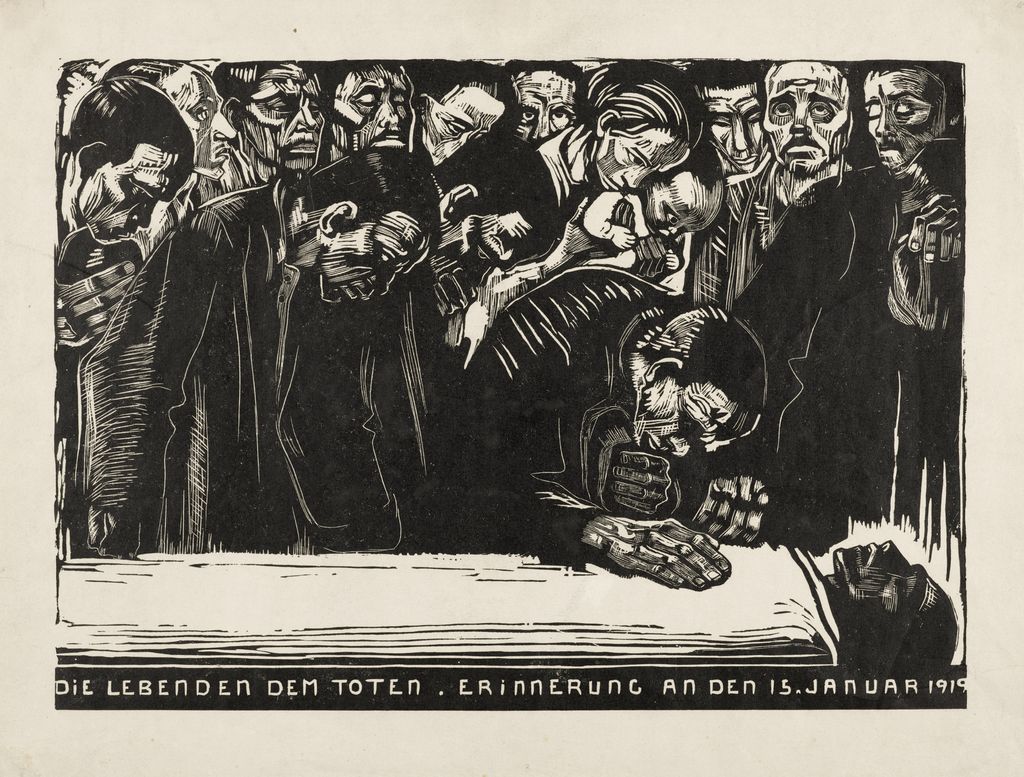
Memorial for Karl Liebknecht, 1920. Kunstsammlungen Chemnitz, 86-47, Kn 159 VI. Photo: Kunstsammlungen Chemnitz/PUNCTUM/Bertram Kober. Image source. Public domain. Resized and exported as JPEG.