


 by Tom Gurney
Tom Gurney BSc (Hons) is an art history expert with over 20 years experience
Email: tomgurney1@gmail.com / Phone: +44 7429 011000
Mother with Her Dead Son: Introduction
In Käthe Kollwitz’s Mother with Her Dead Son, a seated woman bends over the body between her knees. Her head and shoulders are easy to recognise. The son takes longer to see. His bent limbs lie so low that, from the front, they seem at first to be part of the folds of her garment. Both figures fit within a single outline. In the zinc cast at the Kollwitz Museum Köln, that outline is less than 40 centimetres high. The bronze beneath the circular opening of Berlin’s Neue Wache is approximately 1.6 metres high, an enlargement made by the sculptor Harald Haacke in 1993 after Kollwitz’s model of 1937–39. [1] [2]
At a Glance
- ArtistKäthe Kollwitz.
- German titlePietà (Mutter mit totem Sohn).
- Model1937–39, catalogued as Seeler 37. [1] [3]
- Cologne zinc cast1941–43, 386 × 288.5 × 403 mm, Seeler 37 I.B.6, inventory 70100/97007, Kollwitz Museum Köln. [1] [3]
- Berlin enlargementBronze, 1993, approximately 1.6 metres high. Executed by Harald Haacke and cast by Hermann Noack for the Neue Wache on Unter den Linden. [1] [4] [3]
This work across Käthe Kollwitz’s career
A Weavers’ Revolt
1893–97The six sheets take a revolt from household distress to collective action and its aftermath. [5]
Separate impressions and hand-worked proofs show how Kollwitz developed the image. [6]
Peasants’ War
1901–08The seven plates combine the revolt with the aftermath in Battlefield and The Prisoners. [7]
War
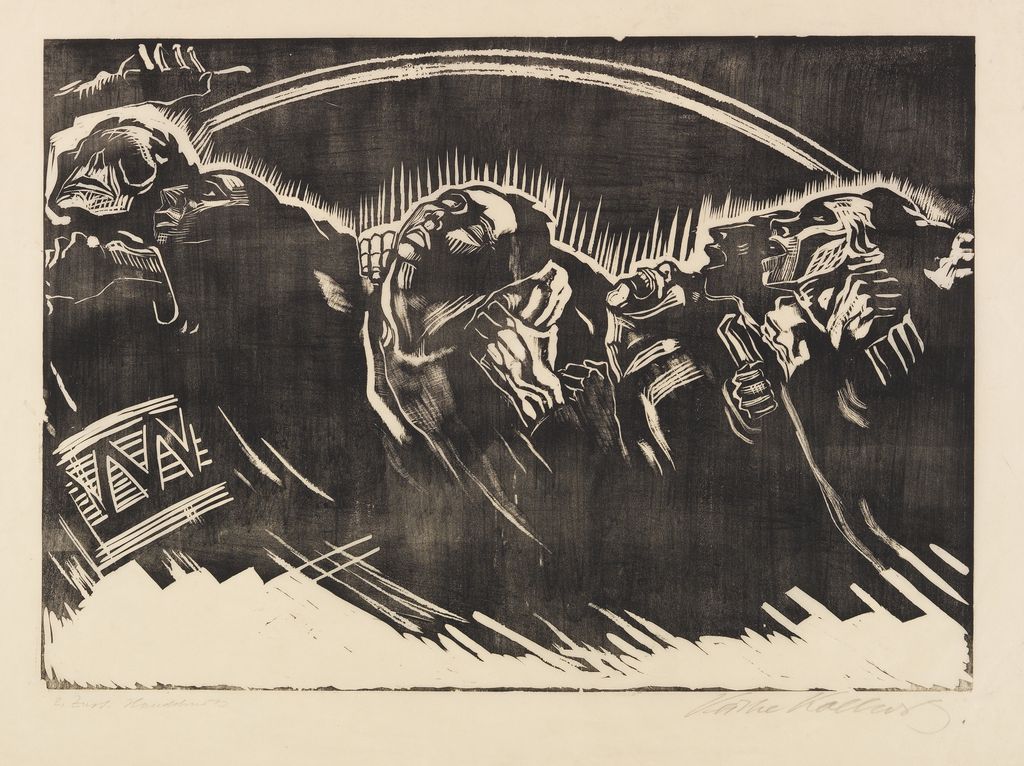
1921–22, published 1923The woodcuts give sustained attention to the experience of those left behind. [8]
The Grieving Parents
1932 installationTwo kneeling figures face the graves in the memorial’s later location at Vladslo. [9]
Mother with Her Dead Son (current article)
1937–39 modelThe small sculpture precedes the 1993 enlargement at the Neue Wache. [1]
Contents
- The small sculpture from the front
- The Pietà and the memory of Peter
- The enlargement in the Neue Wache
- The dedication and the 1993 debate
The small sculpture from the front
The mother’s covering establishes the main outline. It descends from her bowed head, broadens across her shoulders and falls towards the base. An arm crosses the front of her body, interrupting that downward movement and returning the eye to the space between her knees. Her face is partly shaded by the covering. The bend of her head is clear even when her expression is hard to make out. The son’s exposed body, by contrast, is articulated in short curves. The eye follows a shoulder or a bent limb for a little way before it runs into the mass of cloth. There is enough separation to pick out a second body, and enough overlap to make that recognition happen slowly. [1] [11]
The base matters because the son’s weight comes to rest so close to it. Kollwitz described him in her diary as lying in his mother’s lap between her knees. In the finished group, the lap seems to extend down to the ground. His mother’s legs enclose him on either side, and the cloth behind him closes off the space. The Leopold Museum describes the son as crumpled on the floor. The diary and the museum’s description draw attention to different aspects of the same arrangement. He is held within the space of her body, and gravity has pulled him down to its lowest point. His compact posture, which Cologne likens to that of an embryo, brings the idea of a grown son back into contact with the bodily memory of holding a child. [1] [11]
Cologne calls the main view partly relief-like. Seen head-on, the son is compressed between the frontal planes of the garment, and the low, close-fitting base does little to separate the two figures from one another. Yet the Cologne zinc is 403 millimetres deep and 386 millimetres high. A side view changes the reading of the same contours. The knees project forward, the bent upper body has room to lean, and the base can be seen supporting a group that occupies substantial depth. From the front the mother seems to contain the son almost entirely. From the side the gap between her upper body and his makes the inclination of her head and shoulders more apparent. [1] [3]
The origin of the pose is unusually well documented. On 22 October 1937, the anniversary on which she remembered Peter’s death, Kollwitz wrote that the small sculpture had grown out of an attempt to model an elderly person. Seeler’s catalogue gives that preliminary project its own entry, Der alte Mensch. In the diary, Kollwitz says that the work had become something like a Pietà and uses Nachsinnen, or contemplation, for the mother’s state of mind. The two parts of the entry belong together. The study of an ageing body gave her a way of modelling someone who had lived with loss. In the finished group, the gaze stays lowered and the weight of the garment settles around the knees. The posture suggests someone who has already been sitting there for a long time. [1] [3] [12]
Model, casts and casting evidence
Seeler 37 identifies the sculptural model. The letters and numbers that follow distinguish individual examples and groups of casts. An early small bronze in Düsseldorf’s Museum Kunstpalast, inventory 0.1952.48 (II/43), is Seeler 37 I.B.1. Seeler dates it probably to 1939 or early 1940 and records it as a sand cast measuring 383 × 287 × 401 millimetres. It has a partly chased signature near the lower back edge and carries no foundry stamp. Cologne’s I.B.6 is the later zinc cast made during Kollwitz’s lifetime. Its brown matt patina is worn over a round casting repair on the mother’s head. Seeler also records the two-part H. NOACK BERLIN stamp on the rear of its base. The wear and the stamp help identify that particular object even when a photograph of the front makes it look much like a small bronze. [3]
Cologne also has a posthumous bronze, Seeler 37 II.B.1, inventory 70100/86009, probably cast in 1950. It measures 379.5 × 286 × 396 millimetres, bears a three-part H. NOACK BERLIN FRIEDENAU stamp and retains an ownership label inside in Hans Kollwitz’s handwriting. The two Cologne examples thus preserve different evidence about the work’s circulation. One is a wartime zinc acquired from the art market in 1997. The other came from the family estate in 1986 after a period on loan to Berlin’s Neue Nationalgalerie. Antwerp’s Middelheim Museum gives a specific posthumous casting year of 1961 for its bronze, MID.B.212, which entered the collection as a gift in 1963. The Leopold Museum records a bronze from a private Viennese collection at 38.2 × 28.1 × 39.2 centimetres under the date 1937/38. Its entry supplies a single date for the work, while Antwerp explicitly separates the model and casting dates. [11] [3] [13]
The later casts also explain why a single edition total can be misleading. For the bronzes commissioned under Hans Kollwitz’s management of the estate, Seeler compares the family’s figures with the Noack order books and arrives at a range of 26 to 28. For the subsequent Vömel edition organised by the heirs, the 1977 agreement points to ten examples of the Pietà, while the foundry order books list six for 1972–75. Seeler sets out the evidence from each record. A model date, a familiar signature and an approximate height can identify the design, but the date and history of a given cast depend on details such as its material, markings and provenance. [3]
The Pietà and the memory of Peter
In Christian art, a Pietà shows the Virgin Mary mourning the dead Christ, often with his body supported on her lap. Kollwitz retained the mother, the dead son and the physical act of holding. She placed the son low inside the shelter of the mother’s knees and bent her down over him. His body offers few clues about how he died. What the sculpture makes visible is what she can still do for him. She can draw close, shield him and remain with him. Cologne records that Kollwitz repeatedly described the work in secular terms. The title preserves the connection to a religious tradition that makes the relationship immediately legible. [1] [14] [11]
The historian Annette Becker traces an earlier attempt to give that relationship form after Peter, an eighteen-year-old volunteer, was killed in Flanders in 1914. In the diary passages Becker discusses, Kollwitz recorded drawing a mother with her dead son in her arms and wrote about the distance she still felt from Peter, however many such drawings she might make. She also considered a memorial in which the dead son himself would appear above the parents. The completed cemetery memorial eventually gave the space to the parents and their grief. The sculpture begun in 1937 brought the son’s body back into view under different conditions. The elderly woman she had been trying to model bends over him in a gesture whose duration is felt in the pose. The diary supplies a personal setting for the sculpture, while the development from the study of old age helps explain the mother’s particular physical presence. [1] [15] [16] [12]
The Städel Museum’s comparison with Mother with Two Children brings out another feature of the late group. In that earlier sculpture, modelled in 1932–36, the mother’s arms and rounded body gather two small children against her. Their bodies have room to nestle and turn within the hold. In the Pietà, the knees and the garment do much of the enclosing. The son’s folded limbs have settled at the base, and the mother bends into the space left above him. In both works Kollwitz models protection through the arrangement of bodies. In the later one, the protection persists after it has lost its power to keep the child alive. [1] [17]
The 1903 print and the cemetery figures
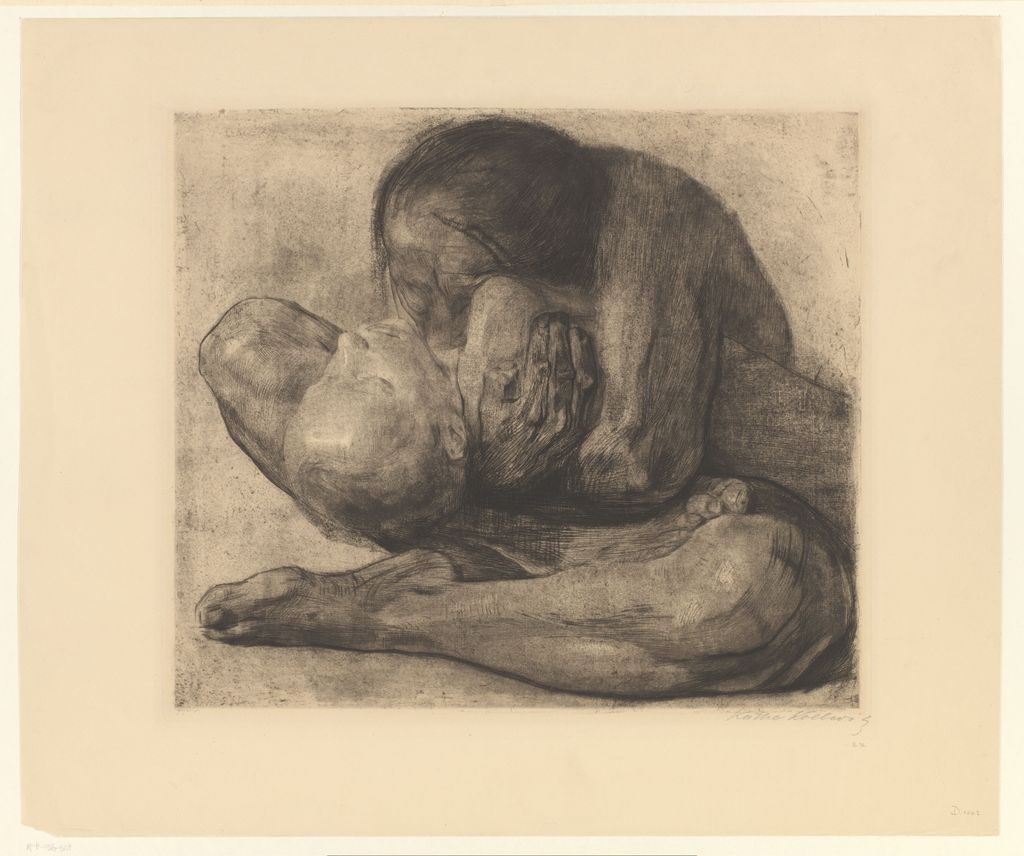
In Woman with Dead Child, made in 1903, a bare, cross-legged woman presses her face into a child’s body. The arc of her back and the child’s torso close around the point of contact. Lines, scratches and grain continue across places where the eye expects a clean boundary between them. Kollwitz used herself and seven-year-old Peter as models. In the account published by Arthur Bonus in 1925, she recalled holding him in front of a mirror as she drew. Hans Kollwitz’s recollection, published in 1966, belongs to the later history of the image. He remembered asking his mother why the motif had appeared so often before the war, and recalled that she came to associate it with Peter’s death. MoMA also places the subject in the context of childhood mortality among the working families served by her husband Karl’s medical practice. [6] [18]
The 2024 MoMA checklist makes it possible to follow Kollwitz’s experiments without conflating the objects. The two-colour lithograph Pietà appears on page 10 in a state III impression from the Ute Kahl collection. Cologne’s separate impression is Kn 77 II. The lithograph holds the bodies in a more open arrangement than the intaglio Woman with Dead Child, Kn 81. In Getty’s preparatory drawing NT 241, part of the woman’s head extends onto the mount. In the state I proof acquired by MoMA in 2024, charcoal reinforces the printed image. The British Museum’s state III on page 12 has gold-coloured wash applied by hand, along with graphite and charcoal. Its state VI on page 13 carries a printed gold tone from a lithographic stone. These are different ways of changing how light falls across the pictured bodies, and the differences belong to the particular sheets. [18] [19] [20] [21]
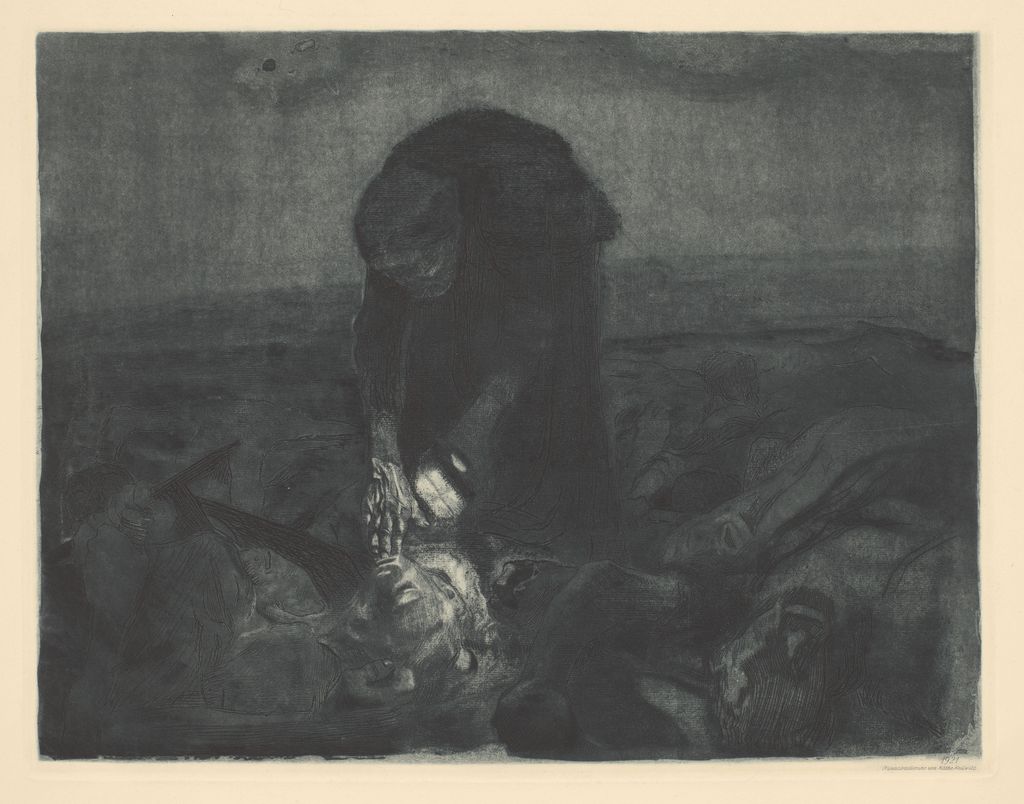
The later proof MoMA acquired in 2018, 181.2018, is state VIII/X, printed on chine collé and listed on page 14 of the checklist. MoMA places it among the proofs preceding the 1918 edition of fifty and distinguishes that edition from later printings. Cologne identifies its example as Kn 81 VIII a, and the Rijksmuseum records its own impression, RP-P-1916-507, as a 1916 gift from J.W.E. vom Rath. A further resemblance in title can obscure another distinction. Mother and Dead Son is a rejected design for Battlefield, the plate eventually built around a woman’s lantern finding her son among the dead. In the 1903 intaglio, the close hold presses towards the picture plane. In the late sculpture, the sweep of the garment and the support of the base settle the action downwards. [6] [18] [19] [22] [23]
The Grieving Parents places grief across a space that a visitor can enter. The original kneeling granite figures were installed in July 1932 at the German military cemetery at Esen-Roggeveld. Fritz Diederich carved the mother and August Rhades the father. Peter’s grave supplied the point towards which the pair was directed. When the cemetery was consolidated in 1956, the sculptures and Peter’s remains were transferred to Vladslo. Mark Connelly and Stefan Goebel document Hans Kollwitz’s distress at the proposed closure and the assurances he received that the figures and Peter would be reunited. They also show how the reassembly changed the work. The parents were set closer together and moved from the entrance to the rear of the cemetery. In Hugo Maertens’s photograph of the Vladslo pair, the flat grave markers spread out in front of the two upright forms. The French-language Flemish Canon reads the figures through the suffering the war left behind, an association reinforced by that field of graves. [15] [16] [24] [25]
At the ruins of St Alban’s in Cologne, enlarged shell-limestone versions of the parents acquired another setting. The father was carved by Joseph Beuys under Ewald Mataré. Connelly and Goebel describe how the change of material and site brought memories of the Second World War into a work first organised around a particular grave from the First. The late Pietà handles the space between mourner and dead differently again. In the cemetery, the visitor has to look from the parents towards the grave to complete the relationship. In the small sculpture, the son’s place is built into the mother’s outline. The two works show how much the setting can contribute to the meaning of Kollwitz’s sculptures. [1] [16] [25]
The enlargement in the Neue Wache
Karl Friedrich Schinkel designed the Neue Wache as a royal guardhouse, built in 1816–18. Heinrich Tessenow converted it in 1930–31 into a memorial to the fallen of the First World War. He replaced the divided interior with a single hall and set a dark granite block beneath a circular opening. A metal oak wreath by Ludwig Gies rested on the block. The Nazi regime subsequently redesignated the building as a Reich memorial. After severe wartime damage, East Germany rebuilt it and opened it in 1960 as a memorial to the victims of fascism and militarism. In 1969 a glass prism containing an eternal flame occupied the centre. The remains of an unknown soldier and an unknown concentration-camp prisoner, commemorated as a resistance fighter, were interred with earth from battlefields and concentration camps. The burials survived the later redesign. [4] [26] [27]
After reunification, the federal government largely restored the spatial arrangement of Tessenow’s hall and placed Haacke’s enlargement beneath the opening. The Käthe-Kollwitz-Museum Berlin identifies Haacke as a pupil of Diederich, who had carved the mother for the cemetery memorial. Seeler traces the physical evidence for the 1993 commission to a small plaster working model. Its footprint and dimensions closely match a plaster in Berlin’s Akademie der Künste, while its signature, with an unlooped final letter in the old German script, resembles that of casts associated with Willy Geisler. Seeler therefore considers it likely that Haacke’s plaster descended from a Geisler-related example through a later moulding. Noack cast the finished enlargement. The surviving plaster evidence gives a more precise account of what “after Kollwitz” means here. Haacke worked from a full-size plaster of the small composition, and the finished bronze translated that composition into a new scale. [1] [2] [3] [28]
In the hall, a visitor can recognise the bowed outline from the entrance, across an expanse of floor. The son’s body becomes distinct later in the approach, as it does when one studies the small cast from the front. The dimensions change the physical experience of that delay. In Berlin the head of the seated woman is nearly at the height of a standing visitor, while the son is still close to the paving. The visitor’s gaze has to descend through almost the full height of the sculpture to reach him. Overhead light picks out the top of the covering and lets the face and the interior of the group fall into shadow. Where Tessenow’s block once bore a wreath, the visitor now encounters a human figure whose pose directs attention downward. [1] [4] [27]
The central placement also creates a relationship between the sculpture and the street. The May 2023 photograph published by the German Historical Institute shows students gathered outside the Neue Wache. The accompanying essay sets the building within the history of successive German states and records the protests that accompanied its most recent dedication. The photograph fixes a public stage in the visit, before anyone reaches the darkened hall. A small cast can be studied as an object in its own right. In Berlin the approach begins at a former guardhouse, passes plaques that set out the official history and dedication, and leads towards a figure designed decades before the state gave it that role. [4] [26] [27]
The dedication and the 1993 debate
The Neue Wache opened on 14 November 1993, Germany’s national day of mourning, as the Central Memorial of the Federal Republic of Germany to the Victims of War and Tyranny. The floor inscription is Den Opfern von Krieg und Gewaltherrschaft. In his November inauguration statement, Chancellor Helmut Kohl presented the memorial as a symbol of reunification and connected the choice of Kollwitz to the Basic Law’s commitment to human dignity, rights and democratic freedom. In the Bundestag debate on 14 May, he had made a more specific argument for the figure. He wanted remembrance to encompass the mother, the widow and the bereaved alongside the dead soldier. He argued that the experience of women affected by war and violence had seldom received that prominence in memorials. [29] [30] [26]
Peter Conradi of the SPD welcomed the choice of Kollwitz and expected the contemplative figure to create a tension with Tessenow’s severe hall. He wanted a trial model before the scale was settled, since enlargement could change the structure, surface and expression of a sculpture about 38 centimetres high. Kohl replied that he had seen the work in progress and considered the proposed scale appropriate, invoking the proportions of the cemetery figures. Conradi also wanted to retain the East German burials and the earth from battlefields and camps. His proposed inscription put the victims of tyranny first and repeated the word “victims” before naming those of wars. He argued that the categories were historically distinct and drew on Richard von Weizsäcker’s 8 May 1985 speech as an example of how to name the people being remembered. [29]
Ilja Seifert of the PDS/Left List called for work to stop while the government put its plan before parliament and the public. His objection was to the political effect of a common tribute that could put victims and perpetrators on the same footing. Konrad Weiß of Alliance 90/The Greens also criticised the lateness of public consultation. He supported a national place of remembrance and read Kollwitz’s contemplative figure as an invitation to reflect on German guilt and responsibility. He suggested that civilians in ordinary clothes could lay wreaths on official occasions, a ceremonial form he considered more consistent with Kollwitz’s pacifism. The next day, taz reported broad parliamentary support for the memorial and noted that the SPD’s call for public discussion went to committee after work had already begun. [29] [31]
The dispute extended to what the sculptural type itself could represent. As the historian Ulrike Jureit documents, Reinhart Koselleck objected that the enlarged Pietà was inadequate to represent mass death and mass murder across generations, sexes and peoples, or to express German responsibility for those crimes. The mother’s absorption in the son was precisely what gave the sculpture its force for some speakers in the May debate. For Koselleck, the specificity of that relationship limited what the state could ask it to stand for. The Christian associations of the image also remained available to viewers even though Kollwitz understood the work in secular terms. [1] [29] [27] [32]
The entrance plaques added in November 1993 give the broad floor dedication more detail. One records the building’s successive uses. The other names groups being commemorated, including the millions of murdered Jews, murdered Sinti and Roma, those killed on account of their ancestry, homosexuality, illness or disability, and people who died for their convictions or in resistance. It also commemorates the fallen of the world wars and civilians who died through war and its consequences. The names and categories are outside, while the common dedication and the sculpture occupy the centre of the hall. That distribution makes a difference to the visit. The plaques ask the reader to distinguish histories and causes. Inside, the arrangement directs sustained attention to a single bereaved figure. [26]
The campaign for a separate Memorial to the Murdered Jews of Europe already had a history of its own. Journalist Lea Rosh and historian Eberhard Jäckel issued the citizens’ initiative’s first appeal in January 1989, and the federal government supported the project and agreed to provide land in 1992. A separate design process led to the Bundestag decision of 25 June 1999. The memorial opened in 2005, with an information centre that documents the persecution and murder of European Jews through individual testimony and family histories. At the Neue Wache, the visitor encounters one mother and one son, a brief floor inscription and a more detailed account at the entrance. The 1993 debate remains legible in that arrangement, in the physical distance between the figure that gathers attention and the words that specify whom the state remembers. [29] [33] [26]
Käthe Kollwitz artworks directory
Selected documented works, including the complete published sequences of the five cycles discussed here. Catalogue links identify the specific record behind each row.
Frequently Asked Questions
Harald Haacke’s approximately 1.6-metre bronze stands in the Neue Wache at Unter den Linden 4 in Berlin. The small zinc cast Seeler 37 I.B.6 belongs to the Kollwitz Museum Köln, which also holds the small posthumous bronze Seeler 37 II.B.1. Other original-size examples are documented in Düsseldorf, Antwerp and Vienna. [1] [11] [4] [3] [13]
Cologne dates Kollwitz’s model to 1937–39 and its zinc cast to 1941–43. Düsseldorf’s small bronze was probably cast in 1939 or early 1940, while Cologne’s small bronze is probably from 1950 and Antwerp dates its bronze to 1961. Berlin’s 1993 date refers to the much larger bronze made by Haacke after Kollwitz’s model. A catalogue entry that supplies both the model date and the cast date identifies two stages in the making of the object. [1] [3] [13]
Discussion
Look again at the images and ideas explored in Mother with Her Dead Son. These editorial prompts invite your observations.
Reader Insights
How does the Neue Wache setting change what you notice in Kollwitz’s small model?
What did the 1993 parliamentary debate reveal about the choice of a single figure group for a national memorial?
How does the change in scale affect where a viewer stands and what they notice?
Join the Conversation
Share a detail, comparison or question about Mother with Her Dead Son below.
References
- Kollwitz Museum Köln, Pietà (Mutter mit totem Sohn), Seeler 37 I.B.6, inventory 70100/97007. See the object caption, diary entry for 22 October 1937, formal analysis and caption for the 1993 enlargement. Object record View source.
- Nathalie Muller, Institut national d’histoire de l’art, Käthe Kollwitz (1867–1945), 2/2. See the paragraph beginning En 1993, on Kohl’s initiative and Haacke’s enlargement. INHA essay View source.
- Annette Seeler, Käthe Kollwitz. Die Plastik. Werkverzeichnis, Kollwitz Museum Köln, 2016, nos. 36–37, print volume pp. 338–53. See also the January 2019 supplementary online catalogue, no. 37, pp. 191–99, especially I.B.1 on Düsseldorf, I.B.6 on the Cologne zinc, II.A on the plasters and Haacke’s working model, and II.B and II.B.1 on posthumous production and the Cologne bronze. Supplementary catalogue View source.
- Landesdenkmalamt Berlin, Neue Wache, monument record 09095950. See the architectural history from Schinkel through the 1993 reopening. Monument record View source.
- Kollwitz Museum Köln, A Weavers’ Revolt, cycle catalogue. View source.
- Museum of Modern Art, Woman with Dead Child (Frau mit totem Kind), state VIII/X, object 181.2018. See medium, edition history and the 2024 exhibition label. Object record View source.
- Kollwitz Museum Köln, Peasants’ War, cycle catalogue. View source.
- Museum of Modern Art, Käthe Kollwitz, 2024 extended gallery labels. View source.
- Flemish Heritage Inventory, Treurend ouderpaar (Vladslo – WOI). View source.
- Kollwitz Museum Köln, Death, series catalogue. View source.
- Leopold Museum, Pietà, object record 7267, interpretation by AK, 2019, and “Object data,” including private-collection credit and Timm 56. Object record View source.
- Annette Becker, Käthe Kollwitz. Le deuil comme proclamation politique, 1914–1945, Politika, 2023. See the opening diary passages, the section Un monument au fils mort, enfin ?, and notes 1–4 on the diary and French edition. Research essay View source.
- Middelheim Museum, Pietà, MID.B.212, French collection entry, “Détails,” including the posthumous cast date and acquisition. Object record View source.
- National Gallery, London, Pietà, glossary entry on the Virgin and the dead Christ. Glossary View source.
- Agentschap Onroerend Erfgoed, Duitse militaire begraafplaats Vladslo met Treurend Ouderpaar. See the historical account of the 1932 installation, the carvers and the cemetery consolidation. Flemish heritage inventory View source.
- Mark Connelly and Stefan Goebel, Forgetting the Great War? The Langemarck Myth between Cultural Oblivion and Critical Memory in (West) Germany, 1945–2014, pp. 16–18, especially notes 59–65, on Hans Kollwitz’s correspondence, the altered placement at Vladslo and the Cologne replicas. Kent Academic Repository View source.
- Städel Museum, Kollwitz, 2024 exhibition guide. See Vom Papier in den Raum, the entry for Mutter mit zwei Kindern, and the closing discussion of the Pietà at the Neue Wache. Exhibition guide View source.
- Kollwitz Museum Köln, Woman with Dead Child, Kn 81 VIII a, and contextual work Pietà, Kn 77 II, inventory 70300/91015. The entry reproduces the modelling account from Arthur Bonus, Das Käthe-Kollwitz-Werk (1925), and Hans Kollwitz’s recollection from Briefe der Freundschaft und Begegnungen (1966). Object and contextual records View source.
- Museum of Modern Art, Käthe Kollwitz Exhibition Checklist, 2024, pp. 10–14. See the state III lithographic Pietà, Getty drawing, state I proof, British Museum states III and VI, and MoMA state VIII impression. Exhibition checklist View source.
- Getty Research Institute, Woman with Dead Child, Nagel/Timm 241, 1903. See the physical description of the drawing and mount. Drawing record View source.
- Museum of Modern Art, Woman with Dead Child (Frau mit totem Kind), charcoal-worked proof, object 113.2024. Object record View source.
- Rijksmuseum, Moeder met dood kind, RP-P-1916-507. See acquisition, donor credit and plate measurements. Object record View source.
- Kollwitz Museum Köln, Battle Field, Kn 100 X b, and related rejected design Mother and Dead Son. See the discussion of the early narrative designs and the finished lantern scene. Object and study records View source.
- Canon van Vlaanderen, Les parents éplorés de Käthe Kollwitz. See the French interpretation and Hugo Maertens’s photograph of the original pair at Vladslo. Essay and photograph View source.
- Kollwitz Museum Köln, Mahnmal Trauernde Eltern. See the installation chronology and archival photographs from Roggeveld, the transfer to Vladslo and the account of the Cologne replicas. Memorial dossier View source.
- Gedenktafeln in Berlin, Neue Wache, Unter den Linden 4, transcription of both entrance plaques and installation date of 12 November 1993. See also the Volksbund Deutsche Kriegsgräberfürsorge site record for the floor inscription and memorial history. Plaque transcription · Volksbund memorial record View source 1. View source 2.
- German Historical Institute, Neue Wache Memorial Berlin (2023), German History in Documents and Images, abstract and Imago/Panthermedia photograph of students outside the memorial, May 2023. Photograph and contextual essay View source.
- Käthe-Kollwitz-Museum Berlin, Art Postcards | Sculptures, introductory paragraphs on Harald Haacke’s enlargement and his training under Fritz Diederich. Museum account View source.
- Deutscher Bundestag, Plenarprotokoll 12/159, 14 May 1993, agenda item 11. See printed pp. 13446–47 for Peter Conradi, pp. 13447–50 for Helmut Kohl, especially p. 13449 on the bereaved and p. 13449 on scale, pp. 13452–53 for Ilja Seifert and pp. 13453–54 for Konrad Weiß. Parliamentary transcript View source.
- German Federal Government, Helmut Kohl’s statement at the dedication of the Neue Wache, 14 November 1993, published in Bulletin 99-93, 16 November 1993. Dedication statement View source.
- taz, Späte Debatte über das Mahnmal Neue Wache, 15 May 1993, especially the opening report on the timing of the debate and the committee referral. Contemporary report View source.
- Ulrike Jureit, Erinnern als Überschritt. Primärerfahrung, Geschichtlichkeit und Erinnerung im Werk Reinhart Kosellecks, opening discussion of Koselleck’s objections to the 1993 memorial. Hamburg Institute for Social Research View source.
- Foundation Memorial to the Murdered Jews of Europe, Memorial to the Murdered Jews of Europe. See the project chronology for January 1989, April 1992 and 25 June 1999, and the Information Centre exhibition descriptions. Memorial history and exhibition View source.
More KOLLWITZ Works
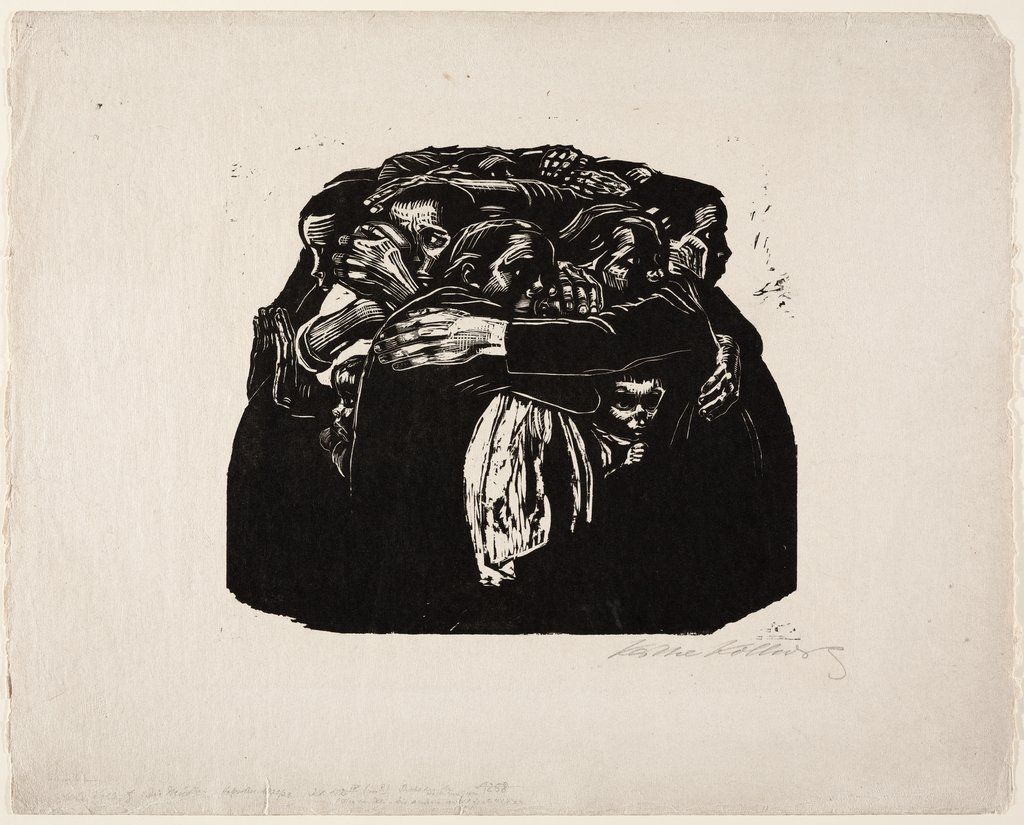
The Mothers
The Mothers, 1921–22. Städel Museum, Frankfurt am Main, SG 4289A D. Image source. Public domain. Resized and exported as JPEG.
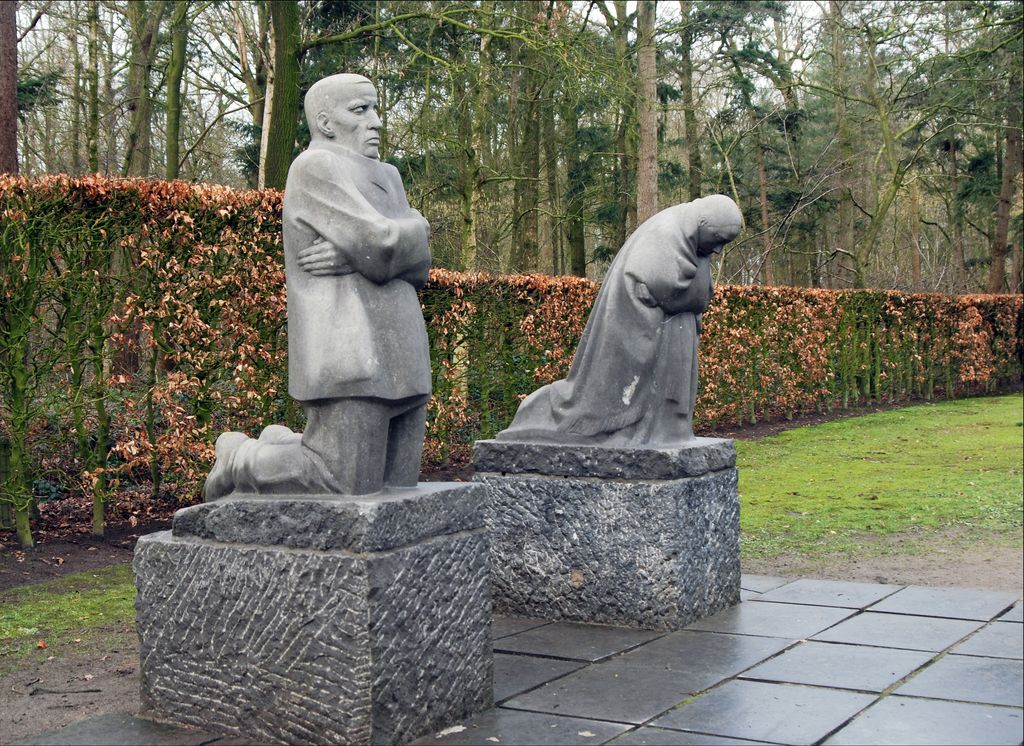
The Grieving Parents
The Grieving Parents at Vladslo, the memorial’s location since 1956. Photograph by Bva, resized. Image source. CC BY-SA 3.0. Resized and exported as JPEG.
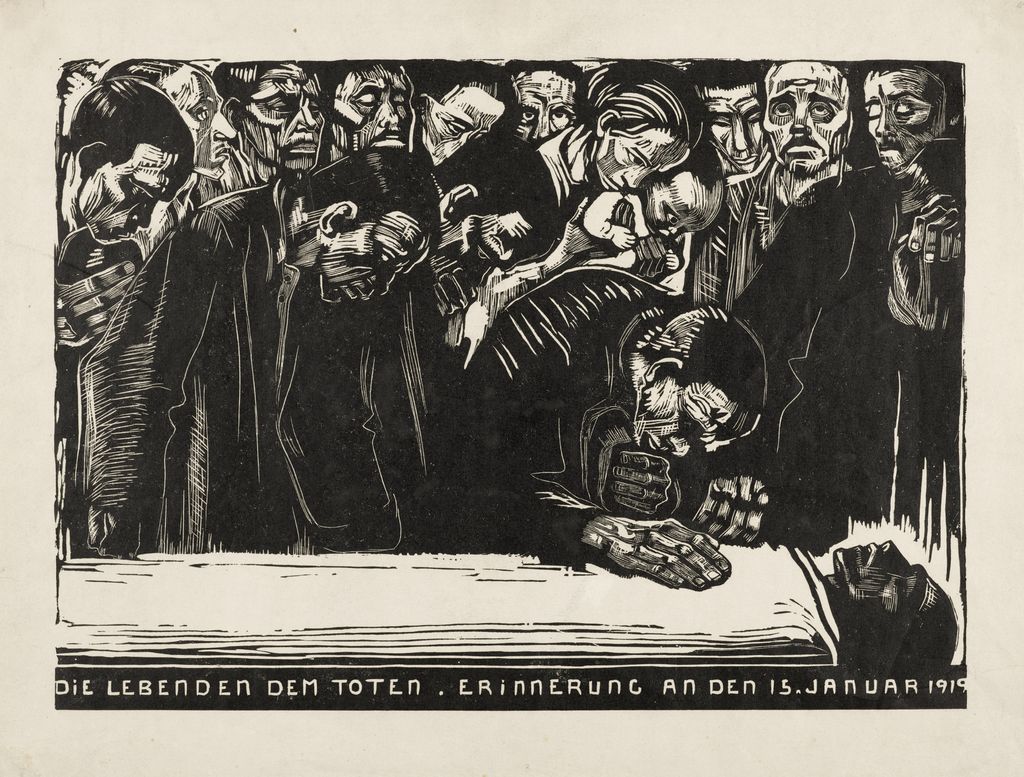
Memorial for Karl Liebknecht
Memorial for Karl Liebknecht, 1920. Kunstsammlungen Chemnitz, 86-47, Kn 159 VI. Photo: Kunstsammlungen Chemnitz/PUNCTUM/Bertram Kober. Image source. Public domain. Resized and exported as JPEG.