


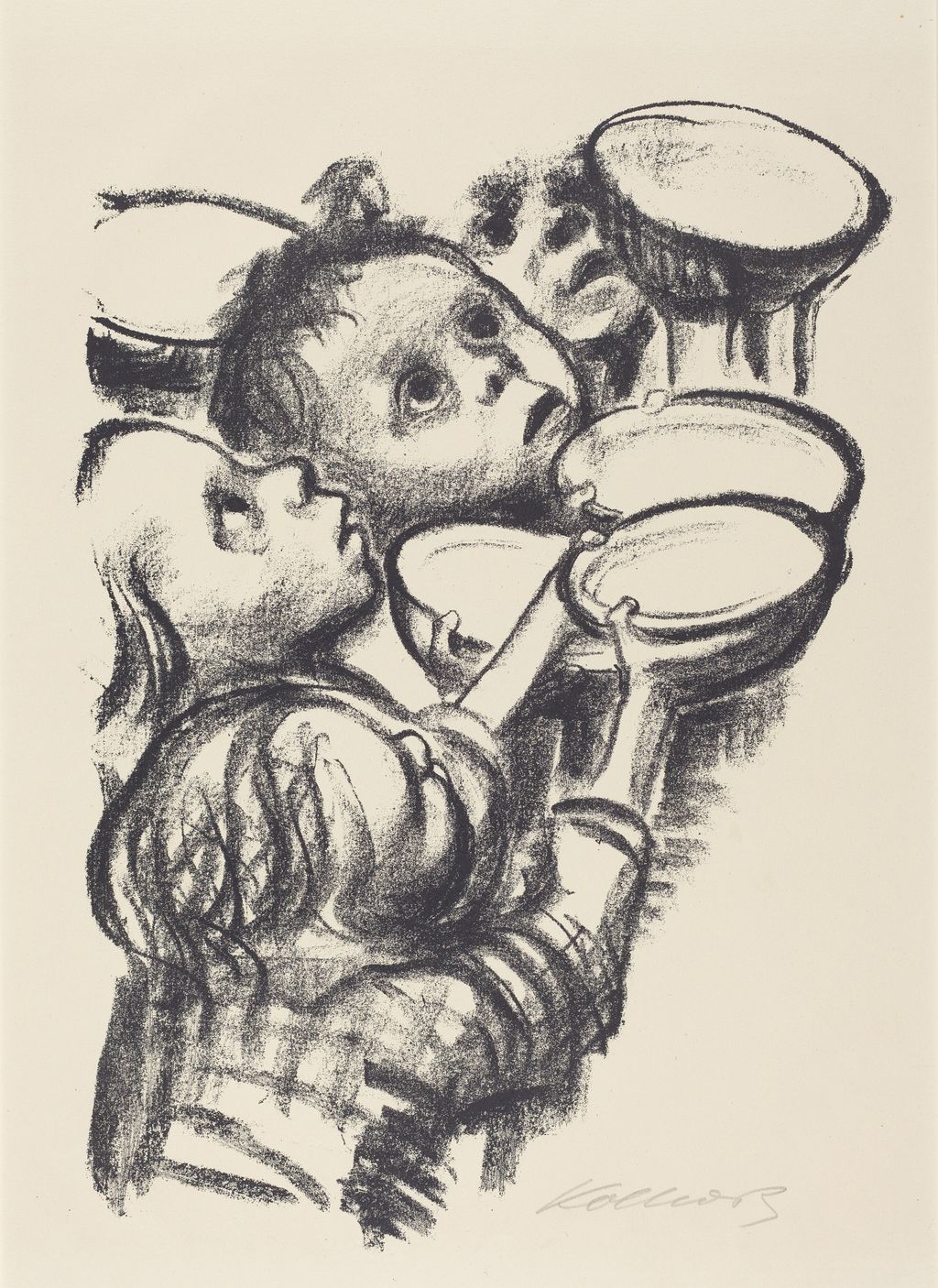
Germany’s Children Are Hungry!, 1924. National Gallery of Art, 1943.3.5277. National Gallery of Art, Washington. Image source. Public domain. Resized and exported as JPEG.
 by Tom Gurney
Tom Gurney BSc (Hons) is an art history expert with over 20 years experience
Email: tomgurney1@gmail.com / Phone: +44 7429 011000
Käthe Kollwitz’s Posters: Introduction
In March 1912, Käthe Kollwitz told her son Hans that the lettering on her housing poster crowded the drawing and weakened its effect at a distance. In Nie wieder Krieg! (Never Again War!), made for a socialist youth gathering in Leipzig in 1924, she let a raised arm cross her handwritten slogan. The arm gives the words the force of an oath. Between those commissions, she made appeals for famine relief, a poster demanding the repeal of Germany’s abortion law and an anti-war design that carried several languages. Each commission gave the person who stopped to look a different part to play. [1] [2] [3] [4] [5] [6]
Those differences survive in the print itself. One sheet tells Leipzig residents which banks will take their donations. Another carries the date of an international anti-war day beneath a group of bereaved adults and children. A third announces a campaign that was cancelled before the poster went up. Read together, the images and their inscriptions show how Kollwitz’s drawings became public appeals and what it took to put them before an audience. [7] [8] [9]
At a Glance
- Work and housingKollwitz made posters for Berlin’s German Cottage Labour Exhibitions in 1906 and 1925. Für Groß Berlin (For Greater Berlin, 1912) announced a public meeting on overcrowding and was banned by Berlin’s police president. [1] [10] [11] [12] [13]
- Famine reliefThe Vienna appeal of 1920 reached the proof stage. Helft Russland! (Help Russia!, 1921) appeared in campaign and unlettered editions, while Deutschlands Kinder hungern! (Germany’s Children Are Starving!, 1923) also survives with wording for a Leipzig winter relief appeal. [7] [3] [4] [14] [8] [15] [16]
- Law reformThe women’s office of the German Communist Party commissioned Kollwitz’s 1923 poster against Paragraph 218, which criminalised abortion. [5] [17]
- Two anti-war commissionsDie Überlebenden (The Survivors) was designed in 1923 for an international trade-union campaign and survives in several languages, including a German printing dated 21 September 1924. Never Again War! was made for the Leipzig youth gathering of 2–4 August 1924 and also appeared in the local newspaper. [2] [6] [9] [18] [19]
Contents
- Cottage labour and the Berlin street
- For Greater Berlin and the fight over housing
- Three relief appeals for Vienna, Russia and Germany
- Paragraph 218 and the cost of another pregnancy
- The Survivors and an international audience
- Never Again War! and the language of an oath
Cottage labour and the Berlin street
The organisers of the 1906 German Cottage Labour Exhibition chose a venue on Unter den Linden, one of imperial Berlin’s most prominent boulevards. Social reformers and trade unions wanted prosperous visitors to see the conditions in which people made goods at home. Kollwitz put an exhausted worker in their path. Light catches the woman’s face, bringing out the shadows beneath her eyes and the hollows of her cheeks. Her gaze drifts past the viewer. The title identifies the event, while the face gives a passer-by a reason to stop. The exhibition could show the goods and explain how they were made. Its poster gave the worker a place in the encounter before the visitor went inside. [10]
Cologne preserves the charcoal study Arbeiterfrau (Woman Worker, NT 406) and a third-state poster, Kn 95 III. The poster combines crayon and brush lithography with spatter and scraping. Those techniques help carry the broken, soft tones of a charcoal drawing into an image meant to be read on the street. The shadow around the woman’s eyes has room to register even though the sheet must also name and advertise an event. Cologne suggests that the commission may have followed from A Weavers’ Revolt, in which Kollwitz had already depicted the hardship of textile workers who worked at home. The exhibition poster concentrated a subject that had occupied a whole print cycle in one face. [10]
The story that the Empress refused to attend while the poster remained on display circulated from the 1920s, according to the Cologne museum. Cologne cites the contemporary Berliner Tageblatt for a narrower point. The royal government had authority over the exhibition building. That makes intervention plausible, while the Empress’s personal role remains uncertain. The location matters in its own right. Putting the worker’s face on Unter den Linden brought the consequences of home industry into a part of the city chosen precisely for the people who passed through it. [10]
Kollwitz returned to the subject for the 1925 German Cottage Labour Exhibition, an event the Käthe-Kollwitz-Museum Berlin places alongside the 1906 commission in its account of her work on the city’s living conditions. In April 1925, the Deutsche Zeitschrift für Wohlfahrtspflege presented the new exhibition as a chance to see what had changed since the Berlin show of 1906 and the Frankfurt show of 1908. It promised examples of goods from different industries as well as information about wages and the effects of social legislation. The Städel’s lettered sheet for 1925 gives the practical details in the stone itself. The exhibition ran from 28 April to 15 May at the Landesausstellungshallen on Alt-Moabit. It names the Society for Social Reform and credits the Berlin printer H. Birkholz. The Berlin Kupferstichkabinett holds a proof before lettering, acquired from Kollwitz in 1927. One sheet preserves the image as the artist developed it. The other preserves the instructions that made it an invitation. [12] [13] [20]
For Greater Berlin and the fight over housing
A committee formed by architects and planners commissioned Für Groß Berlin in 1912 to announce a public meeting. The poster claimed that 600,000 people in Greater Berlin lived in dwellings with at least five people to a room and that hundreds of thousands of children had nowhere to play. Beside the figures, Kollwitz drew an older girl holding a smaller child. A notice in the courtyard forbids play there and on the stairs. The statistics describe the scale of the problem. The notice shows the children encountering it as a rule governing what they can do when they go outside. The meeting announcement, in turn, gives adults somewhere to go. [1] [11]
The association of house and property owners intervened, and Berlin’s police president, Traugott von Jagow, banned the poster on the grounds that it incited class hatred. Cologne notes that Kollwitz had already dropped a boy playing at a drain cover from the final composition. Her own complaint concerned the design. In her letter to Hans of 3 March 1912, she said the drawing was hemmed in by the text and had little effect at a distance. The dense wording was there to explain the problem and advertise a meeting. The size and proximity of the lettering made it harder for the two children to draw the viewer in from across the street. The property owners’ intervention, the police action and Kollwitz’s criticism each concerned a different aspect of the same sheet. [1] [11]
The Dresden print curator Max Lehrs noticed another complication when Kollwitz sent him an impression. In his letter of 19 December 1913, he identified it as an earlier state because the girl’s legs had yet to be lengthened. He also noticed that the list of speakers gave Dominicus where another version named Friedrich Naumann. Cologne records examples of Kn 122 I and II. Even close to the time of the meeting, an impression could preserve different information about both the figures and the event. The municipal enlargement took effect in 1920, eight years after the poster. The Käthe Kollwitz timeline places the commission among her other work, while her life in Berlin and her drawings of urban hardship trace the concerns she brought to social criticism. [1] [11] [21] [12]
Three relief appeals for Vienna, Russia and Germany
Vienna and a campaign that stopped at the proof stage
In her diary on 5 January 1920, Kollwitz imagined Death wielding a whip of hunger as bent and stricken people passed. She was working on Wien stirbt! Rettet seine Kinder! (Vienna Is Dying! Save Its Children!), a commission for a relief campaign. She also wrote about the distress of drawing the children and the obligation she felt to make their suffering public. The title moves from a diagnosis on the scale of a whole city to a direct appeal on behalf of its children. The reader is addressed as someone still in a position to intervene. [7]
Cologne preserves the transfer drawing in lithographic crayon and blue pencil, NT (861a), and a second-state lithograph, Kn 148 II, for which the lettering was transferred from ribbed laid paper. The Getty Research Institute exhibited a first-state impression printed in black on light-brown machine-made paper. The separate records let the drawing, paper and handling of the lettering be traced at different points in production. The campaign itself was halted as conditions worsened in Germany. The surviving impressions therefore show how far the appeal progressed in the workshop. Cologne records that it was never posted. [7] [14]
Russia and the hands that reach into the picture
In Helft Russland! the act of helping takes place inside the composition. A man collapses and hands reach towards him from around the edge of the image. The face fixes attention on one person in the famine that struck the Volga region in 1921. The hands suggest several people acting together. They also leave the origins of the help outside the frame. The viewer sees the moment when a man might be caught, and the campaign headline names the place where help is needed. [3] [15] [16]
The campaign depended on an organisation capable of collecting aid. In an August letter to Hans and a diary entry dated 12 September 1921, Kollwitz described both her wish to help and her discomfort at being drawn into politics through work with Communists. MoMA identifies the appeal with the Communist-backed Internationale Arbeiterhilfe (Workers’ International Relief). The Deutsches Historisches Museum’s campaign sheet, P 58/172, names the Berlin aid committee and is credited to H. Birkholz. The Schleswig-Holstein museum record transcribes a campaign inscription that also gives the committee’s address on Rosenthaler Straße. The reaching hands invite a response. The small print identifies the people to whom the response can be directed. [3] [16] [22] [23]
Cleveland’s impression 1973.151 shows how the image reads with the campaign wording removed. It is catalogued as state III of III under Klipstein 154, from an edition of 300. Leicester records its own unlettered impression as Kn 170 A III and distinguishes it from the overprinted poster. MoMA’s permanent collection also holds an impression of A III, published by the artists’ aid committee of Workers’ International Relief. The Schleswig-Holstein record identifies Paul Cassirer as distributor of that edition. MoMA’s 2024 checklist, by contrast, lists the larger, upright Cologne loan, whose printed composition measures 66.7 by 47.7 centimetres, matching Cologne’s Kn 170 A I record. On the unlettered sheet, the hands and the man’s face have to carry the encounter on their own. The title shared by the museum records covers objects that addressed their audiences in different ways. [3] [15] [16] [23] [24] [25]
Germany’s children and Leipzig’s donation points
Workers’ International Relief commissioned Deutschlands Kinder hungern! in 1923, during Germany’s inflation crisis. In the Strasbourg museums’ exhibition dossier, Les enfants d’Allemagne meurent de faim appears in the context of the posters, leaflets and brochures Kollwitz made for humanitarian, political and trade-union organisations after the war. In this design, the children present their own appeal. They raise bowls towards the viewer. The repeated rims make the emptiness visible, and the simplified faces give the group a common urgency. Cologne preserves the lithographic-crayon transfer drawing, NT 1004, as well as the lettered transfer lithograph Kn 202 B. The arrangement of the bowls already makes the request intelligible in the drawing. The printed headline gives it a national scale. [4] [26]
On the Städel’s Leipzig sheet, the same children appear beside the headline Unsere Kinder hungern! (Our Children Are Starving!). The possessive changes who is being addressed. The smaller print then tells Leipzig residents that donations will be accepted at the city’s banks, at the Leipziger Neueste Nachrichten and at the winter relief office in room 623 of the Stadthaus. A line below the picture names Freytag & Petersen of Leipzig as the firm that donated the paper. The Städel catalogues this particular impression as a photolithograph on light-brown poster paper. The image travelled from a national appeal into a local campaign with its own wording, production and means of collecting money. On the Leipzig sheet a person moved by the bowls could leave knowing where to give. [4] [8]
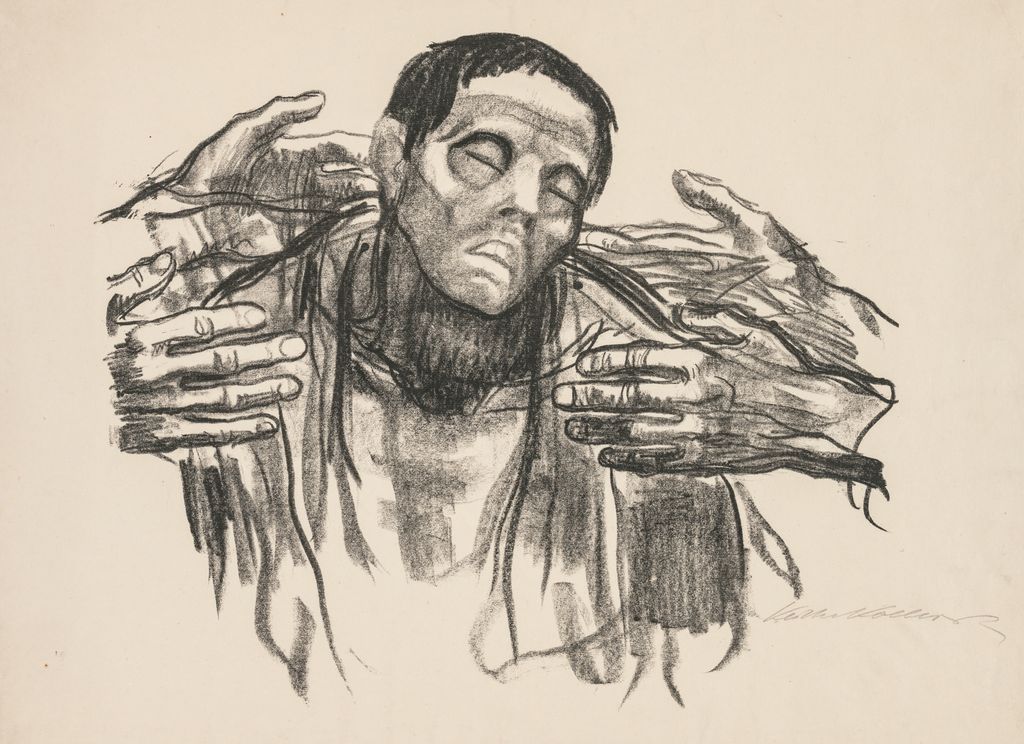
Help Russia, 1921. Cleveland Museum of Art, 1973.151. Image source. CC0 / Public domain. Resized and exported as JPEG.
Paragraph 218 and the cost of another pregnancy
The women’s office of the German Communist Party commissioned Nieder mit den Abtreibungs-Paragraphen! (Down with the Abortion Paragraphs!) in 1923 for its campaign against Paragraph 218 of the criminal code. A pregnant working-class woman and two children fill the image. The figures press close together, making the daily labour of caring for the children visible in the posture of the adult and the children’s dependence on her. The slogan identifies the law as the object of the campaign. The group gives the viewer a household in which to consider what another pregnancy could mean. [5] [17] [27]
In a diary entry of 30 August 1909, Kollwitz recorded a mother speaking about illness, unemployment and the deaths of six of her eleven children. The entry belongs to an earlier encounter, and the poster turns the recurring hardships she heard about into the subject of a specific campaign. MoMA’s 2024 extended label reads the family group through the exhaustion of mothers with children to feed and care for in conditions of poverty. The checklist identifies the exhibited crayon lithograph as a loan from the Daniel Stoll and Sibylle von Heydebrand Collection. Cologne’s Kn 198 II documents a rare lettered impression transferred from a drawing on transparent paper. [5] [25] [27]
The hunger and Paragraph 218 posters were made in the same year, and both make the cost of feeding children visible. Their lettering sends the viewer in different directions. In the hunger appeal, a gift can answer an empty bowl. In the law reform poster, the mother’s circumstances supply an argument for changing the criminal code. The family group carries that argument without requiring a crowd, a meeting date or a list of donation points. [4] [5] [8] [17]
The Survivors and an international audience
The Amsterdam-based International Federation of Trade Unions approached Kollwitz in 1922 about a poster for the international anti-war campaign. She initially imagined women massed together to defend their children, returning to the idea behind Die Mütter (The Mothers), the sixth woodcut in War. In her letter to Beate Bonus-Jeep, she explained that the organisers wanted the people who had survived the war. She widened the group to encompass bereaved parents, widows, blind people and children. Her letter envisaged a campaign spanning fourteen European countries. That figure describes the organisers’ intended reach. The surviving sheets document specific versions of the design. [6] [28] [29]
The crowded arrangement keeps something of the protective grouping Kollwitz had first imagined. A woman gathers children close at the front, while faces emerge from the dark behind her. Some look out and others seem unable to meet the viewer’s gaze. In the lithograph, the contrast can be sharp at one face and soften into darkness around the next. MoMA’s 2024 checklist identifies the Ute Kahl loan as crayon and brush lithography with scraping needle. Cologne records the same combination of techniques for its Danish version, Kn 197 II b 4. The lithograph gives Kollwitz room to vary the light from face to face while keeping the group legible as a single shape. [6] [30] [25]
The Danish sheet and LACMA’s Swedish-language impression show the same image carrying different inscriptions. LACMA dates its impression to 1924 and names the federation as publisher and Dinse Eckert & Co. as printer. The French-language catalogue of the Palais des Nations records a Dutch sheet, De Overlevenden. Oorlog aan den Oorlog!, with the publisher’s line in Dutch. The catalogue renders the title and slogan in French as Les survivants. Guerre à la guerre ! (The Survivors. War against War!). Across the bottom of the Dutch sheet, the title names the people on one side and the slogan states the campaign’s demand on the other. The French wording belongs to the catalogue’s presentation of that Dutch impression. [6] [30] [31]
The Städel’s German sheet, Kn 197 IV, uses the same pairing, Die Überlebenden and Krieg dem Kriege!, and adds Antikriegstag am 21. September 1924 beneath it. The publisher and Berlin printer appear in smaller type. The date belongs to this printing for the anti-war day. The design itself dates from 1923. Murray’s note 49 discusses the September printing in her account of The Survivors, and the Städel sheet lets the reader see where the date sits in relation to the title and slogan. [6] [28] [9]
Never Again War! and the language of an oath
The Socialist Workers’ Youth commissioned Nie wieder Krieg! for the Central German Youth Day in Leipzig on 2–4 August 1924. In the Städel’s lettered impression, SG 4302 D, the inscription for the youth gathering is tucked below the large handwritten words and the raised arm. Cologne’s Kn 205 II b and the Berlin Kupferstichkabinett’s second-state impression preserve the design before the campaign lettering. Cologne’s proof already bears the lithographed signature. The lettered Cologne example, Kn 205 III b, shows how much space the final slogan occupies beside the figure. [2] [32] [18]
The figure raises the right hand with thumb, index and middle fingers extended, and brings the left hand to the chest. The raised hand is a Schwurhand, a gesture used when swearing an oath. The open mouth supplies a speaker for the words. The arm interrupts Krieg, and the two lines under that word drive the eye back towards the gesture. The figure is youthful, in keeping with the commission. Cologne describes a boy, while Murray notes that Kollwitz did not specify the figure’s sex in her written accounts. Murray also identifies a possible precedent in the socialist youth organiser Max Westphal’s anti-war oath at a youth gathering in 1920. The gesture itself would have been familiar from civic and legal settings. [2] [28]
The front page of the Leipziger Volkszeitung for 2 August 1924 gives the figure another setting. The issue appeared the day before the rally on the Augustusplatz and placed the image among arguments about war and the obligations of those who opposed it. Inside, readers encountered work by other artists, including Frans Masereel and Honoré Daumier, alongside political and historical writing. Murray also identifies the oath figure on the jacket of the longer publication issued by the West Saxon Socialist Workers’ Youth, which reproduced several sheets from War. In the street the slogan had to work at a glance. In print it gave the reader a point of entry into a sustained argument. [28] [19]
The August and September sheets addressed people in the same campaigning season. The August Leipzig inscription fixes Never Again War! to a particular youth gathering, where the figure demonstrates an act a participant could perform. The September inscription on The Survivors fixes that design to the trade unions’ anti-war day, where its gathered faces ask the audience to consider what war leaves behind. Later settings changed the scale and occasion again. Oxford’s exhibition catalogue traces an impression formerly owned by the publisher Salman Schocken through a photograph of it in his living room and its listing as item 111 in the 1945 memorial exhibition mounted by the Tel Aviv Museum and the National Bezalel Museum. Strasbourg’s exhibition dossier traces the Leipzig design’s later use by the peace movement and its reproduction on a German commemorative stamp in 2014. The event line anchors the Städel sheet to one weekend. The oath and the three handwritten words could be read long after that weekend had passed. [28] [26] [9] [18] [33]
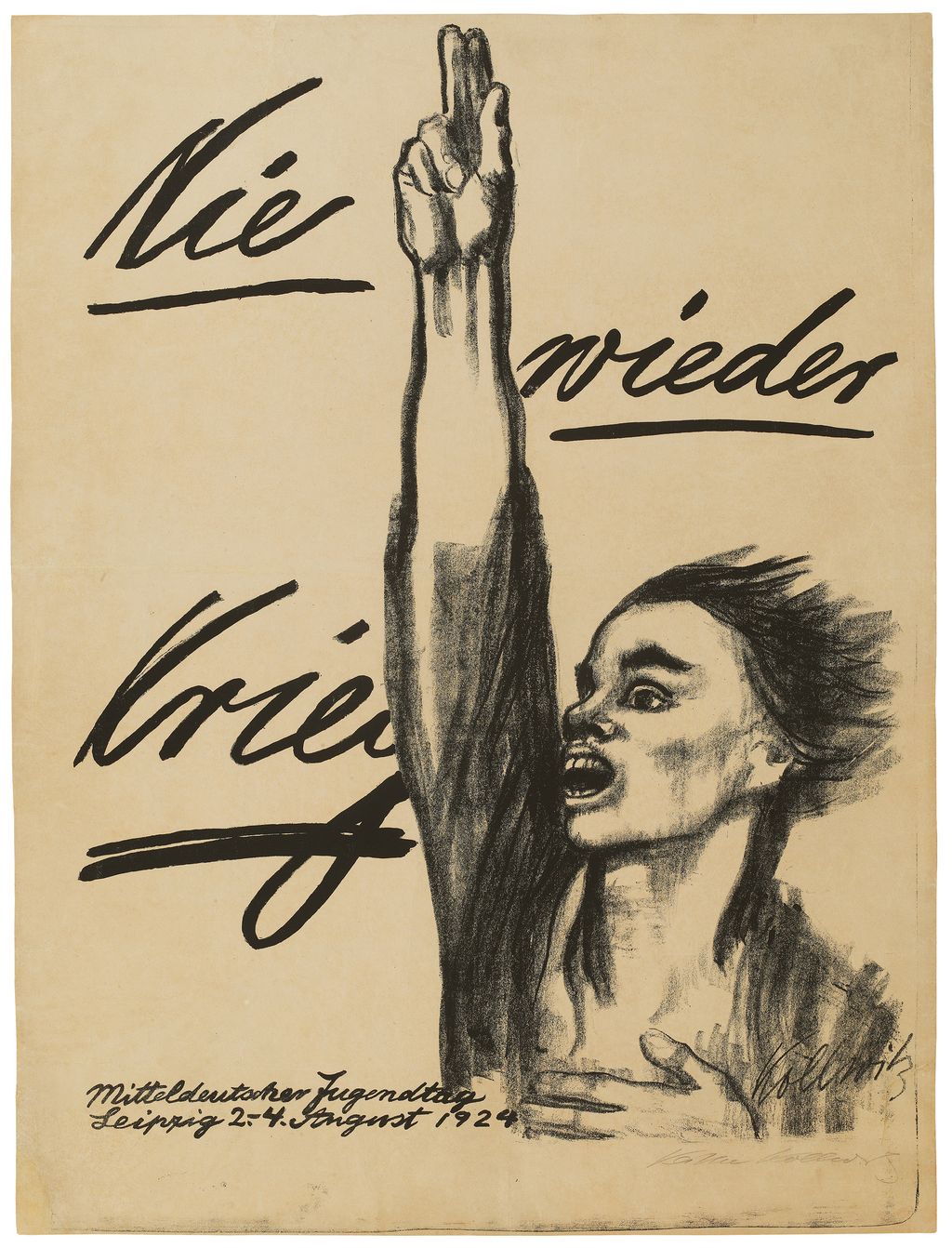
Never Again War!, 1924. Kollwitz Museum Köln, Kn 205 III b, inv. 70300/88018. Kollwitz Museum Köln, Kn 205 III b, inv. 7030088018. Image source. Public domain. Resized and exported as JPEG.
Käthe Kollwitz artworks directory
Selected documented works, including the complete published sequences of the five cycles discussed here. Catalogue links identify the specific record behind each row.
Frequently Asked Questions
It refers to Alexandra von dem Knesebeck’s revised catalogue of Kollwitz’s graphic work. The letters and numerals that follow can distinguish states or versions. Cologne’s Kn 205 II b identifies a signed proof before the slogan, while Kn 205 III b identifies a lettered poster. Some collections also give August Klipstein’s older catalogue numbers. Leicester, for example, lists the unlettered Help Russia under both Klipstein 154 and Knesebeck 170 A III. [2] [34] [24]
The image served different appeals. Cologne’s lettered impression names Germany’s children. The Städel’s Leipzig version says Our Children Are Starving! and tells readers where to donate to the city’s winter relief campaign. The museum’s catalogue title identifies the design, while the inscription identifies the appeal carried by that particular sheet. [4] [8]
Discussion
Look again at the images and ideas explored in Käthe Kollwitz’s Posters. These editorial prompts invite your observations.
Reader Insights
How does Kollwitz change her approach when asking for relief donations or political action?
What can an impression without lettering reveal about the design?
Which poster best shows how Kollwitz balanced the campaign information with the picture?
Join the Conversation
Share a detail, comparison or question about Käthe Kollwitz’s Posters below.
References
- Kollwitz Museum Köln, Für Groß Berlin, Kn 122. Kn 122 I, inv. 70300/88003, and Kollwitz’s letter to Hans of 3 March 1912. View source.
- Kollwitz Museum Köln, Never Again War!. Kn 205 III b and the signed proof before lettering, Kn 205 II b, inv. 70300/97004. View source.
- Kollwitz Museum Köln, Helft Russland!. Kn 170 A I, inv. 70300/93013, letter to Hans of August 1921 and diary entry of 12 September 1921. View source.
- Kollwitz Museum Köln, Deutschlands Kinder hungern!. Kn 202 B and transfer drawing NT 1004, inv. 70200/84015. View source.
- Kollwitz Museum Köln, Nieder mit den Abtreibungs-Paragraphen!. Kn 198 II, inv. 70300/05016, and diary entry of 30 August 1909. View source.
- Kollwitz Museum Köln, Die Überlebenden. Danish version, Kn 197 II b 4, inv. 70300/95011, and the letter to Beate Bonus-Jeep. View source.
- Kollwitz Museum Köln, Wien stirbt! Rettet seine Kinder!. Kn 148 II, inv. 70300/85026, transfer drawing NT (861a), and the January 1920 diary excerpts. View source.
- Städel Museum, Deutschlands Kinder hungern!, SG 4295 D, Leipzig winter relief variant. See the medium and full inscription. View source.
- Städel Museum, Die Überlebenden, SG 4291 D, Kn 197 IV. See the inscription for 21 September 1924 and the publisher and printer lines. View source.
- Kollwitz Museum Köln, Deutsche Heimarbeit-Ausstellung Berlin 1906. Kn 95 III, inv. 00300/88002, and Arbeiterfrau, NT 406, inv. 70200/97006. View source.
- Kollwitz Museum Köln, Zeitstrahl 1901–1913, 1912 entry on the housing commission and police action. View source.
- Käthe-Kollwitz-Museum Berlin, 100 Jahre Groß-Berlin, exhibition account of the 1920 municipal enlargement and the 1906 and 1925 home-industry campaigns. View source.
- Städel Museum, Heimarbeit, SG 4357 D, lettered 1925 exhibition sheet. Staatliche Museen zu Berlin, Kupferstichkabinett, Heimarbeit (1. Zustand, Druck vor der Schrift), 355-1927, with the reference to the lettered Berlin example AM 184-1968. View source 1. View source 2.
- Getty Research Institute, Käthe Kollwitz: Prints, Process, Politics, object checklist, p. 7, Vienna Is Dying! Save Its Children!, state I of II, collection 2016.PR.34. View source.
- Cleveland Museum of Art, Help Russia, 1973.151, Klipstein 154, state III of III. View source.
- Museum of Modern Art, Help Russia (Helft Russland), 222.1997, Kn 170 A III, with Heather Hess’s collection commentary. View source.
- Deutsches Historisches Museum, LeMO, Der Abtreibungsparagraph 218. View source.
- Städel Museum, Nie wieder Krieg, SG 4302 D. See the inscription for the Central German Youth Day, Leipzig, 2–4 August 1924. View source.
- Leipziger Volkszeitung, 2 August 1924, no. 179, 31st year, front page and special issue, SLUB Dresden. The front page is also reproduced in Murray, fig. 7. View source 1. View source 2.
- Deutsche Zeitschrift für Wohlfahrtspflege, vol. 1, no. 1, April 1925, p. 41, “Deutsche Heimarbeitsausstellung 1925.” View source.
- Archiv der Staatlichen Kunstsammlungen Dresden, Kupferstichkabinett, Briefwechsel zwischen Käthe Kollwitz und Max Lehrs, 1898–1929, Lehrs to Kollwitz, 19 December 1913, PDF page 67. View source.
- Deutsches Historisches Museum, poster exhibition catalogue, Werkverzeichnis, entry 156, Helft Russland, P 58/172. View source.
- Stiftung Rolf Horn, Schloss Gottorf, Helft Rußland, record dc00015124, with the campaign inscription and the publication and distribution of the third state. View source.
- Leicester’s German Expressionist Collection, Help Russia, Michael Brooks gift, Wagner 144, Klipstein 154, Kn 170 A III. View source.
- Museum of Modern Art, Käthe Kollwitz, 2024 exhibition checklist, p. 32, entries for Help Russia, The Survivors and Poster Against Paragraph 218. View source.
- Musées de Strasbourg, Käthe Kollwitz. « Je veux agir dans ce temps », exhibition dossier, pp. 8–9, 15 and 22. See the section on post-war hardship, Alexandra von dem Knesebeck’s Guerre et pacifisme and image 11, Plus jamais de Guerre, Kn 205 III b. View source.
- Museum of Modern Art, Käthe Kollwitz, 2024 extended labels, PDF page 8, label b65ead42, Poster Against Paragraph 218. View source.
- Ann Murray, “Käthe Kollwitz: Memorialization as Anti-Militarist Weapon”, Arts 9, no. 1 (2020), article 36, figs. 6–8 and notes 49–54. Note 49 accompanies the discussion of The Survivors. View source.
- Kollwitz Museum Köln, The Mothers, sixth sheet of War, Kn 176. View source.
- Los Angeles County Museum of Art, The Survivors. War against War!, Swedish-language impression, M.2003.114.98. View source.
- United Nations Office at Geneva, Palais des Nations art catalogue, French edition, pp. 81–82, De Overlevenden [Les survivants] and illustrated Dutch inscription. View source.
- Staatliche Museen zu Berlin, Kupferstichkabinett, Nie wieder Krieg (Zweiter Zustand, vor der Schrift). Object 1575774, with Sigrid Achenbach’s catalogue entry, no. 175, pp. 143–44. View source.
- University of Oxford, In Times of Strife, exhibition catalogue, closing Kollwitz section, items 6–8. View source.
- Kollwitz Museum Köln, Catalogue raisonné of Kollwitz’s prints, on Alexandra von dem Knesebeck’s revision of August Klipstein’s catalogue. View source.
More KOLLWITZ Works
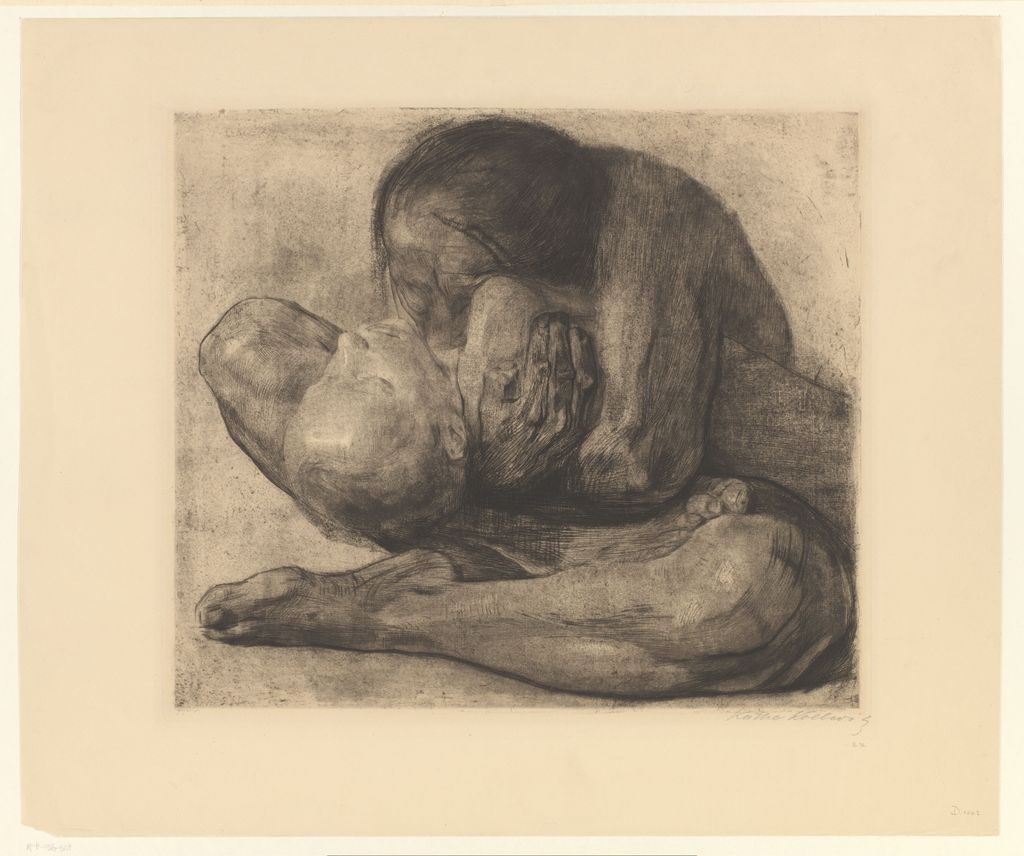
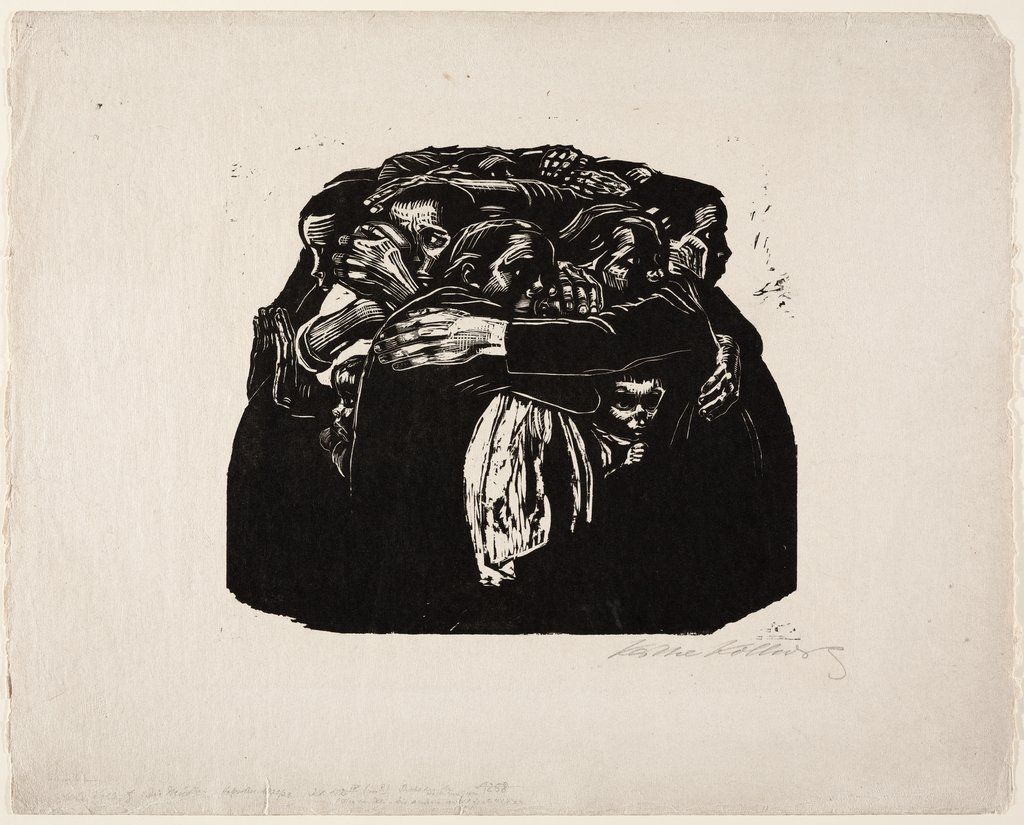
The Mothers
The Mothers, 1921–22. Städel Museum, Frankfurt am Main, SG 4289A D. Image source. Public domain. Resized and exported as JPEG.
The Grieving Parents
The Grieving Parents at Vladslo, the memorial’s location since 1956. Photograph by Bva, resized. Image source. CC BY-SA 3.0. Resized and exported as JPEG.
Memorial for Karl Liebknecht
Memorial for Karl Liebknecht, 1920. Kunstsammlungen Chemnitz, 86-47, Kn 159 VI. Photo: Kunstsammlungen Chemnitz/PUNCTUM/Bertram Kober. Image source. Public domain. Resized and exported as JPEG.