


The Grieving Parents at Vladslo, the memorial’s location since 1956. Photograph by Bva, resized. Image source. CC BY-SA 3.0. Resized and exported as JPEG.
 by Tom Gurney
Tom Gurney BSc (Hons) is an art history expert with over 20 years experience
Email: tomgurney1@gmail.com / Phone: +44 7429 011000
The Grieving Parents by Käthe Kollwitz: Introduction
At the far end of the German military cemetery at Vladslo, two figures kneel above a field of low grave markers. The father holds his torso upright, with one hand visible beneath his folded arms. The mother bends so far forward that the curve of her back seems to continue into the top of her head. Both figures face the burial ground. On a stone in front of them, among the names of other soldiers, is the name of their son, Peter Kollwitz. Käthe Kollwitz once planned to show his body between the parents. In the finished memorial, visitors find him by looking where the figures kneel. [1] [2] [3]
At a Glance
- Artist and titleKäthe Kollwitz, The Grieving Parents (Trauernde Eltern), developed from 1914 to 1932. [1] [4]
- Design and materialKollwitz made the plaster models. August Rhades carved the father and Fritz Diederich carved the mother in Belgian granite. [2] [4]
- First installationEsen-Roggeveld military cemetery near Diksmuide, Belgium, in July 1932, following exhibitions of the plasters in 1931 and the granite figures in 1932. [1] [4]
- Location of the originalsVladslo German military cemetery in West Flanders. The sculptures and Peter’s remains were transferred there in 1956. [1] [5]
- Cologne versionShell-limestone replicas carved by Joseph Beuys and Erwin Heerich for the memorial to the dead of both world wars at Alt St. Alban, dedicated in 1959. [1]
This work across Käthe Kollwitz’s career
A Weavers’ Revolt
1893–97The six sheets take a revolt from household distress to collective action and its aftermath. [6]
Separate impressions and hand-worked proofs show how Kollwitz developed the image. [7]
Peasants’ War
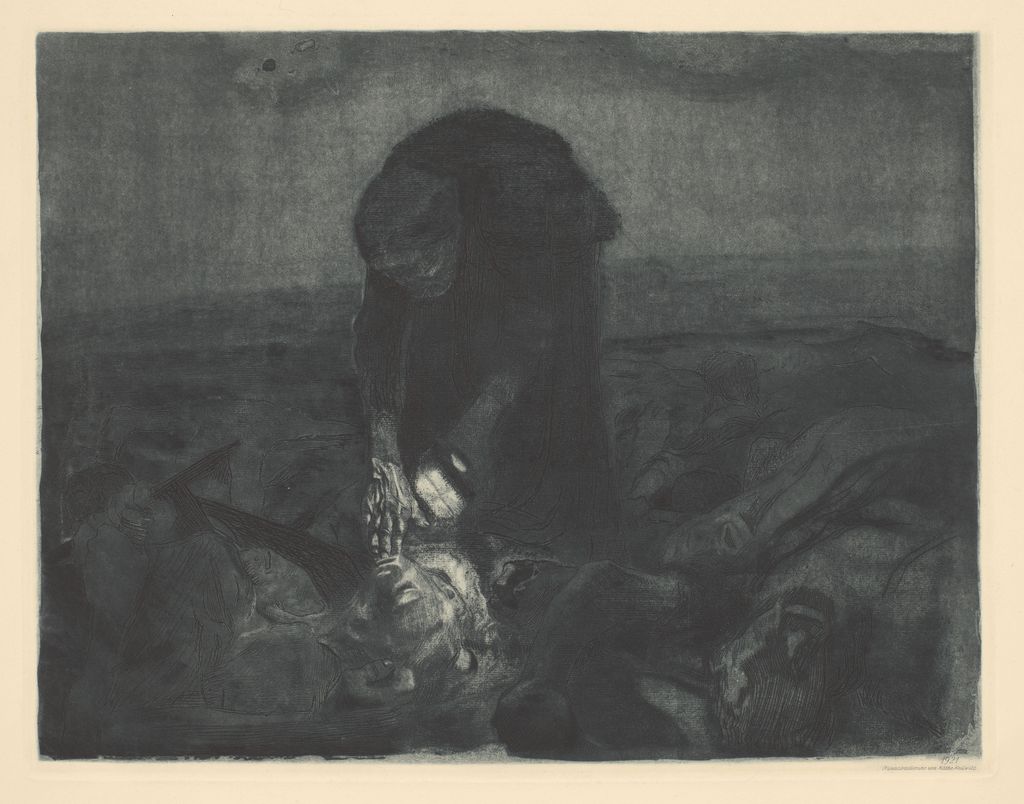
1901–08The seven plates combine the revolt with the aftermath in Battlefield and The Prisoners. [8]
War
1921–22, published 1923The woodcuts give sustained attention to the experience of those left behind. [9]
The Grieving Parents (current article)
1932 installationTwo kneeling figures face the graves in the memorial’s later location at Vladslo. [2]
Mother with Her Dead Son
1937–39 modelThe small sculpture precedes the 1993 enlargement at the Neue Wache. [11]
Contents
- From a fallen soldier to two kneeling parents
- The father, the mother and the space between them
- What changed when the sculptures moved
- The Cologne replicas at Alt St. Alban
- Related works by Kollwitz
From a fallen soldier to two kneeling parents
Peter, the younger son of Käthe and Karl Kollwitz, was eighteen when he volunteered for military service in 1914. He needed his parents’ consent. Karl initially withheld it, and Käthe helped persuade him to agree. Peter was killed in Belgium that October. Bettina Sitter’s study of the family correspondence traces an initial burial in an individual grave at a farm near the front and a subsequent reburial at the military cemetery at Esen-Roggeveld. The correspondence leaves some uncertainty about when that first transfer took place. By the time Käthe and Karl visited in 1926, Peter was buried at Roggeveld. [12] [13] [14]
In Berlin the family kept Peter’s room as a place to remember him. Friends came to read letters and other texts with his parents. The historian Jay Winter describes a Christmas tree set behind the bed with a candle for each of Peter’s eighteen years. In subsequent years the family added candles for the age he would have reached. The ritual gave his absence a place in the house and a measure in time. Winter sees the family’s circle of remembrance widening to include the young men who had shared Peter’s experience of the war. That widening was already part of the problem Kollwitz set herself as a sculptor. [14] [15]
Her diary records the idea for a monument on 1 December 1914. The first project showed a dead soldier laid out between his parents, the father at his head and the mother at his feet. By 1915 Kollwitz was seeking support for a larger-than-life ensemble on the Havel heights at Schildhorn, a popular destination for Berlin day-trippers. An archival photograph preserves the plaster figure of the recumbent soldier. The figure was to represent Peter and honour the young volunteers whose sacrifice Kollwitz still saw in patriotic terms. At Schildhorn, where the audience would encounter the memorial away from the graves, the soldier’s body would have supplied the focus for both the parents and the public. [12] [14]
While the three-figure plan was still in development, Kollwitz tried a different arrangement. A photograph survives of a tinted plaster relief of two kneeling parents, dated 1917–18 by the Kollwitz Museum Köln. In this version their bodies incline towards one another and fit within a single field. Sitter traces a July 1917 diary entry in which Kollwitz considered placing the relief on Peter’s grave, then imagined it at the cemetery entrance, where it could address everyone buried there. She tried out inscriptions that moved from naming Germany’s youth to naming youth alone. Sitter reads the relief as a shift towards the experience of the bereaved. Its intimacy and the changing language of the proposed inscription show how unsettled the relationship between family mourning and public commemoration still was. [14] [16]
By October 1918, Kollwitz publicly opposed the poet Richard Dehmel’s appeal for a final mobilization. In her published reply she recalled the young people who had volunteered in 1914 and argued that the country could ill afford to lose another generation. She set the three-figure monument aside in 1919. When she took up the project again in 1924, the Cologne museum’s chronology identifies two decisions that changed its direction. The sculpted soldier disappeared and the intended site became the cemetery where Peter lay. In a field of graves, the parents could be shown in the act of mourning, and the burial itself could establish whom they mourned. [12] [13] [14]
During the June 1926 visit to Roggeveld, Kollwitz drew a plan of the cemetery and described its size, surroundings and arrangement of graves in letters. Sitter locates the plan in the published correspondence. A separate drawing from 1931, signed and identified by Kollwitz as a placement sketch for Roggeveld, shows the parents close together. The photographs of the finished installation show a wider interval. The two drawings record different kinds of work. The first takes stock of an existing burial ground. The second tests how the figures might occupy it, even after their individual forms had largely been settled. [13] [14] [17]
The studies for the figures record decisions on a smaller scale. Among the drawings reproduced by Sitter are a 1926 charcoal study of the mother’s drapery and four studies of hands for the father from 1929. These are details that help carry the finished poses. The mother’s clothing gives the bowed body a continuous outline and the father’s visible hand makes the pressure of his crossed arms intelligible. By April 1931, Kollwitz was ready to show the two plaster figures at the Prussian Academy of Arts. In her diary entry of 22 April she described how closely she had guarded the work, even from Karl and Hans, and how the response of her colleagues relieved her anxiety about showing it. [4] [17]
The Academy exhibition marked the completion of the plaster version. The two stone figures followed in 1932. A donation from the German Reich and the Prussian state on Kollwitz’s sixtieth birthday in 1927 made the carving possible. Rhades and Diederich worked from her models, and the Nationalgalerie’s director, Ludwig Justi, acquired the plasters for the Kronprinzenpalais. In June 1932 the granite figures were shown in the atrium of the Berlin Nationalgalerie. That July Käthe supervised their installation at Roggeveld, with Karl present. The gallery photographs show that the figures could already stand as a pair indoors. In Belgium the grave and the ground around it completed the relation they had been made to express. [2] [4] [14] [17]
The father, the mother and the space between them
Seen from the burial field at Vladslo, the father is on the left. The deeply set eyes and downturned corners of his mouth give his upright head a fixed expression. His coat falls nearly straight from the crossed arms to the knees. From an oblique angle, the shoes and lower legs extend visibly behind him. That detail changes the apparent balance of the figure. The front gives an impression of height and immobility, while the side makes clear how fully the body has lowered itself to the ground. The hand gripping the opposite side of the coat is one of the few details that breaks the broad surfaces of the torso. [2] [3]
The mother draws her arms in just as firmly. Her shoulders roll forward, and her lowered face sits within the curve made by the head, shawl and upper back. The long garment gathers at the knees and extends behind them. Where the father’s coat leaves the change of direction at the knees legible, the mother’s clothing carries the body down in a nearly unbroken slope. In Hugo Maertens’s photograph of the Vladslo pair, the close-cut forms of the figures sit over visibly rougher bases. The difference makes each kneeling body seem at once recognizably human and firmly attached to its place. [2] [3]
The Kollwitz Museum Köln identifies features of Karl and Käthe in the faces. The likenesses give the work a particular family history, while the poses establish a relation that viewers can read before recognizing either person. Both parents kneel and both fold their arms close, but each holds that position differently. The father’s head projects above the horizontal of his forearms. The mother’s head sinks towards the corresponding line in her own figure. Neither reaches across the interval. The similarity of their gestures makes their separation more apparent, because the viewer keeps looking from one body to the other for a contact that the composition leaves open. [1] [2] [3]
The space between the plinths and the space in front of them have different roles. The interval gives each figure its own outline and can suggest the absence of the child once intended for the middle. The ground in front has an actual grave and a name. It also holds thousands of other names. In a letter to Ludwig Kaemmerer on 11 October 1932, Kollwitz explained that she had tried to put into the figures what had moved everyone who had suffered through the war. At the cemetery that intention is given a physical scale. The two mourners have the features of particular people, while the field their bodies face makes room for losses beyond their own. [1] [5] [18]
What changed when the sculptures moved
The 1932 installation photograph and Willi Moegle’s photograph of 1937, both preserved by the Kollwitz Museum Köln, document the work at Roggeveld. The figures stood near the entrance, overlooking Peter’s grave, with more space between them than they have today. Mark Connelly and Stefan Goebel distinguish that arrangement from the one at Vladslo, where the parents were placed closer together at the far end of the cemetery. The 1932 installation and the current setting are two arrangements of the same carved figures. At Roggeveld the pair met a visitor near the threshold. At Vladslo the visitor sees the pair from the threshold and crosses the cemetery to reach it. [1] [18]
The relocation was part of a wider consolidation of German military burials. In 1952 the Belgian and West German governments decided to concentrate them in four large cemeteries in West Flanders. The Flemish heritage inventory records that about 22,000 dead from more than sixty smaller cemeteries were brought to Vladslo during its expansion in 1955–57. Peter and the sculptures were transferred in 1956. Connelly and Goebel trace the exchange between Hans Kollwitz and the German War Graves Commission in May 1955. Hans wrote of his distress at the prospect of Roggeveld closing. The commission replied that the parents would be reunited with Peter’s grave. For the family, the position of the sculptures and the place of burial were parts of the same memorial. [5] [18]
The burial ground visitors see today also reflects a second redesign. Under Robert Tischler, the expanded cemetery had small wooden markers with metal plates, and its plots were planted with hostas. Narrow strips of grass gave access between them. In 1969–70, under Georg Fischbacher, lawn replaced the planted beds and square granite markers were laid flat in the ground. The 1956 move changed the interval between the parents and the direction from which visitors approached them. The later landscaping changed the visual field across which that approach takes place. [5]
From the entrance, the repeated squares register before their lettering can be read. The parents rise above that horizontal pattern, backed by the hedge and trees. The closer spacing makes them legible as a pair at a distance. Near the sculptures, the viewer must look down to read Peter’s name on a shared marker. The father’s forward-facing posture and the mother’s lowered head become newly specific at that point. Looking up again brings the other markers back into view. In a cemetery with more than 25,000 dead, the act of finding one name gives a visitor a sense of how much personal history the orderly field contains. [2] [3] [5] [18]
The French-language Canon van Vlaanderen presents the parents as an expression of suffering shared across the communities affected by the war. Its account puts a German family’s bereavement within the history of the Belgian Westhoek, where people from many countries fought, worked and died. In 2023 Vladslo was included in the UNESCO World Heritage inscription of 139 First World War burial and memorial sites in Belgium and France. That framework gives the cemetery an international context, while the sculpture retains the specificity of the two figures and the name in front of them. [19] [20]
The Cologne replicas at Alt St. Alban
Hans Kollwitz proposed placing a version of The Grieving Parents on German soil in 1951. Federal President Theodor Heuss supported the idea. Ewald Mataré’s workshop received the commission in 1953 and worked from plaster casts newly taken from the Belgian stone figures. Mataré entrusted the father to Joseph Beuys and the mother to Erwin Heerich. They carved the replicas in shell limestone. The sequence runs from Kollwitz’s original plasters to the granite carved by Rhades and Diederich, then from the finished granite through fresh plaster casts to the Cologne carvings. The plaster used to reproduce the stone surfaces belongs to a different stage from the plaster in which Kollwitz developed those forms. [1] [4] [21]
In October 1954 the organizers settled on Alt St. Alban, a church badly damaged by bombing in the Second World War. The figures were set into the floor of the ruined crossing in March 1959. They turn partly towards each other, and visitors look in from a distance through the portal grille. In Belgium the viewer can approach the figures across the burial ground and read the names near them. In Cologne the grille fixes the viewing distance, and the surviving walls frame the two kneeling bodies. The partly inward turn brings the space between them into the foreground of the composition. Here the ruins carry the evidence of loss that the grave markers provide in Belgium. [1] [18] [21]
At the dedication on 21 May 1959, Heuss spoke of the simplicity with which the figures expressed human suffering and connected it to Germany’s history. Cologne’s mayor, Theo Burauen, extended the remembrance to the dead of the city and of other nations. Connelly and Goebel read the commission as part of West Germany’s effort to commemorate both world wars in a single public setting. The figures still recalled Flanders and 1914, while the ruined church placed them within the experience of bombing and destruction in the second war. Nathalie Muller’s account for France’s Institut national d’histoire de l’art similarly identifies the Cologne pair through its role in federal remembrance. Its photograph also makes visible how much that role depends on the setting. [1] [18] [21]
A further replica shows what a cemetery placement could mean in a different part of Europe. On 20 September 2014 the German War Graves Commission installed a pair at the entrance to the German cemetery at Rzhev, Russia, facing towards the neighbouring Soviet burial ground. The commission connects the site with Kollwitz’s grandson, also named Peter, who died in 1942. It describes his burial at Rzhev as probable. In Flanders the original figures stand by the documented burial of Kollwitz’s son. At Rzhev the replica invokes a later family loss and addresses graves on both sides of a former front. [22]
Related works by Kollwitz
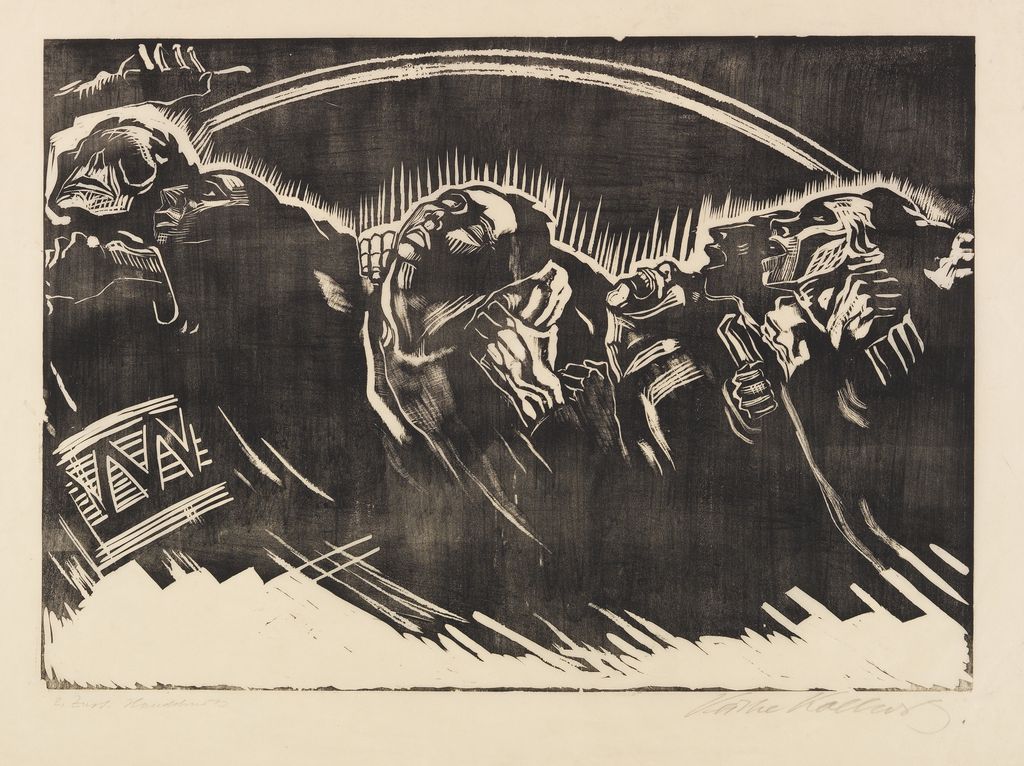
In The Parents (Die Eltern), the third woodcut of the War series, Kollwitz brought two mourners into a single dark mass. The Cologne museum traces an earlier version in which they sat next to each other, drawing on a sculpture by Ernst Barlach. In the final woodcut, one figure folds into the other and their joined silhouette carries much of the expression. Thin cuts distinguish a hand, a face or an edge of clothing within the black. The pair follows The Volunteers in the portfolio. The change from the advancing group in that sheet to the close, stationary form of the parents gives bereavement a place in the sequence of the war. The stone figures share the print’s weight and stillness, while their separate outlines put the burden of connection on the space around them. [23] [24] [25]
MoMA’s 2024 checklist identifies the woodcut as plate three, made in 1921–22 and published in 1923. Its exhibited impression, accession 470.1992.3, is state V/V. The detailed print record identifies it as one of 100 hand-printed, signed and numbered examples on imperial Japan paper. It also records 100 hand-printed examples on wove paper and a further issue of 200 printed from an electrotype in 1924. The Cologne impression is catalogued as Kn 174 V b, inventory 70300/92013. The state describes the stage of the block represented by the impression, while the edition describes its production and publication. These distinctions identify the woodcut precisely when The Parents and The Grieving Parents appear under similar titles. [14] [23] [24] [25]
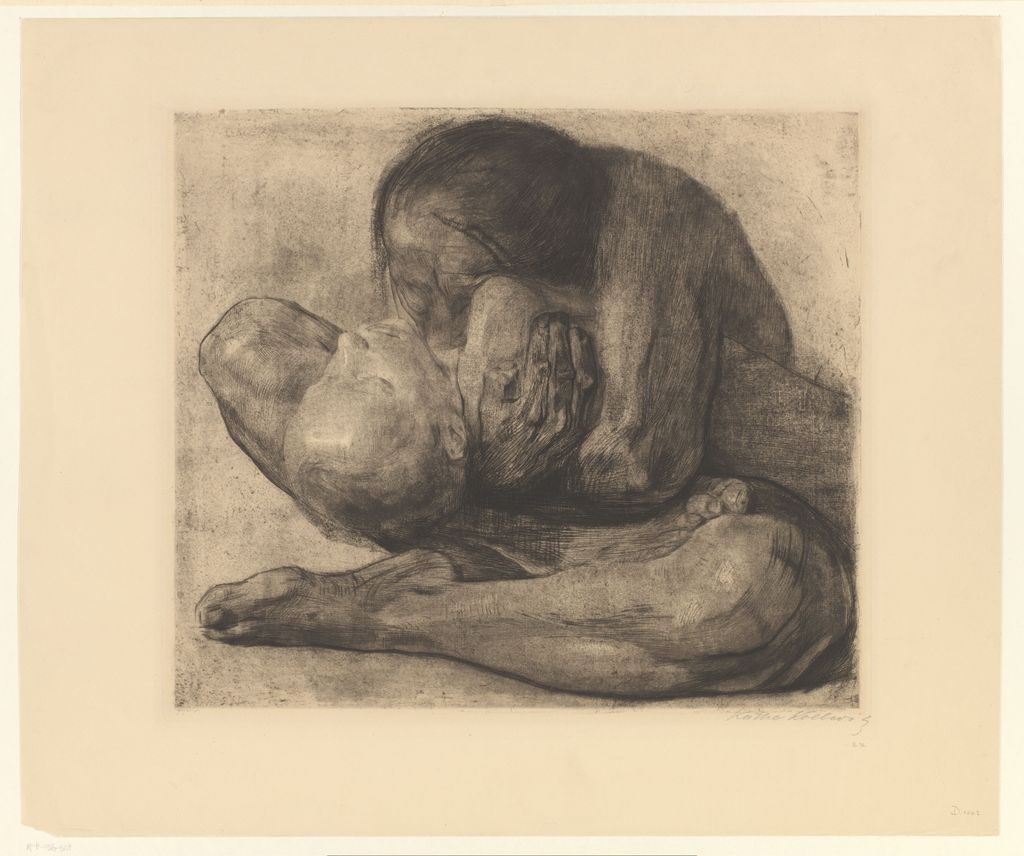
The 1903 print Woman with Dead Child places the child’s body at the centre of an embrace. The mother bends over the child and the outlines close around the two bodies. Kollwitz used herself and seven-year-old Peter as models, eleven years before his death. The earlier lithographic Pietà of 1903 already explored the intertwined pose. Hans later associated the images with his brother’s death, a family reading made in retrospect. MoMA’s 2024 checklist also shows how differently the same etched composition could appear from one impression to the next. Its own early proof was worked over with charcoal, a state III proof lent by the British Museum has a hand-applied gold-coloured wash, and MoMA’s VIII/X impression, accession 181.2018, represents a later stage of the plate. Cologne identifies its own example more specifically as Kn 81 VIII a. [26] [24] [27]
In Mother with Her Dead Son, modelled in 1937–39, the mother sits with her adult son between her knees. The space that separates the figures at Vladslo is here enclosed by a single body. Cologne’s zinc cast, Seeler 37 I.B.6, is dated 1941–43 and measures 386 mm in height. Harald Haacke’s bronze enlargement after the model, installed in Berlin’s Neue Wache in 1993, is about 1.6 metres high. The Berlin Kollwitz museum identifies Haacke as a student of Fritz Diederich, who carved the granite mother for Roggeveld. That link joins the histories of fabrication across two distinct commissions. The Berlin enlargement concentrates public remembrance in one compact group. At Vladslo it takes two figures, the ground before them and the inscribed stone to make the same family relationship visible. [2] [11] [28]
Käthe Kollwitz artworks directory
Selected documented works, including the complete published sequences of the five cycles discussed here. Catalogue links identify the specific record behind each row.
Frequently Asked Questions
The original granite pair stands at the rear of the German military cemetery at Vladslo, near Diksmuide in West Flanders, Belgium. The figures were first installed at Esen-Roggeveld in July 1932. They were moved to Vladslo in 1956 when Peter Kollwitz and the other dead from Roggeveld were reburied there. [1] [5] [18]
Käthe Kollwitz designed the memorial and made the plaster models. August Rhades carved the original father and Fritz Diederich carved the original mother. For the later Cologne memorial, Joseph Beuys carved the father and Erwin Heerich carved the mother in shell limestone, working through Ewald Mataré’s workshop. [1] [2] [4]
Discussion
Look again at the images and ideas explored in The Grieving Parents by Käthe Kollwitz. These editorial prompts invite your observations.
Reader Insights
How does the distance between the figures affect how you experience the memorial?
How did the move from Roggeveld to Vladslo change the visitor’s approach?
What does the gap between the figures contribute to the memorial’s effect?
Join the Conversation
Share a detail, comparison or question about The Grieving Parents by Käthe Kollwitz below.
References
- Kollwitz Museum Köln, Das Mahnmal »Trauernde Eltern«. See the letter to Ludwig Kaemmerer of 11 October 1932, archive photographs 4.c-06, 4.c-10 and 04.c-22, and “Ein Bundesmahnmal in einer kriegszerstörten Stadt,” including Heuss’s speech of 21 May 1959. Memorial dossier View source.
- Hannelore Decoodt and Nele Bogaert, Agentschap Onroerend Erfgoed, Treurend ouderpaar (Vladslo – WOI), 2004, “Beschrijving,” for the poses, bases and individual carving credits. Monument inventory View source.
- Art in Flanders, Hugo Maertens, Treurend ouderpaar, photograph of the original pair at Vladslo, image 0170001003, PID 6688h08b70. Volksbund Deutsche Kriegsgräberfürsorge, teaching resource M 2, Das „Trauernde Elternpaar“ von Käthe Kollwitz, for the grave’s relation to the figures. Photograph record · Volksbund resource View source 1. View source 2.
- Kollwitz Museum Köln, Timeline, 1927–1932, work entries for 1931 and 1932, including the diary of 22 April 1931, the granite exhibition in the Nationalgalerie and the Roggeveld installation. Museum chronology View source.
- Agentschap Onroerend Erfgoed, Duitse militaire begraafplaats Vladslo (geïntegreerd), 2022, “Historische achtergrond” and the site description, for consolidation, the 1956 transfer and the 1969–70 landscaping. Cemetery inventory View source.
- Kollwitz Museum Köln, A Weavers’ Revolt, cycle catalogue. View source.
- Museum of Modern Art, Woman with Dead Child, state VIII/X, 1903. View source.
- Kollwitz Museum Köln, Peasants’ War, cycle catalogue. View source.
- Museum of Modern Art, Käthe Kollwitz, 2024 extended gallery labels. View source.
- Kollwitz Museum Köln, Death, series catalogue. View source.
- Kollwitz Museum Köln, Pietà (Mutter mit totem Sohn), Seeler 37 I.B.6, inv. 70100/97007, including the October 1937 diary extract and the comparison entry for Haacke’s 1993 bronze. Sculpture record View source.
- Kollwitz Museum Köln, Zeitstrahl 1914–1918, 1914–15 entries and archival image of the plaster Toter Soldat, and the 1918 entry reproducing Kollwitz’s published reply to Richard Dehmel. German museum chronology View source.
- Kollwitz Museum Köln, Timeline, 1919–1926, entries on the memorial’s interruption, redesign and cemetery visit, and Biography, June 1926 and July 1932 entries. Museum chronology · Museum biography View source 1. View source 2.
- Bettina Sitter, Kollwitz. Kunst und Wirklichkeit, 2019, vol. 1, pp. 23–24, n. 21(C–D), on burial, installation and the 1926 site plan, with Briefe an den Sohn, pp. 195–199, especially the plan on p. 197. See also vol. 1, pp. 155–156, on the December 1914 diary entry, and vol. 2, § II.7, especially pp. 360 and 364–365, on the relief, and § II.8, n. 1194, on the print editions. Volume 1 · Volume 2 View source 1. View source 2.
- Jay Winter, “Remembrance and Redemption,” Harvard Design Magazine, opening discussion of Peter’s room, family rituals and the changing conception of the memorial, especially nn. 5–8. Essay View source.
- Kollwitz Museum Köln, RE: Kollwitz, catalogue caption for the rejected tinted plaster Grabrelief »Trauernde Eltern«, 1917–18. Relief photograph and caption View source.
- Bettina Sitter, Kollwitz. Kunst und Wirklichkeit, vol. 4, figs. 65, 68 and 71–74. See also the signed 1931 placement drawing, Nagel–Timm 1062, reproduced as lot 160 in the Galerie Kornfeld catalogue. Figure volume · Placement drawing View source 1. View source 2.
- Mark Connelly and Stefan Goebel, “Forgetting the Great War? The Langemarck Myth between Cultural Oblivion and Critical Memory in (West) Germany, 1945–2014,” The Journal of Modern History 94, no. 1 (2022), pp. 17–19, especially nn. 59–61 for the May 1955 correspondence and nn. 63–66 for Cologne. University of Kent repository View source.
- Canon van Vlaanderen, Les parents éplorés de Käthe Kollwitz, introduction and “Commémorer la guerre.” French-language account View source.
- UNESCO World Heritage Centre, Funerary and memory sites of the First World War (Western Front), property 1567rev, inscribed in 2023. World Heritage listing View source.
- Nathalie Muller, Institut national d’histoire de l’art, Käthe Kollwitz (1867–1945) – 2/2, discussion and photograph of the Beuys and Heerich replica at Alt St. Alban. INHA essay View source.
- Volksbund Deutsche Kriegsgräberfürsorge, “Zeichen der Versöhnung in schwieriger Zeit,” 15 September 2014, and the grave-search record for Peter Kollwitz, son of Hans, including the account of the 20 September installation and the uncertainty of his burial at Rzhev. Commission announcement · Grave-search record View source 1. View source 2.
- Kollwitz Museum Köln, The Parents, sheet 3 of War, 1921–22, Kn 174 V b, inv. 70300/92013. Woodcut record View source.
- Museum of Modern Art, Käthe Kollwitz Exhibition Checklist, 2024, pp. 11–14 for Woman with Dead Child and p. 29 for The Parents, plate three of War. Exhibition checklist View source.
- Museum of Modern Art, The Parents (Die Eltern), accession 470.1992.3, and the German Expressionism Digital Archive entry for its paper, editions and catalogue concordance. Object record · Detailed edition record View source 1. View source 2.
- Museum of Modern Art, Woman with Dead Child, 1903, state VIII/X, accession 181.2018, and the separate charcoal-worked proof listed as state I in the 2024 checklist. State VIII/X · Charcoal-worked proof View source 1. View source 2.
- Kollwitz Museum Köln, Woman with Dead Child, Kn 81 VIII a, with comparison to the 1903 lithographic Pietà, Kn 77, and Hans Kollwitz’s later recollection. Print record View source.
- Käthe-Kollwitz-Museum Berlin, Art Postcards | Sculptures, entry for Mother with Dead Son, for Harald Haacke’s training under Fritz Diederich. Berlin museum record View source.
More KOLLWITZ Works
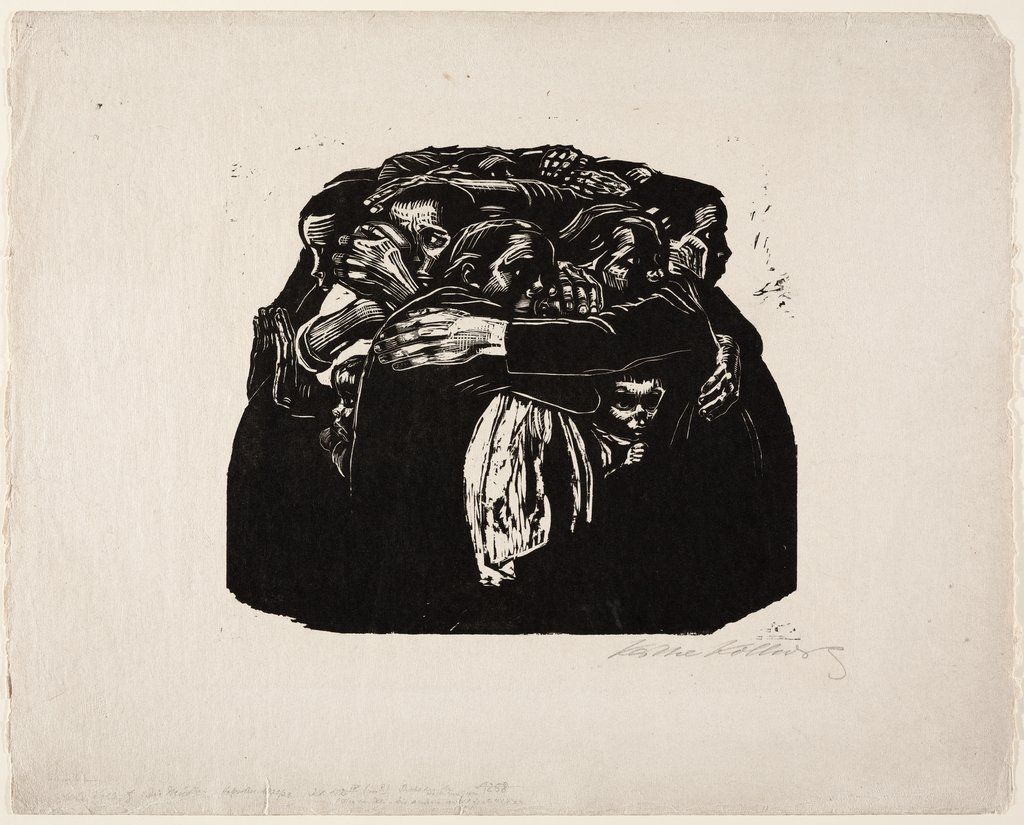
The Mothers
The Mothers, 1921–22. Städel Museum, Frankfurt am Main, SG 4289A D. Image source. Public domain. Resized and exported as JPEG.
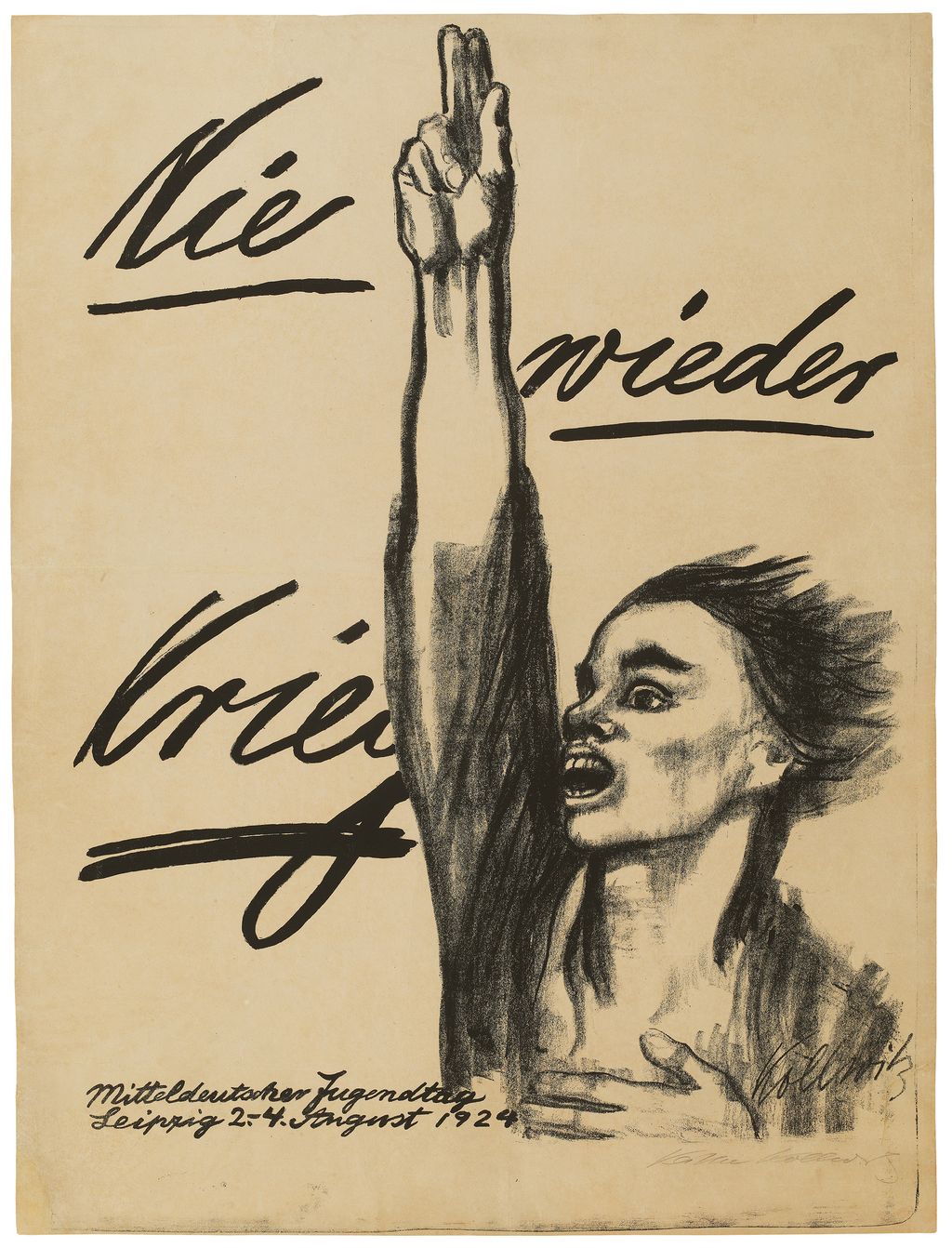
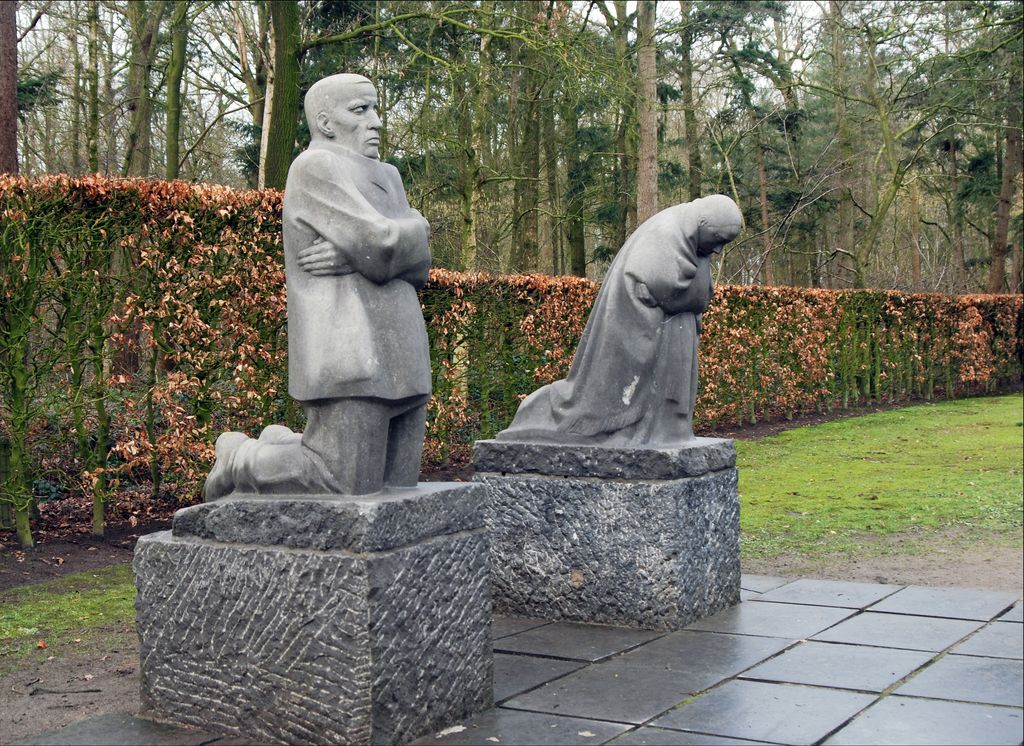
The Grieving Parents
The Grieving Parents at Vladslo, the memorial’s location since 1956. Photograph by Bva, resized. Image source. CC BY-SA 3.0. Resized and exported as JPEG.
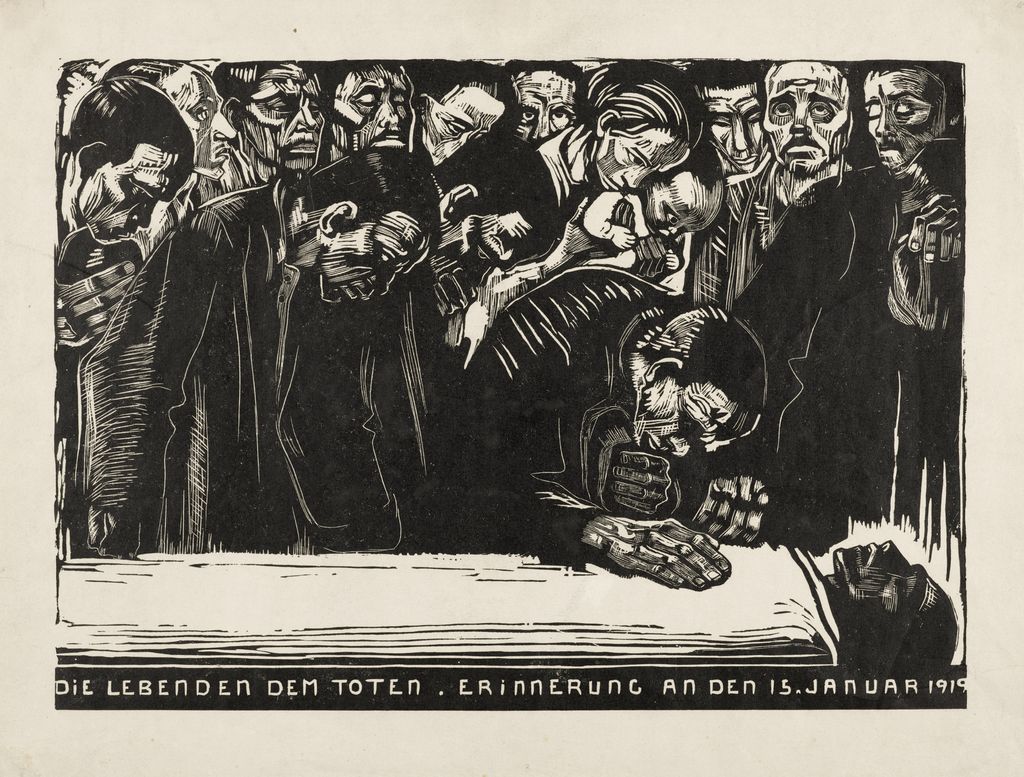
Memorial for Karl Liebknecht
Memorial for Karl Liebknecht, 1920. Kunstsammlungen Chemnitz, 86-47, Kn 159 VI. Photo: Kunstsammlungen Chemnitz/PUNCTUM/Bertram Kober. Image source. Public domain. Resized and exported as JPEG.