


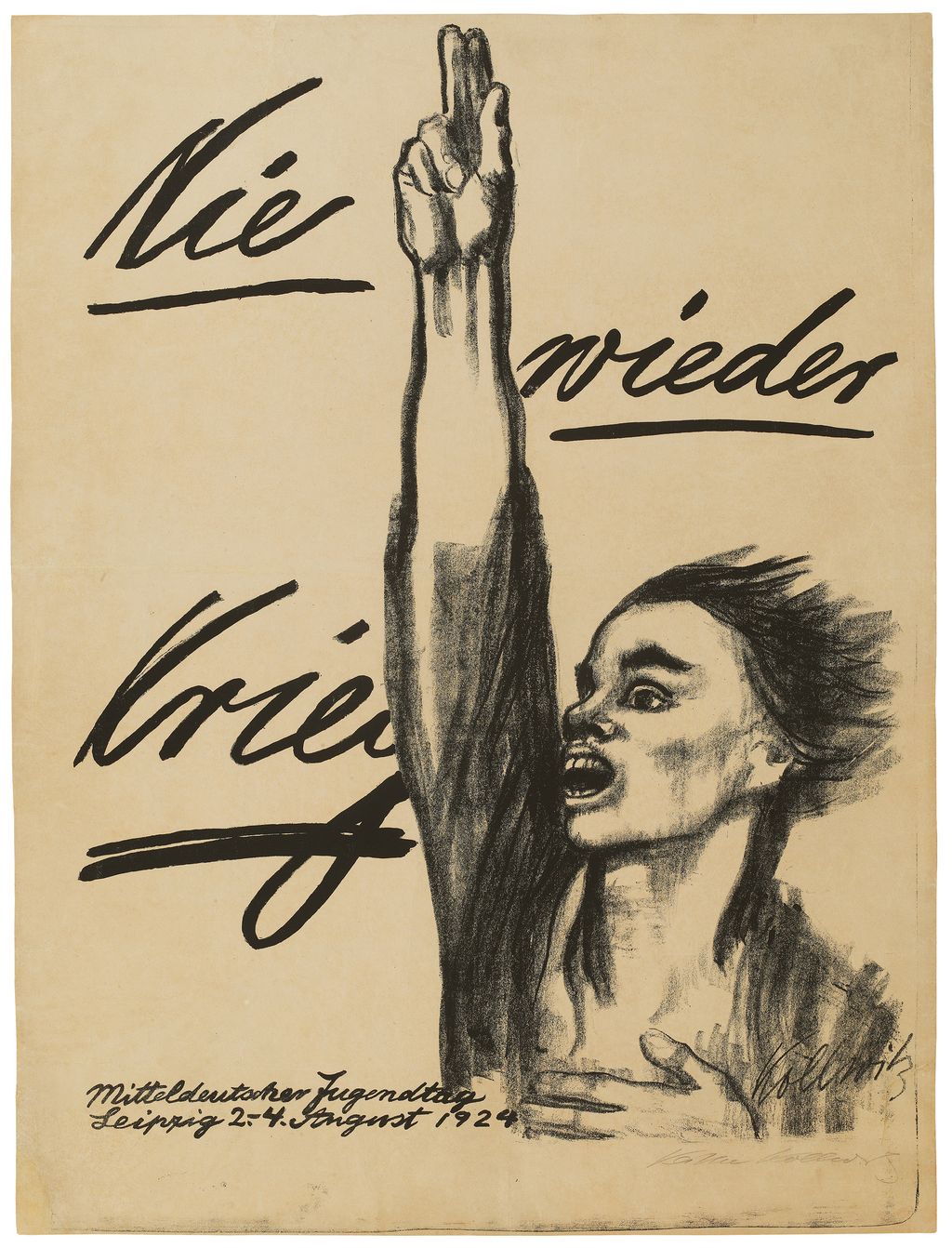
Never Again War!, 1924. Kollwitz Museum Köln, Kn 205 III b, inv. 70300/88018. Kollwitz Museum Köln, Kn 205 III b, inv. 7030088018. Image source. Public domain. Resized and exported as JPEG.
 by Tom Gurney
Tom Gurney BSc (Hons) is an art history expert with over 20 years experience
Email: tomgurney1@gmail.com / Phone: +44 7429 011000
Never Again War! by Käthe Kollwitz: Introduction
A hand rises almost to the top of the sheet. Below it, a young figure throws back their head, opens their mouth and presses their other hand to their chest. Three handwritten words cross the space around the lifted arm. The last, Krieg, is underlined twice. In Käthe Kollwitz’s 1924 poster Nie wieder Krieg, the arm gives the slogan the force of an exclamation mark, while the hand at its tip makes the cry an oath. At the bottom left, in much smaller letters, the Leipzig printing tells anyone who stops to look where and when to gather. [1] [2]
At a Glance
- Artist and dateKäthe Kollwitz, 1924.
- TitleNie wieder Krieg in German, Never Again War! or No More War! in English, and Plus jamais la guerre in French. [1] [2] [3] [4]
- Medium and scaleCrayon and brush transfer lithograph. The Cologne poster’s catalogued image dimensions are 940 × 685 mm. The Städel gives the same image dimensions for its impression and records its sheet separately at 946 × 711 mm. [1] [2]
- Cologne impressionKn 205 III b, inv. 70300/88018. The same museum holds a signed-in-the-print proof before lettering, Kn 205 II b, inv. 70300/97004. [1]
- Original occasionCentral German Youth Day of the Socialist Workers’ Youth in Leipzig, 2–4 August 1924, with an anti-war rally on 3 August. A further printing carried wording for Anti-War Day on 21 September. [1] [2] [3]
This work across Käthe Kollwitz’s career
A Weavers’ Revolt
1893–97The six sheets take a revolt from household distress to collective action and its aftermath. [5]
Separate impressions and hand-worked proofs show how Kollwitz developed the image. [6]
Peasants’ War
1901–08The seven plates combine the revolt with the aftermath in Battlefield and The Prisoners. [7]
War
1921–22, published 1923The woodcuts give sustained attention to the experience of those left behind. [8]
The Grieving Parents
1932 installationTwo kneeling figures face the graves in the memorial’s later location at Vladslo. [9]
Mother with Her Dead Son
1937–39 modelThe small sculpture precedes the 1993 enlargement at the Neue Wache. [11]
Contents
- How the poster turns a cry into an oath
- From the figure alone to the Leipzig poster
- Leipzig in August and Anti-War Day in September
- From the street to the newspaper and book jacket
- How peace movements used the image again
How the poster turns a cry into an oath
At almost a metre high, the Leipzig image gives the gesture room to unfold. The head and shoulders sit low on the right, leaving a long stretch of paper above the face for the arm to traverse. The head tips back and turns left. A dark wedge opens at the mouth, while the uneven edge of the hair makes the upward thrust of the head visible against the bare paper. The lifted arm carries that motion higher. The other arm folds across the body, bringing the hand flat against the chest. One movement opens the body outwards and upwards. The other draws attention back to the person making the promise. [1] [2]
The words take a different route through the image. Nie begins at the upper left, wieder picks up on the other side of the raised arm, and Krieg pulls the eye down to the left, towards the level of the face. The arm cuts across the space in which a reader might expect to follow a single line of text. The two strokes beneath Krieg run towards the arm, bringing the word and the body into contact. The composition asks the eye to cross that boundary and then return to it. By the time the reader reaches Krieg, the open mouth is close enough to make the printed word feel spoken. [1] [2]
The different sizes of lettering give the sheet two reading distances. Across a street or room, the arm and the three big words supply the image’s basic rhythm. Up close, the strokes vary from dense black to grainy grey, especially across the face and clothing. The small Leipzig notice comes into focus at this second distance. A passer-by can absorb the appeal and keep walking. Someone who comes closer can find the information needed to take part. Kollwitz gives the slogan and the invitation different amounts of space, in proportion to how quickly each has to be read. [1] [2]
The raised hand makes the nature of the appeal specific. The palm faces out, the thumb and first two fingers extend, and the remaining fingers curl inwards. Ann Murray identifies the gesture as the Schwurhand, used to affirm a spoken oath in German civic and legal settings. A familiar form of public obligation lends weight to a sentence with no explicit speaker. The poster supplies the implied “I” through the hand against the chest, while the raised hand makes the pledge visible to others. A crowd could give the same words a collective voice without changing them. [1] [3]
Murray also proposes a precedent within the youth movement. At the national youth gathering in Weimar in 1920, Max Westphal, who had lost an arm in the war, reportedly raised his remaining arm and cried out the same slogan. The surviving accounts differ over the hand. Murray describes an oath gesture, while the German Social Democratic newspaper Vorwärts, in its biographical account of Westphal, describes a clenched fist. The shared elements are the public declaration and the raised arm. The episode shows that the words and an emphatic bodily gesture already belonged to the movement’s repertoire, while the link to Kollwitz’s particular design remains a possibility. [3] [12]
The figure’s gender has elicited similarly different readings. Cologne describes a young man. The French Institut national d’histoire de l’art sees a young woman, and Murray reads the figure as androgynous, observing that Kollwitz’s written accounts leave the question open. The crop helps explain why the gesture has proved easier to agree on. The viewer sees the face in profile, a sweep of hair and just enough clothing to register the pull of one arm and the pressure of the other. What comes through most clearly is a young person making a public commitment, an apt figure for an organisation asking young people to speak for themselves. [1] [3] [4]
From the figure alone to the Leipzig poster
Cologne catalogues the finished impression as a crayon and brush lithograph made by transfer, or Umdruck. In transfer lithography, the artist works on a separate support and transfers the drawing to the printing surface. The process can carry both the broken texture of a crayon stroke and the more continuous mark of a loaded brush into the impression. That range is part of what makes the figure work at poster scale. Dark masses establish the shoulder and head at a distance, while softer marks let a viewer at close range see the planes of a cheek or the folds around a wrist. [1] [2]
Cologne’s Kn 205 II b proof, inv. 70300/97004, is catalogued at 940 × 435 mm. It already carries the lithographed signature and has no printed lettering. Its narrower format makes the figure’s vertical reach particularly apparent. The open mouth still suggests a cry, but the proof leaves the viewer to imagine the words. In the wider finished state, the words give the gesture its object and occupy the space the body seems to address. The difference between the two records concerns what was printed and how the image is arranged, as well as the recorded width. [1]
An impression in Washington shows another way words could enter the image. The National Gallery of Art’s 1943.3.5213 is a crayon lithograph on thin wove paper, with charcoal and lithographic ink, or tusche, applied by hand. Its record identifies the slogan faintly written across the centre in charcoal, and signatures in graphite and lithographic crayon at lower right. The gallery cites Nagel 1039 and gives the sheet as 97.3 × 74.8 cm. The faint hand-added wording belongs to that particular object. The Leipzig event inscription and the broad printed slogan can be checked against a finished impression such as the Städel’s. [2] [13]
The Städel’s SG 4302 D is Kn 205 III b, the same catalogue state as Cologne’s finished impression. It is printed in black on brown wove poster paper. The catalogue distinguishes the signature printed at lower right from the pencil signature beside the figure’s left shoulder. It also transcribes the smaller notice at lower left naming Mitteldeutscher Jugendtag and giving Leipzig and the August dates. The printed elements identify the campaign design. The pencil signature is a feature of this sheet, which the Städel acquired from the collection of Helmut and Hedwig Goedeckemeyer in 1964. The record also gives the older Klipstein number, 200 III b, which explains the French INHA entry’s reference to Klipstein 200. [1] [2] [4]
Two Berlin records put the measurements in perspective. The Deutsches Historisches Museum lists its own lithograph, P 62/23, at 94 × 71 cm. MoMA’s 2024 exhibition checklist credits a separate loan to the Käthe-Kollwitz-Museum Berlin and its Association of Friends. On page 33, it lists the composition as 94 × 76.2 cm and the sheet as 94.5 × 71.8 cm. The listed composition is wider than the listed sheet, an inconsistency the entry leaves unresolved. Those figures establish what the checklist reports for the Berlin loan. The Städel’s separately labelled image and sheet measurements supply a firmer basis for describing the scale of its Leipzig impression. [2] [14] [15]
Leipzig in August and Anti-War Day in September
The Leipzig gathering marked ten years since the outbreak of the First World War. The Action Committee of the Nie wieder Krieg movement had called for demonstrations annually since 1920, and mass demonstrations took place across Germany in August 1924. The Leipzig inscription gives the dates of Central German Youth Day as 2–4 August. The anti-war rally on Augustusplatz took place on Sunday, 3 August, within that three-day gathering. The announcement and the date of the rally answer different questions about the same weekend. [1] [2] [3]
The anniversary also brought two generations into the same campaign. Veterans could speak from experience, as Westphal had done in Weimar. Young people who had been children in 1914 could decide what they were prepared to do if asked to fight. The poster puts that decision into the body of a single young speaker. It offers a stance someone could assume and words someone could repeat. The small inscription then gives that individual act a place in an organised public gathering. [1] [2] [3] [12]
Murray, drawing on Alexandra von dem Knesebeck’s catalogue raisonné, documents a further printing of Nie wieder Krieg for German Anti-War Day on 21 September 1924. It retained the slogan and added a line beneath it announcing the September date, with a smaller credit at lower left to the Internationaler Gewerkschaftsbund, the International Federation of Trade Unions. That added wording is the evidence for identifying the September printing. The reach of the arm, the cry and the large lettering could carry over from Leipzig because the information tying the image to a particular campaign occupied a smaller part of the sheet. [2] [3]
The federation had also commissioned a separate design. Cologne dates Die Überlebenden (The Survivors), Kn 197, to 1923 and traces the commission to a request made in 1922 for the international Anti-War Day of 1924. Its Danish-language impression, Kn 197 II b 4, inv. 70300/95011, measures 562 × 685 mm. Cologne records crayon and brush lithography with a scraping needle, made by transfer. The broad format lets a cluster of children and adults spread around the central woman. Faces, including those of people blinded by war, emerge at different heights. The group makes visible who has to live with the consequences once the fighting ends. [16]
Kollwitz’s letter to Beate Bonus-Jeep shows how the patron shaped both the image and its words. She had envisaged a dense group of women shielding their children, taking up the theme of The Mothers from her woodcut series. The proposed caption would have said that women had borne their children for a purpose other than war. The federation’s representatives in Amsterdam pressed for an image of survivors, and Kollwitz reconsidered the composition around parents, widows, blinded people and anxious children. In the same letter she described plans to distribute large anti-war posters across fourteen European countries. Cologne’s Danish impression is material evidence of the campaign’s use of more than one language. [16] [17]
The two posters give the viewer different tasks. The Survivors asks the eye to move through the group and reckon with several kinds of harm. Never Again War! concentrates attention on the effort of one person speaking. The federation’s appearance in the September history of both designs can make the records easy to conflate. The single raised arm identifies Kn 205, while the group of survivors identifies Kn 197. The printed wording on a particular sheet then identifies its audience, language or occasion. [1] [3] [16]
From the street to the newspaper and book jacket
On Saturday, 2 August 1924, the opening day of the youth gathering and the day before the Augustusplatz rally, the figure appeared on the front page of the Leipziger Volkszeitung. Murray reproduces the page and shows that the special issue drew material from a longer anti-war book published by the West Saxony branch of the Socialist Workers’ Youth. In the street the figure announced an event. On the newspaper’s front page it also introduced a selection of work that readers could take away, discuss and circulate. The same figure greeted them again on the jacket of the book from which the issue drew. [3] [18]
The newspaper put the design in the company of other approaches to war. Its inside pages included Georg Kretzschmar’s images of the spectre of war and the trench, work by the Flemish artist Frans Masereel, and Honoré Daumier’s satirical Peace, an Idyll. In the accompanying literary supplement, Walter Mehring’s essay on departure for the front appeared on page two. The contrast between the front page and the material inside was productive. The figure’s oath could be grasped at a glance, while the rest of the issue allowed room for irony, recollection and argument. Daumier’s presence also gave the German anniversary issue a French precedent for using satire to question what passes for peace. [3] [18]
Fritz Kühn edited the West Saxony organisation’s 1924 book, Nie wieder Krieg!. Inside were reproductions of four sheets from Kollwitz’s War woodcut series, The Sacrifice, The Volunteers, The Widow II and The Mothers. Those four images were selections from a seven-sheet portfolio published by Emil Richter in Dresden in 1923 in several editions. Their appearance in the book put them into a new sequence of reading, beginning with the promise on the jacket. Reviewing the book, Dora Heinemann singled out the commitment of the young people who would be expected to form the next army. She also welcomed the way the publication brought pictures, poetry and political writing together. [3] [17]
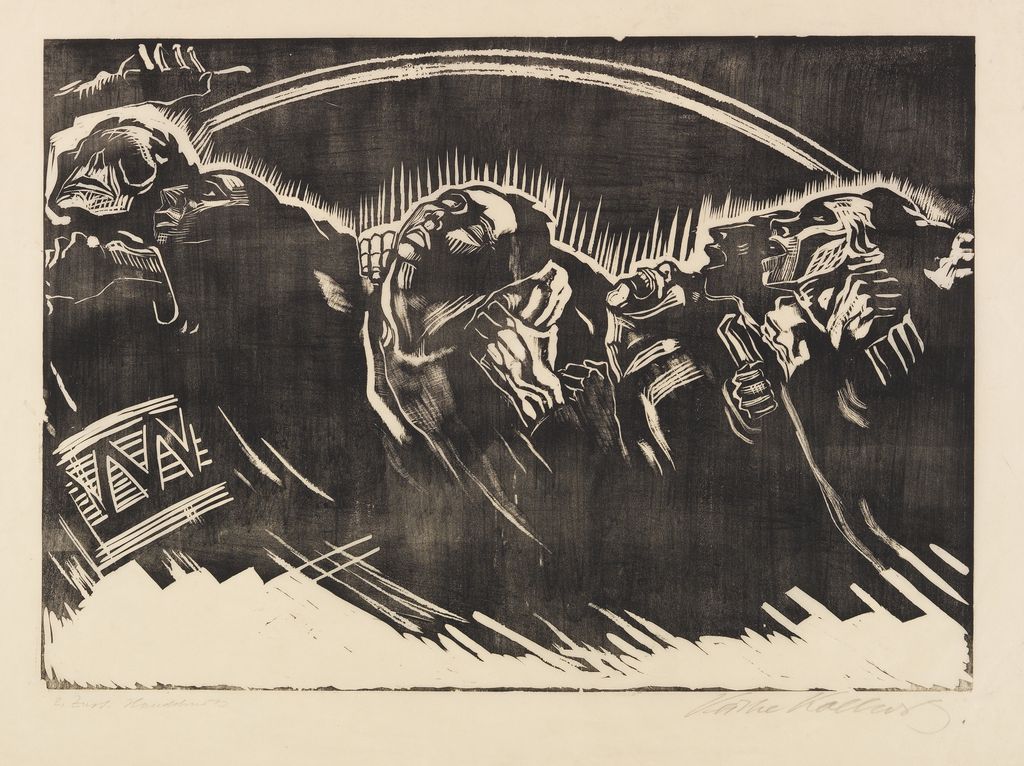
The visual exchange between jacket and pages is especially sharp in The Volunteers. There, the line of young people presses forward behind a skeletal drummer. Their bodies take up the rhythm set by Death. The youth on the poster sets the rhythm of their own utterance, with the pauses around the arm and the double stroke beneath Krieg. In The Mothers, bodies draw together and turn their strength towards sheltering children. The poster takes that same capacity for deliberate action into public space. Kollwitz’s younger son Peter had volunteered and died in October 1914. The woodcuts and the poster give different forms to a question that his death made personal for her and that the youth campaign put to its readers collectively. [1] [3] [17]
Murray records a bilingual French–German edition in 1925, published in Leipzig by Roter Türmer Verlag, that retained the figure on the cover and the woodcuts inside. A separate publication shows how much further the image could travel. Kenyon College records a 1929 volume for the International Federation of Trade Unions with Kollwitz credited as cover artist and photographs drawn from Ernst Friedrich’s Krieg dem Kriege. Its text appears in German, English, French, Spanish, Dutch and Danish. The 1925 edition carried the image and woodcuts into a bilingual setting. The 1929 volume used the cover figure to introduce photographic evidence to a wider multilingual readership. Each has its own date, publisher or sponsoring body, and contents. [3] [19]
How peace movements used the image again
The figure also acquired a history away from organised campaigns. The University of Oxford exhibition In Times of Strife documents an early image formerly owned by the Berlin publisher and collector Salman Schocken and now in Oxford. The exhibition listed a photograph showing the lithograph in Schocken’s living room, a Leipzig poster, and the catalogue of the 1945 memorial exhibition organised by the Tel Aviv Museum and the National Bezalel Museum in Jerusalem. The catalogue listed the Schocken impression as item 111. The sequence records three settings for looking at Kollwitz’s image within a generation of its making: a collector’s home, a public campaign and a memorial exhibition. Cologne’s separately catalogued proof supplies its own evidence for the development of the design before lettering. [1] [20]
The difference between an image that travels and a work made for a particular place was already present in Kollwitz’s response to Peter’s death. While she was making the Leipzig poster, she was also rethinking the memorial that became The Grieving Parents. The original pair was carved in granite, installed at Roggeveld in July 1932 and moved to Vladslo in 1956. The shell-limestone figures at Cologne’s Alt St. Alban were carved later from casts taken from the originals. Her small Mother with Her Dead Son has a different history again. Cologne’s Seeler 37 I.B.6, inv. 70100/97007, is a zinc cast dated 1941–43 from a model of 1937–39. The bronze installed at Berlin’s Neue Wache in 1993 is Harald Haacke’s enlargement after the small work. The kneeling parents ask the visitor to pause in a particular place, and the seated mother encloses the dead son within her own silhouette. The poster throws its figure’s voice out towards whoever happens to pass. Its later versions could recover that address in a new street or a new crowd. [1] [21] [11]
Cologne records repeated use by peace movements in the 1970s and 1980s. Benjamin Ziemann identifies a specific West German example, a poster for Anti-War Day on 1 September 1984, preserved in the Archiv der sozialen Demokratie as 6/PLUA001875. He discusses Kollwitz’s oath-taker among images in which protesters themselves appear as people capable of acting for peace. The link back to Weimar was available through the gesture, even though the date and political circumstances had changed. The figure offered a way to picture what making a public commitment looked like. [1] [22]
In April 1999, a banner at the German Easter peace marches used the pose to address the war in Yugoslavia and NATO’s bombing. Mercedes Valdivieso describes a painted figure with the left hand against the chest, the right arm raised and the mouth open. The banner gave that mouth a single word, NEIN! The setting supplied the immediate object of the refusal. Seventy-five years after Leipzig, the same division of effort between the two arms could make a different word feel like something spoken aloud and meant. [23]
Käthe Kollwitz artworks directory
Selected documented works, including the complete published sequences of the five cycles discussed here. Catalogue links identify the specific record behind each row.
Frequently Asked Questions
Nie wieder means “never again”, so Never Again War! keeps the emphasis on preventing a recurrence. No More War! is the English title used by the Städel and in Murray’s discussion. The INHA gives the French Plus jamais la guerre. These are renderings of the same German slogan. The event lettering is the evidence to look for when distinguishing campaign printings. [1] [2] [3] [4]
Start with the small print. The Städel’s Leipzig impression names Central German Youth Day and gives 2–4 August 1924. Murray records a further printing with a line announcing Anti-War Day on 21 September and crediting the International Federation of Trade Unions. For the earlier stage, Cologne’s Kn 205 II b shows the figure with a lithographed signature before the lettering was printed. If a sheet also carries a pencil signature or handwritten words, check the collection record for that impression. Hand additions and printed wording tell different parts of its history. [1] [2] [3] [13]
Discussion
Look again at the images and ideas explored in Never Again War! by Käthe Kollwitz. These editorial prompts invite your observations.
Reader Insights
How do the lettering and the raised arm work together at street scale?
What did the figure gain or lose as it travelled from poster to newspaper and book jacket?
How did the newspaper and the poster address readers in different settings?
Join the Conversation
Share a detail, comparison or question about Never Again War! by Käthe Kollwitz below.
References
- Kollwitz Museum Köln, Plakat »Nie wieder Krieg«, 1924, Kn 205 III b, inv. 70300/88018, and “Werke im Kontext”, proof Kn 205 II b, inv. 70300/97004. German object record and English object record. View source 1. View source 2.
- Städel Museum, Nie wieder Krieg, 1924, SG 4302 D, image and sheet dimensions, material and technique, inscriptions, catalogue raisonné and acquisition fields. German object record and English object record. View source 1. View source 2.
- Ann Murray, “Käthe Kollwitz: Memorialization as Anti-Militarist Weapon”, Arts 9, no. 1 (2020), article 36, discussion of the Leipzig poster and newspaper, figs. 6–7 and nn. 49–56. Note 49 cites Alexandra von dem Knesebeck, Käthe Kollwitz. Werkverzeichnis der Graphik (2002), pp. 582–85. Note 56 cites Fritz Kühn’s 1925 edition, pp. 66–68. Article. View source.
- Institut national d’histoire de l’art, Käthe Kollwitz (1867–1945) – 1/2, paragraph and caption for Nie wieder Krieg (plus jamais la guerre), Klipstein 200. French essay. View source.
- Kollwitz Museum Köln, A Weavers’ Revolt, cycle catalogue. View source.
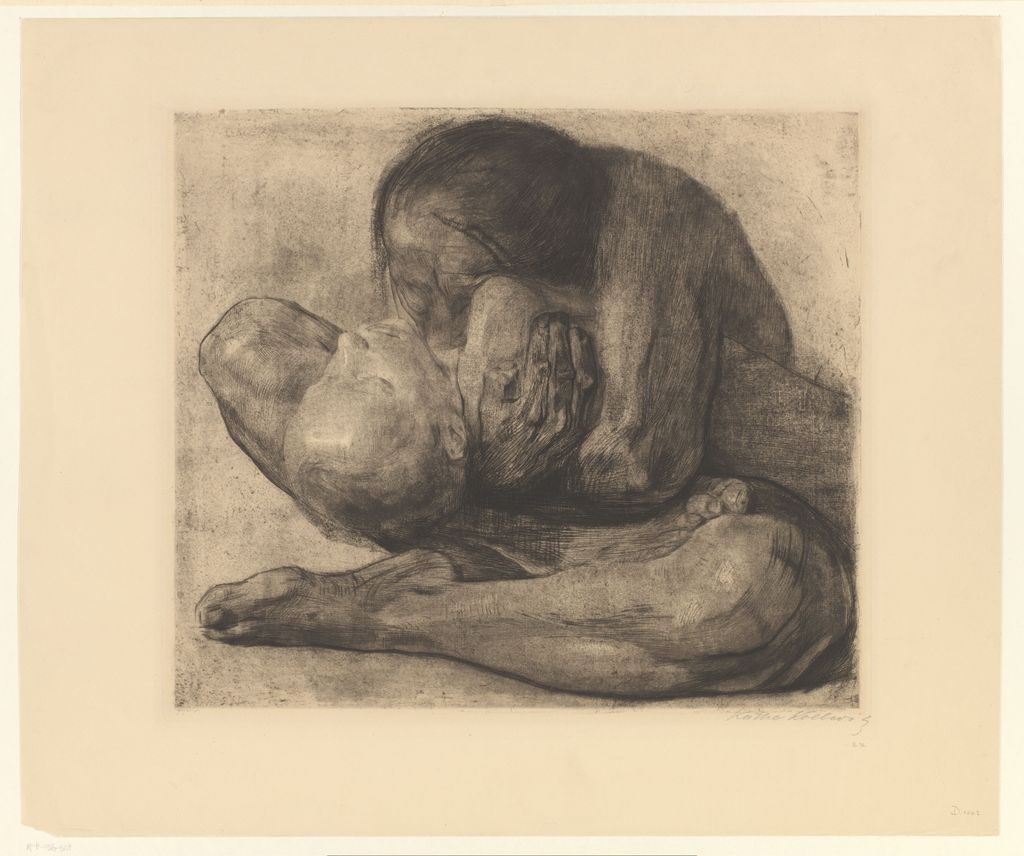
- Museum of Modern Art, Woman with Dead Child, state VIII/X, 1903. View source.
- Kollwitz Museum Köln, Peasants’ War, cycle catalogue. View source.
- Museum of Modern Art, Käthe Kollwitz, 2024 extended gallery labels. View source.
- Flemish Heritage Inventory, Treurend ouderpaar (Vladslo – WOI). View source.
- Kollwitz Museum Köln, Death, series catalogue. View source.
- Kollwitz Museum Köln, Pietà (Mutter mit totem Sohn), Seeler 37 I.B.6, inv. 70100/97007, model and cast caption and account of Harald Haacke’s Neue Wache enlargement. Sculpture record. View source.
- Vorwärts, “Max Westphal: Vom SAJ-Vorsitzenden zum Widersacher Hitlers”, section “Nie wieder Krieg!”, on the closing rally in Weimar. For the contemporary proceedings, see Das Weimar der arbeitenden Jugend, first national youth gathering, 28–30 August 1920. Biographical account and SLUB catalogue entry. View source 1. View source 2.
- National Gallery of Art, Never Again War (Nie Wieder Krieg), 1924, accession 1943.3.5213, Nagel 1039, medium, dimensions and “Inscriptions & Marks”. Object record. View source.
- Deutsches Historisches Museum, Nie wieder Krieg!, 1924, lithograph, inv. P 62/23. LeMO object record. View source.
- Museum of Modern Art, Käthe Kollwitz Exhibition Checklist, 2024, p. 33, Never Again War! (Nie wieder Krieg!), with Berlin lender credit and separate composition and sheet fields. Exhibition checklist. View source.
- Kollwitz Museum Köln, Plakat »Die Überlebenden«, 1923, Danish impression Kn 197 II b 4, inv. 70300/95011, commission history and excerpt from Kollwitz’s letter to Beate Bonus-Jeep, reproduced from Sechzig Jahre Freundschaft mit Käthe Kollwitz. German object record. View source.
- Kollwitz Museum Köln, The War Series, publication history and sheets 1, 2, 5 and 6. Series catalogue. View source.
- Leipziger Volkszeitung, no. 179, Saturday, 2 August 1924, p. 1 and literary supplement, p. 2. The front page is also reproduced in Murray [3], fig. 7. SLUB Dresden issue record. View source.
- Kenyon College, Art History Study Collection, Nie wieder Krieg! No more War! Plus jamais de Guerre!, 1929, record 2095, cover credit, languages and description of the preface and photographs. Publication record. View source.
- University of Oxford, In Times of Strife, exhibition notes, items 6–8, including the photograph of the Schocken interior and the 1945 memorial catalogue, item 111. Exhibition notes. View source.
- Kollwitz Museum Köln, Das Mahnmal »Trauernde Eltern«, photographs and captions for Roggeveld and Vladslo, and “Ein Bundesmahnmal in einer kriegszerstörten Stadt” on the Cologne copies. Memorial dossier. View source.
- Benjamin Ziemann, “The Code of Protest. Images of Peace in the West German Peace Movements, 1945–1990”, Contemporary European History 17, no. 2 (2008), pp. 237–261, at p. 254 and n. 67, Archiv der sozialen Demokratie 6/PLUA001875. University of Sheffield repository copy. View source.
- Mercedes Valdivieso, “Käthe Kollwitz: un grito contra la guerra”, XVI Congreso Nacional de Historia del Arte, p. 953, opening account of the Easter marches, and pp. 959–960 on the 1924 campaigns. Conference proceedings. View source.
More KOLLWITZ Works
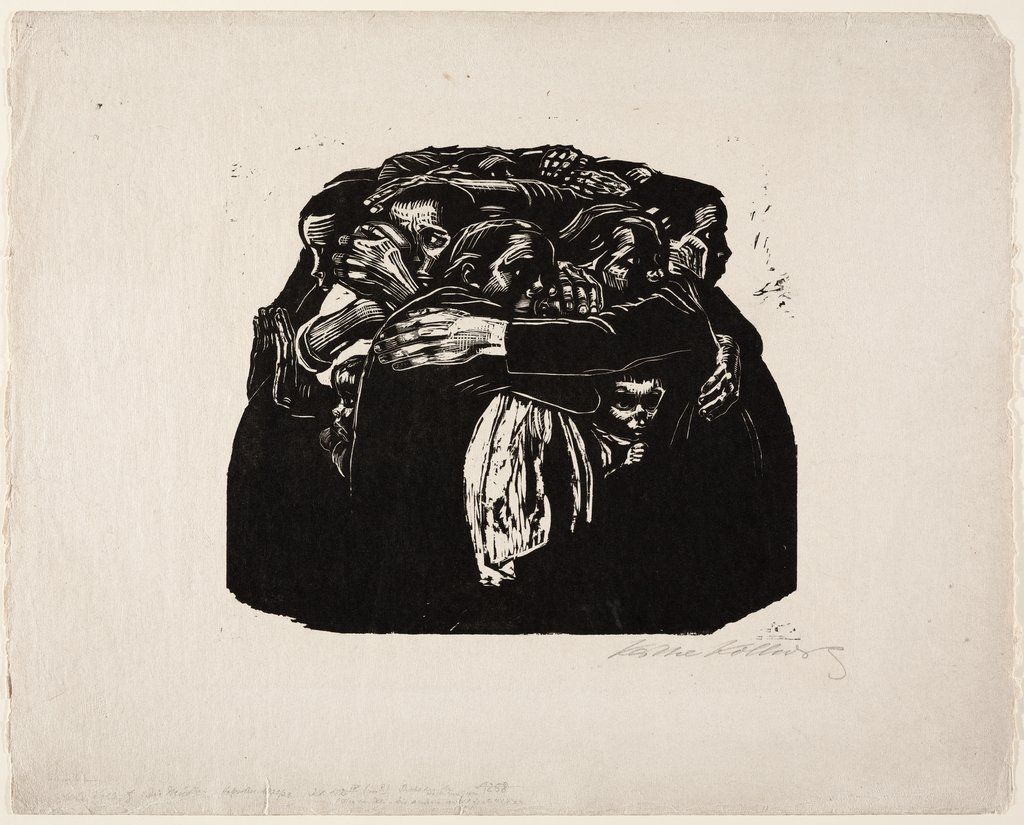
The Mothers
The Mothers, 1921–22. Städel Museum, Frankfurt am Main, SG 4289A D. Image source. Public domain. Resized and exported as JPEG.
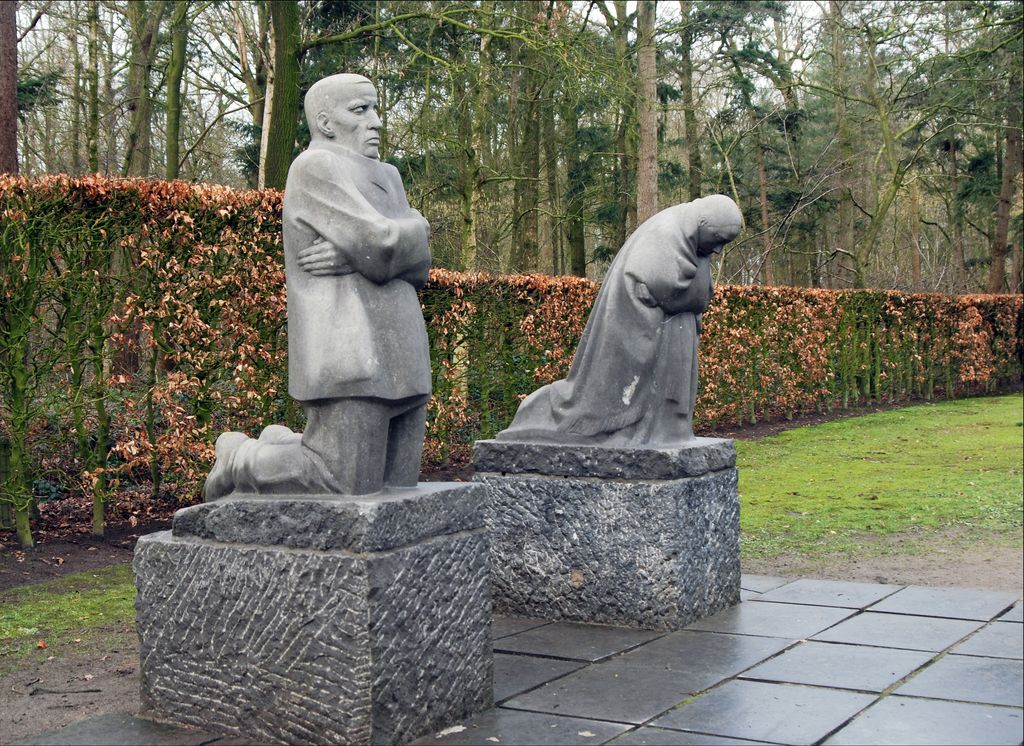
The Grieving Parents
The Grieving Parents at Vladslo, the memorial’s location since 1956. Photograph by Bva, resized. Image source. CC BY-SA 3.0. Resized and exported as JPEG.
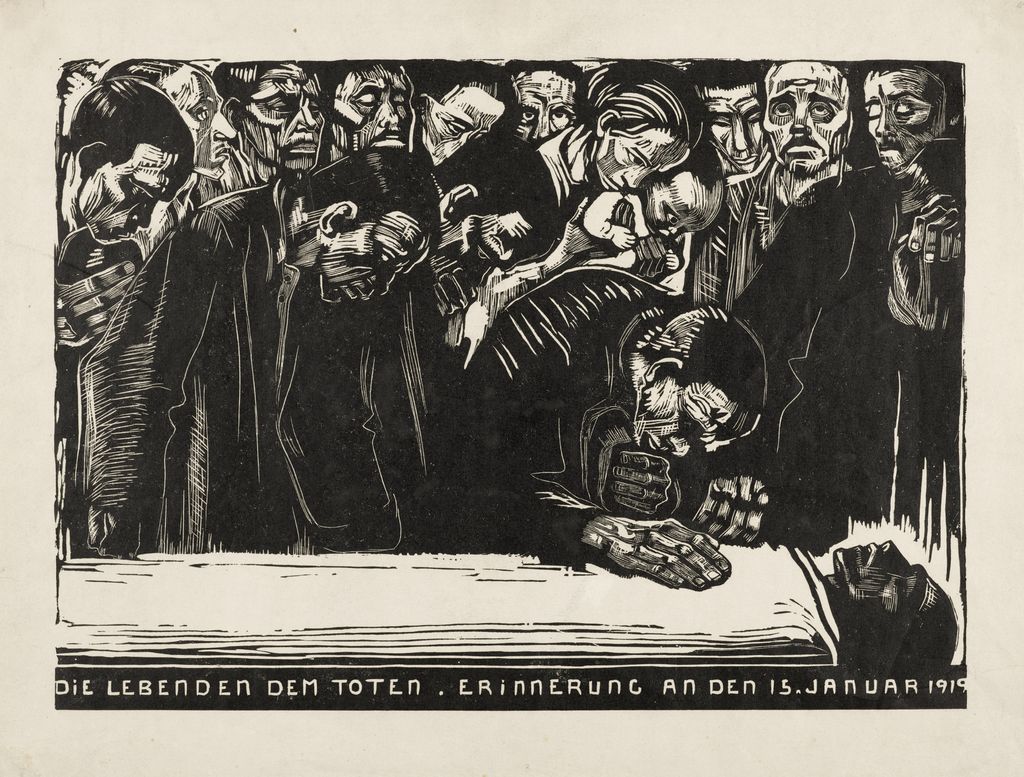
Memorial for Karl Liebknecht
Memorial for Karl Liebknecht, 1920. Kunstsammlungen Chemnitz, 86-47, Kn 159 VI. Photo: Kunstsammlungen Chemnitz/PUNCTUM/Bertram Kober. Image source. Public domain. Resized and exported as JPEG.