


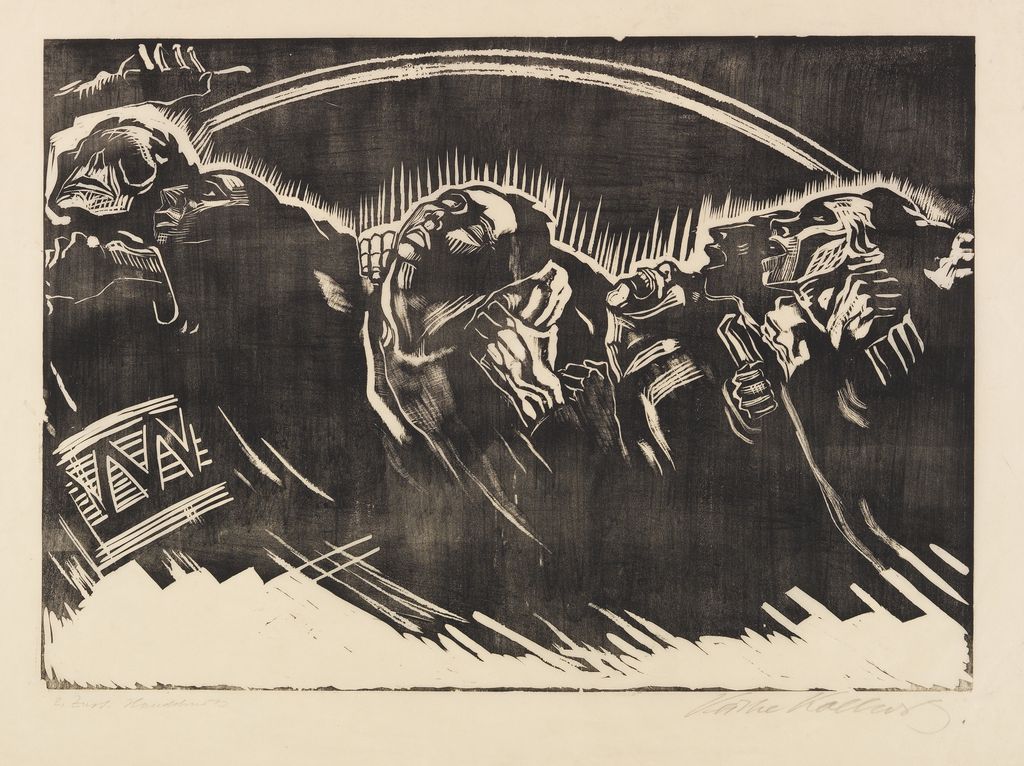
Käthe Kollwitz, The Volunteers, 1921–22, published 1923. Woodcut, sheet 2 of War. Ketterer Kunst reproduction, impression not identified by accession. Image source. Public domain. Resized and exported as JPEG.
 by Tom Gurney
Tom Gurney BSc (Hons) is an art history expert with over 20 years experience
Email: tomgurney1@gmail.com / Phone: +44 7429 011000
Käthe Kollwitz’s War Series: Introduction
In the first woodcut of Käthe Kollwitz’s War, a woman holds an infant out before her. In the sixth, women press shoulder to shoulder around their children. The distance between those gestures gives the portfolio its shape. In the intervening sheets, young men rush to war behind a drummer, two parents fold into an embrace, and a pregnant widow gathers her hands over her body. Then a woman lies with an infant face down across her chest. By the time the mothers close ranks, the act of keeping a child close has acquired a public meaning. The final sheet, The People, asks how far that protection can extend. [1] [2] [3] [4]
At a Glance
- Artist and titleKäthe Kollwitz, War (Krieg).
- Medium and datesSeven woodcuts made in 1921–22, following experiments in etching from 1918 and lithography from 1919. Emil Richter first published the portfolio in Dresden in 1923. MoMA dates the electrotype edition to 1924. [1] [5]
- Published orderThe Sacrifice, The Volunteers, The Parents, The Widow I, The Widow II, The Mothers and The People. The edition A portfolio at MoMA also has a woodcut cover. [1] [5]
- Historical settingThe First World War and its aftermath. Kollwitz’s younger son Peter volunteered and was killed in Belgium in 1914. [1] [6] [7]
Contents
- From wartime conviction to a public portfolio
- The seven woodcuts in order
- From the Academy wall to the portfolio
- Later exhibitions and related work
The series in published order
1. The Sacrifice
Das Opfer. Cologne example Kn 179 IX b, 70300/92011.
3. The Parents
Die Eltern. Cologne example Kn 174 V b, 70300/92013.
4. The Widow I
Die Witwe I. Cologne example Kn 175 V b, 70300/92014.
5. The Widow II
Die Witwe II. Cologne example Kn 178 VII b, 70300/92015.
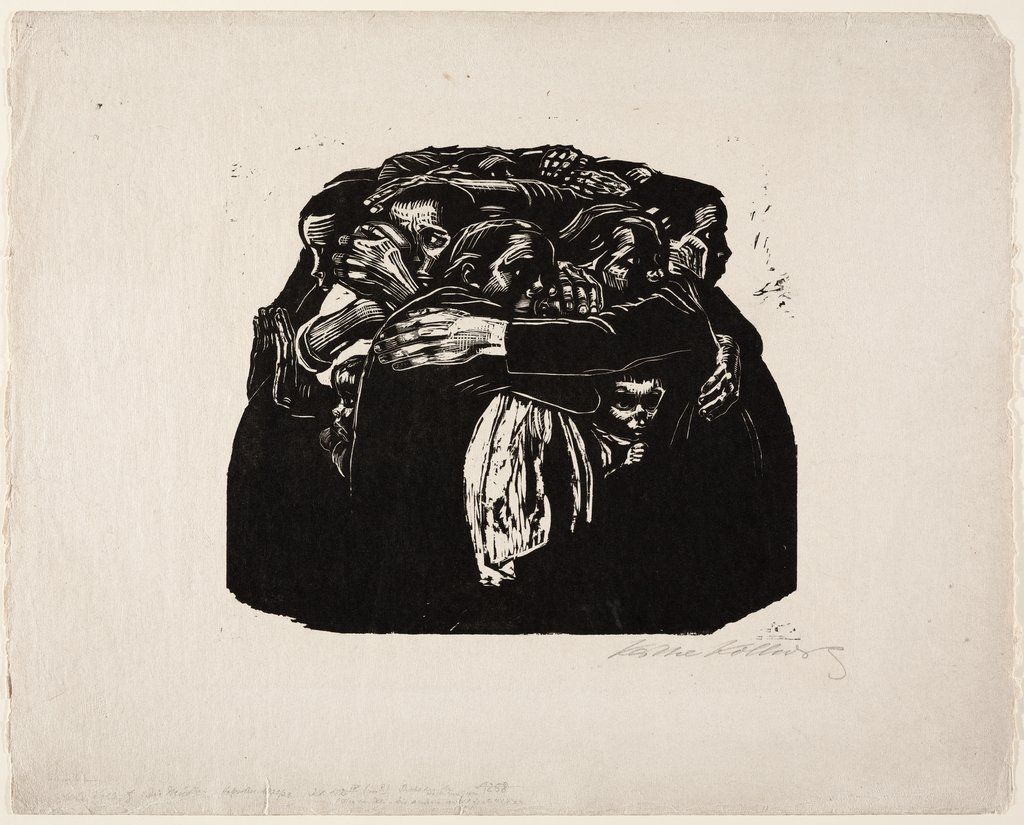
6. The Mothers
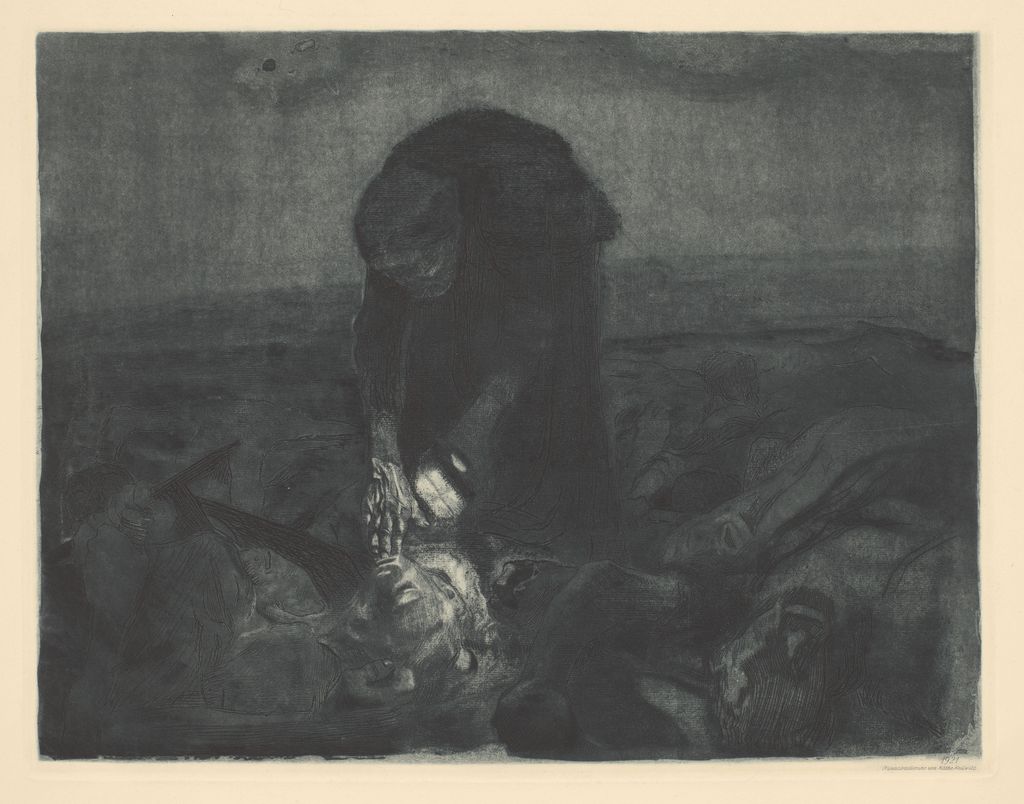
Städel Museum, Frankfurt am Main. Image source.
7. The People
Das Volk. Cologne example Kn 190 VII b, 70300/92017.
From wartime conviction to a public portfolio
Kollwitz initially feared the war while accepting the case for it. The Musée d’Art moderne et contemporain de Strasbourg, in its 2019 exhibition account, places that early judgement in the context of wartime censorship and the family’s belief that Germany was fighting defensively. Her diary shows how far her thinking had shifted by October 1917. Reflecting on Peter and the young men who had volunteered, she extended the same question to their counterparts in England, Russia and France. Each country had asked its young people to give their lives for a patriotic cause. She wondered whether that generation had been deceived. [1] [6] [7]
A year later, when the poet Richard Dehmel called for a final mobilisation, Kollwitz answered publicly. Her response appeared in Vorwärts on 28 October 1918 and in the Vossische Zeitung two days later. She ended by invoking Goethe’s image of seed grain that ought to be kept for sowing. The immediate issue was whether more young people should be sent to fight. In War, that argument takes shape over several sheets. An infant appears before the young men march, and children are still present after the volunteers have disappeared. The adults who surround them at the end have already seen what the first two sheets set in motion. The Käthe Kollwitz timeline places the public letter, the work on the portfolio and the first exhibition in sequence. [6] [8] [2]
On 23 October 1922, Kollwitz wrote to the French writer Romain Rolland that repeated attempts to represent the war had finally brought her close to what she wanted to express. She hoped the sheets would travel widely and convey what people had lived through during those years. By late December, she was still describing the cycle as nearly finished. In a letter to the artist Erna Krüger, she observed that the seven medium-sized blocks scarcely betrayed the years of labour they contained. In her diary on 30 December she took stock again, weighing the limits of the finished work against the size of its task. The October letter registers a breakthrough, while the December accounts show her continuing to assess the work as a whole. [1] [8] [4]
What woodcut made possible
Cologne traces the project from etchings in 1918 to lithographic experiments in 1919 and the woodcuts of 1921–22. MoMA identifies Kollwitz’s encounter with Ernst Barlach’s woodcuts in 1920 as a turning point. In relief printing, the surface left standing takes ink and the cut areas expose the paper. A single cut can bring a cheek or a hand out of a solid black shape. A wider clearing can separate one figure from everything around her. In MoMA’s 2024 audio discussion of The Sacrifice, printmaker Rob Swainston draws attention to the physical resistance of the wood and the sparing use of cuts. Across the portfolio, the effect depends just as much on how much of the block Kollwitz leaves to print black. [1] [5] [9]
The surviving proofs show that even an image built from such direct contrasts could take years to resolve. A trial proof of The Sacrifice in Washington, accession 1947.7.67, carries white gouache over the black woodcut. The National Gallery of Art catalogues it as state ii/vii under Klipstein 177. Cologne’s published impression, Kn 179 IX b, uses the later Knesebeck catalogue. The two Roman numerals belong to different systems. The Getty’s state V/VII proof of The Mothers, printed in black on Japan paper and reworked with white gouache and black ink, shows Kollwitz testing changes on the printed proof. The black and white additions belong to that sheet. A Boston study of 1921, exhibited at MoMA, records a different operation. Kollwitz used brush, black ink and opaque white watercolour on paper that was cut and pasted onto a larger sheet. Together these objects show how freely she could reconsider the image before publication, working across the drawing, the block and the printed sheet. [10] [2] [11] [12]
The seven woodcuts in order
1. The Sacrifice (Das Opfer)
The mother’s eyes are closed. Her bare upper body rises behind the infant, whose small weight rests across her arms. She supports the child from below, holding it out into space with no recipient in view. The exposed face, arms and body make the gesture easy to see, while her closed eyes keep the viewer from meeting her gaze. Cologne reads that combination of nakedness and closed eyes as vulnerability and connects the gesture with Kollwitz’s struggle to accept the demands the war might make on her own family. [11]
In the related charcoal drawing of 1915, NT 722, the mother presses her face against the infant’s. Cologne sees the raised arm in that drawing as a sign of reluctance to part with the child. In the published woodcut the faces are separated, making the space opened up by the mother’s gesture part of the subject. The child is too young to take part in the decision. That is what gives the image its force before The Volunteers, where the young men appear to act on their own convictions. At the opening of the portfolio, the cost of their decision has already been expressed through someone else’s arms. [11] [13] [9]
2. The Volunteers (Die Freiwilligen)
After that suspended gesture, The Volunteers starts moving almost before the eye has sorted out the faces. Death beats a drum at the head of the procession. Behind the drummer, the young men press into one another, and sharp white cuts around their heads drive the movement along the upper edge of the group. The drum gives a common rhythm to figures whose expressions vary. In Cologne’s reading, some are carried forward by enthusiasm, while others follow in loyalty or despair. The museum places the scene in the tradition of the dance of death and reads the light around the heads as an expression of the volunteers’ own conviction. That conviction gives the image its momentum even as the identity of the drummer gives it a destination. [13]
A marginal inscription on a Cologne proof connects the figures with Peter and his friends. Cologne identifies Peter as the young man immediately beside Death. The connection comes from the proof record, while the published image leaves the volunteers unnamed. MoMA’s impression is catalogued as state IV/IV, and Cologne’s published impression as Kn 173 IV b, accession 70300/92012. In the sequence, this is the one sheet that shows the men going to war. The next image removes the rush of bodies, the drum and the jagged illumination. It leaves the viewer with two people who have nowhere to follow. [5] [13] [14]
3. The Parents (Die Eltern)
Two people bow into one another until their clothes form a single dark mass. The patches of exposed paper that pick out hands and portions of faces give the eye just enough information to understand the embrace. The figures take up much of the sheet, yet their posture turns attention inward, towards the points where their bodies meet. The preceding woodcut binds a group through its shared direction. Here the weight of each figure comes to rest on the other. [13] [15]
Cologne relates an earlier, side-by-side arrangement to a sculpture by Barlach. It also preserves rejected transfer lithographs from 1919 and 1920, Kn 142 a and Kn 149. Even late in the process, Kollwitz judged the woodcut too light and sharply defined, as she recorded on 13 December 1922. In the final version she reduced the internal detail and made the group darker. That decision asks the viewer to read the couple’s grief through the bend and compression of their bodies. The dark has a specific function here. It makes it difficult to draw a line between the two people. [15]
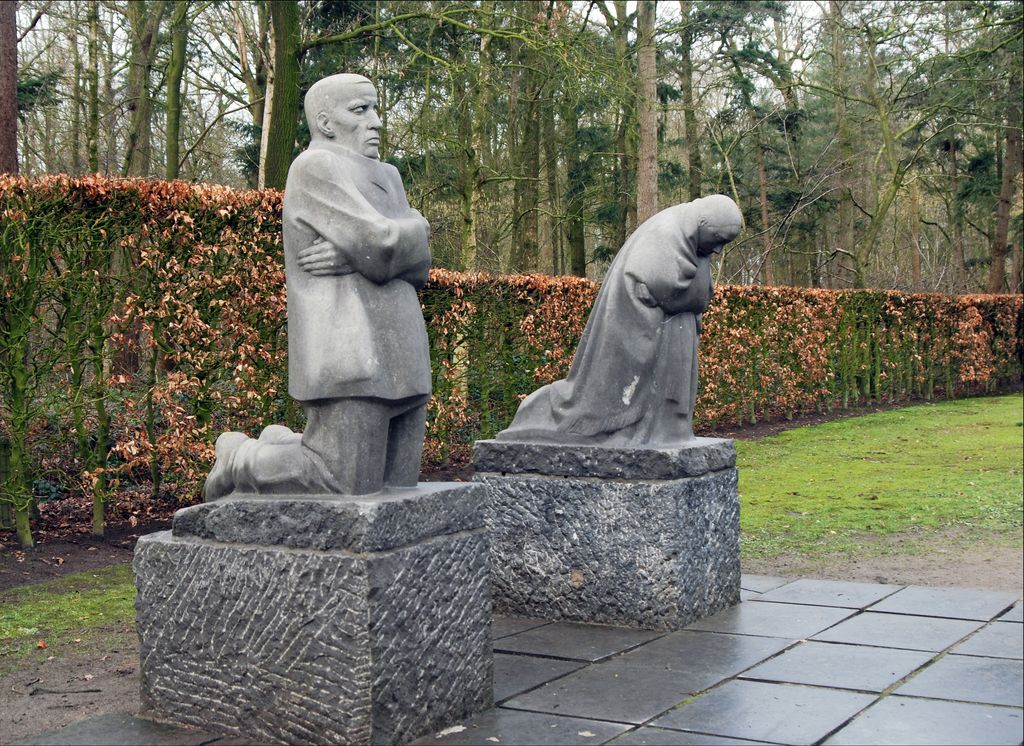
The separate stone memorial The Grieving Parents makes the interval between the mourners central to the encounter. First installed at the Roggeveld military cemetery in 1932, and later moved to Vladslo, it sets two kneeling figures apart. A visitor can take in the distance between them in the space of the cemetery. The woodcut achieves its concentration on a single sheet, through the closeness of the two figures and the dark they share. [15] [16]
4. The Widow I (Die Witwe I)
The fourth sheet narrows abruptly. In MoMA’s set the printed composition measures 37.2 by 23.6 centimetres, and its upright format leaves a light surround close to the widow’s body. Her head tips down and her hands gather over her torso. The hands are large enough to draw attention away from her face and towards the rounded form below them. Cologne identifies her as pregnant, while MoMA’s collection commentary treats the pregnancy as suggested by the rounded form and the placement of her hands. Both readings attend to the same concentration of the figure around her own body. [2] [17] [18]
In the rejected etching of 1918, Kn 138 I in Cologne, and the rejected lithographic version of 1920, Kn 152 c, the woman’s hands are open and empty. Cologne also draws attention to the lifted shoulders in the lithograph. In the final print the lowered head and gathered hands give the gesture a centre. The parents of the preceding sheet could lean towards each other. The widow stands alone, and the small area enclosed by her arms is the only shelter the image gives her to make. [15] [17]
5. The Widow II (Die Witwe II)
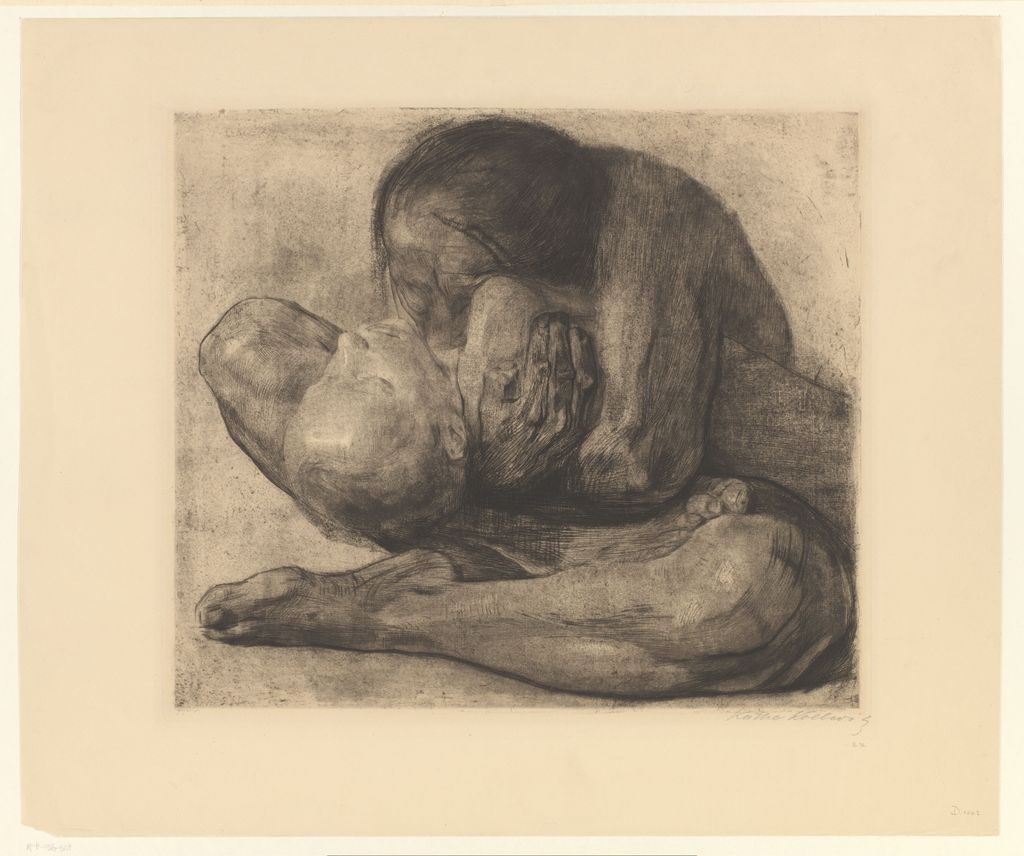
Turning to the next sheet changes the way the eye has to travel. MoMA’s composition is 30 centimetres high and 53 centimetres wide. A woman lies with her head fallen back and an infant face down across her chest. The eye can take in the two bodies together, then follow the length of the woman’s body out to the exposed feet. Kollwitz had first considered ending the composition around the knee. In the rejected lithograph, Kn 154, the infant dominates more strongly. For the final woodcut she added a piece of wood to the block and included the stiff feet with their splayed toes. The extension makes the woman’s full bodily presence part of the encounter. [2] [19]
Cologne interprets the scene as a widow who has taken her own life and that of her child. MoMA’s 2011 gallery text raises starvation as a possibility. The image leaves the cause open. What it fixes is the position of the child against the woman and the inability of either body to respond. The paired titles invite a comparison between the widows, and the change of format makes the comparison physical. The hands gathered over the standing figure’s body had made an image of possible protection. In the horizontal sheet, proximity is all that remains. [5] [17] [19]
6. The Mothers (Die Mütter)
In The Mothers, shoulders, forearms and hands interlock around children who can be seen through openings in the group. The contour holds together even where the faces inside it turn in different directions. Some of the hands reach across neighbouring bodies, so that the act of protecting a child is distributed across the group. Cologne compares the circular arrangement to a fortress. The dark that closed around two mourners in The Parents now has an outer edge the adults appear to hold in place together. [15] [3]
The earlier versions make the change in that arrangement particularly clear. The 1918 etching, Kn 137, and the 1919 transfer lithograph, Kn 140, give the mothers and children more separate poses. On 6 February 1919, Peter’s birthday, Kollwitz wrote in her diary that she had drawn the mother embracing her children in the lithographic design as herself with Hans and Peter. The identification belongs to that work in progress. The final woodcut, Kn 176, makes the mothers’ shared perimeter more legible than any one family. The National Gallery’s 1992 catalogue draws attention to the smoother perimeter of the published group, comparing it with the jagged cutting of The Volunteers. The moving band in sheet two is open to the force leading it forward. The enclosure in sheet six derives its strength from the bodies keeping contact. [3] [20]
MoMA’s retrospective gave visitors several ways to see that development. Its lead image was the Ute Kahl collection’s impression of the rejected 1918 etching, reworked with black ink, opaque white, charcoal and pencil. That impression is distinct from the Getty’s brown-ink state III/III of the etching, and both precede the Getty’s reworked fifth-state woodcut proof. MoMA also showed the 1919 lithograph from the William Benton Museum of Art and the cut-and-pasted Boston study alongside its presentation of the finished series. In the extended label and the audio for the Boston study, curator Starr Figura reads the protective group as resistance to a culture that asked German mothers to accept a son’s death as an honour and bear their grief privately. The change from the first sheet supplies the visual basis for that reading. One woman holds a child outward. In the sixth sheet, the women use their arms to keep the children within reach. [10] [2] [21] [22]
7. The People (Das Volk)
In the last sheet a woman stands at the front of a group. A child peers out below her with hands raised in front of the face. Other faces emerge from the black behind her and crowd towards the shelter she offers. Cologne sees an echo of the Virgin of Mercy, who is traditionally shown with people gathered beneath her mantle. Here the mantle is only suggested. The child’s hands add a second, smaller barrier and make the protection feel provisional. After the broad enclosure of The Mothers, the narrower upright composition puts the central figure and the child directly before the viewer. [2] [3] [4]
Kollwitz developed the relation between faces and darkness through both drawing and proof. MoMA’s checklist identifies the Getty’s pre-1923 study as brush and black ink with white gouache over a preliminary charcoal drawing. The Getty separately records two autumn 1922 woodcut proofs. One is a state II/VII fragment with white and off-white gouache. The state III/VII sheet also has black ink added by hand. Cologne’s published impression is Kn 190 VII b, accession 70300/92017. In that final image the dark is shared by the group, but each face emerges from it differently. The title gives them a collective name while the marks of strain remain individual. [10] [2] [4]
From the Academy wall to the portfolio
The completed cycle was first shown at the Prussian Academy exhibition in 1923, together with preparatory drawings and works on the theme of death. On 13 November Kollwitz wrote to Krüger that she had expected a favourable response, but had been surprised by the depth of it. She was gratified to have spoken for so many people and reported that sales had eased the family’s financial circumstances. The letter gives an immediate public counterpart to the one she had sent Rolland the previous year. In 1922 she had imagined the sheets finding an audience beyond her own experience. At the Academy she learned how strongly an audience could recognise its experience in hers. [8]
Emil Richter’s Dresden publication allowed viewers to encounter the sequence by handling separate sheets. MoMA identifies its set, 470.1992.1–8, as edition A, one of 100 hand-printed, numbered and signed sets on imperial Japan paper. It identifies Fritz Voigt of Berlin as the probable printer. Edition B also consisted of 100 hand-printed, numbered and signed examples, on wove paper. MoMA dates edition C, 200 copies printed from an electrotype on imitation Japan paper, to 1924. The National Gallery of Art’s 1992 essay groups the three editions under 1924. The dating here follows Cologne’s 1923 first-publication account and MoMA’s distinction between the 1923 portfolio and the later electrotype issue. [1] [5] [18] [20]
The cover changes the opening encounter. In MoMA’s set, The Widow I appears on the outside and returns as the fourth composition. The National Gallery of Art’s edition A cover, 1943.3.9440, is printed in black on brown paper and catalogued separately from its interior impression of The Widow I, 1943.3.9437. The cover gives the reader the solitary widow before the mother extends her infant or the volunteers march. A gallery can let the viewer see several sheets in a single glance. Opening the portfolio gives that one figure an interval of her own before the sequence begins. [5] [20] [23] [24]
Later exhibitions and related work
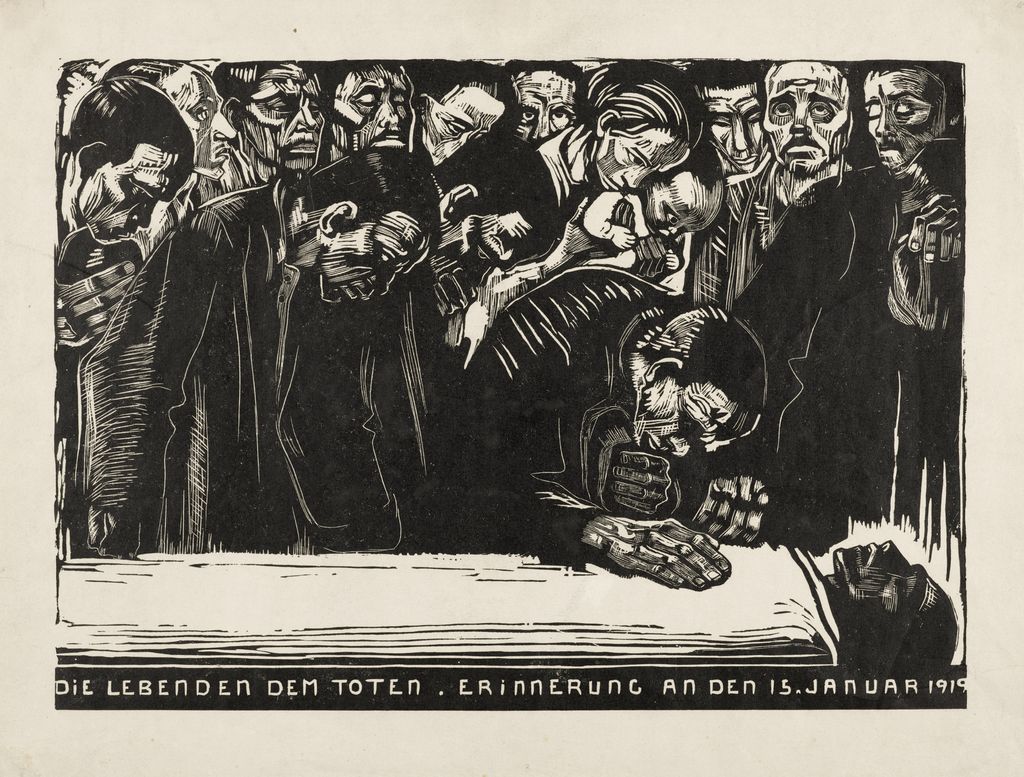
MoMA records a 1924 showing at Berlin’s International Anti-War Museum. Later exhibitions placed the woodcuts in different company. In London, Portrait of the Artist: Käthe Kollwitz, organised by the British Museum with Ikon, followed stops in Birmingham, Salisbury, Swansea and Hull. The British Museum’s 2019–20 display put War and Kollwitz’s memorial woodcut for Karl Liebknecht in its concluding section on woodcuts, war and remembrance. The juxtaposition set the portfolio’s unnamed mourners alongside a public response to a specific political killing. In Strasbourg that same season, Je veux agir dans ce temps included Cologne’s Les Mères, Kn 176, in its account of the First World War and pacifism. The French exhibition read the closing sheets through the refusal implied by the mothers’ protective gestures. MoMA’s 2024 presentation added the opportunity to compare the seven published sheets with objects that exposed the work of arriving at them. [5] [2] [25] [26] [7] [22]
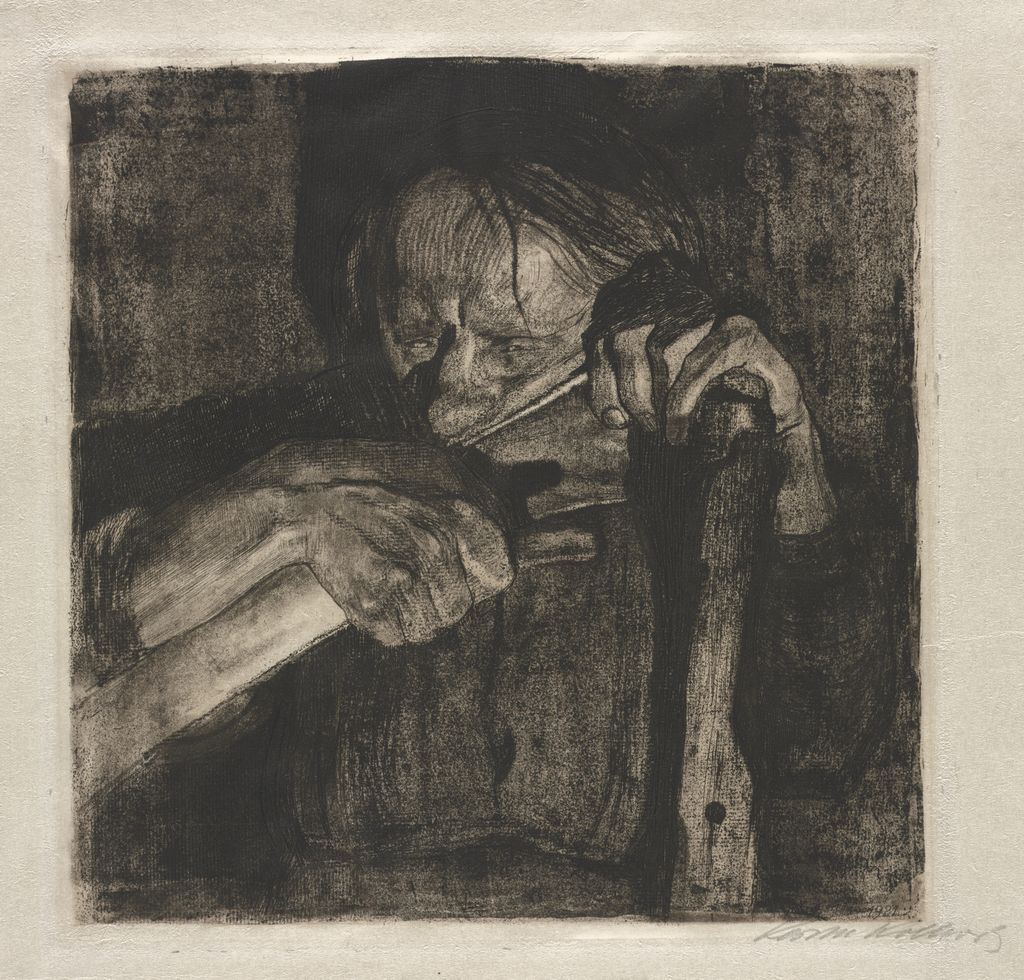
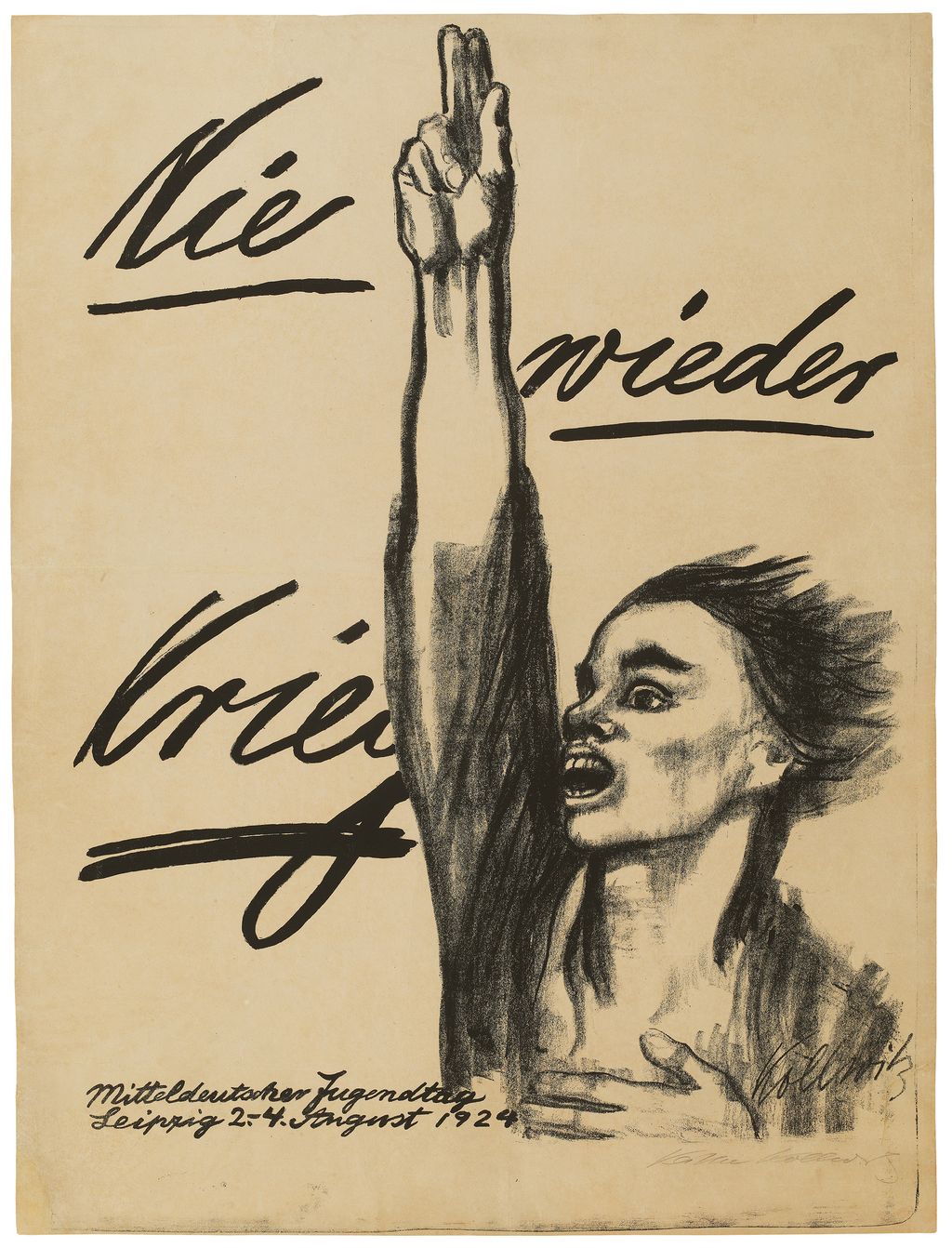
Kollwitz carried aspects of the portfolio into other forms of public address. In preparing The Survivors, a lithographic poster for the international anti-war day of 1924, she initially considered returning to the subject of The Mothers. Her 1924 Never Again War! uses a raised arm and a printed slogan to make its appeal immediately, as the essay on her posters discusses. In the three woodcuts of Proletariat, she used the shorter sequence to give separate weight to unemployment, hunger and child mortality. In War, an argument can take several turns of the sheet to become apparent. The child held out at the beginning changes what the viewer sees in the hands that reach across the children at the end. [3] [27] [28] [29]
Käthe Kollwitz artworks directory
Selected documented works, including the complete published sequences of the five cycles discussed here. Catalogue links identify the specific record behind each row.
Frequently Asked Questions
The first range dates the making of the published woodcut designs. The completed cycle was shown at the Academy and first published by Emil Richter in 1923. Etchings from 1918 and lithographs from 1919 onward belong to the development of the project. MoMA dates the electrotype edition to 1924. [1] [8] [5] [2]
Discussion
Look again at the images and ideas explored in Käthe Kollwitz’s War Series. These editorial prompts invite your observations.
Reader Insights
How does the cover alter the first encounter with the seven woodcuts?
What do the trial prints show about the move from individual grief to collective experience?
How do the portfolio’s contrasting shapes affect the pace at which you turn its sheets?
Join the Conversation
Share a detail, comparison or question about Käthe Kollwitz’s War Series below.
References
- Kollwitz Museum Köln, Folge Krieg, 1918–1922/23, German series overview and the Rolland and Krüger correspondence. View source.
- Museum of Modern Art, Käthe Kollwitz, 2024 exhibition checklist, pp. 26 and 29–32. View source.
- Kollwitz Museum Köln, The Mothers, sheet 6, Kn 176 VII b, inv. 70300/92016, earlier versions and the diary entry of 6 February 1919. View source.
- Kollwitz Museum Köln, The People, sheet 7, Kn 190 VII b, inv. 70300/92017, associated drawings and the diary entry of 30 December 1922. View source.
- Museum of Modern Art, War (Krieg), 470.1992.1–8, edition and paper details, exhibition history and 2011 gallery text. View source.
- Kollwitz Museum Köln, The War Years, including the diary entry of 11 October 1917 and the October 1918 response to Richard Dehmel. View source.
- Musées de Strasbourg and Kollwitz Museum Köln, Käthe Kollwitz. Je veux agir dans ce temps, French exhibition dossier, especially room 6 and the identification of Les Mères. View source.
- Kollwitz Museum Köln, 1919–1926, including the Rolland letter of 23 October 1922, the first showing of the complete cycle and the Krüger letter of 13 November 1923. View source.
- Museum of Modern Art, The Sacrifice, 2024 audio transcript with Starr Figura, Wolfgang Tillmans and Rob Swainston. View source.
- Getty Research Institute, Käthe Kollwitz: Prints, Process, Politics, checklist, pp. 8–9, Simms Collection 2016.PR.34. View source.
- Kollwitz Museum Köln, The Sacrifice, sheet 1, Kn 179 IX b, inv. 70300/92011, and related charcoal drawing NT 722. View source.
- National Gallery of Art, The Sacrifice, trial proof with white gouache, 1947.7.67, Klipstein 177, state ii/vii. View source.
- Kollwitz Museum Köln, The Volunteers, sheet 2, Kn 173 IV b, inv. 70300/92012, and earlier proofs. View source.
- Museum of Modern Art, The Volunteers, state IV/IV, plate 2 of War. View source.
- Kollwitz Museum Köln, The Parents, sheet 3, Kn 174 V b, inv. 70300/92013, and rejected versions. View source.
- Kollwitz Museum Köln, The Memorial Grieving Parents, design and installation history. View source.
- Kollwitz Museum Köln, The Widow I, sheet 4, Kn 175 V b, inv. 70300/92014, and rejected versions. View source.
- Museum of Modern Art, War (Krieg), current collection record and gallery labels. View source.
- Kollwitz Museum Köln, The Widow II, sheet 5, Kn 178 VII b, inv. 70300/92015, and rejected lithograph Kn 154. View source.
- National Gallery of Art, Käthe Kollwitz, 1992 exhibition catalogue, discussion of War and entries for the trial proof of The Sacrifice, the edition A cover and the development of The Mothers. View source.
- Museum of Modern Art, Study for The Mothers, 2024 audio transcript with Starr Figura and Emily Price. View source.
- Museum of Modern Art, Käthe Kollwitz, exhibition of 31 March–20 July 2024, and extended gallery label for War. Exhibition · Extended labels. View source 1. View source 2.
- National Gallery of Art, The Widow I, portfolio cover in black on brown paper, 1943.3.9440. View source.
- National Gallery of Art, War (Krieg), associated objects, including the separate interior impression of The Widow I, 1943.3.9437. View source.
- Ikon Gallery, Portrait of the Artist: Käthe Kollwitz at the British Museum, London. View source.
- British Museum, Portrait of the Artist: Käthe Kollwitz, press release with tour venues and London exhibition sections. View source.
- Städel Museum, Proletariat, three-part woodcut portfolio. View source.
- Kollwitz Museum Köln, Never Again War, 1924, Kn 205 III b. View source.
- Kollwitz Museum Köln, Die Überlebenden, Kn 197, commission history and the initial return to the subject of The Mothers. View source.
More KOLLWITZ Works
The Mothers
The Mothers, 1921–22. Städel Museum, Frankfurt am Main, SG 4289A D. Image source. Public domain. Resized and exported as JPEG.
The Grieving Parents
The Grieving Parents at Vladslo, the memorial’s location since 1956. Photograph by Bva, resized. Image source. CC BY-SA 3.0. Resized and exported as JPEG.
Memorial for Karl Liebknecht
Memorial for Karl Liebknecht, 1920. Kunstsammlungen Chemnitz, 86-47, Kn 159 VI. Photo: Kunstsammlungen Chemnitz/PUNCTUM/Bertram Kober. Image source. Public domain. Resized and exported as JPEG.