


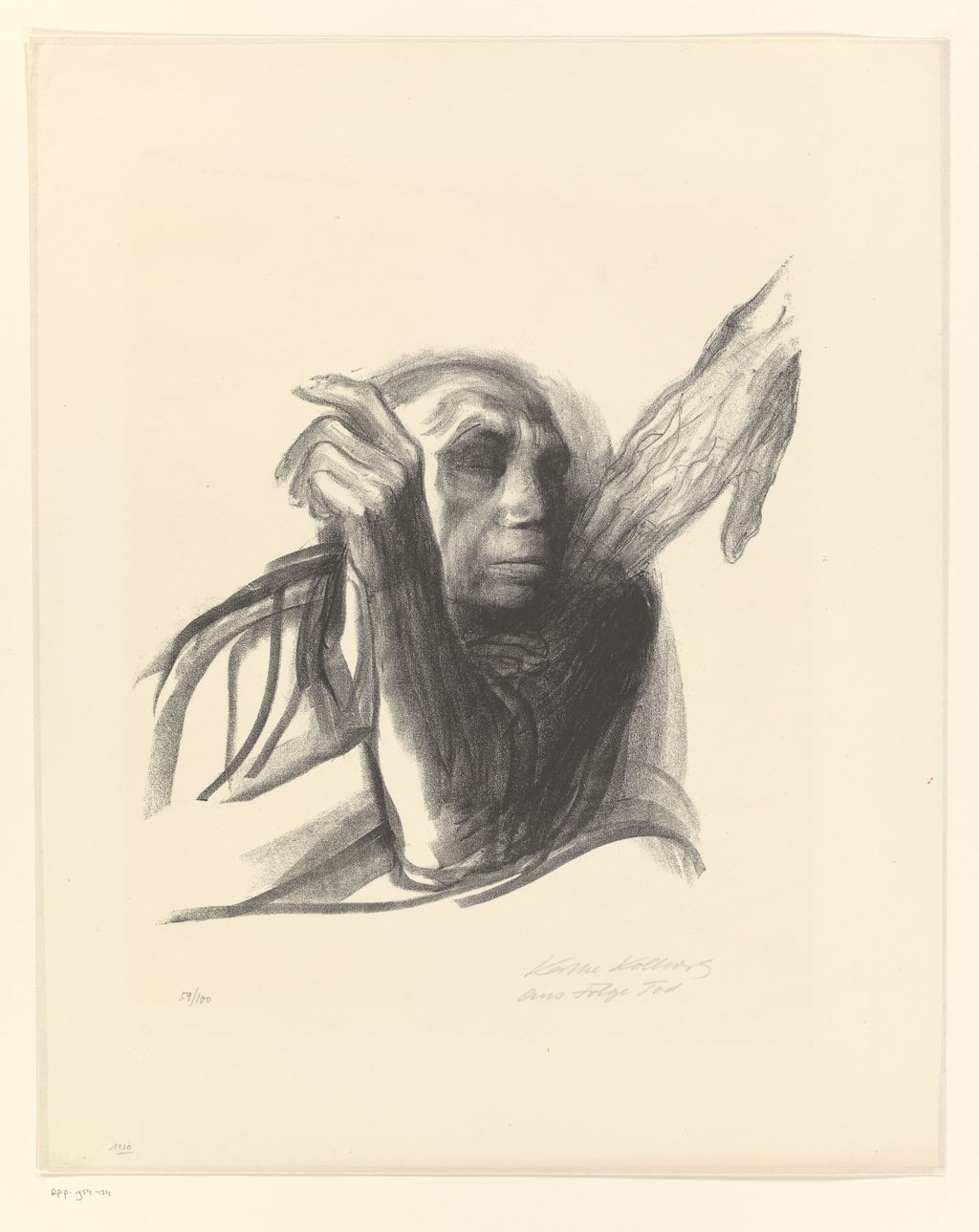
Käthe Kollwitz, Call of Death, sheet 8 of Death. Rijksmuseum, RP-P-1954-124, numbered 59/100. Image source. CC0 / Public domain. Resized and exported as JPEG.
 by Tom Gurney
Tom Gurney BSc (Hons) is an art history expert with over 20 years experience
Email: tomgurney1@gmail.com / Phone: +44 7429 011000
Käthe Kollwitz’s *Death* Series: Introduction
In the first sheet of Käthe Kollwitz’s Death, a mother takes an offered hand while her children press against her. Two sheets later, Death reaches into a group of children and carries two of them away. In the last print, a hand enters from the edge of the image and comes to rest on Kollwitz’s own shoulder. Across eight lithographs made between 1934 and 1937, a hand can offer relief, break a family apart or ask someone to turn and look. The differences are in who reaches first, who can answer and what happens to the people already holding on. [1]
At a Glance
- Artist and titleKäthe Kollwitz, Tod (Death)
- Date and medium1934–37, eight lithographs
- First public showingFive sheets appeared at the Academy of Arts’ autumn exhibition in 1934, while the cycle was still in progress. [2]
- SequenceEight encounters linked by recurring gestures and situations. The order of the sheets differs from the chronology of their making. [1]
- Final sheetRuf des Todes (Call of Death), a self-portrait dated 1937 by the Kollwitz Museum Köln. [3]
Contents
- A project resumed under different circumstances
- Before the cycle, a woman listening in the dark
- An offered hand and a sheltering lap
- The grasp that breaks a family apart
- Two men, one without company
- A family beneath the surface
- Call of Death, from shoulder to stone
- Publishers, proofs and later impressions
The series in published order
1. Woman entrusts herself to Death
Frau vertraut sich dem Tod an. Cologne example Kn 264 b, 70300/89027.
2. Young Girl in the Lap of Death
Tod hält Mädchen im Schoß. Cologne example Kn 265 b, 70300/89028.
3. Death seizes the Children
Tod greift in Kinderschar. Cologne example Kn 266 II b, 70300/83012.
4. Death seizes a Woman
Tod packt eine Frau. Cologne example Kn 267 a, 70300/86057.
5. Death on the Road
Tod auf der Landstraße. Cologne example Kn 270 II b, 70300/06007.
6. Death is recognized as Friend
Tod wird als Freund erkannt. Cologne example Kn 271 b, 70300/89023.
7. Death in the Water
Tod im Wasser. Cologne example Kn 268 b, 70300/02050.
A project resumed under different circumstances
The Kollwitz Museum Köln traces the plan for a graphic cycle on death to a diary entry in 1922. In February 1927, while the sculpture now known as The Grieving Parents still occupied much of her attention, Kollwitz urged herself to return to printmaking and take up the subject. The diary’s repeated “Must, must, must!” records the urgency of the project seven years before she began the lithographs. Cologne suggests that the death of her brother-in-law Georg Stern, a person close to her, may have prompted her to return to the idea in 1934. The long interval between the diary and the prints helps explain the range of material the cycle draws on. Kollwitz could return to a figure conceived during the postwar hunger crisis alongside a study made for the new series. [1] [2]
By spring 1934, when Kollwitz began work on Death, the Nazi regime had forced her to resign from the Prussian Academy of Arts, where she had led the master studio for graphic art. She had also vacated her Academy studio. Five sheets appeared in the Academy’s autumn exhibition that year, a public showing after the institution had lost her as a teacher and member. The exhibition establishes how many sheets were shown at that point. Cologne’s final sequence places two works dated 1937 at numbers five and six, followed by a work dated 1934. From October 1934 she set the prints aside and returned to the sculpture Mother with Two Children in her new workspace at the Klosterstraße studio community. The Käthe Kollwitz timeline follows these changes in her working circumstances. [1] [2] [4]
The interruption matters to the way the cycle treats an embrace. In the 2024 MoMA retrospective, a 1932 charcoal drawing of a mother clutching two children and the sculpture Mother with Two Children preceded the late prints in the checklist. The bronze on display, from Kunstmuseen Krefeld, was cast in 1958 from a work modelled in 1932–36. In the exhibition audio, Tamar Avishai draws attention to the long fingers that cradle and protect the children, while curator Starr Figura describes the group’s rounded form as an expression of maternal love. In the opening lithograph, children also press close to a mother, but one of her hands reaches beyond the family. The sculpture gives a sense of how much can change when a single hand moves out of that protective circle. [2] [5] [6] [7]
Cologne connects Kollwitz’s return to the cycle in 1937 with the encouragement she drew from interest in her prints in the United States. The Bern dealer August Klipstein enlisted Hudson Walker to show her work in New York, and the bookseller Jake Zeitlin organised a small touring exhibition from Los Angeles. In a letter to Dr Löhnberg on 6 May 1937, Kollwitz welcomed the ground opening for her work in America. She contrasted it with the experience of being passed over and treated in Germany as if she were already dead or had lost the right to a living presence. The metaphor belongs to a letter about her professional situation, written as she was returning to images of physical death. It gives particular force to the fact that the cycle reached completion in a year when several plans for exhibitions marking her seventieth birthday fell through in Germany. [2]
Before the cycle, a woman listening in the dark
The earlier Abschied und Tod (Farewell and Death) brought together reproductions of eight drawings. Cologne’s overview places the portfolio in 1923, while its record for the deluxe edition’s introductory print gives 1924 for the Propyläen issue. The issue year remains uncertain across those records. The introductory print itself is securely dated 1923. It is an original transfer crayon lithograph, Kn 200 II b, Cologne inv. 70300/00019. In it, a crouching woman folds her arms as Death emerges beside her. The two figures incline their heads towards each other, giving the encounter the intimacy of listening. Cologne traces the composition back to drawings made in 1904–05 for Inspiration, in the orbit of Peasants’ War. A pose developed for one kind of prompting could serve, years later, for a conversation at the edge of life. [8] [9]
In another design for the introductory sheet, Death and Young Man, Gliding Upwards (c. 1922–23, NT 963, inv. 70200/02022), Death bears a figure upwards on a diagonal. Kollwitz’s February 1923 diary entry associates work on the designs with the birthday of her son Peter, who was killed in the First World War. Cologne reads the rising figure in this group of studies as probably Peter, including in a related charcoal, NT 967, whose catalogue title identifies the companion as a woman. The diary grounds the association with Peter in Kollwitz’s working life, while the identity of each drawn figure remains an interpretation. The contrast between the designs is clear in the images themselves. One makes Death a presence close enough to listen to. The other gives it the power to lift and carry. The later cycle puts comparable possibilities next to one another, where neither can settle the meaning of the other. [9] [10]
An offered hand and a sheltering lap
1. Woman Entrusts Herself to Death (Frau vertraut sich dem Tod an, 1934, Kn 264 b, Cologne inv. 70300/89027). The German vertraut sich … an gives the woman an active part in the meeting. Death appears as an extended hand and she takes it. Cologne reads the gesture as a bitter way out of unbearable hardship and understands her as entrusting the children as well as herself to Death. The children’s response complicates that reading. They press fearfully against her, seeking the protection of the person who is reaching away from them. The print places the mother’s resolve and the children’s dependence in the same moment. An act that could seem like deliverance if she were alone feels much less settled with the children still holding on. [7]
2. Young Girl in the Lap of Death (Tod hält Mädchen im Schoß, 1934, Kn 265 b, Cologne inv. 70300/89028). In the German title, Death is the one who holds. The figure has a maternal bearing, and the young woman nestles into its lap. Her shaded eyes and open mouth suggest that death may already have come. The first sheet asks the viewer to follow a hand across the space between two figures. In the second, the weight of the girl has already passed into the keeping of the figure beside her. The pose can be read as a movement towards comfort or as the stillness that follows it. [7] [11]
Kollwitz had worked extensively on a related idea in the 1920–21 woodcut Woman in the Lap of Death. A crown of thorns lies on the ground in Cologne’s Kn 165 VII c impression. In the account recorded by her friend Beate Bonus-Jeep, Kollwitz imagined Death taking the woman gently and the thorns of her suffering being left behind. The Getty’s Simms collection preserves a rejected first version and impressions from six states of the third and final version. Two impressions of state I alone show different kinds of work on the paper. One is reworked with white pigment, and the other with white pigment and black ink. That history belongs to the earlier woodcut, and it gives a measure of how sustained Kollwitz’s interest in this pose was. In the 1934 lithograph, the support offered by one body to another carries the suggestion of release that the crown of thorns helped convey in the woodcut. [11] [12] [13]
The grasp that breaks a family apart
3. Death Seizes the Children (Tod greift in Kinderschar, 1934, Kn 266 II b, Cologne inv. 70300/83012). Death swoops down and takes two children. The German greift in describes a reach into a group. The composition depends on that intrusion from above and on the sudden displacement of bodies below. After the lap in the preceding sheet, being carried has a different force. The children have become the objects of a grasp they cannot return. Cologne identifies its impression as crayon and brush lithography, a description also used by the Städel Museum for its own impression on wove paper. [14] [15]
The idea arose in January 1920, while Kollwitz was working on the relief poster Vienna Is Dying! Save Its Children! for a campaign that was cancelled as conditions in Germany worsened. Her diary describes Death seizing two children, one by the hair. She imagined that child lying rigid and looking straight at Death. She also imagined a grieving woman who witnesses the seizure and feels it deeply, identifying her explicitly as someone other than the child’s mother. The poster, the separate black-crayon drawing of 1920 (NT 860) and the 1934 lithograph have distinct roles. The poster addresses an audience that could come to the aid of hungry children. The diary and drawing follow a related image of seizure, and the later print makes that action the subject of a sheet in its own right. [14] [16]
MoMA’s 2024 checklist records a second drawing with the title Death Seizes the Children, a 1934 charcoal on paper (117.2024), as well as the lithograph (1655.1940.3). The charcoal sheet measures 69.9 by 52.4 centimetres, while the printed composition in MoMA’s impression measures 50.1 by 41.3 centimetres. Those dimensions distinguish the object being drawn on from the area the image occupies in print. They also help keep the 1934 drawing separate from Cologne’s drawing of 1920. MoMA describes its lithograph as a proof before the edition of 100. The Städel’s Death Seizes the Children (SG 4361 D), signed by Kollwitz, bears the number 27/100, which the museum attributes to another hand. The two records give the proof and a numbered impression places in the history of the same image. [5] [15] [17] [18]
4. Death Seizes a Woman (Tod packt eine Frau, 1934, Kn 267 a, Cologne inv. 70300/86057). The verb packt conveys a sudden grab. A skeleton comes from behind and catches a mother with her child. The woman’s eyes and mouth open, while her right hand goes across the screaming child’s mouth. The gesture that registers the attack in her face meets another gesture that partially hides the child’s. The narrow upright composition keeps the struggle close. In the opening sheet, a mother’s hand can reach out while her children cling to her. Here, her hand stays with the child as the bodies are seized together. [7] [19]
In the earlier Death, Woman and Child (1910, Kn 108 XIII in Cologne), the mother and child press cheek to cheek, and the skull and arm at the edge of the image take time to discern. The delay makes the viewer discover Death while looking at the pair’s closeness. In the 1934 lithograph, the woman’s face makes the instant of contact immediately legible. The 2024 MoMA exhibition showed its proof of the latter print, 1655.1940.4, which its German Expressionism catalogue identifies as Knesebeck 267 b, distinct from Cologne’s 267 a. The difference in catalogue suffix belongs to the individual impressions. Both carry the same position and date in the series. [5] [19] [20] [21]
Two men, one without company
5. Death on the Road (Tod auf der Landstraße, 1937, Kn 270 II b, Cologne inv. 70300/06007). A gaunt man in a dark coat sits against a wall with his eyes closed, his face partly screened by a propped hand. His own face has the appearance of a skull. After two sheets in which Death violently enters a group, this image gives the viewer one body to attend to and no separate personification to look for. The country road of the title is a place people ordinarily pass through. The man has stopped there, and the propped hand makes the duration of that stillness imaginable. Cologne preserves a preparatory charcoal on yellowish laid paper dated 1934 (NT 1254, inv. 70200/07003). The subject was already taking shape in the first year of work on the cycle, even though the lithograph belongs to the year Kollwitz resumed it. [22]
6. Death Is Recognised as a Friend (Tod wird als Freund erkannt, 1937, Kn 271 b, Cologne inv. 70300/89023). The dying man again has a skull-like face, but his eyes are open and his hand reaches around the head of a tall figure whose back faces the viewer. In the previous sheet, the man’s hand supports and partly conceals his own face. Here the hand reaches out, and the visible face carries the recognition promised by the title. Cologne reads the expression as a joyful greeting and the encounter as a release. Because Death faces away, the viewer has to take the character of the visitor from the dying man’s response. The two prints leave room for radically different experiences of solitude and company, even as the faces of the men resemble one another. [22] [23]
A family beneath the surface
7. Death in the Water (Tod im Wasser, 1934, Kn 268 b, Cologne inv. 70300/02050). The mother folds over the child while the father descends more upright, his mouth open. Cologne likens the image to an underwater photograph and points to the lightness that comes from the water bearing the bodies. The print shows the family already submerged and leaves the circumstances of the drowning open. The mother’s proximity to the child recalls the compact groups elsewhere in the cycle, but the water now supports all three figures. The father’s open mouth also recalls the alarm in Death Seizes a Woman. Here the same detail is held in a slower image, without an attacker or a struggle visible around it. [19] [24]
Cologne links the lithograph to a 1934 charcoal study of a drowning man (NT 1258) and traces the broader subject to drawings connected with Kollwitz’s work for Simplicissimus around 1909 and again in the 1920s. In Pregnant Woman, Going into the Water (c. 1926, NT 1114a), the title still describes a person going somewhere. Cologne relates those earlier drawings to the distress that could drive a woman to drown herself. The family lithograph gives the viewer a different vantage point. The bodies are already in the water, and their positions are more evident than any decision or event that brought them there. Kollwitz placed this 1934 sheet after the two encounters dated 1937. It returns the viewer from the individual man to a whole family, just before the final sheet narrows the space to a face, two hands and a shoulder. [1] [24] [25]
Call of Death, from shoulder to stone
8. Call of Death (Ruf des Todes, 1937 in Cologne’s catalogue, Kn 269 b, Cologne inv. 70300/02051). A hand enters from the upper right and rests on Kollwitz’s shoulder. Her pale right forearm rises diagonally towards it, while her face stays in shadow and her left hand comes up to her eyes. The title names a call that the image conveys through touch. In sheet one, the mother answers an outstretched hand by taking it. Here, one of Kollwitz’s hands goes to her own face. The turn towards the visitor and the movement of the hand towards the eyes are simultaneous, so that the print can hold readiness and reluctance in a single pose. [3] [7]
Cologne sees a gesture of letting go. The Musée d’Art moderne et contemporain de Strasbourg, in its 2019 retrospective, treated the final sheet as an example of death that could be hoped for or received as deliverance, alongside the cycle’s violent, sudden and solitary encounters. On MoMA’s 2024 audio guide, Starr Figura hears an artist approaching acceptance of something she had feared. Figura sets that response beside Kollwitz’s early experience of a sibling’s death, the vulnerability of children in the world she grew up in and the threat of another war under Nazism. Writer Sheila Heti uses the same stop to reflect on what it costs an artist to remain attentive to other people’s suffering. MoMA’s gallery label likewise relates the cycle to loss, war and the precariousness of working-class life, and offers a warning or possible premonition as a curatorial reading of its completion in 1937. The face turned into shadow leaves the degree of welcome open to the viewer. [3] [26] [27] [28]
Among Käthe Kollwitz’s self-portraits, the print sits between the direct scrutiny of Self-Portrait Facing Forward (1934) and the inward attention of Self-Portrait in Profile towards Right (c. 1938, Kn 273 III b in Cologne). In the audio for the frontal portrait, Figura describes a practice of asking who she is at each stage of her life. In the later profile, a transfer crayon lithograph, the bowed back, shaded features and lowered eyelids are enough to establish the figure’s withdrawal. Call of Death gives a shaded face a reason to turn. The Käthe-Kollwitz-Museum Berlin includes it in its survey of expressive hands, and the British Museum and Ikon’s Portrait of the Artist placed self-portraiture and the recurring association of death with motherhood within the same survey. Those contexts bring two aspects of the final sheet into focus. It is an image of Kollwitz looking at herself and an encounter shaped by the same vocabulary of hands she had given to the other figures. [3] [29] [30] [31]
The original lithographic stone, displayed in Cologne in 2025–26, is the printing surface from which the image could be taken onto paper. The impression carries the design in reverse relative to the matrix. Seeing the stone beside the image makes the shoulder touch legible as part of a repeatable printed design, while surviving proofs preserve evidence of particular moments in its making. The Getty’s Simms finding aid identifies its black-ink impression on thick, soft Japan paper as Kn 269 a, a proof before the edition. Kollwitz signed it and inscribed it as a print from an unfinished stone. The Städel’s wove-paper impression, SG 4366 D, likewise bears her pencil notation identifying an unfinished stone, along with a later annotation giving 1934–35. The Städel dates the work “1937?” in its current catalogue. Cologne’s Kn 269 b and the Getty’s Kn 269 a identify different states or issues in the catalogue record, while the Städel’s inscription and later annotation describe different layers of evidence on its particular sheet. [3] [13] [32]
Publishers, proofs and later impressions
The publishing history had changed before Kollwitz began the cycle. After the bankruptcy of the Dresden dealer Emil Richter, Alexander von der Becke took over stock and printing matrices in 1931 and established a Berlin imprint for Kollwitz’s graphic work. MoMA describes Death as an exception among his publications, which consisted largely of reissues of earlier prints. Its portfolio record, 1655.1940.1–5, covers sheets one through four and sheet eight. The accession suffix of MoMA’s Call of Death, 1655.1940.5, identifies its place in that acquisition group. It is plate eight in the cycle. MoMA names von der Becke as publisher, dates the work c. 1937 and catalogues its impression as a proof before the edition of 100. [2] [33] [34] [35]
The dates on other museum records answer different questions. The National Gallery of Art dates its Rosenwald impression, 1943.3.5251, to 1934/1935. The Smart Museum of Art catalogues the stone as 1934–35 and specifies that its own impression, 1967.116.147, came from a posthumous edition of 200 printed in autumn 1951. Cologne gives 1937 for the final sheet and the Getty dates its proof to presumably 1937. An early date assigned to the design or stone, a date assigned to the completed work and the date a particular sheet was printed need to be read with the object each museum is describing. The Smart Museum’s 1951 printing and MoMA’s proof before an edition of 100 belong to separate edition histories. [3] [13] [35] [36] [37]
In the Rijksmuseum impression of Call of Death, the number 59/100 appears in the lower left margin. A pencilled inscription below the signature identifies the sheet as part of the Death series. Both marks can be read alongside the broad paper margins of this impression. They record the print’s place in a numbered issue and its relation to the series. [38]
Käthe Kollwitz artworks directory
Selected documented works, including the complete published sequences of the five cycles discussed here. Catalogue links identify the specific record behind each row.
Frequently Asked Questions
Each sheet presents a separate encounter. The sequence connects them through gestures and positions. A lap can shelter a young woman, a grasp can take children away, and a touch can turn the artist’s head. The seventh sheet, Death in the Water, dates to 1934 and follows two prints dated 1937. [1] [3] [11] [14] [24]
Discussion
Look again at the images and ideas explored in Käthe Kollwitz’s *Death* Series. These editorial prompts invite your observations.
Reader Insights
What makes a gesture feel welcome on one sheet and threatening on another?
How do the charcoal drawing and printed proofs reveal different parts of the work?
Which sheet gives the most room for uncertainty about how its figures respond to Death?
Join the Conversation
Share a detail, comparison or question about Käthe Kollwitz’s *Death* Series below.
References
- Kollwitz Museum Köln, The “Death” Series, 1934–37. View source.
- Kollwitz Museum Köln, Zeitstrahl 1933–1945. View source.
- Kollwitz Museum Köln, Call of Death, Kn 269 b, with the original lithographic stone. View source.
- Akademie der Künste, Zur Person Käthe Kollwitz. View source.
- The Museum of Modern Art, Käthe Kollwitz exhibition checklist, pp. 35–36. View source.
- The Museum of Modern Art, Mother with Two Children, 2024 audio transcript. View source.
- Kollwitz Museum Köln, Frau vertraut sich dem Tod an, Kn 264 b. View source.
- Kollwitz Museum Köln, Farewell and Death. View source.
- Kollwitz Museum Köln, Abschied und Tod, Kn 200 II b. View source.
- Kollwitz Museum Köln, Tod und Jüngling, aufschwebend, NT 963, with NT 967. View source.
- Kollwitz Museum Köln, Tod hält Mädchen im Schoß, Kn 265 b. View source.
- Kollwitz Museum Köln, Woman in the Lap of Death, Kn 165 VII c. View source.
- Getty Research Institute, Dr. Richard A. Simms collection finding aid, 2016.PR.34, entries for Knesebeck 163, 165 and 269 a, and Käthe Kollwitz: Prints, Process, Politics, exhibition checklist, p. 10. View source 1. View source 2.
- Kollwitz Museum Köln, Tod greift in Kinderschar, Kn 266 II b, with preparatory material. View source.
- Städel Museum, Tod greift in Kinderschar, SG 4361 D. View source.
- Kollwitz Museum Köln, Vienna Is Dying! Save Its Children!, Kn 148 II. View source.
- The Museum of Modern Art, Death Seizes the Children, charcoal drawing, 117.2024. View source.
- The Museum of Modern Art, Death Seizes the Children, lithograph, 1655.1940.3. View source.
- Kollwitz Museum Köln, Death Seizes a Woman, Kn 267 a. View source.
- Kollwitz Museum Köln, Death, Woman and Child, Kn 108 XIII. View source.
- The Museum of Modern Art, Death Seizes a Woman, 1655.1940.4, and German Expressionism catalogue record for the same impression. View source 1. View source 2.
- Kollwitz Museum Köln, Death on the Road, Kn 270 II b, with study NT 1254. View source.
- Kollwitz Museum Köln, Death Is Recognised as a Friend, Kn 271 b. View source.
- Kollwitz Museum Köln, Death in the Water, Kn 268 b, with study NT 1258. View source.
- Kollwitz Museum Köln, Schwangere, ins Wasser gehend, NT 1114a. View source.
- Musée d’Art moderne et contemporain de Strasbourg, Käthe Kollwitz, « Je veux agir dans ce temps », exhibition dossier, rooms 5 and 8. View source.
- The Museum of Modern Art, Call of Death, 2024 audio transcript. View source.
- The Museum of Modern Art, Käthe Kollwitz, 2024 extended gallery labels. View source.
- Kollwitz Museum Köln, Selbstbildnis im Profil nach rechts, Kn 273 III b, and The Museum of Modern Art, Self-Portrait Facing Forward, 2024 audio transcript. View source 1. View source 2.
- Käthe-Kollwitz-Museum Berlin, Hands in the Work of Käthe Kollwitz. View source.
- The British Museum, Portrait of the Artist: Käthe Kollwitz, exhibition release, and Ikon Gallery, Portrait of the Artist: Käthe Kollwitz at Young Gallery Salisbury. View source 1. View source 2.
- Städel Museum, Call of Death, SG 4366 D. View source.
- Kollwitz Museum Köln, Biography, entry for 1931, and The Museum of Modern Art, Alexander von der Becke, Verlag des graphischen Werkes von Käthe Kollwitz. View source 1. View source 2.
- The Museum of Modern Art, Death (Tod), portfolio group 1655.1940.1–5. View source.
- The Museum of Modern Art, Call of Death, 1655.1940.5. View source.
- National Gallery of Art, The Call of Death, 1943.3.5251. View source.
- Smart Museum of Art, University of Chicago, The Call of Death, 1967.116.147. View source.
- Rijksmuseum, Call of Death, RP-P-1954-124, edition number 59/100. Image and object metadata View source.
More KOLLWITZ Works
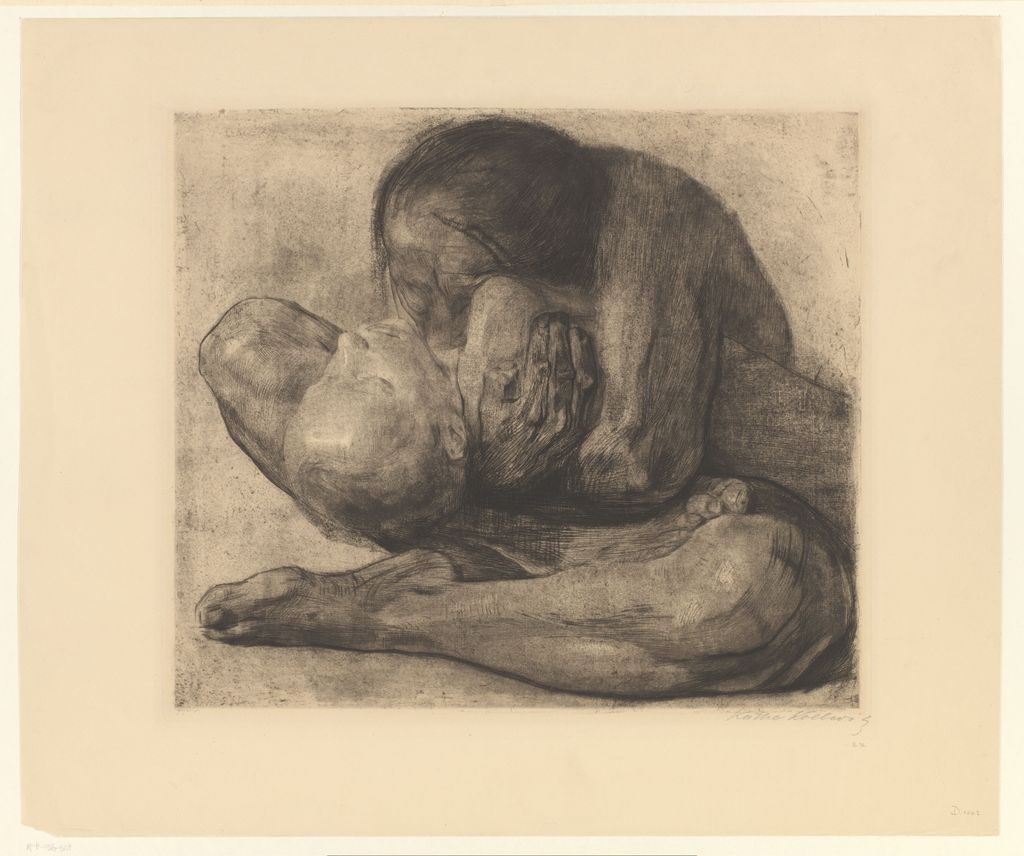
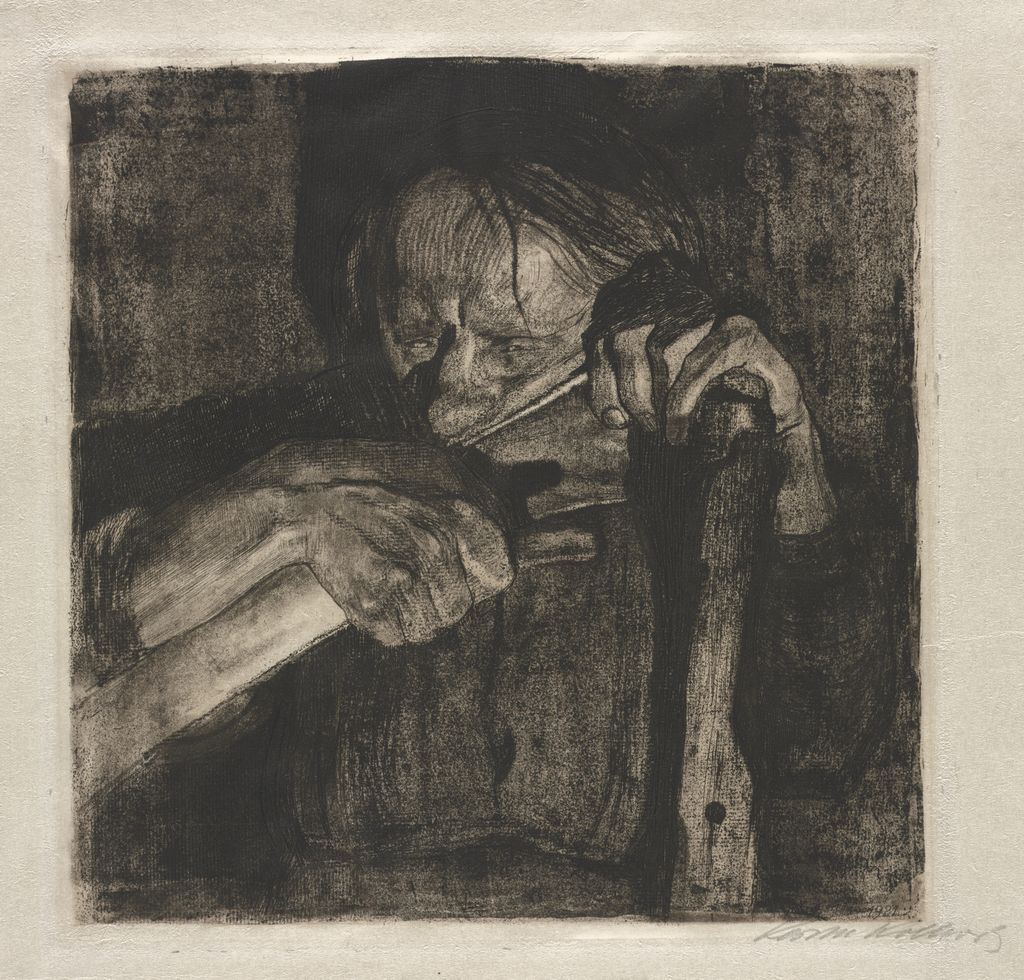
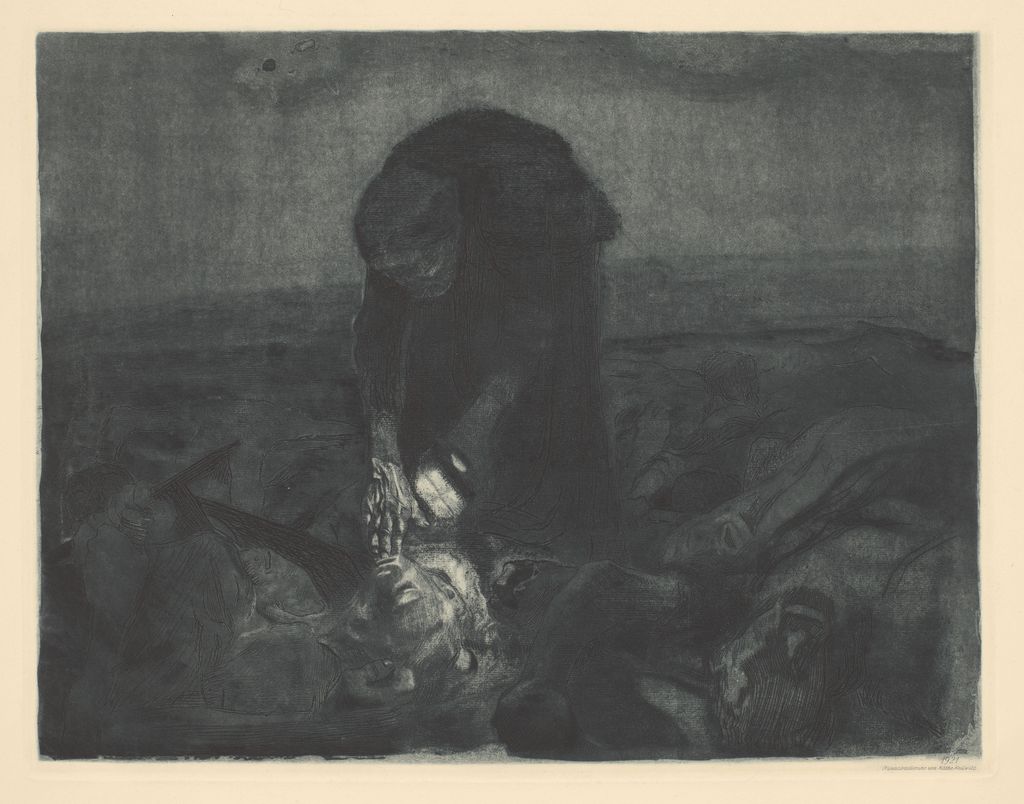
The Mothers
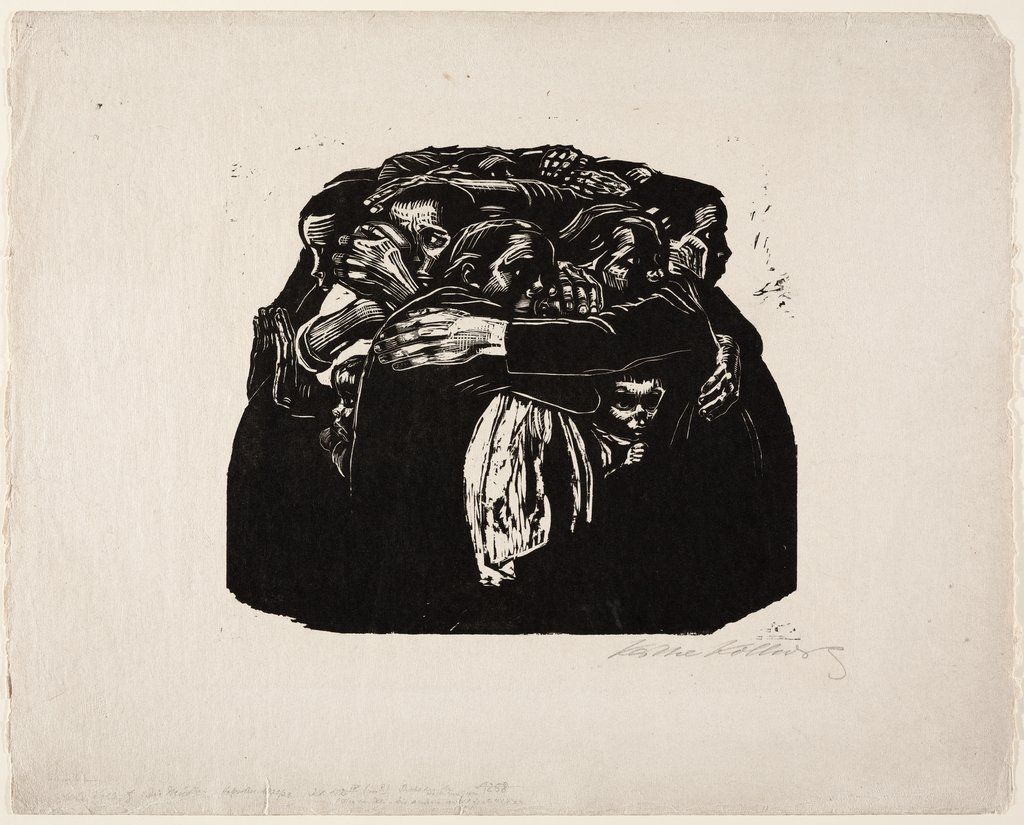
The Mothers, 1921–22. Städel Museum, Frankfurt am Main, SG 4289A D. Image source. Public domain. Resized and exported as JPEG.
The Grieving Parents
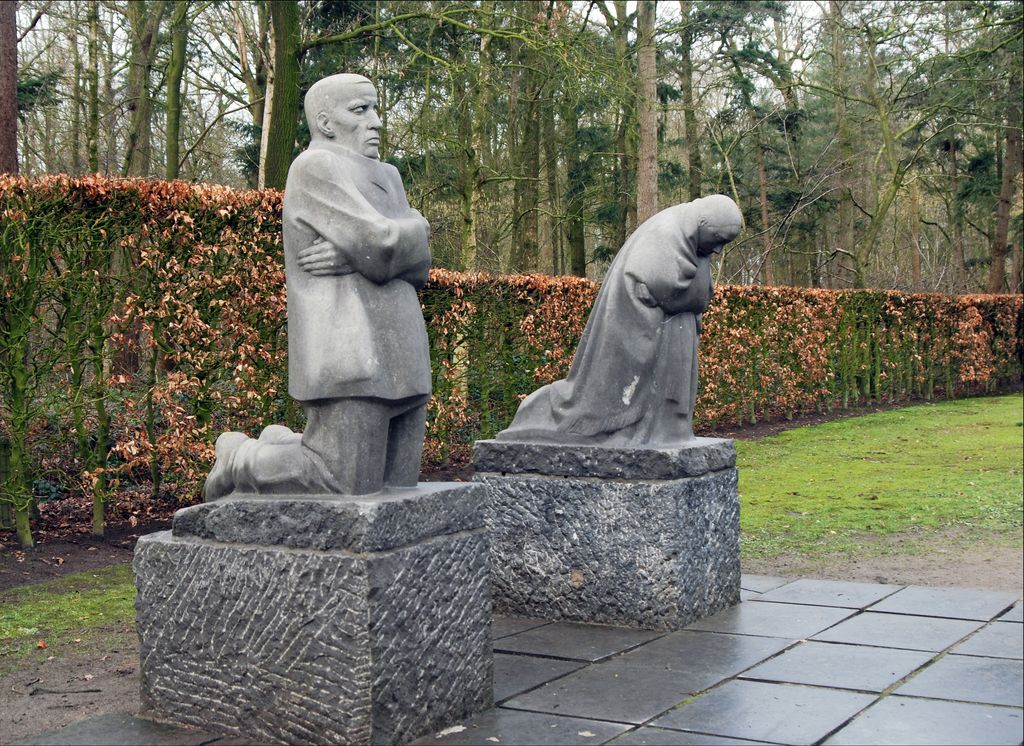
The Grieving Parents at Vladslo, the memorial’s location since 1956. Photograph by Bva, resized. Image source. CC BY-SA 3.0. Resized and exported as JPEG.
Memorial for Karl Liebknecht
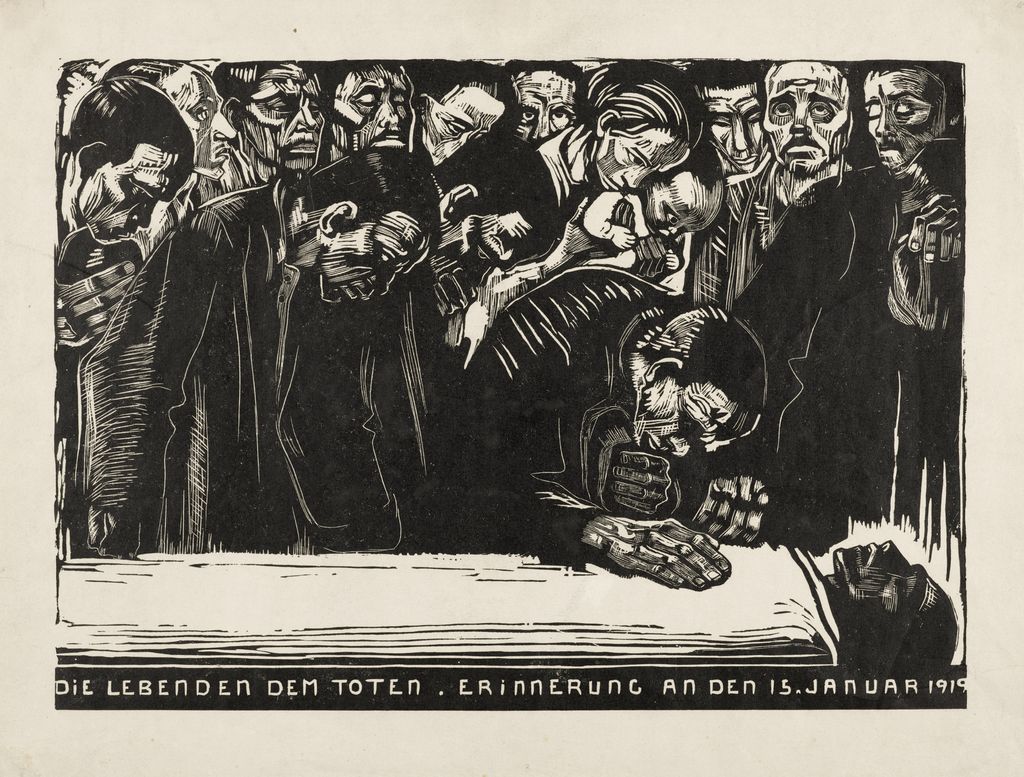
Memorial for Karl Liebknecht, 1920. Kunstsammlungen Chemnitz, 86-47, Kn 159 VI. Photo: Kunstsammlungen Chemnitz/PUNCTUM/Bertram Kober. Image source. Public domain. Resized and exported as JPEG.