


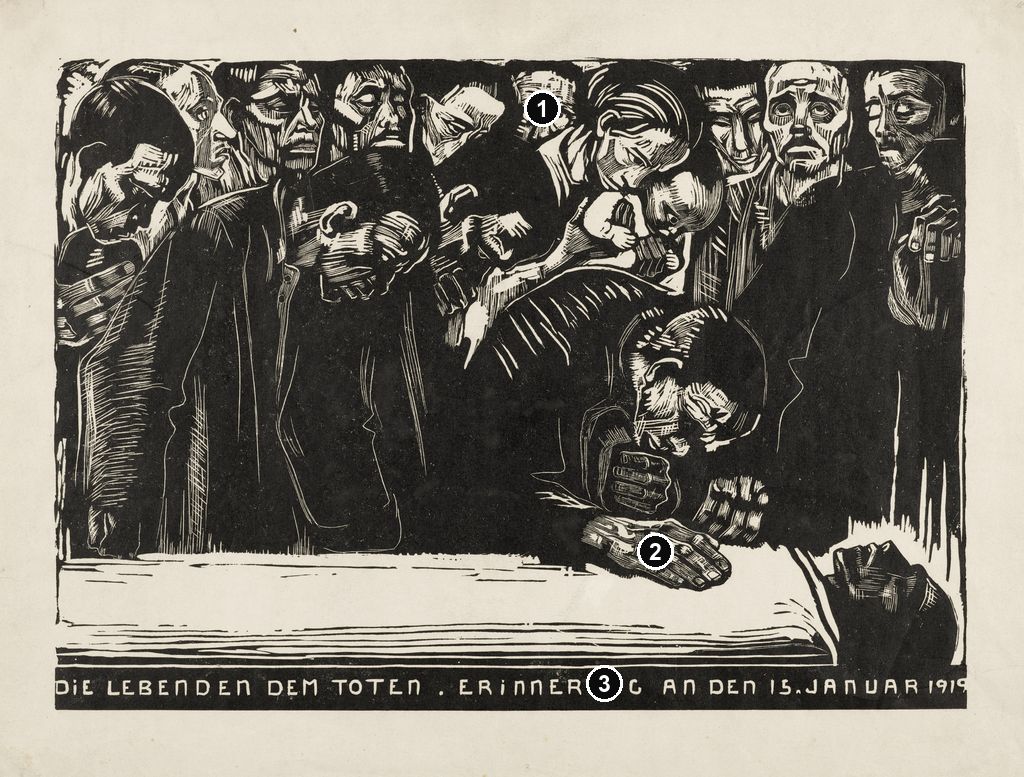
Memorial for Karl Liebknecht, 1920. Kunstsammlungen Chemnitz, 86-47, Kn 159 VI. Photo: Kunstsammlungen Chemnitz/PUNCTUM/Bertram Kober. Image source. Public domain. Resized and exported as JPEG.
 by Tom Gurney
Tom Gurney BSc (Hons) is an art history expert with over 20 years experience
Email: tomgurney1@gmail.com / Phone: +44 7429 011000
Memorial for Karl Liebknecht: Introduction
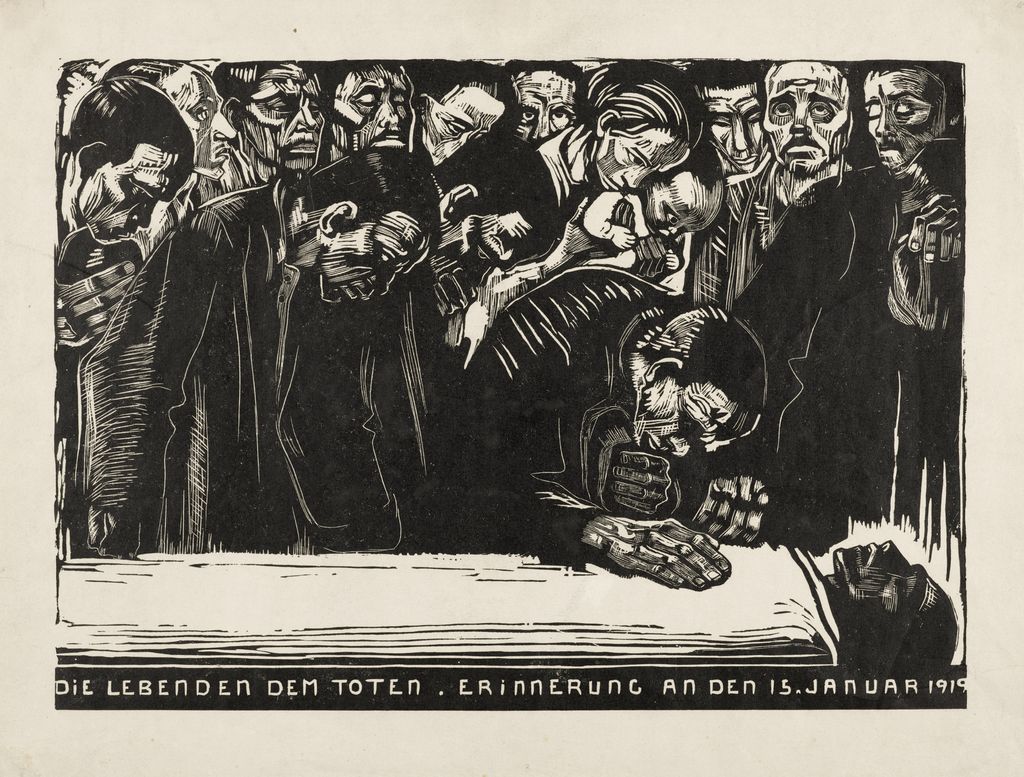
In Käthe Kollwitz’s Memorial for Karl Liebknecht, a man leans over a bier and spreads his fingers on the covering. The people behind him stand so close that their dark coats run together. A forehead, a cheek or the bridge of a nose, picked out in white, is sometimes all that distinguishes one mourner from the next. At the lower edge, the broad, pale covering gives the dead man a stillness that the gathering around him makes more pronounced. [1] [2]
Kollwitz began by drawing the murdered politician in a Berlin mortuary on the morning of his funeral in January 1919. She then worked through a composition drawing, an etching and a transfer lithograph before completing the woodcut in 1920. The surviving sheets preserve decisions that the final print makes look almost inevitable. Kollwitz tried different degrees of separation between the mourners, replaced figures in a drawing and wrote on a lithographic proof about how far a weeping man should bend. The portrait that began with the appearance of one dead man became an account of how people gathered to say goodbye to him. [1] [3] [4] [5]
At a Glance
- Artist and titleKäthe Kollwitz, Memorial for Karl Liebknecht (Gedenkblatt für Karl Liebknecht).
- Date and mediumWoodcut completed in 1920, Knesebeck 159, following two distinct printed designs from 1919, the etching Kn 145 and the transfer lithograph Kn 146. [1] [5]
- SubjectWorkers mourn Karl Liebknecht, a leader of the newly founded Communist Party of Germany (KPD), murdered in Berlin on 15 January 1919. [1] [6]
- Cologne impressionKn 159 VI a, inventory 70300/85024, catalogued at 355 × 500 mm. [1]
- MoMA impressionKn 159 V b, accession 615.1998, from the signed, numbered edition of 100 hand-printed on Japan paper. [2]
This work across Käthe Kollwitz’s career
A Weavers’ Revolt
1893–97The six sheets take a revolt from household distress to collective action and its aftermath. [7]
Separate impressions and hand-worked proofs show how Kollwitz developed the image. [8]
Peasants’ War
1901–08The seven plates combine the revolt with the aftermath in Battlefield and The Prisoners. [9]
War
1921–22, published 1923The woodcuts give sustained attention to the experience of those left behind. [10]
The Grieving Parents
1932 installationTwo kneeling figures face the graves in the memorial’s later location at Vladslo. [11]
Mother with Her Dead Son
1937–39 modelThe small sculpture precedes the 1993 enlargement at the Neue Wache. [13]
Contents
- Berlin, January 1919
- From the mortuary drawings to the trial prints
- The finished woodcut
- Solidarity and political conviction
- An early woodcut and a bridge to War
- Annotated details
Berlin, January 1919
Liebknecht and Rosa Luxemburg were arrested in Wilmersdorf on 15 January, a few days after government forces suppressed the January uprising. Both were taken to the Eden Hotel, headquarters of the Guards Cavalry Rifle Division, and interrogated. Soldiers shot Liebknecht in the nearby Tiergarten. Luxemburg was struck as she was taken from the hotel, shot in a car and thrown into the Landwehr Canal. Her body was recovered at the end of May. Kollwitz’s diary entry for 16 January records her outrage at both murders in a single sentence. [6] [3]
On 25 January, at the request of Liebknecht’s widow, Kollwitz went early to the mortuary. In her diary she described red flowers around his wounded forehead and more flowers on his white shirt. His mouth was slightly open and drawn with pain. She thought his face looked proud and a little surprised. His hands had been placed next to one another in his lap. She took her sketches home and tried to make a drawing that brought her observations together. The description gives colour and expression a prominence they would lose in the woodcut, where a few marks carry the likeness and a much larger area of untouched paper describes the covering. [1] [3] [4]
Other visitors were in the mortuary. Kollwitz remembered an older working-class woman who asked if she could see Liebknecht’s body once more. The request is a small incident in an entry that also follows a mass procession, but it gives a particular meaning to the act of looking. A stranger wanted another moment in the presence of the dead. That desire is legible in the finished woodcut, where the people who have reached the bier bend towards it and those behind them look for a way to see. The diary supplies a context for those gestures without identifying any one figure as the woman Kollwitz met. [1] [3]
Liebknecht was buried that day at Friedrichsfelde with other victims of the uprising. An empty coffin beside his stood for Luxemburg. Kollwitz drew on accounts from people close to her for the procession and burial. Her sister Lise had tried to follow the march and saw how it was diverted from the closed city centre. Her husband Karl saw the procession, and her daughter-in-law Stan went to the cemetery. The diary records the jostling at the grave as well as the shared expression on the faces in the march. Kollwitz objected to the military restrictions. Even between battles, she observed, there was time to bury the dead. By late March, the work she called a funeral observance had gradually become a farewell to Liebknecht. The woodcut gives that public event the dimensions of an encounter at a bier. The march, the burial and the struggles over who could move through the streets belong to the history of Kollwitz’s Berlin. [1] [6] [3]
From the mortuary drawings to the trial prints
The Getty Research Institute holds The Head of Karl Liebknecht on His Deathbed, Nagel/Timm 767, a charcoal and graphite drawing on Japan paper. In the larger composition study Nagel/Timm 773, also at the Getty, Kollwitz had to decide how the head would read within a gathering. The charcoal and graphite drawing is on grey-brown laid paper. She cut into the composition on the right and attached a green-paper fill from behind to revise two figures. There are further sketches on the reverse. MoMA’s 2024 retrospective checklist records the altered drawing at 48 × 63.3 cm and lists it beside the museum’s 1920 woodcut. The two objects bring together a sheet whose physical joins preserve a revision and a finished design in which the boundaries between bodies are deliberately hard to locate. [4] [14]
Other studies let the mourners be examined apart from the bier. Cologne’s Three Men Bending Down, Nagel/Timm 784, is a large black-chalk drawing on blue Ingres laid paper. The shared inclination makes a group, while the different angles of the heads and shoulders give each man a distinct posture. The Berlin Kupferstichkabinett preserves a separate black-chalk study of a single bending man. A change in the pitch of one torso could alter how much space remained for a neighbouring figure or how emphatically a gesture led the eye down to the body. Those adjustments mattered increasingly as Kollwitz compressed the group. [15] [16]
The first printed design, Kn 145, was an etching. The Getty exhibited its second-state impression, the Städel holds a fourth-state impression, and Cologne holds a fifth-state impression. The Städel gives a plate size of 335 × 535 mm and a sheet size of 547 × 718 mm for its own print, SG 4253 D. Etched line defines features and folds, while aquatint, work with sandpaper, lift ground and soft ground supply different kinds of shadow and texture. In Cologne’s fifth state, the soft ground takes the imprint of laid paper. The mourners unfold across the width of the composition, with enough room between their forms for the viewer to register a succession of individual bends and turns. [1] [4] [17] [5]
The group at the right also survives separately as The Four Mourners, Kn 145ter, in Cologne. Its four figures can be read independently of the dead man, through the relations among their bodies. The Getty finding aid documents a different offshoot of the etching, Kn 145bis, and identifies its own impression as a later proof printed by Alexander von der Becke. These objects have distinct catalogue identities. A state of Kn 145 records an alteration in the etched design, while the separate numbers identify related prints that isolate material from it. The group Kollwitz eventually made so compact in the woodcut had already given her several smaller compositions to work with. [1] [4] [17]
The second printed design, Kn 146, is a transfer lithograph from the crayon drawing Nagel/Timm 779. Cologne’s impression, inventory 70300/86032, is catalogued at 420 × 660 mm. The contours have more emphasis than in the etching, and faces emerging behind the front group suggest more people packed into the space. Crayon allows a dark shoulder or head to pass gradually into its neighbour. Kollwitz continued to draw into the printed image. On the Getty’s copy 1 she used charcoal and graphite and wrote that the etching had handled the figure at the left better. She also considered making the weeping man at the right lean farther forward from the upper body. The Getty’s copy 2 carries a different annotation, giving the work the title Farewell to K. Liebknecht. Both impressions belong to the same recorded lithographic state. The additions to copy 1 show what she tested on that particular sheet. [1] [4] [18] [5]
The National Gallery of Art’s Rosenwald impression 1947.12.62 presents a catalogue discrepancy. Its record gives the medium as lithograph and the catalogue number as Klipstein 137. The Städel and Getty associate 137 with the etched design, while the Getty catalogues the transfer lithograph Kn 146 as Klipstein 138. The identification of the Rosenwald sheet within that sequence remains open. [4] [17] [19]
The finished woodcut
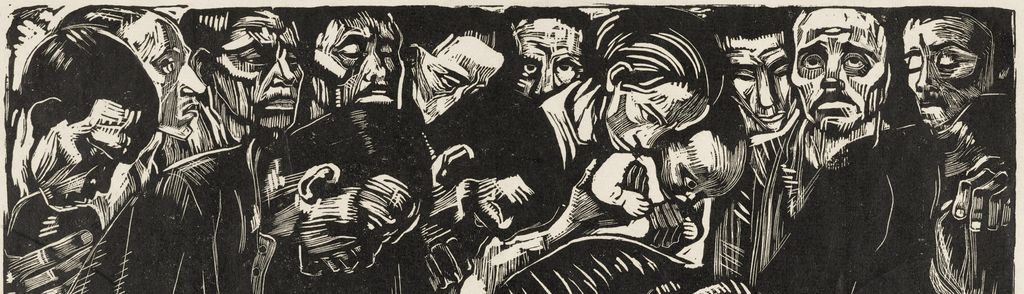
The woodcut makes the mass of clothing do much of the work that tone and modelling did in the earlier versions. In a relief print, the surface left standing takes the ink and the areas cut away leave the paper bare. Kollwitz keeps large stretches of the coats black and uses short incisions to bring individual faces out of that darkness. A pale angle gives a head its turn. A second cut can bring an eye into view beneath a brow. Farther back, features emerge in the narrow spaces left by the heads in front. The viewer can sense people beyond the foremost group without being able to follow the outline of every body. [1] [2] [20]
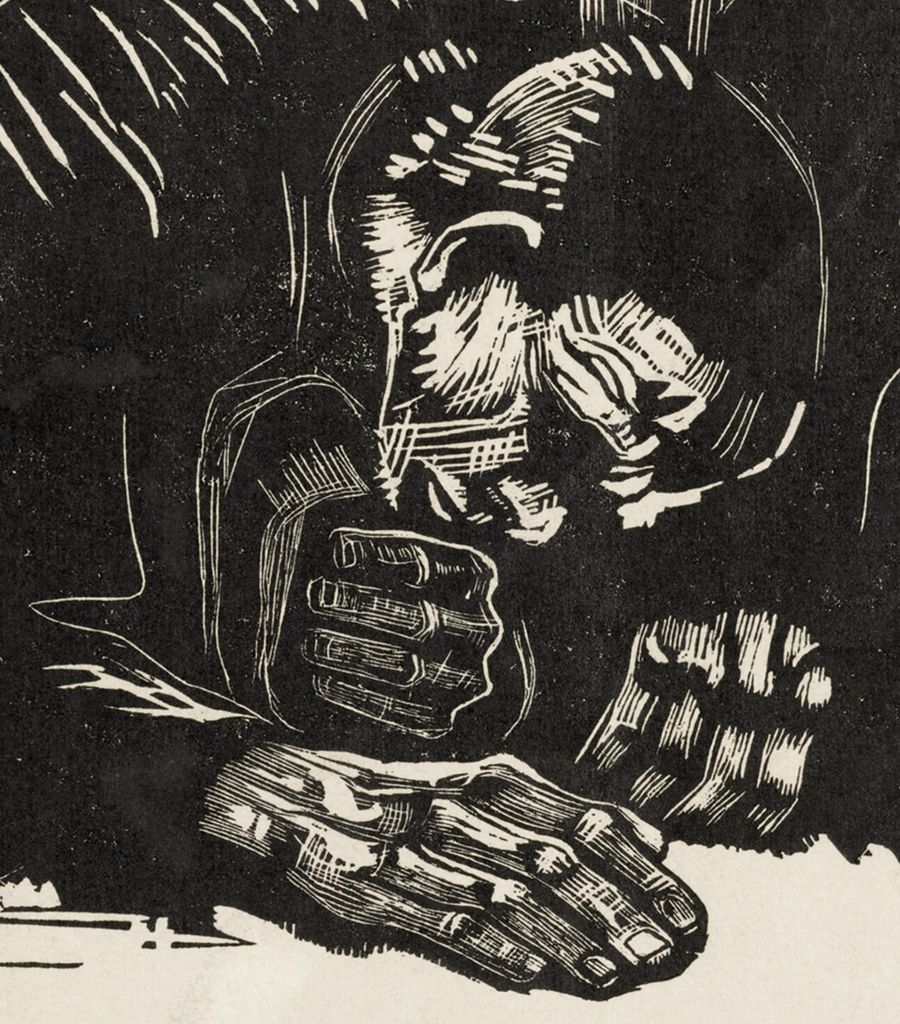
Across the bottom, the pale covering has almost the opposite rhythm. Its breadth makes the eye travel along the body, while the shorter marks above keep changing direction. Liebknecht’s face is low in the composition and modest in scale. There is room to recognise that a particular man lies there, but the broadest light falls on the covering and reaches the figures through the hand that touches it. The foremost mourner’s spread fingers interrupt that pale surface. Elsewhere hands rise towards faces or stay close to the torso. Those differences measure how far each person has come and how much room each has to move. A bend that might have been merely descriptive in a study now brings a man across the dark band of the crowd and into contact with the bier. [1] [2] [20]
The shallow space also determines where a viewer stands. The figures face into the picture from the far side of the body, leaving the near side open. Ann Murray reads that position as a place for another mourner. The covering provides a distance to look across, much as it gives the reaching hand a surface to cross. That reading helps explain how a sheet only about half a metre wide can feel so large. The figures fill the available space, and the point of view brings the viewer close enough to notice the difference between seeing the dead man and touching what covers him. [2] [20]
The arrangement recalls the Christian Lamentation, with the recumbent Christ surrounded by people who lean in to look at or touch him. Murray cites Giotto’s Arena Chapel fresco as an example of the tradition. MoMA reads the association as placing Liebknecht in the role of a martyr. Kollwitz had already explored this form in 1914, when the periodical Kriegszeit asked her to commemorate the Social Democratic lawyer Ludwig Frank. Frank had worked for parliamentary understanding between France and Germany, volunteered at the outbreak of war and was killed on 3 September. Kollwitz abandoned the commission after preparatory drawings and two lithographic designs. Cologne’s Kn 131 I, the rejected second design, is a crayon transfer lithograph with blue-chalk revisions. In the Liebknecht print, the surrounding space visible in the earlier project has contracted, giving the horizontal body and the bends of the mourners much more of the sheet. The precedent shows Kollwitz adapting a compositional problem she had already worked on for a death under very different circumstances. [2] [20] [21]
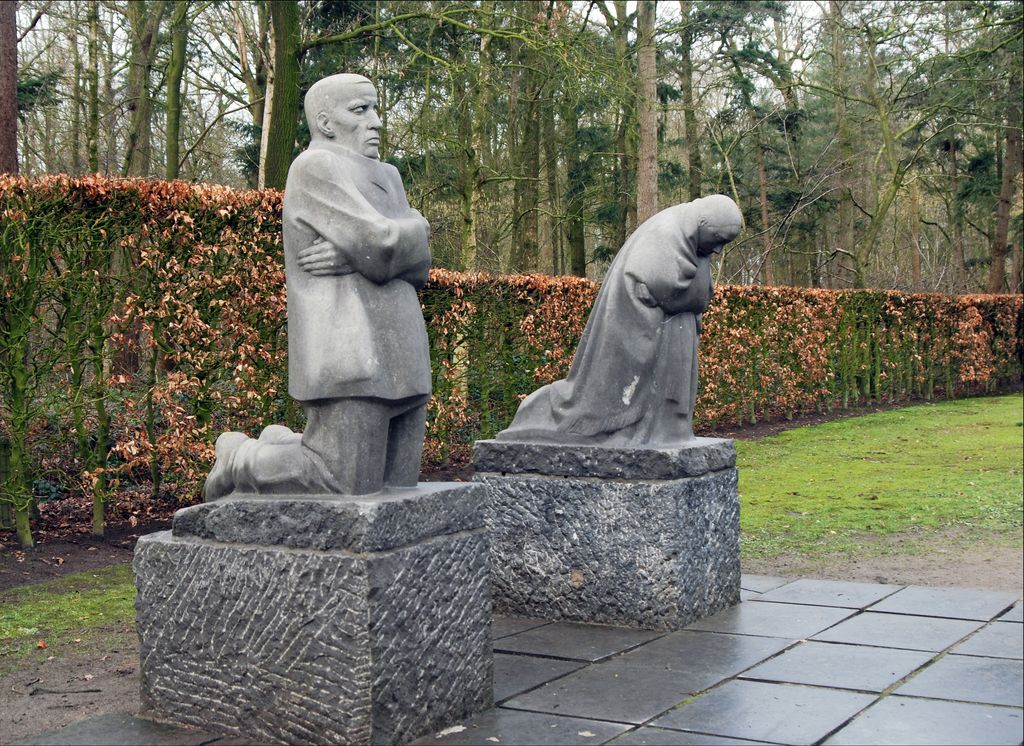
Murray also proposes a possible connection to the Reclining Dead Soldier, a lost plaster model of 1915–16 known from a photograph. Kollwitz made it for an early plan for a memorial to her son Peter, in which the parents would have knelt at the head and feet of the dead soldier. She later withdrew the figure of the son from that design. The granite Grieving Parents installed at Roggeveld in July 1932, and moved to Vladslo in 1956, give the bereaved two separate, substantial figures and leave the space between them open. In the Liebknecht memorial the body remains present and gives the mourners a common direction. Murray’s comparison concerns the abandoned recumbent figure, while the completed stone pair gives a measure of how differently Kollwitz could arrange attention around a loss. [20] [22]
The late Mother with Her Dead Son offers another contrast. In that small Pietà, the mother and son share a silhouette, and she holds him between her knees. The contact that one mourner briefly makes across the bier in the woodcut becomes the structure of the sculpture. Cologne dates the model to 1937–39 and its zinc cast, Seeler 37 I.B.6, to 1941–43. That cast is 386 mm high. The bronze in Berlin’s Neue Wache is Harald Haacke’s roughly fourfold enlargement, installed in 1993. The small sculpture concentrates mourning in the contact between two bodies. The woodcut makes a single touch legible within a gathering. [1] [13]
On lettered impressions, the line below the image gives that gathering an address. The Deutsches Historisches Museum’s LeMO record gr011493, inventory Gr 78/23, preserves the wording Die Lebenden dem Toten. Erinnerung an den 15. Januar 1919, which can be rendered “The living to the dead man. In memory of 15 January 1919.” Princeton’s impression, 2007-2, carries the same dedication. Its first phrase names the people offering the memorial and the person receiving it. The date then attaches the act of mourning to a particular murder. The figures themselves could be recognised as mourners by anyone familiar with the form of a Lamentation. The lettering makes their farewell historically specific. [23] [24]
Annotated Details from Memorial for Karl Liebknecht
The numbered points identify visible features discussed in this article. Return from each detail to the numbered overview. Memorial for Karl Liebknecht, 1920. Kunstsammlungen Chemnitz, 86-47, Kn 159 VI. Photo: Kunstsammlungen Chemnitz/PUNCTUM/Bertram Kober. Image source. Public domain. Resized and exported as JPEG.
Details from MEMORIAL FOR KARL LIEBKNECHT
Compare the cropped details with the source images above. Notice how their colours, shapes and positions contribute to the larger compositions.
Mourners
Close-set heads fill the upper edge. The changes of angle and expression keep the mourners distinct inside the dark mass.
Hand on shroud
The man bows and rests an open hand on the white shroud. His other hand closes against his chest.
Inscription
The lettering names the relationship between the living and the dead and dates the event being commemorated to 15 January 1919.

Solidarity and political conviction
Kollwitz helped initiate and signed a protest against the murders through the League for the Promotion of Humanity. Three days after the diary entry condemning the killings, she voted in the National Assembly election of 19 January, the first in which German women could vote. She chose the Majority Social Democrats, although she felt her sympathies lay further left. She explained her vote in terms of the party’s principles and recorded her reservations about the candidates. In October 1920 she defended her right as an artist to depict the workers’ farewell, and even to dedicate the print to them, while retaining her political distance from Liebknecht. In a letter of 21 January 1921 to Annie Karbe, she described how his death had first moved her towards him and how reading his letters had changed her estimation of him as a person. [1] [3] [15] [20]
Murray records that the print appeared in Kollwitz’s solo presentation at the third Workers’ Art Exhibition, organised by Ernst Friedrich and opened on 1 October 1920 at Petersburger Straße 39 in Berlin. Gertrude Alexander reviewed the exhibition in the KPD newspaper Die Rote Fahne on 12 October. She criticised Kollwitz’s concentration on poverty and suffering and passed over the memorial. Alexander’s review and Kollwitz’s diary response document a disagreement over what art made for workers could do. Alexander’s judgement concerned the exhibition and the work she discussed there. In her diary Kollwitz drew a line from her experience of war and the death of Peter to the kind of socialism she wanted, one in which people could live without a renewed cycle of violence. Murray reads the print within that anti-militarist development. [20]
The Städel records a different strand of reception. It notes that the print was often read as a declaration of allegiance to Liebknecht’s politics and, after the Second World War, was even treated as a founding work of Socialist Realism. The picture gives a worker’s gesture the prominence that a conventional public memorial might give a leader’s face. That redistribution of attention could support a political reading, while the diary shows how precisely Kollwitz distinguished representing the mourners from endorsing the programme of the man they mourned. [1] [20] [25]
An early woodcut and a bridge to War
The Kollwitz Museum Köln connects the artist’s turn to woodcut with seeing prints by Ernst Barlach at the Free Berlin Secession. It counts the memorial as her second work in the medium, while MoMA’s current gallery text calls it her first. Both place the work at the beginning of her sustained engagement with woodcut. Nathalie Muller, writing for France’s Institut national d’histoire de l’art, situates it in a wider post-war change. Kollwitz moved away from the elaborate intaglio work that had established her reputation and explored sculpture, lithography and woodcut. Muller also draws attention to Kollwitz’s deliberate compression or expansion of space for dramatic effect. The memorial shows how closely that decision could be tied to technique. The etched shadows give the figures room to stand apart. The lithograph starts to pack the heads together. The woodcut allows the front rank to hold as one dark form even where the faces and hands have different directions. Those choices recur across Kollwitz’s prints. [1] [15] [2] [26]
Kollwitz had begun print work on the separate War series in 1918 and was trying lithography for it by 1919. Emil Richter published the seven finished woodcuts as a portfolio in 1923. In The Mothers, sheet six, the rejected etching and transfer lithograph give each woman and child a relatively independent posture. The finished Kn 176 closes the adults into a ring, with children appearing in the gaps. The mothers’ joined dark clothing gives the group a protective outer edge. The mourners in the Liebknecht woodcut make a comparable mass, but their bodies open towards a person laid out before them. In one print the group leaves space to approach the dead. In the other it closes ranks around the living. Kollwitz’s diary identification of herself and her sons belongs specifically to the lithographic work in progress on 6 February 1919. [27] [28]
Exhibitions have made different parts of that history visible. The British Museum placed the memorial beside War in the final section of Portrait of the Artist: Käthe Kollwitz in 2019–20. The Getty’s contemporaneous Prints, Process, Politics displayed the head study, composition drawing, rejected etching and reworked lithograph, followed in its checklist by a fifth-state woodcut. MoMA’s 2024 checklist paired the Getty’s altered composition drawing with its own fifth-state impression. In Berlin, the Kupferstichkabinett included a different final woodcut, 363-1927, in Die gerettete Moderne. Its checklist gives an image measure of 35.6 × 50.1 cm and a sheet measure of 55.6 × 69.9 cm. The exhibition texts place Kollwitz’s politically and socially engaged prints within Willy Kurth’s collecting at the museum and leave open how far he may have protected her work during the 1937 confiscations. The London pairing brought the later portfolio into view, the American displays foregrounded the working process, and the Berlin impression put the memorial within the history of a particular collection. [29] [5] [14] [30]
The Kunstsammlungen Chemnitz impression, inventory 86-47, is a 1920 woodcut of the third and final design, catalogued as Kn 159 VI. The inscription beneath the image ties the mourning scene to 15 January 1919. In the Chemnitz impression it reads as a single line against a dark band, extending nearly the width of the coffin above it. [31]
Käthe Kollwitz artworks directory
Selected documented works, including the complete published sequences of the five cycles discussed here. Catalogue links identify the specific record behind each row.
Frequently Asked Questions
The murder, mortuary visit, funeral and first two printed designs date to 1919. Cologne and MoMA date the final woodcut to 1920. The Getty dates its fifth-state woodcut to between early August and Christmas 1920. The National Gallery of Art dates its Rosenwald woodcut, accession 1943.3.5243, to 1919, and the Deutsches Historisches Museum also gives 1919 in its object record. Princeton uses circa 1919–20. The Städel transcribes a later pencil annotation on one of its impressions that describes the woodcut as begun in 1919 and completed in 1920. On the lettered impressions, 15 January 1919 is the date commemorated in the dedication. [1] [2] [23] [32] [5] [24] [25]
MoMA’s impression, Kn 159 V b, belongs to an edition of 100 numbered, signed copies hand-printed on Japan paper. Its record names Emil Richter of Dresden as publisher and Fritz Voigt of Berlin as printer. MoMA separately records proofs and a machine-printed sixth-state edition of unspecified size with a band of text at the foot. Cologne’s VI a and MoMA’s V b identify two states of the same final woodcut design. Princeton’s VI a and the Städel’s VI a, SG 4254 D, both carry the dedication and have graphite signatures. The Städel describes the inscription as a band attached below the printing block and transcribes a later annotation identifying its sheet as a proof on thick Japan paper. The printed dedication, the pencil signature and the later catalogue annotation belong to different stages in the history of the sheet. [1] [2] [23] [25]
Discussion
Look again at the images and ideas explored in Memorial for Karl Liebknecht. These editorial prompts invite your observations.
Reader Insights
How does the final woodcut change the relationship between the crowd and the body?
How does the inscribed date shape the image’s meaning as a memorial?
How does the date below the shroud guide the viewer’s reading of the crowd?
Join the Conversation
Share a detail, comparison or question about Memorial for Karl Liebknecht below.
References
- Kollwitz Museum Köln, Gedenkblatt für Karl Liebknecht, dritte endgültige Fassung, Kn 159 VI a, inv. 70300/85024. See the October 1920 diary excerpt and Verworfene Fassungen, entries for Kn 145 V, Kn 145ter and Kn 146. German catalogue record View source.
- Museum of Modern Art, In Memoriam Karl Liebknecht, 615.1998, Kn 159 V b, Klipstein 139 III. See Paper, Publisher, Printer, Edition and the 2011 gallery text. German Expressionism catalogue record and current collection entry View source 1. View source 2.
- Käthe Kollwitz, diary entries of 16 and 25 January and late March 1919, and letter to Annie Karbe, 21 January 1921, transcribed by the Kollwitz Museum Köln. Diary and letter excerpts View source.
- Getty Research Institute, Finding Aid for the Dr. Richard A. Simms Collection, 2016.PR.34. See box 9, Kn 145 II, 145bis c and 146, especially p. 75 and its continuation for Kn 146 copy 1 and copy 2. See box 20, NT 767 and 773, for the drawings. Finding aid View source.
- Getty Research Institute, Käthe Kollwitz: Prints, Process, Politics, 2019–20 exhibition checklist, pp. 8–9. See the five Liebknecht entries, from the head study to the woodcut, state V of VI. Exhibition checklist View source.
- Deutsches Historisches Museum, LeMO, Die Ermordung von Rosa Luxemburg und Karl Liebknecht, opening account of the arrests, interrogations and murders. Historical dossier View source.
- Kollwitz Museum Köln, A Weavers’ Revolt, cycle catalogue. View source.
- Museum of Modern Art, Woman with Dead Child, state VIII/X, 1903. View source.
- Kollwitz Museum Köln, Peasants’ War, cycle catalogue. View source.
- Museum of Modern Art, Käthe Kollwitz, 2024 extended gallery labels. View source.
- Flemish Heritage Inventory, Treurend ouderpaar (Vladslo – WOI). View source.
- Kollwitz Museum Köln, Death, series catalogue. View source.
- Kollwitz Museum Köln, Pietà (Mutter mit totem Sohn), Seeler 37 I.B.6, inv. 70100/97007. See the model and cast dates, the diary entry of 22 October 1937 and the account of the 1993 Neue Wache enlargement. Sculpture record View source.
- Museum of Modern Art, Käthe Kollwitz Exhibition Checklist, 20 March 2024, p. 28. See the Getty’s 1919 composition drawing and MoMA’s 1920 woodcut, with separate composition and sheet measurements for the print. 2024 checklist View source.
- Kollwitz Museum Köln, Zeitstrahl 1919–1926, entries for 1919 and 1920. See the League protest, the diary entry of 19 January 1919, Drei sich niederbeugende Männer, NT 784, inv. 70200/83027, and the entry on Barlach and Kn 159. German chronology View source.
- Staatliche Museen zu Berlin, Kupferstichkabinett, Sich niederbeugender Mann (aus einem Entwurf zum „Gedenkblatt für Karl Liebknecht“), object 3845604. Drawing record View source.
- Städel Museum, Memorial Print for Karl Liebknecht, 1919, rejected first version, Kn 145 IV, SG 4253 D. See the plate and sheet measurements, medium, catalogue numbers and related works. Object record View source.
- Kollwitz Museum Köln, In Memoriam Karl Liebknecht, entry for the rejected second version, Kn 146, inv. 70300/86032, identifying transfer drawing NT 779. English catalogue record View source.
- National Gallery of Art, Memorial to Karl Liebknecht, Rosenwald Collection, 1947.12.62. See Medium and Catalogue Raisonné. Object record View source.
- Ann Murray, “Käthe Kollwitz: Memorialization as Anti-Militarist Weapon,” Arts 9, no. 1 (2020), article 36. See the discussion of the memorial, figs. 2–4 and nn. 25–32. Note 29 cites Gertrude Alexander, “Arbeiter-Kunst-Ausstellung,” Die Rote Fahne, 12 October 1920, p. 5. Notes 29–30 locate Kollwitz’s October diary response in Jutta Bohnke-Kollwitz’s 2012 edition, p. 483. Article and notes View source.
- Kollwitz Museum Köln, Dem Andenken Ludwig Franks, rejected second design, 1914, Kn 131 I, inv. 70300/93006. See the blue-chalk revisions, the Kriegszeit commission and the connection to the Liebknecht composition. German object record View source.
- Kollwitz Museum Köln, Das Mahnmal „Trauernde Eltern“. See the original plan for three figures, the Roggeveld photographs and the record of the 1956 transfer to Vladslo. Memorial dossier View source.
- Princeton University Art Museum, Gedenkblatt für Karl Liebknecht, 2007-2. See Inscription and Reference Numbers, Kn 159 VI a and Klipstein 139 IV a. Object record View source.
- Deutsches Historisches Museum, LeMO, Die Lebenden dem Toten. Erinnerung an den 15. Januar 1919, online record gr011493, inventory Gr 78/23. Lettered woodcut View source.
- Städel Museum, Gedenkblatt für Karl Liebknecht, final woodcut, two impressions. See Über das Werk and Beschriftung for SG 4254 D, Kn 159 VI a, and Nachträgliche Beschriftung and Werkverzeichnis for the second impression, catalogued as Kn 159 VI a or c. SG 4254 D and second impression View source 1. View source 2.
- Nathalie Muller, Käthe Kollwitz (1867–1945) – 2/2, Institut national d’histoire de l’art. See the discussion of spatial compression, post-war techniques and Krieg. French research essay View source.
- Kollwitz Museum Köln, The War Series, 1918–1922/1923. See the chronology of the media, the December 1922 letter to Erna Krüger and the 1923 publication by Emil Richter. Series record View source.
- Kollwitz Museum Köln, The Mothers, sheet six of War, Kn 176 VII b. See the rejected versions Kn 137 III and Kn 140 II and the diary entry of 6 February 1919. Object and studies View source.
- British Museum, Portrait of the Artist: Käthe Kollwitz, 2019–20 exhibition press release, p. 1, final section, Woodcuts, War and Remembrance. Exhibition release View source.
- Staatliche Museen zu Berlin, Kupferstichkabinett, Die gerettete Moderne. Meisterwerke von Kirchner bis Picasso, 2024. See the work list entry 363-1927 and exhibition text §8, Sonderfälle: Kollwitz, Munch und Corinth. Work list and exhibition texts View source 1. View source 2.
- Kunstsammlungen Chemnitz, In Memoriam Karl Liebknecht (third and final version), Kn 159 VI, inv. 86-47. See catalogue number and published image. Object record View source.
- National Gallery of Art, Memorial to Karl Liebknecht, Rosenwald Collection woodcut, 1943.3.5243. See the object date and medium. Object record View source.
More KOLLWITZ Works
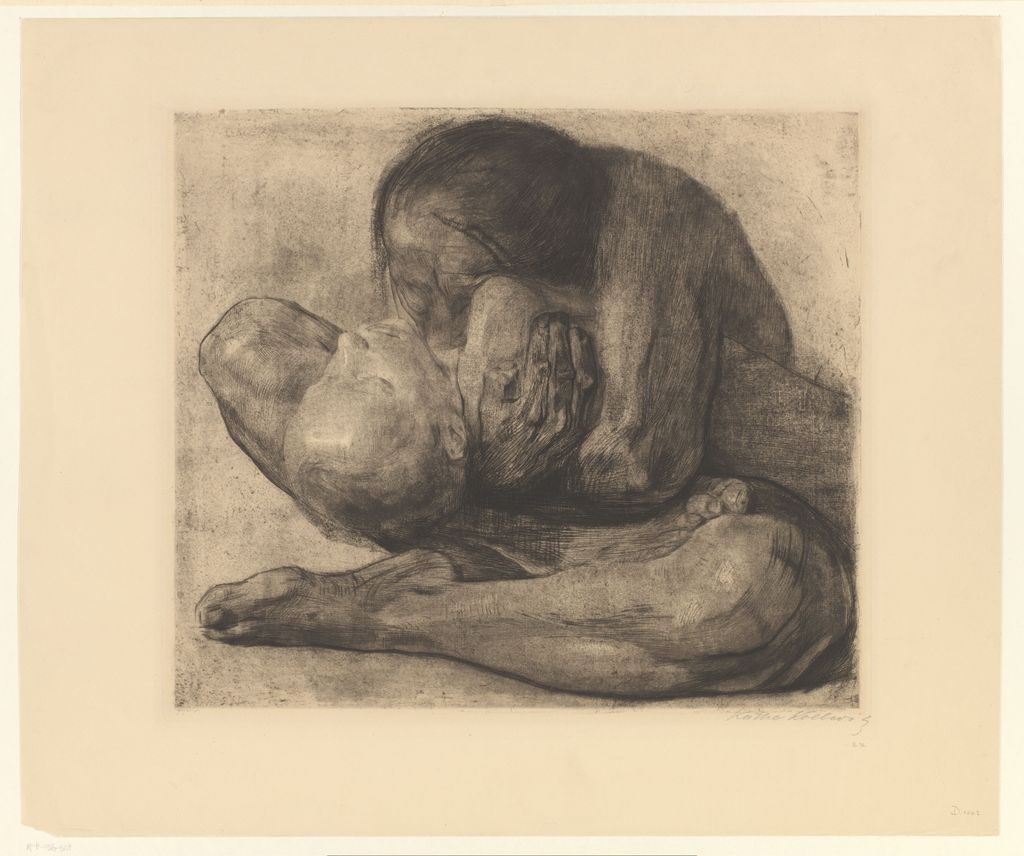
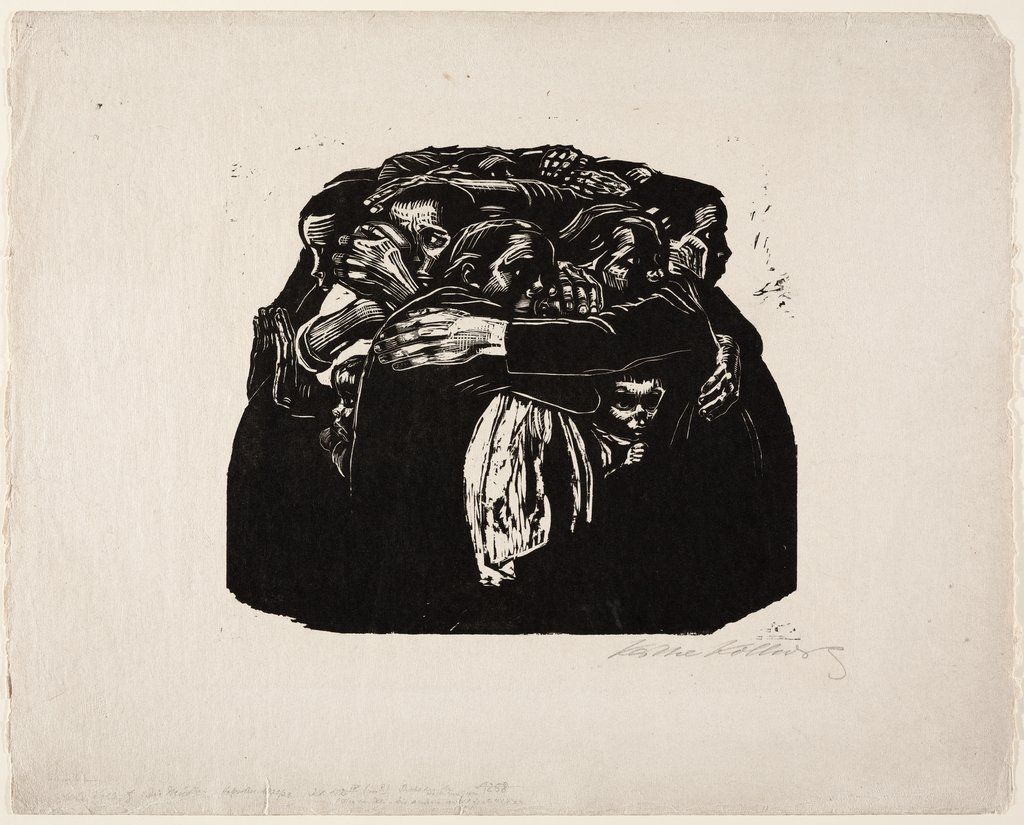
The Mothers
The Mothers, 1921–22. Städel Museum, Frankfurt am Main, SG 4289A D. Image source. Public domain. Resized and exported as JPEG.
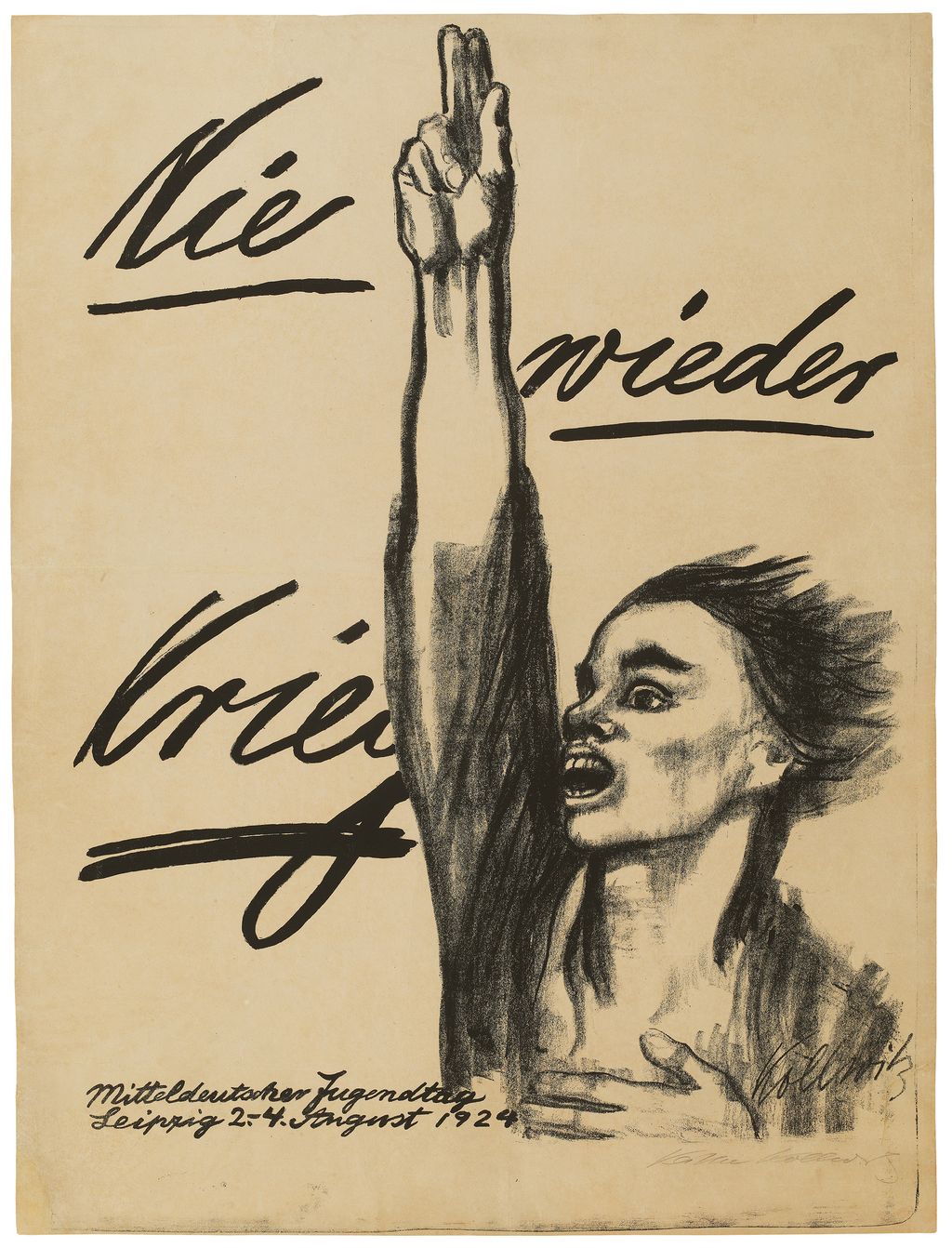
The Grieving Parents
The Grieving Parents at Vladslo, the memorial’s location since 1956. Photograph by Bva, resized. Image source. CC BY-SA 3.0. Resized and exported as JPEG.
Memorial for Karl Liebknecht
Memorial for Karl Liebknecht, 1920. Kunstsammlungen Chemnitz, 86-47, Kn 159 VI. Photo: Kunstsammlungen Chemnitz/PUNCTUM/Bertram Kober. Image source. Public domain. Resized and exported as JPEG.