


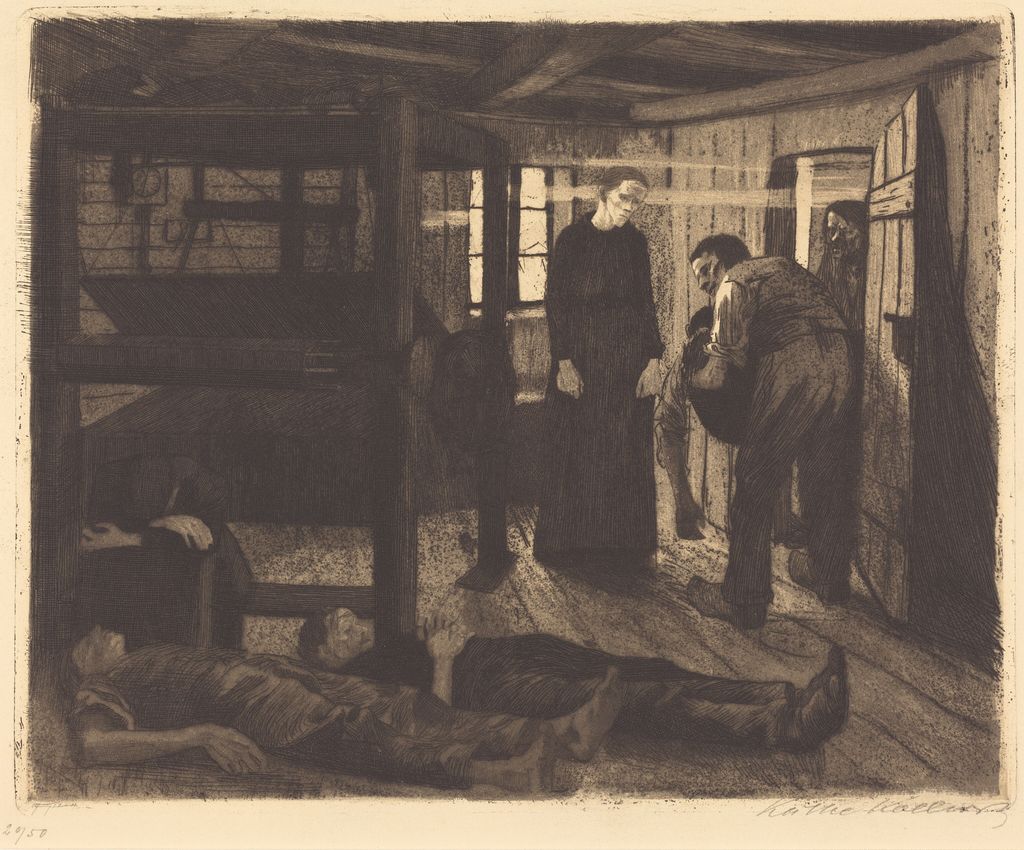
Käthe Kollwitz, The End, 1897. National Gallery of Art, 1943.3.5307. National Gallery of Art, Washington. Image source. Public domain. Resized and exported as JPEG.
 by Tom Gurney
Tom Gurney BSc (Hons) is an art history expert with over 20 years experience
Email: tomgurney1@gmail.com / Phone: +44 7429 011000
A Weavers’ Revolt by Käthe Kollwitz: Introduction
In the first print of Käthe Kollwitz’s A Weavers’ Revolt, a mother bends over a sick child. In the last, men carry a dead worker into a room where a loom still stands. Between those interiors, four men meet in an inn, workers march on their employer’s house, and a woman supplies stones for the attack. Kollwitz gives the assault one sheet. She spends more time showing what makes the workers rise and what the survivors have to do when the revolt is put down. [1] [2] [3] [4]
At a Glance
- Original titleEin Weberaufstand
- Artist and dateKäthe Kollwitz, 1893–97
- FormatSix prints, with three lithographs followed by three etchings
- SubjectA fictional revolt set in Kollwitz’s own time, prompted by Gerhart Hauptmann’s drama about the Silesian weavers’ uprising of 1844
- First exhibitionThe Great Berlin Art Exhibition of 1898, where the jury recommended Kollwitz for a small gold medal and Kaiser Wilhelm II withheld the award [1] [5] [6]
Contents
- From the Silesian uprising to the Berlin stage
- The six prints in order
- The ending Kollwitz set aside
- Berlin, Dresden and the first collectors
- The cycle in Paris, Birmingham and New York
- Annotated details
The series in published order
1. Need
Not. Cologne example Kn 33 A III a, 70300/84005.
2. Death
Tod. Cologne example Kn 34 A b, 70300/90043.
4. March of the Weavers
Photo: Kunstsammlungen Chemnitz/PUNCTUM/Bertram Kober. Image source.
5. Storming the Gate – Attack
Sturm. Cologne example Kn 37 II a, 70300/84003.
From the Silesian uprising to the Berlin stage
In June 1844, Silesian weavers rose against employers who exploited their labour. Troops suppressed the uprising. Gerhart Hauptmann made those events the basis of The Weavers (Die Weber), published in 1892. His five-act drama moves between workers’ households, an inn and a manufacturer’s home. People on different sides of the dispute get to speak in settings they know intimately. By the time the manufacturer Dreißiger hears the crowd outside his house, the audience has already spent time among people struggling to live on what he pays them. [7] [8] [9]
Hauptmann first wrote the play in Silesian dialect as De Waber. The authorities refused permission to stage it publicly and also banned the revised version. Kollwitz saw the private première on 26 February 1893 at Berlin’s Neues Theater, given for members of the Freie Bühne theatre society. In October 1893 a Prussian administrative court lifted the prohibition for Berlin’s Deutsches Theater, where the first public performance took place on 25 September 1894. In her 1941 recollections Kollwitz described the private performance as a turning point in her career. She had begun the cycle more than a year before the play reached the public Berlin stage. [1] [7] [10] [5]
Kollwitz brought the uprising into the late nineteenth century. The workers wear clothes that became common after mid-century, a change a Berlin viewer could register before attending to anything else in the scene. Famine among Silesian weavers in 1891–92 had drawn sustained press attention across the German Empire. The dress brought that recent crisis into view. In Need, the loom and the sickbed occupy the same room, giving the question of what the weavers earn an immediate consequence for the people who live where they work. [1] [2]
The unfinished Germinal project
Kollwitz was already working on a series drawn from Émile Zola’s 1885 novel Germinal, about a French mining community. Three etchings survive from the project, two versions of a conspiracy scene and a tavern fight. For the fight she drew on studies made in a sailors’ tavern in Königsberg. Cologne’s impression, Kn 19 III b, is more than twice as wide as it is high. That breadth gives the quarrel between two men, with Catherine at its centre, room to play out in front of the other people in the tavern. [5] [11]
After the première Kollwitz set Germinal aside. The move from a French novel to a German play changed the setting and occupation of her protagonists, while leaving her with a question she had already begun to explore in the earlier conspiracy designs. How much of a collective conflict can be shown through a few people in a room? In the wide tavern fight, the eye can travel across the space around the quarrel. In the narrow Conspiracy, the four weavers and their table take up nearly all the attention. The shift makes the effort of speaking and listening an event in its own right. [5] [11] [12]
The six prints in order
1. Need (Not)
The child’s pale head draws the eye into an interior whose limits are difficult to make out. The mother bends over the bed with her head in her hands. The child’s face is more exposed than hers. In the shadows behind them, another woman holds an infant who sucks on a finger. That detail gives the eye a second place to stop and brings a second child into the account of hunger. The loom takes longer to discern. Once it comes into view, the sickbed and the mother’s posture belong to a room where the household must earn its living as well as tend its children. [2] [8]
Cologne’s impression, Kn 33 A III a, inventory 70300/84005, is a chalk and pen lithograph worked with a scraper and scraping needle. The first of the six Art Complex Museum impressions exhibited at the Museum of Modern Art in 2024 has a composition only 15.2 centimetres square, printed on chine collé, a thin paper attached to a heavier support. The compact image calls for a close look. By the time the second woman and infant have emerged from the dark, the suffering first registered in a single face has become a condition shared across the room. [2] [13]
2. Death (Tod)
An upturned bowl occupies the table in the second sheet. Death touches the seated woman’s arm and rests its other hand on the bowl. Cologne reads the figure’s approach as gentle, a release from the woman’s suffering. The crockery gives that gesture its cause. A child watches from across the table, while the man in the foreground stands with his back to us, his hands clasped behind him. His position gives us someone to look past. His stillness leaves the encounter between the woman and Death to unfold in its own time. [14] [8]
Kollwitz studied the fall of light in a 1895 drawing of her son Hans with a candle, made in black ink with pen and brush. Cologne identifies it as a detail study for Death and links its dense shadows to the technical difficulty she faced in obtaining comparable darks in intaglio at the time. The finished Cologne impression, Kn 34 A b, inventory 70300/90043, combines chalk, pen and brush lithography with scraping. In the print the light reaches the bowl, the child and Death’s hand. The visible objects and gestures are enough to follow what is happening while much of the room stays in shadow. [5] [14]
3. Conspiracy (Beratung)
Four men meet around a table in an inn. One leans into the conversation and plants a clenched fist on the tabletop. Two sit in the dark, and a fourth listens from the narrow end. The upright format gives their gathering little room to spread. We see enough of the fist and the listening faces to follow the pressure of the exchange. Where the table in Death held the empty bowl, this one bears the weight of a man making his case. The German Beratung also carries the sense of consultation, a useful word for the work the men are doing before a crowd takes to the road. [14] [12] [8]
Cologne holds the finished chalk lithograph with scraping, Kn 35 A II a, inventory 70300/84007, alongside a rejected etched version, Kn 28 V. In her letter to Max Lehrs of 5 July 1898, Kollwitz said that the first three sheets had failed as etchings and that she had reworked them in lithography. The change of medium in the finished sequence coincides with the workers’ move outdoors. Her letter places the origin of that division in the practical work of making the prints. The 2024 MoMA checklist records all three Duxbury lithographs on chine collé, with crayon and scraping needle common to them and additional pen or brush work in the first two. [1] [12] [13] [15]
4. March of the Weavers (Weberzug)
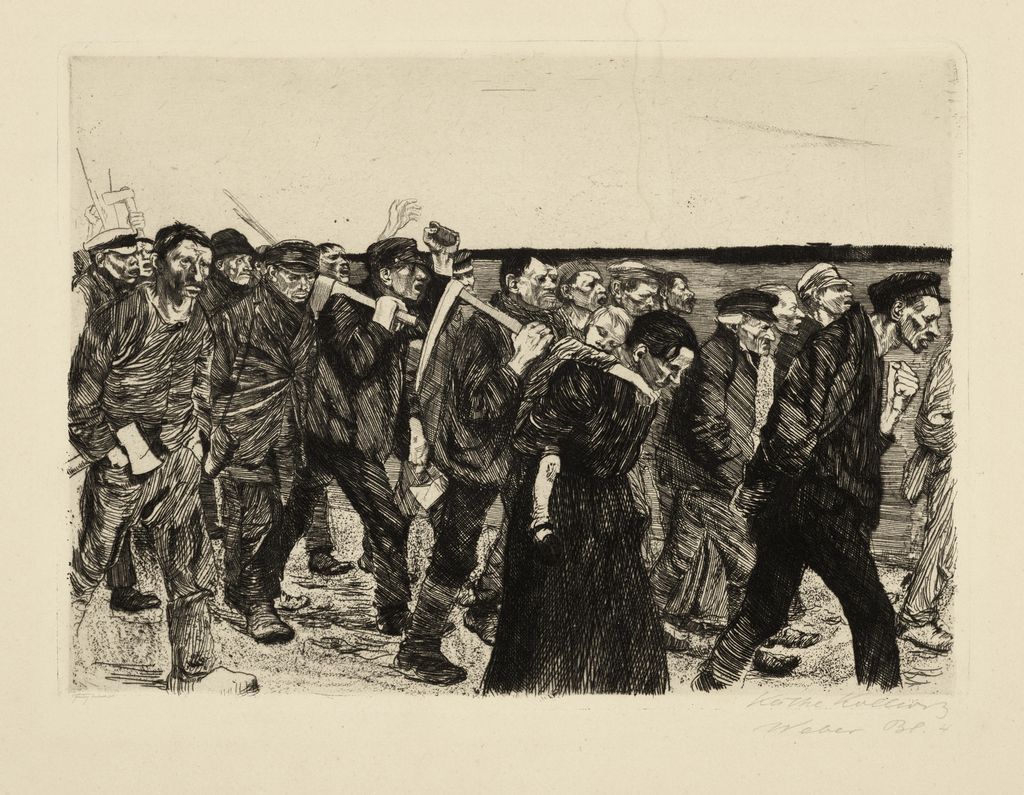
The fourth sheet opens sideways as the workers take to the road. Axes, poles and raised fists break the line of the crowd, while a strong horizontal just above the marchers’ heads makes the open space feel low. The stooping figures carry the exhaustion of the earlier interiors into public view. The woman with a child in the foreground keeps the families of the opening sheets in sight. The crowd has a common direction, yet the etched contours let the eye pause at individual faces and hands before moving on with it. [16] [8]
Cologne’s impression, Kn 36 II a, inventory 70300/84002, is a line etching with sandpaper work. Its preparatory material includes a full-length study of a standing man from 1896, in pen and ink and pencil. MoMA’s Study for Marching Weavers, dated 1896–97 and accessioned as 110.2024, combines charcoal, ink, pencil, watercolour and pastel. The studies show the range of drawing materials behind the finished image. Kollwitz told Lehrs she had no trial impression to send of the march because the first etching had succeeded. Her account of that first bite and the survival of the drawings describe different stages of the same work. [16] [15] [17]
Other impressions give the march a longer history than the design dates alone suggest. The Getty records a Knesebeck IIa impression, also Klipstein Ia, in black ink on copperplate paper, signed by Kollwitz and printer Otto Felsing. MoMA’s impression 223.1997 is Knesebeck IV, one of several impressions of that state, with the total unknown. Its record separates the 1893–97 design from publication around 1931 by Alexander von der Becke and identifies Felsing as printer. The sheet number tells us where the image belongs in the revolt. The state and publication details tell us which object we are looking at. [18] [19]
5. Storming the Gate – Attack (Sturm)
The march meets a wall and an ornate iron gate. Some men swing axes at the gate while others throw cobblestones towards the house. A woman hands up stones, and children are close to the action. In the march, separate gestures were carried in one direction by the crowd. Here the blows, throws and movement of stones send the eye in several directions, all within reach of a barrier that still holds. The house and its elaborate boundary make the employer’s wealth visible from the workers’ side of the gate. Cologne’s impression, Kn 37 II a, inventory 70300/84003, is a line etching with sandpaper work. [16] [3]
In Act IV of The Weavers, the attack is first heard from inside Dreißiger’s house. There are blows against the door, breaking panes and calls for his clerk Pfeifer. After a crash and a cheer, the stage directions call for a pause, then tentative footsteps on the stairs. Young weavers eventually appear in the doorway and begin to explore the rooms. Kollwitz gives the crowd and gate directly to the viewer. The fifth sheet holds us at the moment of assault, where the people passing stones and wielding axes can be seen clearly and the occupants of the house are out of view. [3] [8] [9]
The barrier had its own preparatory drawing. Cologne dates Gateway, in pencil and pen and ink on brown cardboard, to around 1896. MoMA’s 1897 study, accession 111.2024, uses ink, pencil and gouache. Its main composition is about 23 by 31 centimetres within a considerably taller sheet. The Duxbury impression shown at MoMA in 2024 adds another kind of evidence. The checklist identifies opaque white worked directly over that particular line etching. The drawing and the altered impression show two places Kollwitz could make decisions about the image, on a preparatory sheet and on paper that had already been through the press. [3] [13] [20]
6. End (Ende)
In the National Gallery of Art’s Rosenwald Collection impression, start at the doorway. Smoke drifts through the opening as two men bring in another casualty. A standing woman faces the bearers. Farther inside, a second mourner folds into herself beside the bodies. The loom’s straight timbers are easier to follow than the overlapping limbs and clothes beneath them. As the eye adjusts to the darker parts of the room, it becomes clear how much of the aftermath has been gathered into the place where the weavers work. The soldiers’ suppression of the revolt reaches us through the smoke and the arrival of the dead. [4] [21] [8]
The National Gallery dates its impression to 1897 and catalogues it as aquatint, etching and emery stone pencil, accession 1943.3.5307, Klipstein 37, state ii/v. Cologne describes its own impression, inventory 70300/84008, as line etching, aquatint, sandpaper and burnisher, Kn 38 II a. In its 2019–20 exhibition in Strasbourg, the Musée d’Art moderne et contemporain drew attention to the density that aquatint brings to the final scene after the more sharply lit march and assault. The last print returns to the dark interior of the opening sheets with a different means of making darkness. [2] [16] [3] [4] [21] [22]
Kollwitz tried several ways to place the people receiving the dead. The 2024 MoMA exhibition showed a 1897 study lent by Dresden’s Kupferstich-Kabinett, in pencil, black ink and brown wash with white heightening. It is a separate drawing from MoMA’s 1896 charcoal study, accession 109.2024, and from Cologne’s pencil and pen studies on cardboard. In the centre and left margin of the Dresden drawing, the standing woman clasps her hands. In a lower sketch the hands tighten into fists. MoMA’s label follows that gesture into the print and reads it as anger that leaves open the possibility of another uprising. Cologne sees the standing woman as seemingly paralysed by grief. Both readings direct attention to the still figure by the door. Her hands are tense even as she stands and watches the bearers do their work. [4] [13] [23] [24]
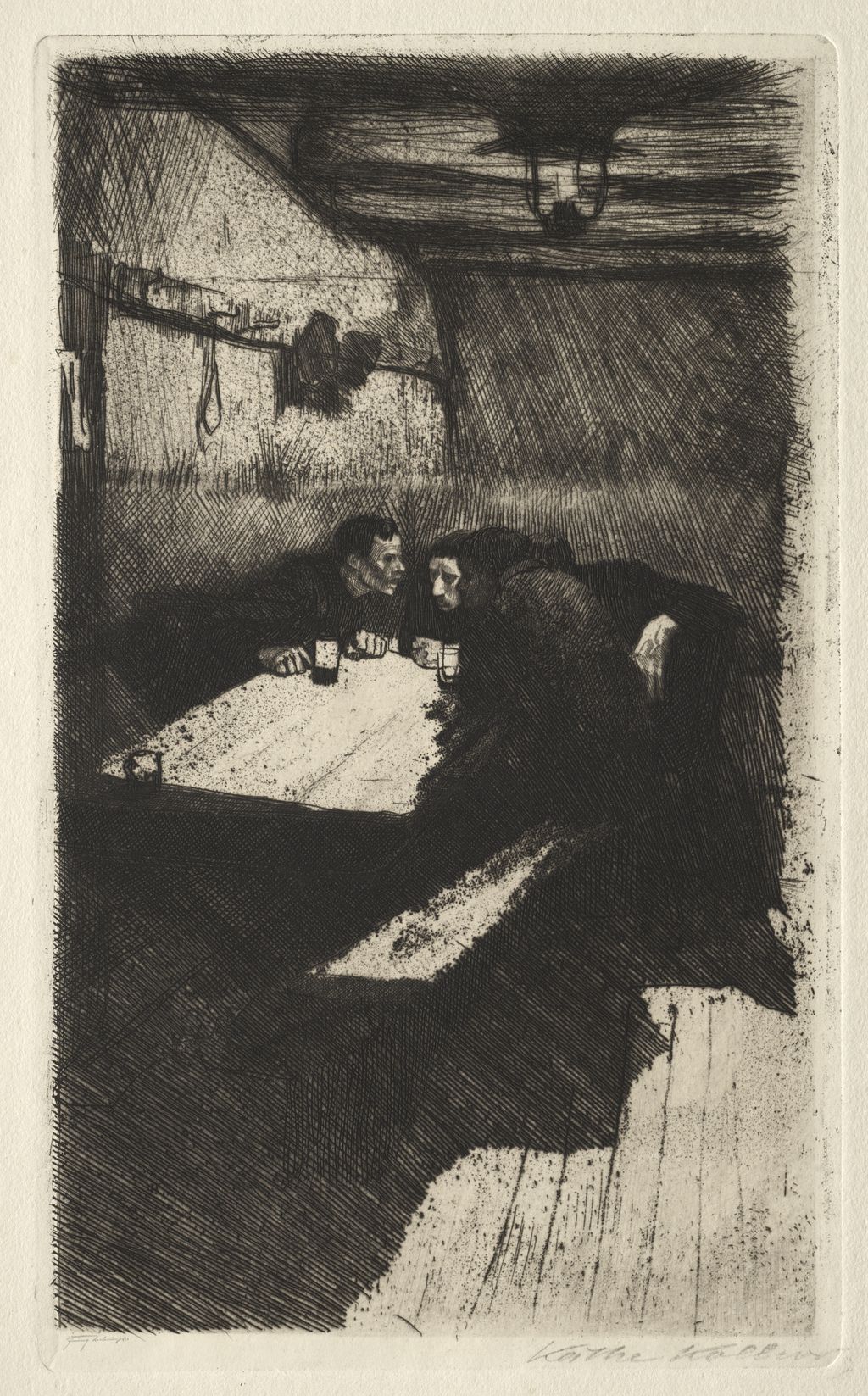
Käthe Kollwitz, Conspiracy, sheet 3 of A Weavers’ Revolt. Cleveland Museum of Art, 1950.204. Image source. CC0 / Public domain. Resized and exported as JPEG.
Käthe Kollwitz, March of Weavers, sheet 4 of A Weavers’ Revolt, Kn 36 II. Kunstsammlungen Chemnitz, 86-50. Photo: Kunstsammlungen Chemnitz/PUNCTUM/Bertram Kober. Image source. Public domain. Resized and exported as JPEG.
Annotated Details from A Weavers’ Revolt
The numbered points identify visible features discussed in this article. Return from each detail to the numbered overview. Käthe Kollwitz, The End, 1897. National Gallery of Art, 1943.3.5307. National Gallery of Art, Washington. Image source. Public domain. Resized and exported as JPEG.
.jpg)
Details from A WEAVERS’ REVOLT
Compare the cropped details with the source images above. Notice how their colours, shapes and positions contribute to the larger compositions.
Loom
The loom fills the left half of the room. Its heavy posts and dark horizontal bars interrupt the view of the people and place the workers’ trade inside the scene of mourning.
 Detail 01 loom.jpg)
Doorway
The doorway frames the arrival of another body. The bent carrier and the standing figure at the threshold draw the eye from the dim interior to the right edge.
 Detail 02 doorway.jpg)
Foreground
The bodies lie almost parallel to the lower edge. The foreground band brings the aftermath of the revolt close to the viewer and slows the movement introduced at the doorway.
 Detail 03 foreground.jpg)
The ending Kollwitz set aside
Kollwitz considered closing the cycle with From Many Wounds You Bleed, Oh People. Cologne’s impression, Kn 32 II c, inventory 70300/85006, combines line etching, drypoint, aquatint and burnisher. Two bound women and a dead man appear alongside a figure who leans on a sword and touches the man’s wound. Cologne sees the figure as an allegorical avenger promising liberation. The museum also traces the print’s visual language to Max Klinger and identifies echoes of Holbein’s Dead Christ in the Tomb and of the bound figures in Crucifixion imagery. The wound becomes the place where the avenger’s promise and the borrowed imagery of suffering meet. [25]
Cologne sets the avenger alongside the criticism of Hauptmann voiced by Kollwitz’s brother Konrad Schmidt. In a review dated 1898 by the museum, Schmidt complained that the play gave its weavers no prospect of revenge, a prospect he found in Germinal. The date makes the review a parallel to the rejected design, which Cologne dates 1893–97. In the finished cycle, any suggestion that the struggle will continue has to be inferred from the survivors themselves. Some of the discarded design’s gestures and figures return in Peasants’ War, where Cologne connects the figure bending towards a body with Battlefield and the bound figures with The Prisoners. [4] [25] [26] [23]
Berlin, Dresden and the first collectors
The Great Berlin Art Exhibition of 1898 brought the six prints before a broad public. Max Liebermann supported Kollwitz on the awards jury, which recommended her for a small gold medal. Wilhelm II withheld it. The cycle remained on view. The award decision belonged to the exhibition, four years after the first public Berlin performance of Hauptmann’s play. In MoMA’s 2024 audio introduction, curator Starr Figura situates the searching gaze of Kollwitz’s self-portrait of around 1900 just after her first professional success. The prints had made her reputation while she was still establishing herself as an artist in Berlin. [1] [5] [6] [27]
The Dresden correspondence brings that success down to the scale of individual sheets. On 8 June 1898, Max Lehrs asked Kollwitz to reserve a set of especially fine impressions for the 1899 Dresden exhibition. He proposed keeping a set for the print room and explained that its budget could not meet exhibition prices. Kollwitz replied on 13 June that she needed to have fresh impressions of the final plate made before she could send a complete set. She proposed 200 marks in place of 400 and invited him to say what the museum could afford. The two letters are preserved as 01/KK 04 Bd. 4, nos. 535–537 and 538–539. [15]
By 24 June Lehrs had the prints. He accepted the price, asked about a second set for the exhibition and requested trial impressions for the collection. On 5 July Kollwitz acknowledged payment and sent two trials as gifts. The archival transcription associates the finished set with Dresden accessions A 1899-156 through A 1899-161 and the two trials with A 1899-165 and A 1899-166. Lehrs admired the way Kollwitz had condensed the spirit of the drama into a handful of scenes. His description of their force as masculine, in the letter and again in his later criticism, shows the terms on which even an early supporter recognised a woman’s achievement. [28] [15]
At the German Art Exhibition in Dresden in 1899, Lehrs and Max Klinger supported Kollwitz. The jury awards notice published on 8 May lists her among the recipients of a silver plaque. Lehrs called the award gold in his 1903 account. The contemporary notice agrees with the Cologne museum’s chronology and supplies the wording for the Dresden distinction, separate from the proposed Berlin medal. In Vienna that same year, the Albertina began its Kollwitz collection with End, acquired at the fifth Vienna Secession exhibition according to Cologne’s chronology. The Albertina records impression DGNF5771 under the Hofbibliothek in its 1899 provenance and identifies it as Klipstein 37 II and Knesebeck 38 II.a. The timeline places these exhibitions and acquisitions alongside Kollwitz’s other work of the period. [5] [6] [28] [29] [30]
The cycle in Paris, Birmingham and New York
Kollwitz exhibited at the Galerie Hessèle in Paris in 1901. Writing about the weavers and Die Carmagnole in the Gazette des beaux-arts, Noël Clément-Janin drew attention to the bite of her etching and her handling of grain and varnish. A decade later, as he took charge of Jacques Doucet’s modern print collection, Lehrs connected Doucet’s library with the Dresden galleries of Ernst Arnold and Emil Richter. The 1911 correspondence preserved at the INHA shows Lehrs offering to select impressions in Germany because they were difficult to find in Paris. His role had widened from securing a set for one print room to helping another collection gain access to Kollwitz’s work. [31]
Later exhibitions have given the sheets different neighbours. The 2017 British Museum and Ikon partnership in Birmingham presented the first and fifth sheets, under the English titles Want and Riot in its press material, within a group devoted to social and political protest. Strasbourg devoted a room to the cycle in its 2019–20 retrospective, drawing attention to the two women confronting death at either end of the sequence. MoMA’s 2024 retrospective, organised by Starr Figura with Maggie Hire, brought all six Duxbury impressions together with studies for the fifth and sixth sheets. Its display let viewers follow the revolt in order and then look again at particular decisions, from the opaque white on the gate print to the standing woman’s hands in the drawing for End. These displays trace different aspects of the relationship between Kollwitz’s prints, her social criticism and the reception of her work. [13] [22] [23] [32] [33]
Käthe Kollwitz artworks directory
Selected documented works, including the complete published sequences of the five cycles discussed here. Catalogue links identify the specific record behind each row.
Frequently Asked Questions
Discussion
Look again at the images and ideas explored in A Weavers’ Revolt by Käthe Kollwitz. These editorial prompts invite your observations.
Reader Insights
What changes when the series moves from indoor scenes to the march?
How does The End change your understanding of the earlier prints?
How does the last sheet change the way you read the earlier meeting and march?
Join the Conversation
Share a detail, comparison or question about A Weavers’ Revolt by Käthe Kollwitz below.
References
- Kollwitz Museum Köln, A Weavers’ Revolt, cycle overview. View source.
- Kollwitz Museum Köln, Need, sheet 1, Kn 33 A III a. View source.
- Kollwitz Museum Köln, Storming the Gate – Attack, sheet 5, Kn 37 II a, and Gateway study. View source.
- Kollwitz Museum Köln, End, sheet 6, Kn 38 II a, and preparatory drawings. View source.
- Kollwitz Museum Köln, Timeline 1891–1900. View source.
- H. Brinkmann, Der Zyklus „Ein Weberaufstand“ von Käthe Kollwitz und seine Rezeption in der deutschen Kunstgeschichte, University Library Heidelberg. View source.
- Universitätsbibliothek Gießen, Die Weber, digitised editions and historical context. View source.
- Kunsthalle Bielefeld, Taking a Stand. Käthe Kollwitz, Mona Hatoum, audio transcripts on the six sheets and Hauptmann’s play. View source.
- Gerhart Hauptmann, De Waber / Die Weber, Act IV. View source.
- Muzeum Miejskie Dom Gerharta Hauptmanna, The Weavers, censorship and staging history, and Gerhart-Hauptmann-Gesellschaft, chronology of Hauptmann’s life and work. View source 1. View source 2.
- Kollwitz Museum Köln, Scene from Germinal, Kn 19. View source.
- Kollwitz Museum Köln, Conspiracy, sheet 3, Kn 35 A II a and rejected design Kn 28 V. View source.
- Museum of Modern Art, Käthe Kollwitz, 2024 exhibition checklist, pp. 2–5. View source.
- Kollwitz Museum Köln, Death, sheet 2, Kn 34 A b. View source.
- Staatliche Kunstsammlungen Dresden, Briefwechsel zwischen Käthe Kollwitz und Max Lehrs, pp. 8–12. View source.
- Kollwitz Museum Köln, March of the Weavers, sheet 4, Kn 36 II a. View source.
- Museum of Modern Art, Study for Marching Weavers, 1896–97, accession 110.2024. View source.
- Getty Research Institute, Richard A. Simms collection finding aid, 2016.PR.34, entry for March of the Weavers. View source.
- Museum of Modern Art, March of the Weavers, 1893–97, published c. 1931, accession 223.1997. View source.
- Museum of Modern Art, Study for Storming the Gate – Attack, 1897, accession 111.2024. View source.
- National Gallery of Art, The End (Ende), 1897, Rosenwald Collection, accession 1943.3.5307. View source.
- Musée d’art moderne et contemporain de Strasbourg, Käthe Kollwitz. Je veux agir dans ce temps, exhibition dossier, room 2. View source.
- Museum of Modern Art, Käthe Kollwitz, 2024 extended gallery labels, label for the Dresden Study for End. View source.
- Museum of Modern Art, Study for End, 1896, accession 109.2024. View source.
- Kollwitz Museum Köln, Aus vielen Wunden blutest du, o Volk, rejected final sheet, Kn 32 II c. View source.
- Kollwitz Museum Köln, The Prisoners, sheet 7 of Peasants’ War, with discussion of the rejected Weavers ending. View source.
- Museum of Modern Art, Starr Figura, Introduction to Käthe Kollwitz, 2024 audio transcript. View source.
- Max Lehrs, Käthe Kollwitz, Die Graphischen Künste, vol. 26, 1903, p. 55, digitised by University Library Heidelberg. View source.
- Deutscher Reichsanzeiger, German Art Exhibition in Dresden, jury awards, 8 May 1899, p. 3302. View source.
- Albertina, Ende, sheet 6, accession DGNF5771. View source.
- Nathalie Muller, Institut national d’histoire de l’art, Käthe Kollwitz (1867–1945), part 2, with early French criticism and the Doucet correspondence. View source.
- Ikon and the British Museum, Portrait of the Artist: Käthe Kollwitz, 2017 Birmingham exhibition materials. View source.
- Museum of Modern Art, Käthe Kollwitz, 31 March–20 July 2024, exhibition overview. View source.
- Kollwitz Museum Köln, Death, late lithograph series. View source.
More KOLLWITZ Works
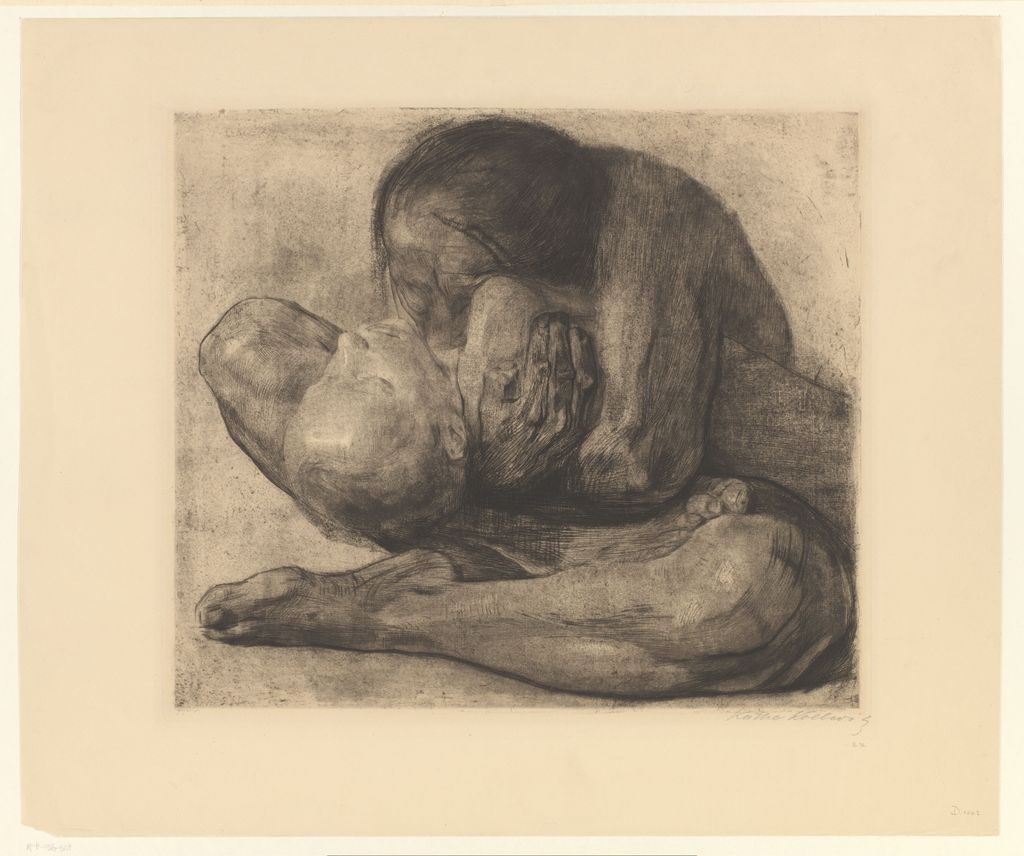
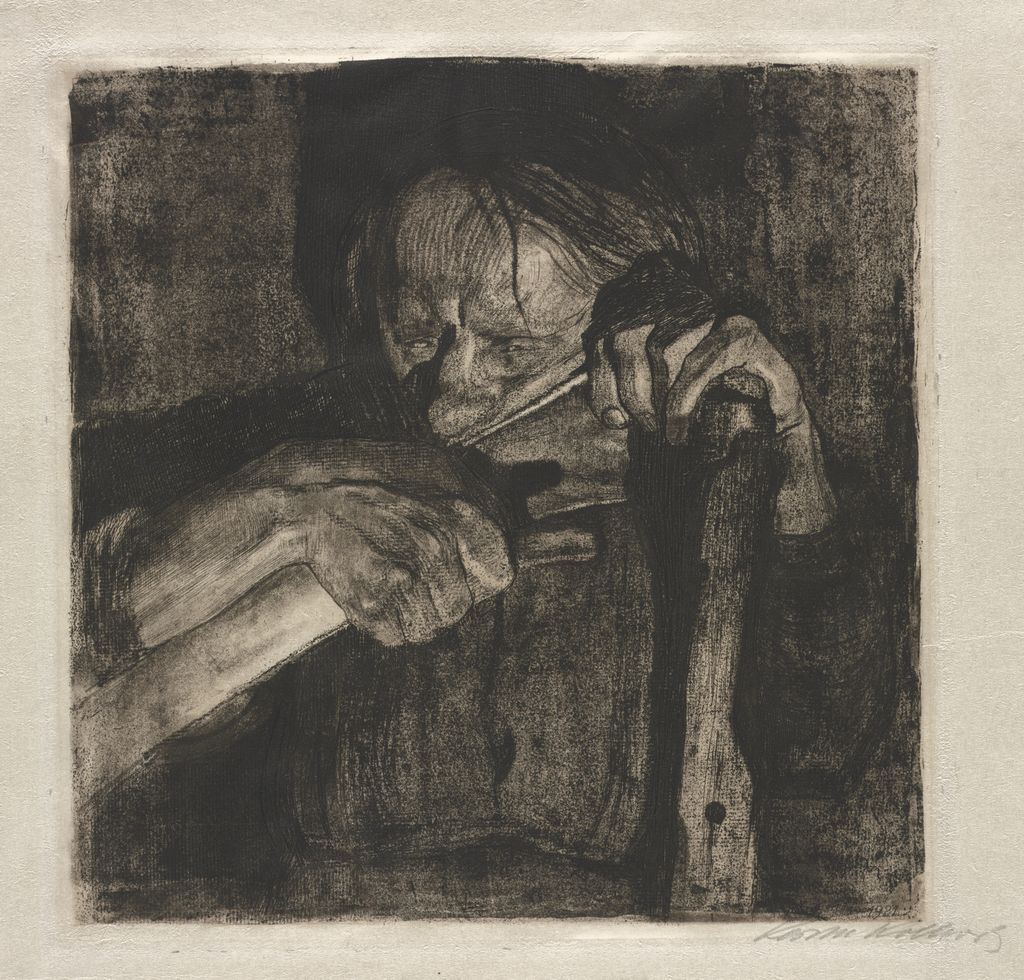
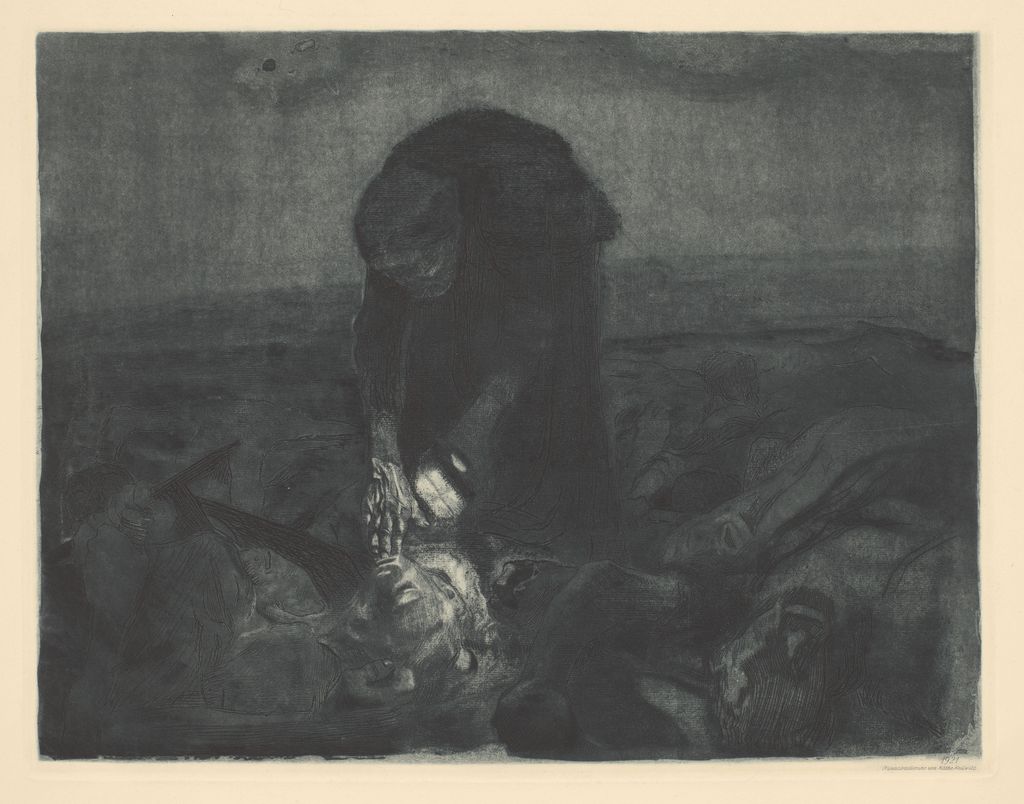
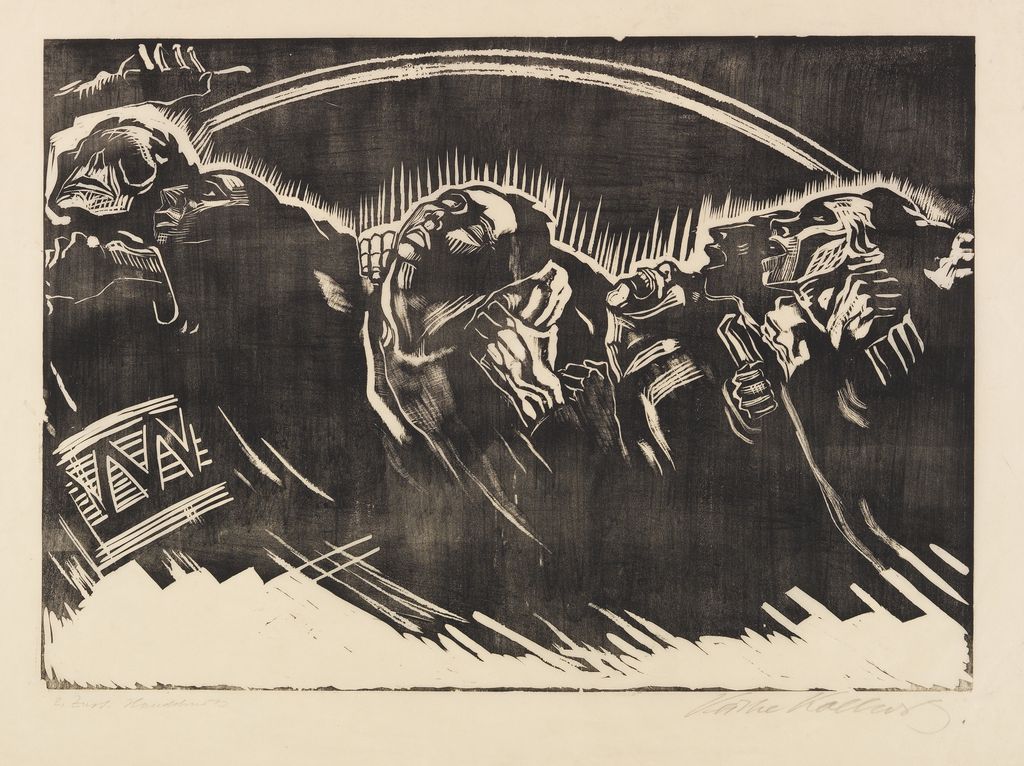
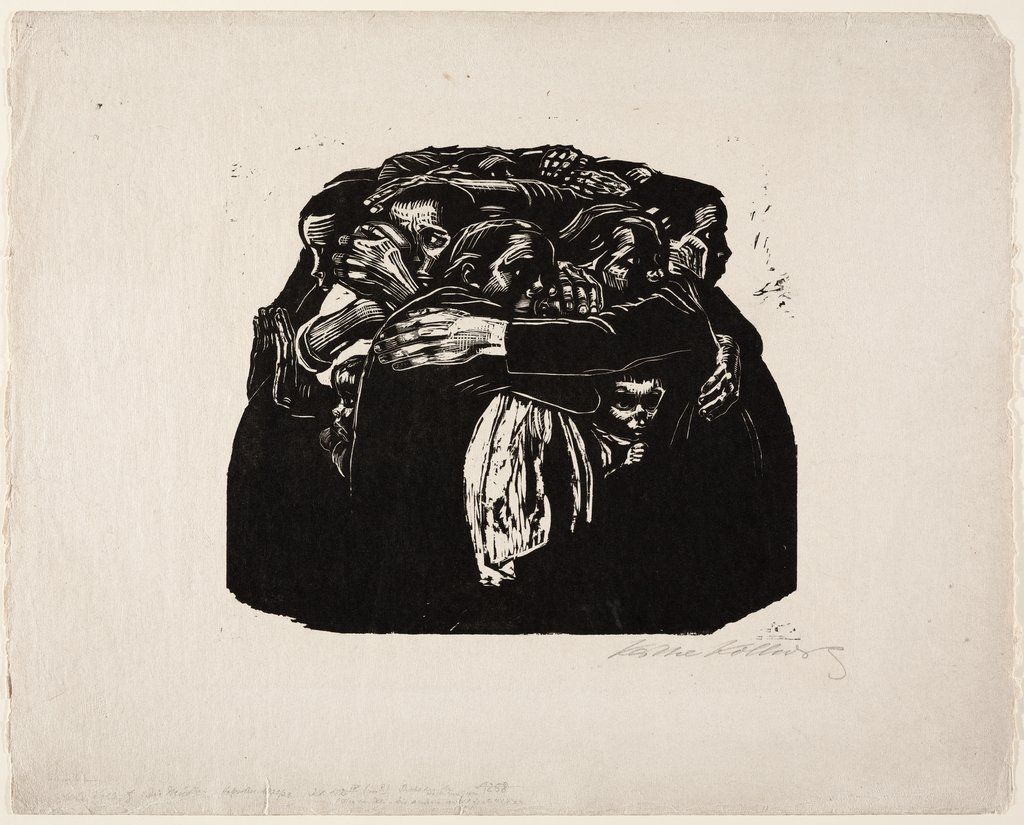
The Mothers
The Mothers, 1921–22. Städel Museum, Frankfurt am Main, SG 4289A D. Image source. Public domain. Resized and exported as JPEG.
The Grieving Parents
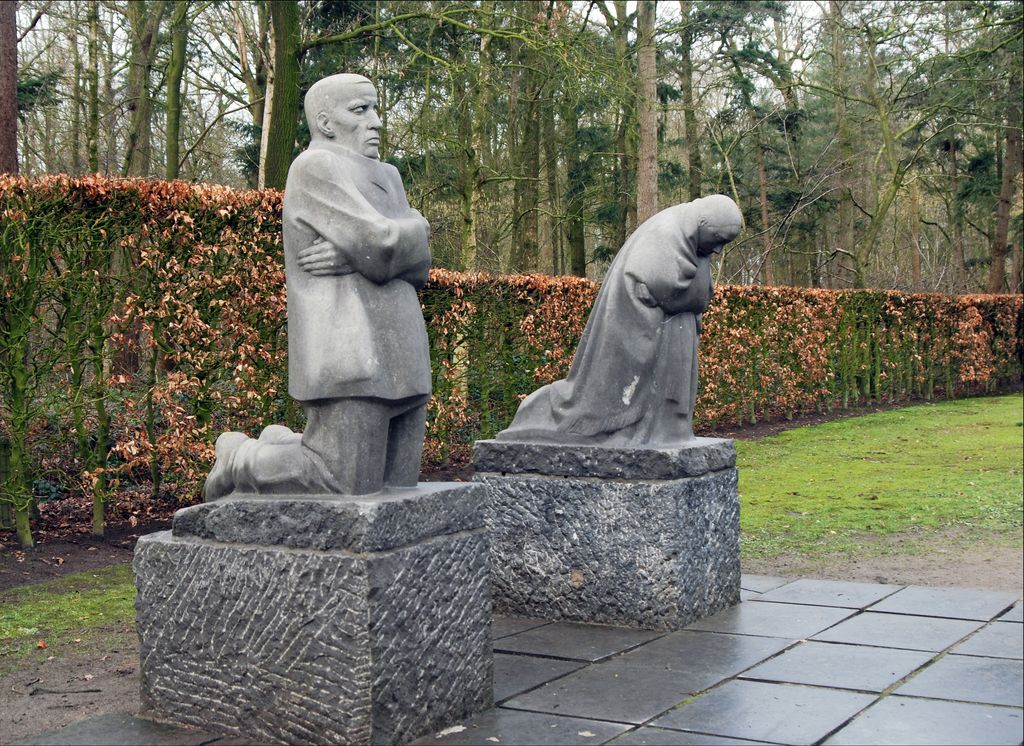
The Grieving Parents at Vladslo, the memorial’s location since 1956. Photograph by Bva, resized. Image source. CC BY-SA 3.0. Resized and exported as JPEG.
Memorial for Karl Liebknecht
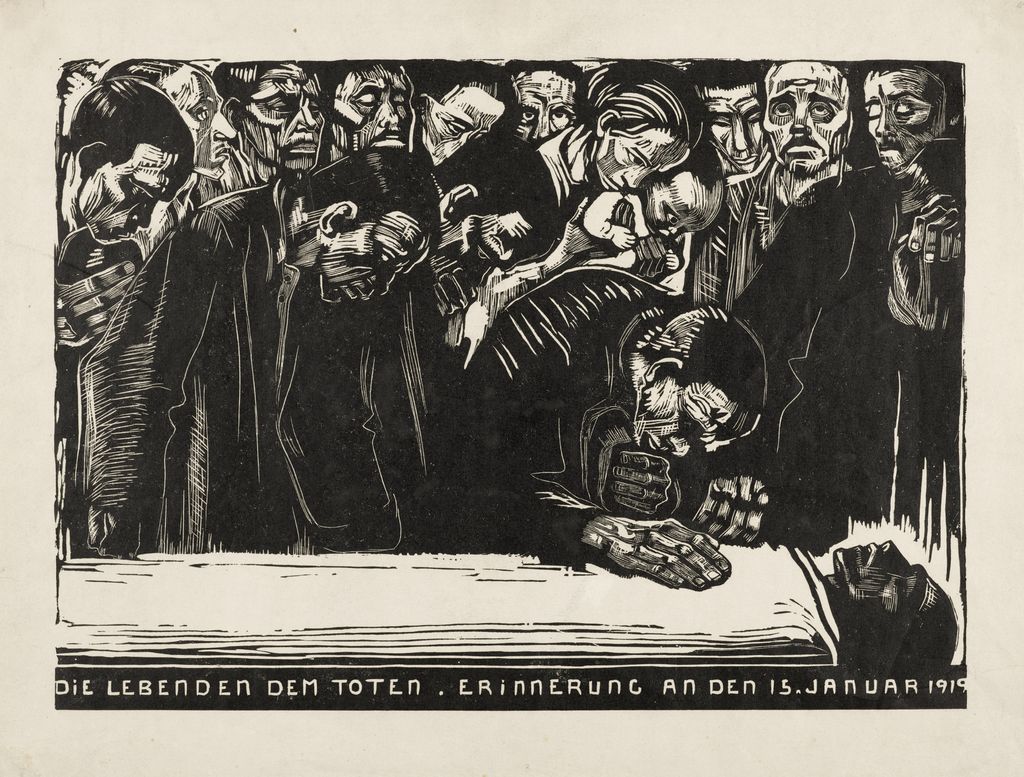
Memorial for Karl Liebknecht, 1920. Kunstsammlungen Chemnitz, 86-47, Kn 159 VI. Photo: Kunstsammlungen Chemnitz/PUNCTUM/Bertram Kober. Image source. Public domain. Resized and exported as JPEG.