


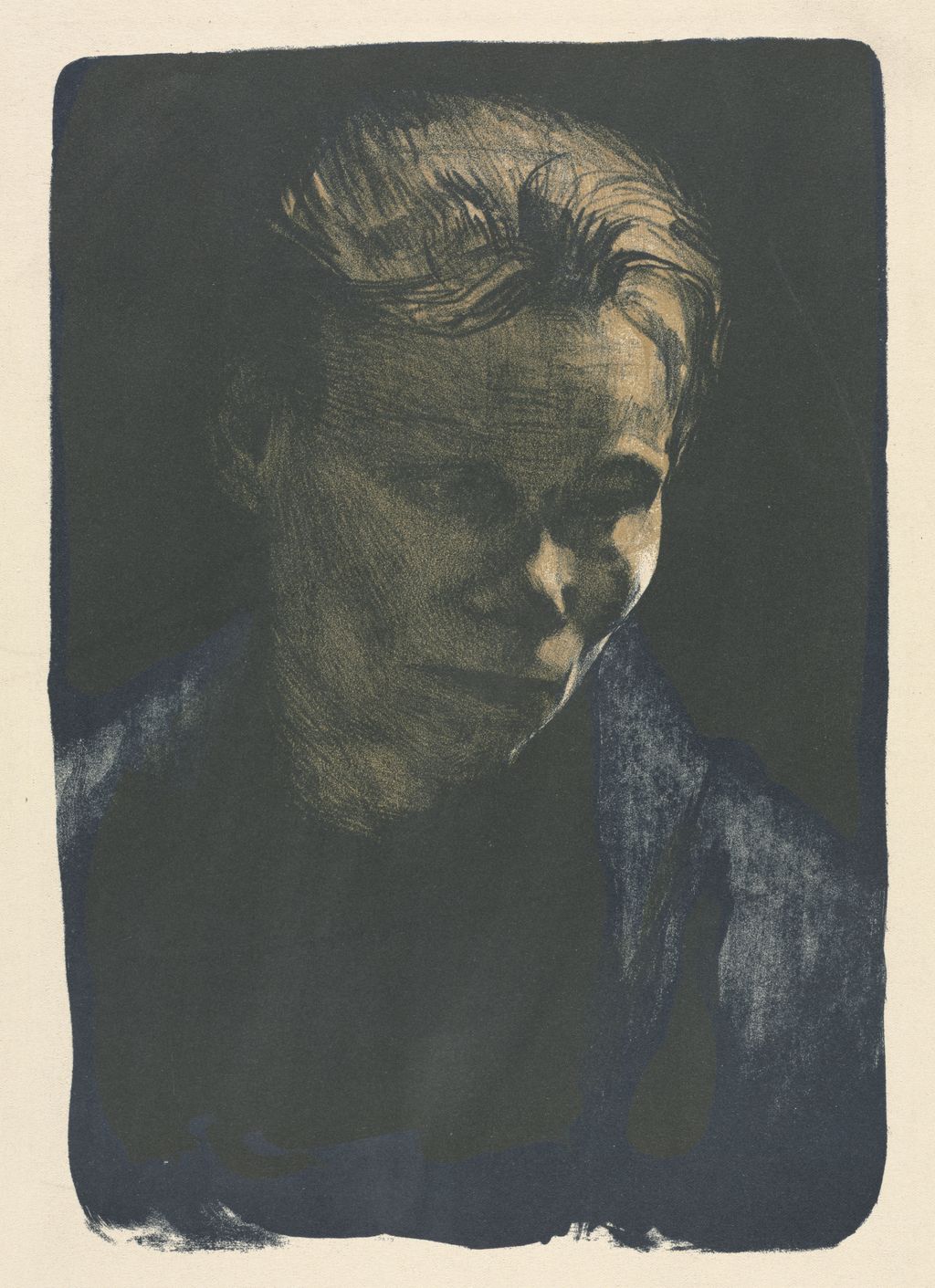
Working Woman with Blue Shawl, 1903. Cleveland Museum of Art, 1932.320. Image source. CC0 / Public domain. Resized and exported as JPEG.
 by Tom Gurney
Tom Gurney BSc (Hons) is an art history expert with over 20 years experience
Email: tomgurney1@gmail.com / Phone: +44 7429 011000
Käthe Kollwitz in Paris: Introduction
Käthe Kollwitz brought a proof of Die Carmagnole (The Carmagnole) to Paris in 1901 and showed it to Théophile-Alexandre Steinlen. She had made the print in Germany, imagining a crowd in revolutionary Paris through a scene probably suggested by Charles Dickens. When she returned in 1904, she worked from what she saw in the city itself. In the mornings she learned to model at the Académie Julian. In the cellars beneath the market halls she drew people adjusting to a low doorway, falling asleep at a table or turning to watch a quarrel. [1] [2] [3]
Between those visits Kollwitz made some of her most sustained experiments with printed colour. A piece of fruit holds the strongest colour in one small print. In another, a face emerges where she scraped away part of a lithographic stone’s printing surface. A blue shawl went through changes of shade and contour before appearing in a portfolio issued in several hundred impressions. The surviving sheets show what she did with the possibilities she encountered in Paris and how much of that work depended on decisions made back in the print workshop. [3] [4] [5] [6]
At a Glance
- 1901Kollwitz visited Paris galleries and exhibitions, saw work by the Nabis and Neo-Impressionists, bought an early Picasso pastel and showed Steinlen a proof of The Carmagnole. [1] [2] [3]
- 1904She spent two months in Paris, attended the sculpture class at the Académie Julian and visited Auguste Rodin in Paris and Meudon. Her drawings from this stay include scenes beneath the market halls. [2] [3] [7]
- Colour printsWoman with an Orange combines copperplate and lithographic printing. Self-Portrait Looking Left uses scraping to open highlights in a printed tone. Bust of a Worker Woman with Blue Shawl was made in 1903 and published in a portfolio in 1906. [4] [5] [6]
- Paris exhibitionsHer work appeared at the Galerie Hessèle in 1901, the Salon des Indépendants in 1905 and the Salon of the Union internationale des beaux-arts et des lettres in 1910. [2] [8] [9]
Contents
- 1901 — Steinlen, the galleries and a proof from Berlin
- Three ways of using printed colour
- 1904 — Modelling at the Académie Julian and visiting Rodin
- Beneath the market halls
- From a colour-lithograph plan to Peasants’ War
- What Paris saw, and what French collections kept
1901 — Steinlen, the galleries and a proof from Berlin
By her first visit to Paris, Kollwitz had completed the six-sheet Ein Weberaufstand (A Weavers’ Revolt) and joined the Berlin Secession. In Paris she reconnected with the painter Maria Slavona, whom she knew from her student years. Through Slavona she had access to a circle that included Camille Pissarro and the critic Julius Meier-Graefe. Cologne’s account credits the dealer and collector Otto Ackermann, Slavona’s husband, with introducing Kollwitz to the galleries. At Ambroise Vollard’s she acquired Picasso’s pastel La bête (The Beast), dated 1900. Her later recollections singled out Édouard Manet and the Impressionists, while the museum’s account also places works by the Nabis and Neo-Impressionists among the art she saw. [1] [2] [3]
The meeting with Steinlen can be tied to a particular work. Kollwitz brought a proof of Die Carmagnole, the large etching she had just completed. The title comes from a revolutionary song and dance. The likely literary prompt was the Carmagnole episode in Dickens’s A Tale of Two Cities, in which the dance turns collective excitement into something frightening. In the print, the guillotine gives the circling crowd a fixed centre. Raised arms and turning bodies carry the dance around it, while grain and shadow make individual figures harder to follow at the edges. The varying legibility is part of the effect. The crowd keeps moving even where the eye can scarcely separate one body from another. [2] [10]
Cologne’s Kn 51 V b combines line etching, drypoint, aquatint or brush etching, and work with sandpaper. The 2024 Museum of Modern Art exhibition put a charcoal Tanz um die Guillotine (Dance around the Guillotine) and an impression of the etching on the same checklist page. The drawing and the print give two ways to follow the organisation of the crowd. Charcoal can establish a mass with a broad stroke. On the copperplate, etched lines, roughened surfaces and bitten tones let Kollwitz build passages in which a gesture is clear and its surroundings are hard to read. The proof she showed Steinlen was already the product of that kind of translation. [10] [11]
Kollwitz’s own account of Steinlen’s appeal came much later. In Erinnerung an Steinlen (Remembering Steinlen), published in January 1924, she located the beauty he saw in working people in their gestures, speech and clothes. Her emphasis was on the pleasure he took in observing the people of Paris in all their variety. That helps explain what she recognised in his work. A figure’s occupation or place in society could register through the way a coat hung or a body occupied a chair, details worth attending to in their own right. In The Carmagnole, too, collective action depends on particular bodies. The larger pattern of the dance is made out of individual turns, steps and raised hands. [2] [10] [12]
Three ways of using printed colour
A fruit against a dark interior
Frau mit Orange (Woman with an Orange, 1901) is only about thirteen centimetres high in the Cologne impression. The woman’s clothing merges with the dark interior, the tabletop runs out of the bottom of the image, and the orange holds the eye near the figure. Cologne compares the composition with Pierre Bonnard’s Le Corsage à carreaux (The Chequered Blouse, 1892), now at the Musée d’Orsay. In both works a slightly elevated viewpoint brings the table up towards the viewer and compresses the space behind it. Bonnard spreads the pattern of the blouse across much of the picture. Kollwitz gives the strongest colour to an object small enough to fit in one hand. The two pictures make different uses of a shallow space and a close crop. [4] [13]
The apparently simple image required two kinds of printing surface. Cologne’s Kn 56 II 2 was made from a copperplate worked with aquatint, reservage and drypoint, and a stone carrying brush lithography. Aquatint gives the plate a way to print areas of tone. Drypoint, scratched directly into the metal, can give a line a softer, ink-rich edge. The stone supplies the orange, and Kollwitz went over this impression with charcoal. The small sheet therefore retains traces of work on metal, stone and paper. When it was shown at the Berlin Secession in November 1901, the combination of processes prompted a controversy in Die Kunst für Alle. The comparison with Bonnard concerns the arrangement of the picture. The Berlin discussion centred on how such a picture could be printed. [1] [4]
A face brought out of darkness
In Selbstbildnis nach links (Self-Portrait Looking Left, 1901), Kollwitz used colour to control the passage from shadow to light. Cologne’s Kn 52 I is a brush and pen lithograph worked with a scraper and a scraping needle on the drawing stone and on the stone that printed brown. By scraping back parts of the brown-printing surface she reduced the ink that would reach selected areas of the paper. The face seems to emerge from within the surrounding tone. Its highlights are the result of taking material away at a stage when she could still determine how the stone would print. [6]
A related problem appears in Arbeiterfrau im Profil nach links (Worker Woman in Profile to the Left, 1903). In Cologne’s final version, Kn 74 III a, the head and hands are suspended against a dark ground and the body disappears into it. The gaps ask the viewer to infer the woman’s posture from a few visible points. A further comparison is Selbstbildnis en face (Self-Portrait, Full Face, c. 1904), which MoMA’s 2024 checklist identifies as a three-colour crayon and pen lithograph. Cologne records that Hermann Birkholz printed that work in Berlin and handled most of Kollwitz’s lithographs, including almost all the colour ones. Paris supplied encounters and examples. The Berlin workshop was where those possibilities had to be realised in ink and on paper. [2] [11] [14]
A blue shawl from proof to portfolio
In Brustbild einer Arbeiterfrau mit blauem Tuch (Bust of a Worker Woman with Blue Shawl, 1903), blue gives the shoulders weight and sets off the pale face. The woman’s gaze falls away from the viewer. There is little to tell us where she sits, so the angle of the head and the darker marks around the eyes and mouth carry much of the expression. The blue also gives the image an outer shape. In Cologne’s working proof, Kn 75 A I 1, the light-brown tone projects above the picture and the blue runs out unevenly to either side. For the edition, Kollwitz regularised those edges and used a different blue. The Gesellschaft für vervielfältigende Kunst issued the print in its 1906 Jahresmappe, or annual portfolio, in several hundred impressions. [5] [15]
Paris preserves a specific example of that circulation. The INHA impression, JAHRESMAPPE 10 (4), is reproduced as catalogue no. 105 in the Fondation Pierre Gianadda exhibition material, which describes it as a two-colour crayon and brush lithograph with scraping on the blue-printing surface. MoMA’s 2024 checklist describes its Minneapolis loan under the same title as printed in three colours. Those descriptions belong to the respective sheets. The INHA also reproduces the recto and verso of a separate print, Arbeiterfrau (Worker Woman), shelfmark EM KOLLWITZ 17. In that case the thin Japanese paper lets the image show through on the reverse. The records give two different reasons to pay attention to the physical sheet, from the way a coloured passage is printed to the way its support transmits light. Such differences run throughout Kollwitz’s prints. [8] [15] [11] [16]
1904 — Modelling at the Académie Julian and visiting Rodin
The second stay had a more regular working routine. Kollwitz spent two months in Paris and used the mornings to learn the fundamentals of modelling in the sculpture class at the private Académie Julian. In her 1941 recollection she described spending afternoons and evenings in museums, around the market halls and in the dance venues of Montmartre. Cologne identifies Raoul Verlet as her probable teacher. The Paris class also has a Berlin context. In 1904 Kollwitz, Sabine Lepsius, Julie Wolfthorn and others petitioned the director Anton von Werner over women’s access to the state art school. Kollwitz had taught at the independent Damenakademie of the Verein Berliner Künstlerinnen. Women remained excluded from fine-art study at the Berlin state institution until 1918. [2] [3] [17]
Hugo von Tschudi, director of Berlin’s Nationalgalerie, wrote the introduction that opened Rodin’s studios to her in Paris and Meudon. Kollwitz later described what stayed with her in Rodin, her 1917 obituary in Sozialistische Monatshefte. She admired his ability to find a form particular to an emotion. Among the examples she recalled were the hands in a group of lovers, Les Bourgeois de Calais (The Burghers of Calais) and a crouching figure. The hands were worth remembering because an emotion could register in the way one person touched another, even within a group whose full action had to be discovered by moving around it. [2] [3] [18]
That observation gives a way to look at Kollwitz’s own Liebesgruppe (Group of Lovers), modelled in 1913–15. The two bodies curl together, and the points of contact make the embrace into a compact volume. From one angle a limb can seem to close the group. From another it helps the eye find where the two bodies separate. Cologne’s sculpture record follows Kollwitz’s treatment of closely related poses across different subjects, including a mother holding a dead child and a personification of death holding a girl. In the lovers the same problem of supporting and enclosing another body has a different emotional meaning. Kollwitz exhibited the final plaster in 1916 at the Berlin Free Secession as Liebespaar (Lovers). The timeline places the Paris lessons well before that exhibition, and her later sculptures show how long she continued to work through the possibilities of a two-figure group. [2] [18] [19]
Beneath the market halls
Kollwitz’s Paris drawings take the viewer into rooms where there is little space to step back. In Caveau des Innocents (1904), coloured chalk on brownish paper, the cross-vaulting and cobbled floor establish the cellar before the people resolve into view. At the right, the low opening forces a man to bend on his way in. The detail gives the viewer a bodily sense of the room’s height. It also gives the architecture something to do. The vault and the doorway determine how someone can move through the picture. Cologne relates the Paris pastels to drawings by Degas and Toulouse-Lautrec and to paintings by Vuillard. Here the off-centre entrance, compressed interior and figures picked out unevenly in the gloom give those comparisons a specific basis. [7]
Pariser Kellerlokal (Parisian Cellar Tavern, 1904) puts the pressure of the room to a different use. A man has got up and comes forward with clenched fists. The man who had fallen asleep over the table lifts his head, while another person turns towards them. Kollwitz catches the moment when the disturbance has reached several people at once, each a fraction of a second apart. The vigorous chalk lines suit that uneven burst of movement. Cologne also preserves the quieter black-chalk study Schlafender Mann am Tisch (Man Asleep at a Table), NT 278a. Seen beside the larger scene, the study shows how a pose of complete inattention could become the starting point of a confrontation. The dealer Wilhelm Uhde recalled in his 1938 memoir that he took Kollwitz and Alexandra Kalmikoff into the cellars. His account explains how she gained access to rooms outside the usual visitor circuit. [20]
In Zwei Männer und ein Liebespaar auf einer Bank (Two Men and a Pair of Lovers on a Bench, 1904), the bench brings four people into close physical proximity. The couple turn towards each other, while one man sleeps and the other drifts into his own thoughts. Graphite, ink and white heightening allow Kollwitz to pick out a posture or a point of contact without describing much of the room. A related graphite drawing is in the National Gallery of Art in Washington as Four People Seated on a Bench. The gallery records that Kollwitz signed and dated that sheet in 1912, later than the date assigned to its making. Together the works show the range of behaviour she found in confined public interiors. The same few feet of bench could hold intimacy, sleep and distraction. [21]
From a colour-lithograph plan to Peasants’ War
Kollwitz initially planned Bauernkrieg (Peasants’ War) as a cycle of colour lithographs. Cologne associates the plan tentatively with the first Paris visit. A surviving proof gives the idea substance. The Getty Research Institute’s rejected Bewaffnung in einem Gewölbe (Arming in a Vault), made before June 1902, is a crayon and brush lithograph on Japanese paper. The drawing stone printed brown and two tone stones printed green and orange. Scraping on the drawing stone let Kollwitz open up parts of the brown. The Getty checklist also records a rejected version of Ploughmen and Woman with a dark-brown drawing and an orange-brown tone. She was testing colour for more than one episode of the projected cycle. [2] [22] [23]
The early Arming in a Vault already has the spiral stair that carries the peasants out of the enclosed space. In the final design Kollwitz reversed the diagonal, so the figures climb from left to right. The curved steps bunch the bodies together before the diagonal carries them towards the exit. Cologne’s 1906 Kn 96 VI is a two-colour impression of plate four, made with line etching, drypoint, aquatint and soft-ground etching with an imprint of Ziegler’s transfer paper. MoMA’s checklist records a separate two-colour impression lent by the Kunstmuseum Basel. The lithographic proof and the two intaglio impressions show both a change in how the marks were made and a continuing use of colour within this particular composition. [24] [23] [11]
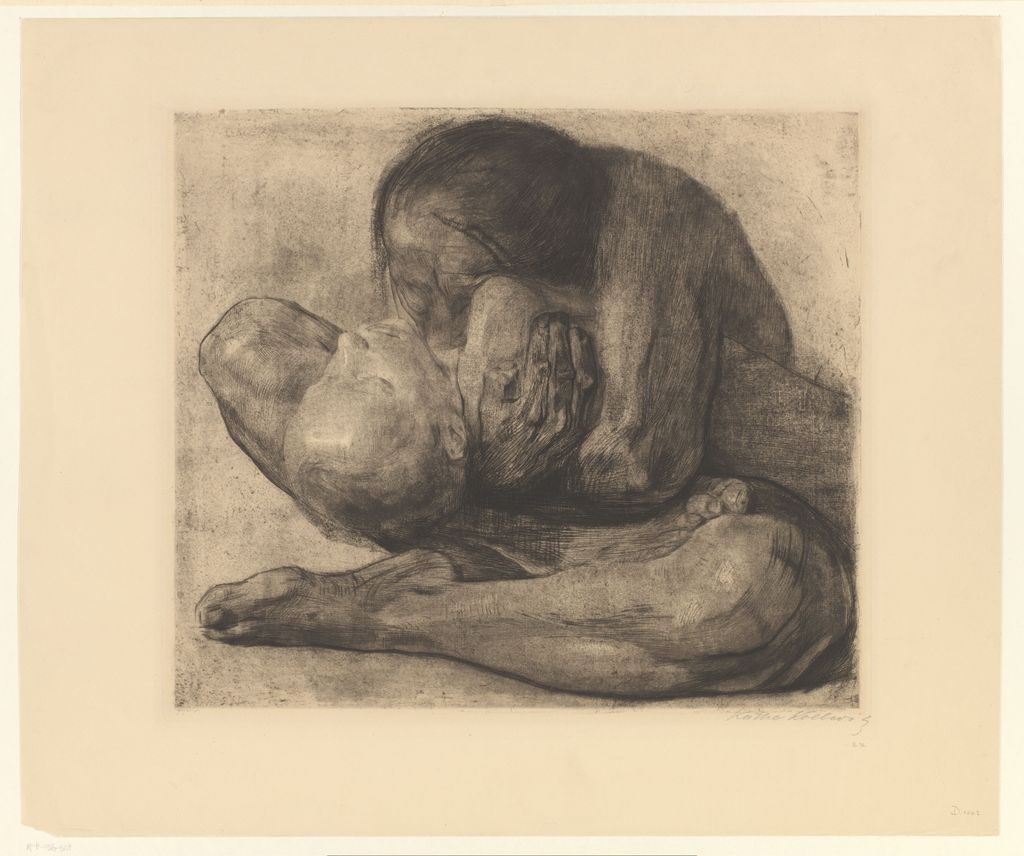
The commission followed work already under way. In 1904 Kollwitz sought support from the Verbindung für historische Kunst, the Association for Historical Art. She submitted Losbruch (Charge), which became plate five, and the independent print Frau mit totem Kind (Woman with Dead Child). Max Lehrs helped secure support for the cycle, and the seven-sheet portfolio appeared in 1908 through the association and the Dresden dealer Emil Richter. The MoMA checklist traces the development of Woman with Dead Child through drawings and successive states, including a British Museum proof from Dodgson’s bequest worked over in gold-coloured wash, graphite and charcoal. Like the first lithographic Arming in a Vault, it preserves decisions that would be difficult to recover from a published version alone. [22] [11]
What Paris saw, and what French collections kept
Kollwitz’s exhibitions in Paris followed a chronology of their own. In 1901 the Galerie Hessèle on rue Laffitte showed her work alongside prints by artists including Karl Stauffer-Bern, Heinrich Vogeler and Max Klinger. In Quelques peintres-graveurs allemands (Some German Painter-Printmakers), published in the February 1902 issue of the Gazette des Beaux-Arts, Noël Clément-Janin discussed The Carmagnole and the Weavers prints. In the passage transcribed by INHA, he connects the force of the scenes to the deep bite of the etching and singles out Kollwitz’s handling of grain and varnish. His choice of terms directs attention to what happens on the plate. In The Carmagnole, differences in tone and texture determine where the dancers separate into individuals and where they become a crowd. [8] [10] [9]
INHA also records her participation in the permanent exhibition at the Galerie Tendances nouvelles on rue Le Peletier. In 1905 she exhibited at the Salon des Indépendants, whose twenty-first exhibition took place in the city’s large greenhouses on the Cours-la-Reine. Cologne and INHA give different totals for her contribution. Cologne’s account names A Weavers’ Revolt, The Carmagnole, Hamburger Kneipe (Hamburg Tavern), Woman with an Orange and a seated female nude. That range gives a sense of the work then reaching Paris, from narrative prints to a small colour experiment and a figure study. INHA records a further showing in 1910 at the Salon of the Union internationale des beaux-arts et des lettres, at the Alcazar d’été on the Champs-Élysées, where the critic Arsène Alexandre praised her participation. In 1929 the Bibliothèque nationale included her etchings in Peintres graveurs allemands contemporains (Contemporary German Painter-Printmakers). [2] [8] [25]
Seeing prints at an exhibition and obtaining impressions for a collection were different matters. Letters from Lehrs and dealers’ invoices reproduced by INHA document purchases for Jacques Doucet’s Bibliothèque d’art et d’archéologie in 1911–12. Lehrs offered to help select impressions because they were difficult to obtain in Paris and put the library in touch with Ernst Arnold and Emil Richter in Dresden. Clément-Janin, who had reviewed Kollwitz’s prints after the Hessèle exhibition, was by then in charge of Doucet’s print cabinet. One of the resulting holdings, Die Carmagnole, EM KOLLWITZ 1, brings the history back to the work Kollwitz carried to Steinlen a decade earlier. In Britain, Lehrs encouraged Campbell Dodgson to buy Kollwitz’s prints in Germany before the First World War. Dodgson’s 1948 bequest brought those sheets to the British Museum. [8] [26]
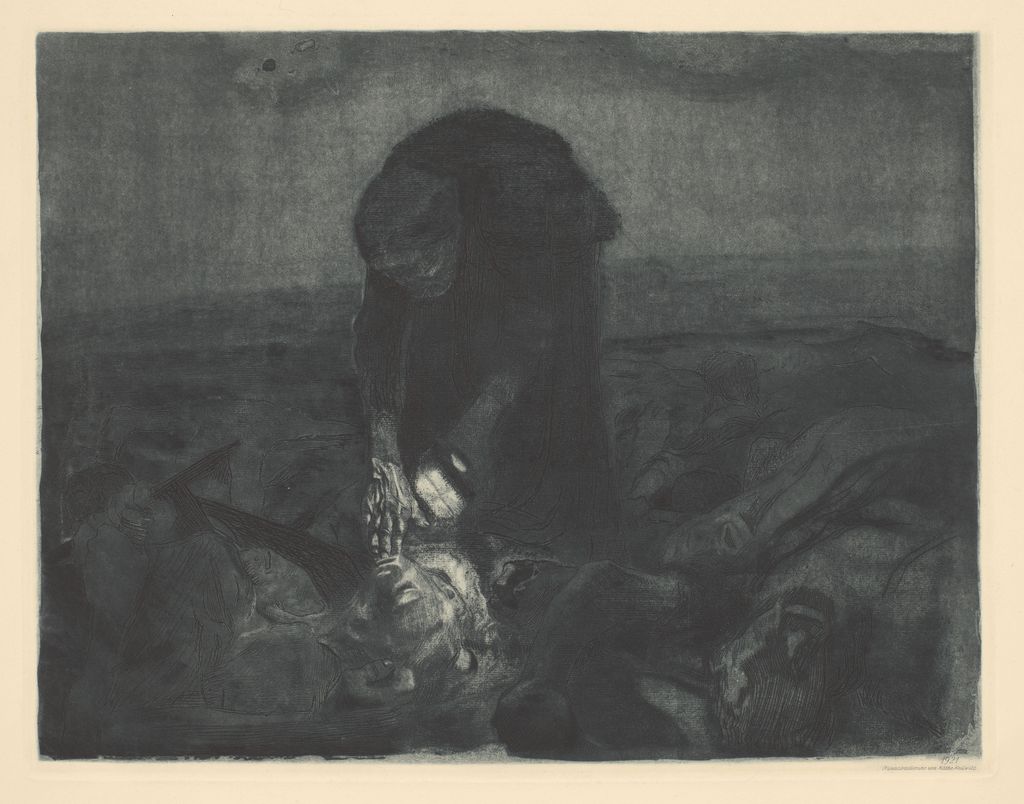
A different route into a French public collection is documented at Strasbourg. Its impression of Schlachtfeld (Battlefield), plate six of Peasants’ War, entered as a gift on 27 June 1908. The Joconde record, accession 5.916, identifies several processes on the sheet, including soft-ground etching with impressions of laid paper and Ziegler’s transfer paper. It also traces the print through later displays, including Strasbourg’s 2002 Kollwitz exhibition dossier. In 2019–20 the Musée d’Art moderne et contemporain de Strasbourg worked with the Kollwitz Museum Köln on Je veux agir dans ce temps (I Want to Act in These Times), a chronological retrospective that brought local holdings together with loans. [27] [28]
Cologne had already focused on the French connection in its twenty-fifth anniversary exhibition, Paris bezauberte mich … Käthe Kollwitz und die französische Moderne (Paris Enchanted Me … Käthe Kollwitz and French Modernism), which ran from 29 October 2010 to 30 January 2011. A display of Paris works from its collection followed in 2011. The title came from Kollwitz’s own recollection. The works give that memory a scale and texture, from the small orange printed on stone to the flecks of light drawn under a cellar vault. Paris also remained part of the reception of Kollwitz’s work through the critics who described those textures, the dealers who supplied impressions and the collections that kept them available to compare. [3] [29] [28]
Käthe Kollwitz artworks directory
Selected documented works, including the complete published sequences of the five cycles discussed here. Catalogue links identify the specific record behind each row.
Frequently Asked Questions
Discussion
Look again at the images and ideas explored in Käthe Kollwitz in Paris. These editorial prompts invite your observations.
Reader Insights
What changes in the prints when Kollwitz begins experimenting more actively with colour?
Which connections with Paris come from documents and which depend on visual comparison?
How do the different colour impressions change the sitter’s presence?
Join the Conversation
Share a detail, comparison or question about Käthe Kollwitz in Paris below.
References
- Kollwitz Museum Köln, Biography, 1901 and 1904 entries View source.
- Kollwitz Museum Köln, Zeitstrahl 1901–1913, entries for 1901–06, including the 1905 Salon section and Birkholz’s printing work View source.
- Kollwitz Museum Köln, Parisian Inspirations, including Kollwitz’s 1941 recollection and Tschudi’s introduction View source.
- Kollwitz Museum Köln, Frau mit Orange, Kn 56 II 2, inv. 70300/97001 View source.
- Kollwitz Museum Köln, Brustbild einer Arbeiterfrau mit blauem Tuch, Kn 75 A I 1, inv. 70300/87011 View source.
- Kollwitz Museum Köln, Selbstbildnis nach links, Kn 52 I, inv. 70300/91004 View source.
- Kollwitz Museum Köln, Caveau des Innocents, NT 275, and studies NT 275 a and NT 275 b View source.
- Nathalie Muller, INHA, Käthe Kollwitz (1867–1945), part 2, “Collections” and “Réception,” with the 1911 Lehrs letters and Arnold and Richter documents View source.
- Noël Clément-Janin, “Quelques peintres-graveurs allemands,” Gazette des Beaux-Arts, 3rd series, vol. 27, no. 536, February 1902, pp. 133–38, Heidelberg University Library View source.
- Kollwitz Museum Köln, Die Carmagnole, Kn 51 V b View source.
- Museum of Modern Art, Käthe Kollwitz exhibition checklist, 2024, pp. 8–9, The Carmagnole and Charge, pp. 11–14, Woman with Dead Child, p. 15, Bust of a Worker Woman with Blue Shawl and Self-Portrait en Face, and p. 20, Arming in a Vault View source.
- Käthe Kollwitz, “Erinnerung an Steinlen,” Sozialistische Monatshefte, vol. 30, no. 1, 22 January 1924, pp. 27–28, Friedrich-Ebert-Stiftung issue index View source.
- Musée d’Orsay, Pierre Bonnard, Le Corsage à carreaux, 1892 View source.
- Kollwitz Museum Köln, Arbeiterfrau im Profil nach links, final version, Kn 74 III a View source.
- Marie Ève Fwakasumbu, INHA, Buste d’une ouvrière au châle bleu, with the library’s impression View source.
- Fondation Pierre Gianadda, De Manet à Kelly, exhibition list, cat. 105, INHA JAHRESMAPPE 10 (4) View source.
- Universität der Künste Berlin, Das Frauenstudium in der bildenden Kunst, sections on the Damenakademie and the 1904 petition View source.
- Käthe Kollwitz, “Rodin,” Sozialistische Monatshefte, vol. 23, no. 24, 1917, pp. 1226–27, Friedrich-Ebert-Stiftung View source.
- Kollwitz Museum Köln, Liebesgruppe, 1913–15, Seeler 13 View source.
- Kollwitz Museum Köln, Pariser Kellerlokal, NT (277a), and Schlafender Mann am Tisch, NT 278a, with Wilhelm Uhde’s recollection from Von Bismarck bis Picasso, 1938 View source.
- Kollwitz Museum Köln, Zwei Männer und ein Liebespaar auf einer Bank, NT (287a) and National Gallery of Art, Four People Seated on a Bench, accession 1947.7.66 View source 1. View source 2.
- Kollwitz Museum Köln, Peasants’ War, development, commission and publication of the cycle View source.
- Getty Research Institute, Käthe Kollwitz: Prints, Process, Politics, object checklist, p. 2, rejected Ploughmen and Woman, and p. 5, rejected Arming in a Vault View source.
- Kollwitz Museum Köln, Bewaffnung in einem Gewölbe, plate four, Kn 96 VI, inv. 70300/23008 View source.
- Société des Artistes Indépendants, Catalogue de la 21e exposition 1905, 24 March–30 April, Bibliothèque nationale de France, FRBNF35034083 View source.
- British Museum, Portrait of the Artist: Käthe Kollwitz, exhibition press dossier, section on the Dodgson collection View source.
- French Ministry of Culture, Joconde 00160010900, Strasbourg’s Schlachtfeld, inv. 5.916 View source.
- Musée d’Art moderne et contemporain de Strasbourg, Käthe Kollwitz. Je veux agir dans ce temps, 2019–20 exhibition dossier, pp. 2–4 and 11–14 View source.
- Kollwitz Museum Köln, exhibition archive, 2010–11 Paris exhibitions View source.
More KOLLWITZ Works
The Mothers
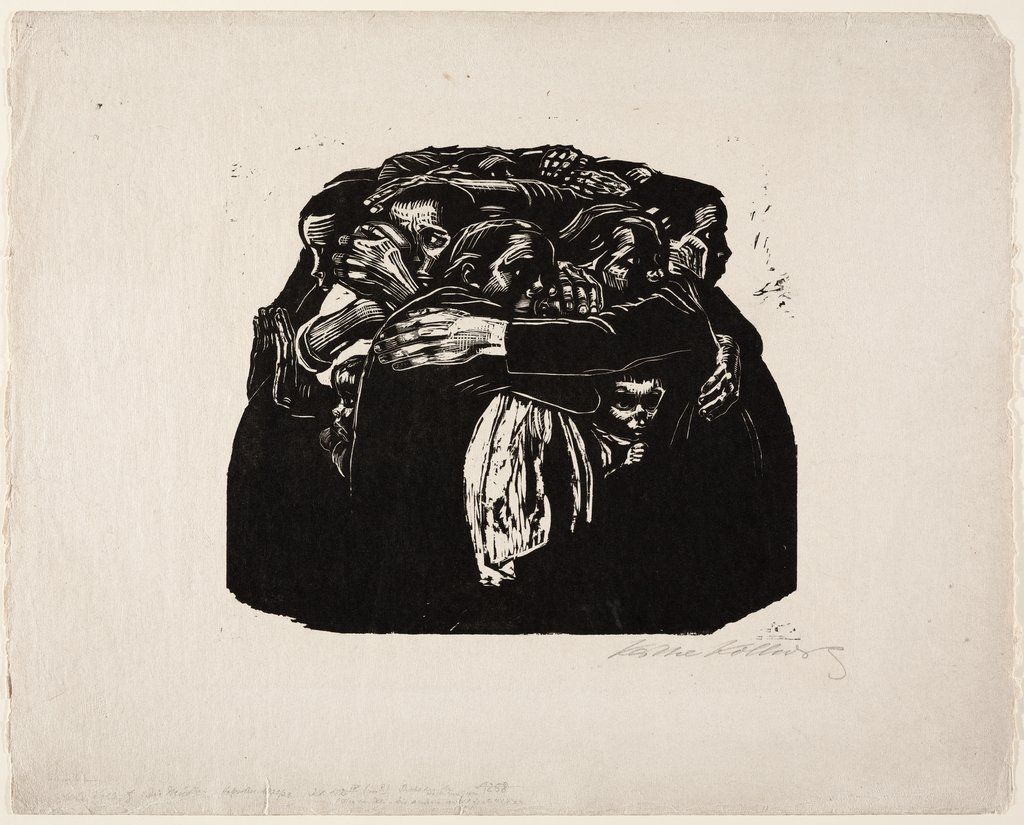
The Mothers, 1921–22. Städel Museum, Frankfurt am Main, SG 4289A D. Image source. Public domain. Resized and exported as JPEG.
The Grieving Parents
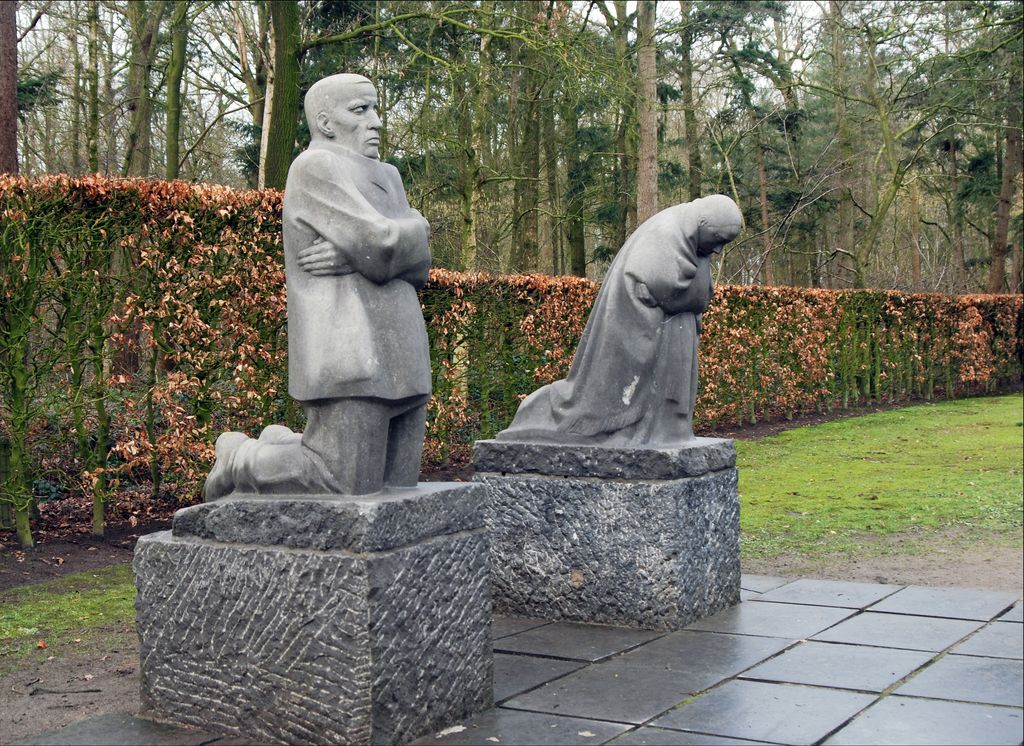
The Grieving Parents at Vladslo, the memorial’s location since 1956. Photograph by Bva, resized. Image source. CC BY-SA 3.0. Resized and exported as JPEG.
Memorial for Karl Liebknecht
Memorial for Karl Liebknecht, 1920. Kunstsammlungen Chemnitz, 86-47, Kn 159 VI. Photo: Kunstsammlungen Chemnitz/PUNCTUM/Bertram Kober. Image source. Public domain. Resized and exported as JPEG.