


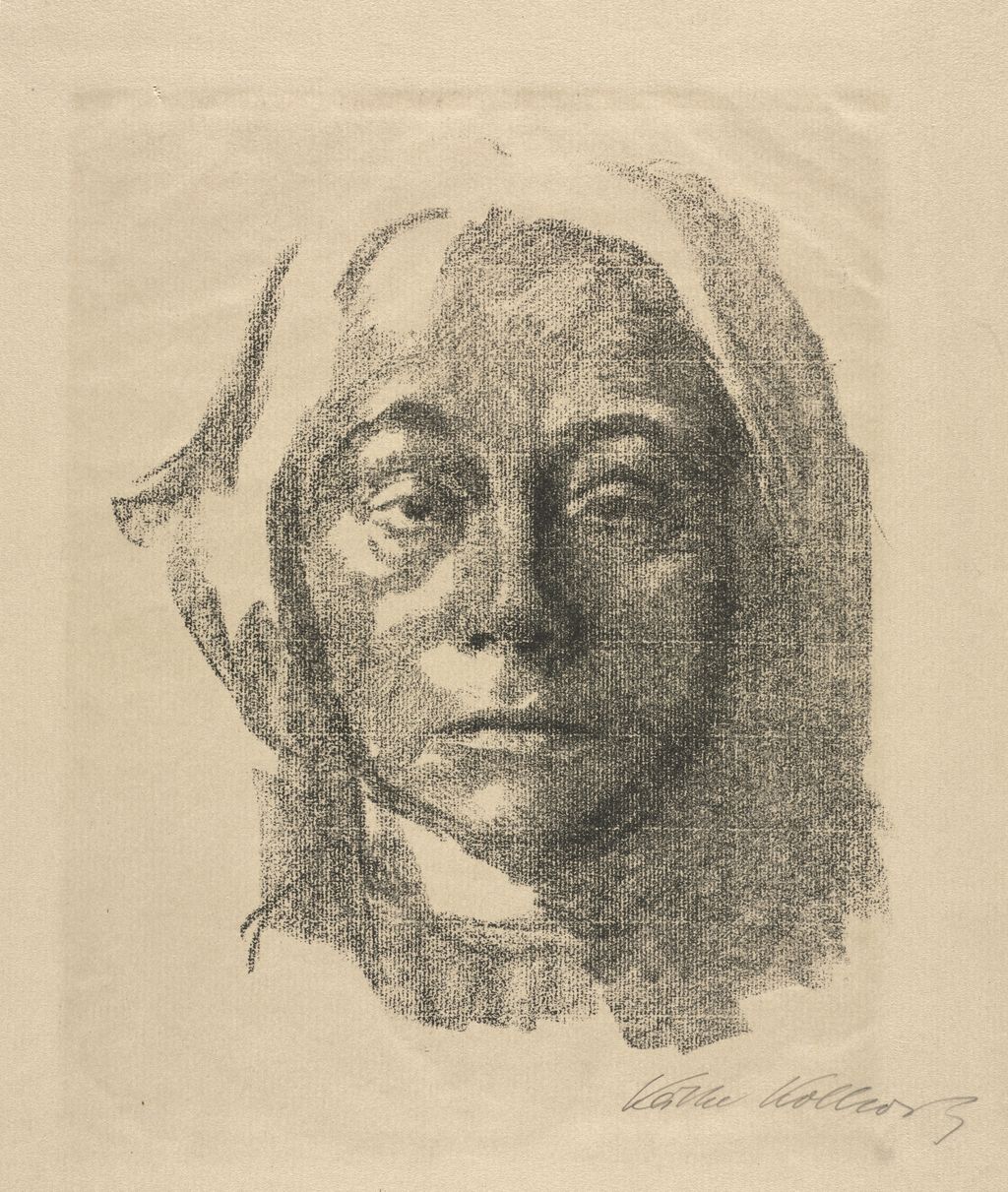
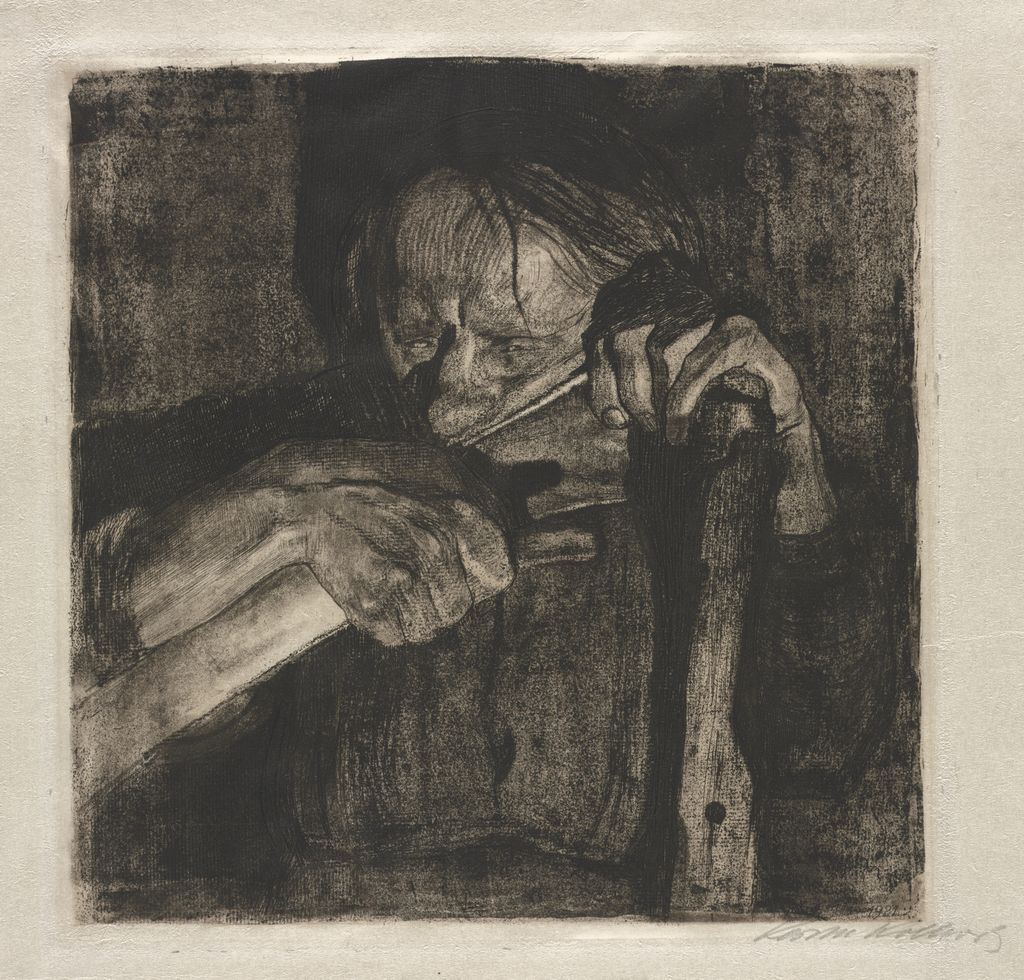
Käthe Kollwitz, Self-Portrait, 1915. Lithograph. Cleveland Museum of Art, 1941.493. Image source. CC0 / Public domain. Resized and exported as JPEG.
 by Tom Gurney
Tom Gurney BSc (Hons) is an art history expert with over 20 years experience
Email: tomgurney1@gmail.com / Phone: +44 7429 011000
Käthe Kollwitz Timeline: Introduction
Käthe Kollwitz’s first major print cycle took four years to make; her memorial to her son took nearly eighteen. This timeline follows those projects from their beginnings to the moments when the public first saw them, alongside the exhibitions, publications and moves that shaped her career. For the continuous story of her life, see the Käthe Kollwitz biography.
At a Glance
- Born8 July 1867, Königsberg, East Prussia, now Kaliningrad. [1]
- Died22 April 1945, Moritzburg, near Dresden. [2]
- Principal mediaDrawing, etching, lithography, woodcut and sculpture. [3] [4] [5] [6] [7]
- Exhibition breakthroughA Weavers’ Revolt at the Great Berlin Art Exhibition in 1898. [8] [3]
- Academy milestonesElected a full member in 1919, appointed to lead a master studio in 1928 and forced to resign in 1933. [9] [10] [2]
- Periods1867–1890 · 1891–1900 · 1901–1913 · 1914–1926 · 1927–1945 · After 1945
Contents
- 1867–1890: Early life and training
- 1891–1900: Berlin and the Weavers
- 1901–1913: Paris, London and Peasants’ War
- 1914–1926: War, mourning and public action
- 1927–1945: The Academy, late work and displacement
- After 1945: Memorials, collections and exhibitions
1867–1890: Early life and training
8 July 1867 — Born in Königsberg
Käthe Schmidt was born to Carl and Katharina Schmidt in Königsberg. Her father recognised her ability and supported her training. Her first teachers there included the painter Gustav Naujok and the engraver Rudolf Mauer. She later returned to Mauer to learn printmaking techniques when she was considering how to turn a planned painting into an etching. [1]
1886–1890 — Studies in Berlin, Königsberg and Munich
In 1886 Schmidt took portrait classes with Karl Stauffer-Bern at the Berlin school for women artists. He drew her attention to Max Klinger, whose published etching cycle A Life showed her what a sequence of prints could do. She returned to Königsberg for further instruction with Emil Neide, then studied in Munich from 1888 to 1890. In Ludwig Herterich’s class she painted the nude from a live model for the first time. [1]
1890 — A scene from Germinal moves from painting towards print
While in Munich she had begun drawing a quarrel from Émile Zola’s novel about mining life. Back in Königsberg, she prepared to paint it and made studies in taverns. With marriage and a move to Berlin approaching, the prospect of less working space helped steer her towards etching. The Germinal project remained unfinished, but it already brought together habits she would use in her first completed cycle: working from literature, observing contemporary life and developing a subject across several images. [1] [8]
1891–1900: Berlin and the Weavers
1891–1896 — Marriage, a Berlin household and two sons
Käthe married the doctor Karl Kollwitz on 21 June 1891. They moved that year to Berlin, settling at Weißenburger Straße 25 in Prenzlauer Berg, where Karl established his practice. Hans was born in 1892 and Peter in 1896. The practice brought the consequences of poverty and illness close to the household, while the family itself also supplied models: Kollwitz drew Hans for her first lithograph in 1896. [8] [11]
1893–1897 — The making of A Weavers’ Revolt
After seeing Gerhart Hauptmann’s The Weavers in 1893, Kollwitz set aside the proposed Germinal series and began A Weavers’ Revolt. Hauptmann’s drama drew on the Silesian weavers’ uprising of 1844. Kollwitz devised a fictional revolt and dressed its participants in clothes recognisable from her own time, bringing the subject closer to the workers her first audiences knew. [8] [3]
She completed the six sheets in 1897. The first three are lithographs, moving from a household in distress to a meeting where the weavers plan their response. The last three are etchings: the weavers march, attack and suffer defeat. The final sheet takes the viewer indoors again as the dead are brought in. [3]
1898 — The Berlin exhibition and the withheld medal
The completed cycle appeared at the Great Berlin Art Exhibition in 1898. Max Liebermann supported a jury recommendation for a medal, but Kaiser Wilhelm II refused to approve the award. The exhibition nevertheless established Kollwitz’s reputation. In the same year she began teaching drawing from life and etching at the Berlin school for women artists where she had once studied. [8] [3]
8 and 13 June 1898 — Max Lehrs requests impressions for Dresden
On 8 June, Max Lehrs, director of the Dresden Kupferstich-Kabinett, asked Kollwitz to reserve a set of especially good impressions for the graphic section of the 1899 Dresden exhibition. He asked what she would charge the print room and, given its limited funds, proposed that the set used in the exhibition might also be secured for the collection. [12]
Kollwitz replied from Weißenburger Straße on 13 June. She had discovered that she had no more good impressions of the final plate and needed to have fresh ones printed. She suggested 200 marks instead of 400, with room for the museum to pay what it could afford. The letters show what still had to happen after the cycle was complete: a finished plate made it possible to print more copies, but an exhibition set still depended on the quality and availability of individual impressions. [12]
May 1899 — Dresden awards Kollwitz a silver plaque
The contemporary notice headed Deutsche Kunstausstellung in Dresden lists the jury’s gold and silver plaques separately and names Käthe Kollwitz of Berlin among the silver recipients. The notice records an award she received in Dresden, a year after the Berlin jury’s recommendation was refused. [8] [3] [13]
1901–1913: Paris, London and Peasants’ War
1901 — First Paris visit and exhibitions in France and Britain
Kollwitz visited Paris for the first time in 1901, seeing exhibitions and meeting the artist Théophile-Alexandre Steinlen. Her prints also appeared at Charles Hessèle’s gallery in Paris and at an exhibition of the International Society of Sculptors, Painters and Gravers in London. The French critic Noël Clément-Janin paid particular attention to her use of grain and varnish in the prints shown at Hessèle’s, including Die Carmagnole and sheets from the Weavers cycle. [14] [15]
The London exhibition is an early date for the public appearance of her work in Britain. It may have brought her to Campbell Dodgson’s attention, although the British Museum documents a firmer connection: Dodgson bought her prints in Germany before the First World War, influenced by his colleague Max Lehrs. [14] [16]
1901–1904 — A second cycle takes shape
Kollwitz began developing Peasants’ War after reading Wilhelm Zimmermann’s history of the uprising of 1524–25. She considered making the cycle in colour lithography before settling on intaglio, in which ink is taken from recesses in the plate. The images came together out of sequence: Charge, eventually the fifth sheet, was already in development in 1902–03. In 1904 the Association for Historical Art commissioned her to complete the cycle for its members, with the Dresden dealer Emil Richter sharing in the arrangement. [14] [4]
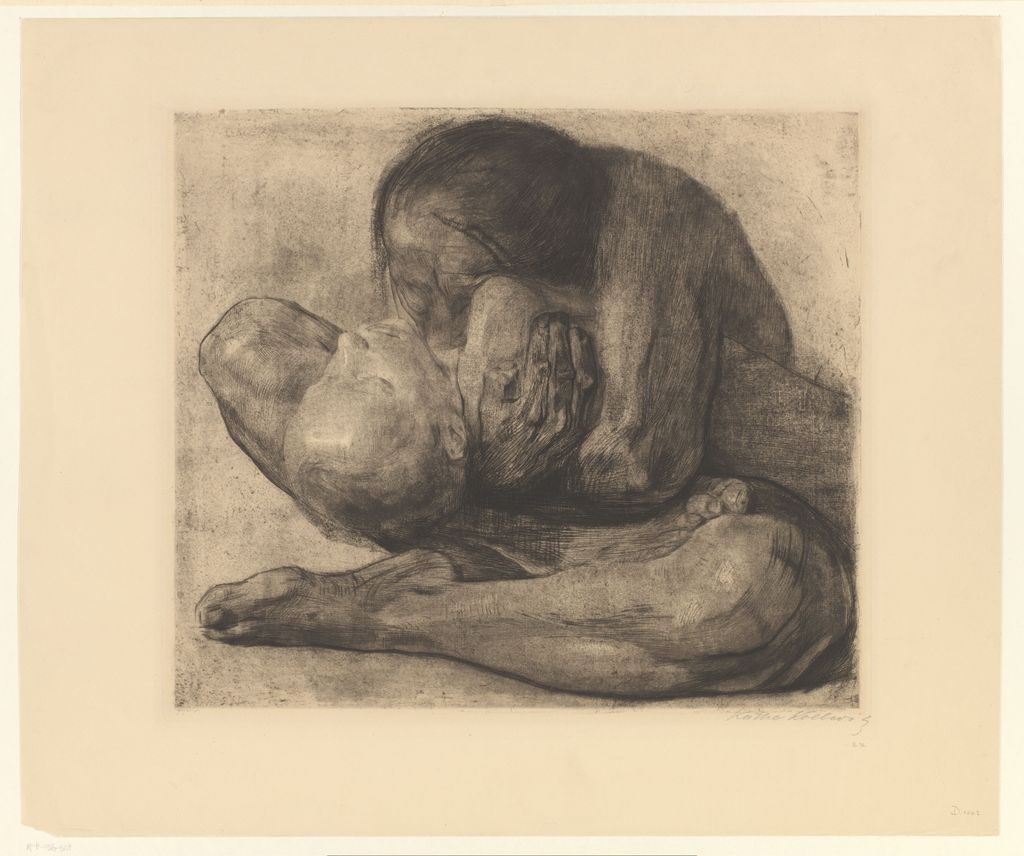
The surviving correspondence shows which works belonged to the commission. On 16 June 1904, Kollwitz acknowledged that Dresden was entitled to an impression of the Peasants’ War plates. She identified Woman with Dead Child as an independent print when listing the works for which she expected payment. She had made it in 1903, using herself and her young son Peter as models for the intertwined figures. [12] [17]
1904–1906 — Sculpture study, a Paris salon and a colour print in a portfolio
On her second visit to Paris in 1904, Kollwitz spent about two months studying at the Académie Julian and visited Auguste Rodin’s studios in Paris and Meudon with an introduction from Hugo von Tschudi. Her studies in sculpture were a separate episode from the exhibition of eight works at the Salon des Indépendants in 1905. [14] [15]
Her experiments with colour reached readers through a different channel. The Institut national d’histoire de l’art dates the making of Bust of a Woman Worker in a Blue Shawl to 1903 and records its publication in an annual portfolio in 1906. It was the one colour lithograph from this group of experiments to be issued in an edition. [18]
1907–1908 — Battlefield is made; the portfolio is published and a print enters Strasbourg
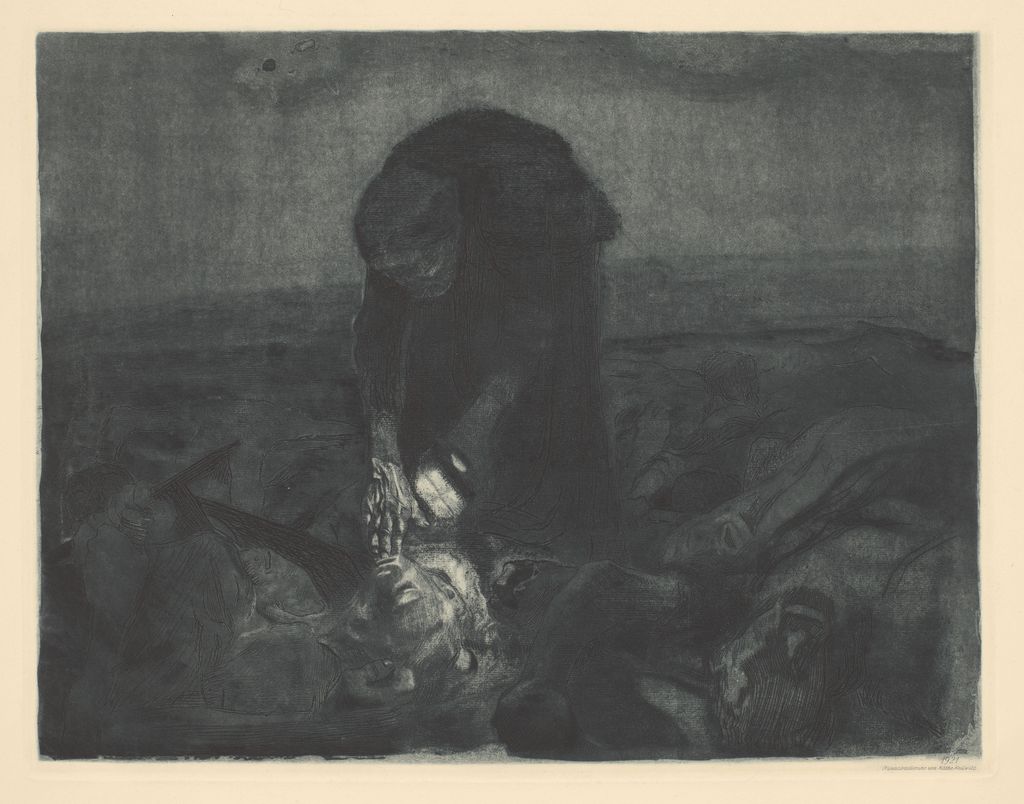
Kollwitz made Battlefield, the sixth plate, in 1907. Its searching figure carries a light across the field, bringing the viewer down among the fallen. The final sheet, The Prisoners, followed in 1908 and shifted the ending from the search for the dead to the fate of the survivors. In 1908 the Association for Historical Art and Emil Richter published the seven-sheet cycle. Strasbourg’s impression of Battlefield, accession 5.916, was recorded as a gift on 27 June that year. Its making, publication as part of the cycle and accession into a French collection are three separate events. [4] [19]
1908–1910 — Drawings for Simplicissimus and another Paris exhibition
From 1908 Kollwitz sent drawings to the Munich satirical weekly Simplicissimus. The magazine could give a drawing its own title and caption. Her study of a public warming hall, made in 1908–09, appeared on 1 March 1909 as Mißtrauen (Mistrust), with a caption that turned a scene of people sheltering from the cold into a pointed joke about the coal trade. In 1910 her work was again exhibited in Paris, at the Salon of the Union internationale des beaux-arts et des lettres. [15] [20] [21]
1914–1926: War, mourning and public action
October 1914 — Peter is killed; a memorial begins to take shape
Kollwitz’s younger son Peter volunteered for military service and was killed in Belgium in October 1914. She began thinking about a memorial that year. An early conception gave a place to the fallen son himself; years of revision eventually produced two separate kneeling parents. The diary sketches dated 11 January 1924 and her visit to Peter’s grave in 1926 belong to that long development, before the stone figures were installed. [22] [23] [9] [24]
1918–1923 — War: experiments, woodblocks and publication
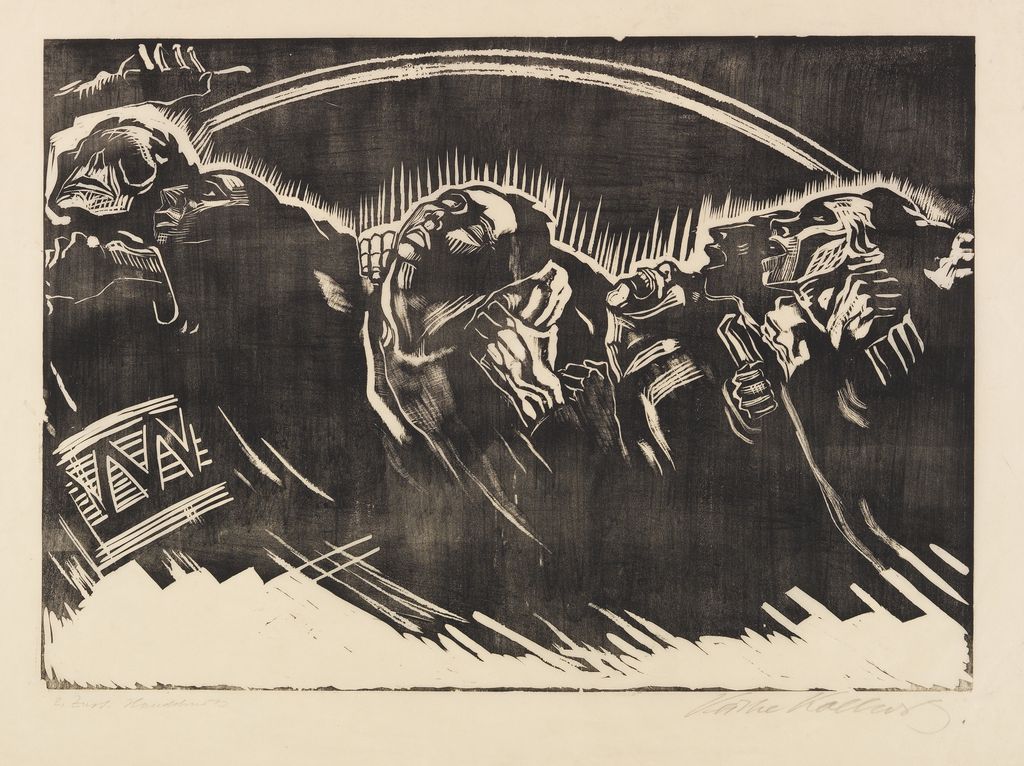
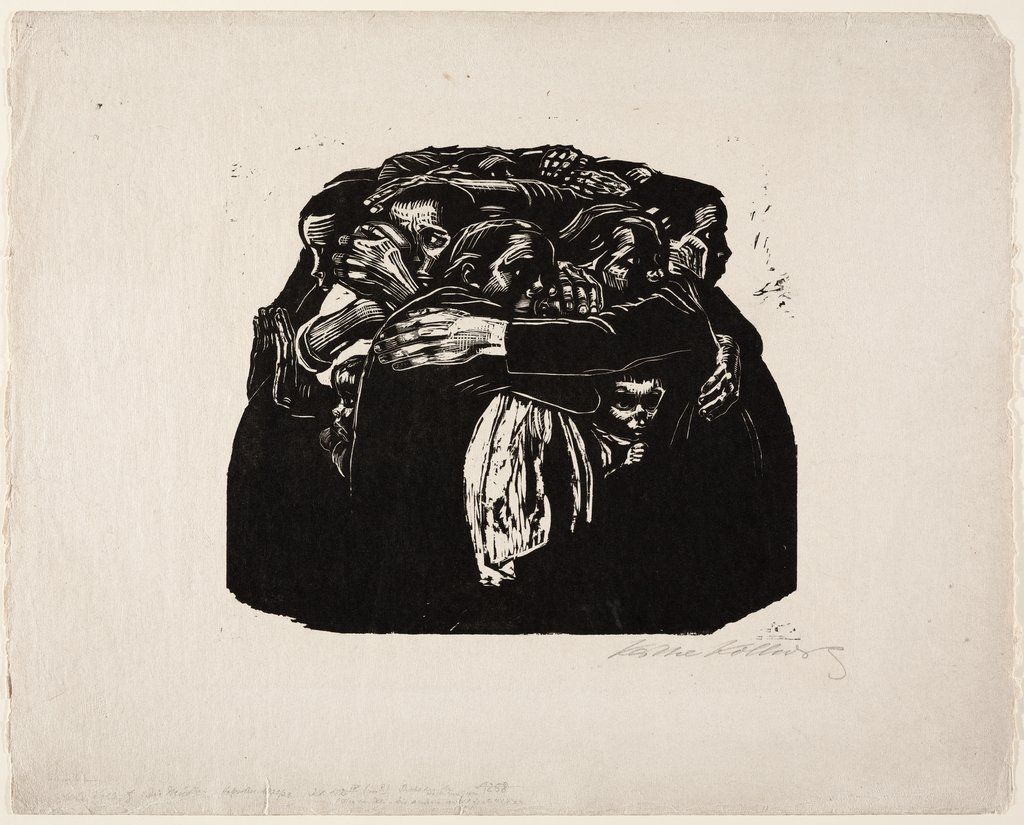
Kollwitz began testing etching for War in 1918 and tried lithography from 1919. The seven final woodcuts took shape in 1921–22. In The Volunteers, Death leads a close-packed procession. In The Mothers, adults press together around children. Those two sheets give the series very different kinds of collective action: a group surging forwards and a group closing ranks to protect its own. [5]
In October 1922 Kollwitz wrote to Romain Rolland about her hope that the images would circulate widely. In December she told Erna Krüger how much work lay behind the seven blocks. Emil Richter issued the portfolio in Dresden in 1923 in several editions. The correspondence dates the work on the series; 1923 is the publication date. [5]
24 January 1919 — Election to the Prussian Academy of Arts
The Academy elected Kollwitz a full member on 24 January 1919, following reforms and a proposal by Max Liebermann. Its account identifies her as the first woman elected since 1833. Election gave her a place in the institution; the appointment that put her in charge of a studio came nine years later. [9] [10]
1919–1920 — From the morgue to the Liebknecht woodcut
After Karl Liebknecht and Rosa Luxemburg were murdered in January 1919, Kollwitz drew Liebknecht in the morgue at his family’s request. She worked through studies and versions in different media before completing the woodcut Memorial for Karl Liebknecht in 1920. The final sheet gives much of its space to the mourners bending towards the body. Their presence makes the print a record of collective grief as well as a memorial to an individual. [25] [24]
August 1924 — Never Again War! addresses a public gathering
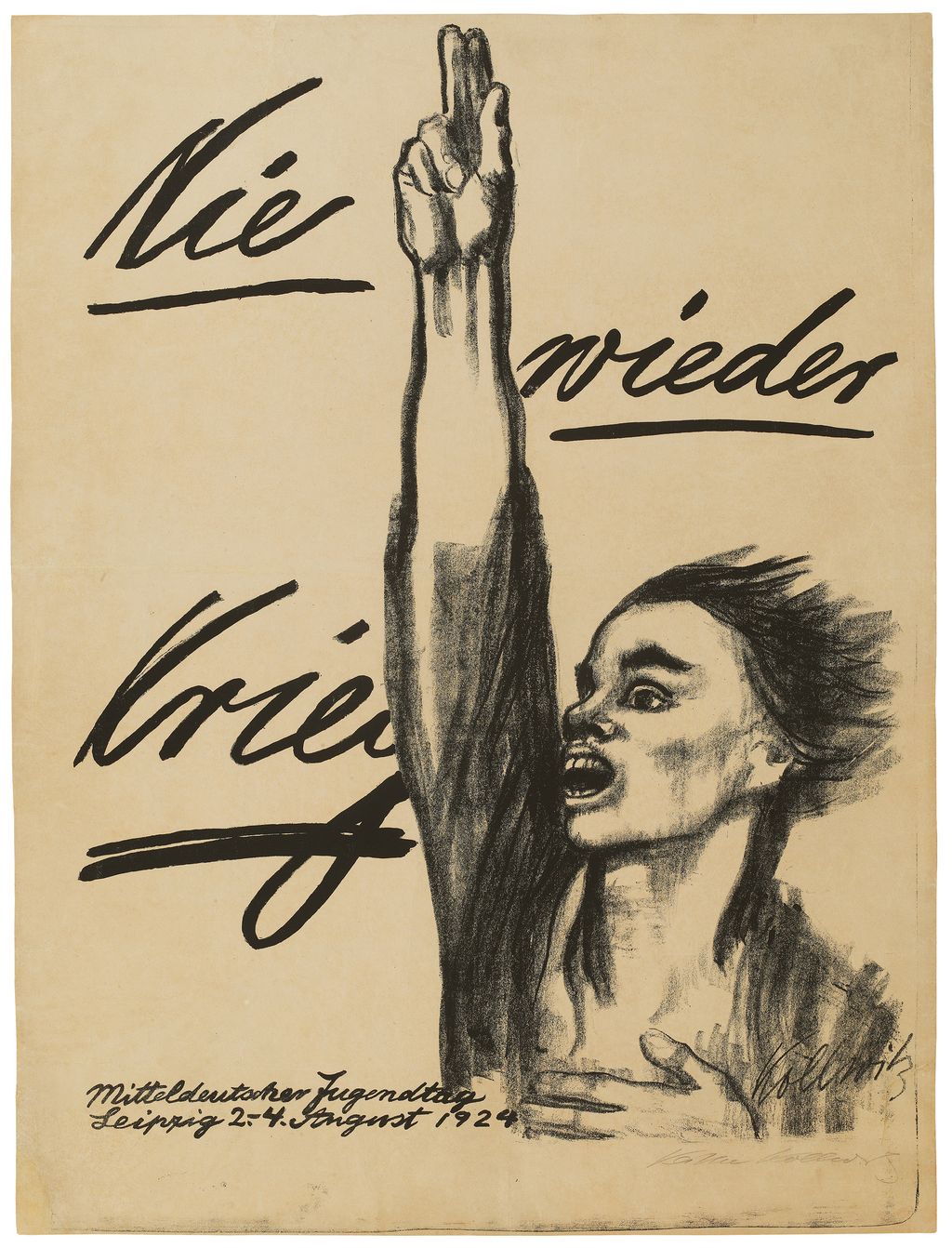
Kollwitz made Never Again War! for the Socialist Workers’ Youth in Leipzig. It belonged to a campaign that brought people out to demonstrate in August 1924, ten years after the outbreak of the war. A young figure raises one hand as if taking an oath and presses the other to their chest. The raised arm carries the eye into the handwritten slogan, making the gesture and the words legible together at a glance. [26]
1924–1926 — Proletariat is cut and issued
Kollwitz made the three woodcuts of Proletariat in 1924–25. The order is Unemployment, Hunger and Child Mortality. Read together, the sheets trace how the loss of work can reach into a household and endanger a child. Emil Richter published the triptych in Dresden in 1926 in an edition of 100. The Berlin print room records an unnumbered proof of the first sheet; the Städel holds the numbered set 22/100. [27] [28]
1927–1945: The Academy, late work and displacement
1928 — Leadership of an Academy master studio
Kollwitz became the first woman to lead one of the Academy’s six master studios in the visual arts section and joined its senate. The position gave her a formal role in teaching and in the running of the institution, distinct from the recognition conferred by her election in 1919. [9] [10]
July 1932 — The Grieving Parents installed at Roggeveld
The original stone figures of The Grieving Parents were installed in July 1932 at the German military cemetery at Roggeveld, near Esen in Belgium, where Peter was buried. August Rhades executed the father figure and Fritz Diederich the mother. The two kneeling figures were set apart: the space between them and the graves was part of the memorial visitors encountered. [23] [29]
February 1933–1940 — Forced resignation and two changes of workplace
After the Nazi takeover, Kollwitz signed an appeal for the left-wing parties to act together in the coming March election, as she had supported a similar appeal in 1932. In February 1933 she was forced to leave the Academy and lost her master studio. From autumn 1934 she rented space in the Klosterstraße studio community. She gave it up in 1940 as her health declined and brought her work back to the family flat. In a letter the following May, she explained that having her materials to hand let her work whenever she had the strength, even for half an hour. [11] [10] [2]
1934–1937 — The lithographs of Death
Kollwitz made the eight lithographs of Death in two groups, in 1934 and 1937. The finished sequence mixes those dates. In one sheet Death reaches into a group of children; in the closing Call of Death, a hand touches the shoulder of a woman whose face is Kollwitz’s own. The dates mark separate periods of work, while the order of the finished series lets violent and quieter encounters with death sit alongside one another. [6]
1937–1943 — A small Pietà, late prints and a final sculpture
Kollwitz modelled Mother with Her Dead Son in 1937–39. The sculpture draws on the Pietà tradition, with the adult son gathered into the seated mother’s lap. Cologne dates its zinc cast to 1941–43. The original model and that lifetime cast both precede the much larger bronze made for Berlin’s Neue Wache in 1993. [7]
Karl died in 1940, and Kollwitz completed the small sculpture Farewell in 1941. That year she also made the lithograph Seed Corn Must Not Be Ground, returning to an image she had used to argue against sending the young to war. Her last print was a lithographic portrait of Cläry Bartning, made in the winter of 1941–42. In September 1942 her eldest grandson, also named Peter, was killed in Russia. She continued to work in sculpture, bringing Two Waiting Soldiers’ Wives to the plaster stage in 1943. [2]
August 1943–April 1945 — Nordhausen, Moritzburg and the loss of the Berlin home
Kollwitz left Berlin for Nordhausen in August 1943, accepting shelter from the sculptor Margret Böning. The Berlin home was destroyed in a November air raid, after she had left. Many drawings and almost all her early paintings were lost, though Böning and Clara Stern had already helped move a substantial group of graphic works to safety. In Nordhausen, Kollwitz sorted and signed works that had survived. [2]
In July 1944 she moved again, this time to the Rüdenhof in Moritzburg near Dresden. She died there on 22 April 1945 and was initially buried in Moritzburg. Her final resting place is the family grave in Berlin-Friedrichsfelde. [2]
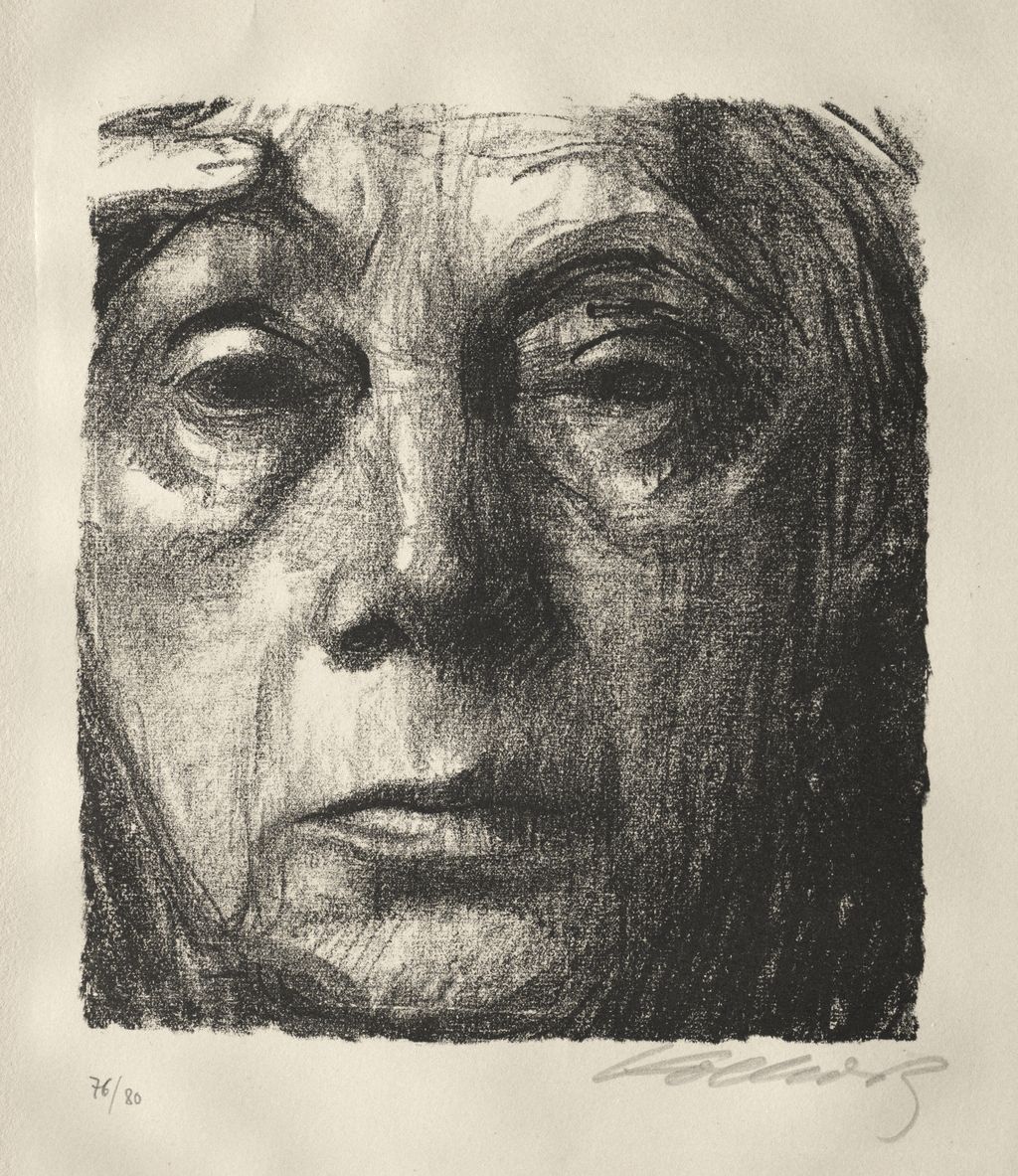
Käthe Kollwitz, Self-Portrait, 1934. Lithograph. Cleveland Museum of Art, 1936.30. Image source. CC0 / Public domain. Resized and exported as JPEG.
After 1945: Memorials, collections and exhibitions
1948 — The Dodgson bequest reaches the British Museum
Campbell Dodgson’s bequest brought to the British Museum prints he had bought privately, including works acquired in Germany before the First World War. The bequest turned his early collecting into a public resource and supplied much of the material for the museum’s later Kollwitz exhibition. [16]
1956 — The original stone parents move to Vladslo
As German military burials in West Flanders were consolidated, Peter’s remains and the original Grieving Parents were moved from Roggeveld to the cemetery at Vladslo. The figures were placed at the far end of the larger cemetery, with Peter’s grave in front of them. Their new position kept the connection to his grave while setting the pair before the graves of many other soldiers. [23] [29]
1964 and 1985 — Collections take institutional shape in Frankfurt and Cologne
In 1964 Frankfurt acquired the Kollwitz collection of Helmut and Hedwig Goedeckemeyer for its municipal gallery. The Proletariat set at the Städel is one traceable part of that acquisition. Cologne’s museum grew from a different starting point: the local savings bank acquired 60 drawings from the artist’s estate in 1983. The collection’s first public exhibition, on 22 April 1985, the fortieth anniversary of her death, marked the foundation of the museum devoted to her work. [28] [30]
14 November 1993 — The Neue Wache dedication
The Federal Republic dedicated the Neue Wache in Berlin as its central memorial to the victims of war and tyranny. The figure group inside is Harald Haacke’s bronze enlargement of Kollwitz’s small Pietà. The 1993 date belongs to the enlargement and its public dedication in Berlin. The original stone parents, made for a different memorial and moved in 1956, remain at Vladslo. [7] [31] [29]
2017–2020 — A British tour and a Strasbourg retrospective
Portrait of the Artist: Käthe Kollwitz, organised by Ikon with the British Museum, opened in Birmingham on 13 September 2017. It travelled to Salisbury, Swansea and Hull before reaching the British Museum, where it ran from 12 September 2019 to 12 January 2020. The tour brought impressions from the British Museum’s collection to audiences outside London before the London showing. [16] [32]
Meanwhile, from 4 October 2019 to 12 January 2020, Strasbourg’s Musée d’Art moderne et contemporain presented Je veux agir dans ce temps in partnership with the Kollwitz Museum Köln. The retrospective brought drawings, prints and sculpture together across the career. Strasbourg’s own collecting history went back to Kollwitz’s lifetime, as the accession of Battlefield in 1908 shows. [19] [33]
2024 — Frankfurt and New York revisit the work
The Städel Museum presented its Kollwitz retrospective in Frankfurt from 20 March to 9 June. Its exhibition companion examined the political and cultural meanings attached to Kollwitz in Germany after 1945. From 31 March to 20 July, the Museum of Modern Art in New York presented a retrospective centred on the artist’s working process. Its checklist traces the development of Sharpening the Scythe through rejected designs, a drawing and several states of the final plate. Seen together, those works show how much Kollwitz altered before a print entered a published series. The two exhibitions offer distinct starting points for the reception of her work. [34] [35] [36]
2025 — An early drawing enters the Cologne collection
Cologne’s Kollwitz Museum received Brian McCrindle’s gift of an 1883 pencil portrait of Arthur Schopenhauer, drawn by Käthe Schmidt at sixteen. The museum identifies it as the earliest drawing by her currently known. It had been missing from view and is absent from the Nagel–Timm drawing catalogue. McCrindle acquired it with a group of archival material in 2014. The dates of making, rediscovery and public acquisition tell different parts of the same work’s history. [37]
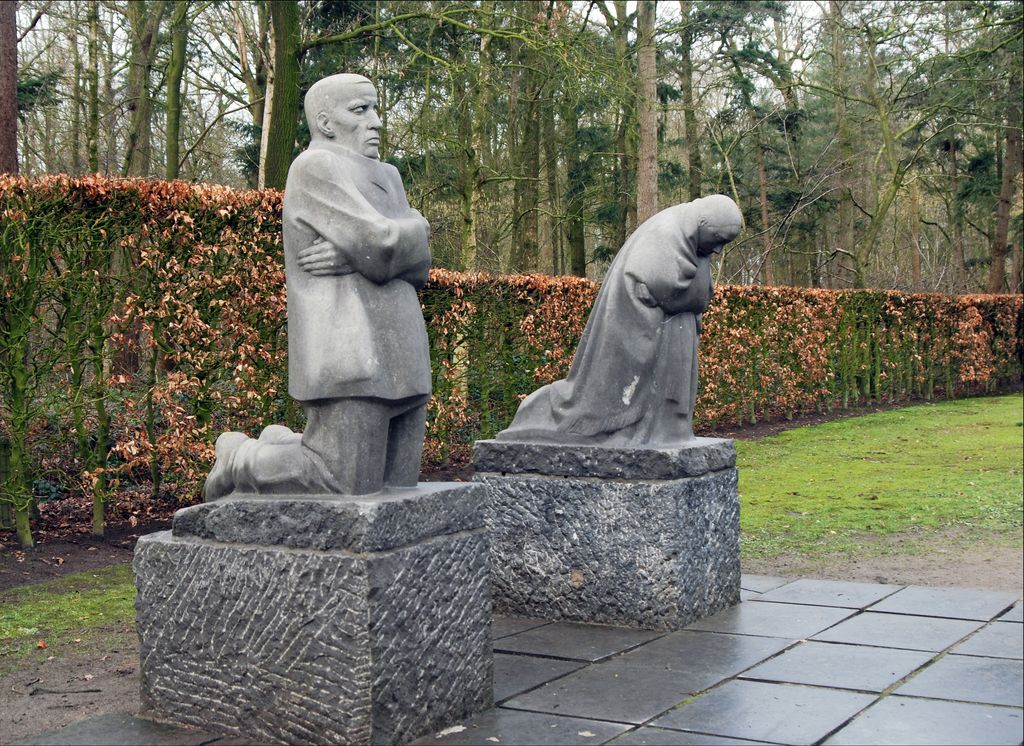
Käthe Kollwitz’s Grieving Parents at Vladslo, the memorial’s location since 1956. Photograph by Bva, resized. Image source. CC BY-SA 3.0. Resized and exported as JPEG.
Käthe Kollwitz artworks directory
Selected documented works, including the complete published sequences of the five cycles discussed here. Catalogue links identify the specific record behind each row.
Discussion
Look again at the images and ideas explored in Käthe Kollwitz Timeline. These editorial prompts invite your observations.
Reader Insights
Which turning points become easier to see when the artworks and life events are read together?
How did the later collecting and exhibition dates change access to Kollwitz’s work?
Which exhibition or acquisition date most changes how you understand the work’s public history?
Join the Conversation
Share a detail, comparison or question about Käthe Kollwitz Timeline below.
References
- Kollwitz Museum Köln, Zeitstrahl 1867–1890: childhood, training and Germinal. View source.
- Kollwitz Museum Köln, Zeitstrahl 1933–1945: late work, displacement and death and dated biography, including burial history. View source 1. View source 2.
- Kollwitz Museum Köln, A Weavers’ Revolt, 1893–1897: cycle and exhibition history. View source.
- Kollwitz Museum Köln, Peasants’ War: the seven plates, commission and publication. View source.
- Kollwitz Museum Köln, War: seven woodcuts, the 1922 letters and the 1923 issue. View source.
- Kollwitz Museum Köln, Death: eight lithographs, 1934–1937. View source.
- Kollwitz Museum Köln, Pietà (Mutter mit totem Sohn), Seeler 37: model, zinc cast and later enlargement. View source.
- Kollwitz Museum Köln, Zeitstrahl 1891–1900: marriage, early work and exhibitions. View source.
- Akademie der Künste, About Käthe Kollwitz: election record and memorial sketches dated 11 January 1924. View source.
- Akademie der Künste, Zur Person Käthe Kollwitz: membership, master studio and forced resignation. View source.
- Käthe-Kollwitz-Museum Berlin, Käthe Kollwitz in Berlin: homes and studios. View source.
- Staatliche Kunstsammlungen Dresden, Briefwechsel zwischen Käthe Kollwitz und Max Lehrs, pp. 8–9, archive 01/KK 04 Bd. 4, nos. 535–537 and 538–539; p. 39, Bd. 9, nos. 222–223. View source.
- SLUB Dresden, ‘Deutsche Kunstausstellung in Dresden’, contemporary jury awards notice, no. 101, May 1899, p. 3302. View source.
- Kollwitz Museum Köln, Zeitstrahl 1901–1913: Paris visits, London exhibition and the development of Peasants’ War. View source.
- Institut national d’histoire de l’art, Nathalie Muller, Käthe Kollwitz (1867–1945), 2/2: French exhibitions and criticism. View source.
- British Museum, Portrait of the Artist: Käthe Kollwitz: exhibition dossier and Dodgson provenance. View source.
- Museum of Modern Art, Woman with Dead Child, 1903, state VIII/X. View source.
- Institut national d’histoire de l’art, Buste d’une ouvrière au châle bleu: making and portfolio issue and the 1903 work and its colour printing. View source 1. View source 2.
- French Ministry of Culture, Joconde, Schlachtfeld, Strasbourg accession 5.916. View source.
- Kollwitz Museum Köln, Sozialkritik: work for Simplicissimus. View source.
- Kollwitz Museum Köln, Wärmehallen, 1908/09, NT (469a), and its publication on 1 March 1909. View source.
- Kollwitz Museum Köln, Zeitstrahl 1914–1918: Peter’s death and the wartime years. View source.
- Kollwitz Museum Köln, Das Mahnmal Trauernde Eltern: development and site history. View source.
- Kollwitz Museum Köln, Zeitstrahl 1919–1926: Weimar years, work and memorial development. View source.
- Kollwitz Museum Köln, Gedenkblatt für Karl Liebknecht, Kn 159, with diary entries. View source.
- Kollwitz Museum Köln, Never Again War!, 1924, Kn 205 III b. View source.
- Staatliche Museen zu Berlin, Kupferstichkabinett, Erwerbslos, sheet one of Proletariat, inv. 362-1927, and the 1926 edition. View source.
- Städel Museum, Proletariat, set 22/100 and acquisition history. View source.
- Flemish Heritage Agency, Vladslo cemetery inventory: original installation at Roggeveld, execution of the figures and transfer in 1956. View source.
- Kollwitz Museum Köln, From a collection to a museum: the 1983 acquisition and the first exhibition in 1985. View source.
- German Federal Government, Chancellor Helmut Kohl’s statement for the dedication of the Neue Wache, 14 November 1993. View source.
- Ikon, Portrait of the Artist: Käthe Kollwitz: British tour dates, 2017–2020. View source.
- City of Strasbourg, 2019 cultural programme: Käthe Kollwitz, Je veux agir dans ce temps, and Musées de Strasbourg, exhibition catalogue record. View source 1. View source 2.
- Städel Museum, Kollwitz: exhibition companion, 20 March to 9 June 2024. View source.
- Museum of Modern Art, Käthe Kollwitz: retrospective, 31 March to 20 July 2024. View source.
- Museum of Modern Art, Käthe Kollwitz: checklist, pp. 16–19. View source.
- Kollwitz Museum Köln, Arthur Schopenhauer, 1883: Brian McCrindle gift. View source.
More KOLLWITZ Works
The Mothers
The Mothers, 1921–22. Städel Museum, Frankfurt am Main, SG 4289A D. Image source. Public domain. Resized and exported as JPEG.
The Grieving Parents
The Grieving Parents at Vladslo, the memorial’s location since 1956. Photograph by Bva, resized. Image source. CC BY-SA 3.0. Resized and exported as JPEG.
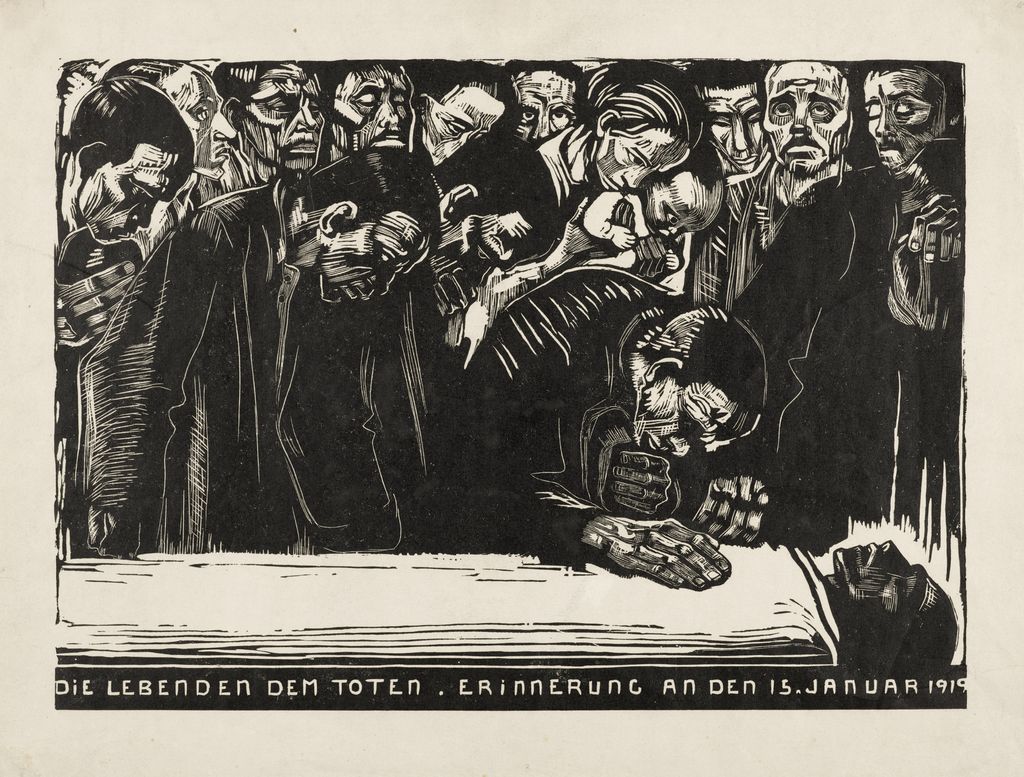
Memorial for Karl Liebknecht
Memorial for Karl Liebknecht, 1920. Kunstsammlungen Chemnitz, 86-47, Kn 159 VI. Photo: Kunstsammlungen Chemnitz/PUNCTUM/Bertram Kober. Image source. Public domain. Resized and exported as JPEG.