


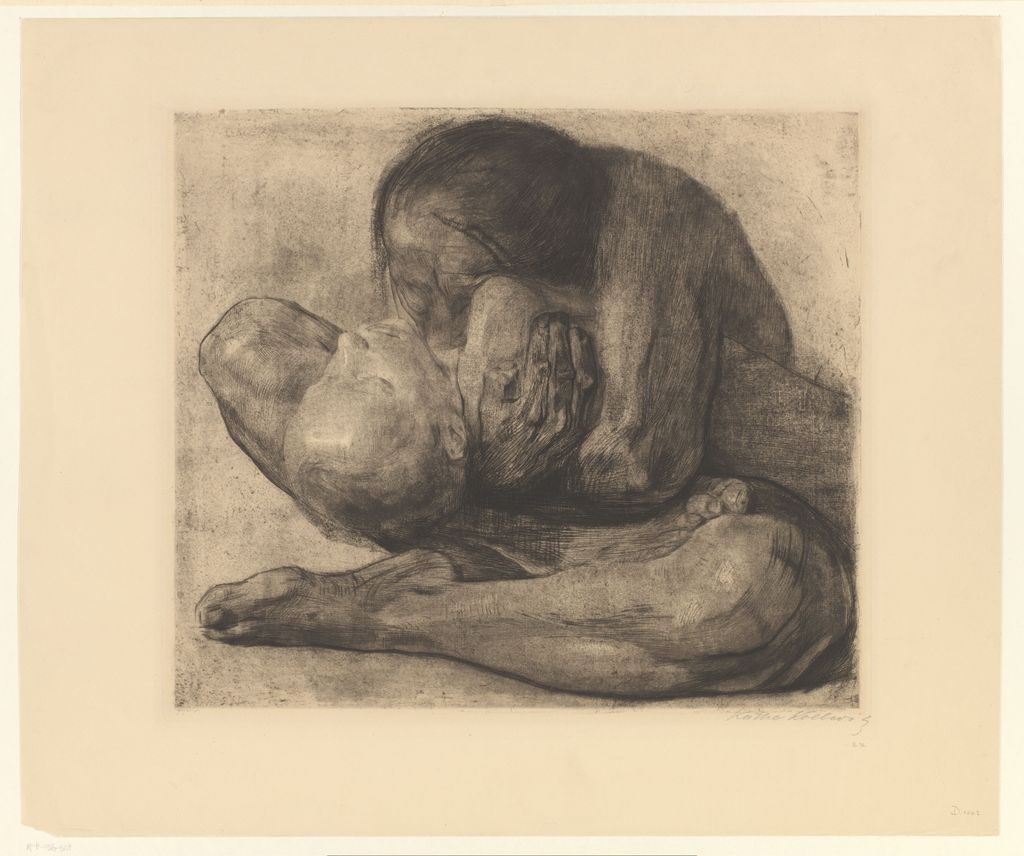
Woman with Dead Child, 1903. Rijksmuseum, RP-P-1916-507. Image source. CC0 / Public domain. Resized and exported as JPEG.
 by Tom Gurney
Tom Gurney BSc (Hons) is an art history expert with over 20 years experience
Email: tomgurney1@gmail.com / Phone: +44 7429 011000
Woman with Dead Child: Introduction
In the Museum of Modern Art’s state VIII impression of Woman with Dead Child, a hand cups the boy’s shoulder so tightly that it takes a moment to see where one body ends and the other begins. His head falls back, exposing his face. The woman bends into the space above him until her features disappear into shadow. One of her legs runs across the bottom of the composition and braces the group, while the upper bodies seem to pitch forward. Käthe Kollwitz gives grief a physical shape through the contrast between the weight of the child and the effort of the woman holding him. [1] [2]
At a Glance
- ArtistKäthe Kollwitz
- Date1903
- German titleFrau mit totem Kind
- MediumIntaglio print combining line etching, drypoint, sandpaper work and soft-ground etching. Supports, printed colour and hand additions vary by impression.
- Catalogue numbersKnesebeck 81 and Klipstein 72. The Kollwitz Museum Köln holds state VIII a, inventory 770300/89021. MoMA catalogues impression 181.2018 as state VIII of ten.
- ModelsKollwitz and her seven-year-old son Peter
- PublicationA standalone print developed during work on Peasants’ War. MoMA records an edition of 50 in 1918 and later printings in 1921 and between 1931 and 1941. [1] [2] [3]
This work across Käthe Kollwitz’s career
A Weavers’ Revolt
1893–97The six sheets take a revolt from household distress to collective action and its aftermath. [4]
Separate impressions and hand-worked proofs show how Kollwitz developed the image. [1]
Peasants’ War
1901–08The seven plates combine the revolt with the aftermath in Battlefield and The Prisoners. [5]
War
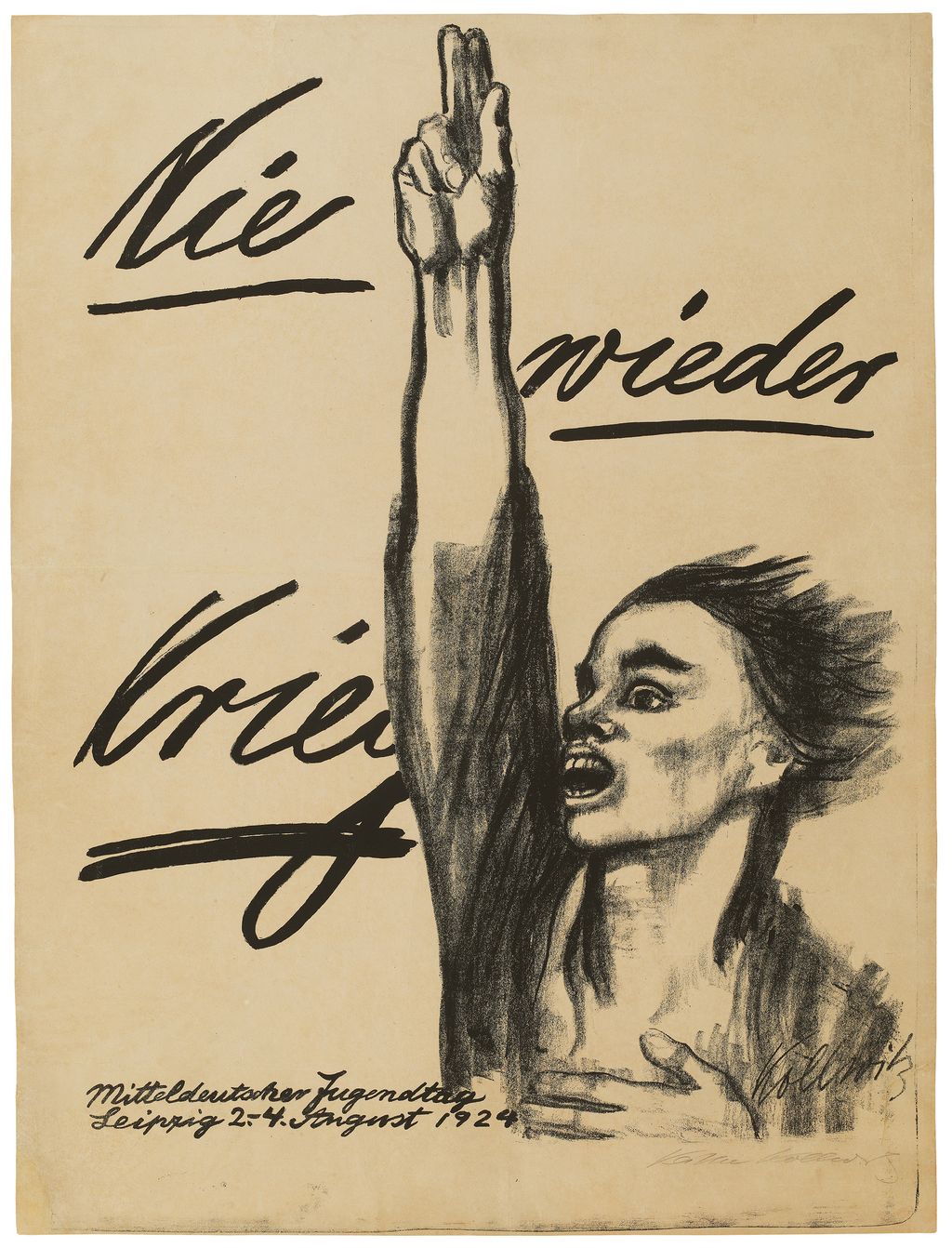
1921–22, published 1923The woodcuts give sustained attention to the experience of those left behind. [6]
The Grieving Parents
1932 installationTwo kneeling figures face the graves in the memorial’s later location at Vladslo. [7]
Mother with Her Dead Son
1937–39 modelThe small sculpture precedes the 1993 enlargement at the Neue Wache. [9]
Contents
- The weight of the embrace
- From the lithographic Pietà to the etching
- How the print acquired its texture
- What changes from one proof to another
- Peter as model and in family memory
- From the studio to Battlefield and the late sculpture
The weight of the embrace
Start with the child’s head. His closed eyes, the bridge of his nose and the slight parting of his lips are easier to pick out than the features of the woman immediately above him. The head is tipped back, with the face turned upwards and towards us. Follow his shoulder towards the centre and the image becomes harder to untangle. The woman’s fingers rise against the shoulder while her forearm passes under him. Her bent head comes down into the same patch of shadow. A contour that seems to describe the child’s body can disappear into a passage that describes the woman’s arm. Finding the hand gives the eye a way back through the embrace. [1] [2]
The figures occupy the print unevenly. Across the bottom, the woman’s folded leg has a long, relatively clear outline. The foot extends towards the left and the knee swells at the right. A second knee rises behind the child’s head, almost like a support for it. Above this broad base, the woman’s back curves down from the upper right and the boy’s head falls towards the left. The opposed directions concentrate attention at the point where she grips him. His exposed face has the stillness of a body that has ceased to answer. Her hand, shoulder and back register the work of continuing to hold it. [1] [2] [10]
The gesture becomes more intimate because the woman gives the viewer so little of her face. Her brow and nose are difficult to distinguish from the shaded area where she presses against the boy. There is no exchange of looks. The pale oval of his face and the more heavily drawn fingers are separated just enough to be seen together. The hand can be read both as support and as a tightening grip. What one would usually learn about a mourner from her expression has to be gathered here from how close she brings her head and how firmly she holds the shoulder. [1] [2]
The open paper around MoMA’s impression matters to that sense of pressure. The museum gives the composition as 41.2 × 47.1 cm and the full sheet as 54.5 × 70.3 cm. The outer margin gives the print considerable room. Within the printed rectangle, there is barely enough space to imagine the figures extending their limbs. A faintly worked surround gives their outlines something to emerge from, while the lower leg lies close to the edge of the image. The sheet can feel expansive in the hand or on a wall even as the scene it carries feels confined. [1] [11]
From the lithographic Pietà to the etching
The title Pietà invokes the Christian image of Mary holding the dead Christ. Kollwitz used it for a separate lithograph earlier in 1903, Knesebeck 77. In the National Gallery of Art’s state III impression, printed in brown and black on grey-green Bristol board, the woman already sits low and bends over the child. Her head rests against his chest, and her arms enclose much of his torso. His face appears at the right, framed against the dark field. A dark cloth distinguishes her lap from the body it carries. Cologne records its own two-colour impression as state II, and MoMA’s 2024 checklist identifies a separate state III impression in the Ute Kahl collection. [2] [12] [11]
The lithograph lets the child’s body extend laterally across a field considerably wider than it is high. Art historian Bettina Sitter draws attention to the steadiness of that horizontal and the greater force of the oblique views in the etching. The difference is visible in the woman’s shoulder. In the lithograph, the lowered head and arms gather around the long axis of the child’s body. In the etching, the bare shoulder and upper arm descend through the image, almost dividing it. The boy’s head drops to the left and towards the foreground. His body looks as if it has been drawn up against hers even as his head falls away. [1] [12] [13]
The two prints also distribute darkness differently. The lithograph’s dark field encloses the pair and gives the child’s head a distinct silhouette. In MoMA’s etching the surround is lighter, and much of the darkness is concentrated where the figures meet. The woman’s own body does the work of enclosing him. The seated mourner and the body across her lap still recall the older devotional composition. In the etching, the uncovered limbs and nearly illegible contact between the two faces make the motif feel like a particular physical encounter. The title identifies the figures simply as a woman and a child. [1] [2] [12]
The surviving drawings show how many parts of the encounter Kollwitz studied separately. MoMA’s checklist records the Stuttgart charcoal Head and Hands of a Sleeping Child among the studies for Pietà. Sleep offered a living model for the slackness of the head and hands. In the Berlin Kupferstichkabinett’s Dead Child Supported by a Hand, black chalk and white heightening on greenish-grey paper isolate the problem of how one body carries another. Cologne also preserves a larger charcoal drawing of the pair on yellowish Ingres paper, Nagel/Timm 234 a. The hand that bears the head, the disposition of the child’s body and the outline of the whole group could each be worked out at a different scale. [2] [11]
The Getty Research Institute’s signed and dated drawing, Nagel/Timm 241, carries that investigation across two surfaces. Kollwitz used black chalk and graphite, with white and orange chalk, on a green wove sheet mounted on darkened beige-blue paper. Part of the woman’s head is drawn directly onto the mount. The green sheet supplies a middle tone against which both dark and light marks register, and the drawing continues where that sheet ends. The place where the support changes is part of the image itself. In the subsequent print proofs, Kollwitz could likewise reconsider the relation between figure and field by altering the plate, adding a printed tone or working directly on a pulled impression. [3] [11] [14]
How the print acquired its texture
In line etching, the artist draws through a protective ground and acid bites the exposed lines into the metal. In drypoint, the needle cuts directly into the plate. The ridge of metal raised alongside the cut, called a burr, can hold ink and give the line a soft, dark edge. Sandpaper abrades the plate and produces areas of grain. A soft ground, or vernis mou, can take the impression of a textured material pressed against it. When the plate is bitten, that pattern becomes part of the printing surface. The descriptions of the Cologne and MoMA impressions name both laid paper and Ziegler’s transfer paper as sources of imprinted texture. [1] [2] [14]
The paper used to texture the plate and the paper that receives the ink play different roles. MoMA’s VIII/X is on chine collé, a thin image-bearing paper bonded to a heavier support during printing. The Getty’s state II proof is printed in black on copperplate paper. Its separate state VIII a proof, credited to printer Otto Felsing, carries black ink on greenish-grey chine collé. The two Getty impressions thus give an example of broadly similar recorded plate techniques yielding prints on distinctly different surfaces. A paper can contribute its colour to every uninked passage, while the texture of another paper survives as a pattern in the ink. [1] [3] [14]
Look again at the transition from the woman’s shoulder to the child’s body. Tighter strokes give the upper arm direction and bulk. Grain and finer lines pass through adjoining shadows and make the meeting of the two bodies difficult to locate. A pale passage can disclose the side of the boy’s face without opening an equally clear view of hers. Assigning a particular stroke to a tool would require closer examination of the impression. What is readily visible is the cooperation between line and tone. The outlines establish the load-bearing parts of the pose, and the darker textures bring the forms together. That interplay gives these prints much of the flexibility of drawing. [1] [2] [14]
Cologne connects Kollwitz’s experiments with coloured backgrounds to French modernism. She had visited Paris in 1901, where she encountered work that was difficult to see in Berlin, and returned in 1904. The 1903 prints fall between those visits. Her early combination of etching and lithography in Woman with an Orange, recorded by the INHA, provides a precedent for using more than one process in a single print. Here a change of colour could change the space immediately around the bodies, even when the contour of the embrace stayed much the same. [2] [15] [16]
What changes from one proof to another
A state identifies a stage in the development of the printed image. An impression is an individual sheet pulled from the printing surface. A trial proof can also carry changes made on that particular sheet. MoMA’s 2024 checklist identifies its early charcoal-worked proof as state I and describes soft-ground paper imprints beneath the drawing. The current object record for that sheet, 113.2024, gives a fuller list of intaglio processes and also records the charcoal. Both identify a sheet trimmed to the plate mark, 42.5 × 48.6 cm. The state II proof from the Getty, shown next in the checklist, is described with line etching, drypoint, sandpaper and the soft-ground imprints. The records offer two kinds of evidence to follow through the sequence, alterations to the printed image and additions made after printing. [3] [11] [17]
The two state IV impressions exhibited in 2024 make the difference particularly clear. The Washington trial proof, 1988.67.1, carries graphite, black chalk and metallic paints. At Yale, Kollwitz worked another state IV impression with charcoal and blue wash and heightened it with white. Metallic paint can catch light at the surface of the Washington sheet. On the Yale sheet, blue provides a cool surrounding tone from which the white accents can emerge. The two works share a state, while their drawn and painted passages record separate decisions about where the image should be light and how the bodies should stand against their surroundings. Both sheets have also been trimmed at or within the plate mark. Their dimensions describe the surviving papers. [11] [18]
The British Museum’s proofs bequeathed by Campbell Dodgson show two further ways to introduce colour. On the state III sheet, gold-coloured wash was applied by hand, along with graphite and charcoal. On the state VI sheet, a separate lithographic tone stone supplied a sprayed gold overprint. Elizabeth Prelinger reads the gold surrounding the group as giving it something of the appearance of an icon, a visual echo of the title Pietà. In state VI the mottled tone could be transferred by printing, a different procedure from brushing colour across an individual proof. Ikon Gallery identified the lithographic gold tone in the example shown in Birmingham in 2017 during the exhibition that later travelled to the British Museum. Set beside it, MoMA’s VIII/X puts the emphasis on the dark junctions inside the group, with no gold treatment recorded for that impression. [1] [11] [19] [14]
Early circulation and later editions
The 1903 Berlin Secession catalogue lists a Kollwitz etching as Totes Kind, catalogue no. 346. It appears among her drawings, lithographs and etchings, including studies of a sick child and works listed under Peasants’ War. That catalogue records the public presence of the subject in the year of its making. The histories of particular sheets then trace several paths from Germany into collections elsewhere. [20]
In France, Nathalie Muller identifies the INHA impression as Femme à l’enfant mort, EM KOLLWITZ 18. She traces the library’s early Kollwitz holdings to purchases in 1911–12, using correspondence and invoices preserved in the Clément-Janin archive. Max Lehrs, director of the Dresden print room, helped Jacques Doucet’s Bibliothèque d’art et d’archéologie make contact with the Dresden galleries of Ernst Arnold and Emil Richter. Lehrs offered to help select impressions at a time when German prints were difficult to find in Paris. In Amsterdam, the Rijksmuseum records the gift of Moeder met dood kind, RP-P-1916-507, from J.W.E. vom Rath in 1916. Its record gives a plate-mark measurement of 425 × 486 mm and cites no. 72-VIII in the earlier catalogue tradition. That accession gives a firm date by which this particular sheet had entered a public collection, two years before the edition of 50. [15] [21]
MoMA records its VIII/X, acquired in 2018, as an unpublished proof printed by Otto Felsing in Berlin, one of 22 known proofs across states I to VIII before the 1918 edition. The museum’s acquisition of the separately charcoal-worked proof in 2024 added an example in which hand drawing is part of the object’s identity. Other records subdivide state VIII more closely. Cologne gives VIII a, while the Statens Museum for Kunst gives VIII a or b for KKS2020-25. The Danish record credits Felsing and transcribes pencil inscriptions naming both him and Kollwitz. The catalogue number identifies the design across collections. The state designation, inscriptions, printing support and accession number identify progressively more about the particular sheet. [1] [2] [22] [17]
MoMA records later printings in states IX and X, in unspecified numbers, in 1921 and between 1931 and 1941. The Museum of Fine Arts, Houston, documents a specific example of the 1921 publication, 2023.454, state IX/X on heavy cream wove paper. Its printed lettering names Kollwitz as the etcher, Emil Richter of Dresden as publisher and O. Felsing of Berlin-Charlottenburg as printer. A graphite signature appears below the plate. The inscriptions make the roles visible on the object itself. The plate belongs to the work dated 1903, the Houston impression to a later issue, and the museum accession to a later moment in that sheet’s history. [1] [23]
Peter as model and in family memory
In the account published by Arthur Bonus in 1925, Kollwitz recalled holding seven-year-old Peter and drawing herself in a mirror. Keeping him in position was tiring enough that she groaned. Peter encouraged her to keep still because he thought the result would be beautiful. In the studio, the child could speak and adjust his weight, and the artist had to hold him while looking and drawing. In the print, the strain of the sitting survives in the mother’s braced posture. The child’s stillness is something the two living models made possible together. [1] [2]
The subject also had a context in the Berlin of 1903. MoMA relates it to the families treated by Kollwitz’s husband Karl, a physician in an underserved part of the city where disease and childhood mortality were commonplace. The print leaves the cause of the child’s death outside the picture. The woman’s posture could therefore give public form to an experience familiar to families around Kollwitz, while the pose itself came from an encounter in her own studio. [1]
Peter was killed in the First World War in 1914, eleven years after the etching. His elder brother Hans later recalled asking their mother why the image of a woman with a dead child had appeared so often in her work before the war. As Hans remembered it, she came to feel that she had somehow anticipated Peter’s death, and told him that she had wept while working on the images. His recollection, published in 1966, belongs to the family’s reading of the work after bereavement. Kollwitz’s account to Bonus preserves a different kind of memory, down to the boy’s voice and the effort it took to keep holding him. [2] [24]
Kollwitz had already returned to the figures of mother and child before the war. In the distinct 1910 etching Death, Woman and Child, Knesebeck 108, a skeletal arm and barely visible skull introduce Death as a third presence. Cologne connects the work to a group made after Hans’s serious illness with diphtheria in 1908. The two faces rest cheek to cheek, with Death pushed towards the edge. In Woman with Dead Child, the mother and child occupy the scene alone. The comparison shows how Kollwitz could alter the meaning of an intimate pose by changing who else was present and what the viewer could see. [2] [25]
From the studio to Battlefield and the late sculpture
The Kollwitz Museum Köln places both the lithographic Pietà and Woman with Dead Child in the development of the sixth plate of Peasants’ War. It credits the etching with helping Kollwitz settle on intaglio for the cycle. A third 1903 work, Mother and Dead Son (Mutter und toter Sohn, Knesebeck 78), is a separate rejected design for that plate. MoMA’s state II/IV impression, 112.2024, is one of six known proofs of the design. Its plate measures 22.8 × 33.6 cm. Brown ink and gouache were applied by hand over an image made with line etching, drypoint, soft ground, a needle bundle and a burnisher. The gouache belongs to this proof of the rejected design. It documents a parallel experiment in working over an intaglio impression. [2] [26] [27]
Cologne traces the narrative for Battlefield from an early conception of Black Anna burying her son at night to the moment of discovery in the finished 1907 plate. A lantern falls upon the dead son among other fallen peasants, so recognition occurs in a place with other bodies and an implied history. The viewer has to search the dark with the mother. In Woman with Dead Child, that search is already over. The woman’s action is to hold the child she has found, and the viewer’s search takes place within the joined contours of the two bodies. The techniques remained closely related. The Strasbourg impression of Battlefield, 5.916, received by gift on 27 June 1908, records drypoint, sandpaper and soft-ground impressions of laid and Ziegler transfer papers, alongside etching and aquatint. [2] [28] [29]
After Peter’s death, Kollwitz gave parental grief a different arrangement in The Grieving Parents. The two granite figures were first installed at Roggeveld in 1932 and transferred to Vladslo in 1956. Each kneels separately. The distance between the parents and the grave is part of what one experiences at the site. In the 1903 etching, the woman can still put her hands around the child. The memorial gives the parents separate bodies and places the son in the ground before them. [30]
Kollwitz returned to the seated mother and the body in her lap in Mother with Her Dead Son, modelled in 1937–39 and catalogued as Seeler 37. On 22 October 1937, she described in her diary the seated mother with her son lying between her knees and characterised the feeling as reflection. The clothed mother and folded son form a compact silhouette with a pronounced frontal view, although their overlap can also be examined from the side. Cologne’s example, Seeler 37 I.B.6, inventory 70100/97007, is a zinc cast dated 1941–43 and measures 386 × 288.5 × 403 mm. Harald Haacke’s roughly fourfold bronze enlargement after Kollwitz’s model, about 1.6 metres high, was installed in Berlin’s Neue Wache in 1993. Its public setting and scale belong to that later commission. The 1903 etching brings the viewer close by other means. From one fixed viewpoint, one has to follow the printed lines and shadows to find how the mother holds the child. [1] [9]
Käthe Kollwitz artworks directory
Selected documented works, including the complete published sequences of the five cycles discussed here. Catalogue links identify the specific record behind each row.
Frequently Asked Questions
They may show different states, papers or treatments of individual proofs. The British Museum has a state III impression with gold wash applied by hand and a state VI impression with gold tone printed from a lithographic stone. Washington’s state IV carries metallic paint, while Yale’s state IV has a blue wash and white heightening. The collection and accession number are the best way to identify the particular sheet behind a reproduction. [11] [18] [19]
Discussion
Look again at the images and ideas explored in Woman with Dead Child. These editorial prompts invite your observations.
Reader Insights
How does the pressure of the embrace change across the studies and impressions?
What changes in your reading once you separate the 1903 modelling session from the family’s later recollection?
What does the mount tell you about how Kollwitz adjusted the shape of the mother’s head?
Join the Conversation
Share a detail, comparison or question about Woman with Dead Child below.
References
- The Museum of Modern Art, Woman with Dead Child, state VIII/X, object 181.2018. See Medium, Dimensions, Printer and Edition, and the 2021 and 2024 gallery labels. Object record View source.
- Kollwitz Museum Köln, Frau mit totem Kind, Kn 81 VIII a, inv. 770300/89021, and “Werke im Kontext.” The museum reproduces Kollwitz’s account to Arthur Bonus from Das Käthe-Kollwitz-Werk (1925) and Hans Kollwitz’s recollection from Briefe der Freundschaft und Begegnungen (1966). Object record and excerpts View source.
- Getty Research Institute, Richard A. Simms collection, 2016.PR.34. See Nagel/Timm 241, box 19, finding aid p. 136, and the Kn 81 II and VIII a impressions, box 5, pp. 42–43. Drawing record · Finding aid View source 1. View source 2.
- Kollwitz Museum Köln, A Weavers’ Revolt, cycle catalogue. View source.
- Kollwitz Museum Köln, Peasants’ War, cycle catalogue. View source.
- Museum of Modern Art, Käthe Kollwitz, 2024 extended gallery labels. View source.
- Flemish Heritage Inventory, Treurend ouderpaar (Vladslo – WOI). View source.
- Kollwitz Museum Köln, Death, series catalogue. View source.
- Kollwitz Museum Köln, Pietà (Mutter mit totem Sohn), Seeler 37 I.B.6, inv. 70100/97007. See the material and dimensions, the diary entry of 22 October 1937 and the caption for the 1993 bronze enlargement. Sculpture record View source.
- Städel Museum, Frau mit totem Kind, Kn 81 VIII b, and Kollwitz exhibition digitorial, discussion of the mother-and-child motif. Object record · Exhibition essay View source 1. View source 2.
- The Museum of Modern Art, Käthe Kollwitz Exhibition Checklist, 2024, pp. 9–14. See the studies for Pietà, the lithograph and the sequence of Woman with Dead Child impressions from states I to VIII. Exhibition checklist View source.
- National Gallery of Art, Pietà, 1943.3.5273, Klipstein 70 III/III. See Artwork Overview and Inscriptions & Marks. Object record View source.
- Bettina Sitter, Käthe Kollwitz. Kunst und Wirklichkeit – Die Hauptwerke, vol. 2, p. 488, entries D–G and nn. 1529–30. Heidelberg dissertation View source.
- Elizabeth Prelinger, “Kollwitz Reconsidered,” in Käthe Kollwitz, National Gallery of Art, 1992, p. 45 and catalogue nos. 52–54. See also the Getty Research Institute’s Käthe Kollwitz: Prints, Process, Politics, exhibition checklist, p. 2, for the drawing and two intaglio impressions. National Gallery catalogue · Getty checklist View source 1. View source 2.
- Nathalie Muller, Institut national d’histoire de l’art, “Käthe Kollwitz (1867–1945) – 2/2.” See “Lieux de conservation et catalogues raisonnés” for the Doucet acquisitions and Clément-Janin archive, and “Œuvres” for Femme à l’enfant mort, EM KOLLWITZ 18, and Femme à l’orange. INHA collection essay View source.
- Kollwitz Museum Köln, “Parisian Inspirations,” on the visits of 1901 and 1904 and their relation to Kollwitz’s experiments with colour. Museum essay View source.
- The Museum of Modern Art, Woman with Dead Child, object 113.2024. See Medium, Dimensions and Edition. Compare the state I entry on p. 11 of the 2024 checklist [5]. Object record View source.
- National Gallery of Art, Woman with Dead Child, trial proof 1988.67.1, Klipstein 72 IV/X. See Medium, Dimensions and Catalogue Raisonné. Object record View source.
- Ikon Gallery and the British Museum, Portrait of the Artist: Käthe Kollwitz. See “Suffering Mother” in Ikon’s 2017 material for the gold-tone lithographic overprint, and the British Museum’s 2019 release for the tour. Ikon exhibition material · British Museum exhibition release View source 1. View source 2.
- Berliner Secession, Katalog der Ausstellung der Berliner Secession, 1903, p. 24, Kollwitz entries 334–347, especially no. 346, Totes Kind. Digitised exhibition catalogue View source.
- Rijksmuseum, Moeder met dood kind, RP-P-1916-507. See “Afmetingen,” “Verwerving en rechten” and the catalogue reference to 72-VIII, pp. 93–94. Object record View source.
- Statens Museum for Kunst, Frau mit totem Kind, KKS2020-25, Kn 81 VIII a or b. See the catalogue reference, printer attribution and pencil inscriptions. Object record View source.
- Museum of Fine Arts, Houston, Woman with Dead Child, 2023.454, Kn 81 IX/X. See Date, Medium and “Inscriptions, Signatures and Marks.” Object record View source.
- Käthe-Kollwitz-Museum Berlin, “Das künstlerische Werk,” discussion of Peter’s death and the mother-and-child motif. Museum essay View source.
- Kollwitz Museum Köln, Tod, Frau und Kind, Kn 108 XIII, inv. 70300/84023. See the account of Hans’s illness and the description of the skeletal figure. Object record View source.
- The Museum of Modern Art, Mother and Dead Son, rejected design for Battlefield, state II/IV, object 112.2024. See Medium, Dimensions and Edition. Object record View source.
- Galerie Kornfeld, Mutter und toter Sohn, 1903, lot 179. See Catalogue Raisonné and the identification of Kn 78 as a rejected design for the sixth plate. Catalogue entry View source.
- Kollwitz Museum Köln, Battle Field, Kn 100 X b, inv. 70300/23009. See the account of the early burial scene and final lantern composition, and the related studies. Object record View source.
- French Ministry of Culture and Musée d’Art moderne et contemporain de Strasbourg, Schlachtfeld, blatt 6 / Le champ de bataille, planche 6, inv. 5.916, Joconde 00160010900. See “Description” and “Date d’acquisition.” Joconde record View source.
- Kollwitz Museum Köln and Flanders Heritage Agency, The Grieving Parents. See the Cologne chronology and installation photographs, and the Flemish cemetery history for the July 1932 installation and 1956 transfer. Cologne memorial dossier · Flemish heritage inventory View source 1. View source 2.
More KOLLWITZ Works
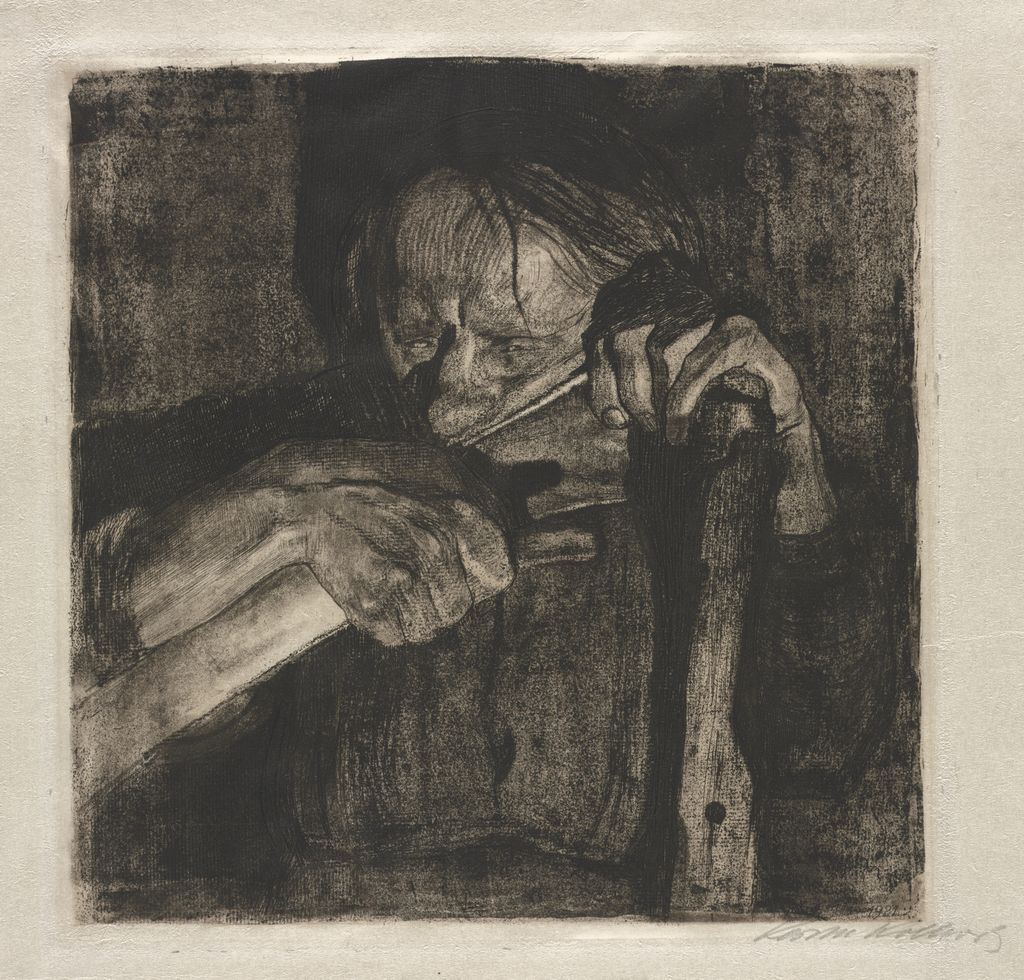
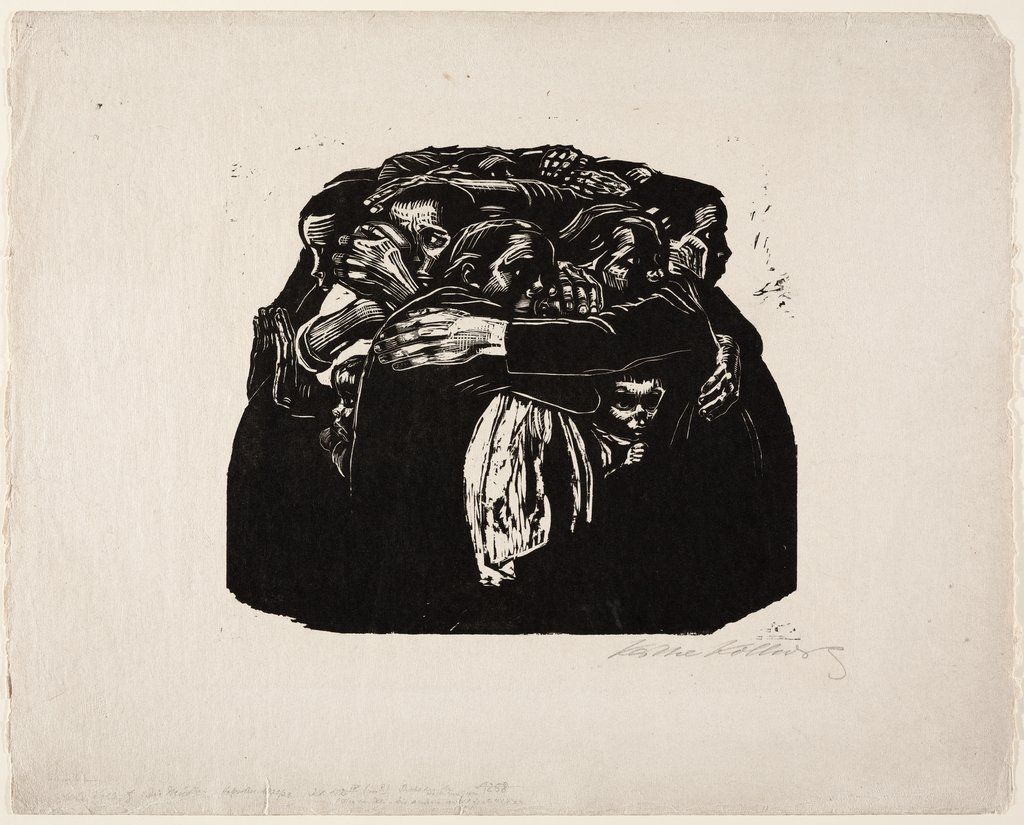
The Mothers
The Mothers, 1921–22. Städel Museum, Frankfurt am Main, SG 4289A D. Image source. Public domain. Resized and exported as JPEG.
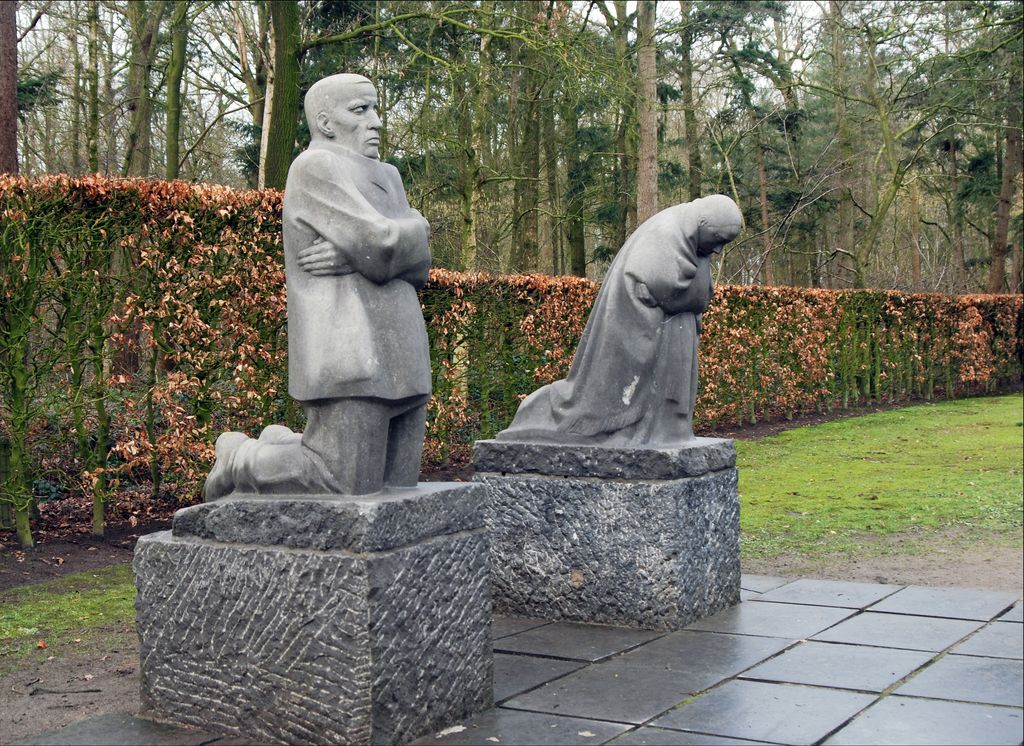
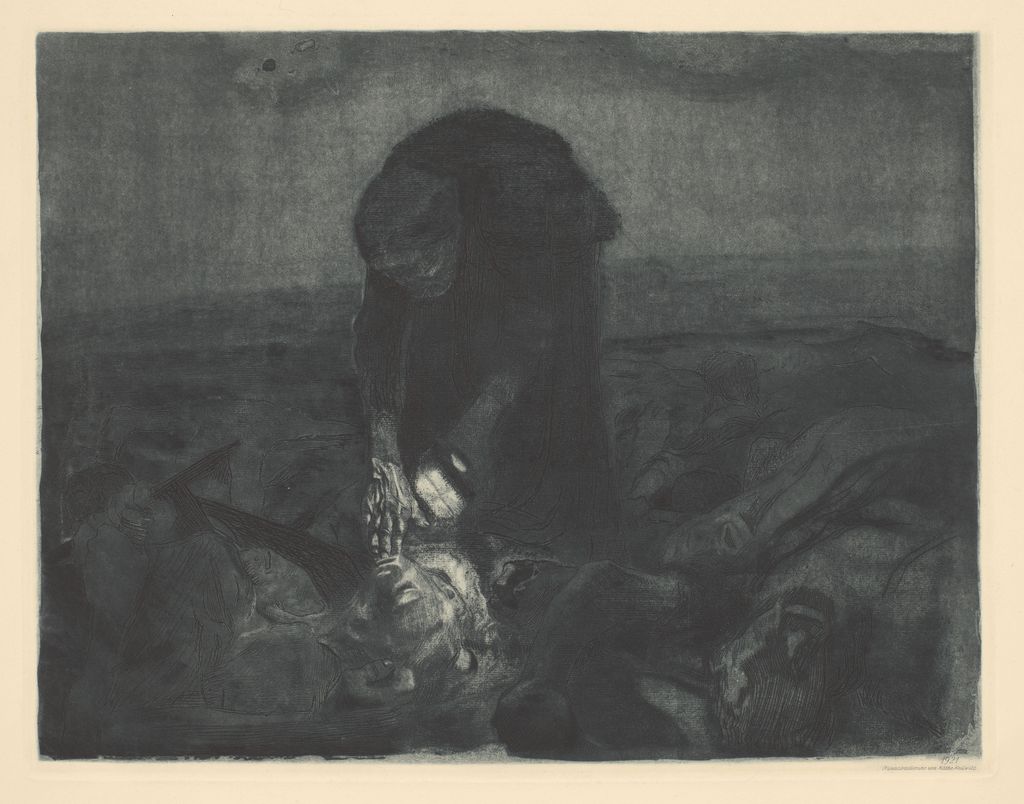
The Grieving Parents
The Grieving Parents at Vladslo, the memorial’s location since 1956. Photograph by Bva, resized. Image source. CC BY-SA 3.0. Resized and exported as JPEG.
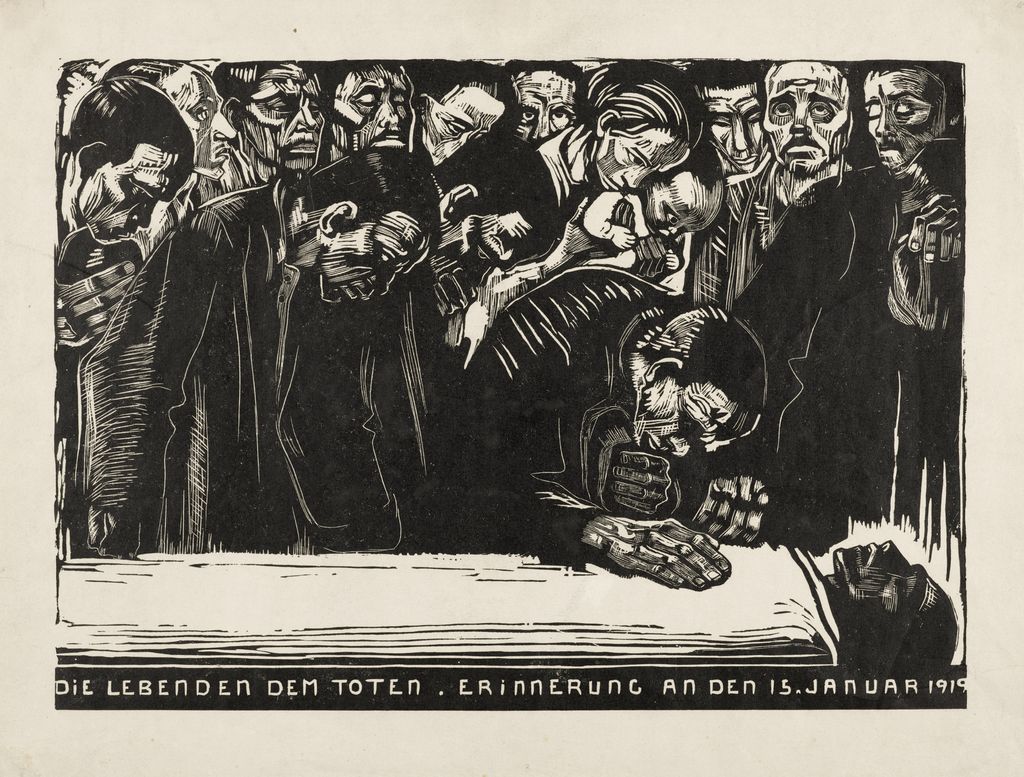
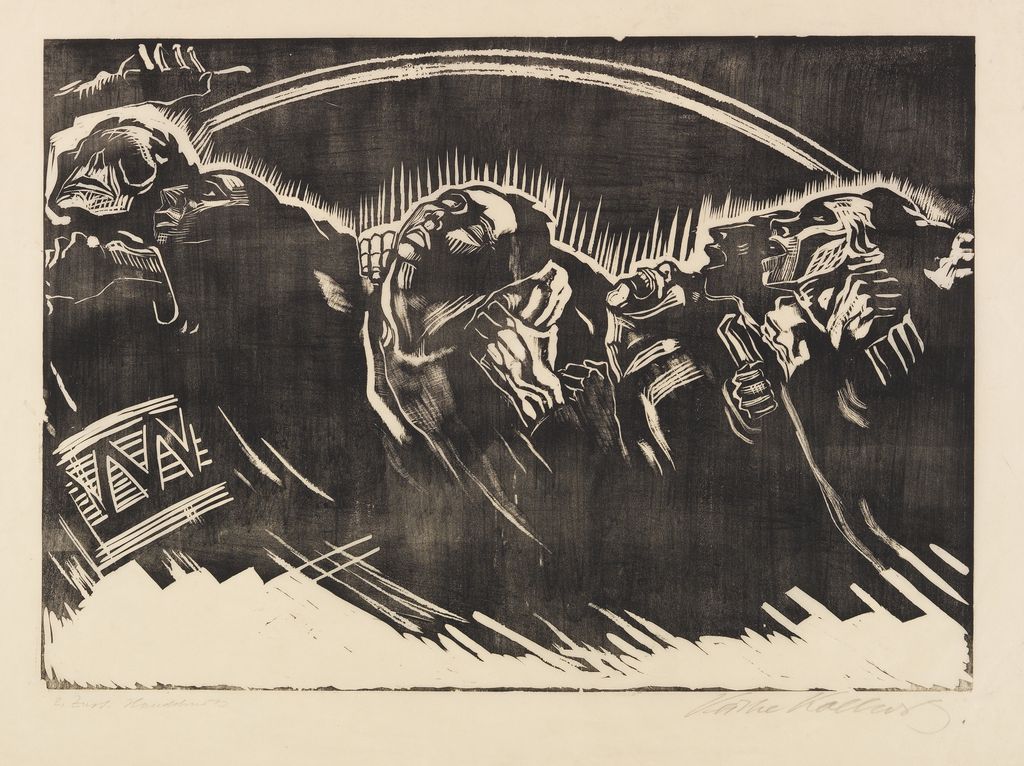
Memorial for Karl Liebknecht
Memorial for Karl Liebknecht, 1920. Kunstsammlungen Chemnitz, 86-47, Kn 159 VI. Photo: Kunstsammlungen Chemnitz/PUNCTUM/Bertram Kober. Image source. Public domain. Resized and exported as JPEG.