


 by Tom Gurney
Tom Gurney BSc (Hons) is an art history expert with over 20 years experience
Email: tomgurney1@gmail.com / Phone: +44 7429 011000
Käthe Kollwitz’s Sculptures: Introduction
Käthe Kollwitz’s Mother with Her Dead Son is small enough for the eye to take in both figures at once. In Cologne’s zinc cast, less than 40 centimetres high, the mother bends over the body gathered between her knees. At the German military cemetery at Vladslo in Belgium, the stone figures of The Grieving Parents kneel on separate bases. The eye travels from one parent to the other and out across the graves. In one work, grief takes the shape of two bodies in contact. In the other, it also occupies the ground between them. [1] [2]
Between those two scales lie plasters made and kept in the studio, bronzes cast decades apart and reliefs that bring a few hands or a single face close to the viewer. Kollwitz could make a figure legible from one position and leave part of it hidden until the viewer moved. She could also revise a group over years, carrying a pose from sculpture into drawing or returning to an idea first recorded on paper. The surviving objects preserve both kinds of change. [3]
At a Glance
- TrainingKollwitz studied sculpture for about two months at the Académie Julian in Paris in 1904. She was working intensively in the medium by 1912. [3] [4]
- MaterialsHer work survives in plaster, bronze, zinc and stone. The date of a model and the date of a particular cast can be decades apart. [5]
- Early sculptureMoMA’s 2024 retrospective showed the Boston plaster of The Lovers, an early surviving example of a composition Kollwitz developed in several versions. [6] [7]
- Two memorialsVladslo holds the original stone Grieving Parents. Berlin’s Neue Wache houses Harald Haacke’s 1993 bronze enlargement of Kollwitz’s small Mother with Her Dead Son. [1] [2]
Contents
- Paris and the Turn to Sculpture
- The Lovers in Plaster and Bronze
- What Happens Between a Model and a Cast
- The Shape of Protection
- What a Relief Can Hold
- A Farewell in the Round
- The last model to survive
- From the Cemetery to the Neue Wache
Paris and the Turn to Sculpture
During her second visit to Paris in 1904, Kollwitz spent her days in the sculpture class at the Académie Julian. The Kollwitz Museum Köln also documents two visits to Auguste Rodin, whom she admired. Hugo von Tschudi, director of Berlin’s Nationalgalerie, wrote to introduce her to him and recommend her work. Nathalie Muller, writing for France’s Institut national d’histoire de l’art, describes Kollwitz as essentially self-taught in sculpture. The Paris course gave her a period of formal instruction, while her long development in the medium took place in her own studio. [4] [8]
On New Year’s Eve 1912, Kollwitz recorded that she had spent nearly the whole year working on sculpture and was still unsure what she could achieve. Her diary shows how central the medium had become years before she exhibited a sculpture. In 1917, writing about the memorial for her son Peter, she set herself the task of condensing the human figure until its form could carry what she wanted to say. That ambition helps explain why a bowed head or a pair of arms drawn tight against the body could bear so much of a work’s meaning. [3]
Sculpture took up an increasing share of her time in the 1930s. In February 1933, under Nazi pressure, she was forced to leave the Prussian Academy of Arts. She could still use her Academy studio until early 1934. Cologne relates the scale of many later pieces to the cost of production and the working space she had available. By 1937 she was telling the playwright Gerhart Hauptmann that sculpture had become her principal occupation. The intimacy of those small works came partly from practical circumstances, and Kollwitz made it a formal strength. A figure as short as a handspan could ask the viewer to come close enough to follow a shift in weight. [3] [9]
The Lovers in Plaster and Bronze
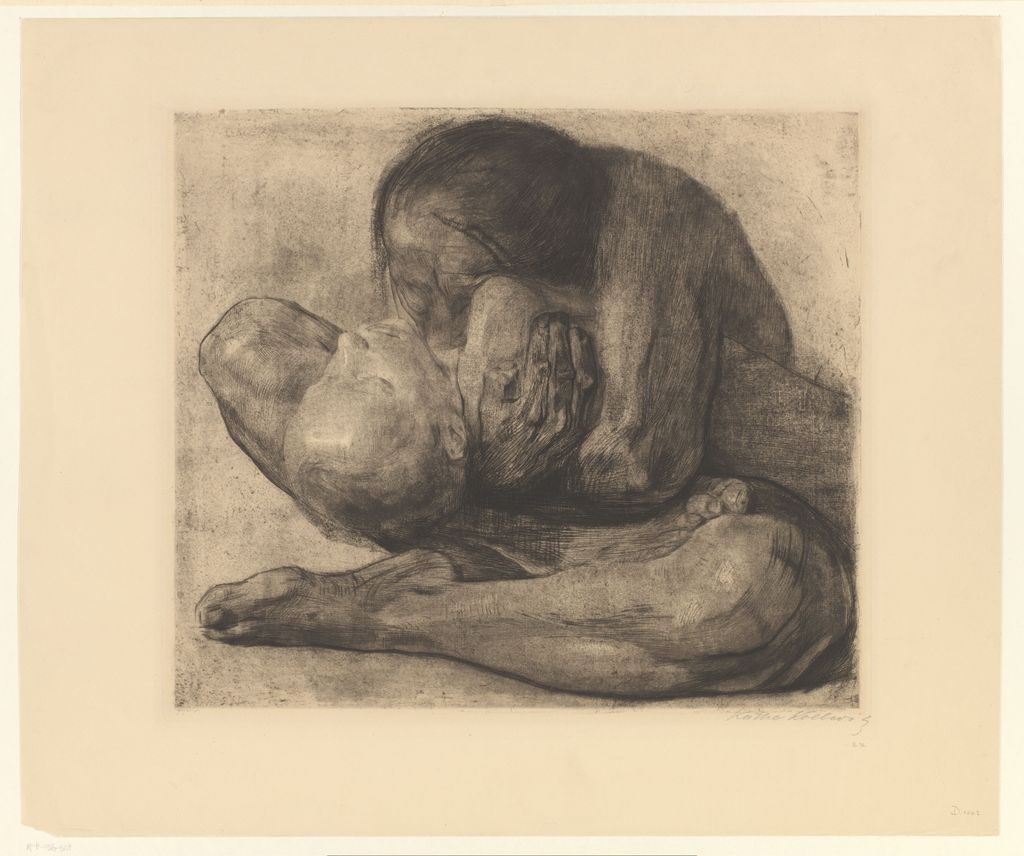
At the Museum of Modern Art’s 2024 retrospective in New York, curated by Starr Figura, The Lovers appeared as a plaster from the Museum of Fine Arts, Boston. MoMA dated that object to 1913 and recorded its height as 74.3 centimetres. Its label identified it as one of the few early Kollwitz plasters to survive the Second World War. The plaster was shown alongside work on paper that let visitors follow the same bodily actions across media. The checklist records a 1911 charcoal and graphite drawing from the Minneapolis Institute of Art, Woman with Dead Child on her Knees, as well as an impression of Death, Woman, and Child worked over in pencil and black ink. [6] [7] [10]
MoMA proposed Rodin’s The Kiss as a possible influence. The Musée Rodin traces that group back to Paolo and Francesca, the lovers in Dante’s Divine Comedy, and records that Rodin exhibited it independently in 1887. The French state’s marble entered the Musée du Luxembourg in 1901, before Kollwitz’s sculpture course in Paris. The chronology makes the comparison plausible, while Cologne’s account of her studio visits documents the contact with Rodin. What MoMA draws out in the Boston plaster is the change in reading as the viewer moves. The bodies can seem to merge in an embrace. From another angle the smaller figure lies limp across the lap, recalling a Pietà. MoMA also compares the encircling arms to those of Death in Kollwitz’s earlier works on paper. [7] [8] [11]
Cologne traces the composition through several stages, including a preliminary version in 1912 and a larger reworking documented in a photograph. In September 1913, Kollwitz wrote in her diary that she was working on the group of a girl sitting on a man’s lap and urged herself to have more confidence in her sculpture. She completed work on the composition late in 1915 and exhibited a plaster of the final version at Berlin’s Free Secession in spring 1916. It was the first sculpture she showed publicly. Cologne records that she was disappointed by its reception, even though the critics were more restrained than her own assessment suggests. The museum also records that the composition circulated in the 1950s under the title Woman with a Dead Child, a revealing instance of how readily viewers could see bereavement in an embrace. [12] [13]
The 1913 Boston plaster has its own object history. Cologne’s Pair of Lovers, catalogued as the second version, gives 1913–15 for the model and 1984 for its bronze. Berlin’s Neue Nationalgalerie records another bronze, Lovers II, as cast in 1976 and documents its passage from the estate through a museum loan to acquisition in 1980. In the bronzes, the larger figure draws the smaller head close. As one face disappears from view, the hand holding the head and the inclination of the two bodies do more of the expressive work. The dates tell us which object we are looking at. The pose tells us why the composition could carry such different readings. [6] [12] [13]
What Happens Between a Model and a Cast
Woman with Child on her Lap shows how long a model could stay in Kollwitz’s working life. Cologne dates its beginning to around 1911 and tentatively places the finishing work in 1936 or 1937. Kollwitz initially kept a single plaster cast, and a drawing made in lithographic crayon in 1921 shows almost exactly the same frontal arrangement. Cologne dates its bronze, Seeler 8 I.B.1, probably to 1937 and by 1938 at the latest. The mother bears the child’s weight while seeming absorbed in thought. Angular planes break up the surface, catching light along the edges of a group whose quiet depends on the steadiness of the supporting lap. [14]
MoMA showed a different solution in Mother with Child Over Her Shoulder, listing a 1917 model and a 1977 bronze from the Daniel Stoll and Sibylle von Heydebrand collection. Cologne dates the modelling to before 1917 and records that Kollwitz kept the group with her as late as her final refuge at Moritzburg. The museum notes that bronze and zinc casting came after her death. Earlier writers associated the pose with the idea of maternal sacrifice. Cologne points out that the angle also allows a more playful reading. From one side the child’s weight presses against the mother, while from another the child seems to scramble up her body for a look over her shoulder. The mother’s shoulder serves as a support and a screen. [6] [15]
A cast’s mounting can matter as much as its material. Cologne’s bronze Self-Portrait, Seeler 26 I.B.3, was modelled in 1926–36 and cast in 1937–39 under Kollwitz’s supervision. In December 1928 she described the frustration of returning to the head day after day. Cologne identifies its example as one of three verifiable lifetime casts. In the early mounting, the head sits upright and appears to meet the viewer directly. The museum contrasts that bearing with the downward inclination of posthumous examples. A small change at the join with the base can give the same face a more withdrawn expression. [16]
Annette Seeler’s sculpture catalogue, first published in 2016, separates the development of a design from the histories of individual examples. The companion online catalogue tracks casts, their whereabouts, ownership and exhibition histories. Cologne explains that foundries took commissions both from Kollwitz and from her heirs. It also records the use of sand casting and lost-wax casting, whose traces can help date particular objects. A foundry name identifies one participant in the making. Saint Louis Art Museum, for example, lists Kollwitz as the artist and the Hermann Noack foundry as the caster of its bronze Lamentation, accession 593:1958. It gives 1938–41 in the date field, while Cologne separately reports an estimated casting date for its own example. [5] [17] [18]
The Shape of Protection
In Mother with Two Children, the mother squats with a child in each arm. In a letter to Hans and Ottilie dated 15 July 1937, Kollwitz recalled seeing Ottilie hold her twins that way and realising that her group needed a second child. Cologne places the sculpture alongside The Twins, a 1923 chalk drawing, and the 1932 charcoal Mother, clutching two Children. The museum’s bronze, Seeler 29 I.B.6, stands 76 centimetres high. The model dates from 1932–36 and the cast from 1984. [19]
The second child alters the mechanics of the whole group. The mother’s weight drops towards the ground as her arms reach in opposite directions, and the rounded backs and shoulders bring the bodies together into a roughly cubic mass. Move around it and an arm that dominates the outline from one side reveals the child it encloses from another. The structure makes protection feel like work the mother has to keep doing. [19]
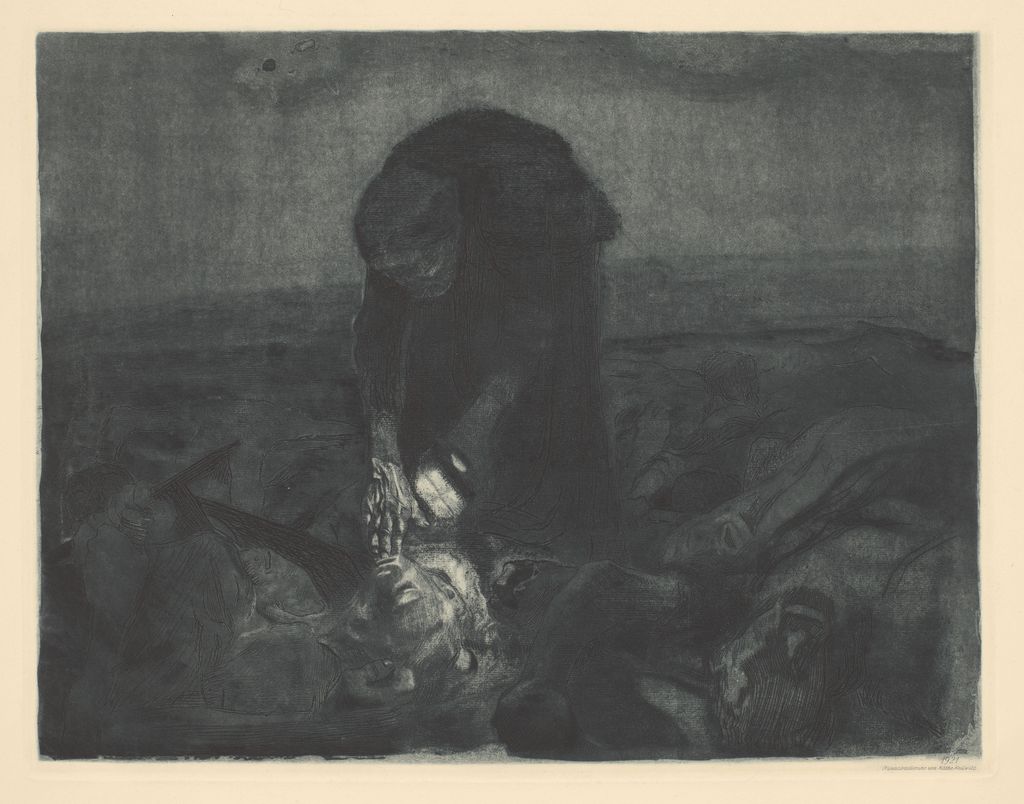
Tower of Mothers gives that effort to a group. While working on The Mothers, the sixth woodcut in her War series, Kollwitz recorded in April 1922 that she wanted to sculpt mothers defending their children in a circle. In the woodcut, children peer out through gaps in a dark wall of bodies. In the sculpture, modelled in 1937–38, one standing woman anchors the front. Her legs brace apart and her arms reach back towards the children. Her stance lets us see her face the threat and maintain the shelter behind her at the same time. Moving around the work reveals the depth of the circle that the woodcut conveys through overlap. [20] [21]
The tower’s apparent height comes from that standing formation. The zinc-alloy cast from the Baltimore Museum of Art shown at MoMA measures just under 28 centimetres high and dates from 1941–43. Cologne’s bronze, Seeler 35 II.B.1, is about the same height and was probably cast in 1946. Cologne documents bronze casting during Kollwitz’s lifetime as well and cites the painter Otto Nagel’s account that the Nazis removed the sculpture from the 1938 Christmas exhibition at the Klosterstrasse studio community. The model, its exhibition history and the two surviving objects thus belong to three distinct parts of the story. [6] [21]
In the 1941 reliefs Mother Protecting Her Child I and II, Kollwitz compressed the action into two hand-sized compositions that face in opposite directions. Cologne reads the crying child and the mother’s alarmed look in the first relief as signs of immediate danger. The second arrangement is quieter. Noack’s foundry books entered the zinc casts Kollwitz commissioned under Fliegerbombe, meaning aerial bomb. Cologne connects that name with an earlier drawing of a mother throwing herself over her children and with the experience of air raids in wartime Berlin. MoMA exhibited later bronzes of both designs, the first cast in 1962 and the second in 1958. The checklist gives them depths of 4.2 and 7.8 centimetres respectively. At a similar width, the second projects appreciably further from the surface. [6] [22]
What a Relief Can Hold
In Repose in the Peace of His Hands, two large hands draw a cloak around a departing figure. Kollwitz’s sister Lise asked her to make a relief for the family tomb after the death of Lise’s husband. Kollwitz chose the title from Goethe’s West-Eastern Divan. The family tomb is in Berlin’s Friedrichsfelde cemetery. Cologne dates the model to 1935–36 and its own bronze, Seeler 30 III.B.1, probably to 1947–50. At around 35 centimetres high and less than nine centimetres deep, the cast concentrates the action into a face-on encounter. The curve of each hand is legible against the fold it gathers. Where Mother with Two Children makes the viewer follow arms around several bodies, the relief gives the hands much of the expressive force of a whole figure. [19] [23]
For the grave of Franz Levy, Kollwitz reduced the composition further. Doris Levy commissioned the work in 1938, the year after her husband’s death. Kollwitz’s letter to Erna Krüger of 11 May describes the request for four clasping hands. She worked through drawings and models in clay and plaster before the stonecarver transferred the design to marble. Cologne points to the veins that stand out on the foremost hand in the finished relief at the Bocklemünd Jewish Cemetery. They give the contact a physical immediacy. After the November pogrom, Kollwitz wrote to Doris of her grief, shame and anger. In June 1939 she wrote of hoping that the relief had conveyed an enduring bond. The correspondence gives the clasp a particular history, rooted in the family’s bereavement and the persecution they were living through. [24]
Hands govern what can be seen in Lamentation, too. One covers the mouth and the other obscures an eye. Cologne recognises Kollwitz’s features in what remains visible. After Ernst Barlach’s death in 1938, she recorded seeing him in his coffin, with his small, bony hands lying together. In a 1941 letter to Trude Bernhard, she said that his death and the injustice done to him had weighed on her as she made the relief. In contrast with the upright bronze Self-Portrait, the face here is given in fragments. The gesture that expresses grief also restricts our access to the person grieving. [9] [16] [18]
The surviving examples call for some care with dates. Cologne’s object caption places the beginning of the model in 1938 and its probable completion in 1941. It dates its bronze tentatively to before 1945 or probably by 1946. The chronology’s accompanying text gives 1940 as the completion year. MoMA’s checklist, meanwhile, dates the privately owned, silver-painted plaster shown in New York to 1941–42, and its exhibition label identifies that plaster as one of the few to survive the war. The firmest points of reference are the dated letter, the separately identified objects and the qualified dates in their records. [6] [7] [9] [18]
A Farewell in the Round
Kollwitz began Abschied (Farewell) in February 1940, when her husband Karl was gravely ill. Her diary describes him sinking and slipping out of her arms as she works out the group. Karl died that July. Cologne dates the model to 1940–41 and its bronze, Seeler 39 I.B.1, probably to 1955. At just 17.4 centimetres high, the group retains a sketch-like directness. Broad, blocky forms make the transfer of weight perceptible without much detail. The embrace seems to be loosening even as it holds the two figures together. [25]
Cologne pairs the sculpture with a charcoal double portrait in which Karl props himself up beside Käthe. On paper, each figure has a place alongside the other, even as both recede into shadow. In Abschied, each body’s position depends on what the other body is doing. The physical resemblance to The Lovers lies in that interdependence. The difference is in the direction of the movement. In the early group the bodies seem to fold together. In Abschied the embrace registers the moment when they begin to part. [12] [25]
The last model to survive
Kollwitz began Two Soldiers’ Wives, Waiting in 1941 as a relief. She explained to Beate Bonus-Jeep that the arrangement grew out of the Christian grouping of Saint Anne, Mary and the infant Christ. In her first conception a young soldier’s wife held her child while sitting on her mother’s lap. She dropped the child and modelled the remaining figures as a freestanding group. Cologne points to the contrast between the smooth surface of the younger woman and the rough cloak of the older woman, where the bronze retains the texture of the clay. The model was finished in 1943. Cologne identifies its bronze as Seeler 43 I.B.1 and tentatively dates the cast to before 1950. [26]
From the Cemetery to the Neue Wache
Kollwitz began planning The Grieving Parents after Peter was killed in the First World War. The original stone figures were installed at Roggeveld military cemetery in 1932. The Flemish heritage inventory names August Rhades as the sculptor who executed the father and Fritz Diederich as the sculptor who executed the mother, both from Kollwitz’s designs. The father kneels upright with his arms crossed tight against his body. The mother bows forwards and draws her arms in close. Each figure has its own centre of gravity and a base of its own. [2] [27]
The move to Vladslo in 1956 changed the interval between them. Drawing on correspondence preserved in the German Foreign Office archive, historians Mark Connelly and Stefan Goebel show that the figures were placed closer together at the rear of the new cemetery. At Roggeveld they had stood near the entrance. The same two stones now meet the visitor at a different point in the approach to the graves. The shell-limestone figures at Alt St. Alban in Cologne are later replicas made from new plaster casts of the originals. Erwin Heerich undertook the mother and Joseph Beuys the father in Ewald Mataré’s workshop. [27] [28]
In the small Mother with Her Dead Son, or Pietà, the figures come back into contact. Cologne dates the model to 1937–39 and its zinc cast, Seeler 37 I.B.6, to 1941–43. The front has the concentration of a relief. The broad outline of the mother’s clothing encloses the son’s folded body, while a side view makes clear how deeply he rests between her knees. Kollwitz drew on the familiar shape of the Pietà and understood her own sculpture in secular terms. Her diary describes its mood as contemplative. [1]
Harald Haacke’s bronze enlargement for Berlin’s Neue Wache, installed in 1993, is roughly four times the height of the small sculpture. The chamber, dedicated to the victims of war and tyranny, gives the group a different viewing distance. Close to the zinc cast, the son’s position emerges from the folds and from the space between the mother’s knees. Across the Berlin chamber, the bowed outline is what the eye can grasp first. The angle at which she gathers him remains readable at both scales. [1]
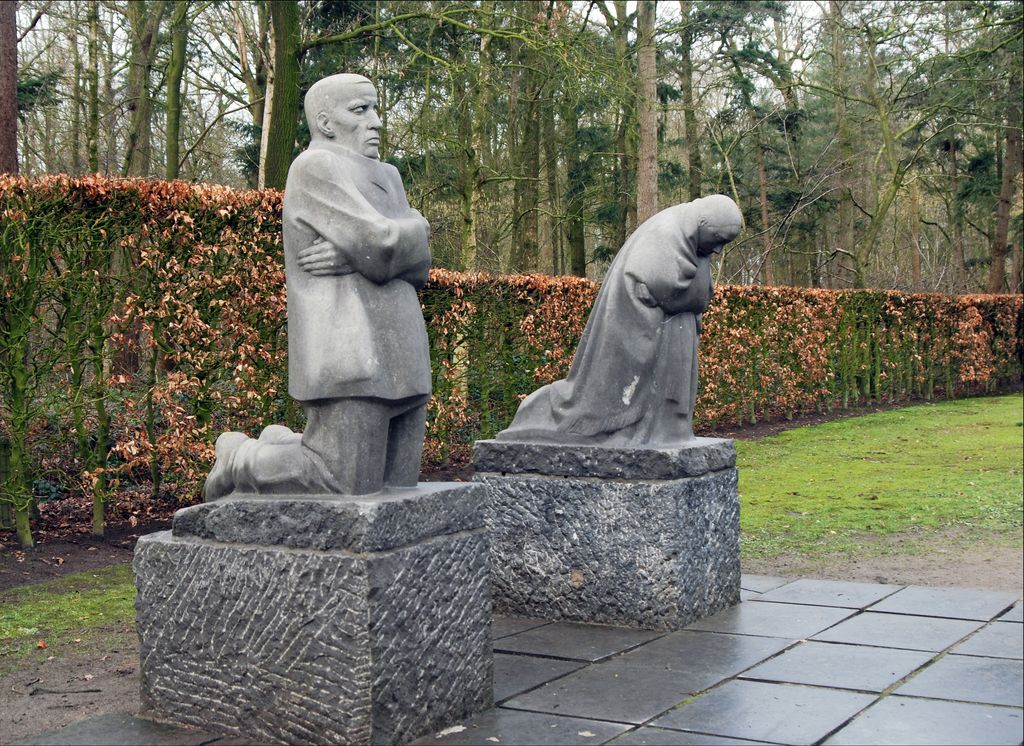
Käthe Kollwitz’s Grieving Parents at Vladslo, the memorial’s location since 1956. Photograph by Bva, resized. Image source. CC BY-SA 3.0. Resized and exported as JPEG.
Käthe Kollwitz artworks directory
Selected documented works, including the complete published sequences of the five cycles discussed here. Catalogue links identify the specific record behind each row.
Frequently Asked Questions
The model date describes when Kollwitz developed the form. The cast date describes when a particular object was made from that design. Cologne’s Woman with Child on her Lap began around 1911 and its bronze was probably cast in 1937. Its bronze Mother with Two Children was cast in 1984 from a design developed in 1932–36. [14] [19]
Discussion
Look again at the images and ideas explored in Käthe Kollwitz’s Sculptures. These editorial prompts invite your observations.
Reader Insights
How does moving around a sculpture change the gesture you see?
Which aspects of a clay model can survive in a later metal cast?
How does the mounting of a head change the expression you see in a cast?
Join the Conversation
Share a detail, comparison or question about Käthe Kollwitz’s Sculptures below.
References
- Kollwitz Museum Köln, Pietà (Mutter mit totem Sohn), Seeler 37 I.B.6 View source.
- Agentschap Onroerend Erfgoed, Treurend ouderpaar (Vladslo – WOI) View source.
- Kollwitz Museum Köln, The Sculptural Work View source.
- Nathalie Muller, Institut national d’histoire de l’art, Käthe Kollwitz (1867–1945) – 2/2 View source.
- Kollwitz Museum Köln, The Catalogue Raisonné of Kollwitz’s Sculptural Work View source.
- The Museum of Modern Art, Käthe Kollwitz Exhibition Checklist, pp. 24–26 and 37–38 View source.
- The Museum of Modern Art, Käthe Kollwitz Extended Exhibition Labels, pp. 8–10 View source.
- Kollwitz Museum Köln, Parisian Inspirations View source.
- Kollwitz Museum Köln, Timeline 1933–1945 View source.
- The Museum of Modern Art, Käthe Kollwitz, 2024 exhibition record View source.
- Musée Rodin, Le Baiser, marble, S.01002 View source.
- Kollwitz Museum Köln, Pair of Lovers, Seeler 13 View source.
- Neue Nationalgalerie, Staatliche Museen zu Berlin, Liebespaar II, NG 23/80 View source.
- Kollwitz Museum Köln, Woman with Child on her Lap, Seeler 8 I.B.1 View source.
- Kollwitz Museum Köln, Mutter mit Kind über der Schulter, Seeler 15 View source.
- Kollwitz Museum Köln, Self-Portrait, Seeler 26 I.B.3 View source.
- Saint Louis Art Museum, Lamentation, accession 593:1958 View source.
- Kollwitz Museum Köln, Lamentation, Seeler 38 I.B.3 View source.
- Kollwitz Museum Köln, Mother with Two Children, Seeler 29 I.B.6 View source.
- Kollwitz Museum Köln, The Mothers, sheet six of War, Kn 176 VII b View source.
- Kollwitz Museum Köln, Tower of Mothers, Seeler 35 II.B.1 View source.
- Kollwitz Museum Köln, Mutter schützt ihr Kind I und II, Seeler 41 and 42 View source.
- Kollwitz Museum Köln, Repose in the Peace of His Hands, Seeler 30 III.B.1 View source.
- Kollwitz Museum Köln, Das Grabrelief für Franz Levy, Seeler 34 B View source.
- Kollwitz Museum Köln, Abschied, Seeler 39 I.B.1 View source.
- Kollwitz Museum Köln, Two Soldiers’ Wives, Waiting, Seeler 43 I.B.1, accession 70100/86004. View source.
- Kollwitz Museum Köln, The Memorial “Grieving Parents” View source.
- Mark Connelly and Stefan Goebel, Forgetting the Great War?, pp. 17–18, Kent Academic Repository View source.
More KOLLWITZ Works
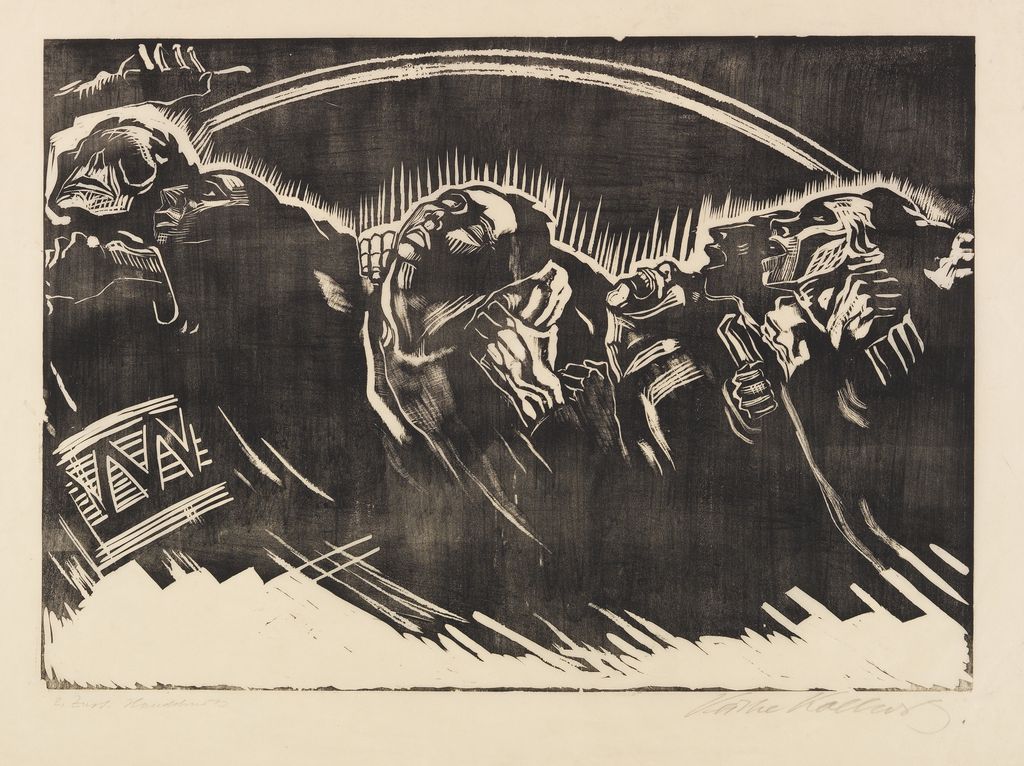
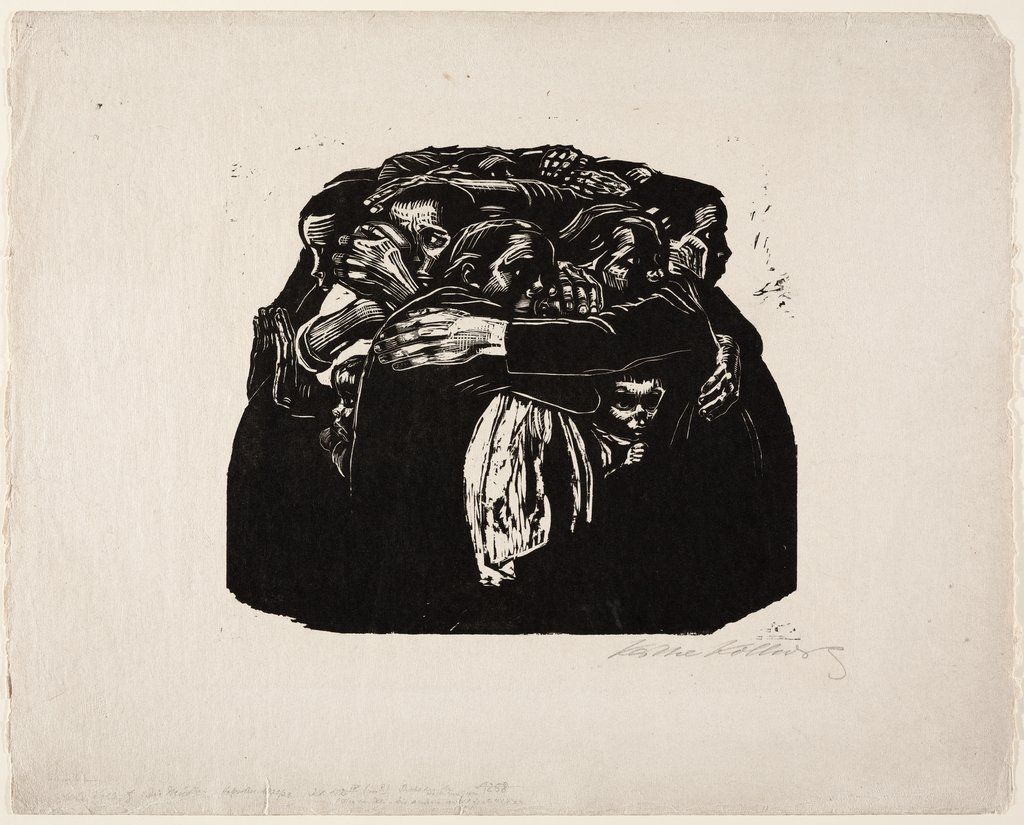
The Mothers
The Mothers, 1921–22. Städel Museum, Frankfurt am Main, SG 4289A D. Image source. Public domain. Resized and exported as JPEG.
The Grieving Parents
The Grieving Parents at Vladslo, the memorial’s location since 1956. Photograph by Bva, resized. Image source. CC BY-SA 3.0. Resized and exported as JPEG.
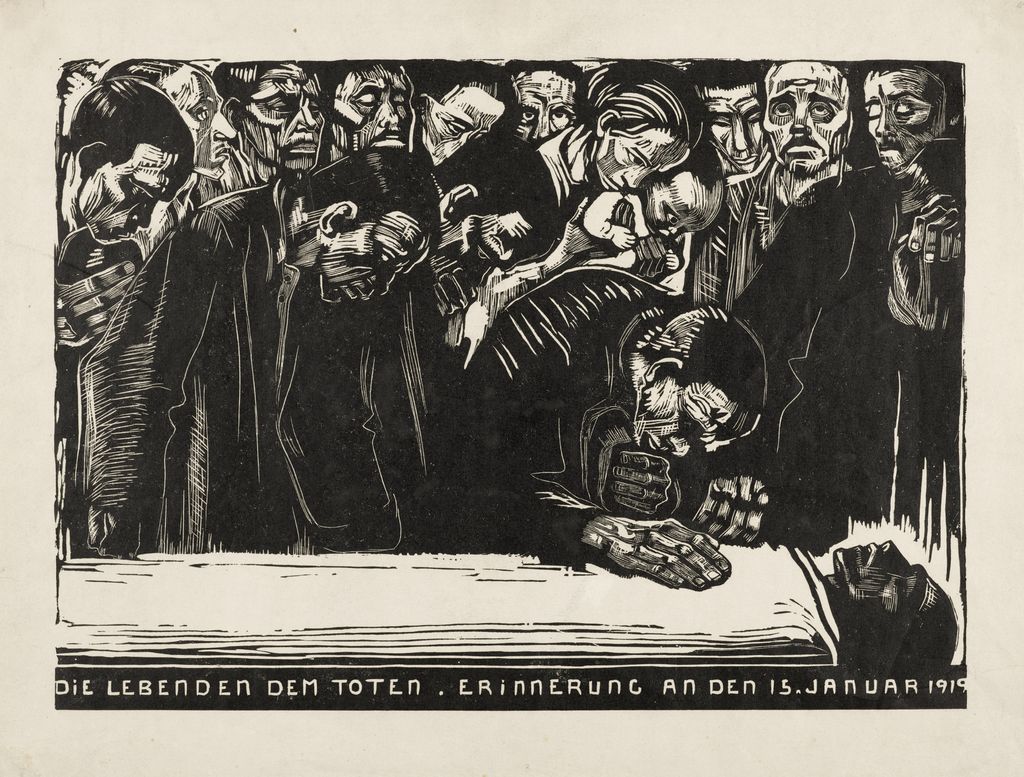
Memorial for Karl Liebknecht
Memorial for Karl Liebknecht, 1920. Kunstsammlungen Chemnitz, 86-47, Kn 159 VI. Photo: Kunstsammlungen Chemnitz/PUNCTUM/Bertram Kober. Image source. Public domain. Resized and exported as JPEG.