


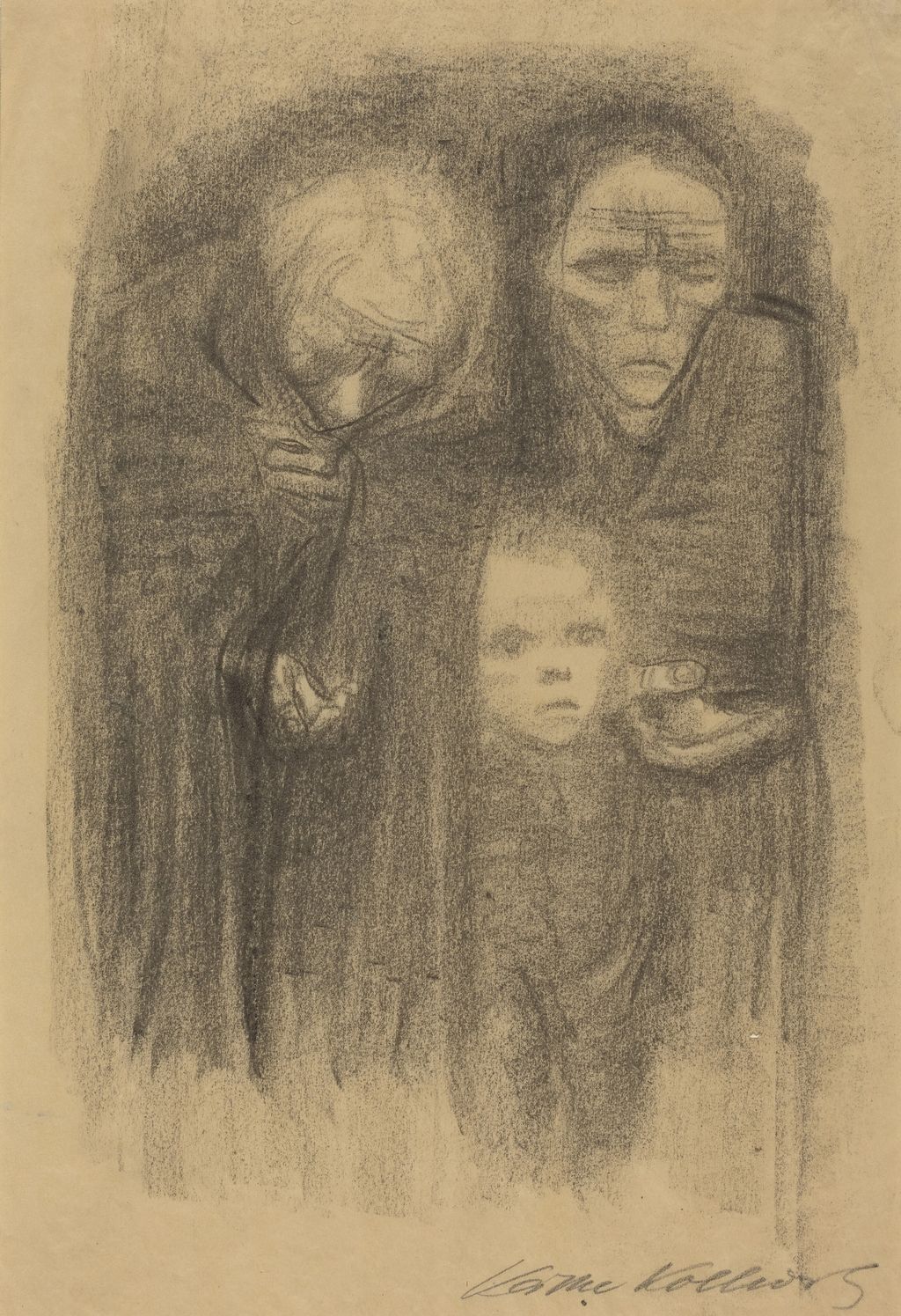
Käthe Kollwitz, Beggars, 1924. National Gallery of Art, 1943.3.5219. National Gallery of Art, Washington. Image source. Public domain. Resized and exported as JPEG.
 by Tom Gurney
Tom Gurney BSc (Hons) is an art history expert with over 20 years experience
Email: tomgurney1@gmail.com / Phone: +44 7429 011000
Käthe Kollwitz Drawings: Introduction
In Käthe Kollwitz’s Out of Work (1909), a man sits with his chin on his fists. Behind him, two children sleep against a reclining woman. Black chalk gives the man’s coat and profile their weight, while opaque white watercolour brings the pillow and clothing forward. The woman’s features are so lightly drawn that the grey-brown paper seems to come through her face. Where the man’s dark profile meets the white clothing, a change of tone separates two people who have scarcely any room between them. Beneath the chalk and watercolour is blue pencil. On the front Kollwitz wrote Arbeitslosigkeit, the German title, and on the back she gave her Berlin address, Weißenburger Straße 25. The National Gallery of Art in Washington holds the sheet as accession 1943.3.5218. [1]
A mark of white could give fabric its weight, pick out a body in a night scene or anticipate a line cut into a woodblock. Kollwitz also drew directly on trial impressions, where a pencil or brush could change a picture already printed. MoMA’s 2024 retrospective, organised by Starr Figura with Maggie Hire, brought drawings and working proofs together so that these decisions could be seen across several versions of a work. The surviving sheets also show how much drawing could do on its own, from the fragile grey of a face to the blunt force of charcoal dragged across paper. [2]
At a Glance
- MaterialsGraphite, charcoal, chalk, pastel, ink and opaque watercolour on supports that include drawing board, tracing paper, coloured paper and sandpaper. [1] [3] [4] [5]
- Three drawings to compareOut of Work (1909), the grey-green chalk study for Battlefield (c. 1907) and Self-Portrait in Profile Facing Left, Drawing (1933). [1] [6] [7]
- Drawing catalogueNT refers to the Nagel–Timm catalogue. Its first edition, published in 1972, gathered nearly 1,300 drawings then known. Further sheets have since come to light. [3] [8]
Contents
- From a copied portrait to a scene from Zola
- What the surface contributes
- Joining paper and drawing over prints
- Finding the gesture in Peasants’ War
- Battlefield and the placement of light
- The drawing sheet and the weekly press
- Drawing a face in shadow and in light
- The late drawing and the sculptor’s eye
From a copied portrait to a scene from Zola
The earliest drawing currently known is a portrait of Arthur Schopenhauer made in 1883, when the artist was sixteen and still known as Käthe Schmidt. The graphite drawing on board is scarcely larger than a postcard. Her teacher in Königsberg, the engraver Rudolf Mauer, had taught her to draw from plaster casts and printed models. Here she worked from an etching. Georg Paga, the friend for whom she made the drawing, wrote on its reverse in 1946 that the etched portrait came from a biography of the philosopher. The sheet was known to researchers, but its whereabouts were unclear until Brian McCrindle acquired it at auction in 2014. He donated it to the Kollwitz Museum Köln in 2025. It has no NT number. The history of this one sheet shows why the catalogue’s total is a record of what could be located and documented at the time. [3] [8]
Within a decade, Kollwitz was working in the other direction, developing a drawing into a print. France’s Institut national d’histoire de l’art traces the early sketches for Scene from Germinal to a fight in Émile Zola’s novel about a mining community. In the Getty’s drawing, made between 1891 and 1893, pen and brush establish dark passages on buff paper, and white gouache can cover those passages wherever Kollwitz wants to recover a light. The Getty’s separate etched proof, Kn 19 IIIb, uses brown ink on copperplate paper. Light there depends on how much ink the plate deposits. The Städel Museum’s impression makes the spatial effect clear. Catherine looks on as the men fight in a room so long and low that the museum likens its proportions to a mine passage. The drawing gave Kollwitz a way to organise the action and light. The plate required her to build them again in a new material. [9] [10] [11] [12]
What the surface contributes
The Getty’s Sitting Female Nude, dated about 1904 and shown at MoMA in 2024, combines green, blue and white pastel with charcoal on sandpaper. The rough surface catches particles of pastel, breaking a broad stroke into flecks of colour. A cool passage can suggest the turn of the body without a firm outline, while charcoal can deepen a shadow or pick out an edge. The sheet is nearly 75 centimetres high. The grain remains part of the effect even across passages large enough to read from a distance. [4]
Compare the seated nude seen from behind in Cologne, NT 674, dated about 1910–12. Kollwitz drew it in charcoal on brown paper. The ground supplies a middle tone from the outset, so a dark mark can turn a shoulder or suggest the weight of the seated body without her shading the whole surface. Cologne also catalogues a separate drawing with the same title in black chalk on yellowish Ingres paper, and a seated profile in charcoal on blue-grey paper. Each ground changes the range available to a single dark drawing material. [13]
Drawing also gave Kollwitz room to make work for a private audience. MoMA’s label for Love Scene I places it among the erotic drawings she called her Sekreta, which remained unexhibited and unsold during her lifetime. In that drawing, the bold charcoal strokes give the embrace much of its force. The marks have a different task from the shading in the seated nudes. They register the pressure and movement of bodies against each other. [14]
Joining paper and drawing over prints
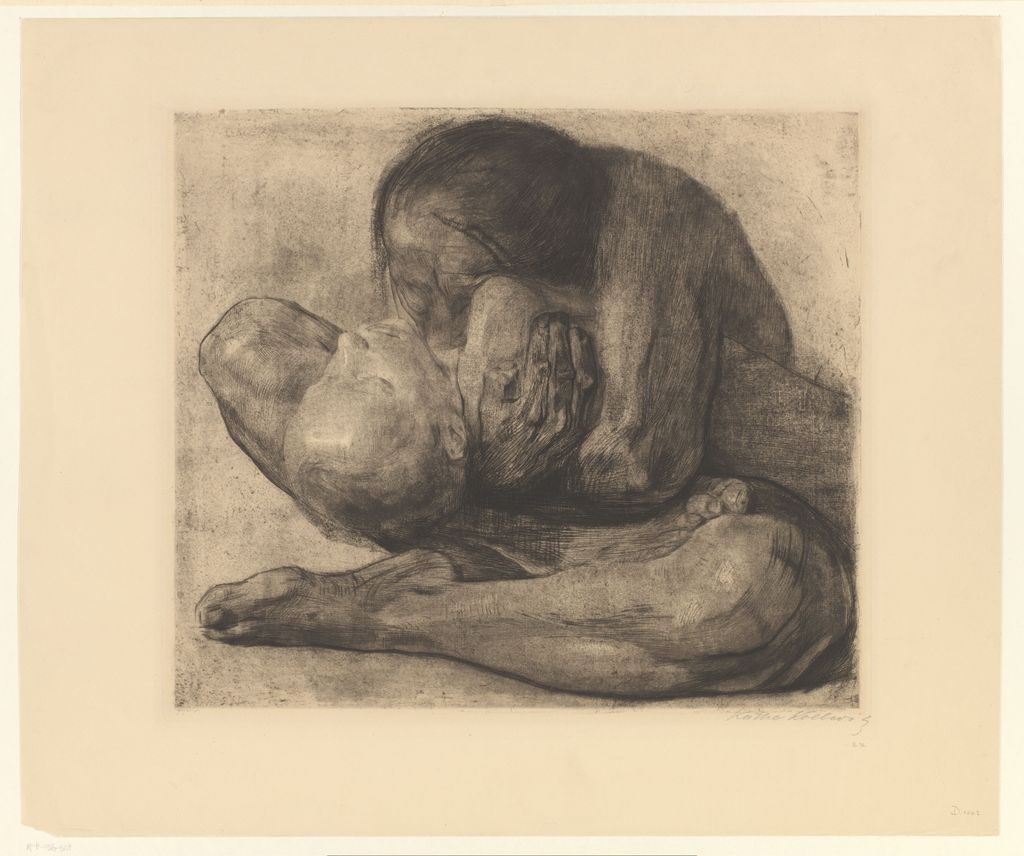
The Getty’s Woman with Dead Child of 1903, NT 241, shows how far Kollwitz could take an image on paper. She used black chalk and graphite with white and orange chalk on green wove paper mounted on a second, darkened beige-blue sheet. The Simms finding aid records that she drew part of the woman’s head on the mount itself. The join falls within the working area of the drawing. The Getty describes the sheet as a finished drawing in its archival inventory and links it to two impressions of the related print, Kn 81 II and VIIIa. It can be read as a developed work in its own right and alongside the changes Kollwitz made in print. [15] [11]
MoMA exhibited the Getty drawing beside early impressions of the image. Its own first-state proof, accession 113.2024, carries charcoal worked over the printed image. In the Getty’s pair, the state II impression uses black ink on copperplate paper, while state VIIIa uses black ink on greenish-grey chine collé, a thin paper attached to a backing. The latter brings a coloured ground into the image through the choice of paper. The green of the drawing, the charcoal on the MoMA proof and the tint of the later Getty impression belong to three different stages of making the image visible. [10] [4] [11] [16]
Two British Museum impressions in MoMA’s checklist make another distinction visible. On the state III sheet, gold-coloured wash, graphite and charcoal were worked over the impression. The state VI sheet was overprinted from a gold-sprayed lithographic tone stone. Kunsthalle Bielefeld documents another experimental impression made using a gold-coloured stone. A metallic passage can therefore belong to work done on an individual sheet or to a separate printing operation. Kollwitz’s letter to Max Lehrs of 16 June 1904 supplies a further distinction. While settling which prints Dresden would buy, she described Woman with Dead Child as an independent work and separated it from the two Peasants’ War sheets under discussion. [4] [17] [18]
Finding the gesture in Peasants’ War
For the third plate of Peasants’ War, Kollwitz worked through several ways of showing a woman with a scythe. In the charcoal, pencil and white chalk drawing Inspiration, dated 1904 or 1905, a second figure guides the woman. Kollwitz took that conception into an intaglio version and then abandoned it. MoMA showed two state IV impressions of the rejected print. The Berlin Kupferstichkabinett impression records the work of the plate, while the Mayer family impression also carries charcoal, white chalk and ink applied to the sheet. In the next rejected version, Woman with Scythe, the woman has the composition to herself. The gesture and the blade now have to carry the action that the companion figure once helped explain. [4] [19] [20]
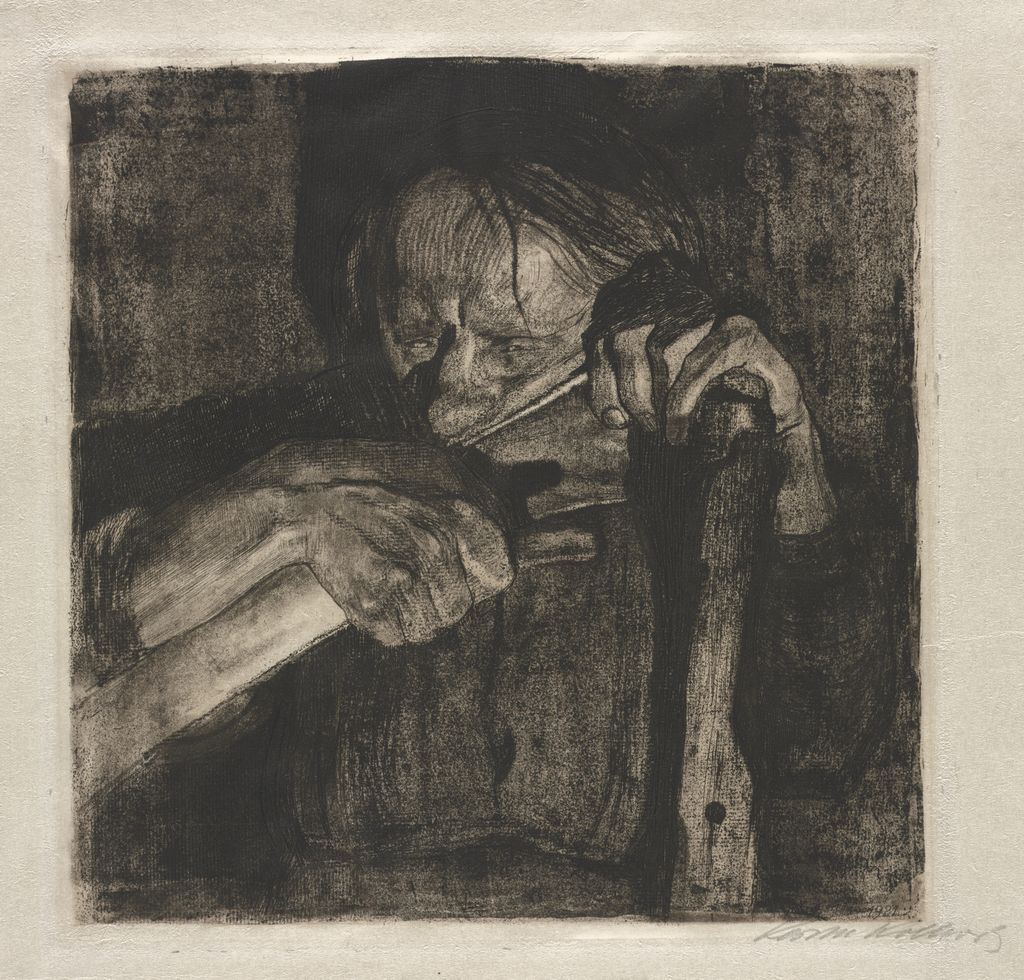
Cologne’s chalk-and-pencil study NT (396a) gives the figure a tall space. The eventual square plate of Sharpening the Scythe closes in on her head, arm, torso and blade. The narrow crop takes the eye from the sharpening to the pause in the woman’s face, where her brow tightens over narrowed eyes. Even after fixing the square format, Kollwitz kept drawing. MoMA’s checklist records graphite on Boston’s first-state impression and pencil, charcoal and black and white chalk on San Francisco’s fourth-state impression. The latter also has a reworked piece of paper glued at the lower left. She could draw a new edge, change a tone or insert a correction on the proof and judge it against the image already there. [4] [19] [20]
An earlier pair of studies shows how much can happen before a plate is made. MoMA holds a charcoal Study for End of 1896 for A Weavers’ Revolt, accession 109.2024. A separate study of 1897 in Dresden, also exhibited in 2024, uses pencil, pen and brush, black ink and brown wash with white heightening. Charcoal lets a dark mass spread and soften across the sheet. The later study combines the pen’s ability to pick out a boundary with the brush’s ability to cover an area in tone. The two drawings preserve different ways of testing how the final scene would read. [4] [21]
Battlefield and the placement of light
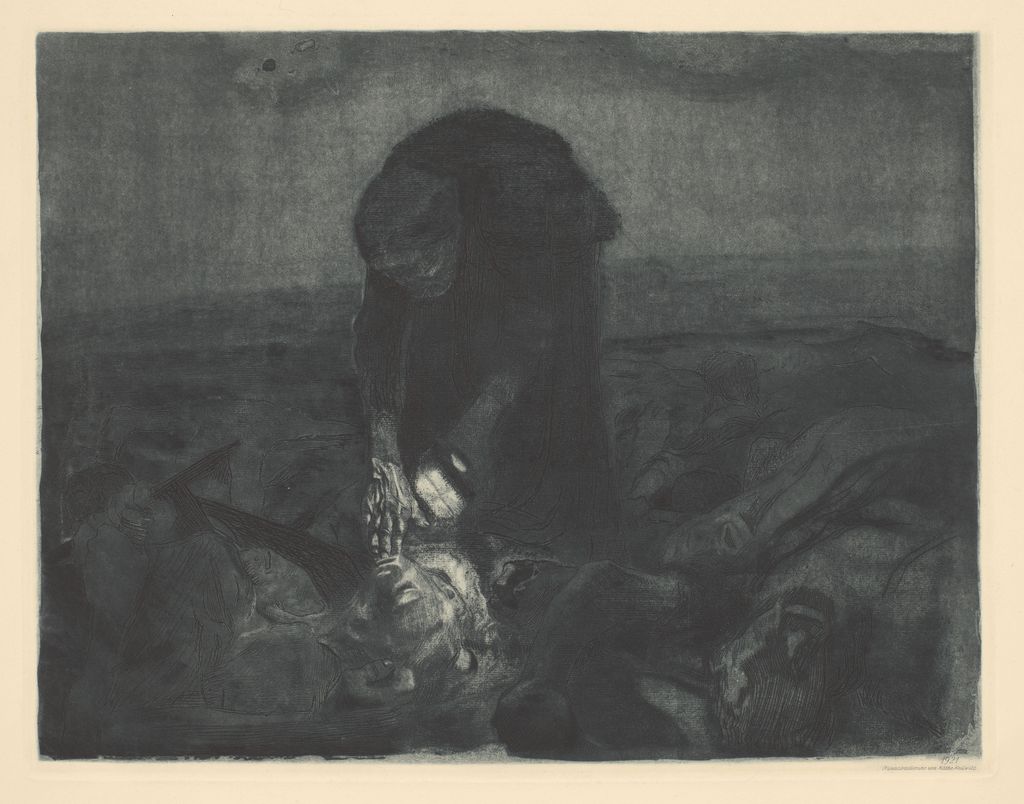
The drawings for Battlefield preserve different ways of telling what happened after the rebellion. In an early conception, a woman buries her son at night. In Detroit’s Burial, dated about 1903, heavy charcoal gives weight to the digging figure, while touches of yellow and white draw attention to the faces of the mother and child. Cologne’s separate charcoal Woman Digging, NT 254, isolates the physical action. Bending and digging give the mother a task and make the scene unfold over time. [22] [6]
Two other sheets in Cologne separate problems that meet in the 1907 print. The tall Battlefield study, NT (411a), uses black chalk heightened with white on grey-green laid paper. With a middle value already present, Kollwitz could deepen the surrounding darkness and add light to the same surface. Dead Boy, NT 413, is a horizontal charcoal drawing on white Ingres paper. Here the white can come from the paper itself, and Kollwitz can consider the weight and position of the body apart from the woman who discovers it. In the finished print, Kn 100, the decisive action is recognition. A lantern picks out the son among the fallen peasants. The same light that identifies him also makes the presence of the other bodies harder to overlook. [6]
Strasbourg’s impression, Le champ de bataille, inventory 5.916, entered the collection as a gift in June 1908. Its French catalogue records etching, drypoint, aquatint, emery and soft ground carrying the impressions of laid paper and Ziegler transfer paper. The texture of paper thus matters twice in the development of the image. In the chalk study the laid sheet takes the marks directly. In the print, the texture impressed into the soft ground helps form the image that the plate prints. [6] [23]
The drawing sheet and the weekly press
Beginning in 1908, Kollwitz contributed drawings to the Munich satirical weekly Simplicissimus. On 19 July 1909 the magazine published the Washington Out of Work as Das einzige Glück (The Only Good Fortune). Its caption suggested that the authorities would tax children too if they did not need future soldiers. The title on Kollwitz’s sheet names the family’s situation. The published title and caption tell the reader where to direct their anger. The drawing’s contrasts also had to work in reproduction, where the physical differences between the paper, chalk and opaque white could only be conveyed as differences in printed tone. [1] [24] [25] [26]
In Warm Shelter (Wärmehallen, 1908–09), Cologne identifies a specific adjustment for the magazine’s printing. Kollwitz emphasised the inked areas, working with pen and brush in ink and sepia as well as black chalk on olive-green paper, with white heightening in the background. The magazine published the image on 1 March 1909 under the title Mißtrauen (Distrust). The stronger ink masses helped her design carry through a new reproduction process. The added title and caption gave that design a second life in the magazine’s satire. [27]
Kollwitz also developed Arbeitslosigkeit as an intaglio print. The Städel’s preparatory charcoal drawing, NT 544, is larger than the Washington sheet and has a study of a reclining nude on the reverse. The Berlin Kupferstichkabinett identifies the seated man as a feature carried over from the version reproduced in Simplicissimus. Its first-state proof shows how she kept adjusting the room after printing began. She marked a new position for a bedpost farther left and adopted it in the next state. Moving the post changes the boundary of the bed and the space around the figures. The later Unemployment (Erwerbslos) belongs to Proletariat and is a separate woodcut. The related titles trace a persistent subject in her social criticism across different sheets and audiences. [26] [28] [29]
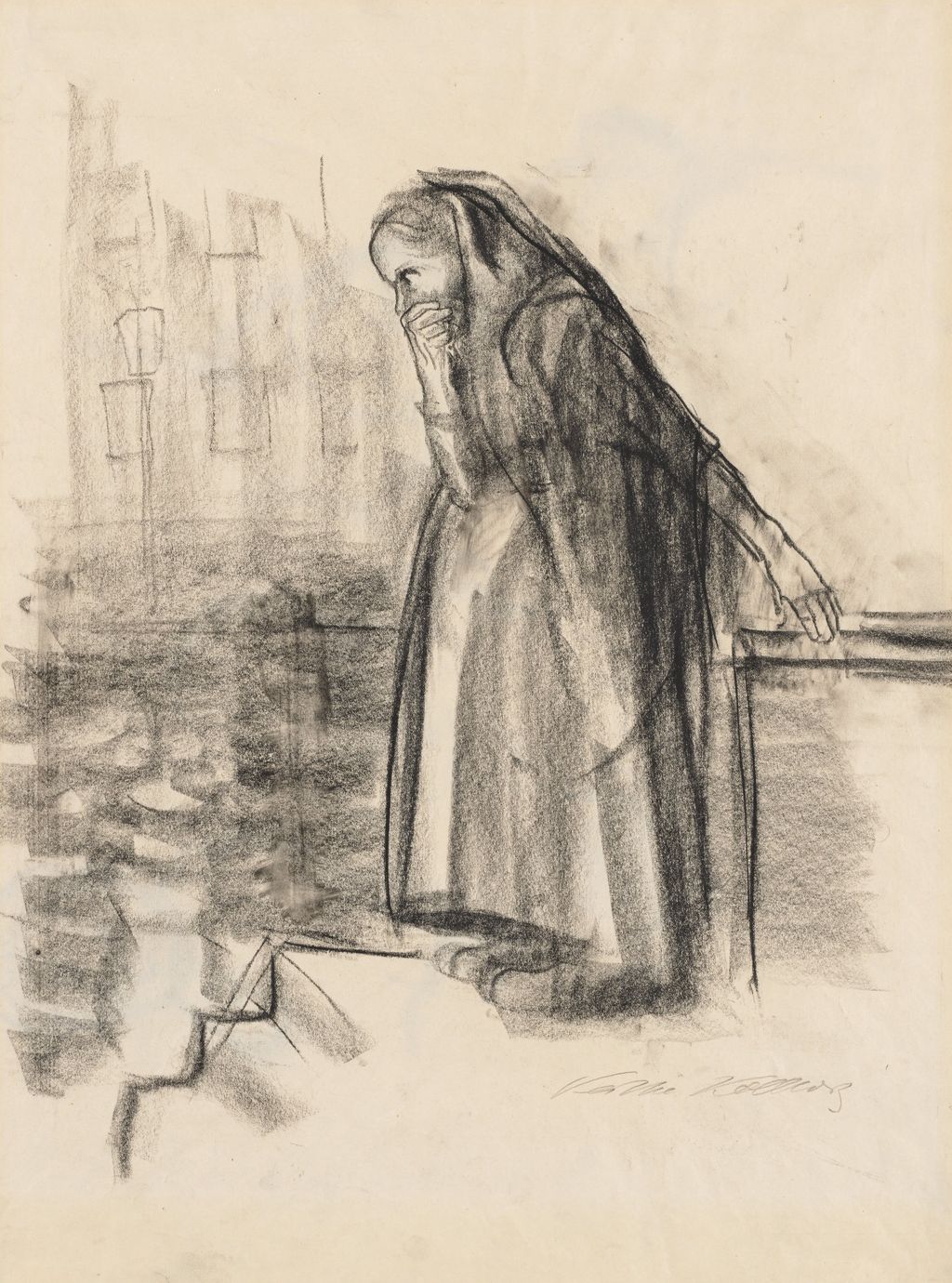
Käthe Kollwitz, Pregnant Woman Contemplating Suicide (recto), c. 1926. Cleveland Museum of Art, 1962.291.a. Image source. CC0 / Public domain. Resized and exported as JPEG.
Drawing a face in shadow and in light
In the frontal charcoal Self-Portrait, NT 988, Kollwitz worked on tracing paper that has browned. The shadows around the eyes deepen into the bags beneath them. Cologne dates the sheet to 1923 and notes that Kollwitz added the date years later with a question mark. The museum pairs it with the 1924 lithograph Kn 209, made by transferring a drawing, and presents NT 988 as a related sheet. The strongest kinship is in where darkness collects on the face. The published lithograph carried that close scrutiny into a Leipzig portfolio alongside prints by other artists. [5]
The 1924 left-facing profile NT 1001 solves a different problem. Kollwitz brushed opaque white onto dark green paper, using black wash in places. The pale strokes anticipate the lines left unprinted when she cut into the woodblock. The drawing let her see how much of the face could emerge through light marks alone. In a later state of the woodcut, Kn 203, she substantially shortened the block, tightening the composition around the face. Across these two self-portraits, drawing serves two very different ways of constructing a likeness. One builds it through accumulating shadow. The other finds it by bringing light out of darkness. [5] [30]
The late drawing and the sculptor’s eye
In Self-Portrait in Profile Facing Left, Drawing (1933), NT 1240, Kollwitz holds a drawing implement near a slanting line. The face and hand have sharper definition than the clothing, which she blocks in with broad charcoal strokes. The brown laid Ingres paper remains open around the raised hand. The eye follows the line of the arm, then crosses the small gap between the implement and the surface. Kollwitz makes that interval, the instant before the next mark, the subject of the drawing. She signed and dated the sheet. Arthur Grimm’s 1935 photograph shows her at the Klosterstraße studio with it behind her. Cologne reads the drawing as an act of artistic self-reassurance in the period following the Nazi takeover. [7] [31]
Charcoal still served as a means of developing images for print in these years. MoMA holds both a large 1934 charcoal drawing of Death Seizes the Children, accession 117.2024, and a lithographic proof for plate three of the Death series, accession 1655.1940.3. The drawing measures nearly 70 centimetres high. The printed composition is about 50 centimetres high. The two records make it possible to compare a gesture worked out across an irregular charcoal sheet with the more compressed space it occupies in the portfolio. [32] [33]
On paper Kollwitz could also examine gestures that would later occupy real space in her sculptures. Cologne places the 1920 charcoal Seated Woman with Closed Eyes, Her Head Resting on Her Right Hand, NT 863, alongside the much later Pietà. The sheet concentrates on the weight of a single head supported by a hand. In the sculpture, the mother’s lowered head belongs to a larger grouping in which her body encloses her son. A second comparison spans Aerial Bomb, a brush-and-ink drawing of 1924–25 in which a mother throws herself over her children, and the 1941 reliefs Mother Protecting her Child. In the drawing, protection comes through the sweep of the mother’s body across the paper. In the reliefs, the gesture depends on how far the bodies project from the surface and how they overlap. The drawings preserve earlier explorations of bodily weight and shelter that Kollwitz could take up again in three dimensions. [34] [35]
Käthe Kollwitz artworks directory
Selected documented works, including the complete published sequences of the five cycles discussed here. Catalogue links identify the specific record behind each row.
Frequently Asked Questions
Start with the medium in the museum record. Charcoal, graphite or chalk on paper commonly identifies a drawing. Etching, woodcut and lithography identify printmaking processes. Some sheets combine both. If a caption describes an etching as reworked in charcoal, the inked image came from the plate and the charcoal was added to that particular impression. [4] [16] [26]
A title often names a subject that Kollwitz explored on several sheets. The two 1909 drawings called Arbeitslosigkeit can be distinguished by their materials, holdings and NT numbers. Washington’s NT 545 is the chalk and opaque watercolour sheet reproduced in Simplicissimus. Frankfurt’s NT 544 is the larger charcoal study related to the etching. [1] [24] [26] [28]
NT refers to the catalogue of drawings edited by Otto Nagel and completed by Werner Timm. Kn refers to Alexandra von dem Knesebeck’s catalogue of prints. Letters and numerals after a Kn number can identify a particular state or variant. A museum accession number identifies the individual object held by that institution. [8] [11] [36]
Discussion
Look again at the images and ideas explored in Käthe Kollwitz Drawings. These editorial prompts invite your observations.
Reader Insights
Where does a drawing serve as an independent work and where does it become part of a print’s development?
How do paper, mounted layers and added marks change the way you read a drawing?
What can a drawing’s paper and mounting tell you about how Kollwitz used it?
Join the Conversation
Share a detail, comparison or question about Käthe Kollwitz Drawings below.
References
- National Gallery of Art, Out of Work, 1909, accession 1943.3.5218 View source.
- Museum of Modern Art, Käthe Kollwitz, exhibition, 31 March–20 July 2024 View source.
- Kollwitz Museum Köln, Arthur Schopenhauer, 1883, with Georg Paga’s inscription View source.
- Museum of Modern Art, Käthe Kollwitz, 2024 exhibition checklist View source.
- Kollwitz Museum Köln, Selbstbildnis, Kn 209, with the charcoal drawing NT 988 View source.
- Kollwitz Museum Köln, Battle Field, Kn 100, with Woman Digging, Battlefield and Dead Boy View source.
- National Gallery of Art, Self-Portrait of Left Profile, Drawing, 1933, accession 1943.3.5217 View source.
- Kollwitz Museum Köln, catalogue raisonné of the drawings View source.
- Institut national d’histoire de l’art, Käthe Kollwitz (1867–1945), part 1 View source.
- Getty Research Institute, Käthe Kollwitz: Prints, Process, Politics, object checklist, p. 2 View source.
- Getty Research Institute, Simms collection finding aid 2016.PR.34, series I.A and I.B View source.
- Städel Museum, Szene aus Germinal, impression SG 4186 D View source.
- Kollwitz Museum Köln, Seated Female Nude from behind, looking right, NT 674 and related drawings View source.
- Museum of Modern Art, 2024 extended exhibition labels, including Love Scene I View source.
- Getty Research Institute, Woman with Dead Child, NT 241, Simms collection, box 19 View source.
- Museum of Modern Art, Woman with Dead Child, 1903, proof worked over in charcoal, accession 113.2024 View source.
- Kunsthalle Bielefeld, Taking a Stand. Käthe Kollwitz, Mona Hatoum, with the experimental impression of Woman with Dead Child View source.
- Staatliche Kunstsammlungen Dresden, Kollwitz to Max Lehrs, 16 June 1904, 01/KK 04 Bd. 9, nos. 222–223 View source.
- Kollwitz Museum Köln, Sharpening the Scythe, Kn 88, with study NT (396a) View source.
- Museum of Modern Art, Käthe Kollwitz, exhibition section texts, including “Her Creative Process” View source.
- Museum of Modern Art, Study for End, 1896, accession 109.2024 View source.
- Detroit Institute of Arts, Burial, c. 1903 View source.
- French Ministry of Culture, Joconde record for Strasbourg’s Le champ de bataille, inventory 5.916 View source.
- National Gallery of Art, Käthe Kollwitz, 1992 exhibition catalogue, annotated checklist no. 65, Out of Work, p. 159 View source.
- Kollwitz Museum Köln, Sozialkritik, on drawings for Simplicissimus View source.
- Staatliche Museen zu Berlin, Arbeitslosigkeit, first-state proof, accession 233-1912 View source.
- Kollwitz Museum Köln, Wärmehallen, 1908–09, NT (469a) View source.
- Städel Museum, Arbeitslosigkeit, 1909, preparatory drawing NT 544, SG 358 Z View source.
- National Gallery of Art, Unemployment (Erwerbslos), woodcut View source.
- Kollwitz Museum Köln, Selbstbildnis, Kn 203, with the brush drawing NT 1001 View source.
- Kollwitz Museum Köln, chronology 1933–1945, with Arthur Grimm’s photograph of Kollwitz and NT 1240 View source.
- Museum of Modern Art, Death Seizes the Children, 1934, charcoal drawing, accession 117.2024 View source.
- Museum of Modern Art, Death Seizes the Children, 1934, lithographic proof, accession 1655.1940.3 View source.
- Kollwitz Museum Köln, Pietà, Seeler 37, with the charcoal drawing NT 863 View source.
- Kollwitz Museum Köln, Mother Protecting her Child I and II, Seeler 41–42, with Aerial Bomb, NT 960 View source.
- Kollwitz Museum Köln, catalogue raisonné of the prints View source.
More KOLLWITZ Works
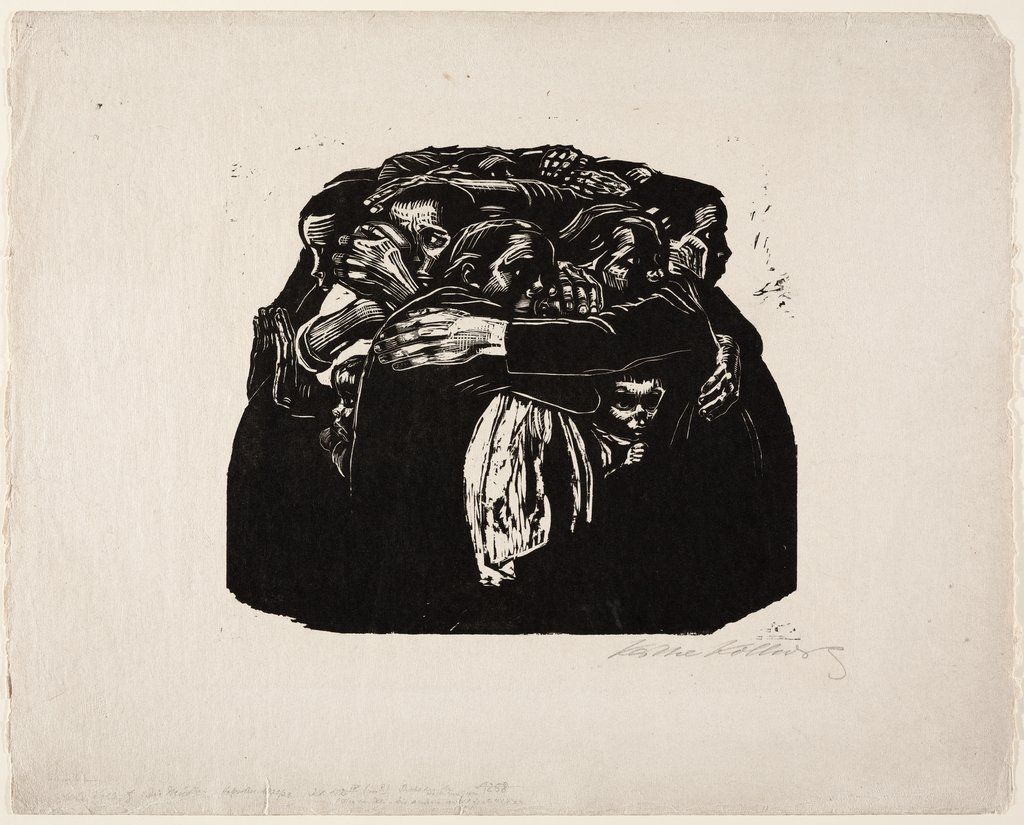
The Mothers
The Mothers, 1921–22. Städel Museum, Frankfurt am Main, SG 4289A D. Image source. Public domain. Resized and exported as JPEG.
The Grieving Parents
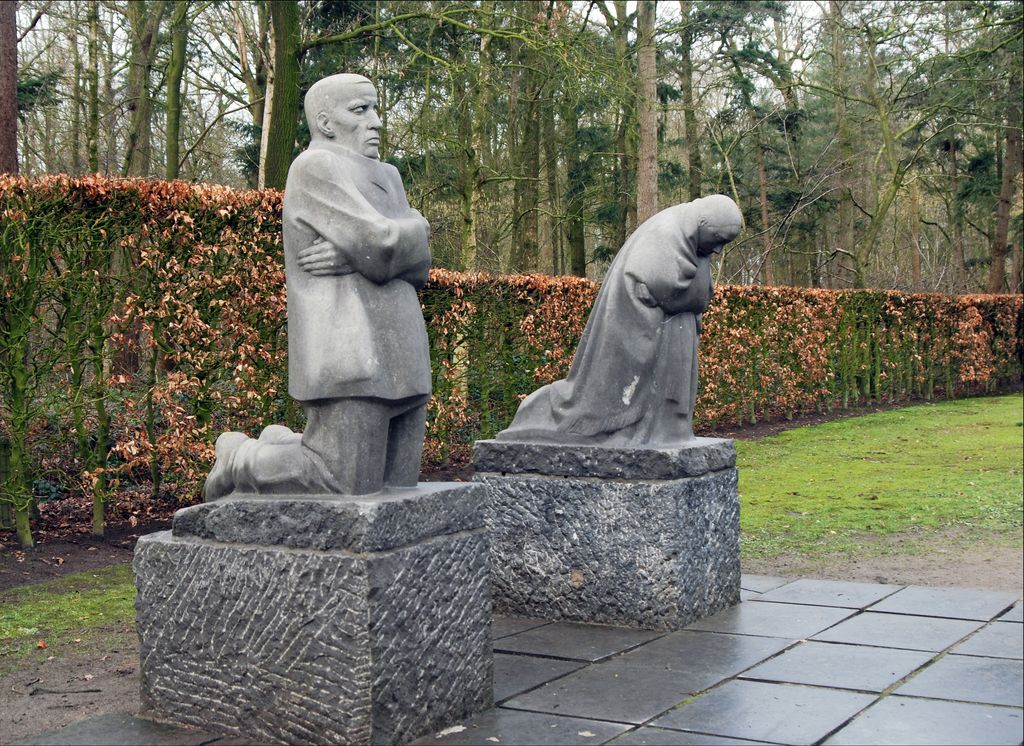
The Grieving Parents at Vladslo, the memorial’s location since 1956. Photograph by Bva, resized. Image source. CC BY-SA 3.0. Resized and exported as JPEG.
Memorial for Karl Liebknecht
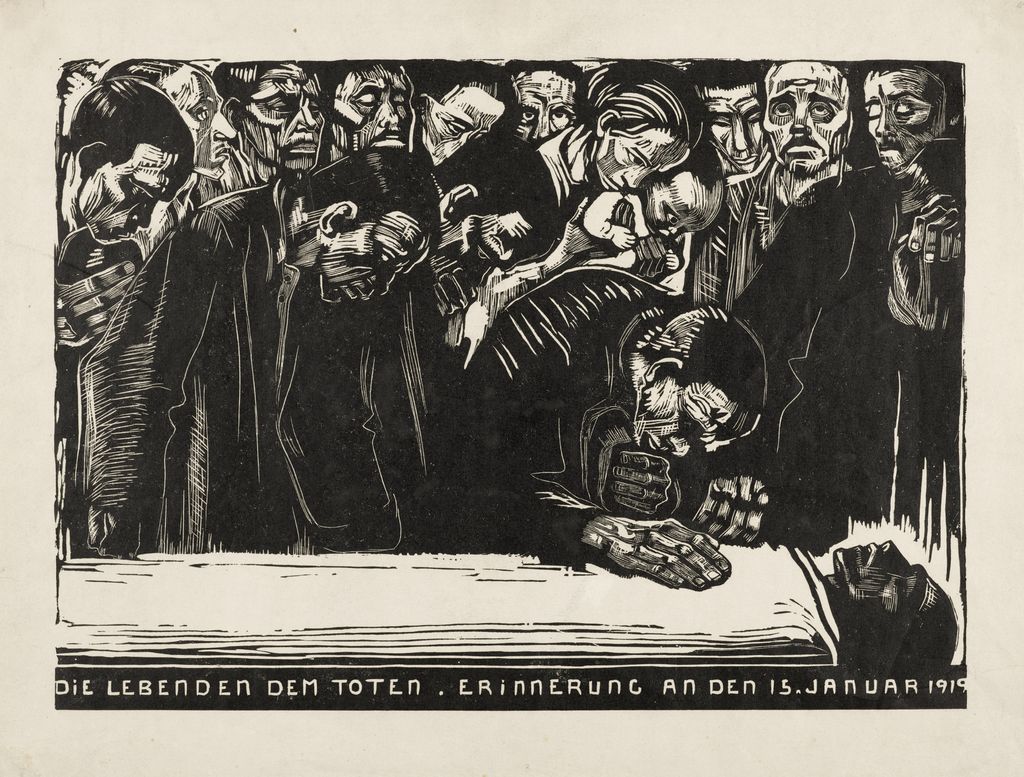
Memorial for Karl Liebknecht, 1920. Kunstsammlungen Chemnitz, 86-47, Kn 159 VI. Photo: Kunstsammlungen Chemnitz/PUNCTUM/Bertram Kober. Image source. Public domain. Resized and exported as JPEG.