 by Tom Gurney
Tom Gurney BSc (Hons) is an art history expert with over 20 years experience
Email: tomgurney1@gmail.com / Phone: +44 7429 011000
Freeman, the Earl of Clarendon’s Gamekeeper, with a Dying Doe and Hound: Introduction
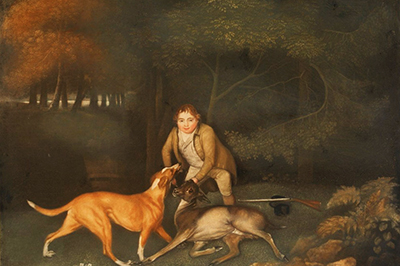
Thomas Freeman bends over a doe in a wooded landscape, with a hound standing close beside him. His gun and hat lie to the right, away from his hands. The three bodies meet in a compact group beneath the trees: the keeper upright, the dog on its feet, the deer lowered almost to the ground. Stubbs makes a working encounter into a picture of concentrated attention. [1]
At a Glance
This work across George Stubbs’s career
Whistlejacket
about 1762 [7]Contents
- A late painting with an earlier companion
- Hands, heads and bodies
- Freeman’s work at The Grove
- A park scene before the Royal Academy
- The 1803 version and the question of collaboration
- From painting to mezzotint
- Two paintings, two ownership histories
- A worker’s portrait and an animal’s death
- Videos on George Stubbs
A late painting with an earlier companion
The painting illustrated here is signed and dated 1803. Christie’s offered this oil on canvas in 2019 as a work by George Stubbs and George Townly Stubbs, measuring 102.1 × 127 centimetres. It had previously appeared in the Simon Sainsbury sale in 2008. [2]
The earlier version, dated 1800, is in the Paul Mellon Collection at the Yale Center for British Art. It measures 101.6 × 127 centimetres. Yale records its exhibition at the Royal Academy in 1801. [17]
Hands, heads and bodies
Freeman’s head rises above the animals, making the apex of a broad triangle. His pale waistcoat and breeches catch the light within the dark enclosure of his coat and the wood behind him. His face turns out towards the spectator while his hands remain engaged below. This division gives him two simultaneous presences: a recognisable person meeting our gaze and a worker occupied with the animal at his knees. [1]
The hound approaches from the left. Its long body stretches across the lower part of the picture, with its tail extending towards the edge and its narrow head lifted towards Freeman. The doe crosses the foreground in the opposite direction. Its body slopes down towards the right, while the raised head brings its face close to the dog’s. The animals’ muzzles and the keeper’s hands occupy a small, crowded area beneath his waist. [1]
Their legs spread that concentrated meeting across the ground. The hound’s straighter limbs support its body; the doe’s legs extend and fold beneath a much lower torso. Overlapping feet and pale contours draw the eye along the bottom of the group. Above them, Freeman’s bent stance holds the centre together. The difference between standing, bending and sinking is built into the design before a title supplies the narrative. [1]
The gun lies horizontally behind the doe, its long barrel and darker stock forming a quieter line across the grass. The hat beneath it separates these objects from the close contact between hands and animals. Around the figures, the woodland is unevenly opened. Pale trunks and a strip of water or reflected light appear at the left; thicker branches and foliage close the space behind Freeman. Low plants and stones gather at the right. The setting encloses the encounter while allowing a glimpse of distance beyond it. [1]
Freeman’s work at The Grove
Freeman became gamekeeper at The Grove in 1772. Egerton interprets the scene as his preparation to kill a wounded doe with a knife; the hound has marked down the animal without savaging it. The original 1800 composition was commissioned by Thomas Villiers, second Earl of Clarendon. [18]
Clarendon kept staghounds, foxhounds and a deer herd. He ordered at least ten Stubbs pictures in 1800–03, including imported cattle, a moose and a bison. Freeman’s portrait belonged to this sustained late patronage. [18] A report by Ozias Humphry from August 1803, quoted in the catalogue essay, records Stubbs still walking to The Grove from his London home when he missed the stagecoach: a journey of sixteen miles with a small trunk. [18]
The house had already been shaped by the preceding generation. Historic England records alterations by Matthew Brettingham in 1754–61 for Thomas Villiers, later the first Earl, followed by an extension by Sir Robert Taylor around 1780. The second Earl’s animal pictures entered the history of this established Hertfordshire estate. The distinction between the two earls matters: the house’s development under the father precedes the son’s commissions from Stubbs. The painting locates work within woodland rather than displaying the architecture of the house itself. [19]
A park scene before the Royal Academy
The Royal Academy’s printed catalogue of 1801 lists Stubbs’s number 175 as a park scene at The Grove, near Watford in Hertfordshire, the Earl of Clarendon’s seat. It credits “G. Stubbs, A.” The wording emphasises the place and its owner; it neither names Freeman nor mentions the doe’s death. [20] On the same page, named portraits sit alongside a hunter and landscape subjects. Stubbs’s entry presents this encounter through its estate setting, within an exhibition accommodating those different kinds of picture. [20]
The modern title redirects attention towards the individual worker and the dying animal. The contemporary description invites us to consider the estate around them. Place, person and animal supply different starting points for looking at the same composition. [17] [20]
In the 1800 Yale picture, the keeper’s face is more softly turned and modelled than in the later version. His light waistcoat forms a narrow central strip between the brown sides of his coat. The hound and doe retain the strongly opposed positions that organise the composition. Comparing the two canvases makes the head and the enclosing foliage particularly noticeable, although the broad arrangement remains recognisable in each. [1] [21]
The 1803 version and the question of collaboration
Egerton proposed that George Stubbs began the 1803 canvas and George Townly completed it for engraving, identifying the son’s hand in Freeman’s expression and the foliage. Christie’s offered it under both names. The proposed collaboration concerns a signed painting. [2] [18]
From painting to mezzotint
The composition appeared in print in 1804. The National Gallery of Art in Washington holds a black mezzotint proof before colour, acquired from Lowell Libson in 2017. It is catalogued as Death of the Doe, on wove paper, with a sheet measuring 39.7 × 49.4 centimetres, trimmed within the plate mark. The museum records it as the first of two states. A proof is a distinct material object in the development of a print, rather than another painted version. [22]
A colour impression republished by Edward Orme on 4 June 1817 bears the title Death of the Doe beneath the image. The animals and keeper face in the same direction as in the paintings. The lettered margin gives the scene a new frame: the event involving the doe becomes the print’s announced subject. In the colour impression, the keeper’s waistcoat is more emphatically red, and the hound much paler than in the warm-toned reproduction of the private canvas. [23]
Egerton favoured George Townly as engraver: she cited technique, expression, the print’s absence from sets in George’s studio sale, and its unreversed orientation. She interpreted George’s inscribed address as identifying the publisher rather than the engraver. [18]
Lowell Libson’s 2013 catalogue dates publication to 16 October 1804 and argues for George himself. Its unusually early black impression was said to preserve a less worn, less smiling face and softer handling of animals and rocks than later impressions. The entry compared those qualities with George’s other mezzotints and endorsed the attribution reached by Lennox-Boyd, Dixon and Clayton. It also stressed George’s usual practice of publishing prints he had engraved himself. An early impression can therefore alter the evidence on which an attribution rests; a later, worn image may present different qualities. [24]
The National Gallery of Art’s proof is associated with both George Stubbs and George Townley Stubbs. Its material description remains distinct from those of the painted canvases. The artist’s other printed subjects are introduced in Stubbs’s prints. [22]
Two paintings, two ownership histories
The 1803 canvas’s early provenance is qualified: Christie’s lists Henry Uttrick Reay as a probable owner, followed by the Bell family. Henry P. McIlhenny acquired it in 1938 and gave it to the Philadelphia Museum of Art. After deaccession it passed through Thomas Gibson to Simon Sainsbury, then the 2008 and 2019 sales. Its commissioner remains uncertain. [2]
The 1800 picture descended through the Clarendon family before its sale in 1920. Paul Mellon acquired it in 1959 and gave it to Yale in 1985. It appeared in the National Portrait Gallery’s 2003–04 exhibition Below Stairs: 400 Years of Servants’ Portraits. [17]
A worker’s portrait and an animal’s death
Below Stairs brought portraits of servants and other employees into a history often dominated by celebrated people and the upper classes. Its curators, Anne French and Giles Waterfield, explored the ambiguity of portraits commissioned by employers, recognising individuals while also representing a household’s order. Freeman’s name and particular occupation give the image a place within that history. His face meets the viewer, while his hands remain at work: likeness and activity share the portrait. [25] [21]
Yale’s 2016 label contrasts living hound and dying doe, illuminated figures and dark forest. It suggests that the subject might reflect Stubbs’s awareness of mortality in old age. This interpretation concerns the earlier canvas; its human and animal encounter remains open to different responses. [17] [21]
Videos on George Stubbs
Explore Stubbs’s equestrian painting in its wider context, including two readings of Whistlejacket.
A Horse Lover’s Guide to the YCBA
A museum tour that places Stubbs alongside other artists who painted horses. It includes a look at Pumpkin with a Stable-lad.
Watch on YouTubeGeorge Stubbs artworks directory
Search works and related prints documented in this guide. Separate versions and printing matrices have separate entries; printmakers are named where known. Unidentified historical titles and untraced studio-sale material are discussed in the essays. A dash means that a date is not established here.
| Name | Date | Medium |
|---|---|---|
| A Bay Horse with a Groom | 1791 | Painting |
| A Bay Hunter with Two Playful Spaniels | 1777 | Painting |
| A Bay Hunter, a Springer Spaniel and a Sussex Spaniel in a wooded river Landscape | 1782 | Painting |
| A Cheetah and a Stag with Two Indian Attendants | about 1764 | Painting |
| A Couple of Fox Hounds (coloured print after Stubbs) | — | Print after Stubbs |
| A Couple of Foxhounds | 1792 | Painting |
| A Foxhound on the Scent | 1788 | Drawing |
| A Gentleman driving a Lady in a Phaeton | 1787 | Painting |
| A Grey Horse | 1793 | Painting |
| A Grey Horse (cantering companion) | 1793 | Painting |
| A Grey Stallion in a Landscape | — | Painting |
| A Horse Affrighted at a Lion | 1 May 1788 | |
| A Horse Belonging to the Rt. Honourable Lord Grosvenor called Bandy from his Crooked Leg | about 1763 | Painting |
| A Horse Frightened by a Lion | 1777 | |
| A Lion (A Lion Resting on a Rock) | 1 May 1788 | |
| A Lion Attacking a Horse | 1770 | Painting |
| A Lion Attacking a Horse (monumental Yale canvas) | 1762 | Painting |
| A lion attacking a horse (NGV) | about 1765 | Painting |
| A Lion Devouring a Horse (1788 print) | 1788 | |
| A lion devouring a horse (attribution disputed) | Proposed mid-1770s | Painting |
| A mare and foal with a bay horse | 1771 | Painting |
| A Monkey | 1799 | Painting |
| A Prancing Horse, Facing Right | c. 1790 | Drawing |
| A Rough Dog | 1790 | Painting |
| A Saddled Bay Hunter | 1786 | Painting |
| A Sleeping Leopard | 1 January 1791 | |
| A Tiger and a Sleeping Leopard | 1 May 1788 | |
| A Tigress (John Dixon after Stubbs) | 1772 | Print after Stubbs |
| A Tyger (A Recumbent Leopard by a Tree) | 1 May 1788 | |
| A Tyger (Sleeping Leopard) | 1 May 1788 | |
| An animal found on the coast of New Holland called kanguroo (after Stubbs) | 1773 | Print after Stubbs |
| An animal of a new species found on the coast of New South Wales (after Stubbs) | July 1773 | Print after Stubbs |
| Antinous and Jockey | — | Painting |
| Antinoüs, a chestnut racehorse, in a landscape | Undated | Painting |
| Bandy belonging to Lord Grosvenor (print after Stubbs) | — | Print after Stubbs |
| Baronet (George Townley Stubbs after Stubbs) | 20 February 1794 | Print after Stubbs |
| Baronet with Sam Chifney Up | 1791 | Painting |
| Baronet with Samuel Chifney up (Royal Collection) | 1791 | Painting |
| Bay Hunter by a Lake | 1787 | Painting |
| Brood Mares (Benjamin Green after Stubbs) | Issue 14 November 1776 | Print after Stubbs |
| Brood Mares and Foals | usually dated 1767 | Painting |
| Brown and White Norfolk or Water Spaniel | 1778 | Painting |
| Bulls Fighting | 1786 | Painting |
| Captain Samuel Sharpe Pocklington with His Wife, Pleasance, and possibly His Sister, Frances | 1769 | Painting |
| Death of the Doe (attribution disputed) | 1804 | |
| Der Englische Hühnerhund (Johann Wölfle after Stubbs) | about 1860 | Print after Stubbs |
| Dog (A Foxhound Viewed from Behind) | 1 May 1788 | |
| Dog [A Foxhound on the Scent] | 1788 | |
| Drill and albino baboon | before 1789 | Painting |
| Eclipse (Charles Hunt after Stubbs) | 12 November 1839 | Print after Stubbs |
| Eclipse (George Townley Stubbs after Stubbs) | 1796 | Print after Stubbs |
| Eclipse (oil study) | — | Painting |
| Eclipse (Thomas Burke after Stubbs) | First published 1772 | Print after Stubbs |
| Eclipse and John Wildman (Benjamin Green after Stubbs) | 1772 | Print after Stubbs |
| Eclipse at Newmarket (Jockey Club version) | Proposed early 1790s; often dated 1770 | Painting |
| Eclipse at Newmarket with a groom and jockey | 1770 | Painting |
| Eclipse with Mr Wildman and His Sons | 1769–71 | Painting |
| Eclipse, the Property of Capt.n O Kelly (anonymous print after Stubbs) | Imprint 4 June 1804; impression undated | Print after Stubbs |
| Euston | 1774 | Painting |
| Finished Study for the Seventh Anatomical Table of the Muscles of the Horse | 1756–58 | Drawing |
| Five Brood Mares at the Duke of Cumberland's Stud Farm in Windsor Great Park | 1765 | Painting |
| Fowl Body, Lateral View (Highly Finished Study for an Unpublished Table; Shows the Last Stage in Dissection) | — | Drawing |
| Fowl Body, Lateral View (Probably Prepared for Transfer to the Plate for Engraving of Table XV) | — | Drawing |
| Fowl Skeleton, Lateral View (Finished Study for Table V) | — | Drawing |
| Freeman, the Earl of Clarendon's Gamekeeper, with a Dying Doe and Hound (Yale) | 1800 | Painting |
| George Stubbs (enamel self-portrait) | 1781 | Enamel |
| Gimcrack (George Townley Stubbs after Stubbs) | 1775 | Print after Stubbs |
| Gimcrack on Newmarket Heath, with a trainer, a jockey and a stable lad | about 1765 | Painting |
| Gimcrack, with John Pratt up, on Newmarket Heath | about 1765 | Painting |
| Hambletonian, Rubbing Down | 1800 | Painting |
| Hay-Makers | 1791 | |
| Haycarting | 1795 | Enamel |
| Haymakers | 1785 | Painting |
| Haymakers (Lady Lever Art Gallery) | 1794 | Enamel |
| Hollyhock (with later additions by Vernet and Boucher) | about 1765–70 | Painting |
| Horse Attacked by a Lion (Episode C) | 1768–69 | Painting |
| Horse Attacked by a Lion (Tate enamel) | 1769 | Enamel |
| Horse Devoured by a Lion | Possibly exhibited 1763 | Painting |
| Horse Frightened by a Lion | 1770 | Painting |
| Horse Frightened by a Lion (Episode A; Wedgwood and Bentley after Stubbs) | — | Sculpture |
| Horse Frightened by a Lion (Tate) | Possibly exhibited 1763 | Painting |
| Horse Frightened by a Lion (Yale) | 1762–68 | Painting |
| Horse in the Shade of a Wood | 1780 | Painting |
| Hound Coursing a Stag | about 1762 | Painting |
| Human Figure, Anterior View (Intended for a Plate That was Never Published) | — | Drawing |
| Human Skeleton, Lateral View | 1795–1806 | Drawing |
| Hunt servants setting out (Southill commission) | 1767 | Painting |
| Hühnerhund (The Spanish Pointer) | about 1766 | Painting |
| John and Sophia Musters Riding at Colwick Hall | 1777 | Painting |
| John Musters on his hunter Pilgrim | 1777–78 | Painting |
| Labourers | 1789 | |
| Labourers (Richard Earlom after Stubbs and Amos Greene) | 25 March 1790 | Print after Stubbs |
| Laetitia, Lady Lade (d.1825) | 1793 | Painting |
| Lemon and White Water Spaniel | — | Painting |
| Lion Attacking a Stag | — | Painting |
| Lord Grosvenor's Arabian Stallion with a Groom | about 1765 | Painting |
| Lord Grosvenor's Arabian Stallion with a Groom (Peter Mazell after Stubbs) | 1771 | Print after Stubbs |
| Mambrino (Eaton Hall painting) | — | Painting |
| Mambrino (George Townley Stubbs after Stubbs) | 1794 | Print after Stubbs |
| Mares and Foals belonging to the 2nd Viscount Bolingbroke | about 1761–62 | Painting |
| Mares and foals beneath large oak trees | — | Painting |
| Mares and Foals by a stream | Exhibited 1764 | Painting |
| Mares and Foals in a River Landscape | about 1763–68 | Painting |
| Mares and Foals in an Extensive Landscape | about 1769 | Painting |
| Mares and Foals without a Background | 1762 | Painting |
| Moose Deer (after Stubbs) (Arctic Zoology plate VIII) | 1784–85 publication | Print after Stubbs |
| Newmarket Heath with a Rubbing-Down House | — | Painting |
| Otho (1796 print after Stubbs) | 1 December 1796 | Print after Stubbs |
| Otho, with John Larkin up | 1768 | Painting |
| Pangloss | about 1762 | Painting |
| Patch (Grafton commission) | 1759 | Painting |
| Phaeton and the Chariot of the Sun (enamel) | 1775 | Enamel |
| Phaeton with a Pair of Cream Ponies and a Stable-Lad | 1780–84 | Painting |
| Phillis | 1772 | Painting |
| Portrait of a Large Dog (Dingo) | 1772 | Painting |
| Pumpkin with a Stable-lad | 1774 | Painting |
| Racehorses Exercising at Goodwood | 1759–60 | Painting |
| Reapers (1791 print) | 1791 | |
| Reapers (Tate) | 1785 | Painting |
| Reapers (Yale) | 1795 | Enamel |
| Red Deer: A Stag and a Hind | 1792 | Painting |
| Richard Wedgwood | — | Enamel |
| Ringwood, a Brocklesby Foxhound | 1792 | Painting |
| Scrub, a bay horse belonging to the Marquess of Rockingham | about 1762 | Painting |
| Self Portrait on a White Hunter | 1782 | Enamel |
| Self-Portrait | about 1759 | Painting |
| Shooting (1770 Woollett plate after Stubbs) | 1770 | Print after Stubbs |
| Shooting (1771 Woollett plate after Stubbs) | 1771 | Print after Stubbs |
| Shooting at Goodwood | 1759–60 | Painting |
| Sir John Nelthorpe as a boy | 1756 | Painting |
| Sir John Nelthorpe partridge shooting with one pointer | — | Painting |
| Sir John Nelthorpe, 6th Baronet, out Shooting with His Dogs in Barton Field, Lincolnshire | 1776 | Painting |
| Sleeping Leopard | 1777 | Enamel |
| Soldiers of the 10th Light Dragoons | 1793 | Painting |
| Stallion and Mare (George Townley Stubbs after Stubbs) | 1776; reissued 1789 | Print after Stubbs |
| Steward and gamekeeper with dogs (Southill commission) | 1767 | Painting |
| Studies of a Lemur (Lemur murinus) in six different attitudes | 1773 | Drawing |
| Study for the Self-portrait in Enamel | c. 1781 | Drawing |
| Study of a Lemur | 1773 | Drawing |
| Study of a Racehorse in Action: Galloping to Left, a Semi-Anatomical Study, with Skin Flayed to Show Action of Muscles | — | Drawing |
| Study of the Legs of a Draught-Horse Pulling a Harrow (attributed to Stubbs) | Proposed about 1786 | Drawing |
| Sweet William (Grosvenor panel) | — | Painting |
| Sweet William (Turf Gallery canvas) | — | Painting |
| The Black Stallion Sampson, Portrayed from Three Angles (with landscape additions) | about 1764 | Painting |
| The Charlton Hunt | 1759–60 | Painting |
| The Fall of Phaeton | — | Sculpture |
| The Frightened Horse | 1780 | Sculpture |
| The Grosvenor Hunt | — | Painting |
| The Haymakers (Upton House) | 1783 | Painting |
| The Horse and Lion (George Townley Stubbs after George Stubbs) | 1770 | Print after Stubbs |
| The Kongouro from New Holland | 1772 | Painting |
| The Labourers | 1779 | Painting |
| The Labourers (Southill original) | 1767 | Painting |
| The lion and horse (Benjamin Green after Stubbs) | 1769; reissued 1777 | Print after Stubbs |
| The Milbanke and Melbourne Families | about 1769 | Painting |
| The Moose | 1770 | Painting |
| The Prince of Wales's Phaeton | 1793 | Painting |
| The Reapers (Upton House) | 1783 | Painting |
| The Sebra, or Wild Ass (George Townley Stubbs after Stubbs) | 1771 | Print after Stubbs |
| The Spanish Pointer (Bradford version) | about 1766–68 | Painting |
| The Spanish Pointer (William Woollett after Stubbs) | January 1768 | Print after Stubbs |
| The Third Duke of Dorset's Hunter with a Groom and a Dog | 1768 | Painting |
| Thomas Freeman, Lord Clarendon's gamekeeper, with a dog and a shot doe (with George Townly Stubbs) | 1803 | Painting |
| Turf, with Jockey up, at Newmarket | — | Painting |
| Turk and Crab | — | Painting |
| Two Bay Hunters Communing On The Bank Of A Lake | — | Painting |
| Tygers at Play | 1780 | |
| Viscount Gormanston's White Dog | 1781 | Painting |
| Viscount Gormanston's White Dog (canvas version) | — | Painting |
| Water Spaniel | 1769 | Painting |
| Wedgwood Family Portrait | 1780 | Painting |
| Whistlejacket | about 1762 | Painting |
| Whistlejacket with two other stallions and a groom | Recorded 1762 | Painting |
| White Poodle in a Punt | about 1780 | Painting |
| William Anderson with two Saddle-Horses | 1793 | Painting |
| Working Drawing for the Seventh Anatomical Table of the Muscles of the Horse | 1756–58 | Drawing |
| Zebra | 1763 | Painting |
Discussion
Look again at the images and ideas explored in Freeman, the Earl of Clarendon’s Gamekeeper, with a Dying Doe and Hound. These editorial prompts invite your observations.
Reader Insights
Compare the 1800 and 1803 faces, then look at the later colour print.
How does each treatment change your response to Freeman?
What difference does it make to begin with the title Park Scene, Freeman’s name, or Death of the Doe?
Join the Conversation
Share a detail, comparison or question about Freeman, the Earl of Clarendon’s Gamekeeper, with a Dying Doe and Hound below.
References
- Christie’s, whole photographic reproduction of the private 1803 painting, lot 51, 4 July 2019. Whole painting. View source.
- Christie’s, Thomas Freeman, Lord Clarendon’s gamekeeper, with a dog and a shot doe, lot 51, 4 July 2019; and the same painting, lot 101, 18 June 2008. 2019 catalogue; 2008 catalogue and saleroom notice. View source 1. View source 2.
- Goodwood, The Collection, Painting Collection modal, Racehorses Exercising at Goodwood; An exciting acquisition: a study by George Stubbs, 30 June 2023; History of the Estate Hounds, 4 October 2023; About Goodwood Racecourse. Accessed 4 November 2026. View source.
- Goodwood, The Collection, Painting Collection modal, Racehorses Exercising at Goodwood; An exciting acquisition: a study by George Stubbs, 30 June 2023; History of the Estate Hounds, 4 October 2023; About Goodwood Racecourse. Accessed 4 November 2026. View source.
- Goodwood, The Collection, Painting Collection modal, Racehorses Exercising at Goodwood; An exciting acquisition: a study by George Stubbs, 30 June 2023; History of the Estate Hounds, 4 October 2023; About Goodwood Racecourse. Accessed 4 November 2026. View source.
- Goodwood, The Collection, Painting Collection modal, Racehorses Exercising at Goodwood; An exciting acquisition: a study by George Stubbs, 30 June 2023; History of the Estate Hounds, 4 October 2023; About Goodwood Racecourse. Accessed 4 November 2026. View source.
- National Gallery, Whistlejacket, NG6569, current collection record, provenance, in-depth discussion and frame entry. View source.
- Yale Center for British Art, Zebra, B1981.25.617, current object metadata, gallery labels, Malcolm Warner’s 1998 catalogue entry and provenance supplied through the museum’s public collection record. View source.
- Christie’s, Gimcrack on Newmarket Heath, with a trainer, a jockey and a stable lad, London, 5 July 2011, lot 12; object details, essay, provenance, exhibitions and whole image. View source.
- Christie’s, Gimcrack on Newmarket Heath, with a trainer, a jockey and a stable lad, London, 5 July 2011, lot 12; object details, essay, provenance, exhibitions and whole image. View source.
- Yale University Art Gallery, A Lion Attacking a Horse, 1770, 1955.27.1, collection record. Accessed 4 November 2026. View source.
- Royal Museums Greenwich, ‘The Kongouro from New Holland’ (Kangaroo), ZBA5754. Accessed 4 November 2026. View source.
- Tate, George Stubbs, Haymakers, 1785, T02256; details, Terry Riggs’s collection text (January 1998), and online caption. Collection record. View source.
- Frances Bailey, ‘Hambletonian, Rubbing Down: A masterpiece by George Stubbs’, National Trust Cultural Heritage Magazine, Autumn/Winter 2024, pp. 22–33. Article. View source.
- Christie’s, Thomas Freeman, Lord Clarendon’s gamekeeper, with a dog and a shot doe, lot 51, 4 July 2019; and the same painting, lot 101, 18 June 2008. 2019 catalogue; 2008 catalogue and saleroom notice. View source.
- Christie’s, Thomas Freeman, Lord Clarendon’s gamekeeper, with a dog and a shot doe, lot 51, 4 July 2019; and the same painting, lot 101, 18 June 2008. 2019 catalogue; 2008 catalogue and saleroom notice. View source.
- Yale Center for British Art, Freeman, the Earl of Clarendon’s Gamekeeper, with a Dying Doe and Hound, 1800, B1985.19.5, current collection record, provenance and 2016 curatorial label. Collection record; Current object manifest. View source 1. View source 2.
- Judy Egerton, George Stubbs, Painter (Yale University Press, 2007), nos. 335 and 335A, as discussed and quoted in Christie’s catalogue essay. Catalogue essay. View source.
- Historic England, ‘The Grove’, list entry 1101580. Historic building record. View source.
- Royal Academy, The Exhibition of the Royal Academy (1801), p. 10, no. 175. Exhibition archive; Original printed page. View source 1. View source 2.
- Yale Center for British Art, photographic reproduction of B1985.19.5. Painting and image manifest. View source.
- National Gallery of Art, Death of the Doe, 1804, 2017.17.1. Print collection record. View source.
- Grosvenor Prints, Death of the Doe, Edward Orme republication, 4 June 1817, stock 20937, record and colour impression. Dealer catalogue. View source.
- Lowell Libson Ltd, 2013 Catalogue, p. 56, ‘George Stubbs ARA 1724–1806: Death of the Doe’. Catalogue. View source.
- National Portrait Gallery, Below Stairs: 400 Years of Servants’ Portraits, exhibition archive, 16 October 2003–11 January 2004. Exhibition account. View source.
- Basic title, date and material metadata for Tate’s Reapers (T02257) and Otho (T02375) is adapted from the Tate collection dataset, October 2014, released under CC0. TheHistoryOfArt.org has reconciled labels and versions. This credit does not apply to Tate’s authored catalogue commentary or images.
- Data Source: Yale Center for British Art. Basic object fields are adapted and reconciled for this directory. Reuse is subject to the Center’s Open Data and Data Services Terms of Use. No museum endorsement is implied. This metadata credit does not relabel scholarly essays or images as open data.
- Basic object metadata for A Horse Frightened by a Lion, 1985.38, The Cleveland Museum of Art, John L. Severance Fund, is available under CC0. Titles and design-level grouping have been reconciled for this directory.