 by Tom Gurney
Tom Gurney BSc (Hons) is an art history expert with over 20 years experience
Email: tomgurney1@gmail.com / Phone: +44 7429 011000
Eclipse: Introduction
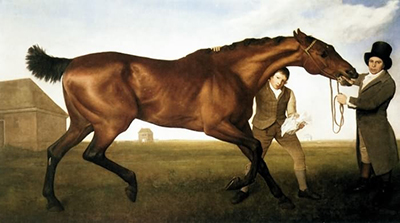
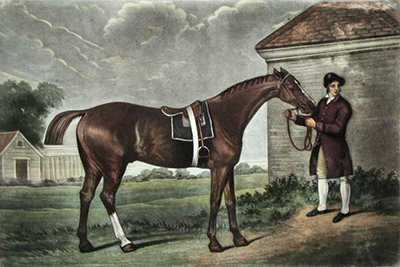
Eclipse appears here through a print design after George Stubbs: a saddled horse, one attendant and a stable building. This single-figure composition belongs to an anonymous reduced mezzotint bearing Laurie & Whittle’s publication date of 4 June 1804. It should be distinguished from Stubbs’s paintings of the horse with two attendants or with the Wildman family. [1]
The chestnut stands facing right, its long body extending across almost the whole image. A pale stocking interrupts one hind leg; the other legs remain dark against the ground. The man stands close to the muzzle, his hands meeting the bridle. Behind him, a grey building and its sloping roof close the right side. A much smaller, pale stable appears at the left, beyond the horse’s tail. The dark sky gives the silhouette a strong edge, while the saddle and its rectangular cloth divide the broad surface of the back and flank. [2]
The surviving colour reproduction does not identify the owner or date of its impression. Nor does the plate’s 1804 imprint date every sheet printed from it: Grosvenor Prints records an example on paper watermarked 1834. Publication history and the history of an individual sheet can therefore be separated even when the pictured horse remains the same. [1] [2]
At a Glance
- Illustrated objectA coloured reproduction of a mezzotint after Stubbs [1]
- Design imprint4 June 1804 [1]
- PrintmakerAnonymous [1]
This work across George Stubbs’s career
Whistlejacket
about 1762 [7]Eclipse, the Property of Capt.n O Kelly (anonymous print after Stubbs) (current article)
Imprint 4 June 1804; impression undated [15]Contents
- The horse behind the portraits
- One horse, several painted settings
- Eclipse in the print trade
- Racing records and breeding science
- A body measured after a racing career
- Copies, fragments and a moving reconstruction
- Videos on George Stubbs
The horse behind the portraits
The General Stud Book of 1803 records Eclipse as a chestnut colt foaled in 1764, by Marske out of Spilletta. Her entry identifies Regulus as her sire and lists Eclipse alongside her other offspring, including Proserpine and Garrick. This is a breeding record organised through a mare and her progeny. It gives the horse a place in a documented family, rather than treating his appearance or reputation as sufficient evidence of ancestry. [16]
The horse’s name preserves a birth tradition. In its account of the family portrait, the Baltimore museum recounts that Eclipse was born on 1 April 1764 during a solar eclipse. The connection between a striking celestial event and the exceptional animal became part of the way his life was remembered. [17]
William, Duke of Cumberland, bred Eclipse. William Wildman subsequently owned him, followed by Denis O’Kelly, who acquired the horse in stages. Their roles matter when reading the pictures: a breeder, an owner, a groom and a jockey need not be the same person. Jim Shanahan’s Dictionary of Irish Biography describes O’Kelly as a professional gambler who became a substantial racehorse owner and breeder. His success did not secure his acceptance into the Jockey Club. The man who profited from Eclipse’s extraordinary reputation remained socially contentious within the sport that celebrated the horse. [18]
Shanahan also gives Charlotte Hayes a place in this history, suggesting that she may initially have helped finance O’Kelly’s gambling career. Their relationship began while they were imprisoned in the Fleet and continued after their release in 1760. She was widely known as Mrs O’Kelly, although the biographer finds no conclusive evidence that they married. [18]
Eclipse’s racing career belonged to a demanding system of heats. Michael Church describes his debut at Epsom on 3 May 1769 as a contest over four-mile heats, with thirty minutes between them for rubbing down. Winning one heat did not necessarily win the plate: a horse had to win two. A competitor finishing 240 yards behind a heat winner was eliminated as distanced. The familiar story of O’Kelly predicting “Eclipse first, the rest nowhere” makes sense within those rules. In the tradition Church recounts, the wager concerned Eclipse leaving every other runner outside the qualifying distance. It was a claim about the whole field, rather than simply a prediction of first place. [19]
Church’s account records eighteen victories, including eleven King’s Plates, across the 1769 and 1770 seasons. Some were walkovers, where no opponent contested the prize. That record combines successful competition with the deterrent effect of a horse whose superiority made challenging him unattractive. The broader world of Georgian racehorse ownership and racing helps explain why a standing portrait could carry such a formidable competitive reputation. [19]
A near-contemporary account also preserves the geographical extent of that reputation. In his Sporting Dictionary of 1803, William Taplin lists prizes at Epsom, Ascot, Winchester, Salisbury, Canterbury, Lewes and Lichfield, followed by successes at Newmarket, Guildford, Nottingham, York and Lincoln. His entry then moves from the racecourse to stud, first at Epsom and later at Cannons in Middlesex. The sequence shows how the horse’s value continued after racing ended. Taplin’s long list of offspring turns the record of one competitor into the beginning of many other horses’ histories. Taplin directs readers to Weatherby’s Stud Book and Racing Calendar for fuller records of Eclipse’s progeny, connecting his compact biography with the expanding literature of breeding. [20]
O’Kelly’s breeding establishment produced further winners. Shanahan records Young Eclipse’s Derby victory in 1781 and Serjeant’s in 1784, and distinguishes Denis from his nephew Andrew, who succeeded to his interests. [18]
One horse, several painted settings
David Pullins discusses Stubbs’s highly finished oil study of Eclipse against an undeveloped ground, now associated with the Royal Veterinary College. He relates it to the horse’s reuse in the Wildman family portrait. He also identifies Benjamin Green’s separate 1772 print, which retained Eclipse and John Wildman while changing the surrounding landscape. A recognisable animal could thus move between compositions without making those compositions identical. [21]
Baltimore’s Eclipse with Mr. Wildman and His Sons is a separate oil painting, dated about 1769–1771. The museum gives its dimensions as 101.6 × 127.1 centimetres and its accession number as 1956.282. The title identifies a family group, rather than an anonymous stable attendant. The museum’s provenance begins with descent in the Wildman family and later includes the collector Walter Gilbey. William Woodward purchased it in 1929; it entered the Baltimore Museum of Art as part of the Woodward Collection in 1956. Its history therefore connects the eighteenth-century owner’s family with later collectors of sporting art. [17]
The signed canvas dated 1770, catalogued by Christie’s, measures 102.1 × 127.6 centimetres. The auction house identifies Denis O’Kelly as its commissioner and traces its descent to Andrew O’Kelly. [22]
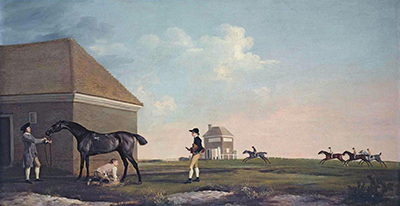
In that painting, the horse occupies the lower part of a much taller field of sky. Its head is close to the man in a blue coat, who holds the bridle; a second man, dressed in scarlet, approaches from the right. The horse’s back, the saddle and the man’s hands form a nearly continuous horizontal passage. Against it, the two human bodies introduce small changes of direction. The blue-coated figure inclines towards the animal, while the scarlet figure steps forward with one arm extended. The encounter is organised around practical contact: reins, muzzle, hand, saddle and the approach of a rider. [22]
The large roof rises behind the men like a second, much steeper back. Its diagonal cuts into the bright clouds, whereas the horse’s outline runs across a quieter, lower part of the sky. Below, the legs divide the open ground into uneven intervals. One hind leg is pale near the hoof; the chestnut coat lightens across the shoulder and rounded hindquarters. The long tail hangs towards the left. Nothing in this arrangement resembles the compressed finish of a race. The animal is presented close enough for its shape and the relations around it to be examined at leisure. [22]
Christie’s associates the setting with Newmarket’s rubbing house and proposes Samuel Merriott as the scarlet-clad jockey. The identification remains qualified. The Jockey Club owns another version: Christie’s proposes an early-1790s date for it, although it has often been dated 1770. The two canvases should remain distinct. [22]
Comparing the 1770 painting with the single-attendant print makes the change particularly clear. The print’s man fills the narrow space between muzzle and building; the approaching scarlet figure has disappeared. The stable at the left is more conspicuous, and the sky is markedly darker. The horse still supplies the composition’s long horizontal centre, but the human action has contracted into one exchange at its head. Colour also changes the balance: the maroon coat in the reproduction gathers the human presence into a single dark mass. These visible differences prevent the print from serving as an exact substitute for the two-figure painting. [2] [22]
Eclipse in the print trade
Thomas Burke’s mezzotint was first published in 1772. Later states and reissues require their own dates: George Glazer Gallery catalogues a colour impression with a Richard H. Laurie imprint as a fourth state. A later publisher’s name does not turn the underlying design into a new Stubbs painting. [22] [23]
The family’s later Turf Gallery project gave famous racehorses another setting for circulation. The National Gallery describes an undertaking begun around 1790 to chronicle fifty years of racing history through horse portraits. Sixteen paintings were completed and exhibited in Conduit Street in 1794. Prints after the pictures, engraved by Stubbs’s son, were produced in two sizes. The project lost its promised financial support, but its ambition is revealing: horses were assembled into a historical sequence and made available as reproducible images. Eclipse could be remembered alongside other celebrated racers through a coordinated publication, rather than only through a painting commissioned by one owner. [24]
Grosvenor Prints records George Townley Stubbs’s Eclipse stipple with an imprint of 1 September 1796 from the Turf Gallery. Its catalogue identifies a two-figure composition. This is another distinct publication, rather than the anonymous single-attendant mezzotint illustrated here. [25]
Charles Hunt’s aquatint of 1839 provides a further example of the image’s continued life. Yale records Hunt as the printmaker after Stubbs and identifies an impression with a J. Moore publication line dated 12 November 1839. Its materials include aquatint with watercolour and gouache on wove paper; a Whatman 1839 watermark supplies evidence about that particular sheet. It belongs to the Paul Mellon Collection, accession B1985.36.1057. The named engraver, printing process, publisher and paper distinguish it from both an eighteenth-century canvas and the Laurie & Whittle reduced print. [26]
The print also carries a long inscription describing pedigree and racing performances. Image and lettering offer complementary ways of identifying its subject: the horse can be recognised by a pictorial likeness and read about through a condensed career. The complete printed object asks its viewer to read as well as look. [26]
Hunt’s image also rearranges the setting. The horse faces right, but a substantial building stands behind its hindquarters on the left. The attendant is farther to the right, beyond the horse’s head, with more open ground between him and the animal. His dark stockings contrast with the white ones in the single-attendant reproduction shown here. The broad likeness of a saddled chestnut is maintained while the framing architecture and human spacing change. The altered spacing gives horse and handler more independent outlines within the landscape. [26]
Racing records and breeding science
The history of the records is part of the story. Weatherbys dates James Weatherby’s appointment as the Jockey Club’s secretary and keeper of the Match Book to 1770. It identifies 1773 as the year of his first Racing Calendar and 1791 as the first General Stud Book. These publications served different purposes: recording sporting events and establishing pedigrees were related activities, but a race result and a breeding entry were different kinds of evidence. Eclipse’s history passes through both. Their growth made it possible to connect seasonal performances with relationships extending across generations. [27]
Modern genetics has examined the reach of Eclipse’s paternal line. In a 2013 study, Barbara Wallner and her colleagues screened 615 male horses from predominantly European breeds and combined Y-chromosome evidence with pedigrees. They associated a prominent haplotype with the line descending through Eclipse, locating its origin in him or one of the following two generations. In their sample, that haplotype occurred in 96.5 per cent of the Thoroughbreds. The result concerns a particular paternal marker in a defined sample. It does not mean that nearly all the horses’ genes came from Eclipse, or establish a single genetic explanation for his racing ability. The authors also acknowledged the limits of their geographical and breed sampling. Their finding gives the horse’s later influence a more precise meaning than a vague assertion that almost every modern racehorse descends from him. [28]
A body measured after a racing career
Eclipse also became an object of anatomical investigation. Charles Vial de Sainbel’s Essay on the Proportions of Eclipse, published in a second edition in 1795, describes measurements made while the horse was alive and examination after dissection. Sainbel sought mechanical explanations of movement, relating parts through a common measure based on divisions of the head. He reported a fourteen-pound heart. Yet his account also contains important limits: Eclipse’s greater bulk in old age affected measurements, founder had distorted his fore feet, and an engraver had made the body in one plate two inches too short. His geometrical reconstruction should be read as an eighteenth-century investigation with stated imperfections, rather than as a modern measurement of the horse’s maximum speed. [29]
Even the date of death differs between early records. Sainbel places it on 27 February 1789; the General Stud Book’s 1803 list gives 26 February. Both identify the same famous horse, but their disagreement cautions against making every later caption appear more exact than the evidence it inherits. [16] [29]
The Royal Veterinary College places the examination of Eclipse within the circumstances surrounding its foundation. Sainbel was seeking support for veterinary education, with backing from the Odiham Agricultural Society and a London committee. The college was established in 1791, and its first students began in 1792. Eclipse’s celebrated body helped make the need for animal knowledge visible, although the institution’s history also involved sustained organisation, patrons and teaching. This is a different connection between art and anatomy from Stubbs’s earlier work for The Anatomy of the Horse: Eclipse’s dissection should not be attributed to the painter. [24] [30]
A modern study returned to the question of the skeleton’s identity. In 2012, Mim Bower and her co-authors reported a combination of mitochondrial DNA comparisons, skeletal measurements, contemporary autopsy measurements, and carbon and nitrogen isotope analysis. Their published abstract describes the evidence as consistent with the putative skeleton being Eclipse’s, and the isotope work addressed whether its bones came from one horse. Several kinds of comparison contributed to the result, bringing the remains into a new relationship with the written measurements made after the horse’s death. [31]
The connection acquired a particularly direct exhibition form at the Mauritshuis. Its announcement for the 2020 Stubbs exhibition described the display of Eclipse’s skeleton beside a rare oil sketch made early in the horse’s career. The pairing brought two surviving kinds of evidence into the same space: the animal’s remains and a painter’s representation of its outward form. The museum framed the exhibition through Stubbs’s close study of nature, giving the racehorse a place in the history of looking as well as in the history of breeding and competition. [32]
Copies, fragments and a moving reconstruction
The image has also entered modern art. Giulio Paolini’s Eclipse (painted by George Stubbs), dated 1986, combines a framed colour photograph of a lithographic reproduction with fragments of a plaster horse cast and a Plexiglas sheet. The artist’s foundation records six numbered examples. It identifies the pictured source as the Jockey Club’s Eclipse composition and the cast’s model as Gaetano Monti’s Cavallo arabo of 1819. This work brings different objects and generations of reproduction together. The foundation describes a play of copies in which the model is eclipsed and fragmented. The earlier equine portrait becomes material for a work concerned with copies, models and the dissolution of an image. [33]
A recent digital project approaches the surviving evidence in another way. Creature Pipeline describes its reanimation of Eclipse as a combination of scans of the skeleton, reference paintings by Stubbs and motion-capture data obtained from modern horses on a treadmill. The same project presents a prototype anatomy game in which a virtual skeleton can be assembled bone by bone. The result is a constructed moving interpretation, drawing different sources together; it cannot be an observation of Eclipse’s own recorded movement. Stubbs’s portraits nevertheless remain useful visual references within that reconstruction. Their afterlife extends from engraved sheets to a digital body that can be put into motion and taken apart for study. [34]
Videos on George Stubbs
Explore Stubbs’s equestrian painting in its wider context, including two readings of Whistlejacket.
A Horse Lover’s Guide to the YCBA
A museum tour that places Stubbs alongside other artists who painted horses. It includes a look at Pumpkin with a Stable-lad.
Watch on YouTubeGeorge Stubbs artworks directory
Search works and related prints documented in this guide. Separate versions and printing matrices have separate entries; printmakers are named where known. Unidentified historical titles and untraced studio-sale material are discussed in the essays. A dash means that a date is not established here.
| Name | Date | Medium |
|---|---|---|
| A Bay Horse with a Groom | 1791 | Painting |
| A Bay Hunter with Two Playful Spaniels | 1777 | Painting |
| A Bay Hunter, a Springer Spaniel and a Sussex Spaniel in a wooded river Landscape | 1782 | Painting |
| A Cheetah and a Stag with Two Indian Attendants | about 1764 | Painting |
| A Couple of Fox Hounds (coloured print after Stubbs) | — | Print after Stubbs |
| A Couple of Foxhounds | 1792 | Painting |
| A Foxhound on the Scent | 1788 | Drawing |
| A Gentleman driving a Lady in a Phaeton | 1787 | Painting |
| A Grey Horse | 1793 | Painting |
| A Grey Horse (cantering companion) | 1793 | Painting |
| A Grey Stallion in a Landscape | — | Painting |
| A Horse Affrighted at a Lion | 1 May 1788 | |
| A Horse Belonging to the Rt. Honourable Lord Grosvenor called Bandy from his Crooked Leg | about 1763 | Painting |
| A Horse Frightened by a Lion | 1777 | |
| A Lion (A Lion Resting on a Rock) | 1 May 1788 | |
| A Lion Attacking a Horse | 1770 | Painting |
| A Lion Attacking a Horse (monumental Yale canvas) | 1762 | Painting |
| A lion attacking a horse (NGV) | about 1765 | Painting |
| A Lion Devouring a Horse (1788 print) | 1788 | |
| A lion devouring a horse (attribution disputed) | Proposed mid-1770s | Painting |
| A mare and foal with a bay horse | 1771 | Painting |
| A Monkey | 1799 | Painting |
| A Prancing Horse, Facing Right | c. 1790 | Drawing |
| A Rough Dog | 1790 | Painting |
| A Saddled Bay Hunter | 1786 | Painting |
| A Sleeping Leopard | 1 January 1791 | |
| A Tiger and a Sleeping Leopard | 1 May 1788 | |
| A Tigress (John Dixon after Stubbs) | 1772 | Print after Stubbs |
| A Tyger (A Recumbent Leopard by a Tree) | 1 May 1788 | |
| A Tyger (Sleeping Leopard) | 1 May 1788 | |
| An animal found on the coast of New Holland called kanguroo (after Stubbs) | 1773 | Print after Stubbs |
| An animal of a new species found on the coast of New South Wales (after Stubbs) | July 1773 | Print after Stubbs |
| Antinous and Jockey | — | Painting |
| Antinoüs, a chestnut racehorse, in a landscape | Undated | Painting |
| Bandy belonging to Lord Grosvenor (print after Stubbs) | — | Print after Stubbs |
| Baronet (George Townley Stubbs after Stubbs) | 20 February 1794 | Print after Stubbs |
| Baronet with Sam Chifney Up | 1791 | Painting |
| Baronet with Samuel Chifney up (Royal Collection) | 1791 | Painting |
| Bay Hunter by a Lake | 1787 | Painting |
| Brood Mares (Benjamin Green after Stubbs) | Issue 14 November 1776 | Print after Stubbs |
| Brood Mares and Foals | usually dated 1767 | Painting |
| Brown and White Norfolk or Water Spaniel | 1778 | Painting |
| Bulls Fighting | 1786 | Painting |
| Captain Samuel Sharpe Pocklington with His Wife, Pleasance, and possibly His Sister, Frances | 1769 | Painting |
| Death of the Doe (attribution disputed) | 1804 | |
| Der Englische Hühnerhund (Johann Wölfle after Stubbs) | about 1860 | Print after Stubbs |
| Dog (A Foxhound Viewed from Behind) | 1 May 1788 | |
| Dog [A Foxhound on the Scent] | 1788 | |
| Drill and albino baboon | before 1789 | Painting |
| Eclipse (Charles Hunt after Stubbs) | 12 November 1839 | Print after Stubbs |
| Eclipse (George Townley Stubbs after Stubbs) | 1796 | Print after Stubbs |
| Eclipse (oil study) | — | Painting |
| Eclipse (Thomas Burke after Stubbs) | First published 1772 | Print after Stubbs |
| Eclipse and John Wildman (Benjamin Green after Stubbs) | 1772 | Print after Stubbs |
| Eclipse at Newmarket (Jockey Club version) | Proposed early 1790s; often dated 1770 | Painting |
| Eclipse at Newmarket with a groom and jockey | 1770 | Painting |
| Eclipse with Mr Wildman and His Sons | 1769–71 | Painting |
| Eclipse, the Property of Capt.n O Kelly (anonymous print after Stubbs) | Imprint 4 June 1804; impression undated | Print after Stubbs |
| Euston | 1774 | Painting |
| Finished Study for the Seventh Anatomical Table of the Muscles of the Horse | 1756–58 | Drawing |
| Five Brood Mares at the Duke of Cumberland's Stud Farm in Windsor Great Park | 1765 | Painting |
| Fowl Body, Lateral View (Highly Finished Study for an Unpublished Table; Shows the Last Stage in Dissection) | — | Drawing |
| Fowl Body, Lateral View (Probably Prepared for Transfer to the Plate for Engraving of Table XV) | — | Drawing |
| Fowl Skeleton, Lateral View (Finished Study for Table V) | — | Drawing |
| Freeman, the Earl of Clarendon's Gamekeeper, with a Dying Doe and Hound (Yale) | 1800 | Painting |
| George Stubbs (enamel self-portrait) | 1781 | Enamel |
| Gimcrack (George Townley Stubbs after Stubbs) | 1775 | Print after Stubbs |
| Gimcrack on Newmarket Heath, with a trainer, a jockey and a stable lad | about 1765 | Painting |
| Gimcrack, with John Pratt up, on Newmarket Heath | about 1765 | Painting |
| Hambletonian, Rubbing Down | 1800 | Painting |
| Hay-Makers | 1791 | |
| Haycarting | 1795 | Enamel |
| Haymakers | 1785 | Painting |
| Haymakers (Lady Lever Art Gallery) | 1794 | Enamel |
| Hollyhock (with later additions by Vernet and Boucher) | about 1765–70 | Painting |
| Horse Attacked by a Lion (Episode C) | 1768–69 | Painting |
| Horse Attacked by a Lion (Tate enamel) | 1769 | Enamel |
| Horse Devoured by a Lion | Possibly exhibited 1763 | Painting |
| Horse Frightened by a Lion | 1770 | Painting |
| Horse Frightened by a Lion (Episode A; Wedgwood and Bentley after Stubbs) | — | Sculpture |
| Horse Frightened by a Lion (Tate) | Possibly exhibited 1763 | Painting |
| Horse Frightened by a Lion (Yale) | 1762–68 | Painting |
| Horse in the Shade of a Wood | 1780 | Painting |
| Hound Coursing a Stag | about 1762 | Painting |
| Human Figure, Anterior View (Intended for a Plate That was Never Published) | — | Drawing |
| Human Skeleton, Lateral View | 1795–1806 | Drawing |
| Hunt servants setting out (Southill commission) | 1767 | Painting |
| Hühnerhund (The Spanish Pointer) | about 1766 | Painting |
| John and Sophia Musters Riding at Colwick Hall | 1777 | Painting |
| John Musters on his hunter Pilgrim | 1777–78 | Painting |
| Labourers | 1789 | |
| Labourers (Richard Earlom after Stubbs and Amos Greene) | 25 March 1790 | Print after Stubbs |
| Laetitia, Lady Lade (d.1825) | 1793 | Painting |
| Lemon and White Water Spaniel | — | Painting |
| Lion Attacking a Stag | — | Painting |
| Lord Grosvenor's Arabian Stallion with a Groom | about 1765 | Painting |
| Lord Grosvenor's Arabian Stallion with a Groom (Peter Mazell after Stubbs) | 1771 | Print after Stubbs |
| Mambrino (Eaton Hall painting) | — | Painting |
| Mambrino (George Townley Stubbs after Stubbs) | 1794 | Print after Stubbs |
| Mares and Foals belonging to the 2nd Viscount Bolingbroke | about 1761–62 | Painting |
| Mares and foals beneath large oak trees | — | Painting |
| Mares and Foals by a stream | Exhibited 1764 | Painting |
| Mares and Foals in a River Landscape | about 1763–68 | Painting |
| Mares and Foals in an Extensive Landscape | about 1769 | Painting |
| Mares and Foals without a Background | 1762 | Painting |
| Moose Deer (after Stubbs) (Arctic Zoology plate VIII) | 1784–85 publication | Print after Stubbs |
| Newmarket Heath with a Rubbing-Down House | — | Painting |
| Otho (1796 print after Stubbs) | 1 December 1796 | Print after Stubbs |
| Otho, with John Larkin up | 1768 | Painting |
| Pangloss | about 1762 | Painting |
| Patch (Grafton commission) | 1759 | Painting |
| Phaeton and the Chariot of the Sun (enamel) | 1775 | Enamel |
| Phaeton with a Pair of Cream Ponies and a Stable-Lad | 1780–84 | Painting |
| Phillis | 1772 | Painting |
| Portrait of a Large Dog (Dingo) | 1772 | Painting |
| Pumpkin with a Stable-lad | 1774 | Painting |
| Racehorses Exercising at Goodwood | 1759–60 | Painting |
| Reapers (1791 print) | 1791 | |
| Reapers (Tate) | 1785 | Painting |
| Reapers (Yale) | 1795 | Enamel |
| Red Deer: A Stag and a Hind | 1792 | Painting |
| Richard Wedgwood | — | Enamel |
| Ringwood, a Brocklesby Foxhound | 1792 | Painting |
| Scrub, a bay horse belonging to the Marquess of Rockingham | about 1762 | Painting |
| Self Portrait on a White Hunter | 1782 | Enamel |
| Self-Portrait | about 1759 | Painting |
| Shooting (1770 Woollett plate after Stubbs) | 1770 | Print after Stubbs |
| Shooting (1771 Woollett plate after Stubbs) | 1771 | Print after Stubbs |
| Shooting at Goodwood | 1759–60 | Painting |
| Sir John Nelthorpe as a boy | 1756 | Painting |
| Sir John Nelthorpe partridge shooting with one pointer | — | Painting |
| Sir John Nelthorpe, 6th Baronet, out Shooting with His Dogs in Barton Field, Lincolnshire | 1776 | Painting |
| Sleeping Leopard | 1777 | Enamel |
| Soldiers of the 10th Light Dragoons | 1793 | Painting |
| Stallion and Mare (George Townley Stubbs after Stubbs) | 1776; reissued 1789 | Print after Stubbs |
| Steward and gamekeeper with dogs (Southill commission) | 1767 | Painting |
| Studies of a Lemur (Lemur murinus) in six different attitudes | 1773 | Drawing |
| Study for the Self-portrait in Enamel | c. 1781 | Drawing |
| Study of a Lemur | 1773 | Drawing |
| Study of a Racehorse in Action: Galloping to Left, a Semi-Anatomical Study, with Skin Flayed to Show Action of Muscles | — | Drawing |
| Study of the Legs of a Draught-Horse Pulling a Harrow (attributed to Stubbs) | Proposed about 1786 | Drawing |
| Sweet William (Grosvenor panel) | — | Painting |
| Sweet William (Turf Gallery canvas) | — | Painting |
| The Black Stallion Sampson, Portrayed from Three Angles (with landscape additions) | about 1764 | Painting |
| The Charlton Hunt | 1759–60 | Painting |
| The Fall of Phaeton | — | Sculpture |
| The Frightened Horse | 1780 | Sculpture |
| The Grosvenor Hunt | — | Painting |
| The Haymakers (Upton House) | 1783 | Painting |
| The Horse and Lion (George Townley Stubbs after George Stubbs) | 1770 | Print after Stubbs |
| The Kongouro from New Holland | 1772 | Painting |
| The Labourers | 1779 | Painting |
| The Labourers (Southill original) | 1767 | Painting |
| The lion and horse (Benjamin Green after Stubbs) | 1769; reissued 1777 | Print after Stubbs |
| The Milbanke and Melbourne Families | about 1769 | Painting |
| The Moose | 1770 | Painting |
| The Prince of Wales's Phaeton | 1793 | Painting |
| The Reapers (Upton House) | 1783 | Painting |
| The Sebra, or Wild Ass (George Townley Stubbs after Stubbs) | 1771 | Print after Stubbs |
| The Spanish Pointer (Bradford version) | about 1766–68 | Painting |
| The Spanish Pointer (William Woollett after Stubbs) | January 1768 | Print after Stubbs |
| The Third Duke of Dorset's Hunter with a Groom and a Dog | 1768 | Painting |
| Thomas Freeman, Lord Clarendon's gamekeeper, with a dog and a shot doe (with George Townly Stubbs) | 1803 | Painting |
| Turf, with Jockey up, at Newmarket | — | Painting |
| Turk and Crab | — | Painting |
| Two Bay Hunters Communing On The Bank Of A Lake | — | Painting |
| Tygers at Play | 1780 | |
| Viscount Gormanston's White Dog | 1781 | Painting |
| Viscount Gormanston's White Dog (canvas version) | — | Painting |
| Water Spaniel | 1769 | Painting |
| Wedgwood Family Portrait | 1780 | Painting |
| Whistlejacket | about 1762 | Painting |
| Whistlejacket with two other stallions and a groom | Recorded 1762 | Painting |
| White Poodle in a Punt | about 1780 | Painting |
| William Anderson with two Saddle-Horses | 1793 | Painting |
| Working Drawing for the Seventh Anatomical Table of the Muscles of the Horse | 1756–58 | Drawing |
| Zebra | 1763 | Painting |
Discussion
Look again at the images and ideas explored in Eclipse. These editorial prompts invite your observations.
Reader Insights
Compare the single-attendant print with the 1770 canvas: how does removing the approaching rider change your attention to the horse?
Consider, too, what each kind of record can preserve.
A portrait, a pedigree, a printed racing account and a skeleton answer different questions about the same animal.
Join the Conversation
Share a detail, comparison or question about Eclipse below.
References
- Grosvenor Prints, records 65684 and 65685, Eclipse, the Property of Capt.n O Kelly, after George Stubbs, Laurie & Whittle imprint, 4 June 1804; Lennox-Boyd, Dixon and Clayton, no. 144. Print records. View source.
- Coloured reproduction of the anonymous reduced Eclipse print after Stubbs. Illustrated image. The physical impression’s source and date are unknown. Wikimedia Commons file record. View source 1. View source 2.
- Goodwood, The Collection, Painting Collection modal, Racehorses Exercising at Goodwood; An exciting acquisition: a study by George Stubbs, 30 June 2023; History of the Estate Hounds, 4 October 2023; About Goodwood Racecourse. Accessed 4 November 2026. View source.
- Goodwood, The Collection, Painting Collection modal, Racehorses Exercising at Goodwood; An exciting acquisition: a study by George Stubbs, 30 June 2023; History of the Estate Hounds, 4 October 2023; About Goodwood Racecourse. Accessed 4 November 2026. View source.
- Goodwood, The Collection, Painting Collection modal, Racehorses Exercising at Goodwood; An exciting acquisition: a study by George Stubbs, 30 June 2023; History of the Estate Hounds, 4 October 2023; About Goodwood Racecourse. Accessed 4 November 2026. View source.
- Goodwood, The Collection, Painting Collection modal, Racehorses Exercising at Goodwood; An exciting acquisition: a study by George Stubbs, 30 June 2023; History of the Estate Hounds, 4 October 2023; About Goodwood Racecourse. Accessed 4 November 2026. View source.
- National Gallery, Whistlejacket, NG6569, current collection record, provenance, in-depth discussion and frame entry. View source.
- Yale Center for British Art, Zebra, B1981.25.617, current object metadata, gallery labels, Malcolm Warner’s 1998 catalogue entry and provenance supplied through the museum’s public collection record. View source.
- Christie’s, Gimcrack on Newmarket Heath, with a trainer, a jockey and a stable lad, London, 5 July 2011, lot 12; object details, essay, provenance, exhibitions and whole image. View source.
- Christie’s, Gimcrack on Newmarket Heath, with a trainer, a jockey and a stable lad, London, 5 July 2011, lot 12; object details, essay, provenance, exhibitions and whole image. View source.
- Yale University Art Gallery, A Lion Attacking a Horse, 1770, 1955.27.1, collection record. Accessed 4 November 2026. View source.
- Royal Museums Greenwich, ‘The Kongouro from New Holland’ (Kangaroo), ZBA5754. Accessed 4 November 2026. View source.
- Tate, George Stubbs, Haymakers, 1785, T02256; details, Terry Riggs’s collection text (January 1998), and online caption. Collection record. View source.
- Frances Bailey, ‘Hambletonian, Rubbing Down: A masterpiece by George Stubbs’, National Trust Cultural Heritage Magazine, Autumn/Winter 2024, pp. 22–33. Article. View source.
- Grosvenor Prints, records 65684 and 65685, Eclipse, the Property of Capt.n O Kelly, after George Stubbs, Laurie & Whittle imprint, 4 June 1804; Lennox-Boyd, Dixon and Clayton, no. 144. Print records. View source.
- James Weatherby, The General Stud-Book (London, 1803), p. 300, ‘Spilletta’, and preliminary list of stallion deaths. Wellcome Collection digitised copy. View source.
- Baltimore Museum of Art, Eclipse with Mr. Wildman and His Sons, c. 1769–1771, accession 1956.282. Collection record; ‘A Racehorse Named Eclipse’, May 2013. View source 1. View source 2.
- Jim Shanahan, ‘O’Kelly, Denis (“Count”)’, Dictionary of Irish Biography (2009). Biography. View source.
- Michael Church, ‘The Life and Times of Eclipse – Parts One and Two’ (5 February 2024). Specialist account. View source.
- William Taplin, The Sporting Dictionary and Rural Repository, vol. 1 (1803), pp. 224–225, ‘Eclipse’. Primary text. View source.
- David Pullins, ‘Stubbs, Vernet & Boucher Share a Canvas: Workshops, Authorship & the Status of Painting’, Journal18 1 (2016), especially the discussion of the Eclipse study and Benjamin Green’s print. Scholarly essay. View source.
- Christie’s, Eclipse at Newmarket with a groom and jockey, 1770, lot 39 (2023), object record, provenance and essay. Catalogue record; painting image. View source 1. View source 2.
- George Glazer Gallery, Thomas Burke after George Stubbs, Eclipse, Richard H. Laurie fourth state. Print record. View source.
- National Gallery, ‘Stubbs: Portrait of a Horse’ (2026), section on the Turf Project. Exhibition account. View source.
- Grosvenor Prints, Catalogue 53, item 236, George Townley Stubbs, Eclipse, 1 September 1796; Lennox-Boyd, Dixon and Clayton, no. 125, state I of II. Catalogue PDF. View source.
- Yale Center for British Art, Charles Hunt after George Stubbs, Eclipse, 1839, B1985.36.1057, Paul Mellon Collection. Collection manifest; print image. View source 1. View source 2.
- Weatherbys, ‘Our history’. Publication chronology. View source.
- Barbara Wallner and others, ‘Identification of Genetic Variation on the Horse Y Chromosome and the Tracing of Male Founder Lineages in Modern Breeds’, PLOS One 8.4 (2013), e60015. Original research. View source.
- Charles Vial de Sainbel, An Essay on the Proportions of Eclipse, 2nd ed. (London, 1795), especially pp. 5–15, 25–27, 53 and 63, in The Works of Charles Vial de Sainbel. University of Bristol copy, Wellcome Collection. View source.
- Royal Veterinary College, ‘A horse called Eclipse…’. Institutional history. View source.
- M. A. Bower and others, ‘Truth in the Bones: Resolving the Identity of the Founding Elite Thoroughbred Racehorses’, Archaeometry 54.5 (2012), 916–925, abstract. Research abstract. View source.
- Mauritshuis, ‘George Stubbs: The Man, The Horse, The Obsession’ (27 November 2019), announcing the 2020 exhibition. Museum account. View source.
- Fondazione Giulio e Anna Paolini, Eclipse (painted by George Stubbs), 1986, GPO-0576. Catalogue raisonné entry. View source.
- Creature Pipeline, ‘Re-animating Eclipse’ and ‘Horse anatomy’ case studies. Creators’ account. View source.
- Basic title, date and material metadata for Tate’s Reapers (T02257) and Otho (T02375) is adapted from the Tate collection dataset, October 2014, released under CC0. TheHistoryOfArt.org has reconciled labels and versions. This credit does not apply to Tate’s authored catalogue commentary or images.
- Data Source: Yale Center for British Art. Basic object fields are adapted and reconciled for this directory. Reuse is subject to the Center’s Open Data and Data Services Terms of Use. No museum endorsement is implied. This metadata credit does not relabel scholarly essays or images as open data.
- Basic object metadata for A Horse Frightened by a Lion, 1985.38, The Cleveland Museum of Art, John L. Severance Fund, is available under CC0. Titles and design-level grouping have been reconciled for this directory.