


 by Tom Gurney
Tom Gurney BSc (Hons) is an art history expert with over 20 years experience
Email: tomgurney1@gmail.com / Phone: +44 7429 011000
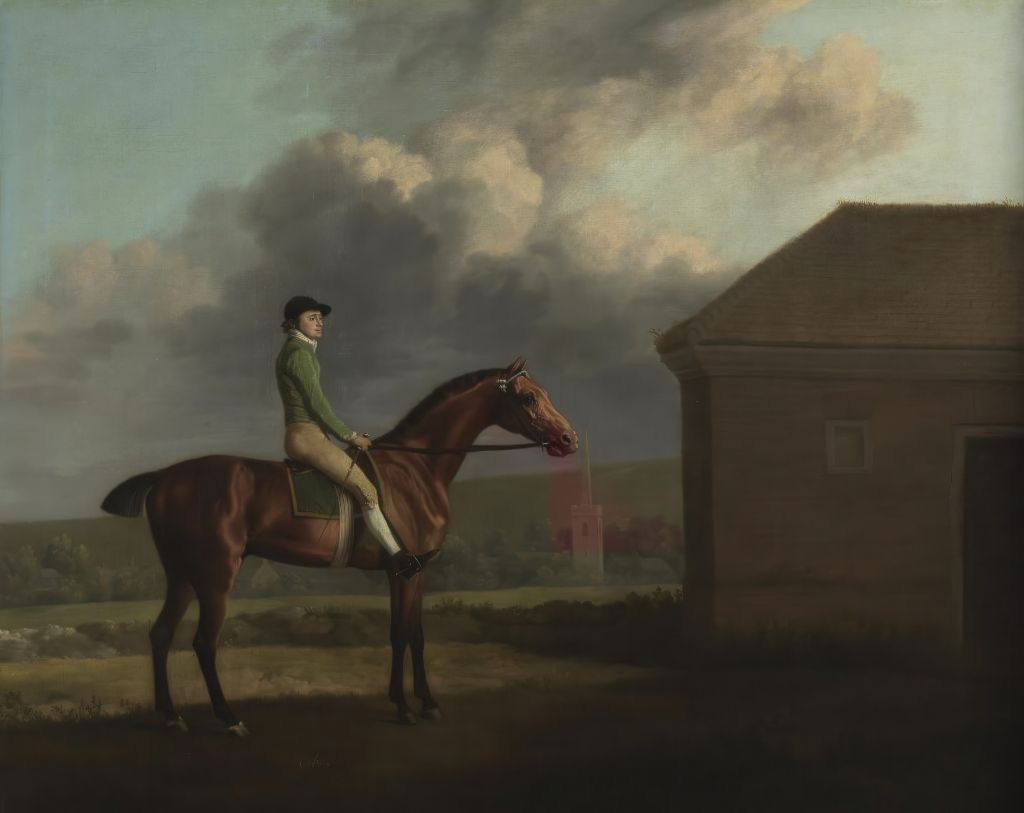
Otho, with John Larkin up by George Stubbs: Introduction
George Stubbs painted Otho, with John Larkin up in 1768. Tate’s canvas, T02375, measures 101.3 by 127 centimetres. It gives a named racehorse and his rider a setting in which light, weather and buildings matter almost as much as the two figures. [1]
At a Glance
This work across George Stubbs’s career
Whistlejacket
about 1762 [6]Contents
- Horse, rider and an unsettled sky
- A portrait after the racing season
- Vernon, Ossory and Otho’s record
- The work behind the building
- Otho at stud
- Otho in print
- Collecting and reinterpreting Otho
- Videos on George Stubbs
Horse, rider and an unsettled sky
Otho stands across the lower left and middle of the picture, facing right. His body is a broad, warm shape against the cooler land behind him. Light picks out the rounded hindquarters, the side of the belly and the long slope towards the shoulder. Darker passages run beneath the saddle and along the underside of the neck. These changes in tone turn the horse’s flank towards us without losing the clarity of his outline. The dark tail projects to the left, balancing the head and muzzle at the other end. [15]
The raised neck makes a long curve from chest to ears. A narrow line of dark mane follows its upper edge, while the face catches a brighter, more golden light. The ears point upwards and slightly apart. Around the eye and muzzle, small dark accents interrupt the illuminated surface. A dark rein runs from the bridle back towards Larkin’s hands. Its nearly horizontal line cuts across the rising neck, connecting the horse’s head with the rider’s quiet position over his back. [15]
John Larkin sits tall in the saddle. His green coat is darker than his yellow breeches, and the pale stockings make his bent leg conspicuous against the horse. His black footwear rests in the stirrup below the belly. The cap and pale neckcloth give his head a compact, sharply edged shape against the clouds. Stubbs places the small, light face above a nearly continuous green outline running down the back and arm. The rider is easily found within the larger mass of the horse, although he occupies much less space. [15]
The hands rest low, close to the front of the saddle, rather than rising in a conspicuous gesture. The body is upright, but the leg bends around the animal’s side. This combination of straight back and angled leg connects a composed upper figure to the curved body beneath it. The dark saddlecloth, its lighter border and the striped girth introduce smaller rectangles and bands. They organise the meeting of rider and horse without breaking the broad sweep from the hindquarters through the shoulder to the lifted head. [15]
Below, the legs make a more open pattern. The forelegs stand close together beneath the chest; the hind legs are spaced farther apart, with their pale hoof edges catching light near the ground. Small intervals of background remain visible between the narrow limbs. Against the substantial body above, these long dark supports look especially delicate. The lower edge of the painting is mostly in shadow. Otho’s name appears within that dark foreground, beneath the horse rather than beside the rider. [15]
The building at the right occupies much of the space towards which the pair faces. Its broad roof slopes up from the lower left before running beyond the picture’s edge. Thick, uneven material at the eaves softens a shape otherwise built from firm diagonals and horizontal lines. Below it, the brick wall carries a small square window and a much larger, almost black doorway. The corner of the structure makes a strong vertical division. Otho’s head stops short of it, leaving a narrow interval between the living group and the wall. [15]
Above the horse, great masses of grey cloud move across a lighter sky. Their rounded forms echo the horse’s body at a much larger scale. Patches of pale blue remain at the left and towards the upper right, but the darkest clouds gather over and behind the rider. The roof cuts across this changing sky with a solid, low silhouette. Weather seems expansive and mobile; the building is heavy and fixed. Horse and rider occupy the space between these two kinds of shape. [15]
The distance is smaller and quieter. A pale spire rises near the horse’s muzzle, above a tower and low buildings partly screened by trees. Behind them, a long green slope makes an almost uninterrupted horizon. The bright tower stands between the dark horse and the shadowed building, pulling the eye through the narrow gap into the landscape. Across the lower picture, strips of lit grass alternate with darker ground. The sunlight touches separate surfaces rather than spreading evenly across a single, open field. [15]
A portrait after the racing season
Tate identifies Otho as a bay colt bred and initially owned by Richard Vernon, a founding member of the Jockey Club. Its commentary singles out several victories in 1767, the horse’s final racing year, and proposes that the portrait commemorated those successes. That makes the painting a reflection on an achieved career, while its dramatic weather gives a still presentation some of racing’s uncertainty. [16]
The Frick Collection’s account names John Larkin as a gentleman jockey who owned and rode racehorses. It places the pair on Newmarket Heath, facing a rubbing-down shed, with the town and Saint Mary’s Church beyond. The same account dates Otho’s retirement to stud to 1768. The portrait therefore brings a recognisable rider and racing place into the horse’s transition from competition to breeding. [17]
Larkin also belonged to a family associated with horses. A Christie’s catalogue identifies his father as James Larkin, who became a prominent trainer. The catalogue proposes James as the rider in a separate painting of Sedbury attributed to James Seymour, while recording reservations about that attribution. [18] This is a useful family connection, but the human presence in Stubbs’s picture remains particular: a named rider whose small face, straight back and close-held hands demand attention alongside the horse. [15]
Vernon, Ossory and Otho’s record
William Pick’s Turf Register of 1803 records Otho as a bay horse foaled in 1760, by Moses out of Miss Vernon. Pick traces his breeding to Richard Vernon and his later sale to Lord Ossory, following a defeat by Bay Malton in April 1766. Earlier successes included a Bedford prize and a Newmarket match against Turf in 1764. The account then records victories in the Jockey Club Plate and over the Duke of Grafton’s Antinous in 1767. [19]
Otho’s record connects him with Antinoüs. The connection gives the individual likeness a larger context within Georgian racing: owners, rivals and named performances surrounded the apparently solitary animal. It does not turn this quiet mounted portrait into an illustration of the encounter with Antinous. [19]
The work behind the building
A rubbing house belonged to the practical care of racehorses. Historic England’s account of Southfields at Newmarket describes horses exercising vigorously under cloths and then having the resulting sweat rubbed down. The surviving Southfields structure dates from about 1860; it later served Alfred Munnings as a studio. Its date places it well after Stubbs’s painting, while its recorded function helps explain a kind of building closely associated with the training grounds. Sheltered handling was part of the same working routine as exertion on open ground. [20]
In the painting, the dark entrance is large enough to compete with the horse as an area of deep tone. The smaller window is set higher, near the level of the muzzle. These two openings punctuate the otherwise broad wall. Neither contains another figure. The rider and horse remain outside, fully exposed to the changing light, while the interior is withheld from view. The building’s presence gives the still pair a destination within the composition without requiring Stubbs to show the work performed inside it. [15]
Otho at stud
Pick places Otho in Lord Ossory’s private stud at Ampthill before 1778. He then records a fee of twenty guineas, with an additional ten shillings and sixpence, and a reduction to five guineas plus the same addition in 1780, continuing through 1784. His list of offspring includes Dorimant. The horse’s life after racing had its own changing arrangements and valuations. [19]
An earlier account gives another glimpse of that breeding career. The Sporting Magazine reported in November 1796 that Otho had subscribers for forty mares at twenty-five guineas each at Ampthill Park in 1777. It also celebrated him as Dorimant’s sire. This dated report places breeding alongside remembered racing achievements: the audience was offered a horse whose importance extended beyond the seasons in which he ran. [21]
Otho in print
The November 1796 magazine advertised a portrait of Otho and described it as taken from a Stubbs painting in the Earl of Upper Ossory’s possession. The accompanying plate carries a separate publication date, 1 December 1796, and names J. Wheble of Warwick Court as publisher. [21] [22] The printed image carries forward the mounted pair, the building at the right and the distant spire. It provided another way for this composition to reach people interested in the horse. [22]
In the print, dark strokes replace the painting’s warm modelling of the coat. Fine, nearly parallel marks cross the sky, while denser lines build the clouds. The horse’s dark mass stands against these lighter bands, and the rider’s pale stocking remains a conspicuous interruption near the centre. On the building, repeated horizontal and vertical marks make the brickwork particularly emphatic. The large black doorway continues to answer the dark horse, but the difference between warm sunlight and cool cloud has become a contrast between densities of printed marks. [22]
The foreground changes in a similar way. Short, irregular strokes describe the grass, while longer bands follow the rising land behind the horse. The spire stays clear as a slender vertical between the head and roof. The translation preserves the arrangement of the principal forms, yet encourages a different kind of looking: the eye follows cut lines and their intersections where the painting offers transitions of colour and tone. [22]
Collecting and reinterpreting Otho
Later collection history survives in scattered references. A Sotheby’s catalogue of 2014 mentions the Tate Otho among works by Stubbs acquired from the Earl of Upper Ossory’s collection by the Monson family. The reference occurs in the provenance of a different sporting picture, rather than as a complete account of Otho’s ownership. [23] It helps place the painting within a collecting network that also valued other portraits of horses and their attendants.
Paul Mellon presented Otho to Tate through the British Sporting Art Trust in 1979. [1] The Frick included it in its 2007 celebration of Stubbs. [17] A work associated with a particular racing community could consequently be encountered as part of the artist’s wider achievement in painting.
Responses to the rider can be strikingly personal. Reviewing the 1985 Yale exhibition, Sanford Schwartz thought Larkin seemed ‘sweet but weak’. He also stressed the force of Stubbs’s individual human portraits within apparently conventional sporting subjects. [24] His reaction belongs to the painting’s reception: it reveals how readily a viewer can read character into a small face without establishing the sitter’s actual temperament.
The composition has also prompted transformation by another artist. The University of Essex records Amador Perez’s Drawing I of 1986, a work based on Stubbs’s Otho, with John Larkin up. [25] [26] In a 2014 teaching account, Valerie Fraser described students finding suggestions of Pegasus and Sagittarius in Perez’s reworkings. She understood these mythological associations as extensions of the speed, power and partnership involved in racing. [25] The eighteenth-century mounted portrait could become material for new images and new conversations about the relationship between a horse and its rider.
Videos on George Stubbs
Explore Stubbs’s equestrian painting in its wider context, including two readings of Whistlejacket.
A Horse Lover’s Guide to the YCBA
A museum tour that places Stubbs alongside other artists who painted horses. It includes a look at Pumpkin with a Stable-lad.
Watch on YouTubeGeorge Stubbs artworks directory
Search works and related prints documented in this guide. Separate versions and printing matrices have separate entries; printmakers are named where known. Unidentified historical titles and untraced studio-sale material are discussed in the essays. A dash means that a date is not established here.
| Name | Date | Medium |
|---|---|---|
| A Bay Horse with a Groom | 1791 | Painting |
| A Bay Hunter with Two Playful Spaniels | 1777 | Painting |
| A Bay Hunter, a Springer Spaniel and a Sussex Spaniel in a wooded river Landscape | 1782 | Painting |
| A Cheetah and a Stag with Two Indian Attendants | about 1764 | Painting |
| A Couple of Fox Hounds (coloured print after Stubbs) | — | Print after Stubbs |
| A Couple of Foxhounds | 1792 | Painting |
| A Foxhound on the Scent | 1788 | Drawing |
| A Gentleman driving a Lady in a Phaeton | 1787 | Painting |
| A Grey Horse | 1793 | Painting |
| A Grey Horse (cantering companion) | 1793 | Painting |
| A Grey Stallion in a Landscape | — | Painting |
| A Horse Affrighted at a Lion | 1 May 1788 | |
| A Horse Belonging to the Rt. Honourable Lord Grosvenor called Bandy from his Crooked Leg | about 1763 | Painting |
| A Horse Frightened by a Lion | 1777 | |
| A Lion (A Lion Resting on a Rock) | 1 May 1788 | |
| A Lion Attacking a Horse | 1770 | Painting |
| A Lion Attacking a Horse (monumental Yale canvas) | 1762 | Painting |
| A lion attacking a horse (NGV) | about 1765 | Painting |
| A Lion Devouring a Horse (1788 print) | 1788 | |
| A lion devouring a horse (attribution disputed) | Proposed mid-1770s | Painting |
| A mare and foal with a bay horse | 1771 | Painting |
| A Monkey | 1799 | Painting |
| A Prancing Horse, Facing Right | c. 1790 | Drawing |
| A Rough Dog | 1790 | Painting |
| A Saddled Bay Hunter | 1786 | Painting |
| A Sleeping Leopard | 1 January 1791 | |
| A Tiger and a Sleeping Leopard | 1 May 1788 | |
| A Tigress (John Dixon after Stubbs) | 1772 | Print after Stubbs |
| A Tyger (A Recumbent Leopard by a Tree) | 1 May 1788 | |
| A Tyger (Sleeping Leopard) | 1 May 1788 | |
| An animal found on the coast of New Holland called kanguroo (after Stubbs) | 1773 | Print after Stubbs |
| An animal of a new species found on the coast of New South Wales (after Stubbs) | July 1773 | Print after Stubbs |
| Antinous and Jockey | — | Painting |
| Antinoüs, a chestnut racehorse, in a landscape | Undated | Painting |
| Bandy belonging to Lord Grosvenor (print after Stubbs) | — | Print after Stubbs |
| Baronet (George Townley Stubbs after Stubbs) | 20 February 1794 | Print after Stubbs |
| Baronet with Sam Chifney Up | 1791 | Painting |
| Baronet with Samuel Chifney up (Royal Collection) | 1791 | Painting |
| Bay Hunter by a Lake | 1787 | Painting |
| Brood Mares (Benjamin Green after Stubbs) | Issue 14 November 1776 | Print after Stubbs |
| Brood Mares and Foals | usually dated 1767 | Painting |
| Brown and White Norfolk or Water Spaniel | 1778 | Painting |
| Bulls Fighting | 1786 | Painting |
| Captain Samuel Sharpe Pocklington with His Wife, Pleasance, and possibly His Sister, Frances | 1769 | Painting |
| Death of the Doe (attribution disputed) | 1804 | |
| Der Englische Hühnerhund (Johann Wölfle after Stubbs) | about 1860 | Print after Stubbs |
| Dog (A Foxhound Viewed from Behind) | 1 May 1788 | |
| Dog [A Foxhound on the Scent] | 1788 | |
| Drill and albino baboon | before 1789 | Painting |
| Eclipse (Charles Hunt after Stubbs) | 12 November 1839 | Print after Stubbs |
| Eclipse (George Townley Stubbs after Stubbs) | 1796 | Print after Stubbs |
| Eclipse (oil study) | — | Painting |
| Eclipse (Thomas Burke after Stubbs) | First published 1772 | Print after Stubbs |
| Eclipse and John Wildman (Benjamin Green after Stubbs) | 1772 | Print after Stubbs |
| Eclipse at Newmarket (Jockey Club version) | Proposed early 1790s; often dated 1770 | Painting |
| Eclipse at Newmarket with a groom and jockey | 1770 | Painting |
| Eclipse with Mr Wildman and His Sons | 1769–71 | Painting |
| Eclipse, the Property of Capt.n O Kelly (anonymous print after Stubbs) | Imprint 4 June 1804; impression undated | Print after Stubbs |
| Euston | 1774 | Painting |
| Finished Study for the Seventh Anatomical Table of the Muscles of the Horse | 1756–58 | Drawing |
| Five Brood Mares at the Duke of Cumberland's Stud Farm in Windsor Great Park | 1765 | Painting |
| Fowl Body, Lateral View (Highly Finished Study for an Unpublished Table; Shows the Last Stage in Dissection) | — | Drawing |
| Fowl Body, Lateral View (Probably Prepared for Transfer to the Plate for Engraving of Table XV) | — | Drawing |
| Fowl Skeleton, Lateral View (Finished Study for Table V) | — | Drawing |
| Freeman, the Earl of Clarendon's Gamekeeper, with a Dying Doe and Hound (Yale) | 1800 | Painting |
| George Stubbs (enamel self-portrait) | 1781 | Enamel |
| Gimcrack (George Townley Stubbs after Stubbs) | 1775 | Print after Stubbs |
| Gimcrack on Newmarket Heath, with a trainer, a jockey and a stable lad | about 1765 | Painting |
| Gimcrack, with John Pratt up, on Newmarket Heath | about 1765 | Painting |
| Hambletonian, Rubbing Down | 1800 | Painting |
| Hay-Makers | 1791 | |
| Haycarting | 1795 | Enamel |
| Haymakers | 1785 | Painting |
| Haymakers (Lady Lever Art Gallery) | 1794 | Enamel |
| Hollyhock (with later additions by Vernet and Boucher) | about 1765–70 | Painting |
| Horse Attacked by a Lion (Episode C) | 1768–69 | Painting |
| Horse Attacked by a Lion (Tate enamel) | 1769 | Enamel |
| Horse Devoured by a Lion | Possibly exhibited 1763 | Painting |
| Horse Frightened by a Lion | 1770 | Painting |
| Horse Frightened by a Lion (Episode A; Wedgwood and Bentley after Stubbs) | — | Sculpture |
| Horse Frightened by a Lion (Tate) | Possibly exhibited 1763 | Painting |
| Horse Frightened by a Lion (Yale) | 1762–68 | Painting |
| Horse in the Shade of a Wood | 1780 | Painting |
| Hound Coursing a Stag | about 1762 | Painting |
| Human Figure, Anterior View (Intended for a Plate That was Never Published) | — | Drawing |
| Human Skeleton, Lateral View | 1795–1806 | Drawing |
| Hunt servants setting out (Southill commission) | 1767 | Painting |
| Hühnerhund (The Spanish Pointer) | about 1766 | Painting |
| John and Sophia Musters Riding at Colwick Hall | 1777 | Painting |
| John Musters on his hunter Pilgrim | 1777–78 | Painting |
| Labourers | 1789 | |
| Labourers (Richard Earlom after Stubbs and Amos Greene) | 25 March 1790 | Print after Stubbs |
| Laetitia, Lady Lade (d.1825) | 1793 | Painting |
| Lemon and White Water Spaniel | — | Painting |
| Lion Attacking a Stag | — | Painting |
| Lord Grosvenor's Arabian Stallion with a Groom | about 1765 | Painting |
| Lord Grosvenor's Arabian Stallion with a Groom (Peter Mazell after Stubbs) | 1771 | Print after Stubbs |
| Mambrino (Eaton Hall painting) | — | Painting |
| Mambrino (George Townley Stubbs after Stubbs) | 1794 | Print after Stubbs |
| Mares and Foals belonging to the 2nd Viscount Bolingbroke | about 1761–62 | Painting |
| Mares and foals beneath large oak trees | — | Painting |
| Mares and Foals by a stream | Exhibited 1764 | Painting |
| Mares and Foals in a River Landscape | about 1763–68 | Painting |
| Mares and Foals in an Extensive Landscape | about 1769 | Painting |
| Mares and Foals without a Background | 1762 | Painting |
| Moose Deer (after Stubbs) (Arctic Zoology plate VIII) | 1784–85 publication | Print after Stubbs |
| Newmarket Heath with a Rubbing-Down House | — | Painting |
| Otho (1796 print after Stubbs) | 1 December 1796 | Print after Stubbs |
| Otho, with John Larkin up | 1768 | Painting |
| Pangloss | about 1762 | Painting |
| Patch (Grafton commission) | 1759 | Painting |
| Phaeton and the Chariot of the Sun (enamel) | 1775 | Enamel |
| Phaeton with a Pair of Cream Ponies and a Stable-Lad | 1780–84 | Painting |
| Phillis | 1772 | Painting |
| Portrait of a Large Dog (Dingo) | 1772 | Painting |
| Pumpkin with a Stable-lad | 1774 | Painting |
| Racehorses Exercising at Goodwood | 1759–60 | Painting |
| Reapers (1791 print) | 1791 | |
| Reapers (Tate) | 1785 | Painting |
| Reapers (Yale) | 1795 | Enamel |
| Red Deer: A Stag and a Hind | 1792 | Painting |
| Richard Wedgwood | — | Enamel |
| Ringwood, a Brocklesby Foxhound | 1792 | Painting |
| Scrub, a bay horse belonging to the Marquess of Rockingham | about 1762 | Painting |
| Self Portrait on a White Hunter | 1782 | Enamel |
| Self-Portrait | about 1759 | Painting |
| Shooting (1770 Woollett plate after Stubbs) | 1770 | Print after Stubbs |
| Shooting (1771 Woollett plate after Stubbs) | 1771 | Print after Stubbs |
| Shooting at Goodwood | 1759–60 | Painting |
| Sir John Nelthorpe as a boy | 1756 | Painting |
| Sir John Nelthorpe partridge shooting with one pointer | — | Painting |
| Sir John Nelthorpe, 6th Baronet, out Shooting with His Dogs in Barton Field, Lincolnshire | 1776 | Painting |
| Sleeping Leopard | 1777 | Enamel |
| Soldiers of the 10th Light Dragoons | 1793 | Painting |
| Stallion and Mare (George Townley Stubbs after Stubbs) | 1776; reissued 1789 | Print after Stubbs |
| Steward and gamekeeper with dogs (Southill commission) | 1767 | Painting |
| Studies of a Lemur (Lemur murinus) in six different attitudes | 1773 | Drawing |
| Study for the Self-portrait in Enamel | c. 1781 | Drawing |
| Study of a Lemur | 1773 | Drawing |
| Study of a Racehorse in Action: Galloping to Left, a Semi-Anatomical Study, with Skin Flayed to Show Action of Muscles | — | Drawing |
| Study of the Legs of a Draught-Horse Pulling a Harrow (attributed to Stubbs) | Proposed about 1786 | Drawing |
| Sweet William (Grosvenor panel) | — | Painting |
| Sweet William (Turf Gallery canvas) | — | Painting |
| The Black Stallion Sampson, Portrayed from Three Angles (with landscape additions) | about 1764 | Painting |
| The Charlton Hunt | 1759–60 | Painting |
| The Fall of Phaeton | — | Sculpture |
| The Frightened Horse | 1780 | Sculpture |
| The Grosvenor Hunt | — | Painting |
| The Haymakers (Upton House) | 1783 | Painting |
| The Horse and Lion (George Townley Stubbs after George Stubbs) | 1770 | Print after Stubbs |
| The Kongouro from New Holland | 1772 | Painting |
| The Labourers | 1779 | Painting |
| The Labourers (Southill original) | 1767 | Painting |
| The lion and horse (Benjamin Green after Stubbs) | 1769; reissued 1777 | Print after Stubbs |
| The Milbanke and Melbourne Families | about 1769 | Painting |
| The Moose | 1770 | Painting |
| The Prince of Wales's Phaeton | 1793 | Painting |
| The Reapers (Upton House) | 1783 | Painting |
| The Sebra, or Wild Ass (George Townley Stubbs after Stubbs) | 1771 | Print after Stubbs |
| The Spanish Pointer (Bradford version) | about 1766–68 | Painting |
| The Spanish Pointer (William Woollett after Stubbs) | January 1768 | Print after Stubbs |
| The Third Duke of Dorset's Hunter with a Groom and a Dog | 1768 | Painting |
| Thomas Freeman, Lord Clarendon's gamekeeper, with a dog and a shot doe (with George Townly Stubbs) | 1803 | Painting |
| Turf, with Jockey up, at Newmarket | — | Painting |
| Turk and Crab | — | Painting |
| Two Bay Hunters Communing On The Bank Of A Lake | — | Painting |
| Tygers at Play | 1780 | |
| Viscount Gormanston's White Dog | 1781 | Painting |
| Viscount Gormanston's White Dog (canvas version) | — | Painting |
| Water Spaniel | 1769 | Painting |
| Wedgwood Family Portrait | 1780 | Painting |
| Whistlejacket | about 1762 | Painting |
| Whistlejacket with two other stallions and a groom | Recorded 1762 | Painting |
| White Poodle in a Punt | about 1780 | Painting |
| William Anderson with two Saddle-Horses | 1793 | Painting |
| Working Drawing for the Seventh Anatomical Table of the Muscles of the Horse | 1756–58 | Drawing |
| Zebra | 1763 | Painting |
Discussion
Look again at the images and ideas explored in Otho, with John Larkin up by George Stubbs. These editorial prompts invite your observations.
Reader Insights
How does your attention change when you look first at Larkin, then at the horse, and finally at the building?
Does the monochrome print make the composition feel calmer, harder or more unsettled than the painting?
Join the Conversation
Share a detail, comparison or question about Otho, with John Larkin up by George Stubbs below.
References
- Tate, Otho, with John Larkin up, T02375, historical public collection dataset, released 2014. Exact collection data. View source.
- Goodwood, The Collection, Painting Collection modal, Racehorses Exercising at Goodwood; An exciting acquisition: a study by George Stubbs, 30 June 2023; History of the Estate Hounds, 4 October 2023; About Goodwood Racecourse. Accessed 4 November 2026. View source.
- Goodwood, The Collection, Painting Collection modal, Racehorses Exercising at Goodwood; An exciting acquisition: a study by George Stubbs, 30 June 2023; History of the Estate Hounds, 4 October 2023; About Goodwood Racecourse. Accessed 4 November 2026. View source.
- Goodwood, The Collection, Painting Collection modal, Racehorses Exercising at Goodwood; An exciting acquisition: a study by George Stubbs, 30 June 2023; History of the Estate Hounds, 4 October 2023; About Goodwood Racecourse. Accessed 4 November 2026. View source.
- Goodwood, The Collection, Painting Collection modal, Racehorses Exercising at Goodwood; An exciting acquisition: a study by George Stubbs, 30 June 2023; History of the Estate Hounds, 4 October 2023; About Goodwood Racecourse. Accessed 4 November 2026. View source.
- National Gallery, Whistlejacket, NG6569, current collection record, provenance, in-depth discussion and frame entry. View source.
- Yale Center for British Art, Zebra, B1981.25.617, current object metadata, gallery labels, Malcolm Warner’s 1998 catalogue entry and provenance supplied through the museum’s public collection record. View source.
- Christie’s, Gimcrack on Newmarket Heath, with a trainer, a jockey and a stable lad, London, 5 July 2011, lot 12; object details, essay, provenance, exhibitions and whole image. View source.
- Christie’s, Gimcrack on Newmarket Heath, with a trainer, a jockey and a stable lad, London, 5 July 2011, lot 12; object details, essay, provenance, exhibitions and whole image. View source.
- Tate, Otho, with John Larkin up, T02375, historical public collection dataset, released 2014. Exact collection data. View source.
- Yale University Art Gallery, A Lion Attacking a Horse, 1770, 1955.27.1, collection record. Accessed 4 November 2026. View source.
- Royal Museums Greenwich, ‘The Kongouro from New Holland’ (Kangaroo), ZBA5754. Accessed 4 November 2026. View source.
- Tate, George Stubbs, Haymakers, 1785, T02256; details, Terry Riggs’s collection text (January 1998), and online caption. Collection record. View source.
- Frances Bailey, ‘Hambletonian, Rubbing Down: A masterpiece by George Stubbs’, National Trust Cultural Heritage Magazine, Autumn/Winter 2024, pp. 22–33. Article. View source.
- George Stubbs, Otho, with John Larkin up, 1768, Tate T02375; whole-image inspection of Tate’s reproduction. Tate image. View source.
- Tate, ‘George Stubbs: Otho, with John Larkin up’, institutional artwork commentary. Artwork account. View source.
- The Frick Collection, George Stubbs (1724–1806): A Celebration (2007), Otho, with John Larkin Up exhibition entry. Exhibition account. View source.
- Christie’s, Sedbury, with jockey up, and a greyhound in an extensive wooded landscape, with two country houses beyond, catalogue essay. Lot record. View source.
- William Pick, The Turf Register, and Sportsman & Breeder’s Stud-Book, volume I (York, 1803), pp. 356–357. Book. View source.
- Historic England, Southfields Rubbing House, list entry 1392757, citing J. Fairfax-Blakeborough, ‘Old-Time Training and Stable Methods’, Stud and Stable (1966), pp. 48–51. Building account. View source.
- ‘Otho’, The Sporting Magazine, volume IX, November 1796, p. 64; issue contents. Original periodical. View source.
- Otho, plate accompanying The Sporting Magazine, volume IX; publication line dated 1 December 1796, J. Wheble, Warwick Court. Original plate. View source.
- Sotheby’s, Francis Sartorius, A chestnut racehorse led by a groom, Collections (2014), lot 13, provenance. Catalogue entry. View source.
- Sanford Schwartz, ‘Stubbs’, The New Yorker, 14 October 1985 issue; published online with the date 7 October 1985. Review. View source.
- Valerie Fraser, ‘Lecture Notes: Valerie Fraser on Stubbs/Perez’, Essex Art History Staff Blog, 23 July 2014, posted by Matt Lodder. Teaching account. View source.
- University of Essex, Postgraduate Prospectus 2016, p. 129, caption identifying Amador Perez’s 1986 drawing in ESCALA. Prospectus. View source.
- Basic title, date and material metadata for Tate’s Reapers (T02257) and Otho (T02375) is adapted from the Tate collection dataset, October 2014, released under CC0. TheHistoryOfArt.org has reconciled labels and versions. This credit does not apply to Tate’s authored catalogue commentary or images.
- Data Source: Yale Center for British Art. Basic object fields are adapted and reconciled for this directory. Reuse is subject to the Center’s Open Data and Data Services Terms of Use. No museum endorsement is implied. This metadata credit does not relabel scholarly essays or images as open data.
- Basic object metadata for A Horse Frightened by a Lion, 1985.38, The Cleveland Museum of Art, John L. Severance Fund, is available under CC0. Titles and design-level grouping have been reconciled for this directory.


