 by Tom Gurney
Tom Gurney BSc (Hons) is an art history expert with over 20 years experience
Email: tomgurney1@gmail.com / Phone: +44 7429 011000
George Stubbs Self-Portraits and Portraits of the Artist: Introduction
George Stubbs painted himself as a young man in a small oval, as an established artist holding his tools, and as a rider on a white horse. These three surviving painted self-portraits span markedly different scales and settings. The earliest is an oil on copper at the Yale Center for British Art; the later two are enamels on Wedgwood ceramic supports, now in the National Portrait Gallery and Lady Lever Art Gallery. A preparatory drawing survives for the London enamel. Alongside them belong portraits by other artists, whose images of Stubbs passed through drawings, paintings, prints and further enamel copies. [1] [2] [3] [4]
Distinguishing these objects changes how we see the artist. A portrait of Stubbs is not necessarily a portrait by Stubbs; an engraving may reproduce a much earlier drawing; and a familiar likeness can survive in a copy after its original has disappeared. Names such as Self Portrait I and Self Portrait II offer little help unless attached to a maker, date, medium and collection. In particular, the watercolour showing Stubbs with a large circular picture is catalogued after Ozias Humphry, not as a second self-portrait. [5]
The images also resist a single account of an austere horse painter. They show choices about clothing, artistic occupation, format and setting, as well as the decisions of fellow portraitists and later collectors. The wider story of George Stubbs gives those choices their context; the portraits let us examine how his appearance became an image in its own right.
At a Glance
- Illustrated self-portrait1781 [2]
- MediumEnamel on Wedgwood plaque [2]
- CollectionNational Portrait Gallery [2]
This work across George Stubbs’s career
Self-portraits in oil and enamel (current article)
about 1759 and 1781 [10] [11]Whistlejacket
about 1762 [12]Contents
- The early self-portrait at Yale
- Rediscovery, attribution and changing dates
- The 1781 enamel: an artist with his tools
- From squared drawing to finished portrait
- Friendship, framing and the Royal Academy
- Self Portrait on a White Hunter, 1782
- Humphry's portrait and the problem of the surviving copy
- William H. Craft: a likeness with conflicting dates
- Prints: several makers, several kinds of likeness
- The older artist and his posthumous image
- Videos on George Stubbs
The early self-portrait at Yale
Yale dates its Self-Portrait, accession B2006.16, to about 1759. Painted in oil on copper, it measures only 14 × 10.8 cm. Its head and shoulders occupy an oval, with the body turned and the face directed back towards the viewer. The museum regards it as the earliest of the three surviving self-portraits. [1]
In the whole image, the light-coloured coat forms a broad area beneath the head. The collar and white material at the neck make a modest succession of pale shapes; the dark hair and tied queue connect the figure to the surrounding brown ground. The face is modelled through quiet changes of illumination. There is no studio equipment, inscription within the visible composition or animal to specify the sitter's profession. The image asks the face, rather than a collection of attributes, to carry recognition.
The oval contributes to that concentration. Its upper curve leaves a generous field above the head, while the shoulders fill much of the lower half. The figure does not appear as a detached head floating in an ornamental surround: the angled body gives the likeness weight and a direction. Looking from the coat towards the face, the eye encounters an increasingly exact arrangement of mouth, nose and eyes. This is a small picture with a carefully sustained encounter between sitter and spectator.
Its physical size matters. Enlarged reproductions can make it seem comparable to the later London enamel, but the original is an intimate object. The later portrait is much larger and includes a hand and the tools of painting. Here the omission of those tools leaves the relationship between outward appearance and authorship unusually compressed. Calling it a self-portrait identifies the artist and sitter as the same person; that knowledge is not supplied by an obvious painted emblem.
The copper support has prompted a cautious connection with Stubbs's printmaking. Yale suggests that the work may date from the period when he taught himself to etch the plates for The Anatomy of the Horse, published in 1766. The suggestion is useful because it places the picture alongside his investigation of materials. It does not establish why he painted it, nor turn the portrait into a documented preliminary experiment for that book. [1]
Rediscovery, attribution and changing dates
The early oval has not always occupied this secure place in accounts of Stubbs. Its modern history illustrates how a portrait can change scholarly identity without becoming a different physical object. Christie's 2006 catalogue traced it to the collector Alan N. A. Evans and to his estate sale of 26 March 1976, lot 82. The cautious sale title described a portrait of a man, apparently the artist. Spink subsequently handled it, and its private owner lent it to the Fitzwilliam Museum between 1984 and 2006. [20]
Suggested dates shifted too. The 1976 descriptions placed it around 1770; Michael Jaffé proposed about 1765; John Ingamells's 2004 survey listed it around 1755. By the 2006 sale, Judy Egerton's dating of approximately 1756–60 had gained acceptance. Yale's present date of about 1759 belongs to that revised understanding. The museum acquired the work in 2006 in memory of Paul Mellon on his centennial. [1] [20]
These records resolve a potentially confusing double entry. The small, tentatively identified self-portrait dated around 1755 in the older National Portrait Gallery survey is the Yale painting before its acquisition and redating. The matching 1976 auction lot and Fitzwilliam loan identify the same object. It should not be counted as a fourth painted self-portrait. [1] [20] [21]
The distinction between provenance and attribution is essential. An ownership trail can establish that two descriptions concern the same picture even when their dates or opinions differ. Conversely, a plausible likeness cannot by itself prove an artist's hand. Yale's account connects its present attribution and dating with Egerton's assessment of the painting's materials, method and style. The history therefore involves accumulating arguments, rather than a name being recovered from an unquestionable signature. [1]
For a viewer, that history makes the youthful appearance more significant without requiring a romantic story of discovery. The painting's current date places it well before the two ceramic self-images. It offers an earlier face, different dress and a more restricted composition. The changes are visible; the precise circumstances of its making remain less fully documented. Stubbs's biography supplies the broader chronology, but it cannot fill every silence surrounding this small oval.
The 1781 enamel: an artist with his tools
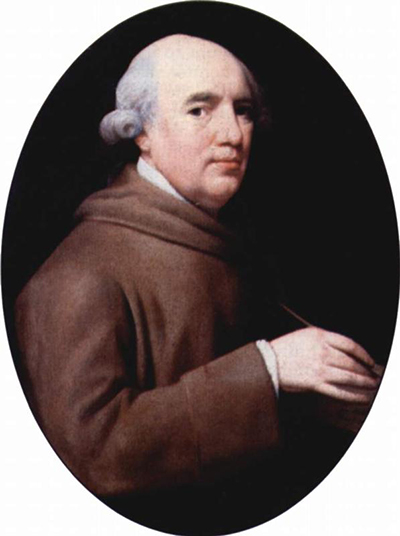
The National Portrait Gallery's NPG 4575 is a self-portrait dated 1781, painted in enamel on a Wedgwood plaque. The current catalogue gives its oval dimensions as 697 × 531 mm. Purchased in 1967 with Art Fund assistance, it is a substantially more expansive presentation than the Yale copper. [2]
Stubbs appears against a dark background, wearing a brown outer garment that wraps across his shoulders. The light falling on his forehead, face and hand makes those areas stand out from the restrained clothing. A brush runs diagonally towards the hand and palette at the right edge. The body turns away while the face returns towards the spectator. Artist and working materials share the narrow space, but the composition does not open into a descriptive studio interior.
The hand performs an important compositional task. Without it, the likeness would be dominated by the head and the sweep of brown fabric. Its pale horizontal shape supplies a second focus, balancing the face and giving the profession a visible action. The brush is slender beside the broad sleeve. The palette, partly cut by the oval, feels continuous with an activity beyond the picture's boundary. The viewer meets a painter who has turned towards us, rather than a sitter isolated from his work.
This need not be read as an instantaneous interruption. The pose is composed, and the preparatory drawing shows how deliberately it was developed. Nevertheless, the relationship between face and tools distinguishes the enamel from the earlier oil. The young man's occupation had to be supplied by our knowledge of his identity; the mature artist presents the means of his trade within the likeness itself.
The ceramic support adds another dimension. This image of a painter is also an example of the kind of painting he chose to investigate. Its significance is more precise than a general claim that Stubbs liked experiments: the medium is present in the actual object in front of us. His enamel and printmaking techniques explain the wider material practice; the portrait concentrates that practice into an image of its maker.
From squared drawing to finished portrait
Yale holds the corresponding Study for the Self-portrait in Enamel, B2001.2.1262, dated about 1781. The sheet measures 30.5 × 23.2 cm and is catalogued as graphite on cream wove paper, squared for transfer. Its grid crosses the carefully developed head, torso, hand and surrounding oval. The artist's name appears on the palette. [3]
The drawing makes planning visible. The face is developed through closely controlled tonal work; the clothing is articulated through boundaries and shading; and the forearm leads to the hand near the right edge. The squares continue across areas of quite different visual importance. They treat a curl, an eye, a sleeve and the dark background as parts of one transferable arrangement. The artist's concern with likeness and his concern with placing that likeness within a larger format are present on the same sheet.
Comparing drawing and enamel is especially revealing at the broadest level. The oval, turned shoulders, returning face and extended hand are already established before colour enters. In the finished portrait, the pale flesh and brown clothing make the divisions immediately legible. In the drawing, the grid remains visible across those divisions. One object shows an organised composition in preparation; the other gives that arrangement the coherence of a finished painted surface.
The sheet also complicates the idea that every surviving likeness is an independent portrait conception. It is an original drawing by Stubbs and a self-image, but it serves the painted enamel. Counting it separately is appropriate when discussing his drawings; treating it as another surviving finished painting would confuse object types. His surviving drawings include evidence of preparation as well as works with other purposes.
Its later inscriptions show that recognition could survive while authorship remained uncertain. Yale transcribes an 1842 note identifying the sitter as the animal painter and drawing attention to his name on the palette, alongside a separate question about who made the drawing. Those are different questions: knowing whom an image represents does not necessarily identify its maker. [3]
Friendship, framing and the Royal Academy
The 1781 enamel was exhibited at the Royal Academy in 1782. A newspaper review quoted by the National Portrait Gallery recognised it as the artist's own likeness but objected to the white as “cadaverous”. The criticism is a reminder that contemporary responses to enamel could involve its appearance as a portrait, rather than simply admiration for technical difficulty. [2]
It is tempting to make the pale face tell us something definite about Stubbs's health or mood. The review does not support that move. It records a judgement about colour and resemblance. Our own view of a digital image is another stage removed from the original viewing conditions. The useful historical point is that the likeness invited scrutiny as both a face and a painting.
The frame belongs to that presentation too. The Gallery's framing research associates its neoclassical type with Wedgwood and his partner Thomas Bentley, and with the frame-maker Thomas Vials. It also explicitly states that Stubbs's employment of Vials is undocumented. A design relationship therefore cannot safely become a claim that a particular craftsman received this commission. [2]
Yale's published catalogue records that the finished portrait was formerly identified as Wedgwood and credits Basil Taylor with correcting the identification in 1965. Its entries also discuss the work as a gift, while giving differing accounts of the intended recipient. [3] This history brings private friendship, disputed identity and public professional display into the story of a single object. None requires us to treat its present identification as obvious to every earlier owner or viewer.
Self Portrait on a White Hunter, 1782
At the Lady Lever Art Gallery, Self Portrait on a White Hunter moves the artist out of the close portrait oval and into an equestrian composition. Art UK's collection record identifies the work as an enamel of 1782 on Wedgwood biscuit earthenware, 93 × 71 cm, accession LL 3684. It entered the Gallery from Lord Leverhulme's private collection in 1922. The National Portrait Gallery's specialist survey records its former identification as Josiah Wedgwood. [4] [21]
The whole composition shows a pale horse in profile facing left, with the rider seated above the saddle near the centre. Stubbs wears a light-coloured coat and a dark tricorn hat. His body follows the horse's orientation, but his face turns towards the viewer. The reins extend from the horse's head towards his hand. A large rock rises behind him on the right; a branching tree and foliage fill much of the upper left. Broad leaves and uneven ground occupy the foreground.
The horse makes an unusually large contribution to the self-image. Its pale body spreads across the oval, and its long neck rises beside the rider. The artist's upright figure is given scale by the animal beneath him. The portrait therefore asks us to look at a relationship between bodies: a seated human figure, the horse's back and shoulders, the falling leg and the line of the reins. The rider remains recognisable as the principal human subject, yet he does not monopolise the picture's attention.
This differs sharply from the 1781 enamel's concentrated arrangement of face, sleeve and brush. There, a dark surrounding field intensifies the pale head and hand. Here, light is distributed across the horse and rider, while rock and vegetation establish a larger environment. One image identifies painting through its tools; the other presents Stubbs within the kind of human and equine company familiar from his paintings.
The former Wedgwood title deserves to be remembered as an identification history, not as evidence that two separate versions exist. Nor does a horse automatically establish that its rider is Stubbs: his patrons and other sitters also appear mounted. The current title rests within the accumulated study of his portraits. The visual comparison helps us understand the image once identified; it does not replace the documentary and scholarly work of identification. [4] [21]
Humphry's portrait and the problem of the surviving copy
Ozias Humphry made a chalk portrait study of Stubbs in 1777. That likeness is connected with a lost, three-quarter-length oil portrait. The surviving National Portrait Gallery watercolour and pencil, NPG 1399, follows Humphry's composition. Its current catalogue date is 1777–79, and its dimensions are 518 × 407 mm. [5] [22]
The distinction between the lost painting and the surviving sheet is crucial. Ingamells proposes a copy for Nicholls's 1809 engraving, supported by the card suggesting a working drawing. A footnote counters that the frame might indicate a late eighteenth-century date. [22] Neither observation establishes an exact moment of execution. The evidence points towards a reproductive function while leaving its chronology open.
The image shows Stubbs standing beside a large circular representation of Phaeton and the Chariot of the Sun. Drapery fills much of the background. One hand rests above the circular picture, while the other is placed against its depicted action. Instead of a brush identifying the artist through an implement, a work of art identifies him through a subject associated with his own production. The composition presents an artist in relation to an artwork.
The depicted Phaeton is larger than the 1775 enamel that Stubbs retained, a discrepancy noted by Ingamells. [22] The two should not automatically be equated. Scale within a portrait is evidence worth considering: an artwork shown inside another artwork is a representation with its own choices about visibility and emphasis.
Its provenance runs through George Townly Stubbs to the Stamfords, who believed it to be by Stubbs. The Gallery bought it in 1905. [22] That belief forms part of its history, while the current attribution is after Humphry. [5] The example is particularly instructive: inheritance from the artist's family can be significant without guaranteeing that the family understood a copy's authorship correctly.
William H. Craft: a likeness with conflicting dates
William H. Craft's enamel portrait at Yale, B2001.2.72, is another image of Stubbs by someone else. The current collection record dates it 1775 and identifies its medium as enamel on copper, measuring 17.1 × 14.6 cm. The same record, however, transcribes a signature and date of 1779, apparently under the mount. The National Portrait Gallery's older survey also dates it 1779. The disagreement is real and should remain visible. [21] [23]
Craft gives Stubbs a pale green outer garment with contrasting edging, a darker front and white material at the neck. A hand rests on a portfolio near the lower right. The head turns towards us, set against a muted surrounding field. The compact oval, formal clothing and careful positioning of the hand produce a self-contained presentation. It resembles the kind of controlled encounter found in the self-images, while belonging to another artist's practice.
The portrait's relation to Humphry is likewise qualified. Ingamells suggests that Craft's head may derive from Humphry's lost painting. [22] Similarity here may be part of a chain of reuse. It need not mean that Craft arranged an independent sitting, and it certainly does not make his enamel a work by Stubbs.
Yale describes Craft as an enamel painter and decorator whose work included portraits, clock faces, landscapes and historical subjects. A possible connection through Wedgwood is presented as a possibility. [23] That context makes the choice of medium intelligible without inventing a meeting or collaboration. The subject is an artist associated with enamel, represented by another practitioner of enamel; the objects share a material interest while preserving separate authorships.
Prints: several makers, several kinds of likeness
Contemporary prints carried Stubbs's appearance beyond a single painted or drawn object. A stipple engraving of 1769 in the National Portrait Gallery, NPG D20153, names D. P. Pariset as engraver after Pierre-Étienne Falconet; its commercial history also includes Ryland and Bryer. The plate measures 217 × 148 mm. Other Gallery impressions come from the same plate, so several collection entries do not necessarily mean several original likenesses. [24]
James Bretherton's etching after Thomas Orde-Powlett offers another chain. The Gallery dates NPG D32108 to 1773–75. Here again the names distinguish an image's source from the maker of the print. The sitter's identity adds a third role. It would be misleading to list such works among Stubbs's self-portraits merely because his name is central to their titles. [25]
The Pariset print presents Stubbs in profile within a medallion-like circle. A ribbon crowns the surrounding design; below it, a tablet names him in Latin as an animal painter. The profile is made part of an ornamental monument on paper. The Bretherton etching has a different emphasis. Stubbs sits with a palette and raises a brush towards a lightly indicated horse. Head and working hands sit within a scene of artistic activity. These are two ways of making the same profession visible: one through a formal identifying inscription, the other through depicted work. [24] [25]
Neither arrangement needs to be treated as an unmediated glimpse of daily life. The medallion is plainly a designed presentation, and the artist-at-work image is selective too. Its relatively developed figure and lightly stated painted horse direct attention towards the maker rather than the finished animal. The image may encourage us to imagine the act of painting, but it cannot establish Stubbs's usual studio routine or handedness. A reproductive print can reverse its source, and the appearance of a raised hand is insufficient to settle such a biographical question.
These distinctions are especially important when reproductions circulate without their inscriptions or margins. A plate date, a drawing date and the date when an impression was acquired answer different questions. Cropping can remove the evidence that separates those stages. The history of Stubbs's prints includes his own production, but the printed portraits of him also belong to the work of engravers, publishers and collectors who made his appearance available to others.
The older artist and his posthumous image
In February 1794, Stubbs sat to Humphry again. The resulting pastel is at the Walker Art Gallery. Neil Jeffares's specialist catalogue records it as 74 × 58.5 cm and identifies its Royal Academy exhibition that year as number 374. The National Portrait Gallery survey connects the sitting with Farington's diary entry of 3 February. [21] [26]
A second 1794 portrait tradition begins with George Dance's profile drawing dated 8 February. William Daniell later translated that likeness into a soft-ground etching, published on 10 April 1802. NPG D12218 measures 270 × 199 mm at the plate and 376 × 263 mm on the sheet. The two dates belong to different stages of the image's life. [27] In the print, the profile occupies a largely open sheet. There is little of the surrounding furniture or work that defines some earlier likenesses. The strong outer contour and the contrast between the face and the darker hair and collar make the head immediately legible. The light indication of the torso allows attention to settle on the profile, an economy quite different from Pariset's ornamental enclosure.
After Stubbs's death, Henry Bone revisited Humphry's likeness. The National Portrait Gallery holds his 1810 pencil drawing, squared in ink for transfer, NPG D17636. At 150 × 113 mm, it is a small working object in another artist's reproductive process. Its date cannot represent a new sitting with Stubbs. [28]
Bone exhibited an enamel portrait after Humphry in 1811. Anne Puetz interprets that exhibition as a pointed tribute to an earlier painter who had pursued enamel as a serious artistic medium. [29] The connection is compelling because it concerns both subject and material: the artist becomes the person commemorated, while a medium associated with his ambitions helps carry the commemoration.
The two squared drawings offer a particularly useful comparison. Stubbs's own study organised a self-image for enlargement into a ceramic portrait. Bone's later sheet organised another artist's likeness of Stubbs for a further translation. Grids could serve original self-representation and posthumous copying alike. Their presence describes a working procedure; it does not decide whether the image began in a mirror, a sitting or an earlier artwork. [3] [28] Bone's sheet makes this particularly clear: the numbered grid dominates a lightly outlined figure, whereas Stubbs's own study develops a much fuller range of tone. Both are preparations, but they preserve different amounts of visual information. The comparison lets us see copying as an active process of selecting and translating a likeness, while leaving the distinction between the first portraitist and the later copyist intact.
Videos on George Stubbs
Explore Stubbs’s equestrian painting in its wider context, including two readings of Whistlejacket.
A Horse Lover’s Guide to the YCBA
A museum tour that places Stubbs alongside other artists who painted horses. It includes a look at Pumpkin with a Stable-lad.
Watch on YouTubeGeorge Stubbs artworks directory
Search works and related prints documented in this guide. Separate versions and printing matrices have separate entries; printmakers are named where known. Unidentified historical titles and untraced studio-sale material are discussed in the essays. A dash means that a date is not established here.
| Name | Date | Medium |
|---|---|---|
| A Bay Horse with a Groom | 1791 | Painting |
| A Bay Hunter with Two Playful Spaniels | 1777 | Painting |
| A Bay Hunter, a Springer Spaniel and a Sussex Spaniel in a wooded river Landscape | 1782 | Painting |
| A Cheetah and a Stag with Two Indian Attendants | about 1764 | Painting |
| A Couple of Fox Hounds (coloured print after Stubbs) | — | Print after Stubbs |
| A Couple of Foxhounds | 1792 | Painting |
| A Foxhound on the Scent | 1788 | Drawing |
| A Gentleman driving a Lady in a Phaeton | 1787 | Painting |
| A Grey Horse | 1793 | Painting |
| A Grey Horse (cantering companion) | 1793 | Painting |
| A Grey Stallion in a Landscape | — | Painting |
| A Horse Affrighted at a Lion | 1 May 1788 | |
| A Horse Belonging to the Rt. Honourable Lord Grosvenor called Bandy from his Crooked Leg | about 1763 | Painting |
| A Horse Frightened by a Lion | 1777 | |
| A Lion (A Lion Resting on a Rock) | 1 May 1788 | |
| A Lion Attacking a Horse | 1770 | Painting |
| A Lion Attacking a Horse (monumental Yale canvas) | 1762 | Painting |
| A lion attacking a horse (NGV) | about 1765 | Painting |
| A Lion Devouring a Horse (1788 print) | 1788 | |
| A lion devouring a horse (attribution disputed) | Proposed mid-1770s | Painting |
| A mare and foal with a bay horse | 1771 | Painting |
| A Monkey | 1799 | Painting |
| A Prancing Horse, Facing Right | c. 1790 | Drawing |
| A Rough Dog | 1790 | Painting |
| A Saddled Bay Hunter | 1786 | Painting |
| A Sleeping Leopard | 1 January 1791 | |
| A Tiger and a Sleeping Leopard | 1 May 1788 | |
| A Tigress (John Dixon after Stubbs) | 1772 | Print after Stubbs |
| A Tyger (A Recumbent Leopard by a Tree) | 1 May 1788 | |
| A Tyger (Sleeping Leopard) | 1 May 1788 | |
| An animal found on the coast of New Holland called kanguroo (after Stubbs) | 1773 | Print after Stubbs |
| An animal of a new species found on the coast of New South Wales (after Stubbs) | July 1773 | Print after Stubbs |
| Antinous and Jockey | — | Painting |
| Antinoüs, a chestnut racehorse, in a landscape | Undated | Painting |
| Bandy belonging to Lord Grosvenor (print after Stubbs) | — | Print after Stubbs |
| Baronet (George Townley Stubbs after Stubbs) | 20 February 1794 | Print after Stubbs |
| Baronet with Sam Chifney Up | 1791 | Painting |
| Baronet with Samuel Chifney up (Royal Collection) | 1791 | Painting |
| Bay Hunter by a Lake | 1787 | Painting |
| Brood Mares (Benjamin Green after Stubbs) | Issue 14 November 1776 | Print after Stubbs |
| Brood Mares and Foals | usually dated 1767 | Painting |
| Brown and White Norfolk or Water Spaniel | 1778 | Painting |
| Bulls Fighting | 1786 | Painting |
| Captain Samuel Sharpe Pocklington with His Wife, Pleasance, and possibly His Sister, Frances | 1769 | Painting |
| Death of the Doe (attribution disputed) | 1804 | |
| Der Englische Hühnerhund (Johann Wölfle after Stubbs) | about 1860 | Print after Stubbs |
| Dog (A Foxhound Viewed from Behind) | 1 May 1788 | |
| Dog [A Foxhound on the Scent] | 1788 | |
| Drill and albino baboon | before 1789 | Painting |
| Eclipse (Charles Hunt after Stubbs) | 12 November 1839 | Print after Stubbs |
| Eclipse (George Townley Stubbs after Stubbs) | 1796 | Print after Stubbs |
| Eclipse (oil study) | — | Painting |
| Eclipse (Thomas Burke after Stubbs) | First published 1772 | Print after Stubbs |
| Eclipse and John Wildman (Benjamin Green after Stubbs) | 1772 | Print after Stubbs |
| Eclipse at Newmarket (Jockey Club version) | Proposed early 1790s; often dated 1770 | Painting |
| Eclipse at Newmarket with a groom and jockey | 1770 | Painting |
| Eclipse with Mr Wildman and His Sons | 1769–71 | Painting |
| Eclipse, the Property of Capt.n O Kelly (anonymous print after Stubbs) | Imprint 4 June 1804; impression undated | Print after Stubbs |
| Euston | 1774 | Painting |
| Finished Study for the Seventh Anatomical Table of the Muscles of the Horse | 1756–58 | Drawing |
| Five Brood Mares at the Duke of Cumberland's Stud Farm in Windsor Great Park | 1765 | Painting |
| Fowl Body, Lateral View (Highly Finished Study for an Unpublished Table; Shows the Last Stage in Dissection) | — | Drawing |
| Fowl Body, Lateral View (Probably Prepared for Transfer to the Plate for Engraving of Table XV) | — | Drawing |
| Fowl Skeleton, Lateral View (Finished Study for Table V) | — | Drawing |
| Freeman, the Earl of Clarendon's Gamekeeper, with a Dying Doe and Hound (Yale) | 1800 | Painting |
| George Stubbs (enamel self-portrait) | 1781 | Enamel |
| Gimcrack (George Townley Stubbs after Stubbs) | 1775 | Print after Stubbs |
| Gimcrack on Newmarket Heath, with a trainer, a jockey and a stable lad | about 1765 | Painting |
| Gimcrack, with John Pratt up, on Newmarket Heath | about 1765 | Painting |
| Hambletonian, Rubbing Down | 1800 | Painting |
| Hay-Makers | 1791 | |
| Haycarting | 1795 | Enamel |
| Haymakers | 1785 | Painting |
| Haymakers (Lady Lever Art Gallery) | 1794 | Enamel |
| Hollyhock (with later additions by Vernet and Boucher) | about 1765–70 | Painting |
| Horse Attacked by a Lion (Episode C) | 1768–69 | Painting |
| Horse Attacked by a Lion (Tate enamel) | 1769 | Enamel |
| Horse Devoured by a Lion | Possibly exhibited 1763 | Painting |
| Horse Frightened by a Lion | 1770 | Painting |
| Horse Frightened by a Lion (Episode A; Wedgwood and Bentley after Stubbs) | — | Sculpture |
| Horse Frightened by a Lion (Tate) | Possibly exhibited 1763 | Painting |
| Horse Frightened by a Lion (Yale) | 1762–68 | Painting |
| Horse in the Shade of a Wood | 1780 | Painting |
| Hound Coursing a Stag | about 1762 | Painting |
| Human Figure, Anterior View (Intended for a Plate That was Never Published) | — | Drawing |
| Human Skeleton, Lateral View | 1795–1806 | Drawing |
| Hunt servants setting out (Southill commission) | 1767 | Painting |
| Hühnerhund (The Spanish Pointer) | about 1766 | Painting |
| John and Sophia Musters Riding at Colwick Hall | 1777 | Painting |
| John Musters on his hunter Pilgrim | 1777–78 | Painting |
| Labourers | 1789 | |
| Labourers (Richard Earlom after Stubbs and Amos Greene) | 25 March 1790 | Print after Stubbs |
| Laetitia, Lady Lade (d.1825) | 1793 | Painting |
| Lemon and White Water Spaniel | — | Painting |
| Lion Attacking a Stag | — | Painting |
| Lord Grosvenor's Arabian Stallion with a Groom | about 1765 | Painting |
| Lord Grosvenor's Arabian Stallion with a Groom (Peter Mazell after Stubbs) | 1771 | Print after Stubbs |
| Mambrino (Eaton Hall painting) | — | Painting |
| Mambrino (George Townley Stubbs after Stubbs) | 1794 | Print after Stubbs |
| Mares and Foals belonging to the 2nd Viscount Bolingbroke | about 1761–62 | Painting |
| Mares and foals beneath large oak trees | — | Painting |
| Mares and Foals by a stream | Exhibited 1764 | Painting |
| Mares and Foals in a River Landscape | about 1763–68 | Painting |
| Mares and Foals in an Extensive Landscape | about 1769 | Painting |
| Mares and Foals without a Background | 1762 | Painting |
| Moose Deer (after Stubbs) (Arctic Zoology plate VIII) | 1784–85 publication | Print after Stubbs |
| Newmarket Heath with a Rubbing-Down House | — | Painting |
| Otho (1796 print after Stubbs) | 1 December 1796 | Print after Stubbs |
| Otho, with John Larkin up | 1768 | Painting |
| Pangloss | about 1762 | Painting |
| Patch (Grafton commission) | 1759 | Painting |
| Phaeton and the Chariot of the Sun (enamel) | 1775 | Enamel |
| Phaeton with a Pair of Cream Ponies and a Stable-Lad | 1780–84 | Painting |
| Phillis | 1772 | Painting |
| Portrait of a Large Dog (Dingo) | 1772 | Painting |
| Pumpkin with a Stable-lad | 1774 | Painting |
| Racehorses Exercising at Goodwood | 1759–60 | Painting |
| Reapers (1791 print) | 1791 | |
| Reapers (Tate) | 1785 | Painting |
| Reapers (Yale) | 1795 | Enamel |
| Red Deer: A Stag and a Hind | 1792 | Painting |
| Richard Wedgwood | — | Enamel |
| Ringwood, a Brocklesby Foxhound | 1792 | Painting |
| Scrub, a bay horse belonging to the Marquess of Rockingham | about 1762 | Painting |
| Self Portrait on a White Hunter | 1782 | Enamel |
| Self-Portrait | about 1759 | Painting |
| Shooting (1770 Woollett plate after Stubbs) | 1770 | Print after Stubbs |
| Shooting (1771 Woollett plate after Stubbs) | 1771 | Print after Stubbs |
| Shooting at Goodwood | 1759–60 | Painting |
| Sir John Nelthorpe as a boy | 1756 | Painting |
| Sir John Nelthorpe partridge shooting with one pointer | — | Painting |
| Sir John Nelthorpe, 6th Baronet, out Shooting with His Dogs in Barton Field, Lincolnshire | 1776 | Painting |
| Sleeping Leopard | 1777 | Enamel |
| Soldiers of the 10th Light Dragoons | 1793 | Painting |
| Stallion and Mare (George Townley Stubbs after Stubbs) | 1776; reissued 1789 | Print after Stubbs |
| Steward and gamekeeper with dogs (Southill commission) | 1767 | Painting |
| Studies of a Lemur (Lemur murinus) in six different attitudes | 1773 | Drawing |
| Study for the Self-portrait in Enamel | c. 1781 | Drawing |
| Study of a Lemur | 1773 | Drawing |
| Study of a Racehorse in Action: Galloping to Left, a Semi-Anatomical Study, with Skin Flayed to Show Action of Muscles | — | Drawing |
| Study of the Legs of a Draught-Horse Pulling a Harrow (attributed to Stubbs) | Proposed about 1786 | Drawing |
| Sweet William (Grosvenor panel) | — | Painting |
| Sweet William (Turf Gallery canvas) | — | Painting |
| The Black Stallion Sampson, Portrayed from Three Angles (with landscape additions) | about 1764 | Painting |
| The Charlton Hunt | 1759–60 | Painting |
| The Fall of Phaeton | — | Sculpture |
| The Frightened Horse | 1780 | Sculpture |
| The Grosvenor Hunt | — | Painting |
| The Haymakers (Upton House) | 1783 | Painting |
| The Horse and Lion (George Townley Stubbs after George Stubbs) | 1770 | Print after Stubbs |
| The Kongouro from New Holland | 1772 | Painting |
| The Labourers | 1779 | Painting |
| The Labourers (Southill original) | 1767 | Painting |
| The lion and horse (Benjamin Green after Stubbs) | 1769; reissued 1777 | Print after Stubbs |
| The Milbanke and Melbourne Families | about 1769 | Painting |
| The Moose | 1770 | Painting |
| The Prince of Wales's Phaeton | 1793 | Painting |
| The Reapers (Upton House) | 1783 | Painting |
| The Sebra, or Wild Ass (George Townley Stubbs after Stubbs) | 1771 | Print after Stubbs |
| The Spanish Pointer (Bradford version) | about 1766–68 | Painting |
| The Spanish Pointer (William Woollett after Stubbs) | January 1768 | Print after Stubbs |
| The Third Duke of Dorset's Hunter with a Groom and a Dog | 1768 | Painting |
| Thomas Freeman, Lord Clarendon's gamekeeper, with a dog and a shot doe (with George Townly Stubbs) | 1803 | Painting |
| Turf, with Jockey up, at Newmarket | — | Painting |
| Turk and Crab | — | Painting |
| Two Bay Hunters Communing On The Bank Of A Lake | — | Painting |
| Tygers at Play | 1780 | |
| Viscount Gormanston's White Dog | 1781 | Painting |
| Viscount Gormanston's White Dog (canvas version) | — | Painting |
| Water Spaniel | 1769 | Painting |
| Wedgwood Family Portrait | 1780 | Painting |
| Whistlejacket | about 1762 | Painting |
| Whistlejacket with two other stallions and a groom | Recorded 1762 | Painting |
| White Poodle in a Punt | about 1780 | Painting |
| William Anderson with two Saddle-Horses | 1793 | Painting |
| Working Drawing for the Seventh Anatomical Table of the Muscles of the Horse | 1756–58 | Drawing |
| Zebra | 1763 | Painting |
Questions about Stubbs's portraits
Three are recognised in the Yale account: the early oil on copper, the 1781 London enamel and the mounted enamel of 1782. The surviving transfer drawing is a related work on paper. Older descriptions of the early miniature concern the painting now at Yale, rather than an additional lost or privately owned self-image. [1] [20]
They show how he and other artists presented his appearance. Tools, clothes, poses and settings support close comparison, but a grave expression cannot establish a fixed temperament. The most revealing differences concern what each image includes: a face alone, a painter's hand, a rider and horse, or an artist displaying another work. Together they give a richer account of his representation than any single likeness can provide.
Discussion
Look again at the images and ideas explored in George Stubbs Self-Portraits and Portraits of the Artist. These editorial prompts invite your observations.
Reader Insights
Which of the self-portraits most strongly presents Stubbs as a working artist?
What changes when you compare a self-portrait with a likeness made by someone else?
What would you expect the physical surface of oil or enamel to add to the experience of the portrait?
Join the Conversation
Share a detail, comparison or question about George Stubbs Self-Portraits and Portraits of the Artist below.
References
- Yale Center for British Art, Self-Portrait, B2006.16, current collection record and provenance, including its account of Judy Egerton's research. Accessed 31 October 2026. View source.
- National Portrait Gallery, George Stubbs, NPG 4575, current record and Jacob Simon's published frame entry. Accessed 31 October 2026. View source.
- Yale Center for British Art, Study for the Self-portrait in Enamel, B2001.2.1262, current record, Angus Trumble's 2007 catalogue entry and Gillian Forrester's 2001 entry. Accessed 31 October 2026. View source.
- Art UK, Lady Lever Art Gallery collection record, Self Portrait on a White Hunter, LL 3684. Accessed 31 October 2026. View source.
- National Portrait Gallery, George Stubbs, NPG 1399, current attribution, date and object details. Accessed 31 October 2026. View source.
- Goodwood, The Collection, Painting Collection modal, Racehorses Exercising at Goodwood; An exciting acquisition: a study by George Stubbs, 30 June 2023; History of the Estate Hounds, 4 October 2023; About Goodwood Racecourse. Accessed 4 November 2026. View source.
- Goodwood, The Collection, Painting Collection modal, Racehorses Exercising at Goodwood; An exciting acquisition: a study by George Stubbs, 30 June 2023; History of the Estate Hounds, 4 October 2023; About Goodwood Racecourse. Accessed 4 November 2026. View source.
- Goodwood, The Collection, Painting Collection modal, Racehorses Exercising at Goodwood; An exciting acquisition: a study by George Stubbs, 30 June 2023; History of the Estate Hounds, 4 October 2023; About Goodwood Racecourse. Accessed 4 November 2026. View source.
- Goodwood, The Collection, Painting Collection modal, Racehorses Exercising at Goodwood; An exciting acquisition: a study by George Stubbs, 30 June 2023; History of the Estate Hounds, 4 October 2023; About Goodwood Racecourse. Accessed 4 November 2026. View source.
- Yale Center for British Art, Self-Portrait, B2006.16, current collection record and provenance, including its account of Judy Egerton's research. View source.
- National Portrait Gallery, George Stubbs, NPG 4575, current record and Jacob Simon's published frame entry. View source.
- National Gallery, Whistlejacket, NG6569, current collection record, provenance, in-depth discussion and frame entry. View source.
- Yale Center for British Art, Zebra, B1981.25.617, current object metadata, gallery labels, Malcolm Warner’s 1998 catalogue entry and provenance supplied through the museum’s public collection record. View source.
- Christie’s, Gimcrack on Newmarket Heath, with a trainer, a jockey and a stable lad, London, 5 July 2011, lot 12; object details, essay, provenance, exhibitions and whole image. View source.
- Christie’s, Gimcrack on Newmarket Heath, with a trainer, a jockey and a stable lad, London, 5 July 2011, lot 12; object details, essay, provenance, exhibitions and whole image. View source.
- Yale University Art Gallery, A Lion Attacking a Horse, 1770, 1955.27.1, collection record. Accessed 4 November 2026. View source.
- Royal Museums Greenwich, ‘The Kongouro from New Holland’ (Kangaroo), ZBA5754. Accessed 4 November 2026. View source.
- Tate, George Stubbs, Haymakers, 1785, T02256; details, Terry Riggs’s collection text (January 1998), and online caption. Collection record. View source.
- Frances Bailey, ‘Hambletonian, Rubbing Down: A masterpiece by George Stubbs’, National Trust Cultural Heritage Magazine, Autumn/Winter 2024, pp. 22–33. Article. View source.
- Christie's, Self portrait, bust-length, circa 1756–60, George Stubbs, sale 8 June 2006, lot 35, provenance and lot essay prepared with Judy Egerton's assistance. Accessed 31 October 2026. View source.
- John Ingamells, Mid-Georgian Portraits 1760–1790 (2004), George Stubbs iconography, reproduced by the National Portrait Gallery; read alongside current collection records. Accessed 31 October 2026. View source.
- John Ingamells, Mid-Georgian Portraits 1760–1790 (2004), extended entry for NPG 1399, reproduced by the National Portrait Gallery. Accessed 31 October 2026. View source.
- Yale Center for British Art, William H. Craft, George Stubbs, B2001.2.72, current record, inscription transcription and 2005 gallery label. Accessed 31 October 2026. View source.
- National Portrait Gallery, George Stubbs, NPG D20153, Pariset after Falconet. Accessed 31 October 2026. View source.
- National Portrait Gallery, George Stubbs, NPG D32108, Bretherton after Orde-Powlett. Accessed 31 October 2026. View source.
- Neil Jeffares, Dictionary of pastellists before 1800, online edition, “Humphry, Ozias”, entry J.41.299. Accessed 31 October 2026. View source.
- National Portrait Gallery, George Stubbs, NPG D12218, Daniell after Dance. Accessed 31 October 2026. View source.
- National Portrait Gallery, George Stubbs, NPG D17636, Bone after Humphry. Accessed 31 October 2026. View source.
- Anne Puetz, “1811: Henry Bone's Enamels and the Triumph of Skill”, The Royal Academy Summer Exhibition: A Chronicle, 1769–2018, Paul Mellon Centre for Studies in British Art, 2018. Accessed 31 October 2026. View source.
- Basic title, date and material metadata for Tate’s Reapers (T02257) and Otho (T02375) is adapted from the Tate collection dataset, October 2014, released under CC0. TheHistoryOfArt.org has reconciled labels and versions. This credit does not apply to Tate’s authored catalogue commentary or images.
- Data Source: Yale Center for British Art. Basic object fields are adapted and reconciled for this directory. Reuse is subject to the Center’s Open Data and Data Services Terms of Use. No museum endorsement is implied. This metadata credit does not relabel scholarly essays or images as open data.
- Basic object metadata for A Horse Frightened by a Lion, 1985.38, The Cleveland Museum of Art, John L. Severance Fund, is available under CC0. Titles and design-level grouping have been reconciled for this directory.