 by Tom Gurney
Tom Gurney BSc (Hons) is an art history expert with over 20 years experience
Email: tomgurney1@gmail.com / Phone: +44 7429 011000
Hambletonian Rubbing Down: Introduction
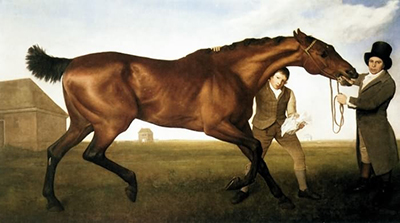
Hambletonian has won his race, but the effort has not ended. His mouth is open, his neck reaches forward and his legs bend into an uneven, restless arrangement. Two attendants stand beside him: one holds the lead while the other carries a white cloth. The enormous horse occupies almost the entire width of George Stubbs’s canvas. Victory becomes an encounter with the body that achieved it. [1]
At a Glance
This work across George Stubbs’s career
Whistlejacket
about 1762 [7]Contents
- A racehorse at life size
- The men who attend him
- The particular horse behind the picture
- The match with Diamond
- Two pictures and a market for likenesses
- At the Royal Academy in 1800
- The dispute over payment
- Landscape, scale and comparison
- Materials and the care of the painting
- A complicated family history
- Videos on George Stubbs
A racehorse at life size
Stubbs painted Hambletonian, Rubbing Down in 1800. The oil on canvas, 209.6 × 367.3 centimetres, belongs to the National Trust’s Londonderry Collection at Mount Stewart, County Down. Its width gives the horse a life-sized presence. [2]
The horse’s flank provides the picture’s broadest continuous surface. Warm brown highlights run over the rounded hindquarters, along the ribs and across the shoulder, while darker passages hollow the belly and separate the legs. The light does not flatten him into a silhouette. It makes his weight and the turns of his body legible across a very large area. [1]
His back runs in a long, shallow curve beneath the pale sky. The line rises towards the withers and then descends along the extended neck, carrying the eye towards the head at the right. A short, dark tail projects at the opposite end. Between these extremities, the body is both strongly contained and awkwardly unsettled: the horse is no longer galloping, yet he does not settle into a composed standing portrait. [1]
The legs give this impression particular force. One hind leg reaches backwards while the other bends beneath the body; the forelegs cross and bend at different angles. These oblique lines contrast with the long horizontal mass above them. The dark lower limbs overlap the grass, making the small points of contact with the ground seem strikingly slight beneath the great torso. [1]
At the head, the bridle introduces narrow, taut lines against the horse’s flesh. His nostril is conspicuous and the parted mouth exposes pale details against the dark muzzle. The head projects towards the man at the far right, whose upright figure supplies a firm ending to the composition. Horse and attendant face different ways: the animal stretches across the picture while the man looks out towards us. [1]
The men who attend him
The adult wears a tall black hat, a long brown coat, pale neckcloth and dark boots. One hand reaches towards the horse’s mouth; the other gathers the hanging lines. His clothing forms a compact, almost vertical shape beside the broad animal. The folds of his coat and the repeated loops of the lead hold the eye at the edge of a scene otherwise dominated by the horse’s length. [1]
The younger attendant is partly hidden behind the neck. His head appears beneath its arch, and a hand rests over the withers above. In his other hand he holds a crumpled white cloth, its pale folds catching the light. His body leans forward, with one leg stretched out for support. The two people are neither decorative spectators nor triumphant riders. Their hands connect the portrait to the work of handling and tending the horse. [1]
The adult has sometimes been called the jockey Frank Buckle. Racing historian David Wilkinson considers Thomas Fields, Vane-Tempest’s trainer at Silvio Hall near Richmond, a more plausible identification. The name remains a proposal; the boy is unidentified. Buckle’s documented part in the race does not establish that the man holding the horse afterwards is his portrait. Keeping that distinction allows us to recognise the work represented without inventing a complete cast of named sitters. [15]
Both attendants direct their faces towards the viewer rather than disappearing into a self-contained scene of care. The boy’s face is framed by the horse’s neck; the older man’s face rises beside the muzzle. These two small human centres punctuate the great animal form. Looking from one to the other, we repeatedly cross the head and shoulder of Hambletonian himself. [1]
The particular horse behind the picture
Hambletonian was a bay colt foaled in 1792. The General Stud-Book of 1803 lists him among the offspring of a Highflyer mare bred by A. Hall in 1782. His sire was King Fergus; his maternal grandmother, Monimia, was by Matchem. The entry places the 1792 colt under John Hutchinson’s ownership. This maternal record supplies a precise identity within a breeding history, rather than treating the horse as an anonymous example of a racing type. [16] [15]
King Fergus was a son of Eclipse. Hambletonian’s pedigree thus connected a later racing celebrity to an earlier one, while the two horses retained their distinct owners, performances and pictorial histories. [15]
William Taplin records Hambletonian’s successive owners: Hutchinson, Sir Charles Turner and Sir Henry Tempest Vane, better known as Vane-Tempest. The horse won the St Leger in 1795 and Doncaster’s Gold Cup the next day. [17]
The match with Diamond
On 25 March 1799 Hambletonian met Joseph Cookson’s Diamond over Newmarket’s Beacon Course. The Sporting Magazine described the distance as four miles, one furlong and 138 yards. Buckle rode Hambletonian; Dennis Fitzpatrick rode Diamond. The first horse carried eight stone three pounds, the second eight stone. The stake was 3,000 guineas. [18] [17]
Taplin reproduced the agreement of 12 October 1798: it specified half forfeit and allowed the owners to alter the day or hour by mutual consent. Weight, course and timing belonged to an arranged contest. [17]
The race attracted extraordinary crowds. Two accounts printed together in the Sporting Magazine describe a close struggle, severe use of whip and spur, and a narrow victory for Hambletonian. Their precise narratives differ: one gives about eight minutes, the other eight and a half, and they do not describe the changing lead or final margin in quite the same way. The contemporary record preserves excitement and disagreement together. [18]
Two pictures and a market for likenesses
A notice signed by Vane-Tempest on 31 May 1799 announced engravings from two pictures by Stubbs. One represented Hambletonian winning, with a likeness of Buckle; the other showed him being rubbed down afterwards, at life size. The owner declared that Stubbs alone had received permission to take the horse’s likeness during his ownership. The two subjects offered complementary forms of commemoration: the winning performance and the animal after it. [19]
The notice asserted that the pictures were finished and promised engravings as soon as possible. These were public assurances made to prospective purchasers. They establish the ambitious two-part project and its intended reproductive audience, but do not by themselves demonstrate the survival of two completed canvases by Stubbs. The later histories of the designs have to be followed separately. [19]
The Sporting Magazine printed the announcement alongside a pointed response. Having already published a likeness supplied by Sartorius, its editor defended the possibility of another artist making an accurate portrait without the owner’s authorisation. Patronage, access to the horse and artistic merit were being argued over in public. Hambletonian’s fame had created a market in which a likeness could circulate well beyond the person who commissioned it. [20]
At the Royal Academy in 1800
The Royal Academy catalogue of 1800 records two works by Stubbs: number 222, Hambletonian beating Diamond at Newmarket, and number 744, Hambletonian, rubbing down. The latter appears within the Library section. The printed catalogue therefore distinguishes the race from its aftermath and places the life-sized portrait within a named exhibition space. [21]
The Library list includes portraits, landscapes, flowers and designs for engravings. Near Hambletonian’s entry are portraits of Dr Monro and Mr C. Plowden; farther down appear Stonehenge and a group of nine designs for engravings. These are catalogue neighbours, rather than a record of precise positions on the wall. Their variety makes the life-sized horse’s place in the exhibition a question of presentation as well as subject. [21]
That location became part of the picture’s reception. A London Packet review of 21 May 1800, quoted by Judy Egerton and discussed by Alison Elizabeth Wright, complained that the animal occupied too much exhibition space and likened the Library to a stable. The critic acknowledged Stubbs’s ability while objecting to the scale and the Hanging Committee’s decision. This was an argument about what kinds of subject deserved room in a public exhibition. [22]
Wright connects the complaint to the picture’s unusually literal physical presence. A horse painted at its own scale could make the room feel occupied by the animal, while the tight frame around its bent, extended body intensified a sense of confinement. Her interpretation shifts attention from the horse alone to the relationship between painted body, frame and gallery. Monumentality could unsettle viewers as well as impress them. [22]
Ward’s Hambletonian and Diamond at Mount Stewart is signed and dated 1819, explicitly after Stubbs. The National Trust proposes a lost 1800 sketch as its model. This related racing design is distinct from the life-sized aftermath. [23]
The dispute over payment
Stubbs had to pursue his patron for payment. Joseph Farington’s diary entry of 9 April 1801 records what Humphry and Lawrence told him about a trial approximately three weeks earlier. Stubbs demanded 300 guineas for a large horse portrait. Garrard also appeared for him, while Hoppner and Opie supported the opposing side. Farington reported that Stubbs obtained a full verdict in the Sheriff’s Court. [24]
The diary gives us an important outcome and a striking group of artist witnesses. It does not record their complete evidence or explain conclusively why the patron withheld payment. Its date is also the date of Farington’s report, not the date of the trial itself. The dispute can be placed in the painting’s history without turning an incomplete legal record into a certainty about Vane-Tempest’s response to the horse’s appearance. [24]
Landscape, scale and comparison
The landscape is unusually spare beside the foreground group. A large, low building stands at the left, while smaller structures sit much farther away across a low horizon. The pale sky occupies a broad, relatively open field around the horse’s upper outline. The distant buildings establish a world beyond the animal, but their small scale continually returns attention to his enormous presence in front of them. [1]
David Pullins places Hambletonian within Stubbs’s repeated use of Newmarket views, noting related backgrounds in Gimcrack and Turf compositions. He notes that two Newmarket views remained in the artist’s studio until the posthumous sale. Such studies could serve as resources for different portraits: familiar buildings and stretches of ground could be brought into a fresh arrangement around a particular horse. The landscape need not be read as a single instantaneous view recorded at the moment shown. It is also part of an artist’s accumulated pictorial resources. [25]
An illuminating comparison is Whistlejacket, painted for the Marquess of Rockingham around 1762. The National Gallery describes that life-sized horse portrait as intentionally unmounted and without a landscape setting. The two pictures give a named animal exceptional scale, but organise our encounter differently: Whistlejacket rises alone against a neutral field; Hambletonian extends across a working setting with people beside him. Large size serves different ways of presenting an individual horse. [26] [1]
Materials and the care of the painting
Treatment at the Hamilton Kerr Institute in 1981–83 addressed cupped paint, discoloured varnish and fragile tacking margins. A 2017 study reports drying oil, beeswax and pine resin, especially in the landscape, while the sky was painted mainly in oil. The medium was not one uniform recipe. [27]
John Mills and Raymond White’s 1985 technical study analysed ten Stubbs paintings dating from 1772 to 1800. The research revised earlier findings. Its published abstract describes a chronological change: the earliest three lacked drying oil, while works from 1783 included it. These findings place Stubbs’s materials within a developing practice, rather than demonstrating that every painting used the same medium. [28]
At Mount Stewart, the top-lit staircase prompted research into light control. Measured illumination and computer modelling informed darker wall and ceiling finishes and an external mesh over the dome. The model predicted average annual exposure falling from 3.5 to 0.63 million lux hours. Adjusted sensor measurements produced a higher estimate for a reference point near the frame. The modelled average and reference-point estimate describe different aspects of the display. [27]
The study also identified light-sensitive pigments: possible red lake in the building’s tiles, Prussian blue in the sky and orpiment among the landscape greens. Some red outlines were visible only under ultraviolet illumination. Such findings show why today’s colours cannot automatically be treated as an unchanged record of the original appearance, and why managing light remains part of caring for this particular painting. [27]
A complicated family history
Bailey, drawing on Anne Casement, traces the painting from Vane-Tempest’s widow, Anne Catherine, Countess of Antrim, in 1813, to her second husband Edmund Phelps in 1824. It was substituted into the 1853 Glenarm sale and bought back by Frances Anne, the daughter of Vane-Tempest and the countess. Whether the canvas had actually travelled from Wynyard to Glenarm is uncertain. [29]
Bailey identifies Hambletonian in Wynyard’s Breakfast Room in 1884 and a photograph of about 1890. By 1930 it was at Londonderry House, set into the Library panelling and photographed in 1937. Lady Mairi Bury brought it to Mount Stewart around 1960. [2]
Mount Stewart’s 2011–15 restoration introduced a frame based on other late Stubbs works. Evidence for the original was unavailable to its designers; a glass-plate photograph of the Wynyard frame emerged afterwards. The reconstruction preceded that discovery. [2] The painting had travelled to the Tate’s 1984–85 Stubbs exhibition following conservation. [2]
The National Trust dates Lady Mairi Bury’s gift of Mount Stewart and selected contents, including Hambletonian, to 1976. [30]
After the famous victory
Hambletonian raced after the Diamond match. Taplin’s 1803 account records later success at Doncaster, a final start at York in 1800 and retirement to stud near Leeds, at ten guineas plus the groom’s fee. The aftermath depicted by Stubbs was one episode in a continuing life. [17]
Videos on George Stubbs
Explore Stubbs’s equestrian painting in its wider context, including two readings of Whistlejacket.
A Horse Lover’s Guide to the YCBA
A museum tour that places Stubbs alongside other artists who painted horses. It includes a look at Pumpkin with a Stable-lad.
Watch on YouTubeGeorge Stubbs artworks directory
Search works and related prints documented in this guide. Separate versions and printing matrices have separate entries; printmakers are named where known. Unidentified historical titles and untraced studio-sale material are discussed in the essays. A dash means that a date is not established here.
| Name | Date | Medium |
|---|---|---|
| A Bay Horse with a Groom | 1791 | Painting |
| A Bay Hunter with Two Playful Spaniels | 1777 | Painting |
| A Bay Hunter, a Springer Spaniel and a Sussex Spaniel in a wooded river Landscape | 1782 | Painting |
| A Cheetah and a Stag with Two Indian Attendants | about 1764 | Painting |
| A Couple of Fox Hounds (coloured print after Stubbs) | — | Print after Stubbs |
| A Couple of Foxhounds | 1792 | Painting |
| A Foxhound on the Scent | 1788 | Drawing |
| A Gentleman driving a Lady in a Phaeton | 1787 | Painting |
| A Grey Horse | 1793 | Painting |
| A Grey Horse (cantering companion) | 1793 | Painting |
| A Grey Stallion in a Landscape | — | Painting |
| A Horse Affrighted at a Lion | 1 May 1788 | |
| A Horse Belonging to the Rt. Honourable Lord Grosvenor called Bandy from his Crooked Leg | about 1763 | Painting |
| A Horse Frightened by a Lion | 1777 | |
| A Lion (A Lion Resting on a Rock) | 1 May 1788 | |
| A Lion Attacking a Horse | 1770 | Painting |
| A Lion Attacking a Horse (monumental Yale canvas) | 1762 | Painting |
| A lion attacking a horse (NGV) | about 1765 | Painting |
| A Lion Devouring a Horse (1788 print) | 1788 | |
| A lion devouring a horse (attribution disputed) | Proposed mid-1770s | Painting |
| A mare and foal with a bay horse | 1771 | Painting |
| A Monkey | 1799 | Painting |
| A Prancing Horse, Facing Right | c. 1790 | Drawing |
| A Rough Dog | 1790 | Painting |
| A Saddled Bay Hunter | 1786 | Painting |
| A Sleeping Leopard | 1 January 1791 | |
| A Tiger and a Sleeping Leopard | 1 May 1788 | |
| A Tigress (John Dixon after Stubbs) | 1772 | Print after Stubbs |
| A Tyger (A Recumbent Leopard by a Tree) | 1 May 1788 | |
| A Tyger (Sleeping Leopard) | 1 May 1788 | |
| An animal found on the coast of New Holland called kanguroo (after Stubbs) | 1773 | Print after Stubbs |
| An animal of a new species found on the coast of New South Wales (after Stubbs) | July 1773 | Print after Stubbs |
| Antinous and Jockey | — | Painting |
| Antinoüs, a chestnut racehorse, in a landscape | Undated | Painting |
| Bandy belonging to Lord Grosvenor (print after Stubbs) | — | Print after Stubbs |
| Baronet (George Townley Stubbs after Stubbs) | 20 February 1794 | Print after Stubbs |
| Baronet with Sam Chifney Up | 1791 | Painting |
| Baronet with Samuel Chifney up (Royal Collection) | 1791 | Painting |
| Bay Hunter by a Lake | 1787 | Painting |
| Brood Mares (Benjamin Green after Stubbs) | Issue 14 November 1776 | Print after Stubbs |
| Brood Mares and Foals | usually dated 1767 | Painting |
| Brown and White Norfolk or Water Spaniel | 1778 | Painting |
| Bulls Fighting | 1786 | Painting |
| Captain Samuel Sharpe Pocklington with His Wife, Pleasance, and possibly His Sister, Frances | 1769 | Painting |
| Death of the Doe (attribution disputed) | 1804 | |
| Der Englische Hühnerhund (Johann Wölfle after Stubbs) | about 1860 | Print after Stubbs |
| Dog (A Foxhound Viewed from Behind) | 1 May 1788 | |
| Dog [A Foxhound on the Scent] | 1788 | |
| Drill and albino baboon | before 1789 | Painting |
| Eclipse (Charles Hunt after Stubbs) | 12 November 1839 | Print after Stubbs |
| Eclipse (George Townley Stubbs after Stubbs) | 1796 | Print after Stubbs |
| Eclipse (oil study) | — | Painting |
| Eclipse (Thomas Burke after Stubbs) | First published 1772 | Print after Stubbs |
| Eclipse and John Wildman (Benjamin Green after Stubbs) | 1772 | Print after Stubbs |
| Eclipse at Newmarket (Jockey Club version) | Proposed early 1790s; often dated 1770 | Painting |
| Eclipse at Newmarket with a groom and jockey | 1770 | Painting |
| Eclipse with Mr Wildman and His Sons | 1769–71 | Painting |
| Eclipse, the Property of Capt.n O Kelly (anonymous print after Stubbs) | Imprint 4 June 1804; impression undated | Print after Stubbs |
| Euston | 1774 | Painting |
| Finished Study for the Seventh Anatomical Table of the Muscles of the Horse | 1756–58 | Drawing |
| Five Brood Mares at the Duke of Cumberland's Stud Farm in Windsor Great Park | 1765 | Painting |
| Fowl Body, Lateral View (Highly Finished Study for an Unpublished Table; Shows the Last Stage in Dissection) | — | Drawing |
| Fowl Body, Lateral View (Probably Prepared for Transfer to the Plate for Engraving of Table XV) | — | Drawing |
| Fowl Skeleton, Lateral View (Finished Study for Table V) | — | Drawing |
| Freeman, the Earl of Clarendon's Gamekeeper, with a Dying Doe and Hound (Yale) | 1800 | Painting |
| George Stubbs (enamel self-portrait) | 1781 | Enamel |
| Gimcrack (George Townley Stubbs after Stubbs) | 1775 | Print after Stubbs |
| Gimcrack on Newmarket Heath, with a trainer, a jockey and a stable lad | about 1765 | Painting |
| Gimcrack, with John Pratt up, on Newmarket Heath | about 1765 | Painting |
| Hambletonian, Rubbing Down | 1800 | Painting |
| Hay-Makers | 1791 | |
| Haycarting | 1795 | Enamel |
| Haymakers | 1785 | Painting |
| Haymakers (Lady Lever Art Gallery) | 1794 | Enamel |
| Hollyhock (with later additions by Vernet and Boucher) | about 1765–70 | Painting |
| Horse Attacked by a Lion (Episode C) | 1768–69 | Painting |
| Horse Attacked by a Lion (Tate enamel) | 1769 | Enamel |
| Horse Devoured by a Lion | Possibly exhibited 1763 | Painting |
| Horse Frightened by a Lion | 1770 | Painting |
| Horse Frightened by a Lion (Episode A; Wedgwood and Bentley after Stubbs) | — | Sculpture |
| Horse Frightened by a Lion (Tate) | Possibly exhibited 1763 | Painting |
| Horse Frightened by a Lion (Yale) | 1762–68 | Painting |
| Horse in the Shade of a Wood | 1780 | Painting |
| Hound Coursing a Stag | about 1762 | Painting |
| Human Figure, Anterior View (Intended for a Plate That was Never Published) | — | Drawing |
| Human Skeleton, Lateral View | 1795–1806 | Drawing |
| Hunt servants setting out (Southill commission) | 1767 | Painting |
| Hühnerhund (The Spanish Pointer) | about 1766 | Painting |
| John and Sophia Musters Riding at Colwick Hall | 1777 | Painting |
| John Musters on his hunter Pilgrim | 1777–78 | Painting |
| Labourers | 1789 | |
| Labourers (Richard Earlom after Stubbs and Amos Greene) | 25 March 1790 | Print after Stubbs |
| Laetitia, Lady Lade (d.1825) | 1793 | Painting |
| Lemon and White Water Spaniel | — | Painting |
| Lion Attacking a Stag | — | Painting |
| Lord Grosvenor's Arabian Stallion with a Groom | about 1765 | Painting |
| Lord Grosvenor's Arabian Stallion with a Groom (Peter Mazell after Stubbs) | 1771 | Print after Stubbs |
| Mambrino (Eaton Hall painting) | — | Painting |
| Mambrino (George Townley Stubbs after Stubbs) | 1794 | Print after Stubbs |
| Mares and Foals belonging to the 2nd Viscount Bolingbroke | about 1761–62 | Painting |
| Mares and foals beneath large oak trees | — | Painting |
| Mares and Foals by a stream | Exhibited 1764 | Painting |
| Mares and Foals in a River Landscape | about 1763–68 | Painting |
| Mares and Foals in an Extensive Landscape | about 1769 | Painting |
| Mares and Foals without a Background | 1762 | Painting |
| Moose Deer (after Stubbs) (Arctic Zoology plate VIII) | 1784–85 publication | Print after Stubbs |
| Newmarket Heath with a Rubbing-Down House | — | Painting |
| Otho (1796 print after Stubbs) | 1 December 1796 | Print after Stubbs |
| Otho, with John Larkin up | 1768 | Painting |
| Pangloss | about 1762 | Painting |
| Patch (Grafton commission) | 1759 | Painting |
| Phaeton and the Chariot of the Sun (enamel) | 1775 | Enamel |
| Phaeton with a Pair of Cream Ponies and a Stable-Lad | 1780–84 | Painting |
| Phillis | 1772 | Painting |
| Portrait of a Large Dog (Dingo) | 1772 | Painting |
| Pumpkin with a Stable-lad | 1774 | Painting |
| Racehorses Exercising at Goodwood | 1759–60 | Painting |
| Reapers (1791 print) | 1791 | |
| Reapers (Tate) | 1785 | Painting |
| Reapers (Yale) | 1795 | Enamel |
| Red Deer: A Stag and a Hind | 1792 | Painting |
| Richard Wedgwood | — | Enamel |
| Ringwood, a Brocklesby Foxhound | 1792 | Painting |
| Scrub, a bay horse belonging to the Marquess of Rockingham | about 1762 | Painting |
| Self Portrait on a White Hunter | 1782 | Enamel |
| Self-Portrait | about 1759 | Painting |
| Shooting (1770 Woollett plate after Stubbs) | 1770 | Print after Stubbs |
| Shooting (1771 Woollett plate after Stubbs) | 1771 | Print after Stubbs |
| Shooting at Goodwood | 1759–60 | Painting |
| Sir John Nelthorpe as a boy | 1756 | Painting |
| Sir John Nelthorpe partridge shooting with one pointer | — | Painting |
| Sir John Nelthorpe, 6th Baronet, out Shooting with His Dogs in Barton Field, Lincolnshire | 1776 | Painting |
| Sleeping Leopard | 1777 | Enamel |
| Soldiers of the 10th Light Dragoons | 1793 | Painting |
| Stallion and Mare (George Townley Stubbs after Stubbs) | 1776; reissued 1789 | Print after Stubbs |
| Steward and gamekeeper with dogs (Southill commission) | 1767 | Painting |
| Studies of a Lemur (Lemur murinus) in six different attitudes | 1773 | Drawing |
| Study for the Self-portrait in Enamel | c. 1781 | Drawing |
| Study of a Lemur | 1773 | Drawing |
| Study of a Racehorse in Action: Galloping to Left, a Semi-Anatomical Study, with Skin Flayed to Show Action of Muscles | — | Drawing |
| Study of the Legs of a Draught-Horse Pulling a Harrow (attributed to Stubbs) | Proposed about 1786 | Drawing |
| Sweet William (Grosvenor panel) | — | Painting |
| Sweet William (Turf Gallery canvas) | — | Painting |
| The Black Stallion Sampson, Portrayed from Three Angles (with landscape additions) | about 1764 | Painting |
| The Charlton Hunt | 1759–60 | Painting |
| The Fall of Phaeton | — | Sculpture |
| The Frightened Horse | 1780 | Sculpture |
| The Grosvenor Hunt | — | Painting |
| The Haymakers (Upton House) | 1783 | Painting |
| The Horse and Lion (George Townley Stubbs after George Stubbs) | 1770 | Print after Stubbs |
| The Kongouro from New Holland | 1772 | Painting |
| The Labourers | 1779 | Painting |
| The Labourers (Southill original) | 1767 | Painting |
| The lion and horse (Benjamin Green after Stubbs) | 1769; reissued 1777 | Print after Stubbs |
| The Milbanke and Melbourne Families | about 1769 | Painting |
| The Moose | 1770 | Painting |
| The Prince of Wales's Phaeton | 1793 | Painting |
| The Reapers (Upton House) | 1783 | Painting |
| The Sebra, or Wild Ass (George Townley Stubbs after Stubbs) | 1771 | Print after Stubbs |
| The Spanish Pointer (Bradford version) | about 1766–68 | Painting |
| The Spanish Pointer (William Woollett after Stubbs) | January 1768 | Print after Stubbs |
| The Third Duke of Dorset's Hunter with a Groom and a Dog | 1768 | Painting |
| Thomas Freeman, Lord Clarendon's gamekeeper, with a dog and a shot doe (with George Townly Stubbs) | 1803 | Painting |
| Turf, with Jockey up, at Newmarket | — | Painting |
| Turk and Crab | — | Painting |
| Two Bay Hunters Communing On The Bank Of A Lake | — | Painting |
| Tygers at Play | 1780 | |
| Viscount Gormanston's White Dog | 1781 | Painting |
| Viscount Gormanston's White Dog (canvas version) | — | Painting |
| Water Spaniel | 1769 | Painting |
| Wedgwood Family Portrait | 1780 | Painting |
| Whistlejacket | about 1762 | Painting |
| Whistlejacket with two other stallions and a groom | Recorded 1762 | Painting |
| White Poodle in a Punt | about 1780 | Painting |
| William Anderson with two Saddle-Horses | 1793 | Painting |
| Working Drawing for the Seventh Anatomical Table of the Muscles of the Horse | 1756–58 | Drawing |
| Zebra | 1763 | Painting |
Discussion
Look again at the images and ideas explored in Hambletonian Rubbing Down. These editorial prompts invite your observations.
Reader Insights
Begin with the horse’s legs, then follow the line of his back towards the attendants.
How do their hands and outward-looking faces change the portrait?
Compare its life-sized scale with Whistlejacket. What does the setting make you notice about work, care and the commemoration of sporting success?
Join the Conversation
Share a detail, comparison or question about Hambletonian Rubbing Down below.
References
- National Trust, photographic reproduction of Hambletonian, Rubbing Down, NT 1220985, supplied through Art UK. Whole painting. View source.
- Frances Bailey, ‘Hambletonian, Rubbing Down: A masterpiece by George Stubbs’, National Trust Cultural Heritage Magazine, Autumn/Winter 2024, pp. 22–33. Article. View source.
- Goodwood, The Collection, Painting Collection modal, Racehorses Exercising at Goodwood; An exciting acquisition: a study by George Stubbs, 30 June 2023; History of the Estate Hounds, 4 October 2023; About Goodwood Racecourse. Accessed 4 November 2026. View source.
- Goodwood, The Collection, Painting Collection modal, Racehorses Exercising at Goodwood; An exciting acquisition: a study by George Stubbs, 30 June 2023; History of the Estate Hounds, 4 October 2023; About Goodwood Racecourse. Accessed 4 November 2026. View source.
- Goodwood, The Collection, Painting Collection modal, Racehorses Exercising at Goodwood; An exciting acquisition: a study by George Stubbs, 30 June 2023; History of the Estate Hounds, 4 October 2023; About Goodwood Racecourse. Accessed 4 November 2026. View source.
- Goodwood, The Collection, Painting Collection modal, Racehorses Exercising at Goodwood; An exciting acquisition: a study by George Stubbs, 30 June 2023; History of the Estate Hounds, 4 October 2023; About Goodwood Racecourse. Accessed 4 November 2026. View source.
- National Gallery, Whistlejacket, NG6569, current collection record, provenance, in-depth discussion and frame entry. View source.
- Yale Center for British Art, Zebra, B1981.25.617, current object metadata, gallery labels, Malcolm Warner’s 1998 catalogue entry and provenance supplied through the museum’s public collection record. View source.
- Christie’s, Gimcrack on Newmarket Heath, with a trainer, a jockey and a stable lad, London, 5 July 2011, lot 12; object details, essay, provenance, exhibitions and whole image. View source.
- Christie’s, Gimcrack on Newmarket Heath, with a trainer, a jockey and a stable lad, London, 5 July 2011, lot 12; object details, essay, provenance, exhibitions and whole image. View source.
- Yale University Art Gallery, A Lion Attacking a Horse, 1770, 1955.27.1, collection record. Accessed 4 November 2026. View source.
- Royal Museums Greenwich, ‘The Kongouro from New Holland’ (Kangaroo), ZBA5754. Accessed 4 November 2026. View source.
- Tate, George Stubbs, Haymakers, 1785, T02256; details, Terry Riggs’s collection text (January 1998), and online caption. Collection record. View source.
- Frances Bailey, ‘Hambletonian, Rubbing Down: A masterpiece by George Stubbs’, National Trust Cultural Heritage Magazine, Autumn/Winter 2024, pp. 22–33. Article. View source.
- David Wilkinson, ‘Hambletonian’, 2005, Thoroughbred Heritage. Specialist account. View source.
- The General Stud-Book (London: J. Weatherby, 1803), p. 145, Highflyer Mare and her offspring. Original volume. View source.
- William Taplin, The Sporting Dictionary and Rural Repository, vol. I (1803), pp. 193–195, 366–369 and 466. Digitised text. View source.
- The Sporting Magazine, vol. XIII, March 1799, pp. 309–311, ‘Diamond and Hambletonian’ and ‘Another Account’. Original volume. View source.
- H. T. Vane, advertisement dated 31 May 1799, in The Sporting Magazine, vol. XIV, June 1799, p. 145. Original notice. View source.
- The Sporting Magazine, vol. XIV, June 1799, pp. 145–146, editorial response to Vane’s advertisement. Original volume. View source.
- Royal Academy, The Exhibition of the Royal Academy (1800), pp. 13 and 29–30, nos. 222 and 744. Exhibition catalogue. View source.
- Alison Elizabeth Wright, Animal and Sporting Painting in Britain, 1760–c.1850: Its Artistic Practices, Patronage and Public Display (PhD thesis, University of East Anglia, 2018), p. 102 and note 250; citing Judy Egerton, George Stubbs, Painter (2007), pp. 624–625, and the London Packet, 21 May 1800. Thesis. View source.
- National Trust Collections, James Ward, Hambletonian and Diamond (after Stubbs), 1819, NT 1220967. Collection record. View source.
- Joseph Farington, The Farington Diary, ed. James Greig, vol. I (1923), pp. 306–307, entry for 9 April 1801. Diary. View source.
- David Pullins, ‘Stubbs, Vernet & Boucher Share a Canvas: Workshops, Authorship & the Status of Painting’, Journal18, no. 1, 2016. Article. View source.
- National Gallery, George Stubbs, Whistlejacket, about 1762, NG 6569. Collection account. View source.
- Nigel Blades, Katy Lithgow, Stephen Cannon-Brookes and John Mardaljevic, ‘New tools for managing daylight exposure of works of art: case study of Hambletonian, Mount Stewart, Northern Ireland’, Journal of the Institute of Conservation, 40, no. 1 (2017). Research manuscript. View source.
- John Mills and Raymond White, ‘The Mediums used by George Stubbs: Some Further Studies’, National Gallery Technical Bulletin, vol. 9 (1985), pp. 60–64, published abstract. Abstract and publication record. View source.
- Anne Casement, ‘The Strange Sale of Pictures from Glenarm, Stubbs’ Hambletonian, Rubbing Down’, National Trust Historic Houses & Collections Annual (2007), pp. 57–61, as summarised by Frances Bailey in 2024. Bailey’s account. View source.
- National Trust, ‘The Londonderry Collection at Mount Stewart’, ‘A generous gift’. Collection history. View source.
- Basic title, date and material metadata for Tate’s Reapers (T02257) and Otho (T02375) is adapted from the Tate collection dataset, October 2014, released under CC0. TheHistoryOfArt.org has reconciled labels and versions. This credit does not apply to Tate’s authored catalogue commentary or images.
- Data Source: Yale Center for British Art. Basic object fields are adapted and reconciled for this directory. Reuse is subject to the Center’s Open Data and Data Services Terms of Use. No museum endorsement is implied. This metadata credit does not relabel scholarly essays or images as open data.
- Basic object metadata for A Horse Frightened by a Lion, 1985.38, The Cleveland Museum of Art, John L. Severance Fund, is available under CC0. Titles and design-level grouping have been reconciled for this directory.