 by Tom Gurney
Tom Gurney BSc (Hons) is an art history expert with over 20 years experience
Email: tomgurney1@gmail.com / Phone: +44 7429 011000
Haymakers: Introduction
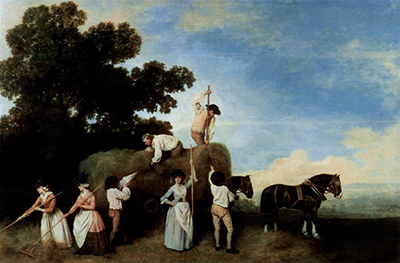
A loaded cart fills the middle of George Stubbs’s Haymakers. Men lift and arrange the hay while women gather it from the ground. Two dark horses wait to the right. Among the angled tools and reaching arms, a woman in blue stands almost upright, looking towards us. The work continues around her pause: one field contains several different rhythms of movement. [1]
This is the 1785 painting in Tate’s collection, accession T02256. Its wooden support measures 89.5 by 135.3 centimetres, and Tate identifies the medium as oil paint. It belongs with the separately catalogued Reapers. Tate acquired it in 1977 with help from the Friends of the Tate Gallery, Art Fund, Pilgrim Trust and public subscribers. The familiar haymaking design also survives in earlier paint, print and later enamel, making the date and physical object essential to its identification. [2]
At a Glance
This work across George Stubbs’s career
Whistlejacket
about 1762 [7]Contents
- Raking, lifting and loading
- The earlier painting and the redesigned field
- Wooden supports and material experiment
- Exhibiting in London and Liverpool
- Studies, a sale and a rediscovered drawing
- The 1791 print and its different states
- Later enamels and the shapes of the composition
- Frames, dignity and idealisation
- The public campaign to acquire the pair
- Videos on George Stubbs
Raking, lifting and loading
At the left edge, two women lean into their rakes. Their long handles cross the foreground at shallow angles, drawing our attention down towards the scattered hay. Beside the cart, a man raises a fork towards another man who bends over the load to receive it. Their opposing reaches make a continuous action across the height of the hay. Above them, a further worker stands against the sky, his tool almost vertical. [1]
The remaining man stands with his back towards us, to the right of the central woman. His raised arms lead up towards the cart. The seven figures occupy different levels: feet on the ground, a body leaning over the load, another body upright on its summit. Sleeves, hats, skirts and breeches separate the people even where their limbs and implements overlap. We can follow the jobs without losing the individual silhouettes. [1]
Stubbs leaves a particularly clear space around the woman in blue. One hand holds her rake upright; the other rests at her waist. Her pale apron makes a long light shape against the darker cart and hay. She looks out across the picture’s edge while the nearby workers look or reach towards their tasks. Her stillness interrupts the chain of lifting and raking, but the handle beside her repeats the upright tool of the man above. [1]
The horses extend the composition beyond the workers. The nearer animal is shown largely in profile, its white lower legs sharply visible against the ground; the second horse’s head appears closer to the cart. Harness lines connect animal bodies and vehicle. Neither horse is displayed against an empty background. They share the field with the load, wheels, scattered hay and working people, occupying the quieter right-hand end of the same arrangement. [1]
The earlier painting and the redesigned field
Stubbs had already painted The Haymakers in 1783. That signed work belongs to the National Trust at Upton House, accession 446708. The holder records oil paint and enamel on oak, with a support of 91.4 by 137.2 centimetres. It is a separate painting with four figures, rather than an alternative date for Tate’s seven-figure picture. [15]
In the earlier image, the cart stands to the left and the large trees rise on the right. Two women occupy the foreground beside a man lifting hay, with one further man on the load. The blue-clad woman already pauses with an upright rake, but she stands towards the left rather than near the middle. The horses face right beneath the trees. More sky opens above the cart than above the animals. [16]
The painted scene with seven figures redistributes those masses. Trees now shelter the left side, while the sky opens above and beyond the horses on the right. Additional workers surround the cart, and the standing man on top raises the group’s highest point. The load still dominates the middle distance, but the foreground becomes a longer succession of bodies and tools. Comparing the two wholes reveals changes in balance and spacing, rather than simply an expanded list of people. [1] [16]
The earlier panel also has its own collection history. It was with Sir Walter Gilbey by 1898, passed through Agnew at the 1915 sale and Knoedler in 1919, and was bought for Lord Bearsted that November for £1,000. It entered the National Trust’s care through the 1948 gift. [15]
Terry Riggs’s Tate account proposes a relationship with Thomas Hearne’s 1783 watercolour of a haymaking scene associated with Thomson’s Seasons. Shared poses might indicate borrowing or study of a similar scene. The relationship remains a suggestion; the particular field in Stubbs’s painting has not been securely identified. [2]
Wooden supports and material experiment
The National Trust describes the 1783 panel as abraded and suggests that the thin consistency of its enamel colours may help explain that condition. The holder’s proposal concerns the particular handling and condition of the earlier panel; it leaves the materials of other painted versions to be investigated separately. [15]
The physical support interested the conservator Ian McClure. Writing in the Getty’s 1998 volume on panel conservation, he noted cradles attached to Upton House’s 1783 Haymakers and Reapers. He proposed that Stubbs might have used such reinforcement preventively, seeking wooden supports as stable as the ceramic plaques made for him by Wedgwood. McClure presented the artist’s responsibility and intention as possibilities, rather than documented facts about who attached the cradles. [17]
McClure placed these panels among Stubbs’s experiments with substantial oak and mahogany supports during the 1770s and 1780s, when wax and animal fat were among the media he explored. That wider material history helps explain why the carrier deserves attention alongside the image. It supplies no recipe for Tate’s Haymakers. Similar subjects can occupy related wooden supports without having identical binders, preparation or subsequent treatment. [17]
Exhibiting in London and Liverpool
The original Royal Academy catalogue for 1786 lists Reapers as number 77 and Haymakers as number 94, both under G. Stubbs, Associate. The eighteenth annual exhibition thus brought the companion subjects before a London public the year after their completion. [18]
They reached another audience in August 1787 at the second exhibition of Liverpool’s Society for Promoting Painting and Design. Joseph Mayer’s 1876 book reproduces that catalogue: number 100 is a harvest scene with reapers, and number 101 a corresponding scene with haymakers. Stubbs is identified as an Associate of the Royal Academy, working at Somerset Street, Portman Square, London. [19]
The Liverpool catalogue’s preface explains the organisers’ ambitions. They wanted to encourage interest in art beyond the capital and had sought assistance from artists outside their immediate region. It also admits the difficulty of finding a sufficiently large exhibition room. Read in that setting, the two harvest pictures participated in an effort to put accomplished metropolitan work before a provincial public. [19]
Studies, a sale and a rediscovered drawing
Evidence of preparation survives in the record of Stubbs’s posthumous sale. The catalogue transcribed by Gilbey in 1898 includes six studies of reapers and two further drawings, a design for a cornfield with reapers, and a design for a hayfield with men loading a hay cart. These descriptions show that the subjects generated drawings as well as finished paintings. They do not allow every listed sheet to be matched to one surviving picture. [20]
The distinction between hay and corn matters here. A neighbouring sale entry describes men loading a cart in Lord Torrington’s garden; another specifically names the hayfield. Treating every rural cart drawing as the same design would erase differences already recognised in the sale. The drawings are evidence of working resources and developing arrangements, even where a sheet’s later whereabouts remain uncertain. [20]
A later rediscovery complicates older statements that all the relevant studies had disappeared. In 2015–16, Lowell Libson presented The Legs of a Draughthorse, a small graphite drawing heightened with white, inscribed with Stubbs’s name by James Ward. The dealer related the arrangement most directly to the horse in Stubbs’s 1786 harrowing picture, while also noting its closeness to the horse at the right of Haymakers. That comparison does not make it a securely identified preparatory study for the Tate panel. [21] [22]
The proposed sale history is equally specific. The leg study was associated with Ward’s purchase of a drawing of four horse’s legs and two academic figures in the 1807 sale. That is a different lot from the hayfield-and-cart design. The attribution and connections recover a possible part of Stubbs’s practice; they cannot restore a complete sequence of drawings for the 1785 composition. [21]
The 1791 print and its different states
Stubbs also made the subject available as a print. The Art Institute of Chicago holds Hay-Makers, dated 1791, accession 2000.105. Its description specifies stipple engraving with roulette on ivory laid paper. The plate and image measure 48.4 by 68.5 centimetres; the sheet measures 53.7 by 71.3. These dimensions describe a paper impression with margins, not the painted support at Tate. [23]
Chicago identifies its impression as Lennox-Boyd 89, state II of III: the second of three catalogued forms of the plate. Its title appears in dark lettering below the image. The form of that lettering provides another way to distinguish this particular impression from other versions of the printed design. [23]
A pair catalogued by Christie’s provides a concrete comparison: Hay-Makers and Reapers, both dated 1791, were described as first states of three, with titles in open letters. The catalogue credits Stubbs with engraving and publishing them in London. Those sheets therefore differ in state from Chicago’s impression even though the pair belongs to the same publication of the harvest designs. Their measurements cannot be substituted for the Chicago sheet’s. [23] [24]
The printed image reverses the arrangement of the painted group. The horses stand on the left and the trees rise on the right, while the working group keeps its recognisable sequence around the cart. In monochrome, the light aprons and sleeves remain clear against the dark load and foliage. The title sits below the image. The design is familiar, but its direction, surface and surrounding paper make the encounter different. [1] [23]
Later enamels and the shapes of the composition
The Lady Lever Art Gallery holds two later enamel works on Wedgwood biscuit earthenware. Current Art UK records identify Haymakers, accession LL3682, as 1794, measuring 74.5 by 103.5 centimetres, and Haycarting, LL3683, as 1795, measuring 77 by 105. Both came from Lord Leverhulme’s private collection in 1922. [25] [26]
The Haycarting oval retains the high cart, the worker standing above it and the horses to the right. Yet the foreground woman who pauses with an upright rake in the rectangular painted design now leans into the action of raking. The oval boundary also presses closely around the workers and horses. Recasting the subject involved the arrangement of figures as well as a change of support. [1] [26] [27]
In 1918, The Landswoman, the journal of the Land Army and the Women’s Institutes, brought the pictures to an unusually practical audience. It reproduced both oval enamels and the earlier rectangular Haymakers. In an article signed H. F., the writer admired the enamel pictures’ colour and lifelike figures, then compared the eighteenth-century women’s clothes with the uniform worn by contemporary landswomen. Picturesque costume, the writer observed, was less suitable for hard work. The comment followed discussion of the enamels; it was not a review of Tate’s 1785 painting alone. [27]
The editor had introduced the reproductions as a change from ordinary photographs. Stubbs’s rural subjects were therefore offered to readers already engaged with agricultural work and its public image. The article’s combination of admiration and practical qualification shows how a later audience could value the pictures while measuring their appearance against another experience of work. [27]
Frames, dignity and idealisation
Frames also formed part of the pictures’ public life. The Frame Blog’s 2026 study, citing information from Judy Egerton, reports Stubbs’s 1787 request to Daniel Daulby for plain frames for Haymakers and Reapers, concerned about damage to original frames. It suggests that the Rococo frames now around the Tate pair were probably supplied by a later purchaser. [28]
For its 2007 exhibition, the Frick described the 1785 paintings as an ambitious attempt to reach a broader audience through rural subjects. Its retrospective account characterises their 1786 reception as lukewarm, with critics wanting more sentiment and narrative incident. The same account interprets the central woman as a classical presence around whom the work is organised. [29]
Tate’s current caption takes the workers’ immaculate appearance seriously. It interprets their elegance and apparent composure as both dignifying labour and offering wealthy viewers a reassuring picture of working conditions. The precision of individual tasks need not make the scene a complete account of agricultural life. [2]
Simon Schama reached a sharper judgement when reviewing the Frick exhibition in 2007. He recognised the convincing labourers and cart horses, but argued that their unusually clean bodies and carefully arranged movements produced a comforting countryside for the gentry. This is a critical reading of how the pictures address their audience. [30]
The public campaign to acquire the pair
In 1977, Haymakers and Reapers became the subject of a public acquisition campaign. Art Fund records a total purchase cost of £771,000 for the pair and its own contribution of £20,000. Its archival account describes Tate’s use of lotteries as a first for a public gallery. The paintings’ public ownership resulted from several kinds of support. [31]
The government’s offer had a defined condition. Answering Andrew Faulds in the House of Commons on 27 July 1977, Gordon Oakes said that Tate would commit a substantial part of its normal purchasing funds and launch an appeal. Government money would match the amount raised, pound for pound, up to £190,000. The special contribution was to come from savings elsewhere in the Department of Education and Science’s programmes, within existing cash limits. [32]
Oakes also explained that the necessary financial provision would follow once Tate’s success in raising its share was known. This was a promise tied to the appeal’s result, not simply an unconditional announcement that the full matching sum had already been paid. The parliamentary answer makes the public fundraising integral to the proposed purchase. [32]
A September 1977 report in JS Journal makes the campaign tangible. Tate and supporting funds could find about £441,000; a promised government contribution of £190,000 still left £140,000 to raise. The private owner had allowed until Christmas to assemble the £771,000 asking price. Sainsbury’s supplied £250 in grocery gift tokens as prizes, British Leyland promised a Mini, and Wedgwood offered a dinner service. Lotteries and competitions translated a museum purchase into a campaign people could join. [33]
The journal reported that the pictures were already on view at Tate and urged readers to consider the loss if they went overseas or returned to private seclusion. Its appeal joined direct access to the paintings with the attraction of donated prizes. The work of a hayfield had become a cause for public giving. [33]
Videos on George Stubbs
Explore Stubbs’s equestrian painting in its wider context, including two readings of Whistlejacket.
A Horse Lover’s Guide to the YCBA
A museum tour that places Stubbs alongside other artists who painted horses. It includes a look at Pumpkin with a Stable-lad.
Watch on YouTubeGeorge Stubbs artworks directory
Search works and related prints documented in this guide. Separate versions and printing matrices have separate entries; printmakers are named where known. Unidentified historical titles and untraced studio-sale material are discussed in the essays. A dash means that a date is not established here.
| Name | Date | Medium |
|---|---|---|
| A Bay Horse with a Groom | 1791 | Painting |
| A Bay Hunter with Two Playful Spaniels | 1777 | Painting |
| A Bay Hunter, a Springer Spaniel and a Sussex Spaniel in a wooded river Landscape | 1782 | Painting |
| A Cheetah and a Stag with Two Indian Attendants | about 1764 | Painting |
| A Couple of Fox Hounds (coloured print after Stubbs) | — | Print after Stubbs |
| A Couple of Foxhounds | 1792 | Painting |
| A Foxhound on the Scent | 1788 | Drawing |
| A Gentleman driving a Lady in a Phaeton | 1787 | Painting |
| A Grey Horse | 1793 | Painting |
| A Grey Horse (cantering companion) | 1793 | Painting |
| A Grey Stallion in a Landscape | — | Painting |
| A Horse Affrighted at a Lion | 1 May 1788 | |
| A Horse Belonging to the Rt. Honourable Lord Grosvenor called Bandy from his Crooked Leg | about 1763 | Painting |
| A Horse Frightened by a Lion | 1777 | |
| A Lion (A Lion Resting on a Rock) | 1 May 1788 | |
| A Lion Attacking a Horse | 1770 | Painting |
| A Lion Attacking a Horse (monumental Yale canvas) | 1762 | Painting |
| A lion attacking a horse (NGV) | about 1765 | Painting |
| A Lion Devouring a Horse (1788 print) | 1788 | |
| A lion devouring a horse (attribution disputed) | Proposed mid-1770s | Painting |
| A mare and foal with a bay horse | 1771 | Painting |
| A Monkey | 1799 | Painting |
| A Prancing Horse, Facing Right | c. 1790 | Drawing |
| A Rough Dog | 1790 | Painting |
| A Saddled Bay Hunter | 1786 | Painting |
| A Sleeping Leopard | 1 January 1791 | |
| A Tiger and a Sleeping Leopard | 1 May 1788 | |
| A Tigress (John Dixon after Stubbs) | 1772 | Print after Stubbs |
| A Tyger (A Recumbent Leopard by a Tree) | 1 May 1788 | |
| A Tyger (Sleeping Leopard) | 1 May 1788 | |
| An animal found on the coast of New Holland called kanguroo (after Stubbs) | 1773 | Print after Stubbs |
| An animal of a new species found on the coast of New South Wales (after Stubbs) | July 1773 | Print after Stubbs |
| Antinous and Jockey | — | Painting |
| Antinoüs, a chestnut racehorse, in a landscape | Undated | Painting |
| Bandy belonging to Lord Grosvenor (print after Stubbs) | — | Print after Stubbs |
| Baronet (George Townley Stubbs after Stubbs) | 20 February 1794 | Print after Stubbs |
| Baronet with Sam Chifney Up | 1791 | Painting |
| Baronet with Samuel Chifney up (Royal Collection) | 1791 | Painting |
| Bay Hunter by a Lake | 1787 | Painting |
| Brood Mares (Benjamin Green after Stubbs) | Issue 14 November 1776 | Print after Stubbs |
| Brood Mares and Foals | usually dated 1767 | Painting |
| Brown and White Norfolk or Water Spaniel | 1778 | Painting |
| Bulls Fighting | 1786 | Painting |
| Captain Samuel Sharpe Pocklington with His Wife, Pleasance, and possibly His Sister, Frances | 1769 | Painting |
| Death of the Doe (attribution disputed) | 1804 | |
| Der Englische Hühnerhund (Johann Wölfle after Stubbs) | about 1860 | Print after Stubbs |
| Dog (A Foxhound Viewed from Behind) | 1 May 1788 | |
| Dog [A Foxhound on the Scent] | 1788 | |
| Drill and albino baboon | before 1789 | Painting |
| Eclipse (Charles Hunt after Stubbs) | 12 November 1839 | Print after Stubbs |
| Eclipse (George Townley Stubbs after Stubbs) | 1796 | Print after Stubbs |
| Eclipse (oil study) | — | Painting |
| Eclipse (Thomas Burke after Stubbs) | First published 1772 | Print after Stubbs |
| Eclipse and John Wildman (Benjamin Green after Stubbs) | 1772 | Print after Stubbs |
| Eclipse at Newmarket (Jockey Club version) | Proposed early 1790s; often dated 1770 | Painting |
| Eclipse at Newmarket with a groom and jockey | 1770 | Painting |
| Eclipse with Mr Wildman and His Sons | 1769–71 | Painting |
| Eclipse, the Property of Capt.n O Kelly (anonymous print after Stubbs) | Imprint 4 June 1804; impression undated | Print after Stubbs |
| Euston | 1774 | Painting |
| Finished Study for the Seventh Anatomical Table of the Muscles of the Horse | 1756–58 | Drawing |
| Five Brood Mares at the Duke of Cumberland's Stud Farm in Windsor Great Park | 1765 | Painting |
| Fowl Body, Lateral View (Highly Finished Study for an Unpublished Table; Shows the Last Stage in Dissection) | — | Drawing |
| Fowl Body, Lateral View (Probably Prepared for Transfer to the Plate for Engraving of Table XV) | — | Drawing |
| Fowl Skeleton, Lateral View (Finished Study for Table V) | — | Drawing |
| Freeman, the Earl of Clarendon's Gamekeeper, with a Dying Doe and Hound (Yale) | 1800 | Painting |
| George Stubbs (enamel self-portrait) | 1781 | Enamel |
| Gimcrack (George Townley Stubbs after Stubbs) | 1775 | Print after Stubbs |
| Gimcrack on Newmarket Heath, with a trainer, a jockey and a stable lad | about 1765 | Painting |
| Gimcrack, with John Pratt up, on Newmarket Heath | about 1765 | Painting |
| Hambletonian, Rubbing Down | 1800 | Painting |
| Hay-Makers | 1791 | |
| Haycarting | 1795 | Enamel |
| Haymakers | 1785 | Painting |
| Haymakers (Lady Lever Art Gallery) | 1794 | Enamel |
| Hollyhock (with later additions by Vernet and Boucher) | about 1765–70 | Painting |
| Horse Attacked by a Lion (Episode C) | 1768–69 | Painting |
| Horse Attacked by a Lion (Tate enamel) | 1769 | Enamel |
| Horse Devoured by a Lion | Possibly exhibited 1763 | Painting |
| Horse Frightened by a Lion | 1770 | Painting |
| Horse Frightened by a Lion (Episode A; Wedgwood and Bentley after Stubbs) | — | Sculpture |
| Horse Frightened by a Lion (Tate) | Possibly exhibited 1763 | Painting |
| Horse Frightened by a Lion (Yale) | 1762–68 | Painting |
| Horse in the Shade of a Wood | 1780 | Painting |
| Hound Coursing a Stag | about 1762 | Painting |
| Human Figure, Anterior View (Intended for a Plate That was Never Published) | — | Drawing |
| Human Skeleton, Lateral View | 1795–1806 | Drawing |
| Hunt servants setting out (Southill commission) | 1767 | Painting |
| Hühnerhund (The Spanish Pointer) | about 1766 | Painting |
| John and Sophia Musters Riding at Colwick Hall | 1777 | Painting |
| John Musters on his hunter Pilgrim | 1777–78 | Painting |
| Labourers | 1789 | |
| Labourers (Richard Earlom after Stubbs and Amos Greene) | 25 March 1790 | Print after Stubbs |
| Laetitia, Lady Lade (d.1825) | 1793 | Painting |
| Lemon and White Water Spaniel | — | Painting |
| Lion Attacking a Stag | — | Painting |
| Lord Grosvenor's Arabian Stallion with a Groom | about 1765 | Painting |
| Lord Grosvenor's Arabian Stallion with a Groom (Peter Mazell after Stubbs) | 1771 | Print after Stubbs |
| Mambrino (Eaton Hall painting) | — | Painting |
| Mambrino (George Townley Stubbs after Stubbs) | 1794 | Print after Stubbs |
| Mares and Foals belonging to the 2nd Viscount Bolingbroke | about 1761–62 | Painting |
| Mares and foals beneath large oak trees | — | Painting |
| Mares and Foals by a stream | Exhibited 1764 | Painting |
| Mares and Foals in a River Landscape | about 1763–68 | Painting |
| Mares and Foals in an Extensive Landscape | about 1769 | Painting |
| Mares and Foals without a Background | 1762 | Painting |
| Moose Deer (after Stubbs) (Arctic Zoology plate VIII) | 1784–85 publication | Print after Stubbs |
| Newmarket Heath with a Rubbing-Down House | — | Painting |
| Otho (1796 print after Stubbs) | 1 December 1796 | Print after Stubbs |
| Otho, with John Larkin up | 1768 | Painting |
| Pangloss | about 1762 | Painting |
| Patch (Grafton commission) | 1759 | Painting |
| Phaeton and the Chariot of the Sun (enamel) | 1775 | Enamel |
| Phaeton with a Pair of Cream Ponies and a Stable-Lad | 1780–84 | Painting |
| Phillis | 1772 | Painting |
| Portrait of a Large Dog (Dingo) | 1772 | Painting |
| Pumpkin with a Stable-lad | 1774 | Painting |
| Racehorses Exercising at Goodwood | 1759–60 | Painting |
| Reapers (1791 print) | 1791 | |
| Reapers (Tate) | 1785 | Painting |
| Reapers (Yale) | 1795 | Enamel |
| Red Deer: A Stag and a Hind | 1792 | Painting |
| Richard Wedgwood | — | Enamel |
| Ringwood, a Brocklesby Foxhound | 1792 | Painting |
| Scrub, a bay horse belonging to the Marquess of Rockingham | about 1762 | Painting |
| Self Portrait on a White Hunter | 1782 | Enamel |
| Self-Portrait | about 1759 | Painting |
| Shooting (1770 Woollett plate after Stubbs) | 1770 | Print after Stubbs |
| Shooting (1771 Woollett plate after Stubbs) | 1771 | Print after Stubbs |
| Shooting at Goodwood | 1759–60 | Painting |
| Sir John Nelthorpe as a boy | 1756 | Painting |
| Sir John Nelthorpe partridge shooting with one pointer | — | Painting |
| Sir John Nelthorpe, 6th Baronet, out Shooting with His Dogs in Barton Field, Lincolnshire | 1776 | Painting |
| Sleeping Leopard | 1777 | Enamel |
| Soldiers of the 10th Light Dragoons | 1793 | Painting |
| Stallion and Mare (George Townley Stubbs after Stubbs) | 1776; reissued 1789 | Print after Stubbs |
| Steward and gamekeeper with dogs (Southill commission) | 1767 | Painting |
| Studies of a Lemur (Lemur murinus) in six different attitudes | 1773 | Drawing |
| Study for the Self-portrait in Enamel | c. 1781 | Drawing |
| Study of a Lemur | 1773 | Drawing |
| Study of a Racehorse in Action: Galloping to Left, a Semi-Anatomical Study, with Skin Flayed to Show Action of Muscles | — | Drawing |
| Study of the Legs of a Draught-Horse Pulling a Harrow (attributed to Stubbs) | Proposed about 1786 | Drawing |
| Sweet William (Grosvenor panel) | — | Painting |
| Sweet William (Turf Gallery canvas) | — | Painting |
| The Black Stallion Sampson, Portrayed from Three Angles (with landscape additions) | about 1764 | Painting |
| The Charlton Hunt | 1759–60 | Painting |
| The Fall of Phaeton | — | Sculpture |
| The Frightened Horse | 1780 | Sculpture |
| The Grosvenor Hunt | — | Painting |
| The Haymakers (Upton House) | 1783 | Painting |
| The Horse and Lion (George Townley Stubbs after George Stubbs) | 1770 | Print after Stubbs |
| The Kongouro from New Holland | 1772 | Painting |
| The Labourers | 1779 | Painting |
| The Labourers (Southill original) | 1767 | Painting |
| The lion and horse (Benjamin Green after Stubbs) | 1769; reissued 1777 | Print after Stubbs |
| The Milbanke and Melbourne Families | about 1769 | Painting |
| The Moose | 1770 | Painting |
| The Prince of Wales's Phaeton | 1793 | Painting |
| The Reapers (Upton House) | 1783 | Painting |
| The Sebra, or Wild Ass (George Townley Stubbs after Stubbs) | 1771 | Print after Stubbs |
| The Spanish Pointer (Bradford version) | about 1766–68 | Painting |
| The Spanish Pointer (William Woollett after Stubbs) | January 1768 | Print after Stubbs |
| The Third Duke of Dorset's Hunter with a Groom and a Dog | 1768 | Painting |
| Thomas Freeman, Lord Clarendon's gamekeeper, with a dog and a shot doe (with George Townly Stubbs) | 1803 | Painting |
| Turf, with Jockey up, at Newmarket | — | Painting |
| Turk and Crab | — | Painting |
| Two Bay Hunters Communing On The Bank Of A Lake | — | Painting |
| Tygers at Play | 1780 | |
| Viscount Gormanston's White Dog | 1781 | Painting |
| Viscount Gormanston's White Dog (canvas version) | — | Painting |
| Water Spaniel | 1769 | Painting |
| Wedgwood Family Portrait | 1780 | Painting |
| Whistlejacket | about 1762 | Painting |
| Whistlejacket with two other stallions and a groom | Recorded 1762 | Painting |
| White Poodle in a Punt | about 1780 | Painting |
| William Anderson with two Saddle-Horses | 1793 | Painting |
| Working Drawing for the Seventh Anatomical Table of the Muscles of the Horse | 1756–58 | Drawing |
| Zebra | 1763 | Painting |
Discussion
Look again at the images and ideas explored in Haymakers. These editorial prompts invite your observations.
Reader Insights
Where does your attention settle first: on the woman who pauses, the men loading the cart or the horses waiting beside it?
How does comparing the earlier panel and the reversed print alter your reading of the painted group?
Join the Conversation
Share a detail, comparison or question about Haymakers below.
References
- George Stubbs, Haymakers, 1785, whole-image reproduction, Yorck Project/Wikimedia Commons. Image. View source.
- Tate, George Stubbs, Haymakers, 1785, T02256; details, Terry Riggs’s collection text (January 1998), and online caption. Collection record. View source.
- Goodwood, The Collection, Painting Collection modal, Racehorses Exercising at Goodwood; An exciting acquisition: a study by George Stubbs, 30 June 2023; History of the Estate Hounds, 4 October 2023; About Goodwood Racecourse. Accessed 4 November 2026. View source.
- Goodwood, The Collection, Painting Collection modal, Racehorses Exercising at Goodwood; An exciting acquisition: a study by George Stubbs, 30 June 2023; History of the Estate Hounds, 4 October 2023; About Goodwood Racecourse. Accessed 4 November 2026. View source.
- Goodwood, The Collection, Painting Collection modal, Racehorses Exercising at Goodwood; An exciting acquisition: a study by George Stubbs, 30 June 2023; History of the Estate Hounds, 4 October 2023; About Goodwood Racecourse. Accessed 4 November 2026. View source.
- Goodwood, The Collection, Painting Collection modal, Racehorses Exercising at Goodwood; An exciting acquisition: a study by George Stubbs, 30 June 2023; History of the Estate Hounds, 4 October 2023; About Goodwood Racecourse. Accessed 4 November 2026. View source.
- National Gallery, Whistlejacket, NG6569, current collection record, provenance, in-depth discussion and frame entry. View source.
- Yale Center for British Art, Zebra, B1981.25.617, current object metadata, gallery labels, Malcolm Warner’s 1998 catalogue entry and provenance supplied through the museum’s public collection record. View source.
- Christie’s, Gimcrack on Newmarket Heath, with a trainer, a jockey and a stable lad, London, 5 July 2011, lot 12; object details, essay, provenance, exhibitions and whole image. View source.
- Christie’s, Gimcrack on Newmarket Heath, with a trainer, a jockey and a stable lad, London, 5 July 2011, lot 12; object details, essay, provenance, exhibitions and whole image. View source.
- Yale University Art Gallery, A Lion Attacking a Horse, 1770, 1955.27.1, collection record. Accessed 4 November 2026. View source.
- Royal Museums Greenwich, ‘The Kongouro from New Holland’ (Kangaroo), ZBA5754. Accessed 4 November 2026. View source.
- Tate, George Stubbs, Haymakers, 1785, T02256; details, Terry Riggs’s collection text (January 1998), and online caption. Collection record. View source.
- Frances Bailey, ‘Hambletonian, Rubbing Down: A masterpiece by George Stubbs’, National Trust Cultural Heritage Magazine, Autumn/Winter 2024, pp. 22–33. Article. View source.
- National Trust Collections, George Stubbs, The Haymakers, 1783, NT 446708. Collection record. View source.
- National Trust/Art UK, The Haymakers, NT 446708, whole-image reproduction. Image. View source.
- Ian McClure, ‘History of Structural Conservation of Panel Paintings in Great Britain’, in Kathleen Dardes and Andrea Rothe, eds, The Structural Conservation of Panel Paintings (Getty Conservation Institute, 1998), p. 240. Publication. View source.
- Royal Academy, The Exhibition of the Royal Academy (1786), p. 5, nos. 77 and 94. Original catalogue. View source.
- Joseph Mayer, Early Exhibitions of Art in Liverpool, with Some Notes for a Memoir of George Stubbs, R.A. (Liverpool, 1876), pp. 71–72 and 84, reproducing the second Liverpool exhibition catalogue of August 1787. Book. View source.
- Walter Gilbey, The Life of George Stubbs, R.A. (1898), appendix D, pp. 196–197, transcribing the 1807 sale catalogue. Book. View source.
- Lowell Libson Ltd, 2016 Catalogue, pp. 24–25, The Legs of a Draughthorse. Catalogue. View source.
- Lowell Libson Ltd, ‘Getting ready for New York: a Stubbs sighting’, 1 December 2015. Article. View source.
- Art Institute of Chicago, George Stubbs, Hay-Makers, 1791, 2000.105; catalogue reference Lennox-Boyd 89 II/III. Collection record. View source.
- Christie’s, George Stubbs, Hay-Makers, Reapers, lot record; citing Charles Lennox-Boyd, Rob Dixon and Tim Clayton, George Stubbs: The Complete Engraved Work (London, 1989), nos. 89–90. Catalogue entry. View source.
- Art UK/Lady Lever Art Gallery, George Stubbs, Haymakers, 1794, LL3682. Collection record. View source.
- Art UK/Lady Lever Art Gallery, George Stubbs, Haycarting, 1795, LL3683. Collection record. View source.
- H. F., ‘An English Painter of Agricultural Subjects’, The Landswoman, vol. 1, no. 9 (September 1918), pp. 185–187. Journal. View source.
- The Frame Blog, ‘George Stubbs and his frames’, 23 May 2026; note 26 attributes information about the Daulby letter to Judy Egerton. Article. View source.
- The Frick Collection, George Stubbs (1724–1806): A Celebration (2007), exhibition accounts of Haymakers and Reapers. Exhibition text. View source.
- Simon Schama, ‘Hoofing It’, The New Yorker, online 26 February 2007; print issue 5 March 2007. Review. View source.
- Art Fund, Haymakers & Reapers, 1785, supported 1977, archival acquisition account. Record. View source.
- UK Parliament, Hansard, ‘Art Purchases (Tate Gallery)’, 27 July 1977, answer by Gordon Oakes to Andrew Faulds. Parliamentary answer. View source.
- JS Journal, September 1977, p. 10, ‘JS supports the Tate’s national supersave’. Journal. View source.
- Basic title, date and material metadata for Tate’s Reapers (T02257) and Otho (T02375) is adapted from the Tate collection dataset, October 2014, released under CC0. TheHistoryOfArt.org has reconciled labels and versions. This credit does not apply to Tate’s authored catalogue commentary or images.
- Data Source: Yale Center for British Art. Basic object fields are adapted and reconciled for this directory. Reuse is subject to the Center’s Open Data and Data Services Terms of Use. No museum endorsement is implied. This metadata credit does not relabel scholarly essays or images as open data.
- Basic object metadata for A Horse Frightened by a Lion, 1985.38, The Cleveland Museum of Art, John L. Severance Fund, is available under CC0. Titles and design-level grouping have been reconciled for this directory.