 by Tom Gurney
Tom Gurney BSc (Hons) is an art history expert with over 20 years experience
Email: tomgurney1@gmail.com / Phone: +44 7429 011000
Sleeping Leopard: Introduction
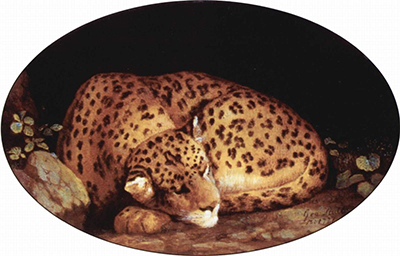
Stubbs’s Sleeping Leopard is a 1777 enamel on Wedgwood biscuit earthenware, now at the Yale Center for British Art. Its oval support measures 10.8 × 16.8 cm; the accession number is B2001.2.209. [1]
At a Glance
- Date1777 [1]
- MediumEnamel on Wedgwood biscuit earthenware [1]
- CollectionYale Center for British Art [1]
This work across George Stubbs’s career
Whistlejacket
about 1762 [6]Contents
- A body within an oval
- Painting on an unexpected support
- The “sleeping tiger” in the sale catalogue
- A leopard reused beside a tiger
- The separate print of 1791
- Collecting a small, powerful animal
- Videos on George Stubbs
A body within an oval
The leopard’s lowered head lies towards the left, its pale muzzle close to the ground. Above it, the back rises into a broad curve before turning down towards the right. The folded body makes a dense, nearly continuous shape: limbs, belly and flank do not separate into a procession of clearly outlined parts. Looking means following their overlaps. Dark markings cross the warm coat, but their distribution also helps the eye negotiate the swelling surfaces beneath them. [1]
The oval gives this resting body a boundary unusually close to its own shape. There is little room for an expansive landscape. A pale rock occupies the lower left; small plants press against the animal at either side. Above the back, a much larger area remains dark. This space prevents the spotted coat from becoming an all-over pattern, while its downward curve echoes the rounded contour below. The image is crowded without placing every part equally near the edge. [1]
The face offers a quieter interruption. Its lighter muzzle, closed eye and whiskers draw attention away from the larger, more conspicuous markings. The head is not raised to meet the viewer. Nor does another animal or human figure supply a narrative incident. Stubbs has made the folded arrangement itself the subject, using changes of surface, light and direction to sustain attention within a very small field. [1]
Painting on an unexpected support
Yale identifies this as Stubbs’s earliest surviving ceramic enamel. A Wedgwood stamp suggests that its support was cut from an existing plate. The object records an experiment, although neither the exact manufacturing sequence nor the plate-cutting interpretation is certain. [1]
The experiment belongs to a larger exchange between painter and manufacturer. According to the World of Wedgwood’s account, Stubbs’s search for a ceramic support had reached Thomas Bentley, Wedgwood’s partner in ornamental wares, by 1775. Producing the large plaques Stubbs wanted took years. The attraction was not merely a new decorative shape: ceramics offered another physical basis for painting in enamel, beyond the copper supports he had investigated. The small leopard therefore sits within a problem of materials and scale. [16]
The later collaboration also crossed the boundary between painting and modelling. Stubbs made relief designs for Wedgwood, including The Frightened Horse, during his 1780 visit; portrait painting and relief work contributed towards payment for the plaques. These later activities reveal an exchange involving the physical making of images as well as the supply of painting surfaces. The technique and materials page follows that wider material history. [16]
The “sleeping tiger” in the sale catalogue
An important early title is considerably less precise than the modern one. On printed page 8 of the catalogue for Stubbs’s 1807 estate sale, lot 64 is described simply as “Sleeping Tiger—in enamel”. The entry stands beside portraits of Mr and Mrs Wedgwood and several other animal subjects. It supplies neither dimensions nor a description detailed enough to identify the Yale oval by itself. [17]
Yale records William Hoare’s purchase at the sale; Angus Trumble’s 2007 entry calls identification with that lot plausible. The current provenance note also acknowledges disputed authorship, recording Judy Egerton’s agreement with Bruce Tattersall’s attribution to Stubbs. These are modern identifications; the terse original entry supplies the historical wording. [1]
Egerton explains that eighteenth-century tiger terminology covered several kinds of feline. Stubbs’s historical titles therefore need not match present-day species names: the sale’s wording belongs to the picture’s documentary history alongside its unmistakably spotted coat. [18]
A leopard reused beside a tiger
Published on 1 May 1788, A Tiger and a Sleeping Leopard combines two animals in a rectangular setting. The Wellcome Collection’s impression is a soft-ground etching with roulette work, in the third of three states; its platemark measures 25.3 × 33 cm. The print was also known as Two Tygers. [19]
Egerton identifies the sleeping leopard as a reversed reuse of the 1777 enamel’s figure. The foreground tiger derives from separate paintings. Stubbs brought the motifs together in a newly organised scene: the print connects compositions, rather than documenting an encounter between the two animals. [18]
In the print, the sleeping animal occupies the rear left, its head turned towards the right. The large striped tiger spreads across the foreground and faces the viewer. A thin branching plant helps divide and join their spaces. The difference in scale and position changes the leopard’s role: the close, dominant oval body has become a comparatively withdrawn presence within a broader arrangement. Looking from one animal to the other replaces the concentrated scrutiny demanded by the enamel. [19]
The separate print of 1791
A Sleeping Leopard, published on 1 January 1791, is another composition again. The Metropolitan Museum of Art holds an impression, accession 49.49.5, made using soft-ground etching with roulette work. It is the second of two states and measures 18.1 × 23.7 cm. Its title can easily lead to confusion with the enamel, although the medium, date and format distinguish them. [20]
Here the lowered head is again at the left, but a massive branching trunk rises above the animal. Knotted forms and broken surfaces take up much more of the rectangular field than the small plants beside the enamel’s oval. The leopard’s patterned back and the dark surrounding forms approach one another in tone; the pale muzzle remains a clearer point of separation. The setting contributes a strongly textured presence of its own. [20]
The Met’s interpretation emphasises Stubbs’s ability to distinguish fur, bark and rock within a restricted range of tones. It also places the great cat within an eighteenth-century association between dangerous animals and the sublime. That historical association gives the printed animal’s repose a latent force within the museum’s reading. [20]
Cleveland’s impression, accession 1980.90, belongs to the same 1791 print. The museum explains how soft-ground etching transferred the texture of a drawing to the plate. It suggests that Stubbs probably visited London menageries; the particular leopard, its owner and its place of captivity remain unidentified in that account. [21]
Princeton also catalogues a 1788 mezzotint, A Tyger (Sleeping Leopard), accession 2010-165, measuring 15.2 × 20.3 cm. Its medium and date distinguish it from the 1791 etching. The prints page follows Stubbs’s printmaking. [22]
Collecting a small, powerful animal
The purchaser William Hoare was a Hammersmith schoolmaster. Yale traces the enamel possibly to his son William Parker Hoare, then possibly to Constance Mary Wilson, William Parker’s daughter. It subsequently passed to her daughter Janet Faurschou in Canada. Mellon bought it privately in November 1974; his 2001 bequest brought it to Yale. [1]
The small painting had an unusually personal place in Mellon’s collecting life. In a 2013 Boston Globe feature, the contribution printed under Amy Meyer’s name recalled its position on his desk. She chose the enamel as a favourite work in Yale’s collection and described the contrast between a powerful animal and an object small enough to hold, admire and possess without fear. That is a particularly revealing modern response to its scale. [23]
Her interpretation draws attention to the difference between an animal’s power and a collector’s control over its small painted image. The emphasis on possession gives this miniature encounter a more complicated character than an appreciation of technical delicacy alone. [23]
Videos on George Stubbs
Explore Stubbs’s equestrian painting in its wider context, including two readings of Whistlejacket.
A Horse Lover’s Guide to the YCBA
A museum tour that places Stubbs alongside other artists who painted horses. It includes a look at Pumpkin with a Stable-lad.
Watch on YouTubeGeorge Stubbs artworks directory
Search works and related prints documented in this guide. Separate versions and printing matrices have separate entries; printmakers are named where known. Unidentified historical titles and untraced studio-sale material are discussed in the essays. A dash means that a date is not established here.
| Name | Date | Medium |
|---|---|---|
| A Bay Horse with a Groom | 1791 | Painting |
| A Bay Hunter with Two Playful Spaniels | 1777 | Painting |
| A Bay Hunter, a Springer Spaniel and a Sussex Spaniel in a wooded river Landscape | 1782 | Painting |
| A Cheetah and a Stag with Two Indian Attendants | about 1764 | Painting |
| A Couple of Fox Hounds (coloured print after Stubbs) | — | Print after Stubbs |
| A Couple of Foxhounds | 1792 | Painting |
| A Foxhound on the Scent | 1788 | Drawing |
| A Gentleman driving a Lady in a Phaeton | 1787 | Painting |
| A Grey Horse | 1793 | Painting |
| A Grey Horse (cantering companion) | 1793 | Painting |
| A Grey Stallion in a Landscape | — | Painting |
| A Horse Affrighted at a Lion | 1 May 1788 | |
| A Horse Belonging to the Rt. Honourable Lord Grosvenor called Bandy from his Crooked Leg | about 1763 | Painting |
| A Horse Frightened by a Lion | 1777 | |
| A Lion (A Lion Resting on a Rock) | 1 May 1788 | |
| A Lion Attacking a Horse | 1770 | Painting |
| A Lion Attacking a Horse (monumental Yale canvas) | 1762 | Painting |
| A lion attacking a horse (NGV) | about 1765 | Painting |
| A Lion Devouring a Horse (1788 print) | 1788 | |
| A lion devouring a horse (attribution disputed) | Proposed mid-1770s | Painting |
| A mare and foal with a bay horse | 1771 | Painting |
| A Monkey | 1799 | Painting |
| A Prancing Horse, Facing Right | c. 1790 | Drawing |
| A Rough Dog | 1790 | Painting |
| A Saddled Bay Hunter | 1786 | Painting |
| A Sleeping Leopard | 1 January 1791 | |
| A Tiger and a Sleeping Leopard | 1 May 1788 | |
| A Tigress (John Dixon after Stubbs) | 1772 | Print after Stubbs |
| A Tyger (A Recumbent Leopard by a Tree) | 1 May 1788 | |
| A Tyger (Sleeping Leopard) | 1 May 1788 | |
| An animal found on the coast of New Holland called kanguroo (after Stubbs) | 1773 | Print after Stubbs |
| An animal of a new species found on the coast of New South Wales (after Stubbs) | July 1773 | Print after Stubbs |
| Antinous and Jockey | — | Painting |
| Antinoüs, a chestnut racehorse, in a landscape | Undated | Painting |
| Bandy belonging to Lord Grosvenor (print after Stubbs) | — | Print after Stubbs |
| Baronet (George Townley Stubbs after Stubbs) | 20 February 1794 | Print after Stubbs |
| Baronet with Sam Chifney Up | 1791 | Painting |
| Baronet with Samuel Chifney up (Royal Collection) | 1791 | Painting |
| Bay Hunter by a Lake | 1787 | Painting |
| Brood Mares (Benjamin Green after Stubbs) | Issue 14 November 1776 | Print after Stubbs |
| Brood Mares and Foals | usually dated 1767 | Painting |
| Brown and White Norfolk or Water Spaniel | 1778 | Painting |
| Bulls Fighting | 1786 | Painting |
| Captain Samuel Sharpe Pocklington with His Wife, Pleasance, and possibly His Sister, Frances | 1769 | Painting |
| Death of the Doe (attribution disputed) | 1804 | |
| Der Englische Hühnerhund (Johann Wölfle after Stubbs) | about 1860 | Print after Stubbs |
| Dog (A Foxhound Viewed from Behind) | 1 May 1788 | |
| Dog [A Foxhound on the Scent] | 1788 | |
| Drill and albino baboon | before 1789 | Painting |
| Eclipse (Charles Hunt after Stubbs) | 12 November 1839 | Print after Stubbs |
| Eclipse (George Townley Stubbs after Stubbs) | 1796 | Print after Stubbs |
| Eclipse (oil study) | — | Painting |
| Eclipse (Thomas Burke after Stubbs) | First published 1772 | Print after Stubbs |
| Eclipse and John Wildman (Benjamin Green after Stubbs) | 1772 | Print after Stubbs |
| Eclipse at Newmarket (Jockey Club version) | Proposed early 1790s; often dated 1770 | Painting |
| Eclipse at Newmarket with a groom and jockey | 1770 | Painting |
| Eclipse with Mr Wildman and His Sons | 1769–71 | Painting |
| Eclipse, the Property of Capt.n O Kelly (anonymous print after Stubbs) | Imprint 4 June 1804; impression undated | Print after Stubbs |
| Euston | 1774 | Painting |
| Finished Study for the Seventh Anatomical Table of the Muscles of the Horse | 1756–58 | Drawing |
| Five Brood Mares at the Duke of Cumberland's Stud Farm in Windsor Great Park | 1765 | Painting |
| Fowl Body, Lateral View (Highly Finished Study for an Unpublished Table; Shows the Last Stage in Dissection) | — | Drawing |
| Fowl Body, Lateral View (Probably Prepared for Transfer to the Plate for Engraving of Table XV) | — | Drawing |
| Fowl Skeleton, Lateral View (Finished Study for Table V) | — | Drawing |
| Freeman, the Earl of Clarendon's Gamekeeper, with a Dying Doe and Hound (Yale) | 1800 | Painting |
| George Stubbs (enamel self-portrait) | 1781 | Enamel |
| Gimcrack (George Townley Stubbs after Stubbs) | 1775 | Print after Stubbs |
| Gimcrack on Newmarket Heath, with a trainer, a jockey and a stable lad | about 1765 | Painting |
| Gimcrack, with John Pratt up, on Newmarket Heath | about 1765 | Painting |
| Hambletonian, Rubbing Down | 1800 | Painting |
| Hay-Makers | 1791 | |
| Haycarting | 1795 | Enamel |
| Haymakers | 1785 | Painting |
| Haymakers (Lady Lever Art Gallery) | 1794 | Enamel |
| Hollyhock (with later additions by Vernet and Boucher) | about 1765–70 | Painting |
| Horse Attacked by a Lion (Episode C) | 1768–69 | Painting |
| Horse Attacked by a Lion (Tate enamel) | 1769 | Enamel |
| Horse Devoured by a Lion | Possibly exhibited 1763 | Painting |
| Horse Frightened by a Lion | 1770 | Painting |
| Horse Frightened by a Lion (Episode A; Wedgwood and Bentley after Stubbs) | — | Sculpture |
| Horse Frightened by a Lion (Tate) | Possibly exhibited 1763 | Painting |
| Horse Frightened by a Lion (Yale) | 1762–68 | Painting |
| Horse in the Shade of a Wood | 1780 | Painting |
| Hound Coursing a Stag | about 1762 | Painting |
| Human Figure, Anterior View (Intended for a Plate That was Never Published) | — | Drawing |
| Human Skeleton, Lateral View | 1795–1806 | Drawing |
| Hunt servants setting out (Southill commission) | 1767 | Painting |
| Hühnerhund (The Spanish Pointer) | about 1766 | Painting |
| John and Sophia Musters Riding at Colwick Hall | 1777 | Painting |
| John Musters on his hunter Pilgrim | 1777–78 | Painting |
| Labourers | 1789 | |
| Labourers (Richard Earlom after Stubbs and Amos Greene) | 25 March 1790 | Print after Stubbs |
| Laetitia, Lady Lade (d.1825) | 1793 | Painting |
| Lemon and White Water Spaniel | — | Painting |
| Lion Attacking a Stag | — | Painting |
| Lord Grosvenor's Arabian Stallion with a Groom | about 1765 | Painting |
| Lord Grosvenor's Arabian Stallion with a Groom (Peter Mazell after Stubbs) | 1771 | Print after Stubbs |
| Mambrino (Eaton Hall painting) | — | Painting |
| Mambrino (George Townley Stubbs after Stubbs) | 1794 | Print after Stubbs |
| Mares and Foals belonging to the 2nd Viscount Bolingbroke | about 1761–62 | Painting |
| Mares and foals beneath large oak trees | — | Painting |
| Mares and Foals by a stream | Exhibited 1764 | Painting |
| Mares and Foals in a River Landscape | about 1763–68 | Painting |
| Mares and Foals in an Extensive Landscape | about 1769 | Painting |
| Mares and Foals without a Background | 1762 | Painting |
| Moose Deer (after Stubbs) (Arctic Zoology plate VIII) | 1784–85 publication | Print after Stubbs |
| Newmarket Heath with a Rubbing-Down House | — | Painting |
| Otho (1796 print after Stubbs) | 1 December 1796 | Print after Stubbs |
| Otho, with John Larkin up | 1768 | Painting |
| Pangloss | about 1762 | Painting |
| Patch (Grafton commission) | 1759 | Painting |
| Phaeton and the Chariot of the Sun (enamel) | 1775 | Enamel |
| Phaeton with a Pair of Cream Ponies and a Stable-Lad | 1780–84 | Painting |
| Phillis | 1772 | Painting |
| Portrait of a Large Dog (Dingo) | 1772 | Painting |
| Pumpkin with a Stable-lad | 1774 | Painting |
| Racehorses Exercising at Goodwood | 1759–60 | Painting |
| Reapers (1791 print) | 1791 | |
| Reapers (Tate) | 1785 | Painting |
| Reapers (Yale) | 1795 | Enamel |
| Red Deer: A Stag and a Hind | 1792 | Painting |
| Richard Wedgwood | — | Enamel |
| Ringwood, a Brocklesby Foxhound | 1792 | Painting |
| Scrub, a bay horse belonging to the Marquess of Rockingham | about 1762 | Painting |
| Self Portrait on a White Hunter | 1782 | Enamel |
| Self-Portrait | about 1759 | Painting |
| Shooting (1770 Woollett plate after Stubbs) | 1770 | Print after Stubbs |
| Shooting (1771 Woollett plate after Stubbs) | 1771 | Print after Stubbs |
| Shooting at Goodwood | 1759–60 | Painting |
| Sir John Nelthorpe as a boy | 1756 | Painting |
| Sir John Nelthorpe partridge shooting with one pointer | — | Painting |
| Sir John Nelthorpe, 6th Baronet, out Shooting with His Dogs in Barton Field, Lincolnshire | 1776 | Painting |
| Sleeping Leopard | 1777 | Enamel |
| Soldiers of the 10th Light Dragoons | 1793 | Painting |
| Stallion and Mare (George Townley Stubbs after Stubbs) | 1776; reissued 1789 | Print after Stubbs |
| Steward and gamekeeper with dogs (Southill commission) | 1767 | Painting |
| Studies of a Lemur (Lemur murinus) in six different attitudes | 1773 | Drawing |
| Study for the Self-portrait in Enamel | c. 1781 | Drawing |
| Study of a Lemur | 1773 | Drawing |
| Study of a Racehorse in Action: Galloping to Left, a Semi-Anatomical Study, with Skin Flayed to Show Action of Muscles | — | Drawing |
| Study of the Legs of a Draught-Horse Pulling a Harrow (attributed to Stubbs) | Proposed about 1786 | Drawing |
| Sweet William (Grosvenor panel) | — | Painting |
| Sweet William (Turf Gallery canvas) | — | Painting |
| The Black Stallion Sampson, Portrayed from Three Angles (with landscape additions) | about 1764 | Painting |
| The Charlton Hunt | 1759–60 | Painting |
| The Fall of Phaeton | — | Sculpture |
| The Frightened Horse | 1780 | Sculpture |
| The Grosvenor Hunt | — | Painting |
| The Haymakers (Upton House) | 1783 | Painting |
| The Horse and Lion (George Townley Stubbs after George Stubbs) | 1770 | Print after Stubbs |
| The Kongouro from New Holland | 1772 | Painting |
| The Labourers | 1779 | Painting |
| The Labourers (Southill original) | 1767 | Painting |
| The lion and horse (Benjamin Green after Stubbs) | 1769; reissued 1777 | Print after Stubbs |
| The Milbanke and Melbourne Families | about 1769 | Painting |
| The Moose | 1770 | Painting |
| The Prince of Wales's Phaeton | 1793 | Painting |
| The Reapers (Upton House) | 1783 | Painting |
| The Sebra, or Wild Ass (George Townley Stubbs after Stubbs) | 1771 | Print after Stubbs |
| The Spanish Pointer (Bradford version) | about 1766–68 | Painting |
| The Spanish Pointer (William Woollett after Stubbs) | January 1768 | Print after Stubbs |
| The Third Duke of Dorset's Hunter with a Groom and a Dog | 1768 | Painting |
| Thomas Freeman, Lord Clarendon's gamekeeper, with a dog and a shot doe (with George Townly Stubbs) | 1803 | Painting |
| Turf, with Jockey up, at Newmarket | — | Painting |
| Turk and Crab | — | Painting |
| Two Bay Hunters Communing On The Bank Of A Lake | — | Painting |
| Tygers at Play | 1780 | |
| Viscount Gormanston's White Dog | 1781 | Painting |
| Viscount Gormanston's White Dog (canvas version) | — | Painting |
| Water Spaniel | 1769 | Painting |
| Wedgwood Family Portrait | 1780 | Painting |
| Whistlejacket | about 1762 | Painting |
| Whistlejacket with two other stallions and a groom | Recorded 1762 | Painting |
| White Poodle in a Punt | about 1780 | Painting |
| William Anderson with two Saddle-Horses | 1793 | Painting |
| Working Drawing for the Seventh Anatomical Table of the Muscles of the Horse | 1756–58 | Drawing |
| Zebra | 1763 | Painting |
Discussion
Look again at the images and ideas explored in Sleeping Leopard. These editorial prompts invite your observations.
Reader Insights
How does the leopard’s curled body fit the oval support?
What changes when the sleeping animal appears in a printed design or beside a tiger?
How would you describe the animal’s rest while keeping the interpretation separate from the title’s history?
Join the Conversation
Share a detail, comparison or question about Sleeping Leopard below.
References
- Yale Center for British Art, Sleeping Leopard, 1777, B2001.2.209: current object record, label texts, provenance and supplied Angus Trumble entry (2007). Official image manifest:. View source 1. View source 2.
- Goodwood, The Collection, Painting Collection modal, Racehorses Exercising at Goodwood; An exciting acquisition: a study by George Stubbs, 30 June 2023; History of the Estate Hounds, 4 October 2023; About Goodwood Racecourse. Accessed 4 November 2026. View source.
- Goodwood, The Collection, Painting Collection modal, Racehorses Exercising at Goodwood; An exciting acquisition: a study by George Stubbs, 30 June 2023; History of the Estate Hounds, 4 October 2023; About Goodwood Racecourse. Accessed 4 November 2026. View source.
- Goodwood, The Collection, Painting Collection modal, Racehorses Exercising at Goodwood; An exciting acquisition: a study by George Stubbs, 30 June 2023; History of the Estate Hounds, 4 October 2023; About Goodwood Racecourse. Accessed 4 November 2026. View source.
- Goodwood, The Collection, Painting Collection modal, Racehorses Exercising at Goodwood; An exciting acquisition: a study by George Stubbs, 30 June 2023; History of the Estate Hounds, 4 October 2023; About Goodwood Racecourse. Accessed 4 November 2026. View source.
- National Gallery, Whistlejacket, NG6569, current collection record, provenance, in-depth discussion and frame entry. View source.
- Yale Center for British Art, Zebra, B1981.25.617, current object metadata, gallery labels, Malcolm Warner’s 1998 catalogue entry and provenance supplied through the museum’s public collection record. View source.
- Christie’s, Gimcrack on Newmarket Heath, with a trainer, a jockey and a stable lad, London, 5 July 2011, lot 12; object details, essay, provenance, exhibitions and whole image. View source.
- Christie’s, Gimcrack on Newmarket Heath, with a trainer, a jockey and a stable lad, London, 5 July 2011, lot 12; object details, essay, provenance, exhibitions and whole image. View source.
- Yale University Art Gallery, A Lion Attacking a Horse, 1770, 1955.27.1, collection record. Accessed 4 November 2026. View source.
- Royal Museums Greenwich, ‘The Kongouro from New Holland’ (Kangaroo), ZBA5754. Accessed 4 November 2026. View source.
- Yale Center for British Art, Sleeping Leopard, 1777, B2001.2.209: current object record, label texts, provenance and supplied Angus Trumble entry (2007). View source.
- Yale Center for British Art, Sleeping Leopard, 1777, B2001.2.209: current object record, label texts, provenance and supplied Angus Trumble entry (2007). View source.
- Tate, George Stubbs, Haymakers, 1785, T02256; details, Terry Riggs’s collection text (January 1998), and online caption. Collection record. View source.
- Frances Bailey, ‘Hambletonian, Rubbing Down: A masterpiece by George Stubbs’, National Trust Cultural Heritage Magazine, Autumn/Winter 2024, pp. 22–33. Article. View source.
- World of Wedgwood, ‘Wedgwood and Artists: Black Basalt Plaque “The Frightened Horse”’. Original correspondence cited there not independently consulted. View source.
- Peter Coxe, catalogue of George Stubbs’s estate sale, 26–27 May 1807, p. 8, lot 64. Original scanned page inspected. View source.
- Judy Egerton, entry for Portrait of the Royal Tiger, Christie’s, lot 260346: relevant motif and historical title passages. Original 1788 advertisement and cited catalogues not independently consulted. View source.
- Wellcome Collection, A Tiger and a Sleeping Leopard, 1 May 1788, 578691i: current object record and official image. View source.
- Metropolitan Museum of Art, A Sleeping Leopard, 1 January 1791, 49.49.5: current object record, commentary and official image. View source.
- Cleveland Museum of Art, A Sleeping Leopard, 1791, 1980.90: current object record and interpretation. View source.
- Princeton University Art Museum, A Tyger (Sleeping Leopard), 1788, 2010-165: publicly indexed object record; image not inspected. View source.
- Thomasine Berg, ‘Museum directors play favorites’, The Boston Globe, 19 October 2013: introduction and contribution printed under Amy Meyer’s name, PDF pp. 1, 3. View source.
- Basic title, date and material metadata for Tate’s Reapers (T02257) and Otho (T02375) is adapted from the Tate collection dataset, October 2014, released under CC0. TheHistoryOfArt.org has reconciled labels and versions. This credit does not apply to Tate’s authored catalogue commentary or images.
- Data Source: Yale Center for British Art. Basic object fields are adapted and reconciled for this directory. Reuse is subject to the Center’s Open Data and Data Services Terms of Use. No museum endorsement is implied. This metadata credit does not relabel scholarly essays or images as open data.
- Basic object metadata for A Horse Frightened by a Lion, 1985.38, The Cleveland Museum of Art, John L. Severance Fund, is available under CC0. Titles and design-level grouping have been reconciled for this directory.