 by Tom Gurney
Tom Gurney BSc (Hons) is an art history expert with over 20 years experience
Email: tomgurney1@gmail.com / Phone: +44 7429 011000
Sir John Nelthorpe: Introduction
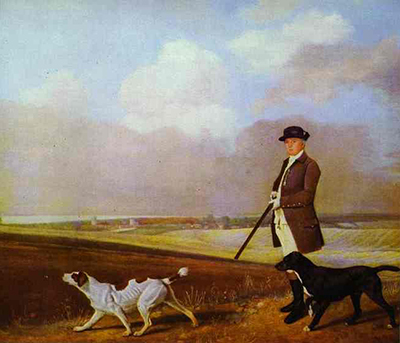
In his 1776 portrait of Sir John Nelthorpe out shooting in Barton Field, George Stubbs places the sixth baronet and two dogs beneath an extensive sky. The oil on panel measures 61 × 71.1 cm and belongs to a private collection. [1]
The man stands towards the right, while the dogs extend the group across the foreground. His gun points downwards. The scene holds its action in reserve: the space ahead of the animals matters more than any dramatic movement by their owner.
At a Glance
This work across George Stubbs’s career
Whistlejacket
about 1762 [6]Contents
- A gentleman and two dogs
- A family’s continuing patronage
- Barton Field and the Wolds
- Pointers and partridge shooting
- Related portraits and the question of the frame
- From family collection to public exhibition
- An English scene in 1907
- Videos on George Stubbs
A gentleman and two dogs
The figure supplies a firm upright near the edge of the composition. His hat makes a distinct shape against the sky, and his stance is clearly outlined against the ground. The gun crosses his body obliquely rather than repeating that vertical stance. Its descending line turns attention towards the lower part of the picture.
The dogs make a different pattern. Their bodies run across the foreground, carrying the eye away from the standing man. The lighter dog at the left has a lifted foreleg; the darker animal passes close in front of its owner. They share the same general direction while occupying different positions in the shallow band of ground nearest the viewer.
Stubbs leaves enough space around each animal for its pose to remain legible. Their differing stances and the spaces between them contribute to the group’s rhythm. The dogs are substantial participants in the arrangement, rather than small accessories placed at the sitter’s feet.
The setting is equally spare in its immediate action. There is no crowd around the sportsman and no conspicuous incident to compete with the animals. The gun is present as an attribute and an instrument, but the painting does not turn on the instant of a shot. Its interest lies in the relation between a stationary figure and dogs whose poses carry an expectation of movement.
A family’s continuing patronage
Sir John’s mother, Elizabeth, née Branston, had already patronised Stubbs. The family history written by Anthony Sutton Nelthorpe records her commission for a portrait of her son as a boy in 1756. It also records Sir John’s commission for the shooting portrait twenty years later, identifying his dogs as Hector and Tinker. [15]
That continuity gives the adult portrait a personal history beyond its sporting subject. Stubbs returned to a sitter whom he had painted in childhood, through a relationship sustained by the family. Sir John also subscribed to the artist’s etchings and engravings, including The Anatomy of the Horse. His support encompassed printed work as well as paintings. [15]
F. Henthorn’s history of Brigg Grammar School situates the Nelthorpes within both local government and a broader property-owning world. Sir John and his father held London property and town houses as well as northern Lincolnshire land. Henthorn also records Sir John’s education at Eton and Trinity College, Oxford, followed by service as High Sheriff in 1767 and Deputy Lieutenant three years later. Sir John’s commissions from Thomas Lawrence included likenesses of himself, his wife and his niece Charlotte Carter. His interest in pictures extended to another artist’s representation of the family. [16]
These connections give substance to the apparently uncomplicated country gentleman. The sitter’s life extended between provincial responsibilities, education and metropolitan property. Choosing to appear with a gun and dogs in open country presented one part of that identity with particular clarity. The fields provided a setting in which his standing could be expressed through an activity and a place. [16]
Barton Field and the Wolds
The low horizon gives the sky a breadth which the compact group cannot dominate. Land runs away behind the figures in shallow changes of level. The distance remains open, with few large forms to interrupt the passage from foreground to horizon. The man’s head and the dogs’ backs register against this spacious setting at different heights.
North Lincolnshire Council’s study of the Wolds landscape identifies the setting as the rolling arable country above Barton, falling towards the east and north. It recognises Barton’s skyline and the Humber beyond, and treats the portrait as a valuable pictorial record of the area. [17]
The place therefore adds more than a general suggestion of countryside. The figure is set within a landscape which can be related to a named town and a larger geographical structure. The Wolds, the settlement and the estuary belong to different distances within the view. This local specificity gives the wide prospect an identity which a wholly invented pastoral background would lack. [17]
Baysgarth was the family’s Barton home during the period of the portrait. Scawby Hall passed to Sir John in 1788, and Baysgarth was sold in 1792; the family account does not establish an exact date for his move between them. The painting’s later association with Scawby consequently belongs to the history of its ownership, while its subject remains rooted in Barton. [15]
Pointers and partridge shooting
An early exhibition record is unusually helpful about the animals and the sport. The 1885 loan catalogue, reprinted by Walter Gilbey in 1898, lists the panel as a portrait of Sir John partridge shooting with his favourite pointers, Hector and Tinker. It records the signature and date, 1776, and names Major R. N. Sutton Nelthorpe as lender. [18]
Those details establish the dogs as particular animals within the family’s history. Their names survive alongside the sitter’s, giving the sporting group a specificity which the broader title alone might not convey. The catalogue identifies them together; it does not provide a secure means of assigning each name to an individual dog in the painting. [18]
Related portraits and the question of the frame
Sir John appears in other family pictures. Gilbey describes a separate upright portrait of him partridge shooting with one pointer and associates that entry with an engraving by J. Pratt. The horizontal 1776 panel with two dogs has a different format and grouping. [18]
The family’s interest in the presentation of Stubbs’s work continued. Jacob Simon’s National Portrait Gallery directory of British framemakers records work by Thomas Allwood on Stubbs pictures for Sir John Nelthorpe in 1785. That evidence concerns the patron’s pictures without identifying this panel as one of them. It provides a glimpse of the practical arrangements around collecting, rather than a secure attribution for the frame now surrounding the portrait. [19]
From family collection to public exhibition
The catalogue for the 2023 Sport and the Country House exhibition, organised by Dreweatts with Historic Houses, records the portrait as painted for Sir John and subsequently passing by descent at Scawby Hall. Scawby lent it to the exhibition. The occasion brought a family-owned object into a temporary public presentation of sporting culture. [20]
Its exhibition history reaches much further back. The same entry lists appearances at Vokins in 1885, the Grosvenor Gallery’s sporting exhibition in 1890, Whitechapel in 1907, the Royal Academy’s British Art exhibition in 1934 and the Tate’s Stubbs exhibition in 1984–85. These settings placed the portrait successively within the artist’s work, the history of sport, animal imagery and British art. [20]
The changing contexts are revealing. A family likeness could be valued for the identity of its sitter and dogs, while an exhibition could emphasise its contribution to a wider account of painting. Its local subject did not prevent it from entering broader discussions of Stubbs and the representation of animals. [20]
An English scene in 1907
At Whitechapel in 1907, a note signed “L.P.” praised the painting’s “Dutch sobriety” and its restrained effect as characteristic of Georgian England. The writer also judged the pointer’s tail too long, bringing a specific criticism of animal form into an otherwise admiring account. [21]
The critic imagined a pointer scenting a covey, explaining the pause in the group’s movement. The bare chalk landscape suggested late autumn after harvest. These are the writer’s interpretations of the scene, rather than a documented season or episode in Sir John’s shooting. [21]
The conclusion made a claim about national taste: familiar English countryside could rival a magnificent Eastern prospect. The comparison attached cultural value to the unshowy fields, sportsman and dogs, showing how this local portrait could serve a later account of Englishness. [21]
Videos on George Stubbs
Explore Stubbs’s equestrian painting in its wider context, including two readings of Whistlejacket.
A Horse Lover’s Guide to the YCBA
A museum tour that places Stubbs alongside other artists who painted horses. It includes a look at Pumpkin with a Stable-lad.
Watch on YouTubeGeorge Stubbs artworks directory
Search works and related prints documented in this guide. Separate versions and printing matrices have separate entries; printmakers are named where known. Unidentified historical titles and untraced studio-sale material are discussed in the essays. A dash means that a date is not established here.
| Name | Date | Medium |
|---|---|---|
| A Bay Horse with a Groom | 1791 | Painting |
| A Bay Hunter with Two Playful Spaniels | 1777 | Painting |
| A Bay Hunter, a Springer Spaniel and a Sussex Spaniel in a wooded river Landscape | 1782 | Painting |
| A Cheetah and a Stag with Two Indian Attendants | about 1764 | Painting |
| A Couple of Fox Hounds (coloured print after Stubbs) | — | Print after Stubbs |
| A Couple of Foxhounds | 1792 | Painting |
| A Foxhound on the Scent | 1788 | Drawing |
| A Gentleman driving a Lady in a Phaeton | 1787 | Painting |
| A Grey Horse | 1793 | Painting |
| A Grey Horse (cantering companion) | 1793 | Painting |
| A Grey Stallion in a Landscape | — | Painting |
| A Horse Affrighted at a Lion | 1 May 1788 | |
| A Horse Belonging to the Rt. Honourable Lord Grosvenor called Bandy from his Crooked Leg | about 1763 | Painting |
| A Horse Frightened by a Lion | 1777 | |
| A Lion (A Lion Resting on a Rock) | 1 May 1788 | |
| A Lion Attacking a Horse | 1770 | Painting |
| A Lion Attacking a Horse (monumental Yale canvas) | 1762 | Painting |
| A lion attacking a horse (NGV) | about 1765 | Painting |
| A Lion Devouring a Horse (1788 print) | 1788 | |
| A lion devouring a horse (attribution disputed) | Proposed mid-1770s | Painting |
| A mare and foal with a bay horse | 1771 | Painting |
| A Monkey | 1799 | Painting |
| A Prancing Horse, Facing Right | c. 1790 | Drawing |
| A Rough Dog | 1790 | Painting |
| A Saddled Bay Hunter | 1786 | Painting |
| A Sleeping Leopard | 1 January 1791 | |
| A Tiger and a Sleeping Leopard | 1 May 1788 | |
| A Tigress (John Dixon after Stubbs) | 1772 | Print after Stubbs |
| A Tyger (A Recumbent Leopard by a Tree) | 1 May 1788 | |
| A Tyger (Sleeping Leopard) | 1 May 1788 | |
| An animal found on the coast of New Holland called kanguroo (after Stubbs) | 1773 | Print after Stubbs |
| An animal of a new species found on the coast of New South Wales (after Stubbs) | July 1773 | Print after Stubbs |
| Antinous and Jockey | — | Painting |
| Antinoüs, a chestnut racehorse, in a landscape | Undated | Painting |
| Bandy belonging to Lord Grosvenor (print after Stubbs) | — | Print after Stubbs |
| Baronet (George Townley Stubbs after Stubbs) | 20 February 1794 | Print after Stubbs |
| Baronet with Sam Chifney Up | 1791 | Painting |
| Baronet with Samuel Chifney up (Royal Collection) | 1791 | Painting |
| Bay Hunter by a Lake | 1787 | Painting |
| Brood Mares (Benjamin Green after Stubbs) | Issue 14 November 1776 | Print after Stubbs |
| Brood Mares and Foals | usually dated 1767 | Painting |
| Brown and White Norfolk or Water Spaniel | 1778 | Painting |
| Bulls Fighting | 1786 | Painting |
| Captain Samuel Sharpe Pocklington with His Wife, Pleasance, and possibly His Sister, Frances | 1769 | Painting |
| Death of the Doe (attribution disputed) | 1804 | |
| Der Englische Hühnerhund (Johann Wölfle after Stubbs) | about 1860 | Print after Stubbs |
| Dog (A Foxhound Viewed from Behind) | 1 May 1788 | |
| Dog [A Foxhound on the Scent] | 1788 | |
| Drill and albino baboon | before 1789 | Painting |
| Eclipse (Charles Hunt after Stubbs) | 12 November 1839 | Print after Stubbs |
| Eclipse (George Townley Stubbs after Stubbs) | 1796 | Print after Stubbs |
| Eclipse (oil study) | — | Painting |
| Eclipse (Thomas Burke after Stubbs) | First published 1772 | Print after Stubbs |
| Eclipse and John Wildman (Benjamin Green after Stubbs) | 1772 | Print after Stubbs |
| Eclipse at Newmarket (Jockey Club version) | Proposed early 1790s; often dated 1770 | Painting |
| Eclipse at Newmarket with a groom and jockey | 1770 | Painting |
| Eclipse with Mr Wildman and His Sons | 1769–71 | Painting |
| Eclipse, the Property of Capt.n O Kelly (anonymous print after Stubbs) | Imprint 4 June 1804; impression undated | Print after Stubbs |
| Euston | 1774 | Painting |
| Finished Study for the Seventh Anatomical Table of the Muscles of the Horse | 1756–58 | Drawing |
| Five Brood Mares at the Duke of Cumberland's Stud Farm in Windsor Great Park | 1765 | Painting |
| Fowl Body, Lateral View (Highly Finished Study for an Unpublished Table; Shows the Last Stage in Dissection) | — | Drawing |
| Fowl Body, Lateral View (Probably Prepared for Transfer to the Plate for Engraving of Table XV) | — | Drawing |
| Fowl Skeleton, Lateral View (Finished Study for Table V) | — | Drawing |
| Freeman, the Earl of Clarendon's Gamekeeper, with a Dying Doe and Hound (Yale) | 1800 | Painting |
| George Stubbs (enamel self-portrait) | 1781 | Enamel |
| Gimcrack (George Townley Stubbs after Stubbs) | 1775 | Print after Stubbs |
| Gimcrack on Newmarket Heath, with a trainer, a jockey and a stable lad | about 1765 | Painting |
| Gimcrack, with John Pratt up, on Newmarket Heath | about 1765 | Painting |
| Hambletonian, Rubbing Down | 1800 | Painting |
| Hay-Makers | 1791 | |
| Haycarting | 1795 | Enamel |
| Haymakers | 1785 | Painting |
| Haymakers (Lady Lever Art Gallery) | 1794 | Enamel |
| Hollyhock (with later additions by Vernet and Boucher) | about 1765–70 | Painting |
| Horse Attacked by a Lion (Episode C) | 1768–69 | Painting |
| Horse Attacked by a Lion (Tate enamel) | 1769 | Enamel |
| Horse Devoured by a Lion | Possibly exhibited 1763 | Painting |
| Horse Frightened by a Lion | 1770 | Painting |
| Horse Frightened by a Lion (Episode A; Wedgwood and Bentley after Stubbs) | — | Sculpture |
| Horse Frightened by a Lion (Tate) | Possibly exhibited 1763 | Painting |
| Horse Frightened by a Lion (Yale) | 1762–68 | Painting |
| Horse in the Shade of a Wood | 1780 | Painting |
| Hound Coursing a Stag | about 1762 | Painting |
| Human Figure, Anterior View (Intended for a Plate That was Never Published) | — | Drawing |
| Human Skeleton, Lateral View | 1795–1806 | Drawing |
| Hunt servants setting out (Southill commission) | 1767 | Painting |
| Hühnerhund (The Spanish Pointer) | about 1766 | Painting |
| John and Sophia Musters Riding at Colwick Hall | 1777 | Painting |
| John Musters on his hunter Pilgrim | 1777–78 | Painting |
| Labourers | 1789 | |
| Labourers (Richard Earlom after Stubbs and Amos Greene) | 25 March 1790 | Print after Stubbs |
| Laetitia, Lady Lade (d.1825) | 1793 | Painting |
| Lemon and White Water Spaniel | — | Painting |
| Lion Attacking a Stag | — | Painting |
| Lord Grosvenor's Arabian Stallion with a Groom | about 1765 | Painting |
| Lord Grosvenor's Arabian Stallion with a Groom (Peter Mazell after Stubbs) | 1771 | Print after Stubbs |
| Mambrino (Eaton Hall painting) | — | Painting |
| Mambrino (George Townley Stubbs after Stubbs) | 1794 | Print after Stubbs |
| Mares and Foals belonging to the 2nd Viscount Bolingbroke | about 1761–62 | Painting |
| Mares and foals beneath large oak trees | — | Painting |
| Mares and Foals by a stream | Exhibited 1764 | Painting |
| Mares and Foals in a River Landscape | about 1763–68 | Painting |
| Mares and Foals in an Extensive Landscape | about 1769 | Painting |
| Mares and Foals without a Background | 1762 | Painting |
| Moose Deer (after Stubbs) (Arctic Zoology plate VIII) | 1784–85 publication | Print after Stubbs |
| Newmarket Heath with a Rubbing-Down House | — | Painting |
| Otho (1796 print after Stubbs) | 1 December 1796 | Print after Stubbs |
| Otho, with John Larkin up | 1768 | Painting |
| Pangloss | about 1762 | Painting |
| Patch (Grafton commission) | 1759 | Painting |
| Phaeton and the Chariot of the Sun (enamel) | 1775 | Enamel |
| Phaeton with a Pair of Cream Ponies and a Stable-Lad | 1780–84 | Painting |
| Phillis | 1772 | Painting |
| Portrait of a Large Dog (Dingo) | 1772 | Painting |
| Pumpkin with a Stable-lad | 1774 | Painting |
| Racehorses Exercising at Goodwood | 1759–60 | Painting |
| Reapers (1791 print) | 1791 | |
| Reapers (Tate) | 1785 | Painting |
| Reapers (Yale) | 1795 | Enamel |
| Red Deer: A Stag and a Hind | 1792 | Painting |
| Richard Wedgwood | — | Enamel |
| Ringwood, a Brocklesby Foxhound | 1792 | Painting |
| Scrub, a bay horse belonging to the Marquess of Rockingham | about 1762 | Painting |
| Self Portrait on a White Hunter | 1782 | Enamel |
| Self-Portrait | about 1759 | Painting |
| Shooting (1770 Woollett plate after Stubbs) | 1770 | Print after Stubbs |
| Shooting (1771 Woollett plate after Stubbs) | 1771 | Print after Stubbs |
| Shooting at Goodwood | 1759–60 | Painting |
| Sir John Nelthorpe as a boy | 1756 | Painting |
| Sir John Nelthorpe partridge shooting with one pointer | — | Painting |
| Sir John Nelthorpe, 6th Baronet, out Shooting with His Dogs in Barton Field, Lincolnshire | 1776 | Painting |
| Sleeping Leopard | 1777 | Enamel |
| Soldiers of the 10th Light Dragoons | 1793 | Painting |
| Stallion and Mare (George Townley Stubbs after Stubbs) | 1776; reissued 1789 | Print after Stubbs |
| Steward and gamekeeper with dogs (Southill commission) | 1767 | Painting |
| Studies of a Lemur (Lemur murinus) in six different attitudes | 1773 | Drawing |
| Study for the Self-portrait in Enamel | c. 1781 | Drawing |
| Study of a Lemur | 1773 | Drawing |
| Study of a Racehorse in Action: Galloping to Left, a Semi-Anatomical Study, with Skin Flayed to Show Action of Muscles | — | Drawing |
| Study of the Legs of a Draught-Horse Pulling a Harrow (attributed to Stubbs) | Proposed about 1786 | Drawing |
| Sweet William (Grosvenor panel) | — | Painting |
| Sweet William (Turf Gallery canvas) | — | Painting |
| The Black Stallion Sampson, Portrayed from Three Angles (with landscape additions) | about 1764 | Painting |
| The Charlton Hunt | 1759–60 | Painting |
| The Fall of Phaeton | — | Sculpture |
| The Frightened Horse | 1780 | Sculpture |
| The Grosvenor Hunt | — | Painting |
| The Haymakers (Upton House) | 1783 | Painting |
| The Horse and Lion (George Townley Stubbs after George Stubbs) | 1770 | Print after Stubbs |
| The Kongouro from New Holland | 1772 | Painting |
| The Labourers | 1779 | Painting |
| The Labourers (Southill original) | 1767 | Painting |
| The lion and horse (Benjamin Green after Stubbs) | 1769; reissued 1777 | Print after Stubbs |
| The Milbanke and Melbourne Families | about 1769 | Painting |
| The Moose | 1770 | Painting |
| The Prince of Wales's Phaeton | 1793 | Painting |
| The Reapers (Upton House) | 1783 | Painting |
| The Sebra, or Wild Ass (George Townley Stubbs after Stubbs) | 1771 | Print after Stubbs |
| The Spanish Pointer (Bradford version) | about 1766–68 | Painting |
| The Spanish Pointer (William Woollett after Stubbs) | January 1768 | Print after Stubbs |
| The Third Duke of Dorset's Hunter with a Groom and a Dog | 1768 | Painting |
| Thomas Freeman, Lord Clarendon's gamekeeper, with a dog and a shot doe (with George Townly Stubbs) | 1803 | Painting |
| Turf, with Jockey up, at Newmarket | — | Painting |
| Turk and Crab | — | Painting |
| Two Bay Hunters Communing On The Bank Of A Lake | — | Painting |
| Tygers at Play | 1780 | |
| Viscount Gormanston's White Dog | 1781 | Painting |
| Viscount Gormanston's White Dog (canvas version) | — | Painting |
| Water Spaniel | 1769 | Painting |
| Wedgwood Family Portrait | 1780 | Painting |
| Whistlejacket | about 1762 | Painting |
| Whistlejacket with two other stallions and a groom | Recorded 1762 | Painting |
| White Poodle in a Punt | about 1780 | Painting |
| William Anderson with two Saddle-Horses | 1793 | Painting |
| Working Drawing for the Seventh Anatomical Table of the Muscles of the Horse | 1756–58 | Drawing |
| Zebra | 1763 | Painting |
Discussion
Look again at the images and ideas explored in Sir John Nelthorpe. These editorial prompts invite your observations.
Reader Insights
How does the lowered gun affect the balance between portraiture and sporting action?
Does the wide sky make the group seem more prominent, or more firmly part of its landscape?
Join the Conversation
Share a detail, comparison or question about Sir John Nelthorpe below.
References
- Bridgeman Images, Sir John Nelthorpe, 6th Baronet, out Shooting with his Dogs in Barton Field, Lincolnshire, 1776, image BAL1585: title, date, medium, dimensions and private collection. Object record. View source.
- Goodwood, The Collection, Painting Collection modal, Racehorses Exercising at Goodwood; An exciting acquisition: a study by George Stubbs, 30 June 2023; History of the Estate Hounds, 4 October 2023; About Goodwood Racecourse. Accessed 4 November 2026. View source.
- Goodwood, The Collection, Painting Collection modal, Racehorses Exercising at Goodwood; An exciting acquisition: a study by George Stubbs, 30 June 2023; History of the Estate Hounds, 4 October 2023; About Goodwood Racecourse. Accessed 4 November 2026. View source.
- Goodwood, The Collection, Painting Collection modal, Racehorses Exercising at Goodwood; An exciting acquisition: a study by George Stubbs, 30 June 2023; History of the Estate Hounds, 4 October 2023; About Goodwood Racecourse. Accessed 4 November 2026. View source.
- Goodwood, The Collection, Painting Collection modal, Racehorses Exercising at Goodwood; An exciting acquisition: a study by George Stubbs, 30 June 2023; History of the Estate Hounds, 4 October 2023; About Goodwood Racecourse. Accessed 4 November 2026. View source.
- National Gallery, Whistlejacket, NG6569, current collection record, provenance, in-depth discussion and frame entry. View source.
- Yale Center for British Art, Zebra, B1981.25.617, current object metadata, gallery labels, Malcolm Warner’s 1998 catalogue entry and provenance supplied through the museum’s public collection record. View source.
- Christie’s, Gimcrack on Newmarket Heath, with a trainer, a jockey and a stable lad, London, 5 July 2011, lot 12; object details, essay, provenance, exhibitions and whole image. View source.
- Christie’s, Gimcrack on Newmarket Heath, with a trainer, a jockey and a stable lad, London, 5 July 2011, lot 12; object details, essay, provenance, exhibitions and whole image. View source.
- Yale University Art Gallery, A Lion Attacking a Horse, 1770, 1955.27.1, collection record. Accessed 4 November 2026. View source.
- Royal Museums Greenwich, ‘The Kongouro from New Holland’ (Kangaroo), ZBA5754. Accessed 4 November 2026. View source.
- Bridgeman Images, Sir John Nelthorpe, 6th Baronet, out Shooting with his Dogs in Barton Field, Lincolnshire, 1776, image BAL1585: title, date, medium, dimensions and private collection. Object record. View source.
- Tate, George Stubbs, Haymakers, 1785, T02256; details, Terry Riggs’s collection text (January 1998), and online caption. Collection record. View source.
- Frances Bailey, ‘Hambletonian, Rubbing Down: A masterpiece by George Stubbs’, National Trust Cultural Heritage Magazine, Autumn/Winter 2024, pp. 22–33. Article. View source.
- Anthony Sutton Nelthorpe, “History”, Scawby Hall, 2008, sections on Sir Henry, fifth baronet, and Sir John, sixth baronet. Family history. View source.
- F. Henthorn, History of Brigg Grammar School, 1959, pp. 56–57. Digitised history. View source.
- North Lincolnshire Council, Area of Outstanding Natural Beauty: Information to Support the Request to Vary the Northern Boundary of the Lincolnshire Wolds Area of Outstanding Natural Beauty, n.d., p. 42. Landscape report. View source.
- Walter Gilbey, Life of George Stubbs, R.A., London: Vinton, 1898, pp. 167–168 and Appendix E, p. 209, no. 11, reprinting the 1885 Vokins loan catalogue. Digitised volume. View source.
- Jacob Simon, “Thomas Allwood”, A Directory of British Framemakers, National Portrait Gallery, citing Simon, 1996, p. 164. Directory entry. View source.
- Dreweatts and Historic Houses, Sport and the Country House, June 2023, Scawby Hall loan entry, “Sir John Nelthorpe Out Shooting On Barton Field”. Exhibition catalogue. View source.
- Whitechapel Art Gallery, Animals in Art, 1907, p. 54, no. 44, with critical note signed “L.P.” Digitised catalogue. View source.
- Basic title, date and material metadata for Tate’s Reapers (T02257) and Otho (T02375) is adapted from the Tate collection dataset, October 2014, released under CC0. TheHistoryOfArt.org has reconciled labels and versions. This credit does not apply to Tate’s authored catalogue commentary or images.
- Data Source: Yale Center for British Art. Basic object fields are adapted and reconciled for this directory. Reuse is subject to the Center’s Open Data and Data Services Terms of Use. No museum endorsement is implied. This metadata credit does not relabel scholarly essays or images as open data.
- Basic object metadata for A Horse Frightened by a Lion, 1985.38, The Cleveland Museum of Art, John L. Severance Fund, is available under CC0. Titles and design-level grouping have been reconciled for this directory.