 by Tom Gurney
Tom Gurney BSc (Hons) is an art history expert with over 20 years experience
Email: tomgurney1@gmail.com / Phone: +44 7429 011000
A Comparative Anatomical Exposition: Introduction
George Stubbs’s final anatomical undertaking placed the human body beside a tiger and a common fowl. Its ambitious publishing scheme remained unfinished, although three instalments appeared during his lifetime. The surviving material includes preparatory drawings, printed plates and explanatory writing: related parts of an investigation, rather than interchangeable illustrations. [1]
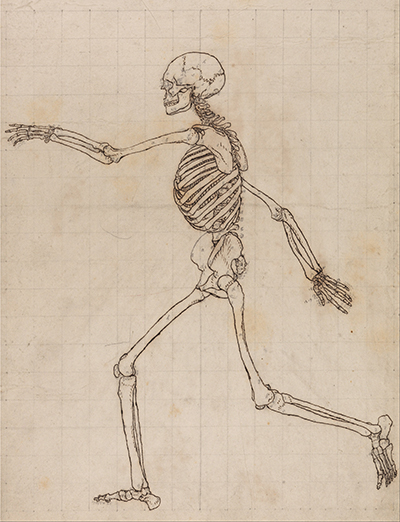
The familiar image of a striding human skeleton belongs to the drawings. Yale calls it Human Skeleton, Lateral View and dates it to 1795–1806. Executed in pen with iron-gall ink and graphite on squared wove paper, the sheet measures 41.3 by 27.3 centimetres. It is in the Yale Center for British Art’s Paul Mellon Collection. [2]
At a Glance
- SubjectsHuman body, tiger and common fowl [1]
- Published during Stubbs’s lifeThree instalments [1]
- Illustrated drawingHuman Skeleton, Lateral View, 1795–1806 [2]
Contents
- A book planned in six numbers
- From skeleton to external form
- The squared human drawing
- A tiger and a fowl under comparison
- Working lines and written explanations
- The 1817 publication and surviving copies
- Rediscovery, ownership and public access
- Reading an unfinished achievement
- Videos on George Stubbs
A book planned in six numbers
The 1802 subscription proposal announced thirty tables, each requiring two copperplates, to be delivered in six numbers of ten plates. It presented the whole undertaking as Stubbs’s execution and identified him through his earlier horse anatomy. This was a staged commitment: subscribers were being offered a sequence whose eventual extent exceeded the images already available. [3]
The distinction between a table and a plate matters. Wellcome’s surviving first part contains plates I–V together with their key figures: ten printed sheets for five subjects. Its copy has neither a title page nor accompanying text. The catalogue dates it to 1804 and records that only the first three projected parts appeared in 1804–06. A description of fifteen tables therefore need not contradict a count of thirty plates. [1]
A copy of Parts II and III catalogued by Sims Reed preserves ten illustrated tables and ten corresponding keys: twenty printed sheets in original wrappers. It came from Thomas Villiers, second Earl of Clarendon. The dealer records W. and C. Spilsbury and J. Nichols and Son as printers for the author and dates the parts to 1803–06. That starting date differs from Wellcome’s account and should not be silently imposed on every copy. [4]
There is also contemporary evidence that the series reached an institutional audience while Stubbs was alive. The Royal Academy’s Academic Annals, published in 1805 under the authority of the Academy and collected by Prince Hoare, lists the second number among additions to its collections during the 1804–05 reporting period. The entry supplies a firm point within publication history, though it does not give the day on which the number was issued. [5]
The Academy’s notice records acquisition rather than a review of the work’s anatomical conclusions. Its value lies partly in that modesty: a named instalment had entered an artistic institution’s collections. The enterprise was already circulating as a publication, not merely existing as a private accumulation of drawings. Its incomplete condition at Stubbs’s death should not erase that lifetime audience. [5]
From skeleton to external form
The issued sequence moved from skeletons to external parts and then to superficial anatomical structures. Further numbers were intended to remove additional muscular layers. The thirty published plates included eighteen human images and six each of tiger and fowl, counting the corresponding keys. This unequal allocation of sheets is another reason to distinguish the organisation of the book from a simple row of three equivalent portraits. [4]
In the British Museum’s printed human skeleton, shaded bones give the figure weight and depth. Beside its corresponding outline key, the same broadly striding arrangement becomes easier to follow as a network of separate contours. The opposed arms, turned head and separated legs remain recognisable across the pair. One sheet offers a fully modelled bodily presence; the other makes that presence available for identification, with less tonal information competing for attention. [6]
The tiger skeleton faces left across the sheet. Its long backbone stretches above a deep cage of ribs, and the tail continues the body’s direction beyond the pelvis. The four legs occupy different positions beneath this elongated structure. The fowl also faces left, but its long curved neck rises above a much more compact torso. Folded wings and staggered legs produce a different balance of lengths and spaces. Comparison depends on keeping those differences visible. [7] [8]
These printed bodies occupy largely empty pages. There is no stable, menagerie or countryside to explain their positions. Attention moves instead between the shapes of the bodies and the intervals inside and around them. The human figure’s upright trunk, the tiger’s extended back and the bird’s rising neck create three different large patterns before any individual bone is named. Their shared clarity of presentation makes looking across species possible without making their silhouettes identical. [6] [7] [8]
The squared human drawing
In Yale’s pen-and-graphite human sheet, the skeleton strides towards the left. One arm reaches forward, while the other extends behind it. The nearer leg runs down towards a planted foot; the other bends back, leaving an open angle beneath the pelvis. The head faces in the direction of the advancing arm. These opposed directions make the figure expansive even though its chest and spine occupy a narrow central band. [2]
A regular grid crosses the paper and continues through the figure. It supplies a second order of lines, independent of the body’s changing contours. Straight verticals and horizontals pass behind the ribs, through the open spaces between the bones and across the blank margins. Against that repeated structure, each deviation of the skeleton becomes conspicuous: the slant of the shin, the bend at the elbow, the curve beneath the ribcage. [2]
The drawing also varies the force of its contours. Darker passages consolidate the head, chest and limbs, while lighter lines remain around and within them. The ribs repeat closely spaced curves, contrasting with the longer, more isolated lengths of the arms and legs. Around the hands and feet the line becomes crowded again. Stubbs gives the extremities attention without allowing their smaller parts to overwhelm the legibility of the whole figure. [2]
Yale describes the squaring as preparation for transfer. The sheet therefore records a stage in making the publication, while the careful placement and articulation of its limbs retain their own visual interest. [2]
A tiger and a fowl under comparison
A separate Yale drawing is identified as a highly finished study of the tiger skeleton for Table IV. Another, more briefly titled Fowl Body, Lateral View, records the bird’s skeleton. Both are dated 1795–1806 and are in graphite. They are distinct working objects, rather than alternate names for the pen-and-ink human sheet. [9] [10]
The tiger’s skull is low and forward, with the jaw opening beneath it. The broad sweep of the ribs occupies much of the central body, while the shoulder blade appears as a flatter shape above the forward part of the chest. The spine continues towards a high pelvis before descending into the tail. Its repeated small divisions provide a visible link between the large masses of head and torso and the fine structure at the body’s end. [9]
The legs give that long body a less uniform rhythm. One foreleg reaches forward and another falls back beneath the chest; the hind legs also separate into different angles. Small clusters at the paws interrupt their longer lengths. Beneath the ribcage and behind the forward limbs, large areas of untouched paper remain. Those openings keep the limbs individually readable, rather than letting them merge into a continuous barrier below the trunk. [9]
The fowl drawing uses the height of its sheet very differently. A small head and pointed beak stand above a long neck built from repeated segments. Below, the overlapping forms of the wings and torso gather into a compact mass. The legs spread away from that mass, one reaching forward and the other back. Their long lower portions bring the feet well below the ribs and the folded wings. [10]
The resulting silhouette is neither a small tiger nor a shortened human figure. Its strongest vertical movement belongs to the neck, while the wing bones introduce angular forms across the chest. The pelvis extends backwards above a bent leg, leaving a conspicuous opening beneath it. The toes spread into narrow branches at the bottom of the sheet. The drawing makes comparison an encounter with a different bodily arrangement, rather than an exercise in overlooking difference. [10]
The isolation of these bodies helps comparison, but limits the story that their appearance can tell. The sheets do not show an animal’s acquisition, its keeper or the circumstances in which its body became available for study. Those questions require evidence beyond the anatomical figure. A highly specific image of bodily structure can coexist with a much less complete history of the individual represented. [9] [10]
Working lines and written explanations
Yale identifies another tiger sheet as a study of surface blood supply for the key to Table IX; the fowl study relates to the key for Table XV. Both combine graphite and red chalk. These identities establish different stages and purposes within the project. Their markings should not be mistaken for a single undifferentiated drawing technique. [11] [12]
The tiger study retains the long lateral outline, but many smaller lines now travel within it. They branch over the head, shoulder, ribs and flank, crossing the larger divisions of the body. Some paths are continuous, others broken or dotted. A faint reddish trace accompanies parts of the darker drawing. The body remains recognisable at a glance, while sustained looking reveals a much denser pattern than the skeletal sheet presents. [11]
This density changes the viewer’s task. The eye can follow a long outer contour, then turn inward to a line that divides and subdivides across the same surface. Areas that seemed relatively open in the skeleton become occupied by branching routes. The drawing holds its overall animal shape steady while asking attention to move through many smaller connections. Its clarity depends on the relationship between those scales, rather than on a uniform degree of detail everywhere. [11]
In the fowl key study, graphite lines and lighter reddish marks run through the long neck and along the limbs. Narrow forms converge around the upper leg and spread again nearer the foot. Across the torso, broad boundaries lie beside much finer parallel lines. The head, beak, wings and extended toes preserve the bird’s overall orientation, so that these increasingly intricate passages remain attached to a legible whole. [12]
The surviving manuscript adds another kind of precision. An English page reproduced in Terence Doherty’s book explains structures of the human head and eye through alphabetic references. It discusses muscles and their attachments, distinguishes neighbouring parts and moves between broad headings and particular anatomical relations. The letters are part of an explanatory apparatus: the image directs the reader towards a place, while prose supplies information that an outline alone cannot convey. This single page demonstrates the importance of writing without allowing the complete manuscript to be reconstructed from it. [13]
In 1968, the physician R. B. Fountain discussed the comparative project as anatomical work as well as art. Drawing on assessments by Basil Taylor and the anatomist W. C. Osman Hill, he described a disciplined comparison of successive layers and a consistent concern with bodily proportions. His account also registered limits: the surviving text was not a perfectly finished statement, and some of the birds had extra toes. Such observations belong to a dated specialist assessment, not to an assumption that every detail is universally representative. [14]
Fountain’s discussion is valuable because accuracy and incompletion can coexist. The care of an individual observation does not establish that the publishing scheme was finished, that every structure was successfully matched across species, or that the chosen specimen represented every animal of its kind. An anatomical image records particular choices about what to expose, preserve and explain. Its scientific value cannot be measured solely by the beauty of the resulting sheet. [14]
The 1817 publication and surviving copies
Edward Orme republished the engraved sequence in June 1817. The British Museum’s set comprises thirty plates, made using etching, stipple and roulette, and lacks a title page. Its record associates the later issue with two letterpress volumes. The sheets measure 58.5 by 45 centimetres; some carry a 1794 paper watermark. That watermark identifies paper within this particular surviving set, rather than proving that the completed publication appeared in 1794. [15]
The Museum credits Stubbs as the maker of the prints. This matters when comparing the engraved sheets with the drawings: the publication was another form of his work, rather than a modern reproductive selection from it. Orme’s later role belongs to the history of republication. It should not be transferred backwards to make him the publisher of every lifetime instalment. [15]
Wellcome records the 1817 text as a version accompanying the same plates and notes differences from the surviving manuscript. A printed explanation and a preparatory draft therefore require separate attention. The later issue made more of the enterprise available without completing all sixty originally proposed plates. [1]
Rediscovery, ownership and public access
The drawings and manuscripts eventually reached Worcester Public Library in Massachusetts as a gift from Dr John Green in 1863. The library’s historical account records a Thomas Bell bookplate, but does not establish a complete chain by which Green acquired the material. [16]
Recataloguing brought the folios back to attention in 1957. Librarian Thurston Taylor contacted the art historian Basil Taylor; a Worcester Art Museum exhibition and a British touring exhibition followed. The recovery made the drawings available for renewed scholarly study, and Doherty’s anatomical volume appeared in Britain in 1974 and the United States in 1975. [16]
Quentin Bell’s 1975 review of Doherty placed the anatomical drawings within a reassessment of Stubbs’s achievement. He challenged a narrow account of British painting that privileged colour or familiar genres at the expense of exact draughtsmanship. For Bell, understanding construction could sharpen an artist’s apprehension of a body, rather than merely burdening a picture with anatomical facts. [17]
Bell also distinguished Stubbs’s observational work from speculative conclusions about the relationship between species. He acknowledged the questions that later generations might bring to the human–tiger–fowl comparison, while finding no reason to credit Stubbs with having advanced beyond the recorder’s task. That is a critical judgement from 1975, not a surviving statement of Stubbs’s intentions. It provides a useful restraint on readings that turn resemblance into evidence of an unrecorded evolutionary theory. [17]
Bell’s distinction concerned the artist’s curiosity as much as the finished drawing. He contrasted registering a surface with wanting to understand weight, consistency, function and construction. Within that reading, anatomical work was a form of enquiry that changed what an artist could apprehend, rather than a store of hidden details to be mechanically inserted into every picture. [17]
The collection’s growing recognition also raised questions about its ownership. The first page of the library board’s complaint to the Massachusetts Probate Court asks for instructions concerning its authority over the anatomical drawings and manuscripts. It seeks, if necessary, application of the doctrine of cy pres. This was a request for legal direction, rather than a declaration that a sale had already occurred. The document makes the institutional problem concrete: the board controlled the collection, but needed clarification before disposing of it. [18]
The subsequent agreement names the City of Worcester, acting through the library board, and Yale University, acting through its Center for British Art. Its opening date is 24 December 1979. It describes 125 drawings and four bound volumes, referring to Doherty’s itemisation, and gives a price of $1.25 million. Those numbers describe the collection in the contract; they should not be treated as an interchangeable count of printed plates or of every anatomical drawing Stubbs ever made. [19]
The complaint recalled Green’s earlier gift of about 7,000 books in 1859 and the establishment of the library. That institutional foundation is separate from the arrival of the Stubbs material in 1863. The board’s appeal placed the drawings within a longer history of charitable provision, requiring it to address the purposes attached to the library’s resources as well as their immediate usefulness. [18]
The first page directs payment to the City’s Green Library Fund. It links payment with the transfer of title and possession, and places collection of the works at Worcester Art Museum. These terms join financial provision for the library to the physical movement of the objects. They also show why the transaction involved more than a change of name on a museum label: a municipal collection was being transferred between institutions with different responsibilities and resources. [19]
The library’s account describes opposition to the sale, including arguments for retaining the drawings locally, alongside support for using the proceeds to improve library services. It records payment on 17 January 1980. The disagreement concerned preservation, access and the meaning of a public gift as well as monetary value. [16]
Yale subsequently undertook conservation of the drawings. In Worcester, income from the sale supported an enclosed, climate-controlled local-history room dedicated in 1982. The project’s survival thus connects two histories: the preservation and study of Stubbs’s working material, and the continuing use of the library fund from which it was sold. [16]
Reading an unfinished achievement
The anatomical drawings and prints invite different kinds of attention. A grid, a change of line or a red-chalk trace can reveal decisions made before publication; the paired printed sheets show how those decisions were organised for readers. Moving between them gives the unfinished project more substance than either a single striking skeleton or a list of missing plates can provide. [2] [6] [11] [12]
This late comparison remains distinct from The Anatomy of the Horse. Its conjunction of drawings, plates and explanatory writing gives the unfinished publication a tangible surviving form. [1] [15]
Videos on George Stubbs
Explore Stubbs’s equestrian painting in its wider context, including two readings of Whistlejacket.
A Horse Lover’s Guide to the YCBA
A museum tour that places Stubbs alongside other artists who painted horses. It includes a look at Pumpkin with a Stable-lad.
Watch on YouTubeGeorge Stubbs artworks directory
Search works and related prints documented in this guide. Separate versions and printing matrices have separate entries; printmakers are named where known. Unidentified historical titles and untraced studio-sale material are discussed in the essays. A dash means that a date is not established here.
| Name | Date | Medium |
|---|---|---|
| A Bay Horse with a Groom | 1791 | Painting |
| A Bay Hunter with Two Playful Spaniels | 1777 | Painting |
| A Bay Hunter, a Springer Spaniel and a Sussex Spaniel in a wooded river Landscape | 1782 | Painting |
| A Cheetah and a Stag with Two Indian Attendants | about 1764 | Painting |
| A Couple of Fox Hounds (coloured print after Stubbs) | — | Print after Stubbs |
| A Couple of Foxhounds | 1792 | Painting |
| A Foxhound on the Scent | 1788 | Drawing |
| A Gentleman driving a Lady in a Phaeton | 1787 | Painting |
| A Grey Horse | 1793 | Painting |
| A Grey Horse (cantering companion) | 1793 | Painting |
| A Grey Stallion in a Landscape | — | Painting |
| A Horse Affrighted at a Lion | 1 May 1788 | |
| A Horse Belonging to the Rt. Honourable Lord Grosvenor called Bandy from his Crooked Leg | about 1763 | Painting |
| A Horse Frightened by a Lion | 1777 | |
| A Lion (A Lion Resting on a Rock) | 1 May 1788 | |
| A Lion Attacking a Horse | 1770 | Painting |
| A Lion Attacking a Horse (monumental Yale canvas) | 1762 | Painting |
| A lion attacking a horse (NGV) | about 1765 | Painting |
| A Lion Devouring a Horse (1788 print) | 1788 | |
| A lion devouring a horse (attribution disputed) | Proposed mid-1770s | Painting |
| A mare and foal with a bay horse | 1771 | Painting |
| A Monkey | 1799 | Painting |
| A Prancing Horse, Facing Right | c. 1790 | Drawing |
| A Rough Dog | 1790 | Painting |
| A Saddled Bay Hunter | 1786 | Painting |
| A Sleeping Leopard | 1 January 1791 | |
| A Tiger and a Sleeping Leopard | 1 May 1788 | |
| A Tigress (John Dixon after Stubbs) | 1772 | Print after Stubbs |
| A Tyger (A Recumbent Leopard by a Tree) | 1 May 1788 | |
| A Tyger (Sleeping Leopard) | 1 May 1788 | |
| An animal found on the coast of New Holland called kanguroo (after Stubbs) | 1773 | Print after Stubbs |
| An animal of a new species found on the coast of New South Wales (after Stubbs) | July 1773 | Print after Stubbs |
| Antinous and Jockey | — | Painting |
| Antinoüs, a chestnut racehorse, in a landscape | Undated | Painting |
| Bandy belonging to Lord Grosvenor (print after Stubbs) | — | Print after Stubbs |
| Baronet (George Townley Stubbs after Stubbs) | 20 February 1794 | Print after Stubbs |
| Baronet with Sam Chifney Up | 1791 | Painting |
| Baronet with Samuel Chifney up (Royal Collection) | 1791 | Painting |
| Bay Hunter by a Lake | 1787 | Painting |
| Brood Mares (Benjamin Green after Stubbs) | Issue 14 November 1776 | Print after Stubbs |
| Brood Mares and Foals | usually dated 1767 | Painting |
| Brown and White Norfolk or Water Spaniel | 1778 | Painting |
| Bulls Fighting | 1786 | Painting |
| Captain Samuel Sharpe Pocklington with His Wife, Pleasance, and possibly His Sister, Frances | 1769 | Painting |
| Death of the Doe (attribution disputed) | 1804 | |
| Der Englische Hühnerhund (Johann Wölfle after Stubbs) | about 1860 | Print after Stubbs |
| Dog (A Foxhound Viewed from Behind) | 1 May 1788 | |
| Dog [A Foxhound on the Scent] | 1788 | |
| Drill and albino baboon | before 1789 | Painting |
| Eclipse (Charles Hunt after Stubbs) | 12 November 1839 | Print after Stubbs |
| Eclipse (George Townley Stubbs after Stubbs) | 1796 | Print after Stubbs |
| Eclipse (oil study) | — | Painting |
| Eclipse (Thomas Burke after Stubbs) | First published 1772 | Print after Stubbs |
| Eclipse and John Wildman (Benjamin Green after Stubbs) | 1772 | Print after Stubbs |
| Eclipse at Newmarket (Jockey Club version) | Proposed early 1790s; often dated 1770 | Painting |
| Eclipse at Newmarket with a groom and jockey | 1770 | Painting |
| Eclipse with Mr Wildman and His Sons | 1769–71 | Painting |
| Eclipse, the Property of Capt.n O Kelly (anonymous print after Stubbs) | Imprint 4 June 1804; impression undated | Print after Stubbs |
| Euston | 1774 | Painting |
| Finished Study for the Seventh Anatomical Table of the Muscles of the Horse | 1756–58 | Drawing |
| Five Brood Mares at the Duke of Cumberland's Stud Farm in Windsor Great Park | 1765 | Painting |
| Fowl Body, Lateral View (Highly Finished Study for an Unpublished Table; Shows the Last Stage in Dissection) | — | Drawing |
| Fowl Body, Lateral View (Probably Prepared for Transfer to the Plate for Engraving of Table XV) | — | Drawing |
| Fowl Skeleton, Lateral View (Finished Study for Table V) | — | Drawing |
| Freeman, the Earl of Clarendon's Gamekeeper, with a Dying Doe and Hound (Yale) | 1800 | Painting |
| George Stubbs (enamel self-portrait) | 1781 | Enamel |
| Gimcrack (George Townley Stubbs after Stubbs) | 1775 | Print after Stubbs |
| Gimcrack on Newmarket Heath, with a trainer, a jockey and a stable lad | about 1765 | Painting |
| Gimcrack, with John Pratt up, on Newmarket Heath | about 1765 | Painting |
| Hambletonian, Rubbing Down | 1800 | Painting |
| Hay-Makers | 1791 | |
| Haycarting | 1795 | Enamel |
| Haymakers | 1785 | Painting |
| Haymakers (Lady Lever Art Gallery) | 1794 | Enamel |
| Hollyhock (with later additions by Vernet and Boucher) | about 1765–70 | Painting |
| Horse Attacked by a Lion (Episode C) | 1768–69 | Painting |
| Horse Attacked by a Lion (Tate enamel) | 1769 | Enamel |
| Horse Devoured by a Lion | Possibly exhibited 1763 | Painting |
| Horse Frightened by a Lion | 1770 | Painting |
| Horse Frightened by a Lion (Episode A; Wedgwood and Bentley after Stubbs) | — | Sculpture |
| Horse Frightened by a Lion (Tate) | Possibly exhibited 1763 | Painting |
| Horse Frightened by a Lion (Yale) | 1762–68 | Painting |
| Horse in the Shade of a Wood | 1780 | Painting |
| Hound Coursing a Stag | about 1762 | Painting |
| Human Figure, Anterior View (Intended for a Plate That was Never Published) | — | Drawing |
| Human Skeleton, Lateral View | 1795–1806 | Drawing |
| Hunt servants setting out (Southill commission) | 1767 | Painting |
| Hühnerhund (The Spanish Pointer) | about 1766 | Painting |
| John and Sophia Musters Riding at Colwick Hall | 1777 | Painting |
| John Musters on his hunter Pilgrim | 1777–78 | Painting |
| Labourers | 1789 | |
| Labourers (Richard Earlom after Stubbs and Amos Greene) | 25 March 1790 | Print after Stubbs |
| Laetitia, Lady Lade (d.1825) | 1793 | Painting |
| Lemon and White Water Spaniel | — | Painting |
| Lion Attacking a Stag | — | Painting |
| Lord Grosvenor's Arabian Stallion with a Groom | about 1765 | Painting |
| Lord Grosvenor's Arabian Stallion with a Groom (Peter Mazell after Stubbs) | 1771 | Print after Stubbs |
| Mambrino (Eaton Hall painting) | — | Painting |
| Mambrino (George Townley Stubbs after Stubbs) | 1794 | Print after Stubbs |
| Mares and Foals belonging to the 2nd Viscount Bolingbroke | about 1761–62 | Painting |
| Mares and foals beneath large oak trees | — | Painting |
| Mares and Foals by a stream | Exhibited 1764 | Painting |
| Mares and Foals in a River Landscape | about 1763–68 | Painting |
| Mares and Foals in an Extensive Landscape | about 1769 | Painting |
| Mares and Foals without a Background | 1762 | Painting |
| Moose Deer (after Stubbs) (Arctic Zoology plate VIII) | 1784–85 publication | Print after Stubbs |
| Newmarket Heath with a Rubbing-Down House | — | Painting |
| Otho (1796 print after Stubbs) | 1 December 1796 | Print after Stubbs |
| Otho, with John Larkin up | 1768 | Painting |
| Pangloss | about 1762 | Painting |
| Patch (Grafton commission) | 1759 | Painting |
| Phaeton and the Chariot of the Sun (enamel) | 1775 | Enamel |
| Phaeton with a Pair of Cream Ponies and a Stable-Lad | 1780–84 | Painting |
| Phillis | 1772 | Painting |
| Portrait of a Large Dog (Dingo) | 1772 | Painting |
| Pumpkin with a Stable-lad | 1774 | Painting |
| Racehorses Exercising at Goodwood | 1759–60 | Painting |
| Reapers (1791 print) | 1791 | |
| Reapers (Tate) | 1785 | Painting |
| Reapers (Yale) | 1795 | Enamel |
| Red Deer: A Stag and a Hind | 1792 | Painting |
| Richard Wedgwood | — | Enamel |
| Ringwood, a Brocklesby Foxhound | 1792 | Painting |
| Scrub, a bay horse belonging to the Marquess of Rockingham | about 1762 | Painting |
| Self Portrait on a White Hunter | 1782 | Enamel |
| Self-Portrait | about 1759 | Painting |
| Shooting (1770 Woollett plate after Stubbs) | 1770 | Print after Stubbs |
| Shooting (1771 Woollett plate after Stubbs) | 1771 | Print after Stubbs |
| Shooting at Goodwood | 1759–60 | Painting |
| Sir John Nelthorpe as a boy | 1756 | Painting |
| Sir John Nelthorpe partridge shooting with one pointer | — | Painting |
| Sir John Nelthorpe, 6th Baronet, out Shooting with His Dogs in Barton Field, Lincolnshire | 1776 | Painting |
| Sleeping Leopard | 1777 | Enamel |
| Soldiers of the 10th Light Dragoons | 1793 | Painting |
| Stallion and Mare (George Townley Stubbs after Stubbs) | 1776; reissued 1789 | Print after Stubbs |
| Steward and gamekeeper with dogs (Southill commission) | 1767 | Painting |
| Studies of a Lemur (Lemur murinus) in six different attitudes | 1773 | Drawing |
| Study for the Self-portrait in Enamel | c. 1781 | Drawing |
| Study of a Lemur | 1773 | Drawing |
| Study of a Racehorse in Action: Galloping to Left, a Semi-Anatomical Study, with Skin Flayed to Show Action of Muscles | — | Drawing |
| Study of the Legs of a Draught-Horse Pulling a Harrow (attributed to Stubbs) | Proposed about 1786 | Drawing |
| Sweet William (Grosvenor panel) | — | Painting |
| Sweet William (Turf Gallery canvas) | — | Painting |
| The Black Stallion Sampson, Portrayed from Three Angles (with landscape additions) | about 1764 | Painting |
| The Charlton Hunt | 1759–60 | Painting |
| The Fall of Phaeton | — | Sculpture |
| The Frightened Horse | 1780 | Sculpture |
| The Grosvenor Hunt | — | Painting |
| The Haymakers (Upton House) | 1783 | Painting |
| The Horse and Lion (George Townley Stubbs after George Stubbs) | 1770 | Print after Stubbs |
| The Kongouro from New Holland | 1772 | Painting |
| The Labourers | 1779 | Painting |
| The Labourers (Southill original) | 1767 | Painting |
| The lion and horse (Benjamin Green after Stubbs) | 1769; reissued 1777 | Print after Stubbs |
| The Milbanke and Melbourne Families | about 1769 | Painting |
| The Moose | 1770 | Painting |
| The Prince of Wales's Phaeton | 1793 | Painting |
| The Reapers (Upton House) | 1783 | Painting |
| The Sebra, or Wild Ass (George Townley Stubbs after Stubbs) | 1771 | Print after Stubbs |
| The Spanish Pointer (Bradford version) | about 1766–68 | Painting |
| The Spanish Pointer (William Woollett after Stubbs) | January 1768 | Print after Stubbs |
| The Third Duke of Dorset's Hunter with a Groom and a Dog | 1768 | Painting |
| Thomas Freeman, Lord Clarendon's gamekeeper, with a dog and a shot doe (with George Townly Stubbs) | 1803 | Painting |
| Turf, with Jockey up, at Newmarket | — | Painting |
| Turk and Crab | — | Painting |
| Two Bay Hunters Communing On The Bank Of A Lake | — | Painting |
| Tygers at Play | 1780 | |
| Viscount Gormanston's White Dog | 1781 | Painting |
| Viscount Gormanston's White Dog (canvas version) | — | Painting |
| Water Spaniel | 1769 | Painting |
| Wedgwood Family Portrait | 1780 | Painting |
| Whistlejacket | about 1762 | Painting |
| Whistlejacket with two other stallions and a groom | Recorded 1762 | Painting |
| White Poodle in a Punt | about 1780 | Painting |
| William Anderson with two Saddle-Horses | 1793 | Painting |
| Working Drawing for the Seventh Anatomical Table of the Muscles of the Horse | 1756–58 | Drawing |
| Zebra | 1763 | Painting |
Discussion
Look again at the images and ideas explored in A Comparative Anatomical Exposition. These editorial prompts invite your observations.
Reader Insights
What becomes clearer when the shaded plate and its outline key are considered together?
How does the working drawing change an interpretation formed from the print alone?
And how should the preservation of a collection be weighed alongside the public purposes of the institution that owns it?
Join the Conversation
Share a detail, comparison or question about A Comparative Anatomical Exposition below.
References
- Wellcome Collection, Part I catalogue record, A Comparative Anatomical Exposition of the Structure of the Human Body with that of a Tiger and a Common Fowl, including publication and manuscript notes. Accessed 4 November 2026. View source.
- Yale Center for British Art, Human Skeleton, Lateral View, 1795–1806, institutional record and image supplied to Google Arts & Culture. Accessed 4 November 2026. View source.
- Grosvenor Prints, Catalogue 56, item 120, stock 38788, description and transcription of the 1802 subscription proposal. Accessed 4 November 2026. View source.
- Sims Reed Rare Books, Physical copy of A Comparative Anatomical Exposition, Parts II and III, stock 39386. Accessed 4 November 2026. View source.
- Prince Hoare, collector, Academic Annals, 1804–5 (London, 1805), printed p. 6, addition of the second number to the Royal Academy collections. Accessed 4 November 2026. View source.
- British Museum, Printed human skeleton, Table III; collection 1947,0618.1.1–30, image 1613611049, read alongside the corresponding outline key, image 1613611048. Accessed 4 November 2026. View source 1. View source 2.
- British Museum, Printed tiger skeleton, Table IV, image 1613611050. Accessed 4 November 2026. View source.
- British Museum, Printed fowl skeleton, Table V, image 1613611051. Accessed 4 November 2026. View source.
- Yale Center for British Art, Tiger Skeleton, Lateral View (Highly finished study for Table IV), institutional record and image. Accessed 4 November 2026. View source.
- Yale Center for British Art, Fowl Body, Lateral View, institutional record and image. Accessed 4 November 2026. View source.
- Yale Center for British Art, Tiger, Lateral View (Outline Study of the Surface Blood Supply, Prepared for the Key Figure to Table IX), institutional record and image. Accessed 4 November 2026. View source.
- Yale Center for British Art, Fowl Body, Lateral View (Study for the Key Figure to Table XV), institutional record and image. Accessed 4 November 2026. View source.
- George Stubbs, English manuscript page, reproduced in Terence Doherty, The Anatomical Works of George Stubbs, Appendix 3, photograph supplied by Worcester Public Library. One reproduced page, not the complete manuscript. Accessed 4 November 2026. View source.
- R. B. Fountain, “George Stubbs (1724–1806) as an Anatomist”, Proceedings of the Royal Society of Medicine 61 (1968), pp. 639–646, especially 644–646. Includes his account of Basil Taylor’s and W. C. Osman Hill’s assessments. Accessed 4 November 2026. View source.
- British Museum, Collection record for Comparative Anatomy, 1947,0618.1.1–30, publication, technique and curator’s notes. Accessed 4 November 2026. View source.
- Worcester Public Library, “Worcester Public Library and the George Stubbs Art Controversy”, 8 December 2025. Institutional history drawing on its local records and newspaper files. Accessed 4 November 2026. View source.
- Quentin Bell, “Anatomy Lessons”, The New York Review of Books, 30 October 1975. Review of Doherty’s anatomical volume. Accessed 4 November 2026. View source.
- Worcester Free Public Library board, First page of the 1978 Complaint for Instructions and for Application of the Doctrine of Cy Pres, reproduced by Worcester Public Library. Accessed 4 November 2026. View source.
- City of Worcester and Yale University, First page of sale agreement entered 24 December 1979, reproduced by Worcester Public Library. The reproduced page does not include signatures or the complete conditions. Accessed 4 November 2026. View source.
- Basic title, date and material metadata for Tate’s Reapers (T02257) and Otho (T02375) is adapted from the Tate collection dataset, October 2014, released under CC0. TheHistoryOfArt.org has reconciled labels and versions. This credit does not apply to Tate’s authored catalogue commentary or images.
- Data Source: Yale Center for British Art. Basic object fields are adapted and reconciled for this directory. Reuse is subject to the Center’s Open Data and Data Services Terms of Use. No museum endorsement is implied. This metadata credit does not relabel scholarly essays or images as open data.
- Basic object metadata for A Horse Frightened by a Lion, 1985.38, The Cleveland Museum of Art, John L. Severance Fund, is available under CC0. Titles and design-level grouping have been reconciled for this directory.