 by Tom Gurney
Tom Gurney BSc (Hons) is an art history expert with over 20 years experience
Email: tomgurney1@gmail.com / Phone: +44 7429 011000
Pumpkin with a Stable-Lad by George Stubbs: Introduction
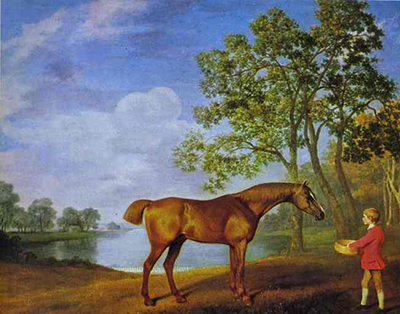
A racehorse and a child face one another beneath spreading trees. Pumpkin occupies most of the foreground, but the small boy at the right gives his stillness a purpose. Between the horse’s lowered muzzle and the vessel in the boy’s hands, Stubbs leaves a narrow interval: the space in which the next movement might happen.
Yale’s Pumpkin with a Stable-lad is signed and dated 1774. Measuring 82.2 × 101.3 cm, it is painted in beeswax and oil on panel. The Yale Center for British Art acquired it through Paul Mellon’s 2001 bequest. [1]
At a Glance
This work across George Stubbs’s career
Whistlejacket
about 1762 [6]Contents
- A horse with a name and a pedigree
- The boy and the waiting horse
- A landscape that changes the balance
- Pumpkin with a jockey
- From the Foley collection to Paul Mellon
- Charm, responsibility and tension
- Videos on George Stubbs
A horse with a name and a pedigree
Pumpkin was bred by John Pratt and owned by Thomas Foley, later the second Baron Foley. Yale identifies Foley as the patron who commissioned this portrait. [1]
The 1793 General Stud-Book gives Pumpkin a place within a recorded family. Under the mare by Squirt, it lists a chestnut colt born in 1769, sired by Matchem, with Mr Foley opposite his name. This is a specific animal with a traceable parentage, rather than a convenient name attached to an anonymous horse. [15]
According to Yale’s account, Pumpkin won sixteen races from twenty-four starts, earning 6,090 guineas and nine hogsheads of claret. Many victories came at Newmarket. His first race, in 1772, reportedly ended with a half-neck defeat of the favourite, Denmark. [16]
No finish, galloping stride or cheering spectator interrupts this scene. The horse stands without a rider, his broad side exposed to the light. The boy faces him from ground level.
The boy and the waiting horse
The object the boy holds is a sieve used to feed his charge. Angus Trumble’s catalogue entry emphasises the child’s serious, responsible bearing. [1]
Stubbs places the vessel low enough for the horse to approach it, but the muzzle has not reached its rim. The boy’s arms stretch forwards while his body remains upright. Neither figure makes a large gesture. Their opposed profiles create the principal exchange, giving significance to a small change of head or hand rather than to an unfolding spectacle.
The difference in their size is impossible to overlook. Pumpkin’s body extends across the centre, and his head reaches towards a figure whose whole height scarcely exceeds the horse’s shoulder. Yet the boy is not hidden behind the animal. His position at the edge keeps his face, jacket, arms and legs available to the viewer. The painting offers two clear silhouettes connected by a practical task.
His red coat carries unusual weight within the scene. Against the subdued browns and greens of the trees, it makes the smallest principal figure immediately noticeable. The pale collar and cuffs break its surface, while the light stockings lead the eye down towards the dark shoes. These contrasts distinguish the child without giving him a commanding gesture or moving him into the centre.
Pumpkin is equally individualised through differences within a narrow range of colour. Light catches the flank, shoulder and long neck; darker passages describe the underside and the separations between the legs. The mane lies along the neck rather than flying outwards. The pale marking down the face gives the head a further point of focus as it turns towards the boy.
The arrangement encourages a sense of mutual attention, but it leaves the degree of intimacy open. The pair do not touch. The horse’s head extends into the intervening space, and the child holds his position. A viewer can attend both to the ordinary usefulness of feeding and to the unequal physical presence of the two participants.
A landscape that changes the balance
The horse and boy occupy the right-hand portion of a much larger setting. At the left, water opens a pale passage through the landscape. Distant trees appear smaller and softer than the trunks behind the figures. Above them, a broad expanse of blue sky and cloud prevents the image from becoming a tightly enclosed double portrait.
This openness matters because the figures are not symmetrically distributed. A heavy mass of foliage rises over the boy, while the horse’s body reaches away from it towards the lake. The eye can move from the red coat to the head, along the animal’s back and out towards the water. Looking back in the other direction, the branches return attention to the meeting beneath them.
A short stretch of white paling fence appears low in the middle distance. Its small, repeated uprights establish a scale beyond the horse’s legs and mark a further separation between the foreground and water. It also interrupts the broad areas of earth, foliage and reflection with something precise and constructed. The landscape contains signs of human arrangement without filling the view with buildings or crowds.
Pumpkin with a jockey
The name Pumpkin also belongs to prints with a very different arrangement. A print issued on 20 February 1794, engraved by George Townly Stubbs after his father and published through their Turf Gallery, shows the horse carrying a jockey. The example catalogued by Donald A. Heald is a stipple engraving with etching. [17]
In that image the horse faces left, and the mounted figure sits upright in a striped jacket. Saddle, reins and the rider’s boots make the relationship quite different from the Yale picture. The broadside presentation remains, but the animal is shown equipped to carry a professional rider. The distant landscape extends behind him; the intimate meeting with a child and a feeding vessel has disappeared.
The distinction has historical support. The Turf Gallery description reproduced by Walter Gilbey identifies the figure on Pumpkin’s back as Old South. It praises the jockey particularly in contests involving crossing and jostling. This language belongs to a competitive world, attaching the rider’s reputation to that of the horse. [18]
The mounted image also circulated beyond the original print. The Royal College of Surgeons records an unsigned painted copy of Pumpkin with Old South, made after the 1794 engraving. Its description identifies the striped clothing and the horse turned to the left. [19] The copy belongs to the afterlife of the jockey image, rather than demonstrating that the Yale boy-and-horse scene was reproduced in that form.
From the Foley collection to Paul Mellon
Yale traces the panel through the Foley family and identifies it with lot 564 in the 1919 sale at Ruxley Lodge, Surrey. [1]
The sale catalogue is much less specific about the horse. Its entry describes a hunter in a landscape, with a groom wearing crimson and holding a sieve. Stubbs is named as the painter, but Pumpkin is not named as the sitter. Listed among the house’s furniture, decorative objects and pictures, the work was presented through immediately recognisable features of its appearance. [20]
This description preserves the child’s task even as it loses the horse’s personal identity. The coat and sieve were useful identifying details in a crowded catalogue; they are also central to the encounter within the picture. The wording shows how an individual animal portrait could be handled as a more general sporting subject when it entered the market. [20]
Yale’s subsequent history records ownership by Daniel Haddock Carstairs in Philadelphia, a return to Knoedler on consignment, and dealings involving Carroll Carstairs and George Atwell. Knoedler sold the picture to Mellon on 1 May 1936. [1]
For Paul and Mary Mellon, the appeal was more personal. A passage from Mellon’s memoir, reproduced by the Frist Art Museum, recalls a hunting visit to the Cotswolds in 1936. There he met Angus Menzies, a partner in Knoedler’s London firm, who recommended a Stubbs. The couple went to see it, and Mellon remembered responding to the horse, the boy’s red jacket and the landscape. He paid $5,000 and described it as his first purchase of a painting. [21]
The recollection joins the two figures and their setting in a single response. Mellon did not remember only a celebrated racehorse or only a celebrated painter. The combination mattered. His enjoyment of horses and of the landscape surrounding them found an unusually direct expression in this small scene. [21]
In a 1992 interview, Mellon again described the 1936 purchase as something done for his own pleasure. Discussing his later collecting with Basil Taylor, he explained his wish to show a broader range of English life than the grand portraits already familiar to American audiences. He also recalled an expectation that the pictures he enjoyed privately would eventually become available to the public. [22]
Duncan Robinson’s recollection after Mellon’s death places Pumpkin among the sporting pictures at the Brick House in Virginia, in the collection which served as Mellon’s private picture gallery. [23]
Charm, responsibility and tension
The scene has not produced a single response. Reviewing the 1999 memorial exhibition of Mellon’s Stubbs collection, Roger Kimball used Pumpkin with a Stable Lad as an example of an animal seeming more individual and animated than its human companion. His broader judgement was that people in Stubbs’s animal paintings often functioned as supporting figures. [24]
An Evening Standard review of the Mellon exhibition at the Royal Academy placed the emphasis elsewhere. It found tension in the unequal composition, reading the boy’s position near the edge as tentative and his approach to the horse as fearful. [25] The same placement that makes him conspicuous can also make him look vulnerable.
These responses direct attention to different parts of the visible relationship. The horse’s size gives him pictorial authority; the child’s red coat resists his disappearance into the setting. Their nearness can suggest familiarity, while their separation keeps the encounter suspended. The painting’s interest depends partly on this openness: an ordinary act remains poised between the two figures.
Videos on George Stubbs
Explore Stubbs’s equestrian painting in its wider context, including two readings of Whistlejacket.
A Horse Lover’s Guide to the YCBA
A museum tour that places Stubbs alongside other artists who painted horses. It includes a look at Pumpkin with a Stable-lad.
Watch on YouTubeGeorge Stubbs artworks directory
Search works and related prints documented in this guide. Separate versions and printing matrices have separate entries; printmakers are named where known. Unidentified historical titles and untraced studio-sale material are discussed in the essays. A dash means that a date is not established here.
| Name | Date | Medium |
|---|---|---|
| A Bay Horse with a Groom | 1791 | Painting |
| A Bay Hunter with Two Playful Spaniels | 1777 | Painting |
| A Bay Hunter, a Springer Spaniel and a Sussex Spaniel in a wooded river Landscape | 1782 | Painting |
| A Cheetah and a Stag with Two Indian Attendants | about 1764 | Painting |
| A Couple of Fox Hounds (coloured print after Stubbs) | — | Print after Stubbs |
| A Couple of Foxhounds | 1792 | Painting |
| A Foxhound on the Scent | 1788 | Drawing |
| A Gentleman driving a Lady in a Phaeton | 1787 | Painting |
| A Grey Horse | 1793 | Painting |
| A Grey Horse (cantering companion) | 1793 | Painting |
| A Grey Stallion in a Landscape | — | Painting |
| A Horse Affrighted at a Lion | 1 May 1788 | |
| A Horse Belonging to the Rt. Honourable Lord Grosvenor called Bandy from his Crooked Leg | about 1763 | Painting |
| A Horse Frightened by a Lion | 1777 | |
| A Lion (A Lion Resting on a Rock) | 1 May 1788 | |
| A Lion Attacking a Horse | 1770 | Painting |
| A Lion Attacking a Horse (monumental Yale canvas) | 1762 | Painting |
| A lion attacking a horse (NGV) | about 1765 | Painting |
| A Lion Devouring a Horse (1788 print) | 1788 | |
| A lion devouring a horse (attribution disputed) | Proposed mid-1770s | Painting |
| A mare and foal with a bay horse | 1771 | Painting |
| A Monkey | 1799 | Painting |
| A Prancing Horse, Facing Right | c. 1790 | Drawing |
| A Rough Dog | 1790 | Painting |
| A Saddled Bay Hunter | 1786 | Painting |
| A Sleeping Leopard | 1 January 1791 | |
| A Tiger and a Sleeping Leopard | 1 May 1788 | |
| A Tigress (John Dixon after Stubbs) | 1772 | Print after Stubbs |
| A Tyger (A Recumbent Leopard by a Tree) | 1 May 1788 | |
| A Tyger (Sleeping Leopard) | 1 May 1788 | |
| An animal found on the coast of New Holland called kanguroo (after Stubbs) | 1773 | Print after Stubbs |
| An animal of a new species found on the coast of New South Wales (after Stubbs) | July 1773 | Print after Stubbs |
| Antinous and Jockey | — | Painting |
| Antinoüs, a chestnut racehorse, in a landscape | Undated | Painting |
| Bandy belonging to Lord Grosvenor (print after Stubbs) | — | Print after Stubbs |
| Baronet (George Townley Stubbs after Stubbs) | 20 February 1794 | Print after Stubbs |
| Baronet with Sam Chifney Up | 1791 | Painting |
| Baronet with Samuel Chifney up (Royal Collection) | 1791 | Painting |
| Bay Hunter by a Lake | 1787 | Painting |
| Brood Mares (Benjamin Green after Stubbs) | Issue 14 November 1776 | Print after Stubbs |
| Brood Mares and Foals | usually dated 1767 | Painting |
| Brown and White Norfolk or Water Spaniel | 1778 | Painting |
| Bulls Fighting | 1786 | Painting |
| Captain Samuel Sharpe Pocklington with His Wife, Pleasance, and possibly His Sister, Frances | 1769 | Painting |
| Death of the Doe (attribution disputed) | 1804 | |
| Der Englische Hühnerhund (Johann Wölfle after Stubbs) | about 1860 | Print after Stubbs |
| Dog (A Foxhound Viewed from Behind) | 1 May 1788 | |
| Dog [A Foxhound on the Scent] | 1788 | |
| Drill and albino baboon | before 1789 | Painting |
| Eclipse (Charles Hunt after Stubbs) | 12 November 1839 | Print after Stubbs |
| Eclipse (George Townley Stubbs after Stubbs) | 1796 | Print after Stubbs |
| Eclipse (oil study) | — | Painting |
| Eclipse (Thomas Burke after Stubbs) | First published 1772 | Print after Stubbs |
| Eclipse and John Wildman (Benjamin Green after Stubbs) | 1772 | Print after Stubbs |
| Eclipse at Newmarket (Jockey Club version) | Proposed early 1790s; often dated 1770 | Painting |
| Eclipse at Newmarket with a groom and jockey | 1770 | Painting |
| Eclipse with Mr Wildman and His Sons | 1769–71 | Painting |
| Eclipse, the Property of Capt.n O Kelly (anonymous print after Stubbs) | Imprint 4 June 1804; impression undated | Print after Stubbs |
| Euston | 1774 | Painting |
| Finished Study for the Seventh Anatomical Table of the Muscles of the Horse | 1756–58 | Drawing |
| Five Brood Mares at the Duke of Cumberland's Stud Farm in Windsor Great Park | 1765 | Painting |
| Fowl Body, Lateral View (Highly Finished Study for an Unpublished Table; Shows the Last Stage in Dissection) | — | Drawing |
| Fowl Body, Lateral View (Probably Prepared for Transfer to the Plate for Engraving of Table XV) | — | Drawing |
| Fowl Skeleton, Lateral View (Finished Study for Table V) | — | Drawing |
| Freeman, the Earl of Clarendon's Gamekeeper, with a Dying Doe and Hound (Yale) | 1800 | Painting |
| George Stubbs (enamel self-portrait) | 1781 | Enamel |
| Gimcrack (George Townley Stubbs after Stubbs) | 1775 | Print after Stubbs |
| Gimcrack on Newmarket Heath, with a trainer, a jockey and a stable lad | about 1765 | Painting |
| Gimcrack, with John Pratt up, on Newmarket Heath | about 1765 | Painting |
| Hambletonian, Rubbing Down | 1800 | Painting |
| Hay-Makers | 1791 | |
| Haycarting | 1795 | Enamel |
| Haymakers | 1785 | Painting |
| Haymakers (Lady Lever Art Gallery) | 1794 | Enamel |
| Hollyhock (with later additions by Vernet and Boucher) | about 1765–70 | Painting |
| Horse Attacked by a Lion (Episode C) | 1768–69 | Painting |
| Horse Attacked by a Lion (Tate enamel) | 1769 | Enamel |
| Horse Devoured by a Lion | Possibly exhibited 1763 | Painting |
| Horse Frightened by a Lion | 1770 | Painting |
| Horse Frightened by a Lion (Episode A; Wedgwood and Bentley after Stubbs) | — | Sculpture |
| Horse Frightened by a Lion (Tate) | Possibly exhibited 1763 | Painting |
| Horse Frightened by a Lion (Yale) | 1762–68 | Painting |
| Horse in the Shade of a Wood | 1780 | Painting |
| Hound Coursing a Stag | about 1762 | Painting |
| Human Figure, Anterior View (Intended for a Plate That was Never Published) | — | Drawing |
| Human Skeleton, Lateral View | 1795–1806 | Drawing |
| Hunt servants setting out (Southill commission) | 1767 | Painting |
| Hühnerhund (The Spanish Pointer) | about 1766 | Painting |
| John and Sophia Musters Riding at Colwick Hall | 1777 | Painting |
| John Musters on his hunter Pilgrim | 1777–78 | Painting |
| Labourers | 1789 | |
| Labourers (Richard Earlom after Stubbs and Amos Greene) | 25 March 1790 | Print after Stubbs |
| Laetitia, Lady Lade (d.1825) | 1793 | Painting |
| Lemon and White Water Spaniel | — | Painting |
| Lion Attacking a Stag | — | Painting |
| Lord Grosvenor's Arabian Stallion with a Groom | about 1765 | Painting |
| Lord Grosvenor's Arabian Stallion with a Groom (Peter Mazell after Stubbs) | 1771 | Print after Stubbs |
| Mambrino (Eaton Hall painting) | — | Painting |
| Mambrino (George Townley Stubbs after Stubbs) | 1794 | Print after Stubbs |
| Mares and Foals belonging to the 2nd Viscount Bolingbroke | about 1761–62 | Painting |
| Mares and foals beneath large oak trees | — | Painting |
| Mares and Foals by a stream | Exhibited 1764 | Painting |
| Mares and Foals in a River Landscape | about 1763–68 | Painting |
| Mares and Foals in an Extensive Landscape | about 1769 | Painting |
| Mares and Foals without a Background | 1762 | Painting |
| Moose Deer (after Stubbs) (Arctic Zoology plate VIII) | 1784–85 publication | Print after Stubbs |
| Newmarket Heath with a Rubbing-Down House | — | Painting |
| Otho (1796 print after Stubbs) | 1 December 1796 | Print after Stubbs |
| Otho, with John Larkin up | 1768 | Painting |
| Pangloss | about 1762 | Painting |
| Patch (Grafton commission) | 1759 | Painting |
| Phaeton and the Chariot of the Sun (enamel) | 1775 | Enamel |
| Phaeton with a Pair of Cream Ponies and a Stable-Lad | 1780–84 | Painting |
| Phillis | 1772 | Painting |
| Portrait of a Large Dog (Dingo) | 1772 | Painting |
| Pumpkin with a Stable-lad | 1774 | Painting |
| Racehorses Exercising at Goodwood | 1759–60 | Painting |
| Reapers (1791 print) | 1791 | |
| Reapers (Tate) | 1785 | Painting |
| Reapers (Yale) | 1795 | Enamel |
| Red Deer: A Stag and a Hind | 1792 | Painting |
| Richard Wedgwood | — | Enamel |
| Ringwood, a Brocklesby Foxhound | 1792 | Painting |
| Scrub, a bay horse belonging to the Marquess of Rockingham | about 1762 | Painting |
| Self Portrait on a White Hunter | 1782 | Enamel |
| Self-Portrait | about 1759 | Painting |
| Shooting (1770 Woollett plate after Stubbs) | 1770 | Print after Stubbs |
| Shooting (1771 Woollett plate after Stubbs) | 1771 | Print after Stubbs |
| Shooting at Goodwood | 1759–60 | Painting |
| Sir John Nelthorpe as a boy | 1756 | Painting |
| Sir John Nelthorpe partridge shooting with one pointer | — | Painting |
| Sir John Nelthorpe, 6th Baronet, out Shooting with His Dogs in Barton Field, Lincolnshire | 1776 | Painting |
| Sleeping Leopard | 1777 | Enamel |
| Soldiers of the 10th Light Dragoons | 1793 | Painting |
| Stallion and Mare (George Townley Stubbs after Stubbs) | 1776; reissued 1789 | Print after Stubbs |
| Steward and gamekeeper with dogs (Southill commission) | 1767 | Painting |
| Studies of a Lemur (Lemur murinus) in six different attitudes | 1773 | Drawing |
| Study for the Self-portrait in Enamel | c. 1781 | Drawing |
| Study of a Lemur | 1773 | Drawing |
| Study of a Racehorse in Action: Galloping to Left, a Semi-Anatomical Study, with Skin Flayed to Show Action of Muscles | — | Drawing |
| Study of the Legs of a Draught-Horse Pulling a Harrow (attributed to Stubbs) | Proposed about 1786 | Drawing |
| Sweet William (Grosvenor panel) | — | Painting |
| Sweet William (Turf Gallery canvas) | — | Painting |
| The Black Stallion Sampson, Portrayed from Three Angles (with landscape additions) | about 1764 | Painting |
| The Charlton Hunt | 1759–60 | Painting |
| The Fall of Phaeton | — | Sculpture |
| The Frightened Horse | 1780 | Sculpture |
| The Grosvenor Hunt | — | Painting |
| The Haymakers (Upton House) | 1783 | Painting |
| The Horse and Lion (George Townley Stubbs after George Stubbs) | 1770 | Print after Stubbs |
| The Kongouro from New Holland | 1772 | Painting |
| The Labourers | 1779 | Painting |
| The Labourers (Southill original) | 1767 | Painting |
| The lion and horse (Benjamin Green after Stubbs) | 1769; reissued 1777 | Print after Stubbs |
| The Milbanke and Melbourne Families | about 1769 | Painting |
| The Moose | 1770 | Painting |
| The Prince of Wales's Phaeton | 1793 | Painting |
| The Reapers (Upton House) | 1783 | Painting |
| The Sebra, or Wild Ass (George Townley Stubbs after Stubbs) | 1771 | Print after Stubbs |
| The Spanish Pointer (Bradford version) | about 1766–68 | Painting |
| The Spanish Pointer (William Woollett after Stubbs) | January 1768 | Print after Stubbs |
| The Third Duke of Dorset's Hunter with a Groom and a Dog | 1768 | Painting |
| Thomas Freeman, Lord Clarendon's gamekeeper, with a dog and a shot doe (with George Townly Stubbs) | 1803 | Painting |
| Turf, with Jockey up, at Newmarket | — | Painting |
| Turk and Crab | — | Painting |
| Two Bay Hunters Communing On The Bank Of A Lake | — | Painting |
| Tygers at Play | 1780 | |
| Viscount Gormanston's White Dog | 1781 | Painting |
| Viscount Gormanston's White Dog (canvas version) | — | Painting |
| Water Spaniel | 1769 | Painting |
| Wedgwood Family Portrait | 1780 | Painting |
| Whistlejacket | about 1762 | Painting |
| Whistlejacket with two other stallions and a groom | Recorded 1762 | Painting |
| White Poodle in a Punt | about 1780 | Painting |
| William Anderson with two Saddle-Horses | 1793 | Painting |
| Working Drawing for the Seventh Anatomical Table of the Muscles of the Horse | 1756–58 | Drawing |
| Zebra | 1763 | Painting |
Discussion
Look again at the images and ideas explored in Pumpkin with a Stable-Lad by George Stubbs. These editorial prompts invite your observations.
Reader Insights
Does your attention settle first on the horse’s body, the boy’s face or the space between them?
How does the open water at the left change your reading of their encounter?
Join the Conversation
Share a detail, comparison or question about Pumpkin with a Stable-Lad by George Stubbs below.
References
- Yale Center for British Art, Pumpkin with a Stable-lad, B2001.2.69: current object information, provenance and Angus Trumble’s 2007 catalogue entry, supplied in the public LIDO record. Collection record. View source.
- Goodwood, The Collection, Painting Collection modal, Racehorses Exercising at Goodwood; An exciting acquisition: a study by George Stubbs, 30 June 2023; History of the Estate Hounds, 4 October 2023; About Goodwood Racecourse. Accessed 4 November 2026. View source.
- Goodwood, The Collection, Painting Collection modal, Racehorses Exercising at Goodwood; An exciting acquisition: a study by George Stubbs, 30 June 2023; History of the Estate Hounds, 4 October 2023; About Goodwood Racecourse. Accessed 4 November 2026. View source.
- Goodwood, The Collection, Painting Collection modal, Racehorses Exercising at Goodwood; An exciting acquisition: a study by George Stubbs, 30 June 2023; History of the Estate Hounds, 4 October 2023; About Goodwood Racecourse. Accessed 4 November 2026. View source.
- Goodwood, The Collection, Painting Collection modal, Racehorses Exercising at Goodwood; An exciting acquisition: a study by George Stubbs, 30 June 2023; History of the Estate Hounds, 4 October 2023; About Goodwood Racecourse. Accessed 4 November 2026. View source.
- National Gallery, Whistlejacket, NG6569, current collection record, provenance, in-depth discussion and frame entry. View source.
- Yale Center for British Art, Zebra, B1981.25.617, current object metadata, gallery labels, Malcolm Warner’s 1998 catalogue entry and provenance supplied through the museum’s public collection record. View source.
- Christie’s, Gimcrack on Newmarket Heath, with a trainer, a jockey and a stable lad, London, 5 July 2011, lot 12; object details, essay, provenance, exhibitions and whole image. View source.
- Christie’s, Gimcrack on Newmarket Heath, with a trainer, a jockey and a stable lad, London, 5 July 2011, lot 12; object details, essay, provenance, exhibitions and whole image. View source.
- Yale University Art Gallery, A Lion Attacking a Horse, 1770, 1955.27.1, collection record. Accessed 4 November 2026. View source.
- Royal Museums Greenwich, ‘The Kongouro from New Holland’ (Kangaroo), ZBA5754. Accessed 4 November 2026. View source.
- Yale Center for British Art, Pumpkin with a Stable-lad, B2001.2.69: current object information, provenance and Angus Trumble’s 2007 catalogue entry, supplied in the public LIDO record. Collection record. View source.
- Tate, George Stubbs, Haymakers, 1785, T02256; details, Terry Riggs’s collection text (January 1998), and online caption. Collection record. View source.
- Frances Bailey, ‘Hambletonian, Rubbing Down: A masterpiece by George Stubbs’, National Trust Cultural Heritage Magazine, Autumn/Winter 2024, pp. 22–33. Article. View source.
- The General Stud-Book, London: J. Weatherby, Junior, 1793, p. 248, “Squirt Mare”. Digitised volume. View source.
- Yale Center for British Art, Pumpkin with a Stable-lad, 2016 gallery label and object details, Google Arts & Culture. Institutional partner entry. View source.
- Donald A. Heald Rare Books, Pumpkin, George Townly Stubbs after George Stubbs, 1794, item 4133. Print and catalogue entry. View source.
- Walter Gilbey, Life of George Stubbs, R.A., 1898, p. 188, reproducing the Turf Gallery description, no. XIII. Digitised book. View source.
- Royal College of Surgeons of England, Pumpkin, P 546, object description supplied to Collections Trust. Copy painting. View source.
- Castiglione & Scott, Ruxley Lodge: Catalogue of the Collection of Heirlooms and Objets d’Art, sale beginning 14 October 1919, p. 40, lot 564. Wellcome Collection. Digitised catalogue. View source.
- Frist Art Museum, Educator Resource Guide, 2019, p. 6, quoting Paul Mellon with John Baskett, Reflections in a Silver Spoon, 1992. Memoir passage. View source.
- Wilson Rockefeller, interview with Paul Mellon, The Art Newspaper, 1 September 1992; republished in 2024 as “How Pumpkin, a George Stubbs portrait of a horse, caused Paul Mellon to fall in love with collecting”. Interview. View source.
- Duncan Robinson, “Of Turf and the Man”, in “Exit an Icon”, Yale Alumni Magazine, Summer 1999. Recollection. View source.
- Roger Kimball, “Exhibition note”, The New Criterion, September 1999, p. 52. Review. View source.
- “Mellon the magpie collector”, Evening Standard, displayed 5 April 2012, reviewing Paul Mellon’s Legacy at the Royal Academy. Review. View source.
- Basic title, date and material metadata for Tate’s Reapers (T02257) and Otho (T02375) is adapted from the Tate collection dataset, October 2014, released under CC0. TheHistoryOfArt.org has reconciled labels and versions. This credit does not apply to Tate’s authored catalogue commentary or images.
- Data Source: Yale Center for British Art. Basic object fields are adapted and reconciled for this directory. Reuse is subject to the Center’s Open Data and Data Services Terms of Use. No museum endorsement is implied. This metadata credit does not relabel scholarly essays or images as open data.
- Basic object metadata for A Horse Frightened by a Lion, 1985.38, The Cleveland Museum of Art, John L. Severance Fund, is available under CC0. Titles and design-level grouping have been reconciled for this directory.