 by Tom Gurney
Tom Gurney BSc (Hons) is an art history expert with over 20 years experience
Email: tomgurney1@gmail.com / Phone: +44 7429 011000
George Stubbs Racehorses and Georgian Racing: Introduction
A horse waits beside a brick building. Its jockey sits quietly; nobody appears to be racing. In another picture, a trainer holds a bridle while a boy works beneath the horse's body and a jockey waits with the tack. A third presents an unmounted stallion on a monumental scale. These are all pictures of racehorses, but they represent different parts of a horse's life. Their meaning depends on recognising the difference between competition, preparation, portraiture and commemoration.
George Stubbs worked within a culture that connected breeding and ownership to skilled labour, recorded performance and painted likeness. Horses changed hands, workers prepared them, owners negotiated engagements, and publishers assembled information about results and descent. The painting preserved something those documents could not: the visible relation of a particular body to people and place. It also selected and arranged that relation. Reading Stubbs's racing subjects therefore means attending both to the evidence of the picture and to the circumstances beyond its frame.
At a Glance
- Guide focusRacehorses, riders, preparation and patronage
- Institutions discussedThe Jockey Club and Weatherbys [1] [2]
Contents
- How to read a Stubbs racehorse
- Newmarket as a working landscape
- Matches, heats and private trials
- Match Book, Racing Calendar and General Stud Book
- Breeding, ownership and the painted stud
- Patrons, estates and portrait types
- The people who made a horse ready
- Gimcrack and Turf: preparation and presentation
- Riders, posture and remembered performance
- Versions, prints and new audiences
- Videos on George Stubbs
How to read a Stubbs racehorse
The first question is what kind of event, if any, the artist depicts. A racehorse portrait need not show a race, and a picture associated with a victory need not show the instant of winning. Yale's Turf, with Jockey up, at Newmarket probably commemorates a successful match, yet the horse stands in presentation. The National Trust's Hambletonian, Rubbing Down follows a famous contest but concentrates on the horse and attendants afterwards. The documents identify the achievement; the painted action selects another moment. [3] [4]
Three different kinds of knowledge meet here. A performance record identifies engagements and results. A pedigree records descent. A likeness offers an account of appearance. They can support one another, but they do not answer the same questions. A well-documented victory does not establish that a painting was commissioned to celebrate it; that connection needs separate evidence. Equally, the beauty or apparent vitality of a painted horse cannot authenticate a bloodline. The documentary frameworks preserved by the National Horseracing Museum make these distinctions unusually tangible: the Match Book and early stud records survive as separate objects with separate purposes. [5] [6]
A fourth kind of evidence concerns the picture itself. A date attached to a horse's name may be a foaling date, a race date, the date of a painting or the publication date of a print. Those dates must be disentangled before a story is built around them. The Huntington's Baronet with Sam Chifney Up dates from 1791; George Townley Stubbs's Mambrino, intended for the later Review of the Turf, is a print published in 1794. The first is a painted horse-and-rider portrait; the second translates a design into another medium and belongs to a serial publishing enterprise. [7] [8]
The same discipline applies to people. Breeder, owner, commissioner, trainer, groom and jockey identify different relationships with an animal. One person might occupy several roles, or perform more than one kind of work, but that does not make the terms interchangeable. Mike Huggins's research stresses the fluid vocabulary of eighteenth-century racing employment. A man described in a document as a groom could possess considerable training and riding expertise; the modern reader should neither demote him automatically to an unskilled servant nor invent a fixed modern job description. [9]
Stubbs's study of structure, discussed in The Anatomy of the Horse, helped him make bodily distinctions legible. That knowledge did not transform a finished painting into a neutral scientific record. Scale, placement, background, human company and the chosen moment all remain artistic decisions. His broader paintings repeatedly combine close observation with such choices. In the racing subjects, the most revealing reading begins with a simple sequence: identify the object, identify the action, then ask which historical record can explain the relationship between them.
Newmarket as a working landscape
Newmarket's open ground can look like an empty stage in a reproduction. Historically, however, heath, course, stable yard and meeting place belonged to a concentrated racing environment. The Jockey Club's history of the town describes the connection between its High Street plots, accommodation, stables and surrounding heath. This was a landscape made useful through movement between places: horses were housed and prepared in one setting, exercised in another and brought to the course under particular conditions. A low building behind a horse could therefore locate the portrait within an intelligible working geography. [1]
The Club gives 1750 as its foundation date and records the lease of Newmarket premises in 1752. These are distinct events. Huggins also challenges the tidy idea that a fully formed governing institution suddenly appeared around 1750. In his account, the Club had earlier roots, and its eighteenth-century rules applied directly to Newmarket while sometimes being copied elsewhere. The official institutional chronology and the specialist caution should be read together: neither the premises nor the influence of members proves immediate control of every British meeting. [1] [10]
This matters when considering Stubbs's patrons. Their connections could give the paintings access to an influential social world without making every canvas an official image of a national sport. A commission from an owner, a portrait of a jockey and a picture destined for a private house carried different relationships from a race run under local articles. An aristocrat's title explains part of the commission, but it does not identify who trained the horse, who rode it or what rules governed a specific engagement.
Surviving buildings offer another check against abstraction. Historic England dates the earliest part of Queensbury's stable range in Newmarket to the middle or later eighteenth century and relates its development to substantial investment in racing accommodation. The yard combines buildings of several periods. It is evidence of a developing industry rather than a frozen reconstruction of one day in Stubbs's lifetime. Its significance is the concentration of specialised structures within the town, not a claim that any particular horse in a painting occupied an identifiable surviving box. [11]
Rubbing houses performed a more specific function. They sheltered horses while workers removed sweat and dirt, dried them and kept them warm. Historic England's account of the early rubbing house at Salisbury discusses the wider history of these buildings, including at least four on Newmarket Heath. It also records the Town Plate's allowance of half an hour for rubbing between heats. The architectural type thus connects preparation and recovery to the organisation of competition. [12]
The Salisbury building should not be confused with one in a Newmarket portrait. Nor should a surviving nineteenth-century Newmarket example be treated as the original structure painted by Stubbs. What can be carried across is the documented function. In Turf and Otho, the rubbing-house setting associates an apparently still horse with the work of training and care. Its meaning lies partly in activity that the chosen moment does not show: exertion before or after the pause, and the workers whose tasks made that pause useful. [3] [13]
Newmarket was unusually influential, but the quieter heaths in Stubbs's pictures cannot stand for the whole experience of Georgian racegoing. Huggins's study of race weeks describes cooperation between local elites and urban organisers, and spaces in which mixing and social separation could coexist. Grandstands, temporary facilities and paying spectators produced different kinds of visibility. A private trial on sparsely occupied ground should therefore be distinguished from a public meeting with its commercial attractions and crowds. [14]
Matches, heats and private trials
Racing acquired consistency gradually. The contractual articles attached to a match could specify the conditions under which particular competitors would meet. Huggins explains that these agreements arose through the issuing and acceptance of challenges, clarifying obligations and limiting opportunities for disputes. Their existence is evidence of deliberate organisation, but their local and contest-specific character also warns against assuming one complete code everywhere. [10]
Conditions such as age, weight and distance altered the comparison being made. A result without its conditions tells only part of the story: who won is different from what the parties agreed to test. Early printed race lists made those conditions part of their advertised information. Cheny's annual lists named owners and horses, distinguished winners and recorded the terms of running. A modern reader who sees only an isolated winner's name can lose precisely the details contemporaries expected to consult. [15]
A match usually sets particular opponents against one another by agreement. A plate identifies a prize, while sweepstakes connect entry and subscription to the competition. Heats introduce repetition within the event, so the result may depend on more than a single burst of speed. These forms could overlap in practice, and their exact terms need the relevant articles or calendar. They should not be reduced to modern assumptions about a large field running once from a starting point to a finish. [16] [12]
Care between heats was built into the historical procedure. The Newmarket Town Plate articles of 1665 allowed time for rubbing, while Historic England explains how drying and shelter served horses between repeated efforts. A rubbing house was consequently more than an outbuilding for idle intervals. It belonged to the practical sequence by which a horse could continue competing. Its presence in a picture can connect a moment of stillness to the larger bodily demands of racing without identifying which heat, day or engagement is shown. [12]
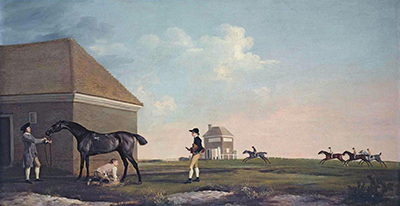
Private trials require another distinction. Their purpose was preparation and assessment rather than the completion of a public race. Huggins's account of eighteenth-century competition includes practice encounters designed to prepare participants for future matches. That category is especially useful for the large Gimcrack composition: the distant running horses do not automatically turn the entire scene into an organised public meeting. The catalogue's interpretation depends on the setting and the absence of the expected public apparatus as well as on the horses' movement. [17] [16]
Rules also required judgement. Owners and subscribers might decide disputes; the roles of judges, tryers and stewards developed unevenly. Huggins's work on meetings describes decisions made by those financially involved and the gradual delegation of judgement to smaller numbers of trusted people. His wider study of sporting arbitration connects written agreements to the question of who could interpret them. This history resists a simple division between unregulated amusement and perfectly administered modern sport. [18] [19]
For a painting, the consequence is practical. Before attaching an event name, ask whether its visible apparatus fits the proposed situation. Are horses moving in comparison, waiting for presentation, being handled before exercise or recovering afterwards? Does a catalogue identify the scene as a trial, or merely associate the horse with a famous result? A canvas may compress several activities into one setting; it need not present a sequential illustration of the rules. Classification keeps the historical explanation close to what the artist actually chose to show.
Match Book, Racing Calendar and General Stud Book
The history of a racing image often depends on knowing where to look for a particular kind of fact. The National Horseracing Museum preserves the Newmarket Match Book with records extending back to 1718. James Weatherby became secretary to the Jockey Club and keeper of that book in 1770. Those facts identify an administrative responsibility and a record of engagements; they do not make the Match Book identical with every subsequent publication issued by the Weatherby business. [2] [5]
An agreement records intention under specified terms. A result records what happened when the engagement was run. The distinction resembles the difference between a commission and a finished painting: one anticipates an action, while the other survives after a process that may have included changes. An entry documenting a match therefore needs to be read for its status, rather than converted automatically into proof that the event took place exactly as first planned. The separate functions of match agreement and published racing information are essential to the documentary culture in which Stubbs worked. [2] [5]
Weatherbys dates its first Racing Calendar to 1773. Its retrospective material belonged to a continuing appetite for printed racing intelligence, already served by annual lists such as Cheny's. The Calendar also looked forward: the catalogue description of its 1773 volume identifies abstracts of future matches at Newmarket, York and Bath alongside accounts of plates, matches and sweepstakes already run. It offered a reader a view of the sport's recent record and forthcoming engagements, rather than a single kind of historical table. [2] [20]
Cheny's titles make the earlier enterprise unusually explicit. Owners, horses' names and colours, winners, running conditions and the places occupied by losing horses were selling points. The declared financial thresholds and geographical coverage also expose the limits of the undertaking. A list of races in England and Wales above a stated prize value cannot be treated as a complete transcript of every contest involving horses. The information became more widely available through print, but the terms of inclusion still shaped what a later historian could recover. [15]
The General Stud Book answered a different question. Weatherbys identifies a first publication in 1791; the title of the 1793 volume announces a compilation reaching back across the preceding fifty years, with some earlier horses and accounts of imported breeding stock. Its remit is retrospective. The existence of a pedigree in that compilation does not mean that an identical registration system had operated continuously from the horse's birth. The compiler brought records together after the events, and the modern reader must retain that direction of travel. [2] [6]
Descent and performance may increase a horse's reputation, yet neither is visible in quite the same way as its coat or stance. A painted likeness cannot show an ancestor's name as a pedigree does. A stud entry cannot preserve the scale at which an owner wanted a horse presented on a wall. A Calendar cannot reproduce the relation between a jockey's seated body and the animal beneath him. Bringing the records together enlarges understanding only when their different kinds of testimony remain distinct.
Their silences are equally revealing. Huggins observes that the Calendar did not routinely include jockeys' names until 1823; systematic trainer information followed later. An eighteenth-century racing document can therefore be detailed about an owner, stake or result while leaving a worker unnamed. The omission does not establish that the work lacked skill or that the person was unknown within racing society. It reveals priorities in recording and transmission. Paintings sometimes preserve the visible prominence of people whom written summaries make difficult to recover. [9]
The reader also needs to distinguish the horse's identification from a later title attached to an artwork. A name painted on a canvas, a documented commission and an established provenance can support an identification in different ways. Where those connections are missing, resemblance alone is a precarious substitute. Stubbs's racing pictures are strongest historical witnesses when the image's own history can be followed alongside the animal's, rather than when one record is forced to answer every question.
Breeding, ownership and the painted stud
The breeding life of a horse extended racing culture beyond the course. Huggins places selective breeding within the financial, social and emotional investments of owners. Imported stallions and British mares belonged to a history of deliberate choices, while the success of those choices remained uncertain. A costly or prestigious pedigree did not guarantee a winner. Paintings of breeding groups can therefore register hopes about future performance as well as the remembered achievements of particular animals. [21]
This changes the meaning of retirement. Whistlejacket had his celebrated York success in 1759 and was retired from racing before Stubbs made the monumental portrait around 1762. The transition to stud did not make the horse irrelevant to sporting reputation. It changed the relation between an accomplished racing past and possible descendants. Rockingham's commission presents a valuable stallion whose significance exceeded the date of a single race. The Whistlejacket portrait belongs to that later phase even though the horse's racing record helps explain why he commanded such attention. [22]
The unmounted format matters. Against the nearly empty field, the rearing horse occupies the picture without a jockey, saddle or recognisable location. Nothing in that arrangement proves that a rider has been removed or that the painting is unfinished. The National Gallery's scholarly catalogue finds no evidence that Stubbs planned a rider. The absence of riding equipment allows the horse's body to dominate, but an interpretation of independence or energy must remain an interpretation; it cannot replace the documented ownership and stud context. [22]
Mares and foals introduce a different kind of sporting image. The Kimbell's Mares and Foals Belonging to the 2nd Viscount Bolingbroke, dated about 1761–62, is a group of three mares and three foals, accession AP 2024.01. It is one particular canvas, with one patronal association. It cannot supply the identity of every similarly arranged equine group by Stubbs. The title, date, composition and object record must travel together. [23]
The National Trust's Five Brood Mares concerns the Duke of Cumberland's Windsor stud. Signed in 1765 and exhibited that year, it is identified as Stubbs's first royal commission. A third group, George Lane Parker's Brood Mares and Foals, has its own provenance and was reproduced in reverse by Benjamin Green in 1768. These are separate pictures rather than alternative labels for one generic subject. Their resemblance makes exact identification more necessary, not less. [24] [25]
In a racehorse portrait, an inscription or accompanying record may allow the viewer to name a particular champion. A breeding group need not offer that degree of identification for every animal. The absence of names does not license a speculative pedigree, nor does the orderly arrangement prove that all the animals occupied the same place together. The reliable starting point is the documented commission and the exact group painted. Broader conclusions about breeding practice require evidence beyond the apparent harmony of the scene.
Ownership, moreover, changes over time. A person who bred a horse might sell it before its major success; a later owner might commission the familiar portrait. The recorded owner of a horse on a race date and the patron of the painting therefore need separate entries in any careful account. Eclipse provides an unusually clear example of that problem: Christie's notes that an April 1770 engagement could remain registered in Wildman's name even though O'Kelly had acquired full ownership. A record's heading and a transaction's effective date need reconciliation rather than an automatic choice between them. [26]
Taken together, the stud groups and individual portraits show why sporting art cannot be confined to winning moments. Breeding, waiting, purchasing, transferring and remembering all helped make a celebrated racehorse. Stubbs's images enter that history at selected points. They may give a horse an enduring public appearance long after the contractual or biological purpose of the commission has changed.
Patrons, estates and portrait types
Stubbs's first important sporting commissions already brought several kinds of activity into relation. At Goodwood, the 3rd Duke of Richmond commissioned three major scenes during the artist's stay around 1759–60: hunting, shooting and the exercise of racehorses. Goodwood's account of a surviving hunting study shows how separate observations of figures and animals could contribute to a larger composition. The estate supplied subjects and a patron, but the finished arrangement still required artistic construction. [27]
The Goodwood exercise scene is especially useful because its title identifies an activity often lost beneath the broader label of sporting painting. These are racing animals being exercised; the commission is not thereby a report of a race run at Goodwood. Calling the picture a race would change the relationship among the figures, the horses and the landscape. Their shared preparation belongs to the subject in its own right. [27]
Rockingham's Whistlejacket presents another solution. The format enlarges one horse to a scale with few distractions, whereas an estate group can spread attention among people, animals and setting. The difference is more than the number of figures. It affects how a viewer encounters the horse: as an individual commanding the entire field, or as one participant in a social and working arrangement. There is no need to rank those forms as more or less accurate portraits. They select different relations for emphasis.
Bolingbroke's commissions demonstrate that a patron might want more than one mode. His horses include the mounted Turf and the large Gimcrack scene with several workers and distant exercise. The Lydiard Archives places these paintings within his patronage and their history at Lydiard Park. They belonged to a collection through which the owner could recall particular animals and his participation in racing, while the separate canvases made different demands on a viewer. [28]
Patronal specificity should not, however, reduce every figure to a possession. A commission may have been paid for by an aristocrat, but the action of a worker holding a bridle remains consequential within the image. Likewise, a horse's value to an owner does not exhaust what the painting makes available to someone unfamiliar with that owner. The scale of the animal, the distribution of empty ground and the balance between stillness and activity can engage a later viewer before the names have been recovered.
Alison Wright's research on sporting pictures argues for looking beyond the assumption of a narrowly specialist audience. Exhibition and reproduction allowed paintings to reach people who had no personal connection with the horses. That wider life did not erase the original commission; it added another setting in which the picture could be understood. A horse portrait might begin in an owner's collection and later become an object of public artistic interest, with the sporting name still attached but no longer the viewer's only reason to look. [29]
The people who made a horse ready
A racehorse reached the moment of competition through work that extended well beyond the jockey's performance. The paintings allow portions of that work to enter the visible record: holding, mounting, waiting with equipment, tending a body or riding out across open ground. Describing those actions precisely is more useful than grouping every non-aristocratic figure under a loose label such as servant. The task and the historical title may both matter, even where they cannot be made to coincide perfectly.
Huggins's study of racing professionals explains why the vocabulary is difficult. Terms could overlap, and the same man might train and ride. Earlier elite-centred histories often obscured that expertise by presenting a simplified social hierarchy. The surviving name is therefore only one part of a person's historical visibility. A worker could be well known in a racing circle and still disappear from a later Calendar entry or painting title. Conversely, recovering a name does not automatically establish all the duties that person performed. [9]
The bodily arrangement in a picture can supply a narrower but valuable kind of knowledge. Someone positioned at the horse's head and holding its rein participates in control and handling. Someone beneath the neck with a cloth attends another part of its care. A mounted jockey brings weight, balance and contact through the reins to a different relationship. These observations describe actions and positions. They do not justify identifying a painted face from a person's reputation or assigning an entire career to a few items of clothing.
The working buildings enlarge that reading. A rubbing house implies a specialised place for drying and shelter; a stable yard gives a setting for repeated preparation. Their functions were connected, but not identical. Historic England's descriptions make the distinction especially useful: the rubbing house belongs to the treatment of a horse around exertion, while a substantial stable range records a longer investment in accommodation and training infrastructure. Neither should become a vague architectural emblem of aristocratic leisure. [12] [11]
Care and control are also closely joined in the images. The cloth and the bridle address bodily needs and movement at the same time. To see tending as gentle does not require denying restraint; to recognise restraint does not establish cruelty in every contact. The visible action needs the surrounding documentary evidence. Where a particular race is known to have been severe, that history changes what an open mouth or tense stance may suggest, but it should be explained rather than silently projected onto every Stubbs horse.
Titles such as Pumpkin with a Stable-Lad offer a useful starting point because they place an occupational relationship beside the animal's name. Other works, including Earl Grosvenor's Bandy, demand their own version and print histories before every accompanying figure can be discussed securely. The words in a title are evidence to examine, not an excuse to transfer a familiar worker from another canvas.
Attention to labour also changes how the spectator reads waiting. A jockey standing with tack has a task even when he is not riding. A handler beside an almost stationary animal remains engaged in maintaining that condition. The quiet interval is not empty time. Stubbs can make it the centre of the picture, giving preparation and attendance the sustained visibility that a rapid account of the winning horse would omit.
Gimcrack and Turf: preparation and presentation
Two principal Gimcrack paintings make the importance of version clear. The Fitzwilliam's canvas, accession PD.7-1982, was painted about 1765 for William Wildman and shows John Pratt mounted. Its current object record gives a canvas of 100 by 124 cm. That combination of patron, rider, dimensions and composition identifies one physical painting. It is not the wide Bolingbroke commission with several attendants simply because the horse and jockey recur. [30]
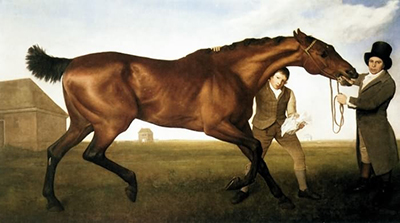
Christie's records the latter canvas at 102 by 193.6 cm and places its commission around 1765. Its long horizontal field creates room for several activities. To the left, a man holds Gimcrack by the head beside the low building. A boy kneels below the horse's body. Nearer the centre, the standing jockey carries equipment, while farther back mounted horses run across the heath. The foreground workers, large and distinct, occupy a different pictorial distance from the small riders at speed. [17]
The composition makes those differences immediately legible. The trainer's extended arms connect his body to the horse's head; the boy's lower position brings another area of the animal into attention. Pratt stands apart, neither riding nor holding the head. The intervals between them prevent the group from becoming a single crowded silhouette. Across the right side, the small running horses stretch the scene laterally, with open ground between them and the foreground horse. Preparation and comparative speed can be considered together without being mistaken for one simultaneous close-range action.
The closed stand and the lack of the expected spectators or officials support the catalogue's interpretation of a private trial. Yet absence alone should not do all the work of identification. A painting can suppress a crowd for compositional reasons. Here the specialist interpretation, the visible architecture and the pattern of activity reinforce one another. The distinction is between a source-supported reading and the tempting assumption that any group of galloping horses must be racing publicly. [17]
The identities of distant horses proposed in the scholarship require still more caution. Small differences in coat or shape cannot substitute for documentation, especially at the scale at which those animals appear. The Gimcrack paintings warrant a fuller account of their competing identifications and provenance. For understanding racing culture, the essential observation is the coexistence of the celebrated horse, waiting jockey, attending workers and a test of speed beyond them.
Turf creates a different balance. Horse and rider stand low against a broad sky, with the large roof of a rubbing house rising to the right. The animal's dark body reads clearly across the lighter open heath. The mounted man forms a narrow upright above it, while the building provides a much larger angular mass. Because no other nearby worker competes for attention, the relationship between the paired bodies and the architecture becomes unusually emphatic.
Yale dates the work about 1766 and associates it, probably, with Turf's victory over King Herod in a 1,000-guinea match that April. The Lydiard Archives gives the date as 4 April and explicitly preserves the jockey's anonymity. These points support a commemorative context but do not identify the painted moment as the race itself. The jockey's colours relate him to Bolingbroke; they do not supply his name. A recognised ownership signal and an unknown individual can coexist within the same portrait. [3] [28]
Set beside the large Gimcrack, Turf shows how a quiet presentation can imply work without displaying its several stages. The rubbing house provides one historical connection, and the mounted horse supplies another. The first picture distributes attention across tasks; the second concentrates it in a stable arrangement of horse, rider and place. Their shared racing culture does not require a shared pictorial formula.
Riders, posture and remembered performance
Tate's Otho, with John Larkin up was painted in 1768. The museum identifies Otho as a bay colt bred and first owned by Richard Vernon. Otho's final racing year, 1767, included several victories. Tate describes a commemorative commission as probable. That careful formulation preserves the difference between the known horse history and the proposed reason for making the portrait. [13]
The portrait of Otho and Larkin shows neither a finish nor a full galloping stride. The jockey sits upright, his hands gathering the reins, while the horse stands before a low building under changing cloud. The broad roof occupies the right of the composition. Horse and rider remain the main group, but the atmosphere and architecture prevent their presentation from becoming a bare diagram. They situate an individual without converting the scene into a timed account of his last race.
Baronet's portrait offers a different documented connection between jockey and result. The Huntington relates the horse's prominence to the 1791 Oatlands Stakes, when he defeated eighteen opponents at 20–1. It also calls attention to Chifney's position well back in the saddle, with relaxed reins and a whip held inactive. These are particular features of a named rider's presentation, supported by the museum's interpretation. They should not become a universal description of every eighteenth-century jockey. [7]
The account of Baronet and Sam Chifney can explore that association more fully. Here it illustrates how a portrait gives visible form to a partnership that the bare result cannot reproduce. A list may establish horse, owner, odds and placing; the image makes the rider's bodily relation to the horse available for looking. Neither kind of evidence makes the other redundant. Their conjunction is especially valuable where the jockey can be securely named.
Where he cannot, anonymity should remain explicit. It is possible to describe Turf's rider's position without assigning him to Pratt's or Chifney's biography. It is also possible to acknowledge the expertise implied by riding without claiming to recover an individual's temperament. A painted posture is selected and sustained by the artist; it is not an involuntary disclosure of character.
The same restraint applies to numerical performance. Modern accounts of Gimcrack give different career totals, with differences in their treatment of English races and the French episode. A count that looks authoritative may depend on what its compiler includes. Repeating the neatest total would give an appearance of precision without resolving the underlying convention. The more useful point for reading Stubbs is that fame travelled through records already shaped by selection, location and retrospective compilation. [30] [17]
Versions, prints and new audiences
One famous horse could generate several paintings, and the name Eclipse is not an adequate identifier on its own. Baltimore's Eclipse with Mr Wildman and His Sons, dated 1769–71, belongs to a family grouping. The signed 1770 Newmarket composition commissioned by Denis O'Kelly places the horse with a groom and an approaching jockey. Their distinct human company and ownership contexts make them different commissions even though Stubbs reused the horse's study. [31] [26]
Christie's proposes Samuel Merriott for the approaching jockey in O'Kelly's canvas, using dress and racing association. The qualification remains part of the identification. It also records uncertainty about which Eclipse painting appeared at the Society of Artists in 1771. A broad exhibition title cannot securely choose between similar versions. This is a useful example of how a genuine historical notice can establish public attention to Eclipse while leaving the exact physical canvas unresolved. [26]
David Pullins examines the flexibility of painted components in his discussion of Hollyhock and related practice. The horse, setting and accompanying figures need not always have originated in one indivisible act of painting. His argument concerns particular objects and the conventions of authorship around them. It should not be generalised into a rule that all Stubbs landscapes were interchangeable additions. It does, however, encourage the reader to attend to which parts of a composition recur and which change when patronage or audience changes. [32]
The Eclipse paintings and reproductions show the practical consequence. Thomas Burke's mezzotint, published in 1772, gave a composition a printed life beyond its original canvas. Reproduction could preserve the horse's recognisable profile while introducing a different material object, credit line and sequence of impressions. The printmaker's work was not simply the painter's signature transferred to paper. Its circulation and physical form require a separate account. [26] [32]
Stubbs's late Turf Gallery attempted to bring famous horses into a much larger historical enterprise. Wright records its opening in Conduit Street on 20 January 1794. The paintings were to support A Review of the Turf, combining images with performance histories, pedigrees and anecdotes. The proposed scale reached 145 or more prints, while only sixteen paintings were realised for the gallery. The intended total, the number displayed and the number of surviving printed objects are therefore different measures of the scheme. [29]
The uncertain financial backing should remain uncertain. Wright explains the proposed identities without treating any one as proved, and describes a project that faltered during 1794. Her account also identifies the sixteen pictures as repetitions of earlier paintings. The venture assembled famous racing subjects retrospectively rather than commissioning sixteen new encounters with contemporary champions. That distinction helps explain how an existing likeness could be made to serve a new historical project without becoming a fresh witness to the animal's appearance. [29]
Failure to complete the whole design does not mean that nothing appeared. The British Museum's Mambrino, dated 1794, is an exact surviving printed object intended for the series. Its record credits George Townley Stubbs as printmaker after George Stubbs and identifies stipple with etching. Father and son, design and translation, painting and impression must all retain their separate roles. [8]
The Huntington places Baronet at the beginning of the undertaking. This joins an established kind of horse-and-rider portrait to the ambition of a serial racing history. The wider account of Stubbs's prints considers his techniques and collaborators; within racing culture, the important change is the proposed combination of visual likeness and written information for subscribers. A portrait once tied closely to ownership might become one component in a historical record assembled for other readers. [7] [8]
Wright's discussion of John Lawrence adds a revealing later response. He valued old horse pictures as witnesses, but worried about unnamed portraits and called for names, pedigrees, dates and performance information to be preserved on their backs. His concern was practical: the memory connecting a likeness to a horse could be lost even while the canvas survived. Information kept with the physical object could outlast its first knowledgeable viewers. The request recognises both the value of the image and its dependence on supporting knowledge. It also helps explain why later titles and inscriptions deserve scrutiny rather than automatic trust. [29]
For present viewers, a reproduction can make a painting easy to encounter while weakening some of those connections. The same short name may accompany a family canvas, a mounted portrait, a mezzotint or a later copy. Identifying medium and maker is consequently part of understanding the subject, not merely a cataloguer's formality. The history of racing imagery includes the making of famous likenesses and the repeated work of keeping those likenesses attached to the correct horses.
After the result: Hambletonian and the work of recovery
Hambletonian, Rubbing Down was signed in 1800, after the horse's 1799 match against Diamond. Commissioned by Sir Henry Vane-Tempest, the enormous canvas commemorates success through a moment of tending. The National Trust identifies the contest as the Beacon Course match of 25 March 1799, over four miles and two furlongs. Francis Buckle rode Hambletonian in the race; that does not make him the adult attendant painted holding the reins. The latter is only possibly the trainer Thomas Fields. [4]
The horse stretches across almost the entire breadth of the image. Its head reaches towards the man at the right; the younger worker stands beneath the extended neck with a cloth. The body separates the figures from much of the background, while its lifted foot and parted mouth interrupt the idea of a perfectly settled display. The two people look towards the viewer, but their hands and equipment keep the tending action in view. At this scale, the animal's bodily presence competes with the viewer's knowledge of a named winner.
The picture's sheen, open mouth, drawn-back ears and extended neck support attention to exertion. The National Trust also relates contemporary reports that the competing horses were heavily punished with whip and spur. That documentary account is distinct from the surface of the canvas, where the reported wounds are not directly displayed. The distinction allows a historically grounded account of bodily cost without pretending that every detail of the race has been painted. [4]
The Hambletonian painting therefore changes the emphasis of commemoration. The victory is indispensable to its history, yet the chosen scene asks the viewer to remain with a body after the performance. Human work occupies that interval: the reins control the horse's movement, the cloth attends its condition, and the composition keeps both actions close to the animal. The celebrated achievement and the practical aftermath belong together.
That conjunction does not require an invented account of the horse's thoughts. Visible signs, contemporary reporting and later interpretation should be stated at their proper levels. The canvas can sustain an argument about the demands placed on an animal; it cannot supply a spoken judgement from the animal itself. Nor does a possible identification of Fields warrant removing the stable boy's anonymity. Exactness strengthens the account of care and exertion because it shows where the evidence is strongest and where it stops.
This is a productive way to read George Stubbs across his racing subjects. Begin with the exact canvas or print and the action it presents. Use match agreements, published racing information and pedigrees for their distinct purposes. Separate the horse's history from the picture's commission and the worker's task from an uncertain name. Then return to the image: its scale, intervals, bodies and setting can reveal aspects of preparation, partnership and recovery that no winning total can contain.
Videos on George Stubbs
Explore Stubbs’s equestrian painting in its wider context, including two readings of Whistlejacket.
A Horse Lover’s Guide to the YCBA
A museum tour that places Stubbs alongside other artists who painted horses. It includes a look at Pumpkin with a Stable-lad.
Watch on YouTubeGeorge Stubbs artworks directory
Search works and related prints documented in this guide. Separate versions and printing matrices have separate entries; printmakers are named where known. Unidentified historical titles and untraced studio-sale material are discussed in the essays. A dash means that a date is not established here.
| Name | Date | Medium |
|---|---|---|
| A Bay Horse with a Groom | 1791 | Painting |
| A Bay Hunter with Two Playful Spaniels | 1777 | Painting |
| A Bay Hunter, a Springer Spaniel and a Sussex Spaniel in a wooded river Landscape | 1782 | Painting |
| A Cheetah and a Stag with Two Indian Attendants | about 1764 | Painting |
| A Couple of Fox Hounds (coloured print after Stubbs) | — | Print after Stubbs |
| A Couple of Foxhounds | 1792 | Painting |
| A Foxhound on the Scent | 1788 | Drawing |
| A Gentleman driving a Lady in a Phaeton | 1787 | Painting |
| A Grey Horse | 1793 | Painting |
| A Grey Horse (cantering companion) | 1793 | Painting |
| A Grey Stallion in a Landscape | — | Painting |
| A Horse Affrighted at a Lion | 1 May 1788 | |
| A Horse Belonging to the Rt. Honourable Lord Grosvenor called Bandy from his Crooked Leg | about 1763 | Painting |
| A Horse Frightened by a Lion | 1777 | |
| A Lion (A Lion Resting on a Rock) | 1 May 1788 | |
| A Lion Attacking a Horse | 1770 | Painting |
| A Lion Attacking a Horse (monumental Yale canvas) | 1762 | Painting |
| A lion attacking a horse (NGV) | about 1765 | Painting |
| A Lion Devouring a Horse (1788 print) | 1788 | |
| A lion devouring a horse (attribution disputed) | Proposed mid-1770s | Painting |
| A mare and foal with a bay horse | 1771 | Painting |
| A Monkey | 1799 | Painting |
| A Prancing Horse, Facing Right | c. 1790 | Drawing |
| A Rough Dog | 1790 | Painting |
| A Saddled Bay Hunter | 1786 | Painting |
| A Sleeping Leopard | 1 January 1791 | |
| A Tiger and a Sleeping Leopard | 1 May 1788 | |
| A Tigress (John Dixon after Stubbs) | 1772 | Print after Stubbs |
| A Tyger (A Recumbent Leopard by a Tree) | 1 May 1788 | |
| A Tyger (Sleeping Leopard) | 1 May 1788 | |
| An animal found on the coast of New Holland called kanguroo (after Stubbs) | 1773 | Print after Stubbs |
| An animal of a new species found on the coast of New South Wales (after Stubbs) | July 1773 | Print after Stubbs |
| Antinous and Jockey | — | Painting |
| Antinoüs, a chestnut racehorse, in a landscape | Undated | Painting |
| Bandy belonging to Lord Grosvenor (print after Stubbs) | — | Print after Stubbs |
| Baronet (George Townley Stubbs after Stubbs) | 20 February 1794 | Print after Stubbs |
| Baronet with Sam Chifney Up | 1791 | Painting |
| Baronet with Samuel Chifney up (Royal Collection) | 1791 | Painting |
| Bay Hunter by a Lake | 1787 | Painting |
| Brood Mares (Benjamin Green after Stubbs) | Issue 14 November 1776 | Print after Stubbs |
| Brood Mares and Foals | usually dated 1767 | Painting |
| Brown and White Norfolk or Water Spaniel | 1778 | Painting |
| Bulls Fighting | 1786 | Painting |
| Captain Samuel Sharpe Pocklington with His Wife, Pleasance, and possibly His Sister, Frances | 1769 | Painting |
| Death of the Doe (attribution disputed) | 1804 | |
| Der Englische Hühnerhund (Johann Wölfle after Stubbs) | about 1860 | Print after Stubbs |
| Dog (A Foxhound Viewed from Behind) | 1 May 1788 | |
| Dog [A Foxhound on the Scent] | 1788 | |
| Drill and albino baboon | before 1789 | Painting |
| Eclipse (Charles Hunt after Stubbs) | 12 November 1839 | Print after Stubbs |
| Eclipse (George Townley Stubbs after Stubbs) | 1796 | Print after Stubbs |
| Eclipse (oil study) | — | Painting |
| Eclipse (Thomas Burke after Stubbs) | First published 1772 | Print after Stubbs |
| Eclipse and John Wildman (Benjamin Green after Stubbs) | 1772 | Print after Stubbs |
| Eclipse at Newmarket (Jockey Club version) | Proposed early 1790s; often dated 1770 | Painting |
| Eclipse at Newmarket with a groom and jockey | 1770 | Painting |
| Eclipse with Mr Wildman and His Sons | 1769–71 | Painting |
| Eclipse, the Property of Capt.n O Kelly (anonymous print after Stubbs) | Imprint 4 June 1804; impression undated | Print after Stubbs |
| Euston | 1774 | Painting |
| Finished Study for the Seventh Anatomical Table of the Muscles of the Horse | 1756–58 | Drawing |
| Five Brood Mares at the Duke of Cumberland's Stud Farm in Windsor Great Park | 1765 | Painting |
| Fowl Body, Lateral View (Highly Finished Study for an Unpublished Table; Shows the Last Stage in Dissection) | — | Drawing |
| Fowl Body, Lateral View (Probably Prepared for Transfer to the Plate for Engraving of Table XV) | — | Drawing |
| Fowl Skeleton, Lateral View (Finished Study for Table V) | — | Drawing |
| Freeman, the Earl of Clarendon's Gamekeeper, with a Dying Doe and Hound (Yale) | 1800 | Painting |
| George Stubbs (enamel self-portrait) | 1781 | Enamel |
| Gimcrack (George Townley Stubbs after Stubbs) | 1775 | Print after Stubbs |
| Gimcrack on Newmarket Heath, with a trainer, a jockey and a stable lad | about 1765 | Painting |
| Gimcrack, with John Pratt up, on Newmarket Heath | about 1765 | Painting |
| Hambletonian, Rubbing Down | 1800 | Painting |
| Hay-Makers | 1791 | |
| Haycarting | 1795 | Enamel |
| Haymakers | 1785 | Painting |
| Haymakers (Lady Lever Art Gallery) | 1794 | Enamel |
| Hollyhock (with later additions by Vernet and Boucher) | about 1765–70 | Painting |
| Horse Attacked by a Lion (Episode C) | 1768–69 | Painting |
| Horse Attacked by a Lion (Tate enamel) | 1769 | Enamel |
| Horse Devoured by a Lion | Possibly exhibited 1763 | Painting |
| Horse Frightened by a Lion | 1770 | Painting |
| Horse Frightened by a Lion (Episode A; Wedgwood and Bentley after Stubbs) | — | Sculpture |
| Horse Frightened by a Lion (Tate) | Possibly exhibited 1763 | Painting |
| Horse Frightened by a Lion (Yale) | 1762–68 | Painting |
| Horse in the Shade of a Wood | 1780 | Painting |
| Hound Coursing a Stag | about 1762 | Painting |
| Human Figure, Anterior View (Intended for a Plate That was Never Published) | — | Drawing |
| Human Skeleton, Lateral View | 1795–1806 | Drawing |
| Hunt servants setting out (Southill commission) | 1767 | Painting |
| Hühnerhund (The Spanish Pointer) | about 1766 | Painting |
| John and Sophia Musters Riding at Colwick Hall | 1777 | Painting |
| John Musters on his hunter Pilgrim | 1777–78 | Painting |
| Labourers | 1789 | |
| Labourers (Richard Earlom after Stubbs and Amos Greene) | 25 March 1790 | Print after Stubbs |
| Laetitia, Lady Lade (d.1825) | 1793 | Painting |
| Lemon and White Water Spaniel | — | Painting |
| Lion Attacking a Stag | — | Painting |
| Lord Grosvenor's Arabian Stallion with a Groom | about 1765 | Painting |
| Lord Grosvenor's Arabian Stallion with a Groom (Peter Mazell after Stubbs) | 1771 | Print after Stubbs |
| Mambrino (Eaton Hall painting) | — | Painting |
| Mambrino (George Townley Stubbs after Stubbs) | 1794 | Print after Stubbs |
| Mares and Foals belonging to the 2nd Viscount Bolingbroke | about 1761–62 | Painting |
| Mares and foals beneath large oak trees | — | Painting |
| Mares and Foals by a stream | Exhibited 1764 | Painting |
| Mares and Foals in a River Landscape | about 1763–68 | Painting |
| Mares and Foals in an Extensive Landscape | about 1769 | Painting |
| Mares and Foals without a Background | 1762 | Painting |
| Moose Deer (after Stubbs) (Arctic Zoology plate VIII) | 1784–85 publication | Print after Stubbs |
| Newmarket Heath with a Rubbing-Down House | — | Painting |
| Otho (1796 print after Stubbs) | 1 December 1796 | Print after Stubbs |
| Otho, with John Larkin up | 1768 | Painting |
| Pangloss | about 1762 | Painting |
| Patch (Grafton commission) | 1759 | Painting |
| Phaeton and the Chariot of the Sun (enamel) | 1775 | Enamel |
| Phaeton with a Pair of Cream Ponies and a Stable-Lad | 1780–84 | Painting |
| Phillis | 1772 | Painting |
| Portrait of a Large Dog (Dingo) | 1772 | Painting |
| Pumpkin with a Stable-lad | 1774 | Painting |
| Racehorses Exercising at Goodwood | 1759–60 | Painting |
| Reapers (1791 print) | 1791 | |
| Reapers (Tate) | 1785 | Painting |
| Reapers (Yale) | 1795 | Enamel |
| Red Deer: A Stag and a Hind | 1792 | Painting |
| Richard Wedgwood | — | Enamel |
| Ringwood, a Brocklesby Foxhound | 1792 | Painting |
| Scrub, a bay horse belonging to the Marquess of Rockingham | about 1762 | Painting |
| Self Portrait on a White Hunter | 1782 | Enamel |
| Self-Portrait | about 1759 | Painting |
| Shooting (1770 Woollett plate after Stubbs) | 1770 | Print after Stubbs |
| Shooting (1771 Woollett plate after Stubbs) | 1771 | Print after Stubbs |
| Shooting at Goodwood | 1759–60 | Painting |
| Sir John Nelthorpe as a boy | 1756 | Painting |
| Sir John Nelthorpe partridge shooting with one pointer | — | Painting |
| Sir John Nelthorpe, 6th Baronet, out Shooting with His Dogs in Barton Field, Lincolnshire | 1776 | Painting |
| Sleeping Leopard | 1777 | Enamel |
| Soldiers of the 10th Light Dragoons | 1793 | Painting |
| Stallion and Mare (George Townley Stubbs after Stubbs) | 1776; reissued 1789 | Print after Stubbs |
| Steward and gamekeeper with dogs (Southill commission) | 1767 | Painting |
| Studies of a Lemur (Lemur murinus) in six different attitudes | 1773 | Drawing |
| Study for the Self-portrait in Enamel | c. 1781 | Drawing |
| Study of a Lemur | 1773 | Drawing |
| Study of a Racehorse in Action: Galloping to Left, a Semi-Anatomical Study, with Skin Flayed to Show Action of Muscles | — | Drawing |
| Study of the Legs of a Draught-Horse Pulling a Harrow (attributed to Stubbs) | Proposed about 1786 | Drawing |
| Sweet William (Grosvenor panel) | — | Painting |
| Sweet William (Turf Gallery canvas) | — | Painting |
| The Black Stallion Sampson, Portrayed from Three Angles (with landscape additions) | about 1764 | Painting |
| The Charlton Hunt | 1759–60 | Painting |
| The Fall of Phaeton | — | Sculpture |
| The Frightened Horse | 1780 | Sculpture |
| The Grosvenor Hunt | — | Painting |
| The Haymakers (Upton House) | 1783 | Painting |
| The Horse and Lion (George Townley Stubbs after George Stubbs) | 1770 | Print after Stubbs |
| The Kongouro from New Holland | 1772 | Painting |
| The Labourers | 1779 | Painting |
| The Labourers (Southill original) | 1767 | Painting |
| The lion and horse (Benjamin Green after Stubbs) | 1769; reissued 1777 | Print after Stubbs |
| The Milbanke and Melbourne Families | about 1769 | Painting |
| The Moose | 1770 | Painting |
| The Prince of Wales's Phaeton | 1793 | Painting |
| The Reapers (Upton House) | 1783 | Painting |
| The Sebra, or Wild Ass (George Townley Stubbs after Stubbs) | 1771 | Print after Stubbs |
| The Spanish Pointer (Bradford version) | about 1766–68 | Painting |
| The Spanish Pointer (William Woollett after Stubbs) | January 1768 | Print after Stubbs |
| The Third Duke of Dorset's Hunter with a Groom and a Dog | 1768 | Painting |
| Thomas Freeman, Lord Clarendon's gamekeeper, with a dog and a shot doe (with George Townly Stubbs) | 1803 | Painting |
| Turf, with Jockey up, at Newmarket | — | Painting |
| Turk and Crab | — | Painting |
| Two Bay Hunters Communing On The Bank Of A Lake | — | Painting |
| Tygers at Play | 1780 | |
| Viscount Gormanston's White Dog | 1781 | Painting |
| Viscount Gormanston's White Dog (canvas version) | — | Painting |
| Water Spaniel | 1769 | Painting |
| Wedgwood Family Portrait | 1780 | Painting |
| Whistlejacket | about 1762 | Painting |
| Whistlejacket with two other stallions and a groom | Recorded 1762 | Painting |
| White Poodle in a Punt | about 1780 | Painting |
| William Anderson with two Saddle-Horses | 1793 | Painting |
| Working Drawing for the Seventh Anatomical Table of the Muscles of the Horse | 1756–58 | Drawing |
| Zebra | 1763 | Painting |
Discussion
Look again at the images and ideas explored in George Stubbs Racehorses and Georgian Racing. These editorial prompts invite your observations.
Reader Insights
Which painting gives the strongest sense of the work surrounding a racehorse?
What can a racing record explain that a portrait alone cannot?
Whose contribution to the racing world becomes most visible when you look beyond the horse’s name?
Join the Conversation
Share a detail, comparison or question about George Stubbs Racehorses and Georgian Racing below.
References
- The Jockey Club, “Our Heritage”, ; and “History of Newmarket”, (accessed 2026-10-31). View source 1. View source 2.
- Weatherbys, “Our History”. (accessed 2026-10-31). View source.
- Yale Center for British Art, George Stubbs, Turf, with Jockey up, at Newmarket, B1981.25.621, collection label hosted by Google Arts & Culture. (accessed 2026-10-31). View source.
- National Trust, George Stubbs, Hambletonian, Rubbing Down, 1220985. (accessed 2026-10-31). View source.
- National Horseracing Museum, “National Horseracing Museum”. (accessed 2026-10-31). View source.
- J. Weatherby Jr, The General Stud-Book (London, 1793), Biodiversity Heritage Library, title and publication metadata. (metadata checked 2026-10-31; full item previously consulted 2026-08-30). View source.
- The Huntington, George Stubbs, Baronet with Sam Chifney Up, 58.8. (accessed 2026-10-31). View source.
- British Museum, George Townley Stubbs after George Stubbs, Mambrino, 1873,0712.572. (accessed 2026-10-31). View source.
- Huggins, “Vital Professionals: Jockeys, Grooms and Trainers”, same volume, pp. 240–277, publicly available chapter summary. (accessed 2026-10-31). View source.
- Mike Huggins, “Racing and its Rules”, Horse Racing and British Society in the Long Eighteenth Century (Boydell & Brewer, 2018), pp. 153–174, publicly available chapter summary. (accessed 2026-10-31). View source.
- Historic England, “Queensbury Stables and yard wall”, Newmarket, NHLE 1249493. (accessed 2026-10-31). View source.
- Historic England, “Former Rubbing House”, Salisbury Racecourse, Netherhampton, NHLE 1468342, historical account of rubbing houses and the Newmarket Town Plate. (accessed 2026-10-31). View source.
- Tate, George Stubbs, Otho, with John Larkin up, T02375. (accessed 2026-10-31). View source.
- Huggins, “Urbs in rure: race-grounds, grandstands and the commercialized consumption of urban leisure, 1750–1805”, Urban History 49.1 (2022), pp. 44–60, repository abstract. (accessed 2026-10-31). View source.
- Wellcome Collection, John Cheny, collection records for the annual historical lists of horse matches and prizes. (accessed 2026-10-31). View source.
- Huggins, “Forms of competition in proto-modern eighteenth-century English sport: a tentative typology”, Sport in History 41.4 (2021), pp. 469–495, repository abstract. (accessed 2026-10-31). View source.
- Christie's, George Stubbs, Gimcrack on Newmarket Heath, with a trainer, a jockey and a stable lad. (accessed 2026-10-31). View source.
- Huggins, “Running the Race Meeting”, same volume, pp. 175–198, publicly available chapter summary. (accessed 2026-10-31). View source.
- Huggins, “Umpires, referees, judges and stewards: changing modes of judgment and arbitration in English sport c.1600–c.1900”, International Journal of the History of Sport 40.8 (2023), pp. 661–679, repository abstract. (accessed 2026-10-31). View source.
- Folger Shakespeare Library, catalogue record for The Racing Calendar (1773). (consulted 2026-08-30; direct revalidation unavailable 2026-10-31). View source.
- Huggins, “The Racehorse, its Ownership and Breeding”, same volume, pp. 199–239, publicly available chapter summary. (accessed 2026-10-31). View source.
- National Gallery, George Stubbs, Whistlejacket, NG6569, ; and Judy Egerton, catalogue entry in The British Paintings (2000), (accessed 2026-10-31). View source 1. View source 2.
- Kimbell Art Museum, George Stubbs, Mares and Foals Belonging to the 2nd Viscount Bolingbroke, AP 2024.01, ; and “Kimbell Acquires Masterpiece by George Stubbs”, 28 June 2024, (institutional metadata checked 2026-10-31). View source 1. View source 2.
- National Trust, George Stubbs, Five Brood Mares at the Duke of Cumberland's Stud Farm in Windsor Great Park, 1535163. (accessed 2026-10-31). View source.
- Sotheby's, George Stubbs, Brood Mares and Foals, Old Master & British Paintings Evening Sale, London, 8 December 2010, lot45. (accessed 2026-10-31). View source.
- Christie's, George Stubbs, Eclipse at Newmarket with a Groom and Jockey, 1770. (accessed 2026-10-31). View source.
- Goodwood, “An Exciting Acquisition: A Study by George Stubbs”, 30 June 2023. (accessed 2026-10-31). View source.
- The Lydiard Archives, “Turf, with Jockey up, at Newmarket, by George Stubbs, c1766”. (accessed 2026-10-31). View source.
- Alison E. Wright, The Rise of the Animal and Sporting Picture in Britain, c.1760–1850 (PhD thesis, University of East Anglia, 2018), especially pp. 95–108 and 145–47. and (accessed 2026-10-31). View source 1. View source 2.
- Fitzwilliam Museum, George Stubbs, Gimcrack, with John Pratt up, on Newmarket Heath, PD.7-1982. and (object record accessed 2026-10-31; highlight account previously consulted 2026-08-30). View source 1. View source 2.
- Baltimore Museum of Art, “A Racehorse Named Eclipse”, May 2013, with object data for Eclipse with Mr Wildman and His Sons, 1956.282. (accessed 2026-10-31). View source.
- David Pullins, “Stubbs, Vernet & Boucher Share a Canvas: Workshops, Authorship & the Status of Painting”, Journal18, 28 March 2016. (accessed 2026-10-31). View source.
- Basic title, date and material metadata for Tate’s Reapers (T02257) and Otho (T02375) is adapted from the Tate collection dataset, October 2014, released under CC0. TheHistoryOfArt.org has reconciled labels and versions. This credit does not apply to Tate’s authored catalogue commentary or images.
- Data Source: Yale Center for British Art. Basic object fields are adapted and reconciled for this directory. Reuse is subject to the Center’s Open Data and Data Services Terms of Use. No museum endorsement is implied. This metadata credit does not relabel scholarly essays or images as open data.
- Basic object metadata for A Horse Frightened by a Lion, 1985.38, The Cleveland Museum of Art, John L. Severance Fund, is available under CC0. Titles and design-level grouping have been reconciled for this directory.