 by Tom Gurney
Tom Gurney BSc (Hons) is an art history expert with over 20 years experience
Email: tomgurney1@gmail.com / Phone: +44 7429 011000
Soldiers of the 10th Light Dragoons: Introduction
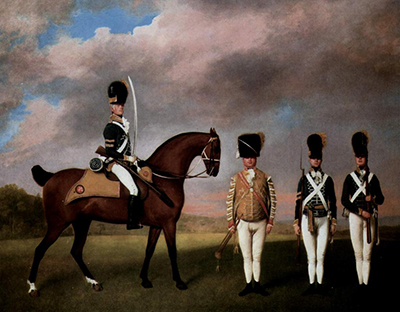
George Stubbs’s Soldiers of the 10th Light Dragoons, dated 1793, brings four men and a single horse into a remarkably formal landscape. The oil painting belongs to the Royal Collection, where it is numbered RCIN 400512. Uniforms, equipment and differences of rank receive the concentrated attention that Stubbs gave to the bodies of his horses. [1]
At a Glance
This work across George Stubbs’s career
Whistlejacket
about 1762 [6]Contents
- Four soldiers, one horse
- The regiment and the Prince
- Uniform as a visible distinction
- An experimental painting medium
- Framing and royal display
- Earlier catalogues and later viewers
- Videos on George Stubbs
Four soldiers, one horse
The Royal Collection identifies the figures as a mounted sergeant, a trumpeter, another sergeant and a private. Its description accompanies a later colour reproduction after the painting, rather than an original print by Stubbs. The identification matters because the group represents different positions within the regiment: these are not four interchangeable officers gathered for a collective portrait. [15]
The horse occupies the left half of the picture, facing towards the standing men. Its broad flank, rising neck and lowered muzzle form a continuous sequence of curves. The rider sits upright above this mass, holding his drawn sword nearly vertical. Against the darker coat and horse, the pale blade becomes a particularly clear line. The arrangement gives the mounted figure height without placing him at the centre of the canvas. [1]
Three men stand to the right. Their feet establish a repeated rhythm along the foreground, while their bodies rise separately into the sky. Small intervals between them preserve the distinct outline of each uniform and weapon. The trumpeter, closest to the horse, provides the strongest colour change. His yellow coat interrupts the blue clothing of the other soldiers, and the instrument hanging from his hand introduces a diagonal beside otherwise upright figures. [1]
The landscape does not compete with this display. A low horizon leaves a considerable expanse of cloud above the men, and the ground offers relatively few obstacles to following the row of feet and hooves. The horse’s horizontal body and the standing men’s vertical silhouettes divide the picture into unequal but balanced parts. The whole group feels deliberately presented to view, even though it stands in open country rather than against an architectural backdrop. [1]
The regiment and the Prince
The word Light is an essential part of the historical title. Richard Cannon’s official regimental history, published in 1843, records the conversion of the Tenth to light dragoons in 1783 and its new association with the Prince of Wales. An order reproduced there gives the name as the Tenth, or Prince of Wales’s Own Regiment of Light Dragoons. Cannon also records a change from scarlet clothing to blue in 1784. [16]
The Prince’s relationship with the unit developed in stages. Cannon distinguishes his appointment as commandant in 1793 from his appointment as colonel on 18 July 1796. The earlier date belongs to the year of Stubbs’s painting. The distinction helps explain why accounts can connect the Prince with the regiment in 1793 while the National Army Museum dates his colonelcy to 1796. [16] [17]
The regiment’s later identity as hussars should not be read backwards into this picture. The National Army Museum places that transformation in 1806, after the period represented here. Stubbs’s men belong to the light-dragoon phase of its history, despite the regiment’s better-known later name. [17]
Cannon describes repeated royal reviews and escort duties, and records the regiment’s encampment at Brighton in August 1793. These activities give the painting a context of military appearance and royal attention. They do not identify the particular field in the picture or establish that Stubbs recorded a specific review. The formal arrangement can be understood without turning its landscape into a documented event. [16]
Uniform as a visible distinction
The clothing establishes connections across the group before the viewer identifies every rank. White belts cross the dark-blue coats, while pale breeches and dark footwear continue the repetition lower down. Yellow appears at collars, cuffs and other edges, and on the horse’s conspicuous saddlecloth. The trumpeter’s coat makes this colour occupy a much larger area, giving him a different visual weight from the two standing men beside him. [1]
The men also differ in what they carry and how they hold it. The mounted soldier’s exposed sword rises above the horse. To the right, long firearms and fixed bayonets extend the standing figures’ outlines. A National Army Museum catalogue entry for a modern reproduction describes the sergeant as shouldering arms and the private as presenting arms. The group therefore displays contrasting military functions and positions as well as a shared uniform. [18]
Stubbs makes the equipment legible without filling the setting with action. The straps, repeated loops across the coats and pale blade offer sharply directed lines; the horse supplies a much broader, rounded form. Looking between them brings out the difference between an animal’s body and the ordered surfaces carried upon human bodies. The distinctions remain readable within a single coherent group. [1]
An experimental painting medium
The painting’s materials received scientific attention in John Mills and Raymond White’s 1985 study of ten works by Stubbs. Their table identifies this work as a canvas with a prepared ground. Analysis found drying oil and pine resin, together with a component that could not be securely distinguished as non-drying oil or fat, or beeswax. This was a more complicated medium than the simple label oil on canvas conveys. [19]
The target samples were small. Higher esters were present, but not in the proportions expected for beeswax, and the characteristic hydrocarbon pattern could not be distinguished. The authors therefore retained the ambiguity. The painting was examined by gas chromatography–mass spectrometry; the study’s exclusion of The Phaeton from that examination applies to the separate carriage painting, not to these soldiers. [19]
The particular drying oil could not be specified. Mills and White considered possible conservation materials, while noting the results’ overall consistency. Their suggestion of a wax-resin medium fused by heat concerned at least three earlier, oil-free panels, not this canvas. These distinctions matter when comparing Stubbs’s technique and other material experiments. [19]
Framing and royal display
The painting’s frame gives the military display an elaborate boundary. A recent specialist discussion in The Frame Blog identifies it with Thomas Allwood and describes its entablature form and frieze of bunched leaves. The supplied photographs distinguish this design from the fluted hollow frame around William Anderson with Two Saddle-Horses. Both belong to the Prince of Wales’s group of Stubbs paintings. [1]
The same account cites two bills from Allwood: one dated 14 February 1793 for eight frames, and another dated 11 May for two more. The surviving documentation does not securely allocate each painting to a particular bill or frame pattern. What it does show is that framing formed part of the expense and presentation of the Prince’s commissions, rather than an incidental addition to them. [1]
The Royal Collection places this painting within thirteen similarly sized canvases dated between 1790 and 1793, acquired by George IV when Prince of Wales. That broader grouping connects the soldiers with Stubbs’s animals and sporting subjects in the royal collection. RCIN 400512 is, however, explicitly excepted from the group’s move from Carlton House to the King’s Lodge in 1822. Its later movements require separate evidence. [20]
Earlier catalogues and later viewers
Walter Gilbey’s 1898 book reproduces an older catalogue description of the work among paintings at Windsor. It calls the mounted man a soldier and describes a bugler, corporal and private before him; the continuation also uses the title Two Corporals, a Private and a Trumpeter. Those labels preserve a history of cataloguing that differs from the modern identification of two sergeants. [21]
Gilbey records references to the Carlton House Armoury in the catalogues of 1816 and 1819, with the respective numbers 480 and 522. His appendix also gives a figure of fifty guineas. That historical catalogue figure is not, by itself, a record of the amount Stubbs received for painting the work. The early inventory setting is more informative than an unsupported reconstruction of the original transaction. [21]
The picture made a strong impression on Sanford Schwartz when it appeared in the Yale retrospective of 1985. In The New Yorker, he admired its direct arrangement and sensuous paint, finding both grandeur and comedy in its formality. His contrast between the mounted man’s pride and the standing soldiers’ smaller, less settled expressions was a critic’s reading of their poses. It remains a useful response to the tension between regimental order and individual presence. [22]
Videos on George Stubbs
Explore Stubbs’s equestrian painting in its wider context, including two readings of Whistlejacket.
A Horse Lover’s Guide to the YCBA
A museum tour that places Stubbs alongside other artists who painted horses. It includes a look at Pumpkin with a Stable-lad.
Watch on YouTubeGeorge Stubbs artworks directory
Search works and related prints documented in this guide. Separate versions and printing matrices have separate entries; printmakers are named where known. Unidentified historical titles and untraced studio-sale material are discussed in the essays. A dash means that a date is not established here.
| Name | Date | Medium |
|---|---|---|
| A Bay Horse with a Groom | 1791 | Painting |
| A Bay Hunter with Two Playful Spaniels | 1777 | Painting |
| A Bay Hunter, a Springer Spaniel and a Sussex Spaniel in a wooded river Landscape | 1782 | Painting |
| A Cheetah and a Stag with Two Indian Attendants | about 1764 | Painting |
| A Couple of Fox Hounds (coloured print after Stubbs) | — | Print after Stubbs |
| A Couple of Foxhounds | 1792 | Painting |
| A Foxhound on the Scent | 1788 | Drawing |
| A Gentleman driving a Lady in a Phaeton | 1787 | Painting |
| A Grey Horse | 1793 | Painting |
| A Grey Horse (cantering companion) | 1793 | Painting |
| A Grey Stallion in a Landscape | — | Painting |
| A Horse Affrighted at a Lion | 1 May 1788 | |
| A Horse Belonging to the Rt. Honourable Lord Grosvenor called Bandy from his Crooked Leg | about 1763 | Painting |
| A Horse Frightened by a Lion | 1777 | |
| A Lion (A Lion Resting on a Rock) | 1 May 1788 | |
| A Lion Attacking a Horse | 1770 | Painting |
| A Lion Attacking a Horse (monumental Yale canvas) | 1762 | Painting |
| A lion attacking a horse (NGV) | about 1765 | Painting |
| A Lion Devouring a Horse (1788 print) | 1788 | |
| A lion devouring a horse (attribution disputed) | Proposed mid-1770s | Painting |
| A mare and foal with a bay horse | 1771 | Painting |
| A Monkey | 1799 | Painting |
| A Prancing Horse, Facing Right | c. 1790 | Drawing |
| A Rough Dog | 1790 | Painting |
| A Saddled Bay Hunter | 1786 | Painting |
| A Sleeping Leopard | 1 January 1791 | |
| A Tiger and a Sleeping Leopard | 1 May 1788 | |
| A Tigress (John Dixon after Stubbs) | 1772 | Print after Stubbs |
| A Tyger (A Recumbent Leopard by a Tree) | 1 May 1788 | |
| A Tyger (Sleeping Leopard) | 1 May 1788 | |
| An animal found on the coast of New Holland called kanguroo (after Stubbs) | 1773 | Print after Stubbs |
| An animal of a new species found on the coast of New South Wales (after Stubbs) | July 1773 | Print after Stubbs |
| Antinous and Jockey | — | Painting |
| Antinoüs, a chestnut racehorse, in a landscape | Undated | Painting |
| Bandy belonging to Lord Grosvenor (print after Stubbs) | — | Print after Stubbs |
| Baronet (George Townley Stubbs after Stubbs) | 20 February 1794 | Print after Stubbs |
| Baronet with Sam Chifney Up | 1791 | Painting |
| Baronet with Samuel Chifney up (Royal Collection) | 1791 | Painting |
| Bay Hunter by a Lake | 1787 | Painting |
| Brood Mares (Benjamin Green after Stubbs) | Issue 14 November 1776 | Print after Stubbs |
| Brood Mares and Foals | usually dated 1767 | Painting |
| Brown and White Norfolk or Water Spaniel | 1778 | Painting |
| Bulls Fighting | 1786 | Painting |
| Captain Samuel Sharpe Pocklington with His Wife, Pleasance, and possibly His Sister, Frances | 1769 | Painting |
| Death of the Doe (attribution disputed) | 1804 | |
| Der Englische Hühnerhund (Johann Wölfle after Stubbs) | about 1860 | Print after Stubbs |
| Dog (A Foxhound Viewed from Behind) | 1 May 1788 | |
| Dog [A Foxhound on the Scent] | 1788 | |
| Drill and albino baboon | before 1789 | Painting |
| Eclipse (Charles Hunt after Stubbs) | 12 November 1839 | Print after Stubbs |
| Eclipse (George Townley Stubbs after Stubbs) | 1796 | Print after Stubbs |
| Eclipse (oil study) | — | Painting |
| Eclipse (Thomas Burke after Stubbs) | First published 1772 | Print after Stubbs |
| Eclipse and John Wildman (Benjamin Green after Stubbs) | 1772 | Print after Stubbs |
| Eclipse at Newmarket (Jockey Club version) | Proposed early 1790s; often dated 1770 | Painting |
| Eclipse at Newmarket with a groom and jockey | 1770 | Painting |
| Eclipse with Mr Wildman and His Sons | 1769–71 | Painting |
| Eclipse, the Property of Capt.n O Kelly (anonymous print after Stubbs) | Imprint 4 June 1804; impression undated | Print after Stubbs |
| Euston | 1774 | Painting |
| Finished Study for the Seventh Anatomical Table of the Muscles of the Horse | 1756–58 | Drawing |
| Five Brood Mares at the Duke of Cumberland's Stud Farm in Windsor Great Park | 1765 | Painting |
| Fowl Body, Lateral View (Highly Finished Study for an Unpublished Table; Shows the Last Stage in Dissection) | — | Drawing |
| Fowl Body, Lateral View (Probably Prepared for Transfer to the Plate for Engraving of Table XV) | — | Drawing |
| Fowl Skeleton, Lateral View (Finished Study for Table V) | — | Drawing |
| Freeman, the Earl of Clarendon's Gamekeeper, with a Dying Doe and Hound (Yale) | 1800 | Painting |
| George Stubbs (enamel self-portrait) | 1781 | Enamel |
| Gimcrack (George Townley Stubbs after Stubbs) | 1775 | Print after Stubbs |
| Gimcrack on Newmarket Heath, with a trainer, a jockey and a stable lad | about 1765 | Painting |
| Gimcrack, with John Pratt up, on Newmarket Heath | about 1765 | Painting |
| Hambletonian, Rubbing Down | 1800 | Painting |
| Hay-Makers | 1791 | |
| Haycarting | 1795 | Enamel |
| Haymakers | 1785 | Painting |
| Haymakers (Lady Lever Art Gallery) | 1794 | Enamel |
| Hollyhock (with later additions by Vernet and Boucher) | about 1765–70 | Painting |
| Horse Attacked by a Lion (Episode C) | 1768–69 | Painting |
| Horse Attacked by a Lion (Tate enamel) | 1769 | Enamel |
| Horse Devoured by a Lion | Possibly exhibited 1763 | Painting |
| Horse Frightened by a Lion | 1770 | Painting |
| Horse Frightened by a Lion (Episode A; Wedgwood and Bentley after Stubbs) | — | Sculpture |
| Horse Frightened by a Lion (Tate) | Possibly exhibited 1763 | Painting |
| Horse Frightened by a Lion (Yale) | 1762–68 | Painting |
| Horse in the Shade of a Wood | 1780 | Painting |
| Hound Coursing a Stag | about 1762 | Painting |
| Human Figure, Anterior View (Intended for a Plate That was Never Published) | — | Drawing |
| Human Skeleton, Lateral View | 1795–1806 | Drawing |
| Hunt servants setting out (Southill commission) | 1767 | Painting |
| Hühnerhund (The Spanish Pointer) | about 1766 | Painting |
| John and Sophia Musters Riding at Colwick Hall | 1777 | Painting |
| John Musters on his hunter Pilgrim | 1777–78 | Painting |
| Labourers | 1789 | |
| Labourers (Richard Earlom after Stubbs and Amos Greene) | 25 March 1790 | Print after Stubbs |
| Laetitia, Lady Lade (d.1825) | 1793 | Painting |
| Lemon and White Water Spaniel | — | Painting |
| Lion Attacking a Stag | — | Painting |
| Lord Grosvenor's Arabian Stallion with a Groom | about 1765 | Painting |
| Lord Grosvenor's Arabian Stallion with a Groom (Peter Mazell after Stubbs) | 1771 | Print after Stubbs |
| Mambrino (Eaton Hall painting) | — | Painting |
| Mambrino (George Townley Stubbs after Stubbs) | 1794 | Print after Stubbs |
| Mares and Foals belonging to the 2nd Viscount Bolingbroke | about 1761–62 | Painting |
| Mares and foals beneath large oak trees | — | Painting |
| Mares and Foals by a stream | Exhibited 1764 | Painting |
| Mares and Foals in a River Landscape | about 1763–68 | Painting |
| Mares and Foals in an Extensive Landscape | about 1769 | Painting |
| Mares and Foals without a Background | 1762 | Painting |
| Moose Deer (after Stubbs) (Arctic Zoology plate VIII) | 1784–85 publication | Print after Stubbs |
| Newmarket Heath with a Rubbing-Down House | — | Painting |
| Otho (1796 print after Stubbs) | 1 December 1796 | Print after Stubbs |
| Otho, with John Larkin up | 1768 | Painting |
| Pangloss | about 1762 | Painting |
| Patch (Grafton commission) | 1759 | Painting |
| Phaeton and the Chariot of the Sun (enamel) | 1775 | Enamel |
| Phaeton with a Pair of Cream Ponies and a Stable-Lad | 1780–84 | Painting |
| Phillis | 1772 | Painting |
| Portrait of a Large Dog (Dingo) | 1772 | Painting |
| Pumpkin with a Stable-lad | 1774 | Painting |
| Racehorses Exercising at Goodwood | 1759–60 | Painting |
| Reapers (1791 print) | 1791 | |
| Reapers (Tate) | 1785 | Painting |
| Reapers (Yale) | 1795 | Enamel |
| Red Deer: A Stag and a Hind | 1792 | Painting |
| Richard Wedgwood | — | Enamel |
| Ringwood, a Brocklesby Foxhound | 1792 | Painting |
| Scrub, a bay horse belonging to the Marquess of Rockingham | about 1762 | Painting |
| Self Portrait on a White Hunter | 1782 | Enamel |
| Self-Portrait | about 1759 | Painting |
| Shooting (1770 Woollett plate after Stubbs) | 1770 | Print after Stubbs |
| Shooting (1771 Woollett plate after Stubbs) | 1771 | Print after Stubbs |
| Shooting at Goodwood | 1759–60 | Painting |
| Sir John Nelthorpe as a boy | 1756 | Painting |
| Sir John Nelthorpe partridge shooting with one pointer | — | Painting |
| Sir John Nelthorpe, 6th Baronet, out Shooting with His Dogs in Barton Field, Lincolnshire | 1776 | Painting |
| Sleeping Leopard | 1777 | Enamel |
| Soldiers of the 10th Light Dragoons | 1793 | Painting |
| Stallion and Mare (George Townley Stubbs after Stubbs) | 1776; reissued 1789 | Print after Stubbs |
| Steward and gamekeeper with dogs (Southill commission) | 1767 | Painting |
| Studies of a Lemur (Lemur murinus) in six different attitudes | 1773 | Drawing |
| Study for the Self-portrait in Enamel | c. 1781 | Drawing |
| Study of a Lemur | 1773 | Drawing |
| Study of a Racehorse in Action: Galloping to Left, a Semi-Anatomical Study, with Skin Flayed to Show Action of Muscles | — | Drawing |
| Study of the Legs of a Draught-Horse Pulling a Harrow (attributed to Stubbs) | Proposed about 1786 | Drawing |
| Sweet William (Grosvenor panel) | — | Painting |
| Sweet William (Turf Gallery canvas) | — | Painting |
| The Black Stallion Sampson, Portrayed from Three Angles (with landscape additions) | about 1764 | Painting |
| The Charlton Hunt | 1759–60 | Painting |
| The Fall of Phaeton | — | Sculpture |
| The Frightened Horse | 1780 | Sculpture |
| The Grosvenor Hunt | — | Painting |
| The Haymakers (Upton House) | 1783 | Painting |
| The Horse and Lion (George Townley Stubbs after George Stubbs) | 1770 | Print after Stubbs |
| The Kongouro from New Holland | 1772 | Painting |
| The Labourers | 1779 | Painting |
| The Labourers (Southill original) | 1767 | Painting |
| The lion and horse (Benjamin Green after Stubbs) | 1769; reissued 1777 | Print after Stubbs |
| The Milbanke and Melbourne Families | about 1769 | Painting |
| The Moose | 1770 | Painting |
| The Prince of Wales's Phaeton | 1793 | Painting |
| The Reapers (Upton House) | 1783 | Painting |
| The Sebra, or Wild Ass (George Townley Stubbs after Stubbs) | 1771 | Print after Stubbs |
| The Spanish Pointer (Bradford version) | about 1766–68 | Painting |
| The Spanish Pointer (William Woollett after Stubbs) | January 1768 | Print after Stubbs |
| The Third Duke of Dorset's Hunter with a Groom and a Dog | 1768 | Painting |
| Thomas Freeman, Lord Clarendon's gamekeeper, with a dog and a shot doe (with George Townly Stubbs) | 1803 | Painting |
| Turf, with Jockey up, at Newmarket | — | Painting |
| Turk and Crab | — | Painting |
| Two Bay Hunters Communing On The Bank Of A Lake | — | Painting |
| Tygers at Play | 1780 | |
| Viscount Gormanston's White Dog | 1781 | Painting |
| Viscount Gormanston's White Dog (canvas version) | — | Painting |
| Water Spaniel | 1769 | Painting |
| Wedgwood Family Portrait | 1780 | Painting |
| Whistlejacket | about 1762 | Painting |
| Whistlejacket with two other stallions and a groom | Recorded 1762 | Painting |
| White Poodle in a Punt | about 1780 | Painting |
| William Anderson with two Saddle-Horses | 1793 | Painting |
| Working Drawing for the Seventh Anatomical Table of the Muscles of the Horse | 1756–58 | Drawing |
| Zebra | 1763 | Painting |
Discussion
Look again at the images and ideas explored in Soldiers of the 10th Light Dragoons. These editorial prompts invite your observations.
Reader Insights
How do the four men’s positions distinguish their roles within the group?
How do horse, uniforms and landscape hold the formal arrangement together?
What becomes clearer when you compare the soldiers’ individual actions rather than reading the group as a single unit?
Join the Conversation
Share a detail, comparison or question about Soldiers of the 10th Light Dragoons below.
References
- The Frame Blog, ‘George Stubbs and his frames’, 23 May 2026, modified 4 June 2026: exact painting caption, section ‘Stubbs, the Prince, and Thomas Allwood’, notes 22–25 and supplied photographs. Original Allwood bills and Oliver Millar’s 1969 catalogue not independently consulted. View source.
- Goodwood, The Collection, Painting Collection modal, Racehorses Exercising at Goodwood; An exciting acquisition: a study by George Stubbs, 30 June 2023; History of the Estate Hounds, 4 October 2023; About Goodwood Racecourse. Accessed 4 November 2026. View source.
- Goodwood, The Collection, Painting Collection modal, Racehorses Exercising at Goodwood; An exciting acquisition: a study by George Stubbs, 30 June 2023; History of the Estate Hounds, 4 October 2023; About Goodwood Racecourse. Accessed 4 November 2026. View source.
- Goodwood, The Collection, Painting Collection modal, Racehorses Exercising at Goodwood; An exciting acquisition: a study by George Stubbs, 30 June 2023; History of the Estate Hounds, 4 October 2023; About Goodwood Racecourse. Accessed 4 November 2026. View source.
- Goodwood, The Collection, Painting Collection modal, Racehorses Exercising at Goodwood; An exciting acquisition: a study by George Stubbs, 30 June 2023; History of the Estate Hounds, 4 October 2023; About Goodwood Racecourse. Accessed 4 November 2026. View source.
- National Gallery, Whistlejacket, NG6569, current collection record, provenance, in-depth discussion and frame entry. View source.
- Yale Center for British Art, Zebra, B1981.25.617, current object metadata, gallery labels, Malcolm Warner’s 1998 catalogue entry and provenance supplied through the museum’s public collection record. View source.
- Christie’s, Gimcrack on Newmarket Heath, with a trainer, a jockey and a stable lad, London, 5 July 2011, lot 12; object details, essay, provenance, exhibitions and whole image. View source.
- Christie’s, Gimcrack on Newmarket Heath, with a trainer, a jockey and a stable lad, London, 5 July 2011, lot 12; object details, essay, provenance, exhibitions and whole image. View source.
- Yale University Art Gallery, A Lion Attacking a Horse, 1770, 1955.27.1, collection record. Accessed 4 November 2026. View source.
- Royal Museums Greenwich, ‘The Kongouro from New Holland’ (Kangaroo), ZBA5754. Accessed 4 November 2026. View source.
- Tate, George Stubbs, Haymakers, 1785, T02256; details, Terry Riggs’s collection text (January 1998), and online caption. Collection record. View source.
- The Frame Blog, ‘George Stubbs and his frames’, 23 May 2026, modified 4 June 2026: exact painting caption, section ‘Stubbs, the Prince, and Thomas Allwood’, notes 22–25 and supplied photographs. Original Allwood bills and Oliver Millar’s 1969 catalogue not independently consulted. View source.
- Frances Bailey, ‘Hambletonian, Rubbing Down: A masterpiece by George Stubbs’, National Trust Cultural Heritage Magazine, Autumn/Winter 2024, pp. 22–33. Article. View source.
- Royal Collection Trust, after George Stubbs, RCIN 760126: bounded public indexed description of a colour relief half-tone reproduction. The original painting’s current full record was unavailable. View source.
- Richard Cannon, Historical Record of the Tenth, the Prince of Wales’s Own Royal Regiment of Hussars (1843), pp. 31–33, including the reproduced order of 29 September 1783. Original scanned pages inspected. View source.
- National Army Museum, ‘10th Royal Hussars (Prince of Wales’s Own)’, current regimental history. View source.
- National Army Museum, Soldiers of the Tenth Light Dragoons, 1793, chromolithograph after Stubbs, published c. 1980, 2002-05-59: public indexed inventory entry. View source.
- John Mills and Raymond White, ‘The Mediums used by George Stubbs: Some Further Studies’, National Gallery Technical Bulletin, 9 (1985), pp. 60–64, especially Table 1 and p. 63. View source.
- Royal Collection Trust, Red Deer: A Stag and a Hind, RCIN 400549: group note identifying the exception of RCIN 400512 to the 1822 move. This is not the full individual record for the soldiers’ painting. View source.
- Walter Gilbey, Life of George Stubbs (1898), Appendix B, pp. 113–114, reproducing earlier royal catalogue descriptions. Original scanned pages inspected; the original 1816 and 1819 catalogues not independently consulted. View source.
- Sanford Schwartz, ‘Stubbs’, The New Yorker, published online with the date 7 October 1985, print issue 14 October 1985: contemporary review of the Yale retrospective. Public indexed article text consulted. View source.
- Basic title, date and material metadata for Tate’s Reapers (T02257) and Otho (T02375) is adapted from the Tate collection dataset, October 2014, released under CC0. TheHistoryOfArt.org has reconciled labels and versions. This credit does not apply to Tate’s authored catalogue commentary or images.
- Data Source: Yale Center for British Art. Basic object fields are adapted and reconciled for this directory. Reuse is subject to the Center’s Open Data and Data Services Terms of Use. No museum endorsement is implied. This metadata credit does not relabel scholarly essays or images as open data.
- Basic object metadata for A Horse Frightened by a Lion, 1985.38, The Cleveland Museum of Art, John L. Severance Fund, is available under CC0. Titles and design-level grouping have been reconciled for this directory.