 by Tom Gurney
Tom Gurney BSc (Hons) is an art history expert with over 20 years experience
Email: tomgurney1@gmail.com / Phone: +44 7429 011000
A Gentleman Driving a Lady in a Phaeton: Introduction
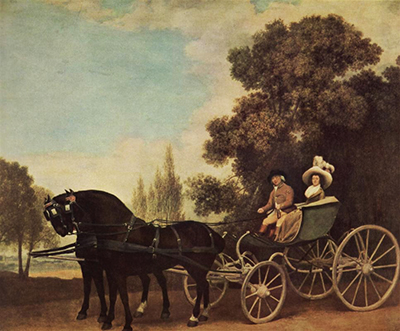
George Stubbs painted A Gentleman Driving a Lady in a Phaeton in 1787. The signed and dated picture, in oil on wood, probably oak, measures 82.5 × 101.6 cm. It is National Gallery NG3529. [1]
The horses have stopped, or seem about to move. Two dark bodies stand across the lower left of the picture; a carriage rises behind them, carrying a man and a woman. Both faces turn out towards us. Their elevated seat is surrounded by an extraordinary network of wheels, curved supports and fine connecting lines. The pleasure of the scene lies partly in that conjunction: living bodies and a delicately exposed machine. [2]
Although the people occupy the highest point in this foreground group, they do not dominate it by size. The horses' long bodies, the large rear wheel and the expanse of foliage all claim substantial areas. Stubbs makes portraiture share the picture with equipment and landscape. To understand the occupants' appearance, we have to look at what carries them, what draws it and how the whole assembly stands on the ground. [2]
At a Glance
This work across George Stubbs’s career
Whistlejacket
about 1762 [7]Contents
- Two horses and a web of reins
- The carriage made visible
- Driving as a social performance
- A landscape arranged for the encounter
- A panel with an experimental paint medium
- The Hope family connection and the public collection
- Videos on George Stubbs
Two horses and a web of reins
The nearer horse presents most of its body in profile. Its companion is partly hidden behind it, yet a second head, another neck and an additional sequence of legs establish the pair. Their heads are close without becoming a single shape. Slight differences in height and angle make each muzzle readable. The harness repeats across the two animals, joining their separate bodies into the ordered arrangement required by the carriage. [2]
Dark coats make light especially important. A narrow gleam follows a shoulder; a warmer strip reveals the curve of a barrel; a small pale area distinguishes a lower leg from the shaded earth. These are restrained accents. They allow the bodies to retain their weight and darkness while showing enough variation to prevent a flat silhouette. The horses remain substantial even where one overlaps the other. [2]
Look at the lines travelling backwards from the heads. Reins extend towards the driver's hands, crossing the open interval above the horses' backs. Other straps pass around the bodies and descend towards the vehicle. Some lines almost disappear against the dark coats, then become visible against a lighter patch of ground. Following them changes the painting from a collection of separate subjects into a connected system. [2]
The legs create a different pattern. They descend at slightly varied angles, leaving slender gaps through which the ground can be seen. Their spacing gives the pair a credible footing without making the lower edge mechanically regular. The heads incline and the ears break the long upper contour. Even in this relatively quiet presentation, the animals introduce small changes that differ from the repeated spokes and fitted curves behind them. [2]
The carriage made visible
The National Gallery identifies the vehicle's crane-neck construction as a means of improving its ability to turn. Its pale undercarriage is placed against foliage, making the mechanism unusually prominent. [1]
The nearest front wheel is smaller than the rear wheel. Their circular forms overlap different parts of the vehicle, while the far wheels are only partially exposed. This is a view at an angle, not a diagram laid flat. Nevertheless, Stubbs keeps the principal relationships legible: wheels touch earth, curved members rise between them, and the green passenger body sits above the intricate framework. [2]
That green body is compact beside the large rear wheel. Its broad side supplies a relatively calm area within the web of pale lines. A light strip runs along its upper edge, immediately beneath the woman. Her skirt descends into this part of the carriage, bringing clothing and upholstery into close visual contact. The people are neither detached busts placed above a machine nor swallowed by its construction. [2]
The buff-coloured structure repeatedly changes direction. Upright spokes meet a central hub; a curved support loops away; another long member carries the eye towards the horses. The alternation between straight and bent forms rewards slow attention. Mechanical detail becomes a pictorial resource, offering rhythms as carefully varied as those of branches overhead. Small patches of shadow give the light framework sufficient thickness to look built rather than merely drawn. [2]
A contemporary coachmaker helps explain why these differences mattered. In the 1796 volume of his Treatise on Carriages, William Felton separated phaetons by size and by their perch or crane-neck construction. He related their proportions to the horses intended to pull them. He also observed that fashionable patrons' driving skill and judgement influenced the patterns other buyers chose. A carriage was something to assess, specify and operate, as well as admire. [16]
Felton connected turning freedom with the distribution of weight. His discussion of large crane-neck phaetons warned that a sharp turn could overturn a high body positioned above the front axle. For a medium-sized design, he recommended setting the body farther back so its weight lay between the supports. These are explanations of choices available to builders, rather than a surviving specification for Stubbs's particular vehicle. [16]
His range was broad enough to include large phaetons equipped for long journeys and smaller arrangements with a coachman's seat for an owner who could not drive. The category therefore encompassed different uses and degrees of independence. Felton's account supplies practical context for the painting without requiring us to assign it an undocumented maker or purchase price. [16]
Driving as a social performance
Historian Ben Jackson places the phaeton within the expanding culture of pleasure-driving. Driving oneself made handling horses and a vehicle part of social display. In his study of eighteenth-century carriage consumption, he uses this Stubbs painting to contrast a relatively plain pleasure carriage with the elaborate coach employed for ceremonial appearances. Informality could itself be an expensive, carefully judged way of appearing in public. [17]
Jackson also draws attention to expenditure beyond a vehicle's purchase. Horses, their care and the upkeep of several carriages could make ownership more demanding than the price of a single carriage suggests. The neat appearance of an equipage represented continuing resources as well as a moment of display. [17]
Jackson's distinction helps us notice that splendour need not take the form of heavy ornament. The painting gives its occupants height, open air and conspicuous equipment, while the driver's hands remain visibly engaged. His place is part of the carriage's operation. The passenger sits beside him within the same compact body, sharing its exposure to the surrounding landscape. Their social presentation depends upon this arrangement of people, horses and things. [17] [2]
The gentleman's forward position makes his hands a hinge between figure and animal. The reins pass into that small area, then spread again towards the bridles. His bent knees and the darker forms beneath his feet give the seated body a practical orientation. The woman provides a quieter neighbouring shape. Together they form a close pair, but the direction of their attention opens the group towards the spectator. [2]
Their hats frame the faces differently. His dark brim is relatively compact; hers spreads widely and carries a high arrangement of pale feathers. White cloth gathers around her throat, providing a bright interval between face and jacket. The contrast helps distinguish the two people at a scale where facial details occupy very little space. Recognition is organised through posture, dress and placement as much as through features. [2]
The present title leaves their identities open. The Gallery has not established their names or whether they were married. Neither the horses' browbands nor their rosettes has supplied an identification. Calling the man a lord would add a social rank that the surviving identification does not establish. [1]
That uncertainty allows the visible relationship to remain specific without supplying an invented biography. The driver sits slightly forward; his companion is farther back beneath her large hat. Their bodies are close, but the hands, faces and clothing retain distinct areas. The painting gives us ample information about how they occupy the carriage, while withholding the personal knowledge that a family member might once have brought to it. [2]
A landscape arranged for the encounter
The large tree mass rises behind the passengers and fills much of the right side. Its darkness brings the pale hats, faces and undercarriage forward. Towards the left, the view becomes more open. A smaller tree stands behind the horses, and a distant band of ground separates their legs from the horizon. The space seems to expand in the direction they face. [2]
Near the centre, a slender group of tall trees interrupts the low distance. These verticals balance the horizontal sweep of horse bodies and reins without competing with the broad canopy. Above them lies a large field of sky. Its pale clouds create an interval between the smaller trees and the upper edge. The foreground assembly consequently feels carefully placed within a wider prospect rather than crowded against a backdrop. [2]
Ground and sky also moderate the stronger colours below. The pale wheels echo lighter tones in the clouded sky; the green carriage belongs beside the foliage, although its smooth, bounded surface differs from the broken leaves. Brown clothing and earth make a warmer connection. These correspondences bring the equipment into the landscape while its clean geometry continues to mark it as a constructed object. [2]
A panel with an experimental paint medium
The apparently conventional country scene also became an important subject of technical investigation. Raymond White, Ashok Roy, John Mills and Joyce Plesters published a preliminary study in 1980 after examining small samples from its sky and tree highlights. Their results suggested drying oil with another fatty material; stearine wax was considered a possibility. The identification was provisional. [18]
Mills and White revisited the painting in their 1985 research, using more sensitive combined gas chromatography and mass spectrometry. They now identified beeswax, alongside drying oil and pine resin. Their table also records a prepared ground. Additional animal fat or stearine remained possible. The presence of other ingredients prevented them from specifying which drying oil had been used. The later findings therefore refine the earlier account rather than simply repeat it. [18]
Their study connects the panel with Stubbs's experiments in painting media. It does not establish a complete working recipe or prove that he heated this particular picture. The authors' stronger suggestion of heat fusion concerned three earlier panels whose analysed medium lacked drying oil. Keeping that distinction preserves the value of the findings for this exact object. [18]
The Hope family connection and the public collection
The Gallery considers a commission from Liverpool's Hope banking family possible, although the first patron has not been identified. By 1888 it belonged to Charles Coates MD, who had married a Hope daughter, and was lent to the Royal Academy. It passed to his niece, Miss Hope, who bequeathed it to the National Gallery in 1920. The possible first commission remains less certain than this later ownership. [1]
The work continues to attract attention as a record of carriage design as well as portraiture. Alistair M. Duckworth's discussion of Stubbs and Jane Austen distinguishes this 1787 crane-neck vehicle from smaller phaetons in other Stubbs paintings. His comparison shows why the word phaeton alone does not describe a single fixed shape. Scale and construction remain essential to understanding what each picture presents. [19]
Here the achievement lies in giving those different demands a common setting. The horses retain bodily weight, the wheels and supports remain intelligible, and the two occupants turn the apparatus into a scene of human encounter. Among Stubbs's paintings, it offers an unusually concentrated view of movement held in reserve: a machine and its living power arranged for a journey that the picture leaves permanently about to begin. [2]
Videos on George Stubbs
Explore Stubbs’s equestrian painting in its wider context, including two readings of Whistlejacket.
A Horse Lover’s Guide to the YCBA
A museum tour that places Stubbs alongside other artists who painted horses. It includes a look at Pumpkin with a Stable-lad.
Watch on YouTubeGeorge Stubbs artworks directory
Search works and related prints documented in this guide. Separate versions and printing matrices have separate entries; printmakers are named where known. Unidentified historical titles and untraced studio-sale material are discussed in the essays. A dash means that a date is not established here.
| Name | Date | Medium |
|---|---|---|
| A Bay Horse with a Groom | 1791 | Painting |
| A Bay Hunter with Two Playful Spaniels | 1777 | Painting |
| A Bay Hunter, a Springer Spaniel and a Sussex Spaniel in a wooded river Landscape | 1782 | Painting |
| A Cheetah and a Stag with Two Indian Attendants | about 1764 | Painting |
| A Couple of Fox Hounds (coloured print after Stubbs) | — | Print after Stubbs |
| A Couple of Foxhounds | 1792 | Painting |
| A Foxhound on the Scent | 1788 | Drawing |
| A Gentleman driving a Lady in a Phaeton | 1787 | Painting |
| A Grey Horse | 1793 | Painting |
| A Grey Horse (cantering companion) | 1793 | Painting |
| A Grey Stallion in a Landscape | — | Painting |
| A Horse Affrighted at a Lion | 1 May 1788 | |
| A Horse Belonging to the Rt. Honourable Lord Grosvenor called Bandy from his Crooked Leg | about 1763 | Painting |
| A Horse Frightened by a Lion | 1777 | |
| A Lion (A Lion Resting on a Rock) | 1 May 1788 | |
| A Lion Attacking a Horse | 1770 | Painting |
| A Lion Attacking a Horse (monumental Yale canvas) | 1762 | Painting |
| A lion attacking a horse (NGV) | about 1765 | Painting |
| A Lion Devouring a Horse (1788 print) | 1788 | |
| A lion devouring a horse (attribution disputed) | Proposed mid-1770s | Painting |
| A mare and foal with a bay horse | 1771 | Painting |
| A Monkey | 1799 | Painting |
| A Prancing Horse, Facing Right | c. 1790 | Drawing |
| A Rough Dog | 1790 | Painting |
| A Saddled Bay Hunter | 1786 | Painting |
| A Sleeping Leopard | 1 January 1791 | |
| A Tiger and a Sleeping Leopard | 1 May 1788 | |
| A Tigress (John Dixon after Stubbs) | 1772 | Print after Stubbs |
| A Tyger (A Recumbent Leopard by a Tree) | 1 May 1788 | |
| A Tyger (Sleeping Leopard) | 1 May 1788 | |
| An animal found on the coast of New Holland called kanguroo (after Stubbs) | 1773 | Print after Stubbs |
| An animal of a new species found on the coast of New South Wales (after Stubbs) | July 1773 | Print after Stubbs |
| Antinous and Jockey | — | Painting |
| Antinoüs, a chestnut racehorse, in a landscape | Undated | Painting |
| Bandy belonging to Lord Grosvenor (print after Stubbs) | — | Print after Stubbs |
| Baronet (George Townley Stubbs after Stubbs) | 20 February 1794 | Print after Stubbs |
| Baronet with Sam Chifney Up | 1791 | Painting |
| Baronet with Samuel Chifney up (Royal Collection) | 1791 | Painting |
| Bay Hunter by a Lake | 1787 | Painting |
| Brood Mares (Benjamin Green after Stubbs) | Issue 14 November 1776 | Print after Stubbs |
| Brood Mares and Foals | usually dated 1767 | Painting |
| Brown and White Norfolk or Water Spaniel | 1778 | Painting |
| Bulls Fighting | 1786 | Painting |
| Captain Samuel Sharpe Pocklington with His Wife, Pleasance, and possibly His Sister, Frances | 1769 | Painting |
| Death of the Doe (attribution disputed) | 1804 | |
| Der Englische Hühnerhund (Johann Wölfle after Stubbs) | about 1860 | Print after Stubbs |
| Dog (A Foxhound Viewed from Behind) | 1 May 1788 | |
| Dog [A Foxhound on the Scent] | 1788 | |
| Drill and albino baboon | before 1789 | Painting |
| Eclipse (Charles Hunt after Stubbs) | 12 November 1839 | Print after Stubbs |
| Eclipse (George Townley Stubbs after Stubbs) | 1796 | Print after Stubbs |
| Eclipse (oil study) | — | Painting |
| Eclipse (Thomas Burke after Stubbs) | First published 1772 | Print after Stubbs |
| Eclipse and John Wildman (Benjamin Green after Stubbs) | 1772 | Print after Stubbs |
| Eclipse at Newmarket (Jockey Club version) | Proposed early 1790s; often dated 1770 | Painting |
| Eclipse at Newmarket with a groom and jockey | 1770 | Painting |
| Eclipse with Mr Wildman and His Sons | 1769–71 | Painting |
| Eclipse, the Property of Capt.n O Kelly (anonymous print after Stubbs) | Imprint 4 June 1804; impression undated | Print after Stubbs |
| Euston | 1774 | Painting |
| Finished Study for the Seventh Anatomical Table of the Muscles of the Horse | 1756–58 | Drawing |
| Five Brood Mares at the Duke of Cumberland's Stud Farm in Windsor Great Park | 1765 | Painting |
| Fowl Body, Lateral View (Highly Finished Study for an Unpublished Table; Shows the Last Stage in Dissection) | — | Drawing |
| Fowl Body, Lateral View (Probably Prepared for Transfer to the Plate for Engraving of Table XV) | — | Drawing |
| Fowl Skeleton, Lateral View (Finished Study for Table V) | — | Drawing |
| Freeman, the Earl of Clarendon's Gamekeeper, with a Dying Doe and Hound (Yale) | 1800 | Painting |
| George Stubbs (enamel self-portrait) | 1781 | Enamel |
| Gimcrack (George Townley Stubbs after Stubbs) | 1775 | Print after Stubbs |
| Gimcrack on Newmarket Heath, with a trainer, a jockey and a stable lad | about 1765 | Painting |
| Gimcrack, with John Pratt up, on Newmarket Heath | about 1765 | Painting |
| Hambletonian, Rubbing Down | 1800 | Painting |
| Hay-Makers | 1791 | |
| Haycarting | 1795 | Enamel |
| Haymakers | 1785 | Painting |
| Haymakers (Lady Lever Art Gallery) | 1794 | Enamel |
| Hollyhock (with later additions by Vernet and Boucher) | about 1765–70 | Painting |
| Horse Attacked by a Lion (Episode C) | 1768–69 | Painting |
| Horse Attacked by a Lion (Tate enamel) | 1769 | Enamel |
| Horse Devoured by a Lion | Possibly exhibited 1763 | Painting |
| Horse Frightened by a Lion | 1770 | Painting |
| Horse Frightened by a Lion (Episode A; Wedgwood and Bentley after Stubbs) | — | Sculpture |
| Horse Frightened by a Lion (Tate) | Possibly exhibited 1763 | Painting |
| Horse Frightened by a Lion (Yale) | 1762–68 | Painting |
| Horse in the Shade of a Wood | 1780 | Painting |
| Hound Coursing a Stag | about 1762 | Painting |
| Human Figure, Anterior View (Intended for a Plate That was Never Published) | — | Drawing |
| Human Skeleton, Lateral View | 1795–1806 | Drawing |
| Hunt servants setting out (Southill commission) | 1767 | Painting |
| Hühnerhund (The Spanish Pointer) | about 1766 | Painting |
| John and Sophia Musters Riding at Colwick Hall | 1777 | Painting |
| John Musters on his hunter Pilgrim | 1777–78 | Painting |
| Labourers | 1789 | |
| Labourers (Richard Earlom after Stubbs and Amos Greene) | 25 March 1790 | Print after Stubbs |
| Laetitia, Lady Lade (d.1825) | 1793 | Painting |
| Lemon and White Water Spaniel | — | Painting |
| Lion Attacking a Stag | — | Painting |
| Lord Grosvenor's Arabian Stallion with a Groom | about 1765 | Painting |
| Lord Grosvenor's Arabian Stallion with a Groom (Peter Mazell after Stubbs) | 1771 | Print after Stubbs |
| Mambrino (Eaton Hall painting) | — | Painting |
| Mambrino (George Townley Stubbs after Stubbs) | 1794 | Print after Stubbs |
| Mares and Foals belonging to the 2nd Viscount Bolingbroke | about 1761–62 | Painting |
| Mares and foals beneath large oak trees | — | Painting |
| Mares and Foals by a stream | Exhibited 1764 | Painting |
| Mares and Foals in a River Landscape | about 1763–68 | Painting |
| Mares and Foals in an Extensive Landscape | about 1769 | Painting |
| Mares and Foals without a Background | 1762 | Painting |
| Moose Deer (after Stubbs) (Arctic Zoology plate VIII) | 1784–85 publication | Print after Stubbs |
| Newmarket Heath with a Rubbing-Down House | — | Painting |
| Otho (1796 print after Stubbs) | 1 December 1796 | Print after Stubbs |
| Otho, with John Larkin up | 1768 | Painting |
| Pangloss | about 1762 | Painting |
| Patch (Grafton commission) | 1759 | Painting |
| Phaeton and the Chariot of the Sun (enamel) | 1775 | Enamel |
| Phaeton with a Pair of Cream Ponies and a Stable-Lad | 1780–84 | Painting |
| Phillis | 1772 | Painting |
| Portrait of a Large Dog (Dingo) | 1772 | Painting |
| Pumpkin with a Stable-lad | 1774 | Painting |
| Racehorses Exercising at Goodwood | 1759–60 | Painting |
| Reapers (1791 print) | 1791 | |
| Reapers (Tate) | 1785 | Painting |
| Reapers (Yale) | 1795 | Enamel |
| Red Deer: A Stag and a Hind | 1792 | Painting |
| Richard Wedgwood | — | Enamel |
| Ringwood, a Brocklesby Foxhound | 1792 | Painting |
| Scrub, a bay horse belonging to the Marquess of Rockingham | about 1762 | Painting |
| Self Portrait on a White Hunter | 1782 | Enamel |
| Self-Portrait | about 1759 | Painting |
| Shooting (1770 Woollett plate after Stubbs) | 1770 | Print after Stubbs |
| Shooting (1771 Woollett plate after Stubbs) | 1771 | Print after Stubbs |
| Shooting at Goodwood | 1759–60 | Painting |
| Sir John Nelthorpe as a boy | 1756 | Painting |
| Sir John Nelthorpe partridge shooting with one pointer | — | Painting |
| Sir John Nelthorpe, 6th Baronet, out Shooting with His Dogs in Barton Field, Lincolnshire | 1776 | Painting |
| Sleeping Leopard | 1777 | Enamel |
| Soldiers of the 10th Light Dragoons | 1793 | Painting |
| Stallion and Mare (George Townley Stubbs after Stubbs) | 1776; reissued 1789 | Print after Stubbs |
| Steward and gamekeeper with dogs (Southill commission) | 1767 | Painting |
| Studies of a Lemur (Lemur murinus) in six different attitudes | 1773 | Drawing |
| Study for the Self-portrait in Enamel | c. 1781 | Drawing |
| Study of a Lemur | 1773 | Drawing |
| Study of a Racehorse in Action: Galloping to Left, a Semi-Anatomical Study, with Skin Flayed to Show Action of Muscles | — | Drawing |
| Study of the Legs of a Draught-Horse Pulling a Harrow (attributed to Stubbs) | Proposed about 1786 | Drawing |
| Sweet William (Grosvenor panel) | — | Painting |
| Sweet William (Turf Gallery canvas) | — | Painting |
| The Black Stallion Sampson, Portrayed from Three Angles (with landscape additions) | about 1764 | Painting |
| The Charlton Hunt | 1759–60 | Painting |
| The Fall of Phaeton | — | Sculpture |
| The Frightened Horse | 1780 | Sculpture |
| The Grosvenor Hunt | — | Painting |
| The Haymakers (Upton House) | 1783 | Painting |
| The Horse and Lion (George Townley Stubbs after George Stubbs) | 1770 | Print after Stubbs |
| The Kongouro from New Holland | 1772 | Painting |
| The Labourers | 1779 | Painting |
| The Labourers (Southill original) | 1767 | Painting |
| The lion and horse (Benjamin Green after Stubbs) | 1769; reissued 1777 | Print after Stubbs |
| The Milbanke and Melbourne Families | about 1769 | Painting |
| The Moose | 1770 | Painting |
| The Prince of Wales's Phaeton | 1793 | Painting |
| The Reapers (Upton House) | 1783 | Painting |
| The Sebra, or Wild Ass (George Townley Stubbs after Stubbs) | 1771 | Print after Stubbs |
| The Spanish Pointer (Bradford version) | about 1766–68 | Painting |
| The Spanish Pointer (William Woollett after Stubbs) | January 1768 | Print after Stubbs |
| The Third Duke of Dorset's Hunter with a Groom and a Dog | 1768 | Painting |
| Thomas Freeman, Lord Clarendon's gamekeeper, with a dog and a shot doe (with George Townly Stubbs) | 1803 | Painting |
| Turf, with Jockey up, at Newmarket | — | Painting |
| Turk and Crab | — | Painting |
| Two Bay Hunters Communing On The Bank Of A Lake | — | Painting |
| Tygers at Play | 1780 | |
| Viscount Gormanston's White Dog | 1781 | Painting |
| Viscount Gormanston's White Dog (canvas version) | — | Painting |
| Water Spaniel | 1769 | Painting |
| Wedgwood Family Portrait | 1780 | Painting |
| Whistlejacket | about 1762 | Painting |
| Whistlejacket with two other stallions and a groom | Recorded 1762 | Painting |
| White Poodle in a Punt | about 1780 | Painting |
| William Anderson with two Saddle-Horses | 1793 | Painting |
| Working Drawing for the Seventh Anatomical Table of the Muscles of the Horse | 1756–58 | Drawing |
| Zebra | 1763 | Painting |
Discussion
Look again at the images and ideas explored in A Gentleman Driving a Lady in a Phaeton. These editorial prompts invite your observations.
Reader Insights
Begin with the large rear wheel and follow the pale supports towards the horses.
Where does your eye first leave the mechanism for a living figure?
Then compare the two faces with the horses' heads. Does the painting feel primarily like a portrait of people, a portrait of horses or a display of the whole equipage?
Join the Conversation
Share a detail, comparison or question about A Gentleman Driving a Lady in a Phaeton below.
References
- National Gallery, George Stubbs, A Gentleman driving a Lady in a Phaeton, 1787, NG3529, current collection record, including the provenance extract from Judy Egerton, National Gallery Catalogues: The British Paintings (2000). Accessed 4 November 2026. View source.
- National Gallery, official whole-image reproduction and zoomable viewer for NG3529. View image and record. Accessed 4 November 2026. View source.
- Goodwood, The Collection, Painting Collection modal, Racehorses Exercising at Goodwood; An exciting acquisition: a study by George Stubbs, 30 June 2023; History of the Estate Hounds, 4 October 2023; About Goodwood Racecourse. Accessed 4 November 2026. View source.
- Goodwood, The Collection, Painting Collection modal, Racehorses Exercising at Goodwood; An exciting acquisition: a study by George Stubbs, 30 June 2023; History of the Estate Hounds, 4 October 2023; About Goodwood Racecourse. Accessed 4 November 2026. View source.
- Goodwood, The Collection, Painting Collection modal, Racehorses Exercising at Goodwood; An exciting acquisition: a study by George Stubbs, 30 June 2023; History of the Estate Hounds, 4 October 2023; About Goodwood Racecourse. Accessed 4 November 2026. View source.
- Goodwood, The Collection, Painting Collection modal, Racehorses Exercising at Goodwood; An exciting acquisition: a study by George Stubbs, 30 June 2023; History of the Estate Hounds, 4 October 2023; About Goodwood Racecourse. Accessed 4 November 2026. View source.
- National Gallery, Whistlejacket, NG6569, current collection record, provenance, in-depth discussion and frame entry. View source.
- Yale Center for British Art, Zebra, B1981.25.617, current object metadata, gallery labels, Malcolm Warner’s 1998 catalogue entry and provenance supplied through the museum’s public collection record. View source.
- Christie’s, Gimcrack on Newmarket Heath, with a trainer, a jockey and a stable lad, London, 5 July 2011, lot 12; object details, essay, provenance, exhibitions and whole image. View source.
- Christie’s, Gimcrack on Newmarket Heath, with a trainer, a jockey and a stable lad, London, 5 July 2011, lot 12; object details, essay, provenance, exhibitions and whole image. View source.
- Yale University Art Gallery, A Lion Attacking a Horse, 1770, 1955.27.1, collection record. Accessed 4 November 2026. View source.
- Royal Museums Greenwich, ‘The Kongouro from New Holland’ (Kangaroo), ZBA5754. Accessed 4 November 2026. View source.
- Tate, George Stubbs, Haymakers, 1785, T02256; details, Terry Riggs’s collection text (January 1998), and online caption. Collection record. View source.
- National Gallery, George Stubbs, A Gentleman driving a Lady in a Phaeton, 1787, NG3529, current collection record, including the provenance extract from Judy Egerton, National Gallery Catalogues: The British Paintings (2000). View source. Accessed 4 November 2026. View source.
- Frances Bailey, ‘Hambletonian, Rubbing Down: A masterpiece by George Stubbs’, National Trust Cultural Heritage Magazine, Autumn/Winter 2024, pp. 22–33. Article. View source.
- William Felton, A Treatise on Carriages (London, 1796), vol. II, chapter V, pp. 68–81, especially pp. 68–70, 73 and 79. Accessed 4 November 2026. View source.
- Ben Jackson, “Phaeton”, The Digital Encyclopedia of British Sociability in the Long Eighteenth Century; and “To Make a Figure in the World: Identity and Material Literacy in the 1770s Coach Consumption of British Ambassador, Lord Grantham”, Gender & History, first published online 2022, 36.2 (2024), pp. 386–407. Encyclopedia article; Research article. Accessed 4 November 2026. View source 1. View source 2.
- Raymond White, Ashok Roy, John Mills and Joyce Plesters, “George Stubbs's ‘Lady and Gentleman in a Carriage’: A Preliminary Note on the Technique”, National Gallery Technical Bulletin, 4 (1980), p. 64; and John Mills and Raymond White, “The Mediums used by George Stubbs: Some Further Studies”, National Gallery Technical Bulletin, 9 (1985), pp. 60–64. 1980 study; 1985 study. Accessed 4 November 2026. View source 1. View source 2.
- Alistair M. Duckworth, “Jane Austen and George Stubbs: Two Speculations”, Eighteenth-Century Fiction, 13.1 (October 2000), pp. 53–66, especially p. 57. Accessed 4 November 2026. View source.
- Basic title, date and material metadata for Tate’s Reapers (T02257) and Otho (T02375) is adapted from the Tate collection dataset, October 2014, released under CC0. TheHistoryOfArt.org has reconciled labels and versions. This credit does not apply to Tate’s authored catalogue commentary or images.
- Data Source: Yale Center for British Art. Basic object fields are adapted and reconciled for this directory. Reuse is subject to the Center’s Open Data and Data Services Terms of Use. No museum endorsement is implied. This metadata credit does not relabel scholarly essays or images as open data.
- Basic object metadata for A Horse Frightened by a Lion, 1985.38, The Cleveland Museum of Art, John L. Severance Fund, is available under CC0. Titles and design-level grouping have been reconciled for this directory.