


 by Tom Gurney
Tom Gurney BSc (Hons) is an art history expert with over 20 years experience
Email: tomgurney1@gmail.com / Phone: +44 7429 011000
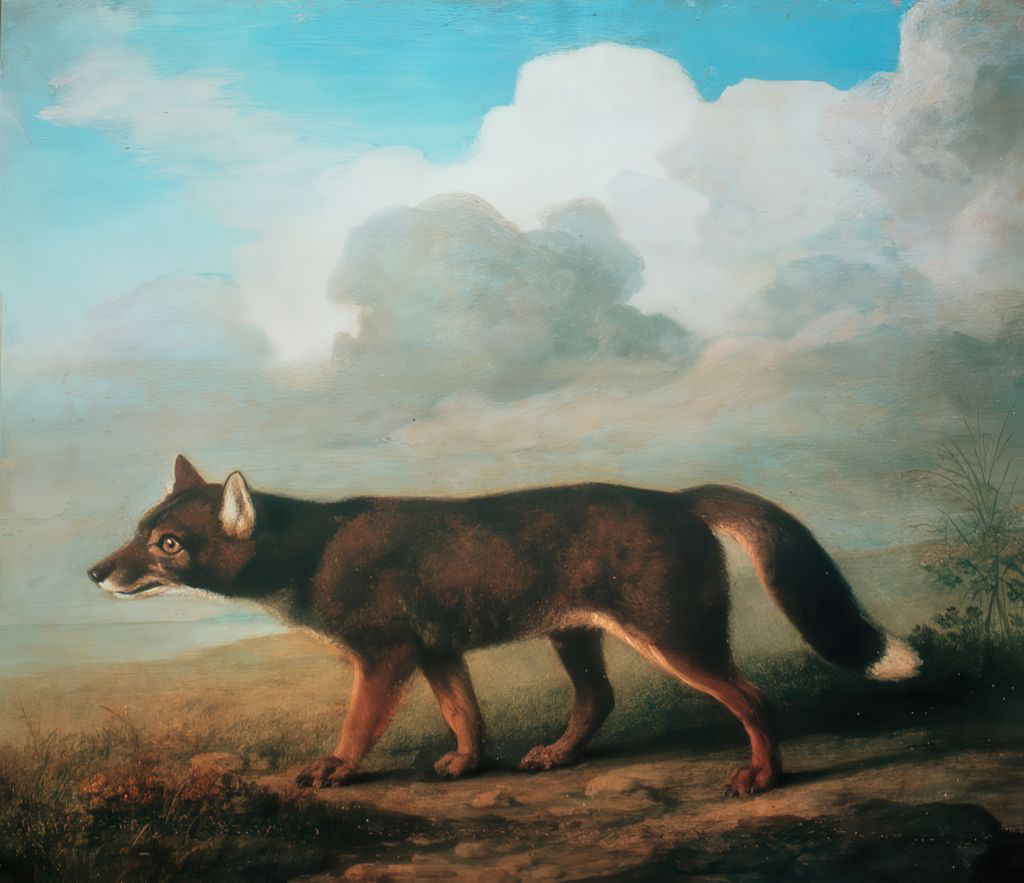
Portrait of a Large Dog (Dingo) by George Stubbs: Introduction
George Stubbs painted Portrait of a Large Dog (Dingo) in 1772 for Joseph Banks, following Banks's participation in the first Endeavour voyage. The National Maritime Museum at Greenwich holds the picture as ZBA5755 and describes its material as beeswax on mahogany panel. It measures 610 by 711 millimetres, with a panel thickness of eight millimetres. Its companion is The Kongouro from New Holland. The pair gave unfamiliar Australian animals a substantial presence in British painting, although their production depended on information carried across an ocean. [1]
At a Glance
This work across George Stubbs’s career
Whistlejacket
about 1762 [6]Contents
- Looking at the painting
- What could Stubbs know?
- An Australian animal before a British portrait
- Material, exhibition and ownership
- A different dingo in print
- Collecting and reimagining the picture
- Videos on George Stubbs
Looking at the painting
The animal moves from right to left across a shallow strip of ground. Its lowered head extends almost horizontally from the long back, while the tail curves away from the rump towards the opposite side. This arrangement makes the body a strong lateral shape. The legs introduce shorter diagonals beneath it, breaking the long sweep without interrupting the overall direction. There is no human attendant, leash or architectural enclosure to explain where the dog belongs. The animal occupies the foreground on its own. [1]
Above it, clouds spread across most of the picture. The pale sky opens around the dark body rather than offering a crowded setting of competing objects. A darker cloud mass hangs above the head and shoulders, while the ground recedes into low, distant forms. At the right, a small area of taller vegetation marks the edge of the animal's passage. The composition offers enough landscape to establish space, but keeps its main subject legible. Sky, earth and animal form broad, distinct areas rather than a continuous screen of detail. [1]
The result combines movement with an unusually clear outline. The head reaches towards the left edge, but the tail and planted feet hold the figure within the picture. The large interval of sky prevents the animal from filling its surroundings, even though it dominates the foreground. These relationships can be followed without inventing an episode beyond the frame. Nothing within this broad arrangement identifies an encounter between hunter and prey. [1]
What could Stubbs know?
Greenwich explains that no living animal was available to Stubbs for this commission. It describes him working from Banks's written and spoken accounts, while assigning Parkinson's sketches and a stuffed or inflated skin specifically to the kangaroo. That distinction matters: the resources described for one member of a pair cannot simply be transferred to the other. The museum's account establishes a mediated encounter, rather than a documented session with a living dingo. [1]
Other authorities give conflicting reconstructions. The export expert's report says that no dingo specimens were known to have returned aboard Endeavour and proposes Banks's recollections as Stubbs's source. The National Museum of Australia instead states that Banks brought back a native-dog skin from which the portrait was painted. These are materially different accounts of what reached London. Neither should disappear into a confident story that Stubbs inflated a dingo pelt. The precise studio resources remain unsettled. [16] [17]
Banks's journal helps explain how uncertain animal knowledge could be before the painting existed. On 1 May 1770, he recorded clawed footprints resembling those of a dog or wolf. On 29 June, an American midshipman reported seeing a wolf resembling animals he knew in America; he had fired at it without killing it. On 6 July, Banks recorded another sighting by the Polynesian voyager Tupia, but made clear that calling it a wolf was his own inference from the description. His general account of Australian quadrupeds also distinguished animals caught from those reported by others. Such entries preserve several stages of knowledge: a trace, an encounter, a spoken description and an attempted classification. They do not identify a particular animal as the sitter for Stubbs's panel. They also caution against treating every wolf-like or dog-like creature in the voyage records as an unequivocal modern identification. [18]
A related dispute concerns the companion painting. In a retrospective exhibition essay, Angus Trumble challenged the familiar story of an inflated kangaroo skin, emphasising a skull and Parkinson's drawings among the documented resources. His argument concerns the kangaroo. It neither proves that a dingo skin existed nor settles the contrary claim that none returned. Its relevance is methodological: memorable accounts of how an artist reconstructed an unfamiliar creature can become more definite in repetition than their documentary foundations permit. [19]
An Australian animal before a British portrait
The picture's importance within European painting should be understood alongside a much longer history. The National Museum of Australia describes dingoes within First Nations companionship, hunting, kinship, story and ceremony, and notes their presence in rock art and burials. Those relationships were not created by Banks's commission. The London portrait belongs to a particular history of representation across distance; it cannot stand for the beginning of human knowledge of the animal. Reading it with that boundary in mind changes what the language of novelty can reasonably mean. [17]
Modern appearance also requires care. Sue Burrell and Mark Eldridge's Australian Museum account uses Canis familiaris with the designation breed Dingo. It describes substantial variation in coat colour, including darker animals in forested regions, as well as the erect ears and bushy tail familiar from many dingo images. A reader expecting every dingo to have a pale ginger coat could therefore mistake a stereotype for an identification test. Conversely, recognising some dog-like features in Stubbs's painting does not recover its animal's ancestry or establish its precise relationship to any living population. Modern classifications answer questions that the eighteenth-century phrase “large dog” leaves open. [20]
The voyage itself combined several purposes. The Admiralty's additional instructions of 30 July 1768 asked Cook to observe animals, vegetation, soil and other natural productions while also surveying coasts and improving navigational knowledge. Their opening connected exploration with national prestige, trade and maritime power. For the continent Cook was instructed to seek, they required the inhabitants' consent when taking possession of suitable places; a separate instruction concerning islands did not repeat that condition. Natural history and territorial ambitions thus appear within the same document. That connection supplies a concrete context for the animal images carried back into British cultural life. It does not require the painting to be treated as a simple emblem with a single political meaning. [21]
Helen McCormack places Banks's collecting within the domestic spaces through which scientific knowledge circulated in London. Banks's collections moved from New Burlington Street to Soho Square, where books, specimens, drawings and the work of artists formed an interconnected enterprise. In her account, images were active parts of the production and communication of knowledge. The Banks animal paintings consequently belong within a culture that valued both visual information and the skills of accomplished artists. Their setting was not confined to a remote field encounter or a finished canvas considered in isolation: it included the London rooms in which objects were arranged, compared and discussed. This gives the wider relationship between animals, science and empire a specific institutional and social form. [22]
Material, exhibition and ownership
John Mills and Raymond White's 1985 technical study examined the media of ten Stubbs paintings. Their table includes wax, resin, non-drying oil or fat, and drying oil in different combinations; neither Banks animal appears among the ten works. The earlier pictures in their sample differed from the later group, in which drying oil was identified. Their discussion also explains difficulties in distinguishing related substances analytically. These findings establish variety within the artist's practice, while leaving the precise mixture used for the dingo untested by this study. They provide comparative evidence for his technique, enamel and printmaking, rather than an object-specific recipe. [23]
The export report records the Society of Artists exhibition of 1773, where the kangaroo was number 318 and its companion followed as number 319, “Ditto, of a large dog”. Its provenance runs from Banks through the family of Dorothea, his widow, to Mary Keith. In 1970, Hazlitt, Gooden & Fox handled the sale to Parham's owners, Clive and Alicia Pearson. Exhibition and descent give the pictures a shared history without making their individual animal evidence identical. [16]
A different dingo in print
A distinct image appeared in The Voyage of Governor Phillip to Botany Bay in 1789. The National Gallery of Victoria holds an impression of Dog of New South Wales, catalogued as an etching by P. Mazell, acting as artist and engraver. Its inscription identifies John Stockdale as publisher and gives 21 September 1789 as the publication date. This is a later natural-history image, rather than a print credited as reproducing Stubbs. Its separate maker, date and publication context matter when tracing how British readers encountered the animal. The distinction matters within the wider history of prints. [24]
The accompanying 1789 account makes the difference unusually tangible. It identifies the animal from which its plate was taken as a female then living with the Marchioness of Salisbury at Hatfield House, sent by Governor Phillip as a gift to Mr Nepean. It also mentions a second animal owned by Mr Lascelles. Here a printed image comes with an explicit account of living animals in Britain. The text describes an animal that lapped like a dog, preferred uncooked rabbits or chickens and reportedly neither barked nor growled when irritated. It then recounts violent encounters with other animals and reaches strongly negative expectations about taming. Those judgements belong to the historical observers and the conditions of captivity they describe. They are evidence for the representation of dingoes, rather than a timeless explanation of their nature. [25]
Collecting and reimagining the picture
The pair's passage into a public collection introduced another debate about where their histories should be told. Art Fund records its support for the National Maritime Museum acquisition in 2013, with a total cost of £4,455,000 and assistance involving the Wolfson Foundation. The pictures had remained privately owned until a sale to an overseas buyer in late 2012 prompted efforts to retain them in Britain. The acquisition changed their institutional setting as well as their ownership: works long preserved together within private collections became available for interpretation within a museum. The price belongs to the pair, rather than to the dingo alone. [26]
Mary Gearin's contemporary ABC report preserves the opposing institutional claims. The National Gallery of Australia expressed disappointment and argued that the works had greater relevance to Australian art than to British maritime history. Christine Riding, then the Maritime Museum's senior paintings curator, emphasised their importance as records arising from Cook's voyage. The report also describes the Australian gallery's negotiations through an intermediary over roughly three years. These positions illuminate why keeping the paintings together did not remove disagreement about their destination. The same objects connected British patronage and production with Australian subjects and histories. Their acquisition was therefore a dispute over the framing of an interconnected past, rather than simply a question of which institution could display two attractive animals. [27]
Contemporary artists have also returned to the image's uncertainties. Anna Glynn describes her work George Stubbs' 1773, Inflatable Dingo in a 2019 finalist announcement, explaining that she reimagined Stubbs's silhouette together with a menagerie of his reference material. The title and her accompanying pelt story belong to her interpretation; they should not replace the original painting's 1772 date or resolve its disputed model. What matters for this later reception is her deliberate reuse of a recognisable but problematic animal image. Her stated interest is in the strangeness of early European animal depictions and the natural-history encounters that generated them. [28]
Videos on George Stubbs
Explore Stubbs’s equestrian painting in its wider context, including two readings of Whistlejacket.
A Horse Lover’s Guide to the YCBA
A museum tour that places Stubbs alongside other artists who painted horses. It includes a look at Pumpkin with a Stable-lad.
Watch on YouTubeGeorge Stubbs artworks directory
Search works and related prints documented in this guide. Separate versions and printing matrices have separate entries; printmakers are named where known. Unidentified historical titles and untraced studio-sale material are discussed in the essays. A dash means that a date is not established here.
| Name | Date | Medium |
|---|---|---|
| A Bay Horse with a Groom | 1791 | Painting |
| A Bay Hunter with Two Playful Spaniels | 1777 | Painting |
| A Bay Hunter, a Springer Spaniel and a Sussex Spaniel in a wooded river Landscape | 1782 | Painting |
| A Cheetah and a Stag with Two Indian Attendants | about 1764 | Painting |
| A Couple of Fox Hounds (coloured print after Stubbs) | — | Print after Stubbs |
| A Couple of Foxhounds | 1792 | Painting |
| A Foxhound on the Scent | 1788 | Drawing |
| A Gentleman driving a Lady in a Phaeton | 1787 | Painting |
| A Grey Horse | 1793 | Painting |
| A Grey Horse (cantering companion) | 1793 | Painting |
| A Grey Stallion in a Landscape | — | Painting |
| A Horse Affrighted at a Lion | 1 May 1788 | |
| A Horse Belonging to the Rt. Honourable Lord Grosvenor called Bandy from his Crooked Leg | about 1763 | Painting |
| A Horse Frightened by a Lion | 1777 | |
| A Lion (A Lion Resting on a Rock) | 1 May 1788 | |
| A Lion Attacking a Horse | 1770 | Painting |
| A Lion Attacking a Horse (monumental Yale canvas) | 1762 | Painting |
| A lion attacking a horse (NGV) | about 1765 | Painting |
| A Lion Devouring a Horse (1788 print) | 1788 | |
| A lion devouring a horse (attribution disputed) | Proposed mid-1770s | Painting |
| A mare and foal with a bay horse | 1771 | Painting |
| A Monkey | 1799 | Painting |
| A Prancing Horse, Facing Right | c. 1790 | Drawing |
| A Rough Dog | 1790 | Painting |
| A Saddled Bay Hunter | 1786 | Painting |
| A Sleeping Leopard | 1 January 1791 | |
| A Tiger and a Sleeping Leopard | 1 May 1788 | |
| A Tigress (John Dixon after Stubbs) | 1772 | Print after Stubbs |
| A Tyger (A Recumbent Leopard by a Tree) | 1 May 1788 | |
| A Tyger (Sleeping Leopard) | 1 May 1788 | |
| An animal found on the coast of New Holland called kanguroo (after Stubbs) | 1773 | Print after Stubbs |
| An animal of a new species found on the coast of New South Wales (after Stubbs) | July 1773 | Print after Stubbs |
| Antinous and Jockey | — | Painting |
| Antinoüs, a chestnut racehorse, in a landscape | Undated | Painting |
| Bandy belonging to Lord Grosvenor (print after Stubbs) | — | Print after Stubbs |
| Baronet (George Townley Stubbs after Stubbs) | 20 February 1794 | Print after Stubbs |
| Baronet with Sam Chifney Up | 1791 | Painting |
| Baronet with Samuel Chifney up (Royal Collection) | 1791 | Painting |
| Bay Hunter by a Lake | 1787 | Painting |
| Brood Mares (Benjamin Green after Stubbs) | Issue 14 November 1776 | Print after Stubbs |
| Brood Mares and Foals | usually dated 1767 | Painting |
| Brown and White Norfolk or Water Spaniel | 1778 | Painting |
| Bulls Fighting | 1786 | Painting |
| Captain Samuel Sharpe Pocklington with His Wife, Pleasance, and possibly His Sister, Frances | 1769 | Painting |
| Death of the Doe (attribution disputed) | 1804 | |
| Der Englische Hühnerhund (Johann Wölfle after Stubbs) | about 1860 | Print after Stubbs |
| Dog (A Foxhound Viewed from Behind) | 1 May 1788 | |
| Dog [A Foxhound on the Scent] | 1788 | |
| Drill and albino baboon | before 1789 | Painting |
| Eclipse (Charles Hunt after Stubbs) | 12 November 1839 | Print after Stubbs |
| Eclipse (George Townley Stubbs after Stubbs) | 1796 | Print after Stubbs |
| Eclipse (oil study) | — | Painting |
| Eclipse (Thomas Burke after Stubbs) | First published 1772 | Print after Stubbs |
| Eclipse and John Wildman (Benjamin Green after Stubbs) | 1772 | Print after Stubbs |
| Eclipse at Newmarket (Jockey Club version) | Proposed early 1790s; often dated 1770 | Painting |
| Eclipse at Newmarket with a groom and jockey | 1770 | Painting |
| Eclipse with Mr Wildman and His Sons | 1769–71 | Painting |
| Eclipse, the Property of Capt.n O Kelly (anonymous print after Stubbs) | Imprint 4 June 1804; impression undated | Print after Stubbs |
| Euston | 1774 | Painting |
| Finished Study for the Seventh Anatomical Table of the Muscles of the Horse | 1756–58 | Drawing |
| Five Brood Mares at the Duke of Cumberland's Stud Farm in Windsor Great Park | 1765 | Painting |
| Fowl Body, Lateral View (Highly Finished Study for an Unpublished Table; Shows the Last Stage in Dissection) | — | Drawing |
| Fowl Body, Lateral View (Probably Prepared for Transfer to the Plate for Engraving of Table XV) | — | Drawing |
| Fowl Skeleton, Lateral View (Finished Study for Table V) | — | Drawing |
| Freeman, the Earl of Clarendon's Gamekeeper, with a Dying Doe and Hound (Yale) | 1800 | Painting |
| George Stubbs (enamel self-portrait) | 1781 | Enamel |
| Gimcrack (George Townley Stubbs after Stubbs) | 1775 | Print after Stubbs |
| Gimcrack on Newmarket Heath, with a trainer, a jockey and a stable lad | about 1765 | Painting |
| Gimcrack, with John Pratt up, on Newmarket Heath | about 1765 | Painting |
| Hambletonian, Rubbing Down | 1800 | Painting |
| Hay-Makers | 1791 | |
| Haycarting | 1795 | Enamel |
| Haymakers | 1785 | Painting |
| Haymakers (Lady Lever Art Gallery) | 1794 | Enamel |
| Hollyhock (with later additions by Vernet and Boucher) | about 1765–70 | Painting |
| Horse Attacked by a Lion (Episode C) | 1768–69 | Painting |
| Horse Attacked by a Lion (Tate enamel) | 1769 | Enamel |
| Horse Devoured by a Lion | Possibly exhibited 1763 | Painting |
| Horse Frightened by a Lion | 1770 | Painting |
| Horse Frightened by a Lion (Episode A; Wedgwood and Bentley after Stubbs) | — | Sculpture |
| Horse Frightened by a Lion (Tate) | Possibly exhibited 1763 | Painting |
| Horse Frightened by a Lion (Yale) | 1762–68 | Painting |
| Horse in the Shade of a Wood | 1780 | Painting |
| Hound Coursing a Stag | about 1762 | Painting |
| Human Figure, Anterior View (Intended for a Plate That was Never Published) | — | Drawing |
| Human Skeleton, Lateral View | 1795–1806 | Drawing |
| Hunt servants setting out (Southill commission) | 1767 | Painting |
| Hühnerhund (The Spanish Pointer) | about 1766 | Painting |
| John and Sophia Musters Riding at Colwick Hall | 1777 | Painting |
| John Musters on his hunter Pilgrim | 1777–78 | Painting |
| Labourers | 1789 | |
| Labourers (Richard Earlom after Stubbs and Amos Greene) | 25 March 1790 | Print after Stubbs |
| Laetitia, Lady Lade (d.1825) | 1793 | Painting |
| Lemon and White Water Spaniel | — | Painting |
| Lion Attacking a Stag | — | Painting |
| Lord Grosvenor's Arabian Stallion with a Groom | about 1765 | Painting |
| Lord Grosvenor's Arabian Stallion with a Groom (Peter Mazell after Stubbs) | 1771 | Print after Stubbs |
| Mambrino (Eaton Hall painting) | — | Painting |
| Mambrino (George Townley Stubbs after Stubbs) | 1794 | Print after Stubbs |
| Mares and Foals belonging to the 2nd Viscount Bolingbroke | about 1761–62 | Painting |
| Mares and foals beneath large oak trees | — | Painting |
| Mares and Foals by a stream | Exhibited 1764 | Painting |
| Mares and Foals in a River Landscape | about 1763–68 | Painting |
| Mares and Foals in an Extensive Landscape | about 1769 | Painting |
| Mares and Foals without a Background | 1762 | Painting |
| Moose Deer (after Stubbs) (Arctic Zoology plate VIII) | 1784–85 publication | Print after Stubbs |
| Newmarket Heath with a Rubbing-Down House | — | Painting |
| Otho (1796 print after Stubbs) | 1 December 1796 | Print after Stubbs |
| Otho, with John Larkin up | 1768 | Painting |
| Pangloss | about 1762 | Painting |
| Patch (Grafton commission) | 1759 | Painting |
| Phaeton and the Chariot of the Sun (enamel) | 1775 | Enamel |
| Phaeton with a Pair of Cream Ponies and a Stable-Lad | 1780–84 | Painting |
| Phillis | 1772 | Painting |
| Portrait of a Large Dog (Dingo) | 1772 | Painting |
| Pumpkin with a Stable-lad | 1774 | Painting |
| Racehorses Exercising at Goodwood | 1759–60 | Painting |
| Reapers (1791 print) | 1791 | |
| Reapers (Tate) | 1785 | Painting |
| Reapers (Yale) | 1795 | Enamel |
| Red Deer: A Stag and a Hind | 1792 | Painting |
| Richard Wedgwood | — | Enamel |
| Ringwood, a Brocklesby Foxhound | 1792 | Painting |
| Scrub, a bay horse belonging to the Marquess of Rockingham | about 1762 | Painting |
| Self Portrait on a White Hunter | 1782 | Enamel |
| Self-Portrait | about 1759 | Painting |
| Shooting (1770 Woollett plate after Stubbs) | 1770 | Print after Stubbs |
| Shooting (1771 Woollett plate after Stubbs) | 1771 | Print after Stubbs |
| Shooting at Goodwood | 1759–60 | Painting |
| Sir John Nelthorpe as a boy | 1756 | Painting |
| Sir John Nelthorpe partridge shooting with one pointer | — | Painting |
| Sir John Nelthorpe, 6th Baronet, out Shooting with His Dogs in Barton Field, Lincolnshire | 1776 | Painting |
| Sleeping Leopard | 1777 | Enamel |
| Soldiers of the 10th Light Dragoons | 1793 | Painting |
| Stallion and Mare (George Townley Stubbs after Stubbs) | 1776; reissued 1789 | Print after Stubbs |
| Steward and gamekeeper with dogs (Southill commission) | 1767 | Painting |
| Studies of a Lemur (Lemur murinus) in six different attitudes | 1773 | Drawing |
| Study for the Self-portrait in Enamel | c. 1781 | Drawing |
| Study of a Lemur | 1773 | Drawing |
| Study of a Racehorse in Action: Galloping to Left, a Semi-Anatomical Study, with Skin Flayed to Show Action of Muscles | — | Drawing |
| Study of the Legs of a Draught-Horse Pulling a Harrow (attributed to Stubbs) | Proposed about 1786 | Drawing |
| Sweet William (Grosvenor panel) | — | Painting |
| Sweet William (Turf Gallery canvas) | — | Painting |
| The Black Stallion Sampson, Portrayed from Three Angles (with landscape additions) | about 1764 | Painting |
| The Charlton Hunt | 1759–60 | Painting |
| The Fall of Phaeton | — | Sculpture |
| The Frightened Horse | 1780 | Sculpture |
| The Grosvenor Hunt | — | Painting |
| The Haymakers (Upton House) | 1783 | Painting |
| The Horse and Lion (George Townley Stubbs after George Stubbs) | 1770 | Print after Stubbs |
| The Kongouro from New Holland | 1772 | Painting |
| The Labourers | 1779 | Painting |
| The Labourers (Southill original) | 1767 | Painting |
| The lion and horse (Benjamin Green after Stubbs) | 1769; reissued 1777 | Print after Stubbs |
| The Milbanke and Melbourne Families | about 1769 | Painting |
| The Moose | 1770 | Painting |
| The Prince of Wales's Phaeton | 1793 | Painting |
| The Reapers (Upton House) | 1783 | Painting |
| The Sebra, or Wild Ass (George Townley Stubbs after Stubbs) | 1771 | Print after Stubbs |
| The Spanish Pointer (Bradford version) | about 1766–68 | Painting |
| The Spanish Pointer (William Woollett after Stubbs) | January 1768 | Print after Stubbs |
| The Third Duke of Dorset's Hunter with a Groom and a Dog | 1768 | Painting |
| Thomas Freeman, Lord Clarendon's gamekeeper, with a dog and a shot doe (with George Townly Stubbs) | 1803 | Painting |
| Turf, with Jockey up, at Newmarket | — | Painting |
| Turk and Crab | — | Painting |
| Two Bay Hunters Communing On The Bank Of A Lake | — | Painting |
| Tygers at Play | 1780 | |
| Viscount Gormanston's White Dog | 1781 | Painting |
| Viscount Gormanston's White Dog (canvas version) | — | Painting |
| Water Spaniel | 1769 | Painting |
| Wedgwood Family Portrait | 1780 | Painting |
| Whistlejacket | about 1762 | Painting |
| Whistlejacket with two other stallions and a groom | Recorded 1762 | Painting |
| White Poodle in a Punt | about 1780 | Painting |
| William Anderson with two Saddle-Horses | 1793 | Painting |
| Working Drawing for the Seventh Anatomical Table of the Muscles of the Horse | 1756–58 | Drawing |
| Zebra | 1763 | Painting |
Discussion
Look again at the images and ideas explored in Portrait of a Large Dog (Dingo) by George Stubbs. These editorial prompts invite your observations.
Reader Insights
How does the dog’s stance relate to the open landscape?
What changes when you compare Stubbs’s painting with the separate later printed dingo?
Which question about this picture would be best answered by specimen history, and which requires looking at the painting?
Join the Conversation
Share a detail, comparison or question about Portrait of a Large Dog (Dingo) by George Stubbs below.
References
- Royal Museums Greenwich, 'Portrait of a Large Dog' (Dingo), ZBA5755, current object record and official L6684-001 whole image, viewed through the museum print collection. View source 1. View source 2.
- Goodwood, The Collection, Painting Collection modal, Racehorses Exercising at Goodwood; An exciting acquisition: a study by George Stubbs, 30 June 2023; History of the Estate Hounds, 4 October 2023; About Goodwood Racecourse. Accessed 4 November 2026. View source.
- Goodwood, The Collection, Painting Collection modal, Racehorses Exercising at Goodwood; An exciting acquisition: a study by George Stubbs, 30 June 2023; History of the Estate Hounds, 4 October 2023; About Goodwood Racecourse. Accessed 4 November 2026. View source.
- Goodwood, The Collection, Painting Collection modal, Racehorses Exercising at Goodwood; An exciting acquisition: a study by George Stubbs, 30 June 2023; History of the Estate Hounds, 4 October 2023; About Goodwood Racecourse. Accessed 4 November 2026. View source.
- Goodwood, The Collection, Painting Collection modal, Racehorses Exercising at Goodwood; An exciting acquisition: a study by George Stubbs, 30 June 2023; History of the Estate Hounds, 4 October 2023; About Goodwood Racecourse. Accessed 4 November 2026. View source.
- National Gallery, Whistlejacket, NG6569, current collection record, provenance, in-depth discussion and frame entry. View source.
- Yale Center for British Art, Zebra, B1981.25.617, current object metadata, gallery labels, Malcolm Warner’s 1998 catalogue entry and provenance supplied through the museum’s public collection record. View source.
- Christie’s, Gimcrack on Newmarket Heath, with a trainer, a jockey and a stable lad, London, 5 July 2011, lot 12; object details, essay, provenance, exhibitions and whole image. View source.
- Christie’s, Gimcrack on Newmarket Heath, with a trainer, a jockey and a stable lad, London, 5 July 2011, lot 12; object details, essay, provenance, exhibitions and whole image. View source.
- Yale University Art Gallery, A Lion Attacking a Horse, 1770, 1955.27.1, collection record. Accessed 4 November 2026. View source.
- Royal Museums Greenwich, ‘The Kongouro from New Holland’ (Kangaroo), ZBA5754. Accessed 4 November 2026. View source.
- Royal Museums Greenwich, 'Portrait of a Large Dog' (Dingo), ZBA5755, current object record and official L6684-001 whole image, viewed through the museum print collection. View source.
- Royal Museums Greenwich, 'Portrait of a Large Dog' (Dingo), ZBA5755, current object record and official L6684-001 whole image, viewed through the museum print collection. View source.
- Tate, George Stubbs, Haymakers, 1785, T02256; details, Terry Riggs’s collection text (January 1998), and online caption. Collection record. View source.
- Frances Bailey, ‘Hambletonian, Rubbing Down: A masterpiece by George Stubbs’, National Trust Cultural Heritage Magazine, Autumn/Winter 2024, pp. 22–33. Article. View source.
- Arts Council England, expert adviser's statement, Case 13, 2012/13: two paintings by George Stubbs, pp. 1–2, 7–9. View source.
- National Museum of Australia, “Arrival of the dingo”, updated 19 September 2022. View source.
- Joseph Banks, The Endeavour Journal of Sir Joseph Banks, entries for 1 May, 29 June and 6 July 1770; “Some Account of New Holland”. View source.
- Angus Trumble, “Stubbs and the horse”, National Portrait Gallery, Australia, web publication 30 October 2018; retrospective exhibition essay. View source.
- Sue Burrell and Mark Eldridge, “Dingo”, Australian Museum, updated 26 May 2026. View source.
- Admiralty, additional instructions to James Cook, 30 July 1768, transcript published by the National Library of Australia. View source.
- Helen McCormack, “Joseph Banks and William Hunter: where the Royal Society meets the Royal Academy”, Journal for Maritime Research, 21 (1–2), 2020, pp. 119–142; accepted manuscript, pp. 1–2, 5–7. View source.
- John Mills and Raymond White, “The Mediums used by George Stubbs: Some Further Studies”, National Gallery Technical Bulletin, 9, 1985, pp. 60–64, especially pp. 60–61 and Table 1. View source.
- National Gallery of Victoria, Dog of New South Wales, P. Mazell, 1789, accession 2005.345. View source.
- The Voyage of Governor Phillip to Botany Bay, compiled from official papers, London: John Stockdale, 1789, chapter XXII, “Dog of New South Wales”. View source.
- Art Fund, i) The Kongouro from New Holland; ii) Portrait of a Large Dog, archived acquisition record, support dated 2013. View source.
- Mary Gearin, “George Stubbs's iconic oil paintings, the first depicting Australia, to remain in Britain”, ABC News, 7 November 2013. View source.
- Anna Glynn, artist news, “2019 Finalist Ravenswood Australian Women's Art Prize”, artist's statement concerning George Stubbs' 1773, Inflatable Dingo. View source.
- Basic title, date and material metadata for Tate’s Reapers (T02257) and Otho (T02375) is adapted from the Tate collection dataset, October 2014, released under CC0. TheHistoryOfArt.org has reconciled labels and versions. This credit does not apply to Tate’s authored catalogue commentary or images.
- Data Source: Yale Center for British Art. Basic object fields are adapted and reconciled for this directory. Reuse is subject to the Center’s Open Data and Data Services Terms of Use. No museum endorsement is implied. This metadata credit does not relabel scholarly essays or images as open data.
- Basic object metadata for A Horse Frightened by a Lion, 1985.38, The Cleveland Museum of Art, John L. Severance Fund, is available under CC0. Titles and design-level grouping have been reconciled for this directory.


