 by Tom Gurney
Tom Gurney BSc (Hons) is an art history expert with over 20 years experience
Email: tomgurney1@gmail.com / Phone: +44 7429 011000
George Stubbs: Exotic Animals, Science and Empire: Introduction
A zebra standing in woodland, a cheetah held by its attendants and a kangaroo poised above a distant landscape can seem to belong to the same imaginative menagerie. Their histories are considerably less uniform. One animal reached a royal paddock alive; another travelled with a skilled keeper; the kangaroo presented a different challenge, whose precise studio aids remain disputed. [1] [2] [3] George Stubbs's pictures brought these different forms of access into the apparently continuous space of a painting. Understanding that transformation changes what we see.
The word ‘exotic’ needs a viewpoint. An animal unfamiliar to an eighteenth-century London audience was already familiar within other environments, languages and systems of knowledge. Calling it exotic describes the interests of that audience, its collectors and its institutions. It does not describe a permanent quality belonging to the animal. The question is therefore how an unfamiliar creature became available to Stubbs, and whose work made it available.
The answer involves empire, but empire operated through identifiable arrangements. East India Company patronage, a diplomatic gift, naval transport, a scientific voyage, a dealer's premises and a collector's museum were different circumstances. They could overlap without becoming interchangeable. [1] [4]
These paintings also ask what an image can know. A likeness may preserve an individual's appearance, combine observations of several bodies, or make an absent animal seem present. A later engraving may spread that construction far beyond the painting's first audience. Looking through the wider George Stubbs collection, it is useful to keep the animal's journey, the artist's evidence and the finished object's subsequent history in view together.
At a Glance
- Kangaroo paintingThe Kongouro from New Holland, 1772 [4]
- Cheetah paintingA Cheetah and a Stag with Two Indian Attendants, about 1764 [5]
Contents
- A cheetah, a patron and the people who knew its behaviour
- Keepers carried knowledge as well as animals
- The zebra: diplomatic prestige becomes a public attraction
- Observation, setting and the limits of empathy
- Endeavour and knowledge already present in the landscape
- Banks's kangaroo and dingo: presence made from absence
- Exhibition and engraving changed the authority of an image
- Paintings within working collections
- The moose: a picture assembled for a scientific question
- Primates, dealers and the instability of names
- Videos on George Stubbs
A cheetah, a patron and the people who knew its behaviour
Manchester Art Gallery now calls its large picture A Cheetah and a Stag with Two Indian Attendants, dating it to about 1764. The title matters. ‘Attendants’ recognises the figures' activity, while ‘stag’ identifies the quarry more closely than the generic deer of some earlier labels. The painting, accession 1970.34, is an oil on canvas approximately 183 by 275 centimetres: the human participants and the practical business of handling a large cat occupy a substantial, public scale. [5]
Current institutional research connects the animal with the cheetah known as Miss Jenny, brought from Bengal in 1764 for George Pigot, the former governor of Madras. Historic Royal Palaces identifies an Indian keeper called John Morgan through an Old Bailey record in which he described travelling with an animal for Pigot and continuing to attend it. The historical word ‘tyger’ in that testimony should not silently turn the animal into a modern tiger: eighteenth-century naming and present zoological identification do not always coincide. [1] [5]
Morgan's testimony contributes something that a patron's name cannot supply. Pigot's office helps explain access, influence and the movement of an animal towards royal ownership. A keeper's account establishes work performed with the animal, during a journey and afterwards. The picture's history consequently involves practical animal knowledge as well as the wealth that financed transport and display. Neither kind of evidence should be used to erase the other.
There are still limits. The research supports Morgan's involvement, but it does not securely attach his name to a particular one of the two painted men. Assigning him to the left or right figure would make the image more biographically complete than the evidence allows. The other attendant should not disappear merely because his name has not been recovered. A named participant and an unidentified participant can both be historically significant.
The scene concerns a trained encounter, associated with a demonstration of cheetah hunting at Windsor. It should not be treated as a window onto unmediated animal behaviour in Bengal. Handling, restraint and the presentation of quarry are part of its subject. What looks at first like an encounter between two species is also a scene organised by people, intended to make an unfamiliar practice intelligible to a British audience. [1] [5]
The setting cannot reconstruct the animal's earlier life. Nor does an apparently coherent painted moment necessarily reproduce one instant exactly as it occurred. A picture can arrange relationships clearly while selecting, adjusting and combining what the artist knew. The relevant historical achievement is the intelligibility of the arrangement; its visual persuasiveness should not be mistaken for an exhaustive event record.
The full history of the cheetah, stag and attendants belongs to that particular commission. As a case within Stubbs's wider practice, it makes the contribution of animal handlers unusually difficult to overlook. The journey from Bengal into a British painting was made by people with skills, obligations and experiences as well as by a valuable animal.
Keepers carried knowledge as well as animals
A separate royal-menagerie history helps explain why such expertise mattered. Mishka Sinha's research for Historic Royal Palaces follows Abdullah, who accompanied a caracal from Bengal to London in 1759. The animal, called the ‘Shah Goest’ in English accounts, arrived with someone who understood its care and handling. Abdullah was expected to teach London keepers, and arrangements were eventually made for his return journey. He is not John Morgan, and this caracal is not Stubbs's cheetah. [6]
The comparison makes a narrow but useful point. Transporting a living animal was insufficient if nobody could feed it appropriately, approach it safely or interpret its responses. A keeper's knowledge could therefore be part of what a donor supplied. Newspapers might present the animal and its attendant as a novelty, while the day-to-day survival of the gift depended on work less easily summarised in a spectacular image.
It also changes how ‘diplomatic gift’ should be understood. Such a gift was not simply an object delivered and possessed. A living creature required space, food, labour and continued decisions. Those requirements carried relationships forward after the ceremonial transfer. The attendant could become an intermediary between unfamiliar practices and a British institution, even when the surviving record preserved only fragments of his life.
Care should not be romanticised. Captivity and long-distance transport created risks that an attractive painting might conceal. Equally, a history concerned only with possession misses the people who made observation possible. The task is to reconstruct the documented labour without claiming that skilled care abolished captivity, or that every keeper's relationship with an animal was identical.
Morgan's name is consequently more than a correction to an anonymous label. It reminds us that Stubbs's access to behaviour and bodily appearance could depend on people whose expertise was neither artistic nor aristocratic. Their presence helps explain how the unfamiliar could become observable. It does not allow us to invent their feelings, their private conversations with the painter or a complete biography from a single archival appearance.
The zebra: diplomatic prestige becomes a public attraction
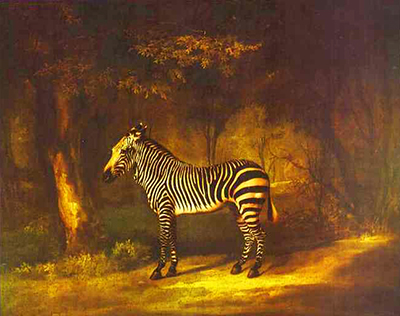
The female zebra painted by Stubbs in 1763 reached Britain through another chain. The Huntington's exhibition account identifies her as an animal sent from South Africa to Queen Charlotte in 1762. King's College London's Mozart and material-culture research supplies the naval connection: Sir Thomas Adams transported two zebra aboard HMS Terpsichore, but only the female survived. Their difference in survival is part of the transport history, not a detail visible in the subsequent portrait. [2] [7]
At Buckingham House the surviving zebra became a conspicuous attraction. The combination of a royal recipient and public visibility made the animal's unfamiliar appearance available beyond a narrow court circle. Nannerl Mozart recorded seeing the zebra in London in 1765, after the date of Stubbs's painting. Her account is valuable evidence of continued display, rather than evidence that the Mozart family saw Stubbs at work. [7]
The queen's possession of the animal and the public's opportunity to look at it belonged to the same history, but to different kinds of experience. A diplomatic gift could advertise distant connections and royal distinction; a visitor might instead concentrate on stripes, shape and movement. The animal did not have to mean exactly the same thing to the donor, the recipient, the painter and a passing spectator.
Yale's Zebra, B1981.25.617, is an oil on canvas measuring 102.9 by 127.6 centimetres. Stubbs isolates the animal in profile, with its striped body strongly legible against trees and shadow. The head turns the pattern into finer, narrower lines; the hindquarters carry broader bands. Its ears do not point in precisely the same direction. These differences reward sustained looking without requiring a story about what the animal is thinking. [8]
The isolation is pictorially useful. It removes competing animals and human visitors, giving the body an uninterrupted outline. Yet that clarity is purchased by excluding most of the circumstances that enabled the portrait. The ship, the paddock, the public and the keeper are absent. Documentary research restores them; the painter's wooded setting cannot supply them by itself.
The zebra's individual history therefore has two kinds of location. Its documented locations belong to the journey and to London display. Its painted location belongs to Stubbs's composition. Keeping them distinct avoids treating every tree or stretch of ground as a report from southern Africa, and allows the landscape to be considered as a deliberate artistic setting.
Observation, setting and the limits of empathy
Direct access to a living animal did not make an entire painting an eyewitness document. Stubbs could study a body closely and still replace its surroundings. In the zebra picture, woodland and soft earth provide a coherent visual world, although the recorded circumstances involved a British royal paddock. The image's natural appearance is therefore partly the result of construction. That is an artistic procedure, not automatically a deception. [8]
The distinction matters when interpreting animal welfare. Yale's recent account places the zebra within a larger history of animals transported to Europe as spectacles. Art historian Marisa Bass suggests that Stubbs's isolated animal may invite empathy, especially because its wooded setting is visibly unlike its natural habitat. This is a current interpretation of the painting's effect. It does not establish a written declaration of compassion by Stubbs, or a diagnosis of this zebra's condition at the moment he painted it. [9]
A viewer can nevertheless recognise an ethical question without pretending to settle the artist's intentions. The controlled opportunity to see a rare animal depended on its removal and confinement. A sympathetic image might sit within that system rather than outside it. Attention to the creature's individuality does not undo the circumstances that made the encounter possible; those circumstances do not exhaust every visual effect the painting produces.
There is also a difference between studying behaviour and projecting a human narrative onto it. An ear angle, a turned head or a resting posture is visible evidence. ‘Lonely’, ‘resigned’ or ‘proud’ describes a proposed inner state. Such terms may express a viewer's response, but they need more support if presented as historical or biological conclusions. Stubbs's precision is best honoured by making our own descriptions equally discriminating.
This balance is central to his animal painting. Individuality can arise from proportion, posture, surface and the organisation of space. It need not depend on turning an animal into a disguised person. Nor must every picture of an unfamiliar species be assigned an allegorical role before its physical presence can be taken seriously.
Endeavour and knowledge already present in the landscape
Banks's Australian commissions shift the problem from a living sitter to voyage collections. The Natural History Museum preserves botanical studies begun by Parkinson aboard Endeavour in 1768–71 and completed by other artists in London. Even this related collection therefore records work done by different hands, in different places, across the voyage's end. [10]
Scientific purpose did not make the voyage politically neutral. The Natural History Museum reproduces Admiralty instructions that placed observation of people, animals and resources alongside the acquisition of specimens and the taking of territory. The ship carried an armed naval company as well as Banks's civilian party. [11] These connections can be named without making every drawing a direct command to colonise. A sketch had an immediate descriptive task, while the expedition that enabled it also served British strategic ambitions. Holding both scales together is more informative than choosing either disinterested science or political power as a complete explanation.
At Waalumbaal Birri, the Endeavour River, the ship's company spent forty-eight days repairing damage and waiting to leave. The National Museum of Australia situates this stay in Guugu Yimidhirr country, including the land and cultural protocols of the Waymburr people. That context changes the meaning of novelty. The animal that astonished Banks was not newly present in the world; it was newly encountered by these European visitors. [12]
The word that developed into ‘kangaroo’ came from the Guugu Yimidhirr gangurru. Language is part of the evidence chain, alongside the skin and the drawing. A European image did not merely add a picture to an otherwise nameless animal. It entered a situation in which knowledge, names and relationships already existed, although the published European account selected and reshaped what it transmitted. [12] [13]
Sydney Parkinson made two sketches of the animal during the stay. Banks returned with a skull and skin; the museum considers John Gore the likely person who shot the associated kangaroo. ‘Likely’ should remain attached to that connection. Identifying the particular skin used by Stubbs is harder: the expert adviser's report for the 2012–13 export review instead gives the tradition that it came from a young female killed by Banks's greyhound. These accounts should not be joined into a falsely seamless history of one specimen. The general movement of remains is clearer than the identity of every individual animal. [12] [14]
Sketches, remains and verbal recollections can offer different kinds of information. A sketch could register posture at a particular moment. A skin preserved colour and surface, but not ordinary movement or the living volume of the body. A skull supplied hard anatomical structure. An account of behaviour conveyed experience that a still image could not reproduce. Their separate capacities help explain why establishing the actual studio aids matters. [15]
The voyage also made evidence vulnerable. Parkinson died before the return to Britain, so the artist who had observed the animal could not simply be consulted in London about every ambiguity. The Natural History Museum explains that other artists in London subsequently finished botanical watercolours from his sketches. [10] That botanical work should not be confused with Stubbs's animal panels, but it reveals a parallel difficulty: first-hand records could be developed into polished images by people who had not shared the original encounter. The paintings emerged from that larger, unfinished labour of preserving, ordering and communicating observations.
Banks's kangaroo and dingo: presence made from absence
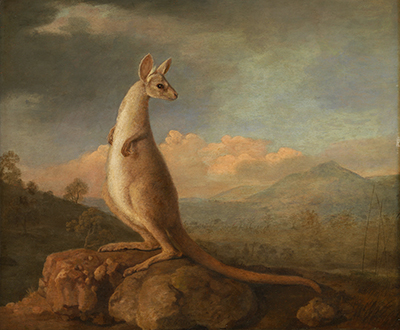
Banks's 1772 companions, The Kongouro from New Holland and Portrait of a Large Dog, are Royal Museums Greenwich ZBA5754 and ZBA5755. The museum catalogues both as beeswax on mahogany panel, approximately sixty by seventy centimetres. [4] [16] The export adviser records signatures and dates of 1772, but describes oil on panel: these catalogue labels establish no exact oil–wax recipe. [14]
Royal Museums Greenwich describes Banks's accounts, Parkinson's sketches and a prepared kangaroo pelt as Stubbs's aids; its account gives no living model for either panel. [4]
The pelt's use is disputed, beyond the question of stuffing or inflation. Angus Trumble doubts that tradition, while Cowley and Hubber report that Parkinson's drawings were believed unavailable. Neither position proves a complete alternative studio method. Collecting remains and drawings does not establish exactly which materials Stubbs handled or how he combined them. [3] [15]
The Kongouro differs from the zebra in the evidence behind its apparently solid body. A painting assembled without a living sitter can still convey weight and presence. Its visual coherence does not resolve which accounts best explain the materials available to Stubbs. [4] [3]
The complete kangaroo panel makes its pictorial construction especially clear. Raised ears and forelimbs held close to the chest give the upper body a concentrated vertical shape, while the elongated feet rest on a rocky platform and the tail extends across the lower foreground. The distant hills and clouded sky make room around that unfamiliar silhouette. The compact upper limbs contrast with the spread of feet and tail; the open sky keeps the head distinct from the receding ground. [4]
The dingo requires a further qualification because accounts disagree. The National Museum of Australia describes Stubbs working from a ‘native dog’ skin brought back by Banks. The earlier export-review report says no dingo specimens were known to have returned and proposes Banks's eyewitness accounts alone. The surviving accounts do not establish an uncontested dingo specimen chain. Shared patronage and exhibition are more secure than an identical material history. [17] [14]
In the dingo portrait, a side-facing animal crosses an open foreground beneath a broad sky. Its low, horizontal body differs markedly from the kangaroo's upright form. The bush at the right and distant ground leave the back and muzzle clearly outlined. Such visual clarity answers a compositional problem; it cannot settle the disputed history of the painter's model. [16] [17] [14]
Indigenous relationships with dingoes long predated Banks's commission. The National Museum describes their presence in companionship, story, ceremony and cultural life. [17] This gives the European painting a necessary boundary: it is a significant event in British representation, not the beginning of the animal's human history. The same distinction holds for the kangaroo, whose increasing visibility in Europe should not displace the knowledge of the people among whom it lived.
Exhibition and engraving changed the authority of an image
The two panels were exhibited together at the Society of Artists in 1773. Their pairing mattered because it offered a London audience two related results of the same celebrated voyage. A collection of drawings and preserved remains was not equally accessible or visually intelligible to every spectator. Stubbs's pictures made the unfamiliar bodies available in the recognisable form of finished animal paintings. [14]
That act of presentation was followed by another transformation. An engraving after the kangaroo appeared in John Hawkesworth's published account of the voyages in 1773. The Art Gallery of South Australia holds an impression entitled An animal found on the coast of New Holland called kanguroo, catalogued as plate 20, engraved by an unidentified maker after Stubbs. Its accession is 752G15; its recorded state is the second of three. [18]
An engraved impression is a separate object. It has paper, a plate mark, an inked surface and a place within a publication. Calling it ‘Stubbs's kangaroo’ can be convenient, but it can also hide the engraver's work and the publisher's role. The animal's apparent authority now depended partly on the official narrative surrounding it, and on the repeatability of the printed image, rather than solely on the original panel's presence.
Repeated images can make a representation seem increasingly familiar without adding fresh observation. A reader encountering the same bodily arrangement in several publications may experience agreement where the images are actually related descendants of one model. The export-review statement traces the many subsequent printed versions of the kangaroo composition. [14] The important question is not simply how often it appeared, but whether each appearance brought independent evidence or reproduced an established visual solution.
This is why the image should not be judged only as an anatomical success or failure against a modern photograph. Such a comparison can reveal differences, but it cannot explain how the painting was made, why the available material seemed persuasive or how reproduction extended its influence. The historical problem concerns the conversion of partial evidence into a usable public image, and the durability of that image once widely circulated.
The wider history of Stubbs's prints helps distinguish original printmaking from engravings made after his pictures by others. Here, the distinction is particularly consequential: voyage observations, disputed studio aids, the panel and the Hawkesworth plate belong to successive stages of representation. They should not be collapsed into a single continuous act of looking. [15]
Paintings within working collections
Banks housed both panels at 32 Soho Square from 1777, among books and specimens. The paintings belonged within a working collection of voyage knowledge. [4]
Helen McCormack's study of Banks and William Hunter places their London households within intersecting artistic and scientific networks. Her comparison is useful precisely because the houses were not identical. Banks's premises accommodated visitors, collections and extensive natural-history work. Hunter's Great Windmill Street establishment was also a working anatomical school, where teaching and the museum shaped the use of images. [19]
The comparison offers a more concrete account of ‘art and science’ than a claim that Stubbs somehow transcended the boundary between them. Images could illustrate a lecture, preserve a likeness, assist comparison, display a patron's interests or circulate in a book. These were activities performed in places, with audiences and practical needs. The same painting could support more than one activity without becoming independent of all of them.
Edwin Rose's research into Banks's library makes this continuing work more tangible. Specimens were connected with manuscript slips, annotated publications and books expanded by inserted material. Different librarians and assistants adapted the arrangements as the collection grew and classifications changed. Solander's work was followed by that of other specialists, including Jonas Dryander and Robert Brown. [20] The apparent unity of ‘Banks's collection’ depended on many people's ability to record, retrieve and revise information.
This botanical organisation does not tell us how Stubbs painted a kangaroo. It clarifies the environment into which the painting entered. A natural-history collection was valuable partly because material could be found again, compared with a description and connected to another record. Display and information management were related activities. The prominent patron's name could conceal the continuing labour that made both possible. For the history of animal imagery, the useful lesson is to look for those mediating tasks rather than assume that possession by a famous collector supplied knowledge automatically.
Patronage could therefore be intellectual as well as financial. A patron might determine which animal was worth recording, secure access, ask for a particular comparison or decide how a picture would be shown. Recognising those interventions does not remove Stubbs's authorship. It explains the conditions within which the artist selected poses, organised evidence and made a credible visible whole.
The term ‘collection’ also needs care. A group of pictures displayed with specimens was not automatically a modern public museum, freely accessible on standard terms. Nor was a private household necessarily a place where knowledge remained static or isolated. Banks's and Hunter's establishments were centres of work and exchange. Their different arrangements helped determine what an animal image could be asked to do. [19]
The moose: a picture assembled for a scientific question
William Hunter's commission of The Moose in 1770 presents a third relationship between observation and construction. A young animal sent from North America to the Duke of Richmond became available for study. The resulting painting, Hunterian GLAHA 43823, is an oil on canvas measuring 61 by 70.5 centimetres. Its purpose involved comparison as well as the recording of an unfamiliar body. [21] [22]
The animal was a yearling. It could not supply the mature antlers that were important to the enquiry, so a separate adult pair was included. This makes the picture an assembly of related evidence rather than a portrait of one complete body at one moment. The young moose and the mature antlers do not belong to the same stage of life. Their conjunction allows the viewer to consider information that an isolated living sitter could not have supplied. [21] [23]
Hunter was interested in the relationship between living moose and the enormous antlers recovered from Irish deposits. Questions about identity, survival and extinction required comparison between present animals and remains. An image was valuable because it made form available for inspection beyond the immediate encounter. It could not, by itself, settle whether all the remains and reported animals belonged to the same creature or resolve the larger problem of extinction. [21] [22]
McCormack's conference research examines Hunter's comments on the usefulness of good animal paintings and the different information that prose could add. This is a productive way to read the commission. A picture could communicate proportions and relations that were cumbersome to describe, while writing could record facts that the pictured body did not reveal. Neither medium made the other redundant. [22]
The moose painting thus belongs beside the scientific ambitions of The Anatomy of the Horse, but it is not another anatomical plate. A horse dissection, a living yearling and detached antlers offered different material, and served different kinds of publication or enquiry. Scientific usefulness did not require every image to adopt a uniform diagrammatic appearance.
Hunter's nilgai project provides a bounded comparison. Stubbs's painting of the Indian antelope, made in 1769, accompanied Hunter's presentation to the Royal Society in 1771; the image also entered a printed history through an engraving. The moose enquiry, by contrast, remained in manuscript. Similar relationships between patron and painter could therefore produce different outcomes in public knowledge. [19] [23]
There was also an opportunity to revise observation. In 1773 a different, older moose at Goodwood was studied, and Stubbs made a drawing of the second animal. It should not be folded retrospectively into the 1770 canvas as though both represented one sitting. Comparison across time could expose the limitations of the earlier evidence rather than merely confirm it. [23]
The case guards against an overly triumphant account of science. A carefully made image, an inquisitive patron and a substantial collection did not guarantee a completed argument or published result. The painting preserves a stage of enquiry. Its survival is important partly because the research around it remained unfinished, leaving later historians to reconstruct questions as well as conclusions.
Primates, dealers and the instability of names
The Royal College of Surgeons now identifies RCSSC/P 266 as Drill and Albino Baboon. The unsigned painting, dated before 1789, is oil on millboard, 67 by 97 centimetres. Its current scientific fields distinguish a drill, Mandrillus leucophaeus, from a pale animal identified at the genus level as Papio. The obsolete label ‘Pavian and Albino Makake’ should not be treated as a precise modern species description. [24]
The holder's record places the animals within London's commercial world. William Gough in Holborn and George Bayly in Piccadilly are associated with the two subjects; the pale animal was advertised in language emphasising its unusual appearance. John Hunter later owned the painting and displayed it in his Leicester Square museum. This is John the surgeon and collector, not William, the patron of the moose commission. [24]
Those details recover a metropolitan chain more securely than an overseas one. The painting cannot tell us where each animal was captured, which ships carried it or every transaction through which it passed. Assigning a generic colonial origin story would replace a gap with a familiar narrative. The available history is valuable even where its beginning remains unknown.
The current record also preserves disagreements in earlier descriptions. William Clift's retrospective notes associated the animals with Lord Shelburne, while the museum's subsequent discussion reports a lack of confirming evidence in the Bowood papers. These are not equally secure parts of a single continuous provenance. An early attribution of ownership and a later failure to corroborate it should remain distinguishable. [24]
Visually, the two animals are sharply contrasted. The darker standing figure holds a staff and raises an arm; the pale figure sits beside it. Their arranged proximity makes differences of colour, stance and bodily form immediately available. It does not prove that they lived together, that their behaviour was spontaneous at the moment of painting or that either expressed an identifiable human emotion.
The historical labels are themselves part of the enquiry. Dealers, collectors, anatomists and later cataloguers did not necessarily classify an animal in the same way. A title could emphasise rarity or colour, while a modern scientific field attempted a more specific identification. Albino appearance should not be allowed to become an exact species name, and replacing an old label need not imply that every remaining uncertainty has been solved.
The fuller account of Drill and Albino Baboon can retain those documentary layers. Here, the picture demonstrates why scientific collecting did not automatically produce stable names. Images and written descriptions survived through institutions, restoration and recataloguing. Their evidential value includes the history of those changing interpretations, not just whatever label appears most confidently today.
A monkey can belong to several histories at once
The Walker Art Gallery's 1799 panel, WAG 2386, appears in digitised records as A Monkey and is also discussed as The Monkey. The title variant does not indicate a different object. The painting is oil on panel, approximately 70 by 55.9 centimetres, showing a macaque amid fruit and foliage. The precise modern species should not be settled simply by choosing the most specific name found in an older account. [25]
Its date introduces another form of mediation. Richard Johns's study of the 1799 Royal Academy exhibition relates the panel to the monkey composition shown by Stubbs in 1775. Reworking an earlier image is different from documenting a newly acquired animal. A late date attached to a surviving painting does not establish that its subject arrived in Britain, was first observed or first entered the artist's imagination in that year. [26]
Johns also explores the monkey's potential wit: the relationship between imitation and art, the exhibition's rules and the possibility of political resonance. These readings illuminate the work's situation within artistic culture. They remain interpretations, rather than a surviving explanation of intention by Stubbs. The existence of a clever historical parallel is not sufficient to make that parallel the picture's exclusive meaning. [26]
The fruit-handling activity gives the painting a more particular subject than the bare category ‘monkey’. The animal grips a branch and holds fruit close to its body, while the surrounding dark vegetation gives those actions a concentrated setting. Description can attend to these relationships without converting them into a moral story or treating the foliage as evidence of the animal's original habitat.
The Walker monkey therefore adds a useful complication. A creature associated with collecting and classification could also become an actor in debates about representation and artistic status. These functions need not cancel one another. They do, however, require different evidence: zoological identity cannot be established from a proposed joke, and a political interpretation cannot be proved by the animal's taxonomic name.
A sleeping leopard: changing materials, changing evidence
Stubbs's unfamiliar animals also crossed material boundaries. Yale's Sleeping Leopard, B2001.2.209, dated 1777, is enamel on Wedgwood biscuit earthenware. It is a small object, measuring 10.8 by 16.8 centimetres. The oval surface is filled by a curled spotted body, with the head resting close to the forepaws. Scale and support make its encounter with the viewer different from that of the large Manchester canvas. [27]
The change of material is not a minor catalogue detail. Enamel depends on colour fixed through firing, and its ceramic support belongs to a process unlike laying oil paint on canvas. Stubbs's work with Wedgwood formed part of his experimentation with stable supports and durable colour. A specialist review of the Holburne exhibition places these animal enamels within that wider technical history. [23]
A related title at the Metropolitan Museum of Art identifies a different object: A Sleeping Leopard, dated 1 January 1791, accession 49.49.5. It is a soft-ground etching worked with roulette, catalogued as the second of two states and measuring 18.1 by 23.7 centimetres. It is neither the physical Yale enamel nor evidence that the enamel was made in 1791. [28]
The later print's black-and-white tonal structure creates another way of presenting a resting animal. Its capacity to circulate differs from that of a single fired plaque. The object could carry Stubbs's engagement with the subject into another setting and audience, but repetition does not supply an independently documented leopard biography. A shared motif is not the same thing as a shared moment of observation.
The exact Sleeping Leopard enamel and the later print consequently need separate captions and histories. Looking across the wider paintings collection, this attention to medium prevents ‘animal portrait’ from becoming a category that conceals how differently the works were made. Material choices shaped the appearance, handling, survival and availability of the represented creature.
Following the evidence through the picture
Stubbs's exotic subjects do not form a single procession from distant capture to a London masterpiece. The cheetah brings handlers and a staged encounter into view. The zebra joins diplomatic transport to public display. Banks's pair converts absent animals into apparently present bodies, while Hunter's moose brings evidence from different stages of life into one image. The primates expose uncertain names and incomplete provenance; the monkey and leopard show how earlier compositions and subjects could be reconsidered in later works.
A useful reading begins with the exact object: its date, support, dimensions and present collection. It then asks what was available to Stubbs and what the image leaves outside its frame. A skin, a drawing, a keeper's practical knowledge and a patron's description do not provide interchangeable forms of access. Distinguishing them makes the painter's achievement more intelligible, because the finished coherence can be considered against the fragmentary evidence from which it emerged.
The next question concerns circulation. Who could see the animal, who could see the painting and who encountered only a printed derivative? An image could become a familiar point of reference after its material source had disappeared. Such familiarity could preserve knowledge and preserve assumptions at the same time. Repetition deserves examination as a historical process, rather than being counted automatically as corroboration.
Finally, the animals' histories extend beyond what British collectors recorded. Recovering Guugu Yimidhirr language, a keeper's name or the limits of an institutional label makes that imbalance visible without pretending to supply everything missing. Stubbs's art remains compelling within those limits. Its specificity lies in the meeting of observed bodies, imperfectly transmitted evidence, human expertise and deliberate pictorial form.
Videos on George Stubbs
Explore Stubbs’s equestrian painting in its wider context, including two readings of Whistlejacket.
A Horse Lover’s Guide to the YCBA
A museum tour that places Stubbs alongside other artists who painted horses. It includes a look at Pumpkin with a Stable-lad.
Watch on YouTubeGeorge Stubbs artworks directory
Search works and related prints documented in this guide. Separate versions and printing matrices have separate entries; printmakers are named where known. Unidentified historical titles and untraced studio-sale material are discussed in the essays. A dash means that a date is not established here.
| Name | Date | Medium |
|---|---|---|
| A Bay Horse with a Groom | 1791 | Painting |
| A Bay Hunter with Two Playful Spaniels | 1777 | Painting |
| A Bay Hunter, a Springer Spaniel and a Sussex Spaniel in a wooded river Landscape | 1782 | Painting |
| A Cheetah and a Stag with Two Indian Attendants | about 1764 | Painting |
| A Couple of Fox Hounds (coloured print after Stubbs) | — | Print after Stubbs |
| A Couple of Foxhounds | 1792 | Painting |
| A Foxhound on the Scent | 1788 | Drawing |
| A Gentleman driving a Lady in a Phaeton | 1787 | Painting |
| A Grey Horse | 1793 | Painting |
| A Grey Horse (cantering companion) | 1793 | Painting |
| A Grey Stallion in a Landscape | — | Painting |
| A Horse Affrighted at a Lion | 1 May 1788 | |
| A Horse Belonging to the Rt. Honourable Lord Grosvenor called Bandy from his Crooked Leg | about 1763 | Painting |
| A Horse Frightened by a Lion | 1777 | |
| A Lion (A Lion Resting on a Rock) | 1 May 1788 | |
| A Lion Attacking a Horse | 1770 | Painting |
| A Lion Attacking a Horse (monumental Yale canvas) | 1762 | Painting |
| A lion attacking a horse (NGV) | about 1765 | Painting |
| A Lion Devouring a Horse (1788 print) | 1788 | |
| A lion devouring a horse (attribution disputed) | Proposed mid-1770s | Painting |
| A mare and foal with a bay horse | 1771 | Painting |
| A Monkey | 1799 | Painting |
| A Prancing Horse, Facing Right | c. 1790 | Drawing |
| A Rough Dog | 1790 | Painting |
| A Saddled Bay Hunter | 1786 | Painting |
| A Sleeping Leopard | 1 January 1791 | |
| A Tiger and a Sleeping Leopard | 1 May 1788 | |
| A Tigress (John Dixon after Stubbs) | 1772 | Print after Stubbs |
| A Tyger (A Recumbent Leopard by a Tree) | 1 May 1788 | |
| A Tyger (Sleeping Leopard) | 1 May 1788 | |
| An animal found on the coast of New Holland called kanguroo (after Stubbs) | 1773 | Print after Stubbs |
| An animal of a new species found on the coast of New South Wales (after Stubbs) | July 1773 | Print after Stubbs |
| Antinous and Jockey | — | Painting |
| Antinoüs, a chestnut racehorse, in a landscape | Undated | Painting |
| Bandy belonging to Lord Grosvenor (print after Stubbs) | — | Print after Stubbs |
| Baronet (George Townley Stubbs after Stubbs) | 20 February 1794 | Print after Stubbs |
| Baronet with Sam Chifney Up | 1791 | Painting |
| Baronet with Samuel Chifney up (Royal Collection) | 1791 | Painting |
| Bay Hunter by a Lake | 1787 | Painting |
| Brood Mares (Benjamin Green after Stubbs) | Issue 14 November 1776 | Print after Stubbs |
| Brood Mares and Foals | usually dated 1767 | Painting |
| Brown and White Norfolk or Water Spaniel | 1778 | Painting |
| Bulls Fighting | 1786 | Painting |
| Captain Samuel Sharpe Pocklington with His Wife, Pleasance, and possibly His Sister, Frances | 1769 | Painting |
| Death of the Doe (attribution disputed) | 1804 | |
| Der Englische Hühnerhund (Johann Wölfle after Stubbs) | about 1860 | Print after Stubbs |
| Dog (A Foxhound Viewed from Behind) | 1 May 1788 | |
| Dog [A Foxhound on the Scent] | 1788 | |
| Drill and albino baboon | before 1789 | Painting |
| Eclipse (Charles Hunt after Stubbs) | 12 November 1839 | Print after Stubbs |
| Eclipse (George Townley Stubbs after Stubbs) | 1796 | Print after Stubbs |
| Eclipse (oil study) | — | Painting |
| Eclipse (Thomas Burke after Stubbs) | First published 1772 | Print after Stubbs |
| Eclipse and John Wildman (Benjamin Green after Stubbs) | 1772 | Print after Stubbs |
| Eclipse at Newmarket (Jockey Club version) | Proposed early 1790s; often dated 1770 | Painting |
| Eclipse at Newmarket with a groom and jockey | 1770 | Painting |
| Eclipse with Mr Wildman and His Sons | 1769–71 | Painting |
| Eclipse, the Property of Capt.n O Kelly (anonymous print after Stubbs) | Imprint 4 June 1804; impression undated | Print after Stubbs |
| Euston | 1774 | Painting |
| Finished Study for the Seventh Anatomical Table of the Muscles of the Horse | 1756–58 | Drawing |
| Five Brood Mares at the Duke of Cumberland's Stud Farm in Windsor Great Park | 1765 | Painting |
| Fowl Body, Lateral View (Highly Finished Study for an Unpublished Table; Shows the Last Stage in Dissection) | — | Drawing |
| Fowl Body, Lateral View (Probably Prepared for Transfer to the Plate for Engraving of Table XV) | — | Drawing |
| Fowl Skeleton, Lateral View (Finished Study for Table V) | — | Drawing |
| Freeman, the Earl of Clarendon's Gamekeeper, with a Dying Doe and Hound (Yale) | 1800 | Painting |
| George Stubbs (enamel self-portrait) | 1781 | Enamel |
| Gimcrack (George Townley Stubbs after Stubbs) | 1775 | Print after Stubbs |
| Gimcrack on Newmarket Heath, with a trainer, a jockey and a stable lad | about 1765 | Painting |
| Gimcrack, with John Pratt up, on Newmarket Heath | about 1765 | Painting |
| Hambletonian, Rubbing Down | 1800 | Painting |
| Hay-Makers | 1791 | |
| Haycarting | 1795 | Enamel |
| Haymakers | 1785 | Painting |
| Haymakers (Lady Lever Art Gallery) | 1794 | Enamel |
| Hollyhock (with later additions by Vernet and Boucher) | about 1765–70 | Painting |
| Horse Attacked by a Lion (Episode C) | 1768–69 | Painting |
| Horse Attacked by a Lion (Tate enamel) | 1769 | Enamel |
| Horse Devoured by a Lion | Possibly exhibited 1763 | Painting |
| Horse Frightened by a Lion | 1770 | Painting |
| Horse Frightened by a Lion (Episode A; Wedgwood and Bentley after Stubbs) | — | Sculpture |
| Horse Frightened by a Lion (Tate) | Possibly exhibited 1763 | Painting |
| Horse Frightened by a Lion (Yale) | 1762–68 | Painting |
| Horse in the Shade of a Wood | 1780 | Painting |
| Hound Coursing a Stag | about 1762 | Painting |
| Human Figure, Anterior View (Intended for a Plate That was Never Published) | — | Drawing |
| Human Skeleton, Lateral View | 1795–1806 | Drawing |
| Hunt servants setting out (Southill commission) | 1767 | Painting |
| Hühnerhund (The Spanish Pointer) | about 1766 | Painting |
| John and Sophia Musters Riding at Colwick Hall | 1777 | Painting |
| John Musters on his hunter Pilgrim | 1777–78 | Painting |
| Labourers | 1789 | |
| Labourers (Richard Earlom after Stubbs and Amos Greene) | 25 March 1790 | Print after Stubbs |
| Laetitia, Lady Lade (d.1825) | 1793 | Painting |
| Lemon and White Water Spaniel | — | Painting |
| Lion Attacking a Stag | — | Painting |
| Lord Grosvenor's Arabian Stallion with a Groom | about 1765 | Painting |
| Lord Grosvenor's Arabian Stallion with a Groom (Peter Mazell after Stubbs) | 1771 | Print after Stubbs |
| Mambrino (Eaton Hall painting) | — | Painting |
| Mambrino (George Townley Stubbs after Stubbs) | 1794 | Print after Stubbs |
| Mares and Foals belonging to the 2nd Viscount Bolingbroke | about 1761–62 | Painting |
| Mares and foals beneath large oak trees | — | Painting |
| Mares and Foals by a stream | Exhibited 1764 | Painting |
| Mares and Foals in a River Landscape | about 1763–68 | Painting |
| Mares and Foals in an Extensive Landscape | about 1769 | Painting |
| Mares and Foals without a Background | 1762 | Painting |
| Moose Deer (after Stubbs) (Arctic Zoology plate VIII) | 1784–85 publication | Print after Stubbs |
| Newmarket Heath with a Rubbing-Down House | — | Painting |
| Otho (1796 print after Stubbs) | 1 December 1796 | Print after Stubbs |
| Otho, with John Larkin up | 1768 | Painting |
| Pangloss | about 1762 | Painting |
| Patch (Grafton commission) | 1759 | Painting |
| Phaeton and the Chariot of the Sun (enamel) | 1775 | Enamel |
| Phaeton with a Pair of Cream Ponies and a Stable-Lad | 1780–84 | Painting |
| Phillis | 1772 | Painting |
| Portrait of a Large Dog (Dingo) | 1772 | Painting |
| Pumpkin with a Stable-lad | 1774 | Painting |
| Racehorses Exercising at Goodwood | 1759–60 | Painting |
| Reapers (1791 print) | 1791 | |
| Reapers (Tate) | 1785 | Painting |
| Reapers (Yale) | 1795 | Enamel |
| Red Deer: A Stag and a Hind | 1792 | Painting |
| Richard Wedgwood | — | Enamel |
| Ringwood, a Brocklesby Foxhound | 1792 | Painting |
| Scrub, a bay horse belonging to the Marquess of Rockingham | about 1762 | Painting |
| Self Portrait on a White Hunter | 1782 | Enamel |
| Self-Portrait | about 1759 | Painting |
| Shooting (1770 Woollett plate after Stubbs) | 1770 | Print after Stubbs |
| Shooting (1771 Woollett plate after Stubbs) | 1771 | Print after Stubbs |
| Shooting at Goodwood | 1759–60 | Painting |
| Sir John Nelthorpe as a boy | 1756 | Painting |
| Sir John Nelthorpe partridge shooting with one pointer | — | Painting |
| Sir John Nelthorpe, 6th Baronet, out Shooting with His Dogs in Barton Field, Lincolnshire | 1776 | Painting |
| Sleeping Leopard | 1777 | Enamel |
| Soldiers of the 10th Light Dragoons | 1793 | Painting |
| Stallion and Mare (George Townley Stubbs after Stubbs) | 1776; reissued 1789 | Print after Stubbs |
| Steward and gamekeeper with dogs (Southill commission) | 1767 | Painting |
| Studies of a Lemur (Lemur murinus) in six different attitudes | 1773 | Drawing |
| Study for the Self-portrait in Enamel | c. 1781 | Drawing |
| Study of a Lemur | 1773 | Drawing |
| Study of a Racehorse in Action: Galloping to Left, a Semi-Anatomical Study, with Skin Flayed to Show Action of Muscles | — | Drawing |
| Study of the Legs of a Draught-Horse Pulling a Harrow (attributed to Stubbs) | Proposed about 1786 | Drawing |
| Sweet William (Grosvenor panel) | — | Painting |
| Sweet William (Turf Gallery canvas) | — | Painting |
| The Black Stallion Sampson, Portrayed from Three Angles (with landscape additions) | about 1764 | Painting |
| The Charlton Hunt | 1759–60 | Painting |
| The Fall of Phaeton | — | Sculpture |
| The Frightened Horse | 1780 | Sculpture |
| The Grosvenor Hunt | — | Painting |
| The Haymakers (Upton House) | 1783 | Painting |
| The Horse and Lion (George Townley Stubbs after George Stubbs) | 1770 | Print after Stubbs |
| The Kongouro from New Holland | 1772 | Painting |
| The Labourers | 1779 | Painting |
| The Labourers (Southill original) | 1767 | Painting |
| The lion and horse (Benjamin Green after Stubbs) | 1769; reissued 1777 | Print after Stubbs |
| The Milbanke and Melbourne Families | about 1769 | Painting |
| The Moose | 1770 | Painting |
| The Prince of Wales's Phaeton | 1793 | Painting |
| The Reapers (Upton House) | 1783 | Painting |
| The Sebra, or Wild Ass (George Townley Stubbs after Stubbs) | 1771 | Print after Stubbs |
| The Spanish Pointer (Bradford version) | about 1766–68 | Painting |
| The Spanish Pointer (William Woollett after Stubbs) | January 1768 | Print after Stubbs |
| The Third Duke of Dorset's Hunter with a Groom and a Dog | 1768 | Painting |
| Thomas Freeman, Lord Clarendon's gamekeeper, with a dog and a shot doe (with George Townly Stubbs) | 1803 | Painting |
| Turf, with Jockey up, at Newmarket | — | Painting |
| Turk and Crab | — | Painting |
| Two Bay Hunters Communing On The Bank Of A Lake | — | Painting |
| Tygers at Play | 1780 | |
| Viscount Gormanston's White Dog | 1781 | Painting |
| Viscount Gormanston's White Dog (canvas version) | — | Painting |
| Water Spaniel | 1769 | Painting |
| Wedgwood Family Portrait | 1780 | Painting |
| Whistlejacket | about 1762 | Painting |
| Whistlejacket with two other stallions and a groom | Recorded 1762 | Painting |
| White Poodle in a Punt | about 1780 | Painting |
| William Anderson with two Saddle-Horses | 1793 | Painting |
| Working Drawing for the Seventh Anatomical Table of the Muscles of the Horse | 1756–58 | Drawing |
| Zebra | 1763 | Painting |
Discussion
Look again at the images and ideas explored in George Stubbs: Exotic Animals, Science and Empire. These editorial prompts invite your observations.
Reader Insights
Which animal’s journey to Britain most changes your understanding of its picture?
Where does the evidence leave the circumstances of observation uncertain?
Which piece of evidence would you most want to recover about the people who transported or cared for an animal?
Join the Conversation
Share a detail, comparison or question about George Stubbs: Exotic Animals, Science and Empire below.
References
- Historic Royal Palaces, ‘The Tower of London Menagerie’, including Miss Jenny and John Morgan. (accessed 31 October 2026). View source.
- The Huntington, ‘Stubbs' Zebra’. (accessed 31 October 2026). View source.
- Angus Trumble, ‘Stubbs and the horse’, National Portrait Gallery, Australia, displayed 30 October 2018; retrospective Kimbell exhibition review anticipating Egerton’s 2007 catalogue. (accessed 4 November 2026). View source.
- Royal Museums Greenwich, George Stubbs, The Kongouro from New Holland (Kangaroo), 1772, ZBA5754, collection record and essay. (accessed 4 November 2026). View source.
- Manchester Art Gallery, Gallery 3: What is Manchester Art Gallery?, entry for A Cheetah and a Stag with Two Indian Attendants, about 1764, 1970.34. (full booklet accessed 30 August 2026; indexed title and date rechecked 31 October 2026). View source.
- Mishka Sinha, ‘An Asian wild cat and his Indian trainer in 18th-century London’, Historic Royal Palaces, 12 July 2024. (accessed 31 October 2026). View source.
- King's College London, Mozart & Material Culture, ‘1764 or 1765, London: Zebra’. (accessed 31 October 2026). View source.
- Yale Center for British Art, George Stubbs, Zebra, 1763, B1981.25.617; museum-supplied Google Arts & Culture record and image. ; current holder catalogue (accessed 31 October 2026). View source 1. View source 2.
- Oscar Sweeting, ‘The first zebra publicly exhibited in Britain’, Yale News, 8 January 2025, including interpretation by Marisa Bass. (accessed 31 October 2026). View source.
- Natural History Museum, ‘The Cook Voyages: HMS Endeavour, HMS Resolution and HMS Discovery’, first-voyage collection history. (accessed 4 November 2026). View source.
- Kerry Lotzof, ‘Endeavour 250: natural history through colonial encounter’, Natural History Museum, including reproduced Admiralty instructions. (accessed 31 October 2026). View source.
- National Museum of Australia, ‘17 June to 4 August 1770: Waalumbaal Birri — Endeavour River’. (accessed 31 October 2026). View source.
- National Museum of Australia, ‘Kangaroo’. (accessed 31 October 2026). View source.
- Arts Council England, expert adviser's statement, Case 13 2012/13, The Kongouro from New Holland (The Kangaroo) and Portrait of a Large Dog (The Dingo), especially pp.1–2 and 6–8. (accessed 4 November 2026). View source.
- Des Cowley and Brian Hubber, ‘Distinct Creation: Early European Images of Australian Animals’, La Trobe Journal 66 (Spring 2000), kangaroo section, pp.3–12 and notes 9–11. (accessed 4 November 2026). View source.
- Royal Museums Greenwich, George Stubbs, Portrait of a Large Dog (Dingo), 1772, ZBA5755. (accessed 4 November 2026). View source.
- National Museum of Australia, ‘Arrival of the dingo’. (accessed 4 November 2026). View source.
- Art Gallery of South Australia, unknown engraver after George Stubbs, An animal found on the coast of New Holland called kanguroo, 1773, plate 20 from Hawkesworth's account, 752G15. (accessed 31 October 2026). View source.
- Helen McCormack, ‘Joseph Banks and William Hunter: Where the Royal Society meets the Royal Academy’, Journal for Maritime Research 21.1–2 (2019; published online 2020), pp.119–142; author's accepted manuscript. ; ; (accessed 31 October 2026). View source 1. View source 2. View source 3.
- Edwin D. Rose, ‘From the South Seas to Soho Square: Joseph Banks's Library, collection and Kingdom of natural history’, Notes and Records 73.4 (2019), pp.499–526. ; (accessed 31 October 2026). View source 1. View source 2.
- University of Glasgow, The Hunterian, George Stubbs, The Moose, 1770, GLAHA 43823; holder record and Yale A&AePortal catalogue cross-reference. ; (holder metadata and indexed cross-reference checked 31 October 2026). View source 1. View source 2.
- Helen McCormack, ‘Animalia, Autopsia, Natura: George Stubbs' The Moose (1770)’, conference paper, MK Gallery, 17 January 2020, repository abstract and full paper. ; (accessed 31 October 2026). View source 1. View source 2.
- Caroline Cannon-Brookes, ‘Stubbs and the Wild’, British Society for Eighteenth-Century Studies, 12 August 2016. (accessed 31 October 2026). View source.
- Royal College of Surgeons of England, SurgiCat, George Stubbs, Drill and albino baboon, before 1789, RCSSC/P 266, current catalogue and transcribed earlier descriptions. (accessed 31 October 2026). View source.
- Walker Art Gallery, National Museums Liverpool, George Stubbs, A Monkey, 1799, WAG 2386; museum-supplied Google Arts & Culture record and image. ; catalogue-linked dimension transcription (accessed 31 October 2026). View source 1. View source 2.
- Richard Johns, ‘1799: Unfinished Monkey Business’, in The Royal Academy Summer Exhibition: A Chronicle, 1769–2018, Paul Mellon Centre, 2018. (accessed 31 October 2026). View source.
- Yale Center for British Art, George Stubbs, Sleeping Leopard, 1777, B2001.2.209; museum-supplied Google Arts & Culture record and image. (accessed 31 October 2026). View source.
- Metropolitan Museum of Art, George Stubbs, A Sleeping Leopard, 1 January 1791, 49.49.5. (accessed 31 October 2026). View source.
- Basic title, date and material metadata for Tate’s Reapers (T02257) and Otho (T02375) is adapted from the Tate collection dataset, October 2014, released under CC0. TheHistoryOfArt.org has reconciled labels and versions. This credit does not apply to Tate’s authored catalogue commentary or images.
- Data Source: Yale Center for British Art. Basic object fields are adapted and reconciled for this directory. Reuse is subject to the Center’s Open Data and Data Services Terms of Use. No museum endorsement is implied. This metadata credit does not relabel scholarly essays or images as open data.
- Basic object metadata for A Horse Frightened by a Lion, 1985.38, The Cleveland Museum of Art, John L. Severance Fund, is available under CC0. Titles and design-level grouping have been reconciled for this directory.