by Tom Gurney
Tom Gurney BSc (Hons) is an art history expert with over 20 years experience
Email: tomgurney1@gmail.com / Phone: +44 7429 011000
George Stubbs and Animal Painting: Introduction
Calling George Stubbs a horse painter is useful, but only if the phrase opens a question rather than closes one. Horses brought him important commissions, directed years of anatomical enquiry and became the subjects through which many later viewers encountered his work. They were central to his practice. They were not its boundary. Stubbs also painted and drew dogs, hounds, cattle, deer, monkeys, a zebra, a cheetah and other animals; he placed them in portraits, breeding groups, sporting narratives, rural-labour scenes, conversation pieces and imagined confrontations. Some designs became small original prints or widely circulated reproductions. Others occupied canvases large enough to confront a standing viewer.
This variety changes what ‘animal painting’ means. A named racehorse is not interchangeable with an unnamed hunter. A breeding group does a different cultural and pictorial job from a portrait of a companion dog. An animal observed alive in London came through a different chain of access from one reconstructed through drawings, reports or a preserved skin. A groom, handler or farm worker changes the subject even when an animal takes up more space. The overview of Stubbs's paintings, the preparatory evidence in his drawings and the altered audiences reached by his prints therefore describe related but non-identical bodies of work.
What holds this range together is not one message about animals. It is a repeated act of distinction. Stubbs examined how bodies bear weight, stop, turn, pull, collide and submit to handling; he also decided how large those bodies should appear, what land or blank space should surround them, which people should share the frame and what an owner or exhibition audience would recognise. Close observation matters throughout. So do selection, arrangement and the unequal historical systems in which animals were bred, worked, transported, possessed and displayed.
At a Glance
Contents
- The narrow usefulness of “horse painter”
- A field larger than its academic rank
- Portrait, breeding group and designed image
- Observation, anatomy and the working animal painter
- Posture without mind-reading
- Landscape, grouping, scale and support
- Patrons, grooms and rural work
- Wild encounter and predation
- Exhibition, circulation and the making of a canon
- Ways through Stubbs's animal painting
- Videos on George Stubbs
The narrow usefulness of “horse painter”
The label has historical roots. Alison E. Wright notes that a London directory of 1763 described Stubbs as a “Painter of Horses, &c.” The wording identifies a market speciality, but the abbreviated remainder matters: eighteenth-century animal painters could work across species and categories even when one subject gave them a public identity. [2] The horse also connected several powerful areas of Georgian life. It was transport and draught power, breeding stock and financial property, an instrument of hunting and war, a participant in racing, and sometimes a named subject whose ancestry and performance were closely recorded. Stubbs's equine commissions cannot be understood apart from those uses.
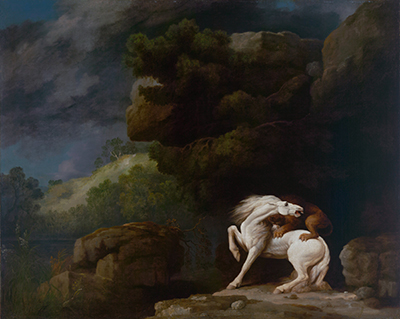
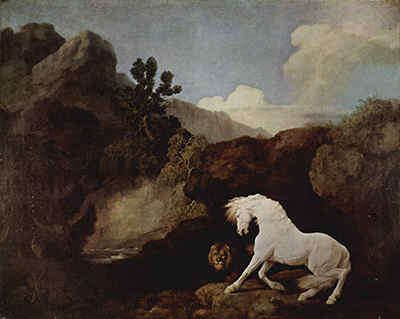
Nor should their artistic ambition be minimised. The Kimbell Art Museum's account of Stubbs and the horse relates rational enquiry to classical form, the sublime and patronal demand. [3] Yet ‘horse picture’ remains too broad to identify what a particular work does. An individual racehorse portrait can preserve markings, pedigree and ownership. A group of mares and foals can record a breeding programme while presenting intervals, touch and turning bodies across a wide canvas. A mounted scene joins horse and rider. A hunter beside a groom records readiness and skilled care. In a lion attack, the horse is no longer a secure possession posed for recognition but a body under pressure in an invented drama.
The same distinctions apply beyond horses. A water dog beside plants may invite attention to coat and stance; a pointing dog can embody a trained pause; paired hounds can belong to a hunt, a kennel and a landowner. Two bulls in contact create an action subject rather than a static livestock record. A zebra painted after live observation can still be placed in an invented woodland. ‘Animal portrait’, ‘sporting picture’, ‘natural-history subject’ and ‘conversation piece’ are therefore not interchangeable descriptions. They name different expectations about identity, action, ownership and setting.
Stubbs did not found animal painting in Britain. Horse portraiture, hunting images and studies of domestic and wild species belonged to older European traditions, while John Wootton and James Seymour supplied major British precedents. The distinctive question is not who began the genre, but how Stubbs enlarged its pictorial and evidential possibilities. [2] His sustained anatomical work was unusual; his commissions crossed species and social functions; his images moved through country houses, exhibitions, prints and later museums. The fuller phrase ‘animal painter’ recovers that breadth without denying why horses mattered.
A field larger than its academic rank
Animal painting and sporting art overlapped, but they did not coincide. Sporting art could include racing, hunting, shooting and coursing, together with the people, animals, equipment and landscapes that enabled those activities. Animal painting included sporting subjects but also companion dogs, farm animals, breeding groups, unfamiliar species and predator-prey inventions. A work such as Hound Coursing a Stag, dated about 1762 by the Philadelphia Museum of Art, depends upon pursuit and anticipated contact; a quiet dog portrait asks for another mode of attention. [4] Genre names help reconstruct expectations, but they cannot decide a picture's meaning before the object is examined.
Academic theory made the position harder. Its genre hierarchy privileged history painting: idealised human bodies engaged in morally or intellectually elevated action. Pictures tied to particular animals, places and appearances stood lower. That order shaped criticism, institutional ambition and later art history. It did not accurately measure the field's size or practical importance. Wright's research estimates that the number of practitioners producing animal and sporting art in Britain rose from just under fifty around 1760 to just under four hundred around 1840—approximately an eightfold increase. [2] A supposedly low subject could sustain an expanding professional community, private commissions and public display.
Demand followed the ubiquity of animals in eighteenth-century life. Horses and oxen moved people and goods. Cattle and sheep belonged to agriculture and breeding programmes. Dogs hunted, guarded, retrieved or lived as companions. These animals could be property, workers, signs of status and living subjects at the same time. A painting might advertise an owner's resources while registering the particular body of the animal owned. It could turn labour into an ordered rural scene while showing the strain that labour required. Those meanings are not mutually exclusive, and a responsible reading should not make affection erase possession or make possession erase observed individuality. [2]
The audience was also wider than the private commission alone suggests. Stubbs exhibited at the Society of Artists from 1762 and served as its president in 1772–73. He began showing at the Royal Academy in 1775, became an Associate in 1780 and was elected a Royal Academician the following year, although the election was not ratified after a disagreement over the required diploma work. [1] This record supports neither a heroic claim that he overthrew the genre hierarchy nor a simple story that the Academy excluded animal art. He worked through patrons and public exhibitions while institutional distinctions remained real.
The Royal Academy catalogue provides a revealing correction to the horse-only stereotype. Martin Postle counts at least fourteen dog paintings shown by Stubbs at the Academy between 1775 and 1791, against eleven exhibited works featuring horses. In 1791 alone the catalogue named a Pomeranian dog, a shepherd's dog from the south of France, a buffalo and a work associated with the Prince of Wales. [5] Those figures are bounded exhibition evidence, not a total of Stubbs's production. Even so, they show that Academy visitors encountered a more varied animal painter than the modern nickname implies.
Contemporary praise needs translation too. Critics commended animal pictures for ‘truth’, ‘nature’, ‘spirit’ or ‘life’, but these words were evaluative conventions rather than measurable synonyms for anatomical accuracy. Wright records comparisons in which Sawrey Gilpin's ‘spirit’ could be preferred to Stubbs's anatomical knowledge. [2] The present canon should not be projected backwards as though every eighteenth-century viewer agreed upon Stubbs's supremacy. Academic rank, critical language, patronal esteem, exhibition response, price and later museum reputation were different measures.
This historical frame restores complexity to apparently descriptive pictures. Description has sometimes been treated as obvious or intellectually thin: an artist records coat, conformation or breed, and the viewer merely recognises it. Yet exact surfaces can carry claims about possession and improvement; a turned animal gaze can complicate the viewer's control; scale can promote a particular body to an encounter normally reserved for human portraiture. Looking closely at what is described, and asking why it is arranged in that form for that audience, makes description a problem rather than a dismissal. [2]
Portrait, breeding group and designed image
Whistlejacket demonstrates why an exact animal portrait is more than an anatomical specimen. Painted about 1762 for Charles Watson-Wentworth, 2nd Marquess of Rockingham, the National Gallery canvas measures 296.1 by 248 centimetres. The chestnut stallion rears within a tall pale field, without rider or conventional landscape narrative. Coat, markings, bone and muscular action make an identifiable horse; scale and subtraction make a designed encounter. There is no evidence that a rider was ever planned. [6]
The surrounding commission matters. Rockingham's 1762 account itemised not one isolated masterpiece but an ensemble: brood mares and foals, stallions, mounted and unmounted human figures, five dogs, and a horse with a dog. A patron could order a suite through which animals, people, breeding and estate interests were distributed across several pictures. [6] The later singular fame of Whistlejacket can hide this original ecology of commissions.
Rockingham appears to have valued exact markings and conformation. Exactness, however, does not mean neutral transcription. The scholarly catalogue explains that Stubbs's knowledge of equine structure coexisted with adjustments that made the pose legible and the body fully available to view. The pale ground sharpens contour, interrupts ordinary spatial narrative and makes the horse's scale difficult to evade. It is safer to describe those effects than to invent a lost background or read the absence as a universal statement about animal freedom. [6]
Breeding groups organise identity differently. The Kimbell Art Museum's Mares and Foals Belonging to the 2nd Viscount Bolingbroke, painted about 1761–62, is an oil on canvas measuring 99 by 187 centimetres. Its title connects the animals to Frederick St John, 2nd Viscount Bolingbroke, while the broad support allows profiles, turns, overlaps and gaps to run laterally. [7] The mares and foals can be distinguished and compared, but the group should not be converted into a human family drama. Nearness, touch and attention are visible; domestic tenderness is an interpretation.
Stubbs's first royal commission offers a related but separate solution. Five Brood Mares at the Duke of Cumberland's Stud Farm in Windsor Great Park was exhibited at the Society of Artists in 1765. The National Trust records an oil on canvas of 99.1 by 188 centimetres: a broad, almost frieze-like sequence of mares beneath an oak, set by meadow and water. [8] Individual bodies, reproductive value, royal ownership and estate landscape occupy the same work. The painting can record a stud and still ask how repeated profiles, shifting heads and the sheltering tree bind several animals into one rhythm.
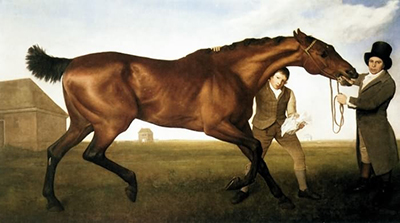
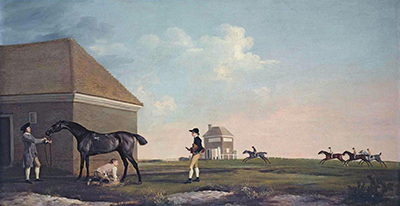
That distinction should govern the wider equine group. Brood Mares and Foals and Mares and Foals in a River Landscape are not aliases for every mare painting. The Duke of Cumberland's five mares retain a specific royal setting. Gimcrack on Newmarket Heath belongs to racehorse portraiture and racing geography, while the Duke of Richmond's horses exercising at Goodwood organise several animals, riders and work in motion. Bay Hunter with Two Playful Spaniels is deliberately mixed-species. Lord Grosvenor's Arabian Stallion with a Groom makes handling part of the identity.
The detailed institutions of the Turf, named owners, trainers, grooms, pedigrees and recorded performances belong to the account of Stubbs's racehorses and racing culture. Here the essential point is taxonomic: ‘horse portrait’ contains several pictorial and social jobs. A name can identify a celebrated individual; an owner can define a commission; a groom can expose labour; a group can record a breeding programme; a landscape can locate property or action. The animal remains observed, but observation has already entered a designed relation.
Observation, anatomy and the working animal painter
Stubbs's anatomical research is indispensable and easily exaggerated. His prolonged study of horse bodies and his 1766 publication offered knowledge of structures hidden by skin. That work made him unusual among animal painters; it was not a routine professional credential across the field. [2] In a 1771 letter to the Dutch anatomist Petrus Camper, Stubbs described pursuing the anatomy needed for painting. [6] The qualification matters. Anatomy served an artistic problem. It did not turn every finished image into an anatomical plate.
The relation between study and picture is therefore indirect but powerful. Knowledge of skeleton and musculature can inform the way a shoulder turns, a ribcage expands or a leg carries weight. A painter still chooses an instant, alters the visibility of overlapping limbs, negotiates a support and directs attention. Even a highly informed pose may be adjusted for legibility or energy. The full history of dissection, drawings, plates and publication belongs to The Anatomy of the Horse and Stubbs's anatomical method; the animal-painting lesson is that embodied knowledge and pictorial construction are partners, not rivals.
Stories about Stubbs working close to live animals are attractive because they seem to explain everything at once. One later account describes Whistlejacket reacting to the painted horse, an anecdote often used to certify extraordinary likeness. Wright warns that this story, transmitted by Ozias Humphry, may carry the romantic machinery of artist biography. [2] It can no longer bear the weight of proof. Stubbs clearly needed access to living animals and probably relied on owners, grooms or assistants to manage them. The exact duration, setting and drama of any undocumented session must remain unknown.
Live observation also has limits. A horse cannot hold a dynamic position indefinitely; two fighting bulls do not offer a controlled studio pose; a lion attack could not be staged safely. Drawings, memory, anatomical knowledge, repeated motifs and other visual sources could supplement sight. The resulting image is evidence of what Stubbs chose to construct, not a transparent recording of one continuous event. This is why the visible painting should be described before its supposed origin is narrated.
The same caution applies to landscape. The National Gallery catalogue notes that backgrounds in some later racehorse portraits may have been produced with another artist, possibly Benjamin Killingbeck. [6] That does not license a general theory of collaboration, but it prevents an automatic assumption that every tree, cloud and animal body came from one process or one hand. Exact object study must precede claims about a uniform Stubbs method.
A careful viewer can work in layers. First establish the physical object: current title, date, medium, dimensions, holder and accession. Then record what the image visibly permits—weight-bearing feet, points of contact, tack, turn of head, interval between bodies, relation to ground. Only then add documentary context: patron, exhibition, provenance, breed history or anatomical research. A source that answers one layer should not be forced to answer them all.
Posture without mind-reading
Stubbs's animals often appear alert or poised between actions. Those impressions are worth examining, but they should not be reported as direct access to an animal mind. The safest sequence begins with bodily facts and tests how the composition makes them significant.
In Yale's Brown and White Norfolk or Water Spaniel of 1778, the curly-coated dog stands with its body largely in profile, turns its head out of that profile and lifts one forepaw. Plants and water occupy the lower edge; the open setting keeps the contour readable. The object is beeswax and oil on panel, 80.6 by 97.2 centimetres, accession B2001.2.10. [9] A viewer may experience the turn as responsive, cautious or expectant, but the image itself secures direction, balance and interrupted movement—not melancholy, loyalty or self-consciousness.
The title provides a second lesson. Yale retains ‘Norfolk or Water Spaniel’. That alternative is not an editorial defect. Historical breed categories, later breed standards and current visual resemblance do not always align. Lincoln Museum similarly notes that its lemon-and-white water spaniel resembles a modern Clumber without being safely identified as a pure-bred example; the dog was commissioned by Charles Anderson-Pelham, for whom Stubbs also painted Ringwood. [10] Catalogue uncertainty can preserve the limits of knowledge better than a confident modern label.
The 1786 Bulls Fighting, also at Yale, replaces suspended movement with contact. Two bulls lower their heads and meet at horns and foreheads. Shoulders drive towards the junction; forelegs brace or advance; the ground receives the opposed weight. These visible relations support a reading of leverage and unstable force. [11] They do not settle which animal initiated the encounter, which will prevail, or whether ‘anger’ is the right account of either animal's state. The painting makes action intelligible without providing a transcript of motive.
A pointing dog sits between trained behaviour and pictorial convention. The Bayerische Staatsgemäldesammlungen dates its Hühnerhund, usually known in English as The Spanish Pointer, to about 1766. The dog is low and elongated, one forepaw lifted, tail nearly horizontal, with the head turned towards the left and slightly outward. A low horizon opens a broad sky around the arrested body. The museum explains the posture as the moment after the dog has caught a scent. [12] That interpretation is grounded in the working convention of a pointer, but the distinction still matters: the raised paw and directional body are visible; the scent is inferred.
The original print Dog (A Foxhound Viewed from Behind) makes the problem stranger. Dated 1 May 1788 by the Metropolitan Museum of Art, the roulette work with etching measures only 10.5 by 12.7 centimetres. It is recorded as a first and only state, designed and worked by Stubbs rather than simply translated from one of his paintings. [13] The dog turns its back to the viewer. Four paws meet the ground, the tail extends to one side and the head angles right against a dark tonal field. Identification does not depend upon frontal eyes or a face arranged for human recognition. Torso, haunches, stance and turn are sufficient to make a singular animal study.
The modest sheet also challenges an easy hierarchy of media. A tiny printed rear view asks for close handling and inspection, whereas Whistlejacket addresses the viewer at near bodily scale. Both can sustain animal portraiture, but through different distances and kinds of attention. This does not make the print a miniature painting; its marks, paper, lettering and potential circulation remain part of the object. The technical account belongs elsewhere, yet the thematic point is essential: reproduction is not the only relationship between Stubbs and print.
White Poodle in a Punt, painted about 1780, gives a dog a far larger vertical field. The National Gallery of Art records an oil on canvas measuring 127 by 101.5 centimetres, now in the Paul Mellon Collection. A dense white dog stands lengthwise on a narrow boat, body crossing the support while its head turns outward; water, willow and pale sky surround it. [14] The punt is not an incidental prop. It limits the footing beneath the dog, creates a horizontal platform inside a vertical canvas and binds portrait to landscape. No undocumented owner, outing or emotion is needed to make that relation interesting.
Different hound pictures pose further identity problems. Foxhound Called Ringwood names an individual, while The Spanish Pointer identifies a working type. Water Spaniel and the brown-and-white Norfolk or water spaniel preserve distinct objects and catalogue histories. The current Tate title A Couple of Foxhounds does not end debate: Getty's record notes a possible harrier identification. [15] The account of the paired hounds can retain that uncertainty without turning their proximity into a human conversation.
This evidence-first approach is not a refusal to interpret. It makes interpretation accountable. Ears, eyes and head turns can contribute, but so can the distribution of weight, pressure through limbs, distance from another body, relation to tack and the room permitted by the landscape. A viewer may describe an effect as tense, calm or attentive if the visual causes are named and the language remains a reading. What should be avoided is the conversion of a persuasive impression into an undocumented fact about what an animal felt.
Landscape, grouping, scale and support
An animal picture's environment is rarely neutral. Stubbs could remove a conventional setting, spread bodies laterally across estate land, isolate a dog against tone, place another on a boat, or enlarge predation to mural scale. These choices determine how animal individuality is encountered.
In Whistlejacket, pale ground breaks the ordinary link between horse portrait and identifiable property. The body seems immediate because little landscape competes with it, yet that immediacy is manufactured through omission. In the Bolingbroke and Cumberland mare paintings, horizontal supports and repeated profiles encourage comparison across the group. Tree, meadow and water can attach breeding bodies to land while also controlling light, depth and interval. A landscape may thus signify estate context and function as a compositional instrument at once.
The pointer's low horizon gives a trained pause a wide field of potential movement. The poodle's punt supplies a narrow platform and an enclosing watery setting. A Rough Dog, signed and dated 1790 and painted for the future George IV, places its subject beneath a tree in a rocky landscape with a glimpse towards the sea. [16] The dog portrait can be embedded in a fully articulated place rather than set against a generic patch of ground. Historical placement adds another layer: the Royal Collection records the painting at Carlton House and its transfer to the King's Lodge in 1822. That later move helps reconstruct royal collecting, although it cannot prove the room for which the work was first imagined.
Scale changes the viewer's bodily relation to the animal. A large horse or lion-and-horse canvas can dominate a gallery wall. A panel of fighting bulls concentrates contact into a smaller field. The rear-view foxhound print can be held and scrutinised closely. These are not merely technical facts. Monumentality can promote an animal subject into the visual territory of ambitious figure painting; intimacy can make tail, haunch and paw the basis of sustained looking. The account of Stubbs's technique, enamel and printmaking distinguishes the material procedures. This thematic comparison asks what the resulting object demands of a viewer.
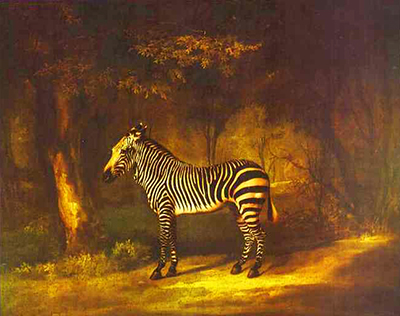
Landscape should not be mistaken for habitat evidence. Yale's Zebra places a directly observed animal within deep, British-looking woodland. The setting frames stripes against darkness and opens a lighter route into depth; it does not document the animal's original environment. [17] Nor should every country setting be read as a transparent estate portrait. Trees and distance can be conventional, invented or collaborative. The safe claim begins with how the setting works in this object, then adds whatever documentary evidence establishes place or authorship.
Grouping likewise operates without requiring human analogy. A mare turns towards a foal; two bulls press together; paired hounds occupy a shared field. These relations may suggest responsiveness because one body changes how another can move. Calling them motherly, argumentative or conversational imports a human script unless stronger evidence supports the language. Stubbs's pictures remain expressive when expression is understood as the organisation of bodies in space, not a list of emotions attached to faces.
Patrons, grooms and rural work
The named animal or owner can overshadow people whose labour made a commission possible. In the Metropolitan Museum's The Third Duke of Dorset's Hunter with a Groom and a Dog of 1768, a bridled horse stands in profile while reins lead to a seated groom beneath a tree. A small dog remains near the man's legs. The title names the Duke as owner; the current record does not supply personal names for hunter, groom or dog. [18] This inequality of naming is part of the evidence.
Calling the horse the principal subject does not reduce the groom to background furniture. Tack, reins and proximity show a working relation. Feeding, cleaning, exercising, presenting and calming horses required skill and routine, whether or not an archive preserved the worker's biography. The Metropolitan Museum interprets the horse's greater scale as a reflection of the commission's social priorities. [18] That is a useful reading when attributed: visual dominance, ownership and status reinforce one another. It is not a fact that can be derived from size alone.
Royal imagery produces another version. A Bay Horse with a Groom is a 1791 oil on panel measuring 56.9 by 73.3 centimetres. The Royal Collection identifies the man's clothing as royal livery. [19] Livery documents service to a household but does not give the groom a personal name. The same record places the work among Stubbs pictures acquired by George IV and mostly transferred in 1822 from Carlton House to the King's Lodge, apparently to form part of a sporting display. The image, commission and later arrangement reveal related histories; they are not one moment.
Other works distribute identity differently. William Anderson with Two Saddle-Horses names a person and two animals without naming the horses in its current route. Freeman, the Earl of Clarendon's Gamekeeper preserves a worker's surname and office. Phaeton with a Pair of Cream Ponies and a Stable-Lad coordinates vehicle, matched animals and an unnamed job. Pumpkin with a Stable-Lad names the horse but not the lad. Reading these titles closely prevents owner, patron, breeder, trainer, groom, jockey and sitter from becoming vague synonyms.
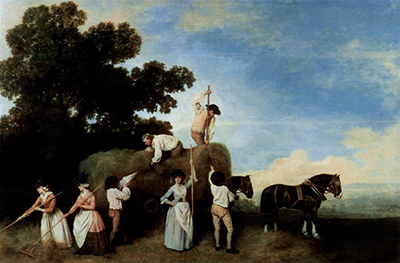
Rural-labour subjects push beyond portraiture. The National Trust's The Haymakers of 1783, made in oil and enamel on oak and measuring 91.4 by 137.2 centimetres, brings workers and a harnessed pair into one system of effort. Figures lift and load the crop; the animals provide draught power; one woman is represented with a wooden leg. The Trust regards the scene as probably imaginary or idealised rather than a documentary portrait of a named work gang. [20] Idealisation does not cancel labour, but it changes what the painting can prove about a real place or workforce.
The design also travelled across objects. The 1791 Reapers in Washington is a stipple-and-roulette print on laid paper, state one of three, recorded as painted, engraved and published by Stubbs. [21] Full comparison of the painted, enamel and printed Haymakers and Reapers belongs to their object-version pages. For animal painting, the comparison establishes that working horses could occupy a labour composition whose later circulation was not limited to the original support.
Conversation pieces mark another boundary. The National Gallery of Art identifies the sitters in its 1769 canvas as Captain Samuel Sharpe Pocklington; his wife, Pleasance; and, tentatively, his sister Frances. The rank ‘Captain’ and the remaining qualification correct the older route wording without pretending that the last sitter is certain. [22] A horse participates in this family and property setting, but it is not the only or necessarily primary portrait subject. The Pocklington group belongs in an animal-painting map precisely because it shows how the category opens into human portraiture.
Hunt and estate commissions widened the network again. They could combine mounted patrons, hounds, game, land, handlers and servants; two weak legacy subjects are responsibly merged into that general context rather than restored as unsupported object pages. The important principle is not that every painting secretly depicts labour. It is that access, handling and ownership should be restored where evidence supports them. An animal can receive extraordinarily close attention within a commission still structured by property and unequal naming.
Wild encounter and predation
The word ‘exotic’ compresses different animals and histories into a single viewpoint centred on Britain. Exact object study begins by separating them. Yale's Zebra is a 1763 oil on canvas measuring 102.9 by 127.6 centimetres. Current research supports Stubbs's direct study of a female Cape mountain zebra brought to London in 1762 and corrects an old claim: other zebras had been kept at Kew in the 1740s, so this animal was conspicuous but not Britain's first. [17]
Direct observation does not make the whole painting documentary. The zebra stands in constructed woodland rather than a recorded southern African habitat. Current Yale research also asks modern viewers to confront public spectacle, transport and harm. [17] That recontextualisation is important, but it should be presented as documented museum research rather than a generic verdict pasted onto every unfamiliar species. The full acquisition and display systems belong to Stubbs's exotic animals and empire and the exact Zebra object page.
Manchester's current title A Cheetah and a Stag with Two Indian Attendants retains human mediation in the subject. The gallery dates the oil on canvas to about 1764, identifies the cheetah by the nickname Miss Jenny and names one attendant as John Morgan, an animal handler from Bengal. [23] Naming Morgan changes the reading: the figure is not merely a decorative sign of foreignness but a documented participant in an organised animal encounter. The dedicated cheetah painting can reconstruct patronage, courtly performance and transnational movement without reducing them to moral shorthand.
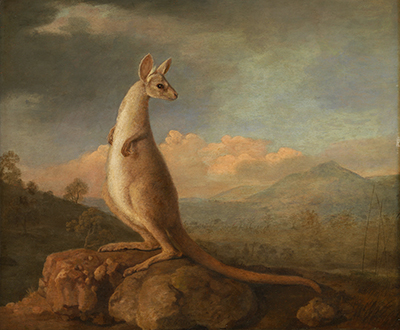
Other animals require other evidential chains. The Kongouro from New Holland raises questions about specimen, image and distance. Drill and Albino Baboon and the late Monkey concern primates but not necessarily the same encounter or version problem. The enamel Sleeping Leopard changes support and viewing scale. The Moose and Portrait of a Large Dog (Dingo) must each be tested against current species, object and source evidence. A species list cannot substitute for those histories.
Predator-prey subjects form a further category because the encounter may be invented from unequal sources. Yale's A Lion Attacking a Horse of 1762 measures 243.8 by 332.7 centimetres. At that scale the closing bodies, contact and vulnerability become a public pictorial event, far from a small study. [24] Yet no single symbolism—civilisation and savagery, beauty and violence, or a universal natural law—can be applied automatically. The lion-and-horse series owns its models, episodes, chronology and variants; Horse Frightened by a Lion and A Lion Attacking a Horse keep anticipation and bodily contact from becoming the same event.
Across these works, observation must be disaggregated. Stubbs may have seen a living animal, studied a dead specimen, consulted another image or recombined remembered forms. Setting and encounter could be invented even when one body came from life. The ethical and historical context likewise depends upon exact routes—who transported which animal, under whose authority, for what display, and with what documented consequences. Precision is stronger than either celebratory wonder or undifferentiated condemnation.
Exhibition, circulation and the making of a canon
Many animal pictures began as private commissions, but their meanings did not remain fixed inside the commission. Society and Royal Academy exhibitions placed named and unnamed animals before paying publics. Catalogues categorised them; critics compared ‘truth’, ‘spirit’ and ‘life’; prints moved designs into new hands; later owners rearranged them in rooms; museums assembled selective histories. Visibility is an event with a date and an institution, not an automatic property of a masterpiece.
The 1765 exhibition of the Duke of Cumberland's mares, for example, made a royal stud commission available to viewers who did not belong to the household. [8] Stubbs's dog-heavy Royal Academy record reveals another public profile. [5] In 1791 the range from dog subjects to buffalo and royal portraiture resisted a neat specialist label. Animal painting could enter public criticism while remaining connected to elite access and ownership.
Repetition complicated exhibition. Richard Johns records that Stubbs returned to the Academy in 1799 with Monkey, a work closely repeating a design shown in 1775, despite a rule against exhibiting copies. [25] The incident should not be turned into a morality tale about deception or decline. It shows that ‘version’, ‘copy’ and ‘new exhibition work’ were practical institutional categories. The same-looking composition could have a different date, support, provenance and public history.
Print made another kind of difference. Some sheets reproduced paintings; others, such as the rear-view foxhound, were conceived as prints. Rural-labour compositions could move from painting or enamel into published impressions. An image's reach might expand while scale, surface, tonal structure and ownership changed. Related object pages and technical studies must identify each state and maker rather than let the subject title collapse painting and print into one image. Judy Egerton's catalogue raisonné remains essential for separating a selective thematic account from the full corpus and its versions. [26]
Rooms also framed interpretation. Whistlejacket later occupied a large room at Wentworth House with only two family portraits. [6] George IV's Stubbs group was moved to the King's Lodge for what the Royal Collection describes, with appropriate caution, as a sporting display. [19] These placements can tell us how later owners valued and grouped the works. They cannot silently be carried backwards as proof of the artist's original intention.
Modern collecting has been equally formative. The Metropolitan Museum notes that Paul Mellon bought his first Stubbs in 1936 and eventually assembled nearly two hundred works; his sustained interest contributed materially to the artist's reassessment. In 2015 the Met brought eight Yale paintings together for a focused display. [27] Yale now holds the strongest group of Stubbs paintings in North America, within a collection whose landscape and sporting strengths shape comparison. [28] The spaniel, bulls, zebra and poodle are therefore not merely surviving objects; they are part of a modern institutional view built through selection, acquisition, scholarship and exhibition.
Not every international movement belongs to that twentieth-century story. The Pinakothek records that its pointing dog was acquired from an English source around 1800; it is now the only Stubbs in a German public collection. [12] The object's early continental passage and present rarity are different facts from Mellon's later concentration of works in the United States.
Retrospectives broaden the canon again. A Frick display could place animal subjects beside landscapes, portraits and rural-labour pictures, making category boundaries visible through juxtaposition. [29] Such exhibitions help recover range, but they also produce a new Stubbs for their own moment. The iconic status of Whistlejacket, the prominence of Mellon's collection and current attention to colonial animal histories should all be historicised. They are powerful ways of seeing now, not timeless summaries of every earlier audience.
Ways through Stubbs's animal painting
A useful reading begins with identity. Establish the current title, date, medium and support, dimensions, holder and accession. Ask whether the thing being viewed is a painting, anatomical drawing, original print, reproductive print, enamel, relief, study or later image. A familiar composition may exist in several versions; one title does not make them the same object.
Next define the picture's job provisionally. Is the animal named? Does the title attach it to an owner? Is the work a breeding group, sporting event, labour scene, conversation piece, observed unfamiliar species or imagined encounter? Then describe bodies before assigning feelings: which feet bear weight; where reins lead; whether horns meet; how a head turns against the torso; what distance separates two animals; what the setting allows or prevents.
Only after that should the surrounding network be restored. A patron commissioned; an owner possessed; a breeder planned lineage; a trainer conditioned; a groom or handler managed; an exhibition made the work public; a print altered circulation; a collector and museum shaped later visibility. Those roles can converge, but they are not synonyms. A gap in a name, provenance or breed history should remain visible rather than be filled by confidence.
This method brings the horse label back in a more useful form. Horses explain much of Stubbs's opportunity and some of his deepest research. They do not monopolise his attention. Across a spaniel's lifted paw, a pointer's arrested body, two bulls' opposing pressure, a groom's reins, a zebra in invented woodland, workers beside draught animals and a lion closing upon a horse, animal painting becomes a field of exact differences. The George Stubbs guide connects those differences without reducing them to one species, one technique or one moral meaning.
Videos on George Stubbs
Explore Stubbs’s equestrian painting in its wider context, including two readings of Whistlejacket.
A Horse Lover’s Guide to the YCBA
A museum tour that places Stubbs alongside other artists who painted horses. It includes a look at Pumpkin with a Stable-lad.
Watch on YouTubeGeorge Stubbs artworks directory
Search works and related prints documented in this guide. Separate versions and printing matrices have separate entries; printmakers are named where known. Unidentified historical titles and untraced studio-sale material are discussed in the essays. A dash means that a date is not established here.
| Name | Date | Medium |
|---|---|---|
| A Bay Horse with a Groom | 1791 | Painting |
| A Bay Hunter with Two Playful Spaniels | 1777 | Painting |
| A Bay Hunter, a Springer Spaniel and a Sussex Spaniel in a wooded river Landscape | 1782 | Painting |
| A Cheetah and a Stag with Two Indian Attendants | about 1764 | Painting |
| A Couple of Fox Hounds (coloured print after Stubbs) | — | Print after Stubbs |
| A Couple of Foxhounds | 1792 | Painting |
| A Foxhound on the Scent | 1788 | Drawing |
| A Gentleman driving a Lady in a Phaeton | 1787 | Painting |
| A Grey Horse | 1793 | Painting |
| A Grey Horse (cantering companion) | 1793 | Painting |
| A Grey Stallion in a Landscape | — | Painting |
| A Horse Affrighted at a Lion | 1 May 1788 | |
| A Horse Belonging to the Rt. Honourable Lord Grosvenor called Bandy from his Crooked Leg | about 1763 | Painting |
| A Horse Frightened by a Lion | 1777 | |
| A Lion (A Lion Resting on a Rock) | 1 May 1788 | |
| A Lion Attacking a Horse | 1770 | Painting |
| A Lion Attacking a Horse (monumental Yale canvas) | 1762 | Painting |
| A lion attacking a horse (NGV) | about 1765 | Painting |
| A Lion Devouring a Horse (1788 print) | 1788 | |
| A lion devouring a horse (attribution disputed) | Proposed mid-1770s | Painting |
| A mare and foal with a bay horse | 1771 | Painting |
| A Monkey | 1799 | Painting |
| A Prancing Horse, Facing Right | c. 1790 | Drawing |
| A Rough Dog | 1790 | Painting |
| A Saddled Bay Hunter | 1786 | Painting |
| A Sleeping Leopard | 1 January 1791 | |
| A Tiger and a Sleeping Leopard | 1 May 1788 | |
| A Tigress (John Dixon after Stubbs) | 1772 | Print after Stubbs |
| A Tyger (A Recumbent Leopard by a Tree) | 1 May 1788 | |
| A Tyger (Sleeping Leopard) | 1 May 1788 | |
| An animal found on the coast of New Holland called kanguroo (after Stubbs) | 1773 | Print after Stubbs |
| An animal of a new species found on the coast of New South Wales (after Stubbs) | July 1773 | Print after Stubbs |
| Antinous and Jockey | — | Painting |
| Antinoüs, a chestnut racehorse, in a landscape | Undated | Painting |
| Bandy belonging to Lord Grosvenor (print after Stubbs) | — | Print after Stubbs |
| Baronet (George Townley Stubbs after Stubbs) | 20 February 1794 | Print after Stubbs |
| Baronet with Sam Chifney Up | 1791 | Painting |
| Baronet with Samuel Chifney up (Royal Collection) | 1791 | Painting |
| Bay Hunter by a Lake | 1787 | Painting |
| Brood Mares (Benjamin Green after Stubbs) | Issue 14 November 1776 | Print after Stubbs |
| Brood Mares and Foals | usually dated 1767 | Painting |
| Brown and White Norfolk or Water Spaniel | 1778 | Painting |
| Bulls Fighting | 1786 | Painting |
| Captain Samuel Sharpe Pocklington with His Wife, Pleasance, and possibly His Sister, Frances | 1769 | Painting |
| Death of the Doe (attribution disputed) | 1804 | |
| Der Englische Hühnerhund (Johann Wölfle after Stubbs) | about 1860 | Print after Stubbs |
| Dog (A Foxhound Viewed from Behind) | 1 May 1788 | |
| Dog [A Foxhound on the Scent] | 1788 | |
| Drill and albino baboon | before 1789 | Painting |
| Eclipse (Charles Hunt after Stubbs) | 12 November 1839 | Print after Stubbs |
| Eclipse (George Townley Stubbs after Stubbs) | 1796 | Print after Stubbs |
| Eclipse (oil study) | — | Painting |
| Eclipse (Thomas Burke after Stubbs) | First published 1772 | Print after Stubbs |
| Eclipse and John Wildman (Benjamin Green after Stubbs) | 1772 | Print after Stubbs |
| Eclipse at Newmarket (Jockey Club version) | Proposed early 1790s; often dated 1770 | Painting |
| Eclipse at Newmarket with a groom and jockey | 1770 | Painting |
| Eclipse with Mr Wildman and His Sons | 1769–71 | Painting |
| Eclipse, the Property of Capt.n O Kelly (anonymous print after Stubbs) | Imprint 4 June 1804; impression undated | Print after Stubbs |
| Euston | 1774 | Painting |
| Finished Study for the Seventh Anatomical Table of the Muscles of the Horse | 1756–58 | Drawing |
| Five Brood Mares at the Duke of Cumberland's Stud Farm in Windsor Great Park | 1765 | Painting |
| Fowl Body, Lateral View (Highly Finished Study for an Unpublished Table; Shows the Last Stage in Dissection) | — | Drawing |
| Fowl Body, Lateral View (Probably Prepared for Transfer to the Plate for Engraving of Table XV) | — | Drawing |
| Fowl Skeleton, Lateral View (Finished Study for Table V) | — | Drawing |
| Freeman, the Earl of Clarendon's Gamekeeper, with a Dying Doe and Hound (Yale) | 1800 | Painting |
| George Stubbs (enamel self-portrait) | 1781 | Enamel |
| Gimcrack (George Townley Stubbs after Stubbs) | 1775 | Print after Stubbs |
| Gimcrack on Newmarket Heath, with a trainer, a jockey and a stable lad | about 1765 | Painting |
| Gimcrack, with John Pratt up, on Newmarket Heath | about 1765 | Painting |
| Hambletonian, Rubbing Down | 1800 | Painting |
| Hay-Makers | 1791 | |
| Haycarting | 1795 | Enamel |
| Haymakers | 1785 | Painting |
| Haymakers (Lady Lever Art Gallery) | 1794 | Enamel |
| Hollyhock (with later additions by Vernet and Boucher) | about 1765–70 | Painting |
| Horse Attacked by a Lion (Episode C) | 1768–69 | Painting |
| Horse Attacked by a Lion (Tate enamel) | 1769 | Enamel |
| Horse Devoured by a Lion | Possibly exhibited 1763 | Painting |
| Horse Frightened by a Lion | 1770 | Painting |
| Horse Frightened by a Lion (Episode A; Wedgwood and Bentley after Stubbs) | — | Sculpture |
| Horse Frightened by a Lion (Tate) | Possibly exhibited 1763 | Painting |
| Horse Frightened by a Lion (Yale) | 1762–68 | Painting |
| Horse in the Shade of a Wood | 1780 | Painting |
| Hound Coursing a Stag | about 1762 | Painting |
| Human Figure, Anterior View (Intended for a Plate That was Never Published) | — | Drawing |
| Human Skeleton, Lateral View | 1795–1806 | Drawing |
| Hunt servants setting out (Southill commission) | 1767 | Painting |
| Hühnerhund (The Spanish Pointer) | about 1766 | Painting |
| John and Sophia Musters Riding at Colwick Hall | 1777 | Painting |
| John Musters on his hunter Pilgrim | 1777–78 | Painting |
| Labourers | 1789 | |
| Labourers (Richard Earlom after Stubbs and Amos Greene) | 25 March 1790 | Print after Stubbs |
| Laetitia, Lady Lade (d.1825) | 1793 | Painting |
| Lemon and White Water Spaniel | — | Painting |
| Lion Attacking a Stag | — | Painting |
| Lord Grosvenor's Arabian Stallion with a Groom | about 1765 | Painting |
| Lord Grosvenor's Arabian Stallion with a Groom (Peter Mazell after Stubbs) | 1771 | Print after Stubbs |
| Mambrino (Eaton Hall painting) | — | Painting |
| Mambrino (George Townley Stubbs after Stubbs) | 1794 | Print after Stubbs |
| Mares and Foals belonging to the 2nd Viscount Bolingbroke | about 1761–62 | Painting |
| Mares and foals beneath large oak trees | — | Painting |
| Mares and Foals by a stream | Exhibited 1764 | Painting |
| Mares and Foals in a River Landscape | about 1763–68 | Painting |
| Mares and Foals in an Extensive Landscape | about 1769 | Painting |
| Mares and Foals without a Background | 1762 | Painting |
| Moose Deer (after Stubbs) (Arctic Zoology plate VIII) | 1784–85 publication | Print after Stubbs |
| Newmarket Heath with a Rubbing-Down House | — | Painting |
| Otho (1796 print after Stubbs) | 1 December 1796 | Print after Stubbs |
| Otho, with John Larkin up | 1768 | Painting |
| Pangloss | about 1762 | Painting |
| Patch (Grafton commission) | 1759 | Painting |
| Phaeton and the Chariot of the Sun (enamel) | 1775 | Enamel |
| Phaeton with a Pair of Cream Ponies and a Stable-Lad | 1780–84 | Painting |
| Phillis | 1772 | Painting |
| Portrait of a Large Dog (Dingo) | 1772 | Painting |
| Pumpkin with a Stable-lad | 1774 | Painting |
| Racehorses Exercising at Goodwood | 1759–60 | Painting |
| Reapers (1791 print) | 1791 | |
| Reapers (Tate) | 1785 | Painting |
| Reapers (Yale) | 1795 | Enamel |
| Red Deer: A Stag and a Hind | 1792 | Painting |
| Richard Wedgwood | — | Enamel |
| Ringwood, a Brocklesby Foxhound | 1792 | Painting |
| Scrub, a bay horse belonging to the Marquess of Rockingham | about 1762 | Painting |
| Self Portrait on a White Hunter | 1782 | Enamel |
| Self-Portrait | about 1759 | Painting |
| Shooting (1770 Woollett plate after Stubbs) | 1770 | Print after Stubbs |
| Shooting (1771 Woollett plate after Stubbs) | 1771 | Print after Stubbs |
| Shooting at Goodwood | 1759–60 | Painting |
| Sir John Nelthorpe as a boy | 1756 | Painting |
| Sir John Nelthorpe partridge shooting with one pointer | — | Painting |
| Sir John Nelthorpe, 6th Baronet, out Shooting with His Dogs in Barton Field, Lincolnshire | 1776 | Painting |
| Sleeping Leopard | 1777 | Enamel |
| Soldiers of the 10th Light Dragoons | 1793 | Painting |
| Stallion and Mare (George Townley Stubbs after Stubbs) | 1776; reissued 1789 | Print after Stubbs |
| Steward and gamekeeper with dogs (Southill commission) | 1767 | Painting |
| Studies of a Lemur (Lemur murinus) in six different attitudes | 1773 | Drawing |
| Study for the Self-portrait in Enamel | c. 1781 | Drawing |
| Study of a Lemur | 1773 | Drawing |
| Study of a Racehorse in Action: Galloping to Left, a Semi-Anatomical Study, with Skin Flayed to Show Action of Muscles | — | Drawing |
| Study of the Legs of a Draught-Horse Pulling a Harrow (attributed to Stubbs) | Proposed about 1786 | Drawing |
| Sweet William (Grosvenor panel) | — | Painting |
| Sweet William (Turf Gallery canvas) | — | Painting |
| The Black Stallion Sampson, Portrayed from Three Angles (with landscape additions) | about 1764 | Painting |
| The Charlton Hunt | 1759–60 | Painting |
| The Fall of Phaeton | — | Sculpture |
| The Frightened Horse | 1780 | Sculpture |
| The Grosvenor Hunt | — | Painting |
| The Haymakers (Upton House) | 1783 | Painting |
| The Horse and Lion (George Townley Stubbs after George Stubbs) | 1770 | Print after Stubbs |
| The Kongouro from New Holland | 1772 | Painting |
| The Labourers | 1779 | Painting |
| The Labourers (Southill original) | 1767 | Painting |
| The lion and horse (Benjamin Green after Stubbs) | 1769; reissued 1777 | Print after Stubbs |
| The Milbanke and Melbourne Families | about 1769 | Painting |
| The Moose | 1770 | Painting |
| The Prince of Wales's Phaeton | 1793 | Painting |
| The Reapers (Upton House) | 1783 | Painting |
| The Sebra, or Wild Ass (George Townley Stubbs after Stubbs) | 1771 | Print after Stubbs |
| The Spanish Pointer (Bradford version) | about 1766–68 | Painting |
| The Spanish Pointer (William Woollett after Stubbs) | January 1768 | Print after Stubbs |
| The Third Duke of Dorset's Hunter with a Groom and a Dog | 1768 | Painting |
| Thomas Freeman, Lord Clarendon's gamekeeper, with a dog and a shot doe (with George Townly Stubbs) | 1803 | Painting |
| Turf, with Jockey up, at Newmarket | — | Painting |
| Turk and Crab | — | Painting |
| Two Bay Hunters Communing On The Bank Of A Lake | — | Painting |
| Tygers at Play | 1780 | |
| Viscount Gormanston's White Dog | 1781 | Painting |
| Viscount Gormanston's White Dog (canvas version) | — | Painting |
| Water Spaniel | 1769 | Painting |
| Wedgwood Family Portrait | 1780 | Painting |
| Whistlejacket | about 1762 | Painting |
| Whistlejacket with two other stallions and a groom | Recorded 1762 | Painting |
| White Poodle in a Punt | about 1780 | Painting |
| William Anderson with two Saddle-Horses | 1793 | Painting |
| Working Drawing for the Seventh Anatomical Table of the Muscles of the Horse | 1756–58 | Drawing |
| Zebra | 1763 | Painting |
Discussion
Look again at the images and ideas explored in George Stubbs and Animal Painting. These editorial prompts invite your observations.
Reader Insights
Which animal’s pose most rewards close observation?
How does the presence of a rider, keeper or groom change your reading of an animal portrait?
Which comparison helps you separate an animal’s visible action from an interpretation of its feelings?
Join the Conversation
Share a detail, comparison or question about George Stubbs and Animal Painting below.
References
- Royal Academy, “George Stubbs ARA”. (accessed 2026-08-30). View source.
- Alison E. Wright, Animal and Sporting Painting in Britain, 1760–c.1850: Its Artistic Practices, Patronage and Public Display (PhD thesis, University of East Anglia, 2018), especially pp. 13–28, 43–55, 68, 80–108, 145–170 and 193–196. and (accessed 2026-08-30). View source 1. View source 2.
- Kimbell Art Museum, “Stubbs and the Horse”. (accessed 2026-08-30). View source.
- Philadelphia Museum of Art, George Stubbs, Hound Coursing a Stag, 1944-20-1. (accessed 2026-08-30). View source.
- Martin Postle, “1791: George Stubbs and the Empty Picture Frame”, Royal Academy Chronicle 250, Paul Mellon Centre. (accessed 2026-08-30). View source.
- National Gallery, George Stubbs, Whistlejacket, NG6569, ; and Judy Egerton, scholarly catalogue entry, (accessed 2026-08-30). View source 1. View source 2.
- Kimbell Art Museum, George Stubbs, Mares and Foals Belonging to the 2nd Viscount Bolingbroke, AP 2024.01. and (accessed 2026-08-30). View source 1. View source 2.
- National Trust, George Stubbs, Five Brood Mares at the Duke of Cumberland's Stud Farm in Windsor Great Park, NT 1535163. (accessed 2026-08-30). View source.
- Yale Center for British Art, George Stubbs, Brown and White Norfolk or Water Spaniel, B2001.2.10. and (accessed 2026-08-30). View source 1. View source 2.
- Lincoln Museum, “Lemon and White Water Spaniel by George Stubbs”. (accessed 2026-08-30). View source.
- Yale Center for British Art, George Stubbs, Bulls Fighting, B1977.14.93. and (accessed 2026-08-30). View source 1. View source 2.
- Bayerische Staatsgemäldesammlungen, George Stubbs, Hühnerhund, inventory 1602. (accessed 2026-08-30). View source.
- Metropolitan Museum of Art, George Stubbs, Dog (A Foxhound Viewed from Behind), 49.49.6, ; collection API, ; and British Museum, impression 1865,0114.919, (accessed 2026-08-30). View source 1. View source 2. View source 3.
- National Gallery of Art, George Stubbs, White Poodle in a Punt, 1999.80.22. (accessed 2026-08-30). View source.
- Tate, George Stubbs, A Couple of Foxhounds, T01705, ; and Getty CONA object record, (accessed 2026-08-30). View source 1. View source 2.
- Royal Collection Trust, George Stubbs, A Rough Dog, RCIN 405001. (accessed 2026-08-30). View source.
- Yale Center for British Art, George Stubbs, Zebra, B1981.25.617, and ; and Yale News, “The first zebra publicly exhibited in Britain”, (accessed 2026-08-30). View source 1. View source 2. View source 3.
- Metropolitan Museum of Art, George Stubbs, The Third Duke of Dorset's Hunter with a Groom and a Dog, 1980.468, and (accessed 2026-08-30). View source 1. View source 2.
- Royal Collection Trust, George Stubbs, A Bay Horse with a Groom, RCIN 402406. (accessed 2026-08-30). View source.
- National Trust, George Stubbs, The Haymakers, NT 446708. (accessed 2026-08-30). View source.
- National Gallery of Art, George Stubbs, Reapers, 223249. (accessed 2026-08-30). View source.
- National Gallery of Art, George Stubbs, Captain Samuel Sharpe Pocklington with His Wife, Pleasance, and possibly His Sister, Frances, 1952.9.4. (accessed 2026-08-30). View source.
- Manchester Art Gallery, Gallery 3 booklet and collection gateway, entry for A Cheetah and a Stag with Two Indian Attendants. and (accessed 2026-08-30). View source 1. View source 2.
- Yale Center for British Art, George Stubbs, A Lion Attacking a Horse, B1977.14.71. (accessed 2026-08-30). View source.
- Richard Johns, “1799: Unfinished Monkey Business”, Royal Academy Chronicle 250, Paul Mellon Centre. (accessed 2026-08-30). View source.
- Yale University Press, Judy Egerton, George Stubbs, Painter: Catalogue Raisonné. (accessed 2026-08-30). View source.
- Metropolitan Museum of Art, “Paintings by George Stubbs from the Yale Center for British Art” (2015). (accessed 2026-08-30). View source.
- Yale Center for British Art, “Paintings and Sculpture”. (accessed 2026-08-30). View source.
- The Frick Collection, “George Stubbs (1724–1806): A Celebration”, archived exhibition image list. (accessed 2026-08-30). View source.
- Basic title, date and material metadata for Tate’s Reapers (T02257) and Otho (T02375) is adapted from the Tate collection dataset, October 2014, released under CC0. TheHistoryOfArt.org has reconciled labels and versions. This credit does not apply to Tate’s authored catalogue commentary or images.
- Data Source: Yale Center for British Art. Basic object fields are adapted and reconciled for this directory. Reuse is subject to the Center’s Open Data and Data Services Terms of Use. No museum endorsement is implied. This metadata credit does not relabel scholarly essays or images as open data.
- Basic object metadata for A Horse Frightened by a Lion, 1985.38, The Cleveland Museum of Art, John L. Severance Fund, is available under CC0. Titles and design-level grouping have been reconciled for this directory.