 by Tom Gurney
Tom Gurney BSc (Hons) is an art history expert with over 20 years experience
Email: tomgurney1@gmail.com / Phone: +44 7429 011000
George Stubbs: Lion and Horse Series: Introduction
George Stubbs returned to the confrontation between a lion and a horse for more than thirty years. He did not treat it as a single composition to be copied unchanged. Sometimes the animals remain apart; elsewhere the lion has reached the horse, or the horse has fallen. The design moves between monumental and cabinet scale, from oil on canvas to a wax-bearing panel, enamel, paper impressions and a ceramic relief. Calling these objects a series is useful so long as it means a sustained investigation, not a numbered story painted in order. [1] [2]
The National Heritage Memorial Fund’s acquisition record, dated 19 January 1994, identifies seventeen known works across oils, enamels, prints and a Wedgwood relief. A Yale interpretation describes the huge 1762 A Lion Attacking a Horse as the first of sixteen paintings. [1] [3] Those statements define their material fields differently; they are not figures to add together. Attributions and the inclusion of repetitions can also alter a catalogue. Most of the central objects are paintings, but drawings, printed impressions and reliefs need their own maker and material labels. The safest way through the subject is therefore to name each object exactly, compare what changes, and keep a modern episode map separate from the order in which George Stubbs made the works.
At a Glance
- DurationMore than thirty years of related work [1] [2]
- Series structureRepeated episodes across different media [1] [2]
Contents
- What the four episodes can and cannot explain
- The monumental attack of 1762
- Alarm and aftermath in the probable 1763 pair
- How a pair organises time
- Repetition changes landscape, scale and material
- Small supports, close viewing and enamel reception
- A made image, not the record of an African attack
- The antique was already an interpretation
- What captive observation could provide
- Looking at action without supplying thoughts
- Videos on George Stubbs
What the four episodes can and cannot explain
The National Heritage Memorial Fund describes four episodes, beginning with the horse alarmed by a nearby lion. [1] Its account does not provide a complete set of four fixed titles. For comparison, alarm, active attack and the lowered or overwhelmed horse offer useful broad distinctions. They also mark a change in distance. In an alarm picture, ground remains between the animals. In an attack, paws and jaws close that interval. A lowered body presents another arrangement of weight and contact. None of these labels should replace scrutiny of a particular painting: a title containing ‘devoured’ does not establish that its horse is visibly dead.
Yet this is not a production timetable. The earliest securely dated monumental picture already shows the animals locked together. Two canvases probably exhibited as companions in 1763 move from alarm to devouring, while paintings made around 1765 and in 1770 return to active attack. A 1770 frightened-horse canvas and a print published in 1788 revisit the first encounter. [1] [4] [5] [6] [7] Stubbs alternated stages instead of completing one and advancing permanently to the next.
The episode names can also hide differences within one category. “Attack” covers a lion stretched across a life-size horse on an enormous canvas, a smaller pair enclosed by a new landscape, a compact wax-and-oil panel and a fired enamel on copper. They share an action but not their support, scale, date, ownership history or surface. A reliable map must hold resemblance and object identity together.
The monumental attack of 1762
The Yale Center for British Art's A Lion Attacking a Horse, B1977.14.71, is dated 1762. It is oil on canvas and measures 243.8 by 332.7 centimetres. [8] Those dimensions make the encounter almost architectural. The picture is not merely a small animal study enlarged: horse and lion spread across a field wider than many domestic interiors, bringing their contact close to a standing viewer's own scale. Yale calls it the first of sixteen paintings on the theme and connects its physical force with eighteenth-century discussions of the sublime. [3]
The high-resolution image rewards a slower account than “lion attacks horse”. The chestnut horse's torso pushes across the foreground, but its directions conflict. Its forelegs extend on different diagonals, the hindquarters turn, and the neck folds back towards the lion. One ear lies nearly flat; the visible eye is set within a sharply turned head; the mouth opens. The lion forms another long diagonal across the horse's back. Its hind paws grip farther along the body while its forelimbs and jaws press towards the upper torso. Tail, mane and legs extend the collision beyond the central knot of heads and paws. [8]
The setting participates without becoming a generic symbol. A dark tree and rock face crowd the left edge. To the right, the lion's raised tail cuts into a more open sky above a distant valley. This alternation makes the bodies appear both trapped and exposed. It is observable structure; it does not prove that the horse represents a nation, a social class or a human virtue.
Patronage helps explain the exceptional scale. A receipt dated 30 December 1762 records the Marquess of Rockingham paying Stubbs eighty guineas for animal pictures described in terms of a lion and a horse at life size. Judy Egerton’s National Gallery catalogue associates the payment with the probable pair of a lion attacking a horse and a lion attacking a stag; it should not be reassigned to Whistlejacket. [9] The evidence places the 1762 canvas within ambitious aristocratic display; the 1770 painting of a lion attacking a horse offers a distinct later treatment of the subject.
Alarm and aftermath in the probable 1763 pair
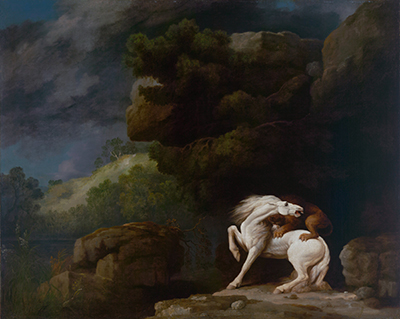
Tate's Horse Frightened by a Lion, T06869, is an oil on canvas possibly exhibited in 1763, with unconfirmed dimensions of 70.5 by 101.9 centimetres. Tate's Horse Devoured by a Lion, T02058, is also catalogued as possibly exhibited in 1763: oil on canvas, 69.2 by 103.5 centimetres. [2] [10] [11] Their close formats support the institutional and specialist conclusion that they were probably companions. They are also likely to be the two lion-and-horse subjects shown at the Society of Artists in 1763. [1] [2] “Probably” and “likely” matter: neither picture should acquire a certain exhibition history merely because the pairing is persuasive.
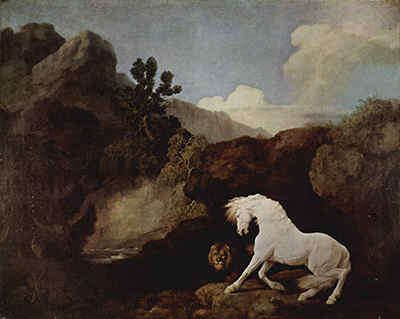
The first holds the animals apart. The horse reacts before physical contact, so open ground becomes active pictorial material. Stubbs can direct attention through a changed stance, angled neck and the relation between a light horse and a darker recess. In the companion, the horse folds low over the stony ground, its head still raised while the lion maintains contact. That visible arrangement does not warrant a clinical account of death or feeding. The lowered body and crowded contact replace the unstable upright balance of the alarm scene. The pair does not simply supply a beginning and ending. Put side by side, it asks how anticipation and aftermath can carry force without showing the central assault.
Other frightened-horse pictures prevent T06869 from becoming a generic template. Yale's B1977.14.73, dated 1762–68, is a different oil on canvas measuring 70.5 by 104.1 centimetres. [12] In its inspected image, a low lion occupies the shadowed left while the horse braces on the brighter right. The horse's front legs bear unevenly, its neck bends back, and the direction of ears and mane intensifies the turn. A rock wall limits the lion's side; pale sky opens above the horse. Distance, light and terrain organise the encounter before any contact occurs.
These distinct objects require distinct histories. The fuller study of the Walker's frightened horse compares its composition with Tate's earlier version. The corresponding account of Horse Devoured by a Lion can establish T02058's exact landscape version. The thematic comparison here joins them without substituting for either study.
How a pair organises time
Looking across Tate’s probable companions makes the distinction between painted time and calendar time especially clear. The alarm picture opens a question about what might happen next. The low horse in the other canvas directs attention to what physical contact has already changed. The spectator can supply an intervening assault without seeing a separate painting of that assault between them. The relationship therefore works through omission as well as repetition. Their similar dimensions help the viewer compare positions across two rectangular fields, but those fields do not establish the exact elapsed time between the actions. [10] [11]
Within the frightened-horse painting, the distance between the animals is essential to the action. The lion’s darker placement and the horse’s exposed body divide the image before the animals meet. A comparison that simply calls both figures ‘terrified’ or ‘ferocious’ loses this organisation. It is the difference between a body responding across an interval and a body carrying another animal’s weight. Stubbs makes the interval readable through the surrounding ground. When that interval disappears in an attack, the viewer must instead disentangle overlapping contours, limbs and contact points.
Nor are Tate’s frightened horse and Yale B1977.14.73 two interchangeable photographs of one event. The Yale horse’s placement, the shape of the enclosing rock and the distribution of light belong to that canvas. Comparing the whole pictures rather than cropped animal groups reveals how much the surrounding space contributes. A dark recess may conceal the lion at first glance, while a brighter stretch of ground makes the horse’s stance immediately available. These are differences in the viewer’s approach to the scene, not evidence that one animal has acquired a different human personality. [10] [12]
This is also why changing the background is consequential even when the main group remains recognisable. The NGV’s observation that Stubbs repeated the animals while revising their setting points to a compositional method. [4] Bodies provide a stable problem against which changes in enclosure, illumination and distance can be tested. A new landscape can make a familiar group appear more isolated, more exposed or more compressed without requiring a new episode. Repetition here creates the conditions for comparison. It need not be explained away as a failure to invent another subject.
Repetition changes landscape, scale and material
The National Gallery of Victoria's A lion attacking a horse, accession 2052-4, is dated about 1765. This oil on canvas measures 69.0 by 100.1 centimetres. The museum notes that Stubbs reused the two animal figures while varying the landscape. [4] A repeated animal arrangement is therefore not necessarily a duplicate. Shifts in rock, vegetation, horizon and available sky can alter how quickly the eye reaches the point of contact and how much room seems to remain around it.
Yale B2006.14.1 condenses attack still further. Its current title is Horse Attacked by a Lion (Episode C); it dates from 1768–69 and measures 25.7 by 29.5 centimetres. The holder identifies its medium as beeswax and oil on panel. [13] The near-square octagonal field compresses the animals against darkness. The pale horse twists its neck back towards the lion, its lifted head forming one edge of the entangled group. The lion's forepaws and hind paws press at separated points on the shoulder and rump. The material description comes from Yale's record, not from the look of the digital file.
Tate T01192 is another compact object but not the same work or process. Its current title is Horse Attacked by a Lion. Dated 1769, it is enamel on copper, 24.1 by 28.3 centimetres. [2] [14] It must remain separate from T02058, the larger oil called Horse Devoured by a Lion, possibly exhibited in 1763. Older titles can make the two sound interchangeable; accession, date, support and present holder terminology prevent that error. The material implications of wax-bearing paint, panel, copper and fired enamel are considered in the guide to Stubbs's technique and printmaking.
Two 1770 canvases show another return rather than a final stage. The Walker Art Gallery's Horse Frightened by a Lion, WAG 2387, is an oil painting dated 1770. Its identity should remain separate from the earlier Tate and Yale alarm pictures. [5] Yale University Art Gallery's separate A Lion Attacking a Horse, 1955.27.1, is a signed and dated 1770 oil on canvas, 102.2 by 127.6 centimetres unframed. [6] Alarm and attack thus continued side by side after the first decade of the subject.
Small supports, close viewing and enamel reception
The octagonal Yale panel and Tate enamel invite a comparison of format before a comparison of technique. Both concentrate the encounter into a small field whose clipped corners keep attention near the animals. Yet the Yale horse and Tate horse belong to different physical objects, catalogued with different supports and media. A bright digital reproduction can make their surfaces look more alike than an encounter with the objects would. It cannot establish how either material was prepared or fired. The collection descriptions must carry that part of the identification. [13] [14]
Scale changes the manner of looking. The monumental 1762 canvas sets out a broad field that a viewer can scan from a distance; a work only about a quarter of a metre wide rewards proximity. At that smaller scale, a leg or paw can become a crucial turn within an almost emblematic arrangement. The whole group is available to the eye quickly, while its interlocking parts can be followed repeatedly. This is a different visual task from approaching a nearly life-size animal body. It should not be confused with a simple reduction in ambition.
Tate’s 1970 catalogue also preserves evidence that enamel had a particular place in contemporary reception. It records the work’s appearance at the Society of Artists in 1770, number 135, and Walpole’s annotation, ‘Very pretty’. Humphry reported that the first enamel was sold to Lord Melbourne for one hundred guineas. [15] These statements are historically mediated by the catalogue, but they make two useful points: the material experiment reached an exhibition public, and its contemporary response need not be identical to the language associated with the earlier startled horse.
Walpole’s brief annotation should not be inflated into a complete judgement of either the process or the series. Its brevity is itself a limit. It records an individual response beside an exhibited object; it does not explain whether colour, finish, small scale, technical novelty or the design prompted it. Read alongside the much more elaborate verse response discussed by Sarafianos, it also prevents ‘shock’ from becoming the only historically permissible encounter with Stubbs’s subject. The same broad motif could invite different vocabulary when its material form and circumstances changed. [2] [15]
A made image, not the record of an African attack
A dramatic biography has often been used to explain the theme. In 1808, two years after Stubbs's death, The Sporting Magazine published a memoir claiming that he visited North Africa after his Italian journey and witnessed a lion attack a horse. The tale is posthumous, and no contemporary travel record has established either that African journey or the witnessed event. [16] It should be identified as an anecdote, not converted into a scene from the artist's life.
The documented journey is Stubbs's visit to Rome in 1754, a useful distinction in the broader biography. [16] There he could encounter a famous ancient type: a lion attacking a horse, known through the sculptural group now associated with the Capitoline collections and through many later reproductions. Its predator bears down on a collapsing horse, offering a forceful precedent for interlocked bodies; the history of the received sculptural form requires closer attention. [17] That relationship is stronger art-historical evidence than the Africa story, but it does not make every Stubbs composition a mechanical copy.
Observation supplied other kinds of knowledge. Humphry’s testimony, considered below, supplies specific evidence for the study of captive lions. [15] Stubbs’s sustained work with horses, supported by dissection and the publication of The Anatomy of the Horse, gave him a different depth of structural information about the prey animal. That background helps explain the articulation of joints, torso and weight in the pictures, while the full anatomical method belongs to the account of Stubbs's anatomy project.
Landscape study is a separate strand. Creswell Crags has documented Stubbs's use of its limestone scenery as a backdrop, and Tate's partner record identifies the rocky setting of T02058 with Creswell. [11] [18] This does not mean that he studied lions at the Crags. The responsible reconstruction keeps captive-animal observation, equine anatomy, an ancient Roman encounter with Greek sculpture and British landscape work distinct before asking how they meet in a finished composition.
Such a combination also dissolves a false choice between “from nature” and “from art”. A lion's paw placement can depend on close looking; the turn of the two bodies can recall an antique model; a limestone wall can derive from a specific landscape; scale and finish can answer a patron or exhibition. No single strand needs to explain the whole picture.
The antique was already an interpretation
The classical model needs to be understood as a material object with a history of its own. Getty’s exhibition account dates the Greek group to about 325–300 BC and records Ruggero Bascapè’s restoration in 1594. Its modern appearance does not transmit every ancient contour unchanged. The reconstructed horse’s head is particularly significant when comparing the direction in which a painted horse turns: an apparently classical precedent can include a Renaissance decision. To call Stubbs’s design ‘after the antique’ therefore identifies a tradition of forms, not an exact transfer from an untouched ancient original. [17]
The Getty’s 2012 presentation also placed the marble beside evidence of its reproductive life. Prints and small bronzes helped carry the group beyond the place where the large sculpture stood; a bronze attributed to Antonio Susini offered a different treatment of the horse’s head. [19] Such translations matter because a familiar sculptural subject could be encountered through more than one material and viewpoint. They also make a direct personal encounter with the marble a different claim from knowledge of its design. Stubbs’s documented Italian journey supplies an opportunity, while surviving resemblance supplies a comparison. Neither alone proves the precise chain by which a particular painted arrangement was developed.
The sculpture places two bodies within one compact mass. Stubbs’s pictures have other resources. Colour can separate the animals where their contours overlap. A background can open beyond them or close around them. A painted tail can interrupt sky rather than project into the spectator’s space. A long rectangular canvas can make the approach between animals its subject, whereas a three-dimensional group must hold together as an object even when viewed from different sides. The classical source thus helps explain the ambition of the attack motif without accounting for the entire series.
It is tempting to turn this relationship into a contest between classical art and empirical observation. That would miss the different tasks each performs. A sculptural model can suggest how two bodies interlock; an observed lion can correct the placement of a paw or the relation of mane and shoulder; equine knowledge can make a bent joint coherent. Painting coordinates these resources on a flat surface. The resulting action need not have occurred before the artist in exactly that configuration. Construction is part of the achievement, rather than evidence that observation has failed.
What captive observation could provide
Humphry’s account offers a more practical origin story than the African adventure. As printed in Tate’s historical catalogue, Stubbs obtained permission to study a lion at Lord Shelburne’s villa near Hounslow Heath. The gardener’s cooperation made access possible. The account stresses that a desired posture did not occur whenever the artist wished: he made other studies while waiting, and continued observing lions at the Tower as a picture approached completion. [15] This is evidence of patient, contingent work with captive animals, not of a freely available model performing an attack on command.
That distinction changes how the finished pictures should be imagined. A painter can accumulate observations made on different occasions, then combine them. A standing lion, a turn of the head or a distribution of weight can contribute to an attacking group without the whole event having been witnessed. Repeated visits also allow an earlier drawing or painted passage to be checked against another view. The account therefore helps explain the paintings’ studied physical detail while leaving their dramatic conjunction a work of composition.
The conditions of captivity belong to this history too. Access depended on private ownership, a managed enclosure and the labour of the person controlling the animal’s surroundings. The Tower offered another setting for repeated looking. These are specific arrangements through which an artist could observe a large exotic predator in Britain. They should not be collapsed into a general assertion that Stubbs knew lions ‘in the wild’. Equally, the surviving account does not establish every feature of an enclosure, the animal’s health or the means by which that individual lion reached Britain. Those subjects require their own evidence.
The posthumous travel anecdote supplies precisely the seamless event that this working account does not: an artist supposedly sees predator and horse together, then carries the scene home. Its narrative neatness is one reason to treat it carefully. A story published after the artist’s death can reveal the kind of explanation later readers wanted, even when it cannot document the artist’s movements. Keeping the anecdote visible as an anecdote preserves that history of reputation without allowing it to displace more securely described working practices. [16] [15]
Looking at action without supplying thoughts
Stubbs's animal painting is most precise when behaviour is described through bodies. In a frightened-horse composition, first ask how much ground separates the animals. Is the lion low or rising? Which legs take weight? Does the horse turn only its head, or does the chest and pelvis also change direction? Ear position, eye visibility, open jaws and a streaming mane are observable. “Panic”, “courage” or “malice” can exceed what the painted evidence gives, even when a historical title uses “frightened”.
Contact works demand another sequence of questions. In B1977.14.71, the lion spans the horse, distributing its grip along a broad moving body. The horse's forelegs and hindquarters pull in different directions. In the small B2006.14.1 panel, pale limbs make a sharper folded pattern inside an octagon, and the lion's paws punctuate the horse at shoulder and rump. Both show attack, yet the paths by which weight travels through the animals differ.
The setting should be read with equal exactness. A rock wall can shorten the visible escape space without proving that it symbolises fate. An open sky can isolate a raised tail or turned head without turning freedom into the painting's fixed message. Shadows can delay recognition of the lion; pale ground can expose the horse's leg position. These relations allow interpretation to begin in the object rather than in a ready-made predator-and-prey moral.
Anatomical accuracy does not make the pictures neutral diagrams. Stubbs selects an instant, overlaps bodies and adjusts contrast. Nor does theatrical arrangement cancel observation. The series gains its tension from the meeting of studied structure with deliberate composition: joints still need to carry or lose weight even when rock, light and scale have been organised for maximum visibility.
Prints and reliefs extend rather than duplicate the paintings
The subject circulated through objects whose makers and processes must be named. The British Museum's The Horse and Lion, 2010,7081.5624, is a 1770 mezzotint and etching measuring 457 by 556 millimetres. George Townley Stubbs made the print after George Stubbs; John Wesson published the scratched-letter state before the title. [20] “After” credits the source design but does not turn George Stubbs into the plate's printmaker.
Stubbs did make a later print himself. The Metropolitan Museum's A Horse Affrighted at a Lion, 1970.603.1, was published on 1 May 1788. It is an etching with roulette, the third of three states, measuring 25.1 by 30.5 centimetres. [7] Its monochrome marks translate horse, lion and rocky interval onto paper. State, process, date and impression all distinguish it from the painted frightened-horse versions; the wider network belongs with Stubbs's prints.
Ceramic relief carried the design into another workshop. World of Wedgwood records that Stubbs selected his frightened-horse image for modelling in clay in 1780. Yale B2001.2.359, Horse Frightened by a Lion (Episode A), is attributed to Josiah Wedgwood and Thomas Bentley after Stubbs: solid blue jasper with white relief, 25.4 by 40.6 centimetres. [21] It is not a painted enamel, oil or paper impression. Modelling bodies as raised pale forms against a blue ground changes both their material presence and the labour credited in the object.
Drawings need an equally strict relation to an object. A documented study, a copy after a painting and a later reproductive drawing are different things. An unverified sheet cannot enter Stubbs’s working sequence merely because it repeats the two animals. Similarity can begin an investigation; maker, date, paper, provenance and the direction of dependence must establish its place.
A print has a maker, a state and a publication history
Benjamin Green’s mezzotint gives a particularly clear lesson in why a date attached to a print cannot simply date the underlying painting. The NGV’s The lion and horse, accession 3029-4, is a third state of five. Its inscription records publication on 1 September 1769 and names Luke Scrafton’s original picture. The Metropolitan Museum holds a fourth-state impression, accession 59.570.364, issued on 1 November 1777 by Sayer and Bennett. [22] These are two points in the life of a plate and its publication, not evidence that Stubbs painted the same subject anew in each of those years.
A state records a change to the printing matrix. An impression records a particular sheet taken from it. Lettering can change the commercial or dedicatory information surrounding a design without turning the depicted action into a different episode. Conversely, a new plate can revisit a familiar action while altering its arrangement. The distinctions between design, plate, state and sheet are therefore as necessary to this series as the distinctions between oil, panel and enamel. Without them, a catalogue can accidentally count publication events as new painted inventions.
The Green impressions must also remain separate from George Townley Stubbs’s 1770 The Horse and Lion. Two reproductive printmakers working after George Stubbs do not become one maker because their names appear beneath related subjects. A painter’s credit identifies the source design; the printmaker’s credit identifies another body of work. Publisher, technique and state then locate the particular printed object more precisely. [20] [22]
There is a further distinction within George Stubbs’s own alarm prints. National Galleries of Scotland catalogues A Horse Affrighted by a Lion, P8690, as a 1777 etching, with a plate measuring 37.5 by 48 centimetres. The Met’s smaller 1788 A Horse Affrighted at a Lion is a separately identified record. [7] [23] Their dates should not be treated as interchangeable captions for one unspecified print. In the inspected Met impression, a light horse at the left turns towards a lion at the right. The interval remains open, and a dense rocky background gives the pale animal a distinct contour.
That black-and-white arrangement changes what the eye can use. Colour differences between coats no longer carry the entire separation of bodies. Marks, unprinted paper and darkened passages must distinguish the animals from their surroundings. Even where the action remains recognisable, the print has to organise visibility through its own means. Its impression can be physically handled, mounted or compared with another sheet; those possibilities differ from the encounter with a large canvas. Circulation is consequently more than the multiplication of an image. It introduces another scale and material form in which the meeting becomes legible.
Relief, repetition and workshop translation
World of Wedgwood’s account supplies a short sequence within the summer of 1780. Clay was ready on 1 August; Stubbs selected his frightened-horse design on 13 August; the model was completed on 21 August. The subject formed part of an exchange involving designs and the plaques prepared for his enamel work. [21] These are stages in developing a model, not a warrant for assigning 1780 as the manufacture date of every surviving relief based on it. A reproducible ceramic design has a history beyond its first modelling.
The Yale jasper example makes the allocation of authorship visible. Its attribution to Wedgwood and Bentley after Stubbs recognises both the source image and its realisation in another medium. Pale relief against a blue body creates separation through actual raised form as well as contrast. Calling it ‘a Stubbs’ may be convenient in conversation, but a catalogue needs to preserve the workshop and material distinction. The artist’s design does not absorb the contribution of everyone who translated it into ceramic form. [21]
This transformation also alters the relationship between figure and setting. A painted recess can imply considerable depth within a flat support; relief has a limited physical projection. A border, ground and raised group become parts of a manufactured object whose surface can catch light differently as the viewer moves. Those basic differences explain why translating a design is an active process. They do not establish a particular firing recipe or the precise contribution of an unnamed modeller, matters for which the surviving object and workshop evidence would have to speak.
Contemporary shock and the language of the sublime
Aris Sarafianos’s Tate study traces Walpole’s verse response to the probable 1763 pair. The poem appeared in the Public Advertiser on 4 November 1763; that date alone does not establish when it was composed. Sarafianos relates the paintings to Burke’s account of the sublime and to bodily participation by the spectator. He also considers James Barry’s admiration and later comparison with the Orpheus paintings, and Richard Cumberland’s 1770 response. [2] These are specific historical witnesses and a modern scholarly interpretation, rather than a single judgement shared by all viewers.
Yale likewise places the monumental attack within the history of the sublime. [3] Scale, exposed flesh and force supply plausible starting points, but the idea should not become a substitute for looking. A very large painted horse addresses a standing body differently from an enamel held close to the eye. A gap between animals asks the spectator to anticipate contact; an interlocked group demands that contact be disentangled. Historical aesthetic language can help explain those effects without requiring every picture to illustrate a particular sentence by Burke.
Barry’s response is valuable because it places animal painting within a broader artistic conversation. The question is not merely whether the horse is accurately drawn, but what an artist could achieve through the organisation of action. Admiration from another painter does not erase genre distinctions or prove that everyone ranked sporting and history painting equally. It does show that the encounter could be discussed as a pictorial achievement extending beyond the identification of an animal or its owner. [2]
An Art Fund acquisition account preserves Judy Egerton’s 1994 reading in terms of natural predation and the stronger animal’s power. [24] That interpretation belongs to its own date and critical context. It should not become a claim that a lion intentionally represents a human vice, that the horse embodies one fixed virtue or that all versions communicate the same lesson. Even a persuasive general interpretation must answer to the particular distribution of bodies and space. The recurrence of a motif does not require the recurrence of an identical meaning.
Attribution changes the edges of the series
A work offered by Sotheby’s in 2018 illustrates why the series cannot be reduced to one permanent total. The lot, A lion devouring a horse, was described as oil and wax on millboard, measuring 53.4 by 68.6 centimetres. The catalogue reported that Egerton had omitted it in 2007 because of attribution doubts, and that Alex Kidson endorsed it after cleaning. It proposed a date in the mid-1770s and a relationship to a 1788 attack print. [25] These are auction-catalogue claims with different degrees of certainty, not a new consensus silently binding every collection.
The point is not to settle that attribution here. It is to show what happens when the boundary is reconsidered. Acceptance of the work would affect an all-media account differently from a count restricted to canvas paintings. Its proposed connection with a print would also require the exact attack design to be identified, rather than borrowing evidence from an alarm print with a similar title. Tate’s older catalogue had discussed earlier paintings and enamel in relation to later engravings. The history of identification therefore contains competing proposals; a convenient one-way sequence should not replace them. [15] [25]
Attribution and chronology answer related but separate questions. A persuasive attribution would not by itself make a proposed date certain. A plausible printed descendant would not prove which surviving painted object served as its immediate source. Likewise, a suggested match with an eighteenth-century sale lot needs more than a broadly similar title. Dimensions, support, provenance and the specificity of a catalogue description all affect the argument. The edges of a series become clearer when these separate judgements are recorded rather than bundled into one confident label.
Seeing a dispersed series
Modern exhibitions can make relationships visible, but they also have practical limits. In a historical review republished by the National Portrait Gallery Australia, Angus Trumble described a major Stubbs exhibition in which the large Yale attack and its companion could not travel. [26] The observation belongs to that exhibition’s circumstances; it is not a statement about their present loan status. It nevertheless explains a persistent problem: even an ambitious display may have to reconstruct the series through a selection rather than an all-inclusive assembly.
Digital images help bridge that separation, provided their apparent uniformity is resisted. A large canvas and a small enamel can both fill the same screen. A cropped reproduction can remove the field that makes a pair comparable. Enlarging a print can suggest a scale it never possessed, while a vivid file can disguise the difference between fired colour and paint. Dates, dimensions, support and whole-image viewing restore information that the screen’s convenience can suppress.
A productive comparison can proceed in three stages. First identify the object and the action actually shown. Then compare its proportions and the distribution of bodies within the complete field. Finally ask what the material and viewing circumstances add: monumental display, close inspection of a cabinet picture, a printed sheet or a relief object. This order allows the viewer to notice family resemblance without making every member of the family identical. It also leaves room for a change in interpretation when a current collection revises a date or a disputed work enters the discussion.
A series built from return and difference
The lion-and-horse works hold together because Stubbs kept remaking a limited encounter under new conditions. The four episodes provide a practical index, but date unsettles their apparent order. The 1762 monumental attack, the probable 1763 alarm-and-aftermath pair, the changing landscapes and small experimental supports, two different 1770 canvases, late prints and Wedgwood relief all reveal return rather than linear completion.
Exact identification makes that variety visible. A current title belongs with a date, support, dimensions, collection and accession. A print after Stubbs names another maker; an enamel on copper is not a landscape oil; a relief is not a painted copy. Once those differences are secure, comparison can become richer: the measurable gap between animals, the distribution of paws and hooves, the turn of a neck, the compression of rock and the exposure of sky show how Stubbs repeatedly rebuilt the same dangerous meeting.
Videos on George Stubbs
Explore Stubbs’s equestrian painting in its wider context, including two readings of Whistlejacket.
A Horse Lover’s Guide to the YCBA
A museum tour that places Stubbs alongside other artists who painted horses. It includes a look at Pumpkin with a Stable-lad.
Watch on YouTubeGeorge Stubbs artworks directory
Search works and related prints documented in this guide. Separate versions and printing matrices have separate entries; printmakers are named where known. Unidentified historical titles and untraced studio-sale material are discussed in the essays. A dash means that a date is not established here.
| Name | Date | Medium |
|---|---|---|
| A Bay Horse with a Groom | 1791 | Painting |
| A Bay Hunter with Two Playful Spaniels | 1777 | Painting |
| A Bay Hunter, a Springer Spaniel and a Sussex Spaniel in a wooded river Landscape | 1782 | Painting |
| A Cheetah and a Stag with Two Indian Attendants | about 1764 | Painting |
| A Couple of Fox Hounds (coloured print after Stubbs) | — | Print after Stubbs |
| A Couple of Foxhounds | 1792 | Painting |
| A Foxhound on the Scent | 1788 | Drawing |
| A Gentleman driving a Lady in a Phaeton | 1787 | Painting |
| A Grey Horse | 1793 | Painting |
| A Grey Horse (cantering companion) | 1793 | Painting |
| A Grey Stallion in a Landscape | — | Painting |
| A Horse Affrighted at a Lion | 1 May 1788 | |
| A Horse Belonging to the Rt. Honourable Lord Grosvenor called Bandy from his Crooked Leg | about 1763 | Painting |
| A Horse Frightened by a Lion | 1777 | |
| A Lion (A Lion Resting on a Rock) | 1 May 1788 | |
| A Lion Attacking a Horse | 1770 | Painting |
| A Lion Attacking a Horse (monumental Yale canvas) | 1762 | Painting |
| A lion attacking a horse (NGV) | about 1765 | Painting |
| A Lion Devouring a Horse (1788 print) | 1788 | |
| A lion devouring a horse (attribution disputed) | Proposed mid-1770s | Painting |
| A mare and foal with a bay horse | 1771 | Painting |
| A Monkey | 1799 | Painting |
| A Prancing Horse, Facing Right | c. 1790 | Drawing |
| A Rough Dog | 1790 | Painting |
| A Saddled Bay Hunter | 1786 | Painting |
| A Sleeping Leopard | 1 January 1791 | |
| A Tiger and a Sleeping Leopard | 1 May 1788 | |
| A Tigress (John Dixon after Stubbs) | 1772 | Print after Stubbs |
| A Tyger (A Recumbent Leopard by a Tree) | 1 May 1788 | |
| A Tyger (Sleeping Leopard) | 1 May 1788 | |
| An animal found on the coast of New Holland called kanguroo (after Stubbs) | 1773 | Print after Stubbs |
| An animal of a new species found on the coast of New South Wales (after Stubbs) | July 1773 | Print after Stubbs |
| Antinous and Jockey | — | Painting |
| Antinoüs, a chestnut racehorse, in a landscape | Undated | Painting |
| Bandy belonging to Lord Grosvenor (print after Stubbs) | — | Print after Stubbs |
| Baronet (George Townley Stubbs after Stubbs) | 20 February 1794 | Print after Stubbs |
| Baronet with Sam Chifney Up | 1791 | Painting |
| Baronet with Samuel Chifney up (Royal Collection) | 1791 | Painting |
| Bay Hunter by a Lake | 1787 | Painting |
| Brood Mares (Benjamin Green after Stubbs) | Issue 14 November 1776 | Print after Stubbs |
| Brood Mares and Foals | usually dated 1767 | Painting |
| Brown and White Norfolk or Water Spaniel | 1778 | Painting |
| Bulls Fighting | 1786 | Painting |
| Captain Samuel Sharpe Pocklington with His Wife, Pleasance, and possibly His Sister, Frances | 1769 | Painting |
| Death of the Doe (attribution disputed) | 1804 | |
| Der Englische Hühnerhund (Johann Wölfle after Stubbs) | about 1860 | Print after Stubbs |
| Dog (A Foxhound Viewed from Behind) | 1 May 1788 | |
| Dog [A Foxhound on the Scent] | 1788 | |
| Drill and albino baboon | before 1789 | Painting |
| Eclipse (Charles Hunt after Stubbs) | 12 November 1839 | Print after Stubbs |
| Eclipse (George Townley Stubbs after Stubbs) | 1796 | Print after Stubbs |
| Eclipse (oil study) | — | Painting |
| Eclipse (Thomas Burke after Stubbs) | First published 1772 | Print after Stubbs |
| Eclipse and John Wildman (Benjamin Green after Stubbs) | 1772 | Print after Stubbs |
| Eclipse at Newmarket (Jockey Club version) | Proposed early 1790s; often dated 1770 | Painting |
| Eclipse at Newmarket with a groom and jockey | 1770 | Painting |
| Eclipse with Mr Wildman and His Sons | 1769–71 | Painting |
| Eclipse, the Property of Capt.n O Kelly (anonymous print after Stubbs) | Imprint 4 June 1804; impression undated | Print after Stubbs |
| Euston | 1774 | Painting |
| Finished Study for the Seventh Anatomical Table of the Muscles of the Horse | 1756–58 | Drawing |
| Five Brood Mares at the Duke of Cumberland's Stud Farm in Windsor Great Park | 1765 | Painting |
| Fowl Body, Lateral View (Highly Finished Study for an Unpublished Table; Shows the Last Stage in Dissection) | — | Drawing |
| Fowl Body, Lateral View (Probably Prepared for Transfer to the Plate for Engraving of Table XV) | — | Drawing |
| Fowl Skeleton, Lateral View (Finished Study for Table V) | — | Drawing |
| Freeman, the Earl of Clarendon's Gamekeeper, with a Dying Doe and Hound (Yale) | 1800 | Painting |
| George Stubbs (enamel self-portrait) | 1781 | Enamel |
| Gimcrack (George Townley Stubbs after Stubbs) | 1775 | Print after Stubbs |
| Gimcrack on Newmarket Heath, with a trainer, a jockey and a stable lad | about 1765 | Painting |
| Gimcrack, with John Pratt up, on Newmarket Heath | about 1765 | Painting |
| Hambletonian, Rubbing Down | 1800 | Painting |
| Hay-Makers | 1791 | |
| Haycarting | 1795 | Enamel |
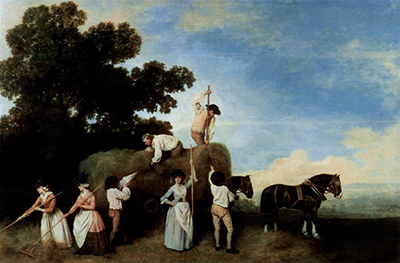
| Haymakers | 1785 | Painting |
| Haymakers (Lady Lever Art Gallery) | 1794 | Enamel |
| Hollyhock (with later additions by Vernet and Boucher) | about 1765–70 | Painting |
| Horse Attacked by a Lion (Episode C) | 1768–69 | Painting |
| Horse Attacked by a Lion (Tate enamel) | 1769 | Enamel |
| Horse Devoured by a Lion | Possibly exhibited 1763 | Painting |
| Horse Frightened by a Lion | 1770 | Painting |
| Horse Frightened by a Lion (Episode A; Wedgwood and Bentley after Stubbs) | — | Sculpture |
| Horse Frightened by a Lion (Tate) | Possibly exhibited 1763 | Painting |
| Horse Frightened by a Lion (Yale) | 1762–68 | Painting |
| Horse in the Shade of a Wood | 1780 | Painting |
| Hound Coursing a Stag | about 1762 | Painting |
| Human Figure, Anterior View (Intended for a Plate That was Never Published) | — | Drawing |
| Human Skeleton, Lateral View | 1795–1806 | Drawing |
| Hunt servants setting out (Southill commission) | 1767 | Painting |
| Hühnerhund (The Spanish Pointer) | about 1766 | Painting |
| John and Sophia Musters Riding at Colwick Hall | 1777 | Painting |
| John Musters on his hunter Pilgrim | 1777–78 | Painting |
| Labourers | 1789 | |
| Labourers (Richard Earlom after Stubbs and Amos Greene) | 25 March 1790 | Print after Stubbs |
| Laetitia, Lady Lade (d.1825) | 1793 | Painting |
| Lemon and White Water Spaniel | — | Painting |
| Lion Attacking a Stag | — | Painting |
| Lord Grosvenor's Arabian Stallion with a Groom | about 1765 | Painting |
| Lord Grosvenor's Arabian Stallion with a Groom (Peter Mazell after Stubbs) | 1771 | Print after Stubbs |
| Mambrino (Eaton Hall painting) | — | Painting |
| Mambrino (George Townley Stubbs after Stubbs) | 1794 | Print after Stubbs |
| Mares and Foals belonging to the 2nd Viscount Bolingbroke | about 1761–62 | Painting |
| Mares and foals beneath large oak trees | — | Painting |
| Mares and Foals by a stream | Exhibited 1764 | Painting |
| Mares and Foals in a River Landscape | about 1763–68 | Painting |
| Mares and Foals in an Extensive Landscape | about 1769 | Painting |
| Mares and Foals without a Background | 1762 | Painting |
| Moose Deer (after Stubbs) (Arctic Zoology plate VIII) | 1784–85 publication | Print after Stubbs |
| Newmarket Heath with a Rubbing-Down House | — | Painting |
| Otho (1796 print after Stubbs) | 1 December 1796 | Print after Stubbs |
| Otho, with John Larkin up | 1768 | Painting |
| Pangloss | about 1762 | Painting |
| Patch (Grafton commission) | 1759 | Painting |
| Phaeton and the Chariot of the Sun (enamel) | 1775 | Enamel |
| Phaeton with a Pair of Cream Ponies and a Stable-Lad | 1780–84 | Painting |
| Phillis | 1772 | Painting |
| Portrait of a Large Dog (Dingo) | 1772 | Painting |
| Pumpkin with a Stable-lad | 1774 | Painting |
| Racehorses Exercising at Goodwood | 1759–60 | Painting |
| Reapers (1791 print) | 1791 | |
| Reapers (Tate) | 1785 | Painting |
| Reapers (Yale) | 1795 | Enamel |
| Red Deer: A Stag and a Hind | 1792 | Painting |
| Richard Wedgwood | — | Enamel |
| Ringwood, a Brocklesby Foxhound | 1792 | Painting |
| Scrub, a bay horse belonging to the Marquess of Rockingham | about 1762 | Painting |
| Self Portrait on a White Hunter | 1782 | Enamel |
| Self-Portrait | about 1759 | Painting |
| Shooting (1770 Woollett plate after Stubbs) | 1770 | Print after Stubbs |
| Shooting (1771 Woollett plate after Stubbs) | 1771 | Print after Stubbs |
| Shooting at Goodwood | 1759–60 | Painting |
| Sir John Nelthorpe as a boy | 1756 | Painting |
| Sir John Nelthorpe partridge shooting with one pointer | — | Painting |
| Sir John Nelthorpe, 6th Baronet, out Shooting with His Dogs in Barton Field, Lincolnshire | 1776 | Painting |
| Sleeping Leopard | 1777 | Enamel |
| Soldiers of the 10th Light Dragoons | 1793 | Painting |
| Stallion and Mare (George Townley Stubbs after Stubbs) | 1776; reissued 1789 | Print after Stubbs |
| Steward and gamekeeper with dogs (Southill commission) | 1767 | Painting |
| Studies of a Lemur (Lemur murinus) in six different attitudes | 1773 | Drawing |
| Study for the Self-portrait in Enamel | c. 1781 | Drawing |
| Study of a Lemur | 1773 | Drawing |
| Study of a Racehorse in Action: Galloping to Left, a Semi-Anatomical Study, with Skin Flayed to Show Action of Muscles | — | Drawing |
| Study of the Legs of a Draught-Horse Pulling a Harrow (attributed to Stubbs) | Proposed about 1786 | Drawing |
| Sweet William (Grosvenor panel) | — | Painting |
| Sweet William (Turf Gallery canvas) | — | Painting |
| The Black Stallion Sampson, Portrayed from Three Angles (with landscape additions) | about 1764 | Painting |
| The Charlton Hunt | 1759–60 | Painting |
| The Fall of Phaeton | — | Sculpture |
| The Frightened Horse | 1780 | Sculpture |
| The Grosvenor Hunt | — | Painting |
| The Haymakers (Upton House) | 1783 | Painting |
| The Horse and Lion (George Townley Stubbs after George Stubbs) | 1770 | Print after Stubbs |
| The Kongouro from New Holland | 1772 | Painting |
| The Labourers | 1779 | Painting |
| The Labourers (Southill original) | 1767 | Painting |
| The lion and horse (Benjamin Green after Stubbs) | 1769; reissued 1777 | Print after Stubbs |
| The Milbanke and Melbourne Families | about 1769 | Painting |
| The Moose | 1770 | Painting |
| The Prince of Wales's Phaeton | 1793 | Painting |
| The Reapers (Upton House) | 1783 | Painting |
| The Sebra, or Wild Ass (George Townley Stubbs after Stubbs) | 1771 | Print after Stubbs |
| The Spanish Pointer (Bradford version) | about 1766–68 | Painting |
| The Spanish Pointer (William Woollett after Stubbs) | January 1768 | Print after Stubbs |
| The Third Duke of Dorset's Hunter with a Groom and a Dog | 1768 | Painting |
| Thomas Freeman, Lord Clarendon's gamekeeper, with a dog and a shot doe (with George Townly Stubbs) | 1803 | Painting |
| Turf, with Jockey up, at Newmarket | — | Painting |
| Turk and Crab | — | Painting |
| Two Bay Hunters Communing On The Bank Of A Lake | — | Painting |
| Tygers at Play | 1780 | |
| Viscount Gormanston's White Dog | 1781 | Painting |
| Viscount Gormanston's White Dog (canvas version) | — | Painting |
| Water Spaniel | 1769 | Painting |
| Wedgwood Family Portrait | 1780 | Painting |
| Whistlejacket | about 1762 | Painting |
| Whistlejacket with two other stallions and a groom | Recorded 1762 | Painting |
| White Poodle in a Punt | about 1780 | Painting |
| William Anderson with two Saddle-Horses | 1793 | Painting |
| Working Drawing for the Seventh Anatomical Table of the Muscles of the Horse | 1756–58 | Drawing |
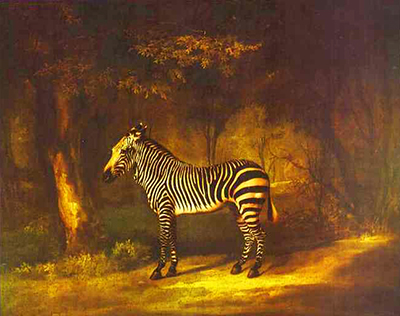
| Zebra | 1763 | Painting |
Discussion
Look again at the images and ideas explored in George Stubbs: Lion and Horse Series. These editorial prompts invite your observations.
Reader Insights
Which change between the lion-and-horse episodes most alters the encounter?
How does a change from painting to enamel or print affect the design?
What should remain constant when you compare related designs, and what belongs to each individual object?
Join the Conversation
Share a detail, comparison or question about George Stubbs: Lion and Horse Series below.
References
- National Heritage Memorial Fund, “Horse Frightened by a Lion by Stubbs”. (accessed 31 October 2026). View source.
- Aris Sarafianos, “Sublime Action: George Stubbs's Lion and Horse series”, Tate Research Publication, January 2013. (accessed 31 October 2026). View source.
- Yale Center for British Art, “A Lion Attacking a Horse”. (accessed 31 October 2026). View source.
- National Gallery of Victoria, George Stubbs, A lion attacking a horse, 2052-4. (accessed 31 October 2026). View source.
- Walker Art Gallery institutional partner record, George Stubbs, Horse Frightened by a Lion, with a Wikimedia Commons file carrying Art UK and Walker source metadata for WAG 2387. and (accessed 30 August 2026). View source 1. View source 2.
- Yale University Art Gallery, George Stubbs, A Lion Attacking a Horse, 1955.27.1. (accessed 30 August 2026). View source.
- Metropolitan Museum of Art, George Stubbs, A Horse Affrighted at a Lion, 1970.603.1. (accessed 31 October 2026). View source.
- Yale Center for British Art, George Stubbs, A Lion Attacking a Horse, B1977.14.71, IIIF manifest. (accessed 31 October 2026). View source.
- Judy Egerton, “Whistlejacket”, The British Paintings: National Gallery Catalogues. (accessed 31 October 2026). View source.
- Tate, George Stubbs, Horse Frightened by a Lion, T06869. (accessed 31 October 2026). View source.
- Tate, George Stubbs, Horse Devoured by a Lion, T02058, and Tate institutional partner record. and (accessed 31 October 2026). View source 1. View source 2.
- Yale Center for British Art, George Stubbs, Horse Frightened by a Lion, B1977.14.73, IIIF manifest. (accessed 31 October 2026). View source.
- Yale Center for British Art, George Stubbs, Horse Attacked by a Lion (Episode C), B2006.14.1. (accessed 31 October 2026). View source.
- Tate, George Stubbs, Horse Attacked by a Lion, T01192. (accessed 31 October 2026). View source.
- Tate, catalogue entry for T01192, originally published in The Tate Gallery 1968–70, London, 1970; including transcribed Humphry testimony and Walpole annotation. (accessed 31 October 2026). View source.
- Nineteenth-Century Art Worldwide/FACOS, “A Lion Attacking a Horse”, citing T. N., “Memoirs of George Stubbs, Esq”, The Sporting Magazine, volume 32, May 1808, pp. 55–57. (accessed 30 August 2026). View source.
- J. Paul Getty Museum, “Lion Attacking a Horse”. (accessed 31 October 2026). View source.
- Creswell Crags, “Creswell Crags announces new artists in residence”. (accessed 30 August 2026). View source.
- J. Paul Getty Museum, “Lion Attacking a Horse on Loan from the Capitoline Museums”, 18 July 2012. (accessed 31 October 2026). View source.
- British Museum, George Townley Stubbs after George Stubbs, The Horse and Lion, 2010,7081.5624. (accessed 30 August 2026). View source.
- World of Wedgwood, “Wedgwood and Artists: Black Basalt Plaque ‘The Frightened Horse’”, and Wikimedia Commons file carrying Yale Center for British Art source metadata for B2001.2.359. and (accessed 31 October 2026). View source 1. View source 2.
- National Gallery of Victoria, Benjamin Green after George Stubbs, The lion and horse, 3029-4; Metropolitan Museum of Art, The Lion and Horse, 59.570.364. and (accessed 31 October 2026). View source 1. View source 2.
- National Galleries of Scotland, George Stubbs, A Horse Affrighted by a Lion, P8690. (accessed 31 October 2026). View source.
- Art Fund, “Horse Frightened by a Lion”, acquisition account preserving Judy Egerton’s 1994 interpretation. (accessed 31 October 2026). View source.
- Sotheby’s, Old Masters Evening Sale, London, 2018, lot 67, A lion devouring a horse. (accessed 31 October 2026). View source.
- Angus Trumble, “Stubbs and the horse”, National Portrait Gallery Australia, historical exhibition review republished 30 October 2018. (accessed 31 October 2026). View source.
- Basic title, date and material metadata for Tate’s Reapers (T02257) and Otho (T02375) is adapted from the Tate collection dataset, October 2014, released under CC0. TheHistoryOfArt.org has reconciled labels and versions. This credit does not apply to Tate’s authored catalogue commentary or images.
- Data Source: Yale Center for British Art. Basic object fields are adapted and reconciled for this directory. Reuse is subject to the Center’s Open Data and Data Services Terms of Use. No museum endorsement is implied. This metadata credit does not relabel scholarly essays or images as open data.
- Basic object metadata for A Horse Frightened by a Lion, 1985.38, The Cleveland Museum of Art, John L. Severance Fund, is available under CC0. Titles and design-level grouping have been reconciled for this directory.