


 by Tom Gurney
Tom Gurney BSc (Hons) is an art history expert with over 20 years experience
Email: tomgurney1@gmail.com / Phone: +44 7429 011000
Reapers by George Stubbs: Introduction
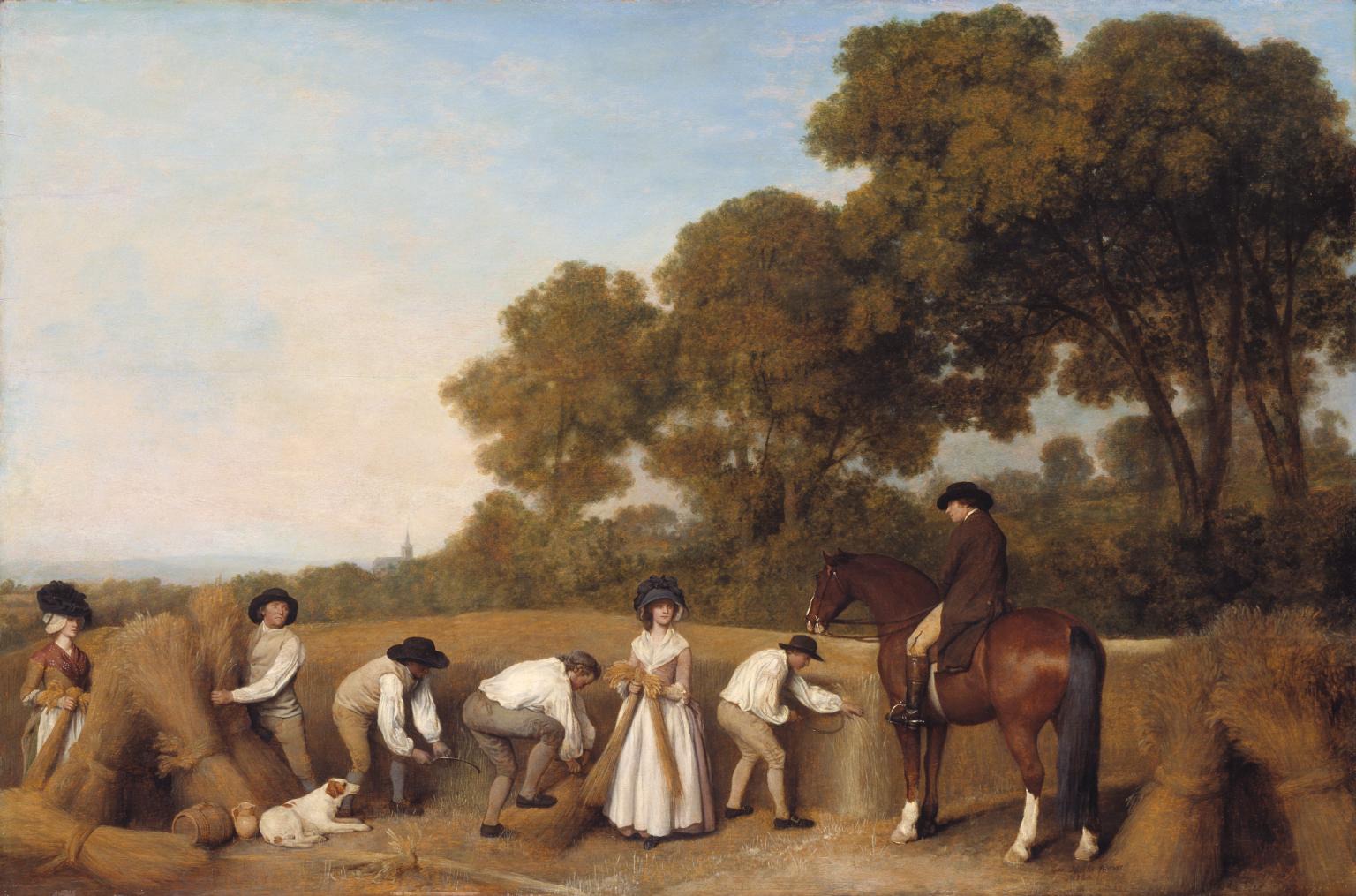
George Stubbs’s Reapers at Tate, T02257, dates from 1785. Painted in oil on wood, its support measures 89.9 by 136.8 centimetres. It entered the collection through an assisted purchase in 1977. [1] Its companion is Haymakers. [2]
The National Gallery of Art in Washington holds a different object: Stubbs’s Reapers of 1791, accession 2021.102.1. This is a print made with stipple and roulette on laid paper. Its publication line credits Stubbs with painting, engraving and publishing the design. [3] The image invites us to follow harvesting through distinct actions, from cutting stalks to carrying and binding sheaves. [4]
At a Glance
This work across George Stubbs’s career
Whistlejacket
about 1762 [9]Contents
- Across the printed field
- An earlier arrangement
- Wood, paint and fired enamel
- Drawings and public exhibitions
- Dignity, order and tension
- From named designs to circulating objects
- Buying and exhibiting the harvest
- Videos on George Stubbs
Across the printed field
The mounted man fills the left side of the print. His horse faces into the picture, towards the people cutting and gathering grain. The rider’s tall, almost upright body rises above the workers’ heads, but the animal’s lowered head points towards their level. Behind him, tree trunks climb through a dense canopy. The horse and trees together give this end of the image a dark, substantial weight. [4]
Six people work beyond the horse: four men and two women. Near the centre, a woman stands almost frontally, holding stalks against her pale apron. Her long skirt makes an uninterrupted shape between the bent figures on either side. The man immediately to her left reaches into the standing crop with a curved blade. On her other side, another man bends forward, his head uncovered and his body turned across our view. Their lowered backs and extended arms frame her upright figure without concealing what she holds. [4]
Farther right, another stooping man brings his tool close to the grain. His spread legs and lowered hands repeat the action on the opposite side of the central woman, although his head, hat and waistcoat give him a different outline. Behind him stands a man carrying a large bundle. The stalks rise above his shoulder and open against the lighter distance. At the far right, the second woman holds another upright bundle. These tall masses of grain answer the standing bodies, while the workers nearest the ground make a lower, alternating rhythm. [4]
The crop itself divides the space. Upright stalks form a continuous band behind the foreground figures; in front of them, short stubble leaves room for feet, blades and completed bundles. Several sheaves lie across the lower edge, their tied centres making narrow waists between spreading ends. Others stand together at the right, with their stalks leaning into one another. Loose, horizontal bundles, upright sheaves and the uncut field give the same plant three different shapes within the picture. [4]
Among the bundles, a dog lies with its head lifted. A small cask rests on its side nearby, and a handled vessel stands between the animal and the grain. Their low forms occupy the space beneath the workers’ arms. Stubbs does not clear the foreground for a parade of isolated figures: the things on the ground overlap the people’s working space, and the long stalks lead our eyes across their shoes and stockings. [4]
Beyond this activity, the landscape opens towards the right. A small spire rises above distant buildings, separated from the workers by fields and low vegetation. Much of the upper right consists of pale sky. Fine printed marks describe clouds and distant land more lightly than the foliage above the horse. The scene therefore changes in density as we cross it: heavy trees and a large animal at one end, open air and a distant settlement at the other. [4]
The print’s lower edge carries a title and a compact publication inscription. These sit beneath the field scene, inside the surviving sheet. Their regular lettering contrasts with the many small marks that build the trees, clothes and grain. We encounter both a pictured harvest and an image made available under a named title, with words occupying their own narrow strip below the work. [4]
An earlier arrangement
Stubbs had painted The Reapers in 1783. That signed picture is now in the National Trust’s Bearsted Collection at Upton House, accession 446709. The holder describes oil and enamel on oak, measuring 91.4 by 137.2 centimetres. Its account identifies a mounted farmer, a woman preparing twisted wheat to bind a sheaf, and a man cutting with a sickle. [18]
The earlier composition is less crowded. Four people on foot occupy the left and middle of the field, with the mounted figure to their right. A standing woman provides a clear vertical near the centre, while the horse faces left towards the group. Tall trees rise behind the workers; open fields recede at the right. The bundles at either end hold the foreground together, but there is more space between the central group and the sheaves at the right edge. [19]
The National Trust traces this panel to Sir Walter Gilbey by 1898. After his 1915 sale it passed through Agnew and Knoedler, before Lord Bearsted bought it in November 1919 for £1,000. Its transfer to the Trust came with the gift of Upton House in 1948. [18]
Wood, paint and fired enamel
The 1783 Reapers supplies unusually specific evidence of Stubbs’s paint materials. John Mills and Raymond White included the National Trust picture in their 1985 examination of ten paintings. Their table records a prepared ground, drying oil, beeswax and pine resin. The results place it among a later group in which drying oil accompanies other components, whereas the three earliest sampled pictures lacked drying oil and a conventional ground. [20]
The investigation used gas chromatography and, for most of the pictures, mass spectrometry. Its authors explain that ageing and overlapping chemical products complicate identification. They could recognise classes of material without giving a complete original mixture or specifying the particular drying oil. This makes the table evidence for the sampled 1783 work, rather than a ready-made recipe for every version of the harvest scene. The larger history of Stubbs’s experiments with paint and enamel involves changing practices as well as changing supports. [20]
The support attracted another kind of investigation. In his history of panel conservation, Ian McClure noted cradles attached to Upton House’s 1783 Haymakers and Reapers. He suggested that Stubbs might have arranged this reinforcement preventively, seeking stability comparable to the ceramic plaques made for him by Josiah Wedgwood. McClure’s suggestion concerns a possible intention behind the cradles, rather than documentary proof that the artist installed them. It brings the back of the panel into the history of an image usually discussed from the front. [21]
The Yale Center for British Art’s Reapers, B1981.25.618, changes the physical object again. Dated 1795, it is enamel on Wedgwood biscuit earthenware, measuring 76.8 by 102.9 centimetres. Yale explains the process as applying enamel to earthenware and firing it into a finished plaque. The collaboration offered Stubbs the prospect of making pictures with exceptional durability. [22]
Its oval boundary surrounds five people, including the rider on the right. Two men bend to cut the crop between him and a man holding a bundle at the left. A woman beside the bundle holds stalks in front of her apron. The dog lies close to their feet, with a cask and jug tucked into the lower left. One long sheaf stretches across the immediate foreground. The curving edge brings these low objects close to the border, while the trees rise over the horse and the sky opens above the workers. [23]
Compared with the Washington print, the oval reduces the working group and changes the relationship between figures and edge. There is no second woman at the opposite end of a seven-person sequence. The horse occupies much of the right-hand curve, and the foreground sheaf follows the narrowing space beneath the dog and cutting men. The composition fits this enclosing shape through placement and selection, rather than by merely removing the corners of a rectangle. [23]
Drawings and public exhibitions
The record of Stubbs’s studio sale helps explain the resources behind these repeated arrangements. Walter Gilbey’s 1898 transcription of the 1807 catalogue lists six studies of reapers and two unfinished drawings. It also includes a drawing described as the original design for a cornfield with reapers. Separate entries name men loading a cart in Lord Torrington’s garden and a hayfield with men loading a hay cart. [24]
The distinctions matter. A cornfield, a garden cart and a hay cart were individually described subjects within the studio’s contents. The catalogue presents harvest pictures as compositions with a history in drawings, rather than spontaneous records requiring no preparation. It does not identify which surviving version each sheet preceded. The sale descriptions preserve evidence of an active store of studies even where a particular sheet cannot now be securely matched. [24]
The original Royal Academy catalogue for 1786 lists Reapers as exhibit 77 and Haymakers as 94, both credited to G. Stubbs, Associate. The harvest subjects appeared among portraits, landscapes and literary scenes in the eighteenth annual exhibition, bringing field work into a public exhibition of contemporary art. [25]
The pair also appeared in Liverpool’s second exhibition of paintings and designs in 1787. Joseph Mayer’s 1876 account reproduces entries 100 and 101: a harvest scene with reapers, followed by the corresponding haymakers. Stubbs is identified as an Associate of the Royal Academy, with his address at Somerset Street, Portman Square, London. The same two subjects thus travelled together from the London exhibition to an audience in his native city. [26]
Their exhibition history also involved choices about presentation. The Frame Blog’s 2026 study, citing information from Judy Egerton, reports that Stubbs asked Daniel Daulby in 1787 to put Haymakers and Reapers into plain frames, concerned about damage to original frames. The author tentatively assigns the Tate paintings’ present Rococo surrounds to a subsequent owner. [27]
The Frick Collection’s account of its 2007 Stubbs exhibition interprets the 1785 pair as an attempt to attract a broader public through rural subjects. It describes their reception in 1786 as lukewarm, with critics wanting greater sentiment and narrative detail. It also locates the paintings within the popularity of pastoral poetry among urban audiences. [2]
Dignity, order and tension
How much of rural life does such an ordered harvest reveal? The Frick emphasised an idyllic vision, with spotless clothes, easy-looking movements and plentiful grain. Its account found accuracy in the depicted tasks alongside an ideal countryside. That combination helps explain why the pictures can appear attentive to particular kinds of work while offering so little visible disruption to the collective rhythm. [2]
The art historian Cinzia Maria Sicca proposes a more specific set of comparisons. Writing in 2023, she relates Reapers to Poussin’s Summer, also known as Ruth and Boaz, and suggests James Thomson’s Seasons as a likely literary source. Her comparison concerns a rural community made harmonious through shared harvesting, with classical composure surviving beneath eighteenth-century costume. [28]
Sicca also finds restrained social tension in the glances exchanged between the workers and the mounted figure who supervises them. Her reading gives the scene a pressure that its orderly poses might initially conceal. Authority and cooperation need not produce the same experience for everyone represented. The picture’s organisation can therefore support discussion of unequal positions without supplying the names, wages or private thoughts of its individual figures. [28]
Yale’s interpretation of the later enamel stresses idealisation against the poverty and hardship experienced by agricultural workers. Its curators also connect the distant church with Christian associations of harvesting and the relationship between work and prayer. These readings concern the meanings viewers may find in an orderly rural scene. They extend beyond identifying a spire or counting the working figures, and leave room for different understandings of what the harvest represents. [22]
Art Fund’s archival acquisition account offers a striking counterpoint: it describes the peasants as unglamorised in their toil and sees them anticipating later realism. Here the harvest subjects are valued for the seriousness with which Stubbs presents working people, a different emphasis within their modern appreciation. [29]
From named designs to circulating objects
The subjects travelled farther than London and Liverpool. Natasha Eaton’s research into the colonial art market reproduces a proposed scheme advertised in the Calcutta Gazette of 1 September 1785. Paintings carried in Captain Urmston’s investment were to be distributed through a game involving forty subscribers and throws of dice. A large Reapers was listed as first prize, with a same-sized Haymakers second. [30]
Eaton’s account opens another history for the harvest subjects: British rural images offered to prospective buyers in colonial Bengal. The advertisement names pictures without securely identifying them with the panels now at Tate or Upton House. It is evidence of a proposed commercial scheme, not a completed provenance for either surviving pair. The distinction allows this distant market to enter the story without turning similar titles into proof of identical objects. [30]
Sicca dates the announcement of Stubbs’s intended engravings to 1788–89. [28] The printed designs followed in 1791. Washington’s sheet measures 48.26 by 68.58 centimetres and is trimmed to the platemark. The NGA identifies it as the first of three states catalogued by Lennox-Boyd, Dixon and Clayton. Its inscription dates publication to 1 January 1791 at Stubbs’s Somerset Street address. [3]
A pair offered by Christie’s provides a comparison: its 1791 Hay-Makers and Reapers were catalogued as first states with open title letters and surviving margins. Each plate measured 48.3 by 68.5 centimetres. These are descriptions of particular paper impressions, whose margins and lettering help distinguish them within the publication history. Stubbs’s printmaking made the harvest designs repeatable, while each sheet retained its own physical history. [31]
The Washington impression’s recorded ownership includes a Christie’s sale in 1993, a British private collection and the London dealer Andrew Edmunds. The NGA records its purchase in 2022. [3] That chain follows the paper object, independently of the histories of the painted panels and fired enamel.
Buying and exhibiting the harvest
In 1977 the Tate pair became the subject of a public appeal. A September report in JS Journal described a £771,000 asking price and a deadline that Christmas. It reported £190,000 in promised government support, alongside Tate’s and other funds’ contribution, with £140,000 still to raise. A lottery and a competition brought donated prizes into the campaign: grocery tokens, a Mini and a Wedgwood dinner service. The article noted that the paintings were already on view, joining the appeal for money to the experience of seeing them. [32]
The earlier panel continues to acquire new public contexts. For the National Trust’s loan to Becoming America: How Science Shaped a Nation, at London’s Science Museum from 23 October 2026 to 25 April 2027, The Reapers was selected to illuminate Anglo-American agriculture and the estate interests of George Washington and George III. [33]
Videos on George Stubbs
Explore Stubbs’s equestrian painting in its wider context, including two readings of Whistlejacket.
A Horse Lover’s Guide to the YCBA
A museum tour that places Stubbs alongside other artists who painted horses. It includes a look at Pumpkin with a Stable-lad.
Watch on YouTubeGeorge Stubbs artworks directory
Search works and related prints documented in this guide. Separate versions and printing matrices have separate entries; printmakers are named where known. Unidentified historical titles and untraced studio-sale material are discussed in the essays. A dash means that a date is not established here.
| Name | Date | Medium |
|---|---|---|
| A Bay Horse with a Groom | 1791 | Painting |
| A Bay Hunter with Two Playful Spaniels | 1777 | Painting |
| A Bay Hunter, a Springer Spaniel and a Sussex Spaniel in a wooded river Landscape | 1782 | Painting |
| A Cheetah and a Stag with Two Indian Attendants | about 1764 | Painting |
| A Couple of Fox Hounds (coloured print after Stubbs) | — | Print after Stubbs |
| A Couple of Foxhounds | 1792 | Painting |
| A Foxhound on the Scent | 1788 | Drawing |
| A Gentleman driving a Lady in a Phaeton | 1787 | Painting |
| A Grey Horse | 1793 | Painting |
| A Grey Horse (cantering companion) | 1793 | Painting |
| A Grey Stallion in a Landscape | — | Painting |
| A Horse Affrighted at a Lion | 1 May 1788 | |
| A Horse Belonging to the Rt. Honourable Lord Grosvenor called Bandy from his Crooked Leg | about 1763 | Painting |
| A Horse Frightened by a Lion | 1777 | |
| A Lion (A Lion Resting on a Rock) | 1 May 1788 | |
| A Lion Attacking a Horse | 1770 | Painting |
| A Lion Attacking a Horse (monumental Yale canvas) | 1762 | Painting |
| A lion attacking a horse (NGV) | about 1765 | Painting |
| A Lion Devouring a Horse (1788 print) | 1788 | |
| A lion devouring a horse (attribution disputed) | Proposed mid-1770s | Painting |
| A mare and foal with a bay horse | 1771 | Painting |
| A Monkey | 1799 | Painting |
| A Prancing Horse, Facing Right | c. 1790 | Drawing |
| A Rough Dog | 1790 | Painting |
| A Saddled Bay Hunter | 1786 | Painting |
| A Sleeping Leopard | 1 January 1791 | |
| A Tiger and a Sleeping Leopard | 1 May 1788 | |
| A Tigress (John Dixon after Stubbs) | 1772 | Print after Stubbs |
| A Tyger (A Recumbent Leopard by a Tree) | 1 May 1788 | |
| A Tyger (Sleeping Leopard) | 1 May 1788 | |
| An animal found on the coast of New Holland called kanguroo (after Stubbs) | 1773 | Print after Stubbs |
| An animal of a new species found on the coast of New South Wales (after Stubbs) | July 1773 | Print after Stubbs |
| Antinous and Jockey | — | Painting |
| Antinoüs, a chestnut racehorse, in a landscape | Undated | Painting |
| Bandy belonging to Lord Grosvenor (print after Stubbs) | — | Print after Stubbs |
| Baronet (George Townley Stubbs after Stubbs) | 20 February 1794 | Print after Stubbs |
| Baronet with Sam Chifney Up | 1791 | Painting |
| Baronet with Samuel Chifney up (Royal Collection) | 1791 | Painting |
| Bay Hunter by a Lake | 1787 | Painting |
| Brood Mares (Benjamin Green after Stubbs) | Issue 14 November 1776 | Print after Stubbs |
| Brood Mares and Foals | usually dated 1767 | Painting |
| Brown and White Norfolk or Water Spaniel | 1778 | Painting |
| Bulls Fighting | 1786 | Painting |
| Captain Samuel Sharpe Pocklington with His Wife, Pleasance, and possibly His Sister, Frances | 1769 | Painting |
| Death of the Doe (attribution disputed) | 1804 | |
| Der Englische Hühnerhund (Johann Wölfle after Stubbs) | about 1860 | Print after Stubbs |
| Dog (A Foxhound Viewed from Behind) | 1 May 1788 | |
| Dog [A Foxhound on the Scent] | 1788 | |
| Drill and albino baboon | before 1789 | Painting |
| Eclipse (Charles Hunt after Stubbs) | 12 November 1839 | Print after Stubbs |
| Eclipse (George Townley Stubbs after Stubbs) | 1796 | Print after Stubbs |
| Eclipse (oil study) | — | Painting |
| Eclipse (Thomas Burke after Stubbs) | First published 1772 | Print after Stubbs |
| Eclipse and John Wildman (Benjamin Green after Stubbs) | 1772 | Print after Stubbs |
| Eclipse at Newmarket (Jockey Club version) | Proposed early 1790s; often dated 1770 | Painting |
| Eclipse at Newmarket with a groom and jockey | 1770 | Painting |
| Eclipse with Mr Wildman and His Sons | 1769–71 | Painting |
| Eclipse, the Property of Capt.n O Kelly (anonymous print after Stubbs) | Imprint 4 June 1804; impression undated | Print after Stubbs |
| Euston | 1774 | Painting |
| Finished Study for the Seventh Anatomical Table of the Muscles of the Horse | 1756–58 | Drawing |
| Five Brood Mares at the Duke of Cumberland's Stud Farm in Windsor Great Park | 1765 | Painting |
| Fowl Body, Lateral View (Highly Finished Study for an Unpublished Table; Shows the Last Stage in Dissection) | — | Drawing |
| Fowl Body, Lateral View (Probably Prepared for Transfer to the Plate for Engraving of Table XV) | — | Drawing |
| Fowl Skeleton, Lateral View (Finished Study for Table V) | — | Drawing |
| Freeman, the Earl of Clarendon's Gamekeeper, with a Dying Doe and Hound (Yale) | 1800 | Painting |
| George Stubbs (enamel self-portrait) | 1781 | Enamel |
| Gimcrack (George Townley Stubbs after Stubbs) | 1775 | Print after Stubbs |
| Gimcrack on Newmarket Heath, with a trainer, a jockey and a stable lad | about 1765 | Painting |
| Gimcrack, with John Pratt up, on Newmarket Heath | about 1765 | Painting |
| Hambletonian, Rubbing Down | 1800 | Painting |
| Hay-Makers | 1791 | |
| Haycarting | 1795 | Enamel |
| Haymakers | 1785 | Painting |
| Haymakers (Lady Lever Art Gallery) | 1794 | Enamel |
| Hollyhock (with later additions by Vernet and Boucher) | about 1765–70 | Painting |
| Horse Attacked by a Lion (Episode C) | 1768–69 | Painting |
| Horse Attacked by a Lion (Tate enamel) | 1769 | Enamel |
| Horse Devoured by a Lion | Possibly exhibited 1763 | Painting |
| Horse Frightened by a Lion | 1770 | Painting |
| Horse Frightened by a Lion (Episode A; Wedgwood and Bentley after Stubbs) | — | Sculpture |
| Horse Frightened by a Lion (Tate) | Possibly exhibited 1763 | Painting |
| Horse Frightened by a Lion (Yale) | 1762–68 | Painting |
| Horse in the Shade of a Wood | 1780 | Painting |
| Hound Coursing a Stag | about 1762 | Painting |
| Human Figure, Anterior View (Intended for a Plate That was Never Published) | — | Drawing |
| Human Skeleton, Lateral View | 1795–1806 | Drawing |
| Hunt servants setting out (Southill commission) | 1767 | Painting |
| Hühnerhund (The Spanish Pointer) | about 1766 | Painting |
| John and Sophia Musters Riding at Colwick Hall | 1777 | Painting |
| John Musters on his hunter Pilgrim | 1777–78 | Painting |
| Labourers | 1789 | |
| Labourers (Richard Earlom after Stubbs and Amos Greene) | 25 March 1790 | Print after Stubbs |
| Laetitia, Lady Lade (d.1825) | 1793 | Painting |
| Lemon and White Water Spaniel | — | Painting |
| Lion Attacking a Stag | — | Painting |
| Lord Grosvenor's Arabian Stallion with a Groom | about 1765 | Painting |
| Lord Grosvenor's Arabian Stallion with a Groom (Peter Mazell after Stubbs) | 1771 | Print after Stubbs |
| Mambrino (Eaton Hall painting) | — | Painting |
| Mambrino (George Townley Stubbs after Stubbs) | 1794 | Print after Stubbs |
| Mares and Foals belonging to the 2nd Viscount Bolingbroke | about 1761–62 | Painting |
| Mares and foals beneath large oak trees | — | Painting |
| Mares and Foals by a stream | Exhibited 1764 | Painting |
| Mares and Foals in a River Landscape | about 1763–68 | Painting |
| Mares and Foals in an Extensive Landscape | about 1769 | Painting |
| Mares and Foals without a Background | 1762 | Painting |
| Moose Deer (after Stubbs) (Arctic Zoology plate VIII) | 1784–85 publication | Print after Stubbs |
| Newmarket Heath with a Rubbing-Down House | — | Painting |
| Otho (1796 print after Stubbs) | 1 December 1796 | Print after Stubbs |
| Otho, with John Larkin up | 1768 | Painting |
| Pangloss | about 1762 | Painting |
| Patch (Grafton commission) | 1759 | Painting |
| Phaeton and the Chariot of the Sun (enamel) | 1775 | Enamel |
| Phaeton with a Pair of Cream Ponies and a Stable-Lad | 1780–84 | Painting |
| Phillis | 1772 | Painting |
| Portrait of a Large Dog (Dingo) | 1772 | Painting |
| Pumpkin with a Stable-lad | 1774 | Painting |
| Racehorses Exercising at Goodwood | 1759–60 | Painting |
| Reapers (1791 print) | 1791 | |
| Reapers (Tate) | 1785 | Painting |
| Reapers (Yale) | 1795 | Enamel |
| Red Deer: A Stag and a Hind | 1792 | Painting |
| Richard Wedgwood | — | Enamel |
| Ringwood, a Brocklesby Foxhound | 1792 | Painting |
| Scrub, a bay horse belonging to the Marquess of Rockingham | about 1762 | Painting |
| Self Portrait on a White Hunter | 1782 | Enamel |
| Self-Portrait | about 1759 | Painting |
| Shooting (1770 Woollett plate after Stubbs) | 1770 | Print after Stubbs |
| Shooting (1771 Woollett plate after Stubbs) | 1771 | Print after Stubbs |
| Shooting at Goodwood | 1759–60 | Painting |
| Sir John Nelthorpe as a boy | 1756 | Painting |
| Sir John Nelthorpe partridge shooting with one pointer | — | Painting |
| Sir John Nelthorpe, 6th Baronet, out Shooting with His Dogs in Barton Field, Lincolnshire | 1776 | Painting |
| Sleeping Leopard | 1777 | Enamel |
| Soldiers of the 10th Light Dragoons | 1793 | Painting |
| Stallion and Mare (George Townley Stubbs after Stubbs) | 1776; reissued 1789 | Print after Stubbs |
| Steward and gamekeeper with dogs (Southill commission) | 1767 | Painting |
| Studies of a Lemur (Lemur murinus) in six different attitudes | 1773 | Drawing |
| Study for the Self-portrait in Enamel | c. 1781 | Drawing |
| Study of a Lemur | 1773 | Drawing |
| Study of a Racehorse in Action: Galloping to Left, a Semi-Anatomical Study, with Skin Flayed to Show Action of Muscles | — | Drawing |
| Study of the Legs of a Draught-Horse Pulling a Harrow (attributed to Stubbs) | Proposed about 1786 | Drawing |
| Sweet William (Grosvenor panel) | — | Painting |
| Sweet William (Turf Gallery canvas) | — | Painting |
| The Black Stallion Sampson, Portrayed from Three Angles (with landscape additions) | about 1764 | Painting |
| The Charlton Hunt | 1759–60 | Painting |
| The Fall of Phaeton | — | Sculpture |
| The Frightened Horse | 1780 | Sculpture |
| The Grosvenor Hunt | — | Painting |
| The Haymakers (Upton House) | 1783 | Painting |
| The Horse and Lion (George Townley Stubbs after George Stubbs) | 1770 | Print after Stubbs |
| The Kongouro from New Holland | 1772 | Painting |
| The Labourers | 1779 | Painting |
| The Labourers (Southill original) | 1767 | Painting |
| The lion and horse (Benjamin Green after Stubbs) | 1769; reissued 1777 | Print after Stubbs |
| The Milbanke and Melbourne Families | about 1769 | Painting |
| The Moose | 1770 | Painting |
| The Prince of Wales's Phaeton | 1793 | Painting |
| The Reapers (Upton House) | 1783 | Painting |
| The Sebra, or Wild Ass (George Townley Stubbs after Stubbs) | 1771 | Print after Stubbs |
| The Spanish Pointer (Bradford version) | about 1766–68 | Painting |
| The Spanish Pointer (William Woollett after Stubbs) | January 1768 | Print after Stubbs |
| The Third Duke of Dorset's Hunter with a Groom and a Dog | 1768 | Painting |
| Thomas Freeman, Lord Clarendon's gamekeeper, with a dog and a shot doe (with George Townly Stubbs) | 1803 | Painting |
| Turf, with Jockey up, at Newmarket | — | Painting |
| Turk and Crab | — | Painting |
| Two Bay Hunters Communing On The Bank Of A Lake | — | Painting |
| Tygers at Play | 1780 | |
| Viscount Gormanston's White Dog | 1781 | Painting |
| Viscount Gormanston's White Dog (canvas version) | — | Painting |
| Water Spaniel | 1769 | Painting |
| Wedgwood Family Portrait | 1780 | Painting |
| Whistlejacket | about 1762 | Painting |
| Whistlejacket with two other stallions and a groom | Recorded 1762 | Painting |
| White Poodle in a Punt | about 1780 | Painting |
| William Anderson with two Saddle-Horses | 1793 | Painting |
| Working Drawing for the Seventh Anatomical Table of the Muscles of the Horse | 1756–58 | Drawing |
| Zebra | 1763 | Painting |
Discussion
Look again at the images and ideas explored in Reapers by George Stubbs. These editorial prompts invite your observations.
Reader Insights
What changes when you follow the workers’ separate tasks instead of looking first at the mounted man?
Does comparing the seven-person print with the later oval alter your sense of the harvest’s order?
Join the Conversation
Share a detail, comparison or question about Reapers by George Stubbs below.
References
- Tate, Reapers, T02257, historical public collection dataset, released 2014; support, medium, date and acquisition credit. Exact data. View source.
- The Frick Collection, George Stubbs (1724–1806): A Celebration (2007), Haymakers and Reapers exhibition texts. Exhibition account. View source.
- National Gallery of Art, Reapers, 1791, 2021.102.1; catalogue, inscription and provenance. Collection record. View source.
- George Stubbs, Reapers, 1791, NGA 2021.102.1, whole-image inspection of the museum’s native reproduction. Official image. View source.
- Goodwood, The Collection, Painting Collection modal, Racehorses Exercising at Goodwood; An exciting acquisition: a study by George Stubbs, 30 June 2023; History of the Estate Hounds, 4 October 2023; About Goodwood Racecourse. Accessed 4 November 2026. View source.
- Goodwood, The Collection, Painting Collection modal, Racehorses Exercising at Goodwood; An exciting acquisition: a study by George Stubbs, 30 June 2023; History of the Estate Hounds, 4 October 2023; About Goodwood Racecourse. Accessed 4 November 2026. View source.
- Goodwood, The Collection, Painting Collection modal, Racehorses Exercising at Goodwood; An exciting acquisition: a study by George Stubbs, 30 June 2023; History of the Estate Hounds, 4 October 2023; About Goodwood Racecourse. Accessed 4 November 2026. View source.
- Goodwood, The Collection, Painting Collection modal, Racehorses Exercising at Goodwood; An exciting acquisition: a study by George Stubbs, 30 June 2023; History of the Estate Hounds, 4 October 2023; About Goodwood Racecourse. Accessed 4 November 2026. View source.
- National Gallery, Whistlejacket, NG6569, current collection record, provenance, in-depth discussion and frame entry. View source.
- Yale Center for British Art, Zebra, B1981.25.617, current object metadata, gallery labels, Malcolm Warner’s 1998 catalogue entry and provenance supplied through the museum’s public collection record. View source.
- Christie’s, Gimcrack on Newmarket Heath, with a trainer, a jockey and a stable lad, London, 5 July 2011, lot 12; object details, essay, provenance, exhibitions and whole image. View source.
- Christie’s, Gimcrack on Newmarket Heath, with a trainer, a jockey and a stable lad, London, 5 July 2011, lot 12; object details, essay, provenance, exhibitions and whole image. View source.
- Yale University Art Gallery, A Lion Attacking a Horse, 1770, 1955.27.1, collection record. Accessed 4 November 2026. View source.
- Royal Museums Greenwich, ‘The Kongouro from New Holland’ (Kangaroo), ZBA5754. Accessed 4 November 2026. View source.
- Tate, George Stubbs, Haymakers, 1785, T02256; details, Terry Riggs’s collection text (January 1998), and online caption. Collection record. View source.
- Tate, Reapers, T02257, historical public collection dataset, released 2014; support, medium, date and acquisition credit. Exact data. View source.
- Frances Bailey, ‘Hambletonian, Rubbing Down: A masterpiece by George Stubbs’, National Trust Cultural Heritage Magazine, Autumn/Winter 2024, pp. 22–33. Article. View source.
- National Trust Collections, The Reapers, 1783, NT 446709; full indexed object entry consulted 5 November 2026, during catalogue migration. Collection record. View source.
- National Trust/Art UK, The Reapers, NT 446709, whole-image reproduction; broad composition inspection. Image. View source.
- John Mills and Raymond White, ‘The Mediums used by George Stubbs: Some Further Studies’, National Gallery Technical Bulletin 9 (1985), pp. 60–61, especially Table 1. Study. View source.
- Ian McClure, ‘History of Structural Conservation of Panel Paintings in Great Britain’, in Kathleen Dardes and Andrea Rothe, eds, The Structural Conservation of Panel Paintings (Getty Conservation Institute, 1998), p. 240. Publication. View source.
- Yale Center for British Art, Reapers, 1795, B1981.25.618; object details and gallery labels. Collection record. Museum’s 2022 label. View source 1. View source 2.
- George Stubbs, Reapers, 1795, B1981.25.618; whole-image inspection of Yale’s native reproduction. Official image. View source.
- Walter Gilbey, The Life of George Stubbs, R.A. (1898), appendix D, pp. 196–197, transcribing the 1807 studio sale catalogue. Book. View source.
- Royal Academy, The Exhibition of the Royal Academy (1786), p. 5, nos. 77 and 94; original catalogue scan. Catalogue viewer. View source.
- Joseph Mayer, Early Exhibitions of Art in Liverpool, with Some Notes for a Memoir of George Stubbs, R.A. (Liverpool, 1876), p. 84, reproducing the 1787 exhibition catalogue. Book. View source.
- The Frame Blog, ‘George Stubbs and his frames’, 23 May 2026, discussion of the 1787 Daulby letter and note 26, crediting information from Judy Egerton. Article. View source.
- Cinzia Maria Sicca, ‘Città/Campagna/Paesaggio’, in Chiara Savettieri, ed., Modernità per immagini: Un atlante in venti parole (Carocci, 2023), p. 66. In Italian. Publication. View source.
- Art Fund, Haymakers & Reapers, archival acquisition account, supported 1977; complete indexed entry consulted 5 November 2026. Record. View source.
- Natasha Jane Eaton, Imaging Empire: The Trafficking of Art and Aesthetics in British India c.1772 to c.1795, doctoral thesis (University of Warwick, 2000), pp. 172–174, quoting the Calcutta Gazette, 1 September 1785. Thesis. View source.
- Christie’s, George Stubbs, Hay-Makers, Reapers, lot 10, sale 23946; catalogue references Lennox-Boyd et al. 89–90. Lot record. View source.
- ‘JS supports the Tate’s national supersave’, JS Journal, September 1977, p. 10. Journal. View source.
- National Trust, ‘Loaning items to exhibitions’, The Reapers loan to the Science Museum, 2026–27. Exhibition loan account. View source.
- Basic title, date and material metadata for Tate’s Reapers (T02257) and Otho (T02375) is adapted from the Tate collection dataset, October 2014, released under CC0. TheHistoryOfArt.org has reconciled labels and versions. This credit does not apply to Tate’s authored catalogue commentary or images.
- Data Source: Yale Center for British Art. Basic object fields are adapted and reconciled for this directory. Reuse is subject to the Center’s Open Data and Data Services Terms of Use. No museum endorsement is implied. This metadata credit does not relabel scholarly essays or images as open data.
- Basic object metadata for A Horse Frightened by a Lion, 1985.38, The Cleveland Museum of Art, John L. Severance Fund, is available under CC0. Titles and design-level grouping have been reconciled for this directory.


