 by Tom Gurney
Tom Gurney BSc (Hons) is an art history expert with over 20 years experience
Published on June 19, 2020 / Updated on October 14, 2023
Email: tomgurney1@gmail.com / Phone: +44 7429 011000
Varied Rectangles (Variierte Rechtecke) by Wassily Kandinsky: Introduction
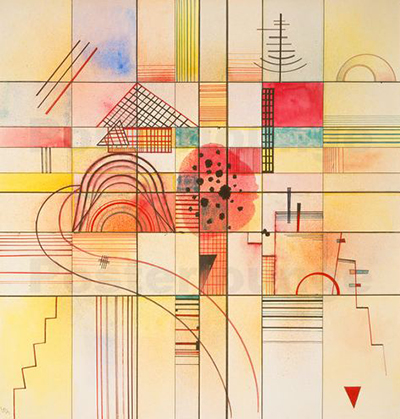
Wassily Kandinsky's Varied Rectangles looks at first like a measured grid. Thin dark lines divide a pale square field; red, yellow, blue and green bands occupy selected cells. But circles, arcs, ladders and scattered dots keep interrupting that apparent order. At the centre, a dark red cluster flecked with black marks pulls the eye away from the straight borders. The work is not a large oil painting. Christie's records Variierte Rechtecke as a watercolour and India ink drawing on paper, mounted by Kandinsky himself on board, made in April 1929 and measuring 39.7 × 38.3 cm. [1].
The sale catalogue describes a front monogram and date, K29, plus a reverse inscription repeating Kandinsky's name mark, date, title and his number 347. These details make the object unusually well identified even though the public lot page does not establish where it is held now. The title suggests a study of rectangular variation; the image shows how much more than rectangles Kandinsky brought into the experiment. [1].
Watch: Wassily Kandinsky
Five museum videos about Kandinsky’s art, sources of inspiration and the relationship between colour and music.
Vasily Kandinsky: Around the Circle
Curator Megan Fontanella introduces Kandinsky and the Guggenheim collection.
Watch on YouTubeAt a Glance
- Artist and title:Wassily Kandinsky, Variierte Rechtecke (Varied Rectangles).
- Date:April 1929, according to the Christie's lot catalogue.
- Medium:Watercolour and India ink on paper laid down by the artist on board.
- Size:39.7 × 38.3 cm (15⅝ × 15⅛ inches).
- Recorded marks:K29 at lower left; reverse title and number 347 in the sale catalogue.
- Documented history:J.B. Neumann and Nierendorf Gallery, New York; exhibited at Nierendorf in 1937.
- Present location:The historical lot page does not establish a current owner or public display location.
Where this work sits in Kandinsky’s career
The Blue Rider
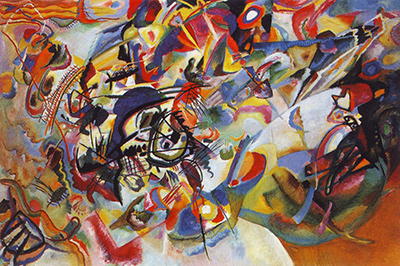
1903Composition VII
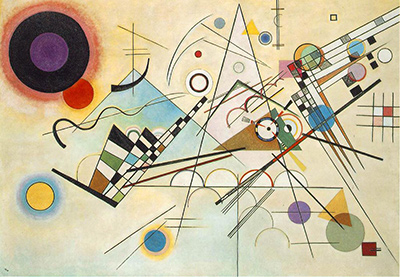
1913Composition VIII
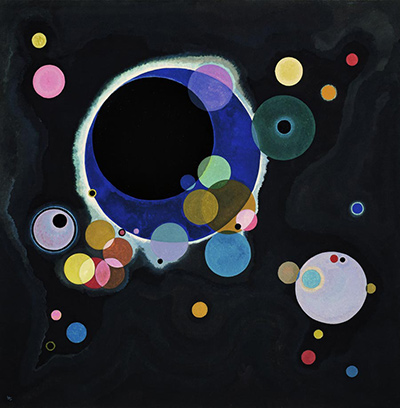
1923Several Circles
1926Sky Blue
1940Contents
- The order that does not quite hold
- A documented work on paper
- What its recorded history can tell us
- Seeing variation at several scales
- Frequently asked questions
- References
The order that does not quite hold
The pale field is crossed by long vertical and horizontal lines, some carried nearly to the edges. They suggest a layout that could be extended beyond the paper, but they are not all equally dark or continuous. A red horizontal near the top, a yellow band across the left middle and several narrow green lines set up uneven accents. The eye tries to read a grid, only to find that coloured marks have different widths, weights and directions. [1]; [2].
Near the upper left, a tilted crosshatched rectangle sits against straighter vertical divisions. It almost resembles a roof, yet no actual building is named in the title or lot record. Its diagonal mesh matters as a texture: a patch of repeated little crossings inside a composition otherwise organised by longer lines. At the upper right, a small dark ladder-like form balances a light semicircle. Kandinsky places several kinds of repetition in one sheet, but keeps each from turning into a uniform pattern. [2].
The centre is denser. A red-pink shape with dark dots overlaps darker bars, while nearby pale red arches loop down toward the left. These curves make the surrounding rectangles feel less settled. Where an upright line promises stability, a broad arc swings across it. A few enclosed colour patches appear to slide from one cell to another; the division between compartments becomes a point of tension rather than an unbreakable boundary. [1]; [2].
At the bottom, step-like outlines frame open pale areas, and a small red inverted triangle sits at the right. It is a strong mark partly because it is so isolated. The composition distributes its accents asymmetrically: a crowded centre is set against spaces where only a few fine lines remain. This contrast helps the work avoid looking like a diagram filled in according to a rule. The title's rectangles are varied by size and colour, but also by the interruptions around and within them. [2].
A documented work on paper
The material matters. Transparent watercolour can allow lighter layers to show through, while India ink gives decisive dark lines and small marks. Christie’s says the paper was laid down by the artist on board. That phrase describes a physical mounting attributed to Kandinsky in the sale catalogue; it does not make the picture an oil on board. A reader should keep the paper support in view when comparing its surface with Kandinsky's Bauhaus-period canvases. [1].
Christie's transcribes the reverse title as “Variierte Rechtecke” and the artist number as 347. It also cites Kandinsky's own watercolour handlist entry IV 1929, 347. The auction essay states that Vivian Endicott Barnett planned to include this watercolour as no. 938 in a forthcoming catalogue raisonné volume. Because the public page uses a future tense, that sentence is evidence of the catalogue's scholarly identification at the time of sale, not a substitute for checking the final published volume. [1].
These identification details also prevent confusion with the separate Thirteen Rectangles, a title attached to another Kandinsky work. The present drawing is the small nearly square April 1929 sheet with the reverse number 347 and a central dotted form. Similar geometric vocabulary does not make one image an alternate view or later state of the other. [1].
What its recorded history can tell us
The Christie’s provenance names J.B. Neumann in New York with the date 23 September 1936, then Nierendorf Gallery in New York. It reports that the lot's then-current owner acquired the work in 1945. Since the sale catalogue is historical, “present owner” in its text means the holder at the time of that sale. It cannot establish who owns the drawing today. The careful conclusion is that the work passed through those named New York channels and that a later current location is not established by the cited public record. [1].
Christie's further lists the 1937 Nierendorf Gallery exhibition Kandinsky, a Retrospective View, where the work appeared as no. 25. This is a useful early point in its exhibition history: the sheet was shown within Kandinsky's lifetime, several years after its making. Yet the exhibition listing does not prove that its grid was intended as a display of a specific theory or classroom lesson. That question would require Kandinsky's own statement or detailed exhibition evidence, neither of which appears in the lot page. [1].
The drawing belongs to Kandinsky's Bauhaus years. By 1929, he had been teaching there since 1922, and his use of elementary forms was well established. That context invites comparison with other works of the period, but each should retain its material and scale. A small paper sheet can sustain exact ruled lines, fine red hatchings and changes of wash that may work differently from paint built up on canvas. [3]; [1].
Seeing variation at several scales
The title might first prompt a count of rectangles, but the more revealing question is how repeated elements change. A red block near the upper centre is broad and solid; a yellow strip left of centre is narrow and extended; the diagonal mesh near the upper left is a rectangle made conspicuous by its interior lines. These are different events even when the same geometric name applies. [2].
Variation also comes from neighbouring forms. Red arches pass across straight divisions. A dark cluster of dots changes the weight of the central colour field. The isolated triangle at the bottom right makes the more regular lines above it seem especially deliberate. Open paper is part of the balance: the thin lines do not close every space, leaving room for the eye to complete or abandon an expected grid. [1]; [2].
Nothing in the cited catalogue identifies a literal architecture, map or musical score in this sheet. Such associations may be useful while looking, but they should remain associations. The documented subject is a named arrangement of varied rectangles, and the visible work adds curves, dots, ladders and areas of silence to that vocabulary. Its precise date, materials and reverse inscription make it a specific surviving Kandinsky watercolour, not simply an illustration of a general idea of geometry. [1].
Kandinsky artworks directory
Frequently Asked Questions
Christie's dates Variierte Rechtecke to April 1929 and records K29 on the front and K 1929 on the reverse. [1].
No. The auction catalogue describes watercolour and India ink on paper, laid down by Kandinsky on board. [1].
It measures 39.7 × 38.3 cm, making it a relatively small, nearly square work on paper. [1].
Christie's transcribes No. 347 on the reverse and cites Kandinsky's watercolour handlist IV 1929, 347. It identifies the individual work; it is not a print-edition number. [1].
No. The sheet documented here is Variierte Rechtecke of April 1929, with the reverse number 347 and the dimensions 39.7 × 38.3 cm. Similar title words alone do not identify another work as the same object. [1].
The cited historical lot page records earlier dealers and a then-owner's 1945 acquisition, but it does not establish a current owner or display location. [1].
Discussion
What do you notice first in Varied Rectangles (Variierte Rechtecke)? Share a close observation or a question about the evidence for this work.
Comments are for comparing what we see and what the cited sources establish.
Reader Insights
Which rectangular passage first seems regular, and what disrupts it?
How do the red arcs and central dots change the balance of the grid?
What can the reverse title and number establish about this specific sheet?
Join the Conversation
Add your observation below and tell us which part of the artwork led you to it.
References
- Christie's, Variierte Rechtecke, lot 2411384: object, inscription, provenance, literature and exhibition history. View source.
- Artothek, image listing for the Christie's Variierte Rechtecke. View source.
- Guggenheim Museum Bilbao, Kandinsky Bauhaus context in its Composition 8 teaching guide. View source.