Kandinsky’s 1911/12 book and its arguments
Concerning the Spiritual in Art is Kandinsky’s argument for what a painting can do beyond describing the visible world. Its German title is Über das Geistige in der Kunst insbesondere in der Malerei—literally, about the spiritual in art, especially in painting. The Munich publisher R. Piper issued it in December 1911, although copies bear a 1912 date. The book went through three editions by the end of 1912, and Michael T. H. Sadleir translated it into English in 1914. These dates matter because the book belongs to a particular moment of experiment, exhibition and debate; it was not a retrospective explanation of everything Kandinsky later made. [1]; [2].
This guide follows the book’s main questions: why imitate nature, how can colour and form affect a viewer, what can painting learn from music, and what does Kandinsky mean by “inner necessity”? It also looks at the illustrated volume as an object and at the limits of applying its theory to individual works. For short, exact passages with translator attribution, use the separate Kandinsky Quotes page. The full German 1912 edition and Sadleir’s 1914 English version are available to read alongside this account.
Watch: Wassily Kandinsky
Five museum videos about Kandinsky’s art, sources of inspiration and the relationship between colour and music.
Vasily Kandinsky: Around the Circle
Curator Megan Fontanella introduces Kandinsky and the Guggenheim collection.
Watch on YouTubeAt a Glance
- Original title:Über das Geistige in der Kunst insbesondere in der Malerei.
- Publication:first issued in Munich in December 1911; the book is commonly dated 1912 from its imprint.
- English edition:Michael T. H. Sadleir’s translation appeared in 1914 as Concerning the Spiritual in Art.
- Structure:an opening general argument followed by chapters on painting, including colour, form, theory, artwork and artist.
- Physical book:MoMA catalogues an illustrated copy with eleven woodcuts, counting the cover.
- Main idea:artistic form should answer an “inner necessity,” rather than obey a compulsory rule to copy or reject visible things.
Contents
- Why the dates and title matter
- The problem Kandinsky sets up
- Music as a comparison, not a recipe
- Colour and form in the book
- Inner necessity and artistic freedom
- An illustrated book with a reception history
- How to read it with the artworks
- Frequently asked questions
- References
Why the dates and title matter
The apparent 1911/1912 disagreement is bibliographic, not a dispute about whether Kandinsky wrote the book at all. MoMA records an illustrated book dated 1911 and says that three editions appeared between December of that year and the end of 1912. A digitised German third edition has “München 1912” on its title page. The Guggenheim describes the object as 1911, dated 1912. When a modern source calls it a “1912 book,” it may be following the printed date; when another calls it a “1911 treatise,” it may be following the first issue. Both can be intelligible if the convention is stated. [1]; [3]; [2].
The phrase “especially in painting” in the German title also matters. Kandinsky discusses music, literature and the wider spiritual life, but his sustained practical question is what painters can do with colour, shape and objects. He does not write a general manual of religion or a scientific account of perception. The book is a passionate and sometimes absolute polemic, made by an artist testing the possibilities of a particular medium. “Spiritual” names the inner effect and purpose he wants art to carry; it should not be reduced to a single religious image or one unchanging meaning of a colour.
A surviving publishing contract dated 2 September 1911 in the Lenbachhaus collection gives a material point in the book’s production. The image currently displayed for that record is a placeholder, so it is not used here. The image above is a different object: Kandinsky’s cover design, catalogued around 1910 by the Lenbachhaus. Its lettering and triangular field show a proposed visual presentation of the book, but it is not presented as the printed cover of a December 1911 copy. [6]; [5].
The problem Kandinsky sets up
Kandinsky opens with the relation between an artwork and its age. He objects to copying the outward style of an earlier period as though its original inner life could simply be recovered. His metaphor of a moving spiritual triangle imagines artists perceiving possibilities before they become widely familiar. This is a historical and aspirational scheme, not a measured law of art history. It tells us what Kandinsky wanted contemporary art to attempt and how he imagined its audience changing. [3]; [4].
The immediate target is a materialist view that values technical imitation, fashionable novelty or market success while neglecting a work’s inner effect. Kandinsky is not saying that material skill is irrelevant. He asks what the skill serves. A competent picture of recognisable objects can still fail, in his view, if its forms never carry a compelling purpose. Conversely, strange or simplified forms may have force even when they do not resemble a scene. This argument helped make room for abstraction, but it does not prove that all representational painting is spiritually empty.
The 1911 Composition V offers a way to hold the theory beside an actual work. MoMA links the painting’s December 1911 moment to Kandinsky’s written question about whether the object must be abandoned. The canvas remains an object with a particular history and visual structure, not a mere illustration of a sentence. Its inherited site route is being revised separately; until that object page is fully checked, the book’s argument should not be used to invent precise symbols in it. [7].
Music as a comparison, not a recipe
Kandinsky repeatedly turns to music because it can move listeners without presenting an identifiable landscape or person. He sees in that relative freedom a model for painting’s release from compulsory depiction. Yet he also states differences between the arts: music unfolds in time, while a painting can present its arrangement to the eye at once. His comparison is therefore more exact than the simple claim that a canvas “is music.” He wants painting to use its own means with comparable independence. [4].
The book introduces the categories impressions, improvisations and compositions, names that borrow musical associations. MoMA notes that these terms helped Kandinsky shift attention away from recognisable subject matter. An impression can start from the external world, an improvisation from a more immediate inner impulse, and a composition from a consciously worked-through arrangement. These are Kandinsky’s conceptual distinctions, not a reliable stopwatch for the time spent making any individual picture. The numbered titles do not by themselves settle every work’s subject, sequence or level of preparation. [1]; [3].
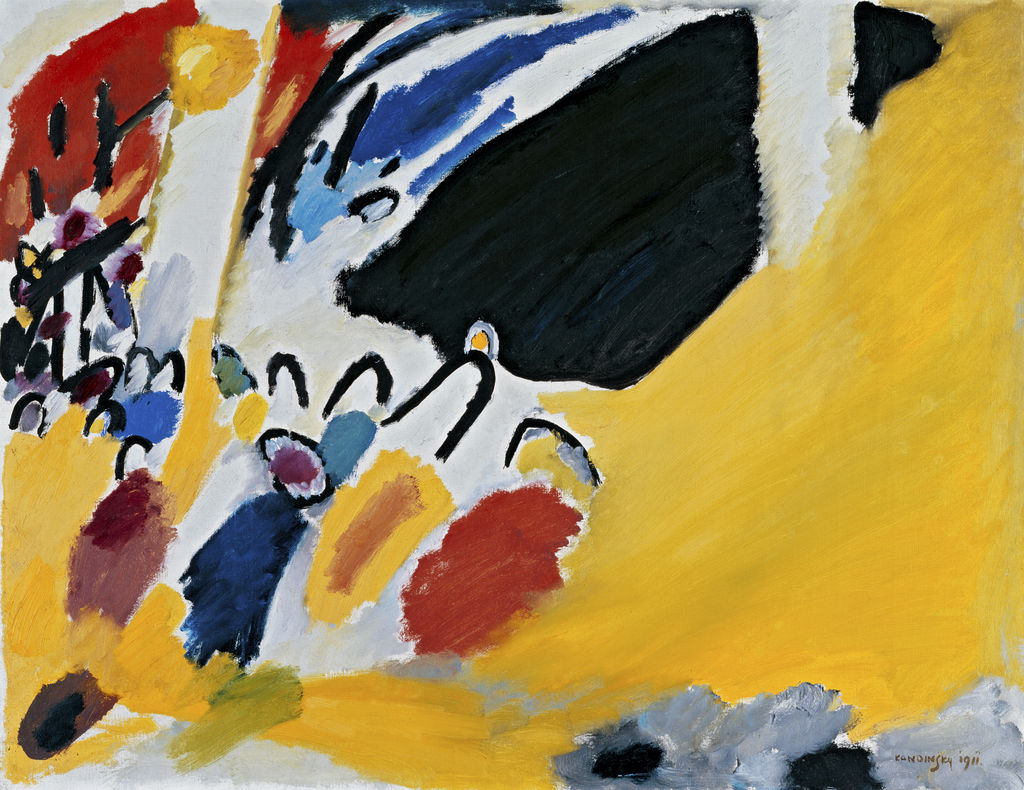
The 1911 Impression III (Concert) makes the musical connection unusually concrete: its owner and exhibition history tie it to a Schoenberg concert. The black piano-like mass and yellow field can be discussed alongside the book’s interest in sound and colour. That relation is not evidence that Kandinsky literally heard colours, nor that the painting translates notes one by one. A dated event, a surviving artwork and a theoretical analogy are three different kinds of evidence. Keeping them separate makes the comparison more useful. [9].
Colour and form in the book
In the section on painting, Kandinsky first considers the physical effect of colour and then its psychic effect. His famous keyboard comparison imagines colour acting upon the soul through the eye, with the artist selecting and arranging the keys. It is a metaphor for making and response. The book also explores how colours seem to advance or recede, and how their effect changes with neighbouring colours and shapes. Kandinsky’s descriptions of yellow, blue, green and other colours are unusually vivid, but they are proposals about experience, not a universally tested chart of emotional outcomes. A footnote in the early English edition explicitly says that some of these assertions rest on spiritual experience rather than a scientific basis. [3]; [4].
Form also has what Kandinsky calls an inner sound. A recognisable object can contribute to a picture, but it may also distract from an abstract arrangement. In one passage he asks whether an object should be replaced, simplified or omitted if its material association weakens what the composition needs. He does not establish a mandatory ban on objects: his answer to artistic questions beginning with “must” is that there is no such absolute command. The shape, colour and object have to be judged in relation to the whole. [3]; [4].
The 1913 Colour Study: Squares with Concentric Circles helps test the practical side of this language. The repeated cells isolate differences among colour combinations, yet their boundaries remain irregular and the sheet uses watercolour, gouache and chalk. Its title calls it a study, and the Lenbachhaus documents its materials and dimensions. The book can suggest questions about colour relations; the museum record establishes what the physical object is. Neither source alone provides a complete account of how Kandinsky intended every cell to be read. [10].
Inner necessity and artistic freedom
Kandinsky’s term innere Notwendigkeit is often translated as “inner necessity” or “inner need.” In the book it connects an artist’s purpose with the particular forms and colours chosen to express it. Sadleir’s translator note warns that Kandinsky sometimes uses the phrase for the impulse to express and sometimes for the achieved expression. It should therefore not be treated as a test that an outside reader can apply mechanically to certify a painting. It names the relation Kandinsky sought between means and inner content. [4].
This is why freedom in the book is demanding. Kandinsky wants the artist to be free from the rule that form must imitate nature, but he also wants each choice to answer the needs of the work. Technical mastery is insufficient if it becomes its own end. The final chapter describes the artist as having responsibilities to art and to the viewer, and it asks for sustained inner training. One can disagree with his spiritual language while still see the practical question: what makes a visual decision purposeful rather than merely fashionable? [3]; [4].
The later Point and Line to Plane takes a more systematic approach to elementary forms in the Bauhaus years. The Lenbachhaus notes that Kandinsky regarded the later publication as an organic continuation of the earlier book. Continuation does not mean identity: it was written in different teaching conditions, and its terminology should not be silently projected back into the 1911/12 text. [8].
An illustrated book with a reception history
MoMA catalogues the original as an illustrated book with eleven woodcuts, counting the front cover. The designs matter because Kandinsky did not confine his argument to abstract prose. The printed object placed lines, shapes and visual reductions alongside its chapters. MoMA describes the woodcuts as distilling complex scenes into simplified designs, and it lists the headpieces for named sections. The book was thus a made and viewed object as well as a text to quote. [1]; [11].
The CC0 image used on this page is a preparatory cover design from the Lenbachhaus, catalogued around 1910. Its hand-painted lettering, triangular enclosure and coloured forms make the work of imagining a book cover visible. The museum calls it Entwurf für den Einband—a design for the binding or cover—and records gouache and ink on paper mounted to darker paper. It should not be captioned as a photograph of the published edition. [5].
Three German editions within roughly a year and an English translation in 1914 show the text’s early circulation. They do not justify saying that the book single-handedly invented abstraction or that every artist who later made abstract work followed Kandinsky. MoMA places his painting and writing amid a wider network of artists, poets and musicians. The book is central evidence for his own aims and for the debates of its moment; a broader history of abstraction needs other artists’ works and statements as well. [7]; [1].
How to read it with the artworks
A good route begins with one chapter and one dated object rather than trying to attach the whole theory to every picture. Read the colour chapters beside the 1913 colour study and ask what the physical sheet supports. Read the comparison with music beside Impression III (Concert), keeping the documented concert separate from the metaphor. Read the argument about objects and form beside a Composition that retains traces of imagery. In each case, the museum’s date, material and provenance record takes priority for facts about that work.
The book also resists a single neat summary. It is a polemic against materialism, an account of artistic experience, a comparison among arts, a discussion of colour and form, and a statement of artistic responsibility. Some claims are assertions of Kandinsky’s own experience rather than findings we can generalise to all viewers. Its value for looking lies in the questions it makes available, including ones a reader may answer differently. The Paintings, Drawings and Prints guides show how varied the objects are across his career.
Kandinsky artworks directory
Frequently Asked Questions
Its first issue appeared in Munich in December 1911, while the title page of the digitised German third edition says 1912. MoMA reports three editions by the end of 1912, and the Guggenheim labels a copy 1911, dated 1912. Cite the particular edition when exact publication evidence matters. [1]; [2].
He means an inner purpose and effect that he believes art can communicate beyond material description. The word runs through his account of colour, form, artistic impulse and the viewer’s response. It does not assign one religious symbol to every abstract shape. [3].
No. Kandinsky asks whether objects should be renounced, but his discussion allows a recognisable form to remain when it serves the composition. He opposes a blanket rule either for copying nature or for rejecting it. [4].
No. He proposes effects and analogies, sometimes from what he calls spiritual experience. The early text does not provide experimental proof that every viewer responds identically to a particular colour. Colour in a work also depends on its neighbours, scale and form. [3].
No. It is Kandinsky’s cover design, dated around 1910 in the Lenbachhaus collection and explicitly offered under CC0. The museum identifies it as a design, not as a photograph of a printed edition. [5].
The German 1912 third edition and Michael T. H. Sadleir’s 1914 English translation are both freely available online. English excerpts on the Quotes page are attributed to Sadleir rather than presented as Kandinsky’s original English. [3]; [4].
Discussion
Which argument in the book changes how you see a particular work?
Name the work and passage, then describe the connection.
Reader Insights
Compare a colour claim with the 1913 Colour Study.
What changes when you read the no must passage in context?
Which English translation choice would you compare with the German?
Join the Conversation
Share an observation anchored to an edition and a specific artwork.
References
- The Museum of Modern Art, Über das Geistige in der Kunst illustrated-book object record. Object, publication history and woodcuts. View source.
- Guggenheim, book object record. 1911 issue dated 1912. View source.
- Wassily Kandinsky, Über das Geistige in der Kunst insbesondere in der Malerei, third edition, Munich, 1912. Primary German text. View source.
- Wassily Kandinsky, Concerning the Spiritual in Art, translated by Michael T. H. Sadleir, 1914. Historical English translation. View source.
- Lenbachhaus, cover design GMS 611. Around 1910, gouache and ink, CC0. View source.
- Lenbachhaus, publishing contract dated 2 September 1911. Physical publication evidence. View source.
- MoMA Kandinsky artist essay. The book and painting in context. View source.
- Lenbachhaus, Punkt und Linie zu Fläche essay. Relationship to the 1926 continuation. View source.
- Lenbachhaus object record. View source.
- Lenbachhaus colour-study record. View source.
- MoMA illustration group. View source.