The return to Moscow and the work of 1914–1921
Wassily Kandinsky’s return to Russia during the First World War changed the conditions under which he made art. He left Munich after war began in August 1914 and was back in Moscow by the end of that year. The years to December 1921 involved war, revolution, a new marriage, diminished resources and work in cultural institutions. They also produced city views, watercolours, reverse-glass pictures, drawings and ambitious oils. To call the period a pause between the Blue Rider and the Bauhaus would hide much of the work and the decisions behind it. [1]; [3].
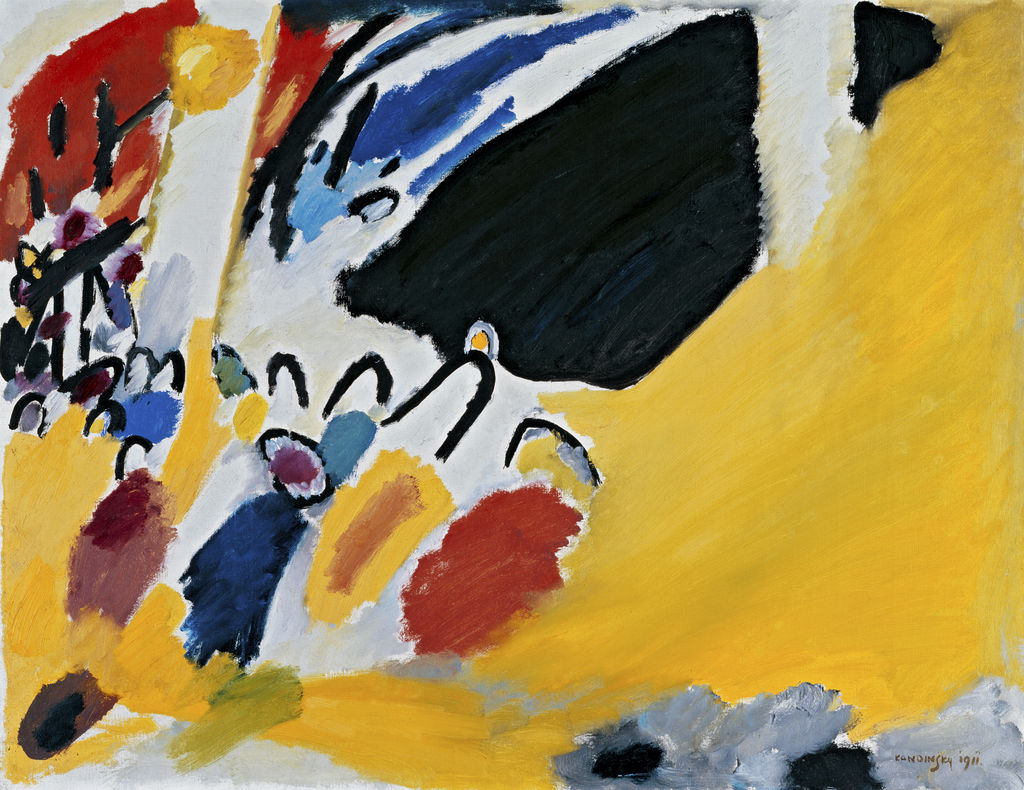
The image above is Zubovsky Platz, a 1916 oil of Kandinsky’s Moscow surroundings owned by the Lenbachhaus. From a high window the city becomes a pattern of rooftops, walls and streets, with colour carrying the view as strongly as architecture does. It is one documented object in a series of window views, not a complete picture of the Russian years. The difference between this place-based oil and a watercolour study for a lost abstract painting shows why no single work can stand in for the period. [5]; [8].
Watch: Wassily Kandinsky
Five museum videos about Kandinsky’s art, sources of inspiration and the relationship between colour and music.
Vasily Kandinsky: Around the Circle
Curator Megan Fontanella introduces Kandinsky and the Guggenheim collection.
Watch on YouTubeAt a Glance
- Return:War began in August 1914; Kandinsky left Germany and returned to Russia after a period in Switzerland, reaching Moscow by late 1914.
- Main working place:An upper-floor apartment near Zubovsky Square became a vantage point for 1916 city views.
- Media:Watercolour, drawing, reverse glass, small and large oils; fewer oils in some years do not mean no artistic work.
- Family:Kandinsky married Nina Andreyevskaya in February 1917; they lived in Moscow through the subsequent upheaval.
- Institutions:He worked with IZO from 1918, directed Museums of Painterly Culture in 1919, took part in INKhUK in 1920 and the Russian Academy of Artistic Sciences in 1921.
- Departure:He left Russia for Berlin in December 1921 and began teaching at the Bauhaus in Weimar in 1922.
Contents
- Leaving Munich in wartime
- Paper, glass and changes of scale
- A Moscow window as a working motif
- Moscow as a painted idea
- Nina, revolution and the household
- Art institutions as part of the work
- The 1919 canvas In Grey
- Departure and what the Moscow years leave us
- Frequently asked questions
- References
Leaving Munich in wartime
The Blue Rider circle had exhibited and published in Munich only a short time before the First World War disrupted it. As a Russian citizen in Germany, Kandinsky had to leave in August 1914. He travelled through Switzerland and returned to Russia toward the end of the year. The departure was practical and political as well as personal: the studios, colleagues and works left in Germany did not travel neatly with him. Gabriele Münter kept a significant body of earlier work, and its later path into the Lenbachhaus shaped how the pre-war years would be studied. His next years in Moscow should nevertheless be understood on their own terms, not only as separation from Munich. [1]; [4].
Moscow was the city of Kandinsky’s birth and earlier university education, but he did not return to an unchanged home. War constrained travel and markets. After 1917, political revolution, property changes and civil conflict reshaped public life and the means of making art. The Guggenheim’s teaching account connects a loss of wealth and reduced resources with an altered practice; the Lenbachhaus provides detailed evidence from the building near Zubovsky Square. These accounts support a description of changed working conditions. They do not make every stylistic choice a direct symptom of hardship. [7]; [5].
The chronology also needs care. The phrase “Russian years” here means the 1914–21 return, not Kandinsky’s entire Russian-born life. He had visited Russia during his Munich period, and he made art in other countries during the return years, including works around a 1915–16 stay in Stockholm. Calling every object of the interval “Moscow-made” would therefore overstate its place of production. A date, medium and owner’s record are better anchors than the broad geographical label. [3]; [8].
Paper, glass and changes of scale
The years immediately after the return were not rich in large oils. The Guggenheim describes 1915 as a year in which Kandinsky painted no oil picture, while the Centre Pompidou and Lenbachhaus describe watercolours, drawings and reverse-glass works. The statements are compatible if “picture” is understood in the Guggenheim’s narrower oil-painting context. It would be false to turn that one year into a claim that Kandinsky stopped creating art in Russia. A paper sheet can be a finished experiment, a study for another work or an independent response to changed circumstances. Its status has to be established object by object. [7]; [4]; [5].
The Centre Pompidou presents a small 1916 watercolour Einfach (Simple) as an example of the period’s spare lines and dispersed colour. Its description stresses that the paper works are substantial evidence for Kandinsky’s development, not marginal souvenirs. The same museum discusses a 1917 oil at Akhtyrka that recalls a domestic scene and memory. One object reduces marks; another holds onto place and people. Neither establishes a wholesale retreat from abstraction nor an automatic march to geometry. The variety is a reason to avoid assigning a single visual programme to an entire seven-year span. [4].
A 1916 watercolour preserved in Milan, called Composition on this site, shows a different relationship between paper and painting. The Italian national catalogue identifies it as a study for the lost oil Picture with Two Red Spots. Its areas of wash, drawn lines and red accents survive; the finished oil is known through other records, not available for a direct surface comparison. The sheet is not one of Kandinsky’s numbered Compositions simply because its title says “Composition.” Nor should a reproduction of it be treated as permission to use the image. The local article retains its existing splash under the separate rights decision for that route. [8].
A Moscow window as a working motif
The Lenbachhaus records Zubovsky Platz as a 1916 oil on canvas mounted on cardboard, 41.8 × 45.8 cm. Its essay places Kandinsky in an upper-floor apartment near the square from early 1915. He used the elevated view for a group of city pictures, varying the weather, time and extent of the scene. The museum quotes a May 1916 letter to Münter in which he says he was making landscapes from his windows under different light and finding the exercise useful for colour harmonies. This is a dated statement about working practice, not a guarantee that every window painting was made on the exact same day or from precisely the same angle. [5].
In the reproduction, roofs and façades occupy a compressed space below the viewer. Warm yellow and pale blue interrupt darker green, brown and violet masses. The loosely handled street and buildings remain identifiable. These observations can support a reading of the view as both a place and a colour construction. They do not identify each roof by address. Other views from Kandinsky’s apartment use wider or shifted viewpoints. Kunstmuseum Den Haag holds a separate circa-1916 painting titled View of Moscow from the Window of Kandinsky’s Apartment at No. 1, Zubovsky Square. It is a distinct object with different dimensions and ownership, so its image and measurements must not be substituted for the Lenbachhaus work shown here. [5]; [6].
The building’s later history adds context without changing what is visible in the painting. The Lenbachhaus traces Kandinsky’s ownership, an early-1917 sale with a right to continue occupying an upper floor, and property losses after the revolution. Kandinsky and Nina remained there amid changing arrangements; at times Alexander Rodchenko and Varvara Stepanova had studios in the building. Their proximity is historically interesting, but it is not evidence that they helped paint Zubovsky Platz. The canvas belongs to Kandinsky’s 1916 series. The subsequent household history helps explain the city as a continuing working environment. [5].
Moscow as a painted idea
Moscow I of 1916 offers a useful contrast with the more particular Zubovsky window. The Guggenheim’s teaching materials identify Moscow I as an oil on canvas, 51.5 × 49.5 cm, in the State Tretyakov Gallery. Kandinsky’s city is condensed into a crowded, ringing composition rather than described from one recoverable window. The museum cites his ambition to assemble elements of Moscow into a single painted whole. A title referring to a place can therefore work very differently across two oils of the same year: one chooses a vantage point, while the other combines impressions into a more encompassing image. [7].
A formal contrast should not become a rigid sequence in which the view is merely a rehearsal for Moscow I. The two works have separate supports, dimensions, collections and visual structures. Each uses colour to reorganise a city, but one gives the viewer recognizable rooftops seen from above while the other compresses many city elements into a more symbolic field. The separate Moscow I article examines the Tretyakov canvas and its owner title Moscow. Red Square in detail. The museum reproductions are research evidence, not reuse-licensed page assets. [11]; [7]; [5].
The comparison also resists a simple “return to figuration” label. Kandinsky did paint legible urban views, yet he also made abstract sheets and canvases in these years. The Moscow subject could provide observed architectural forms, recollected places and a conceptual image of the city. In the Centre Pompidou’s account, even a small 1917 Akhtyrka scene is bound up with memory rather than a general renunciation of abstraction. A shift in subject or scale may answer a local artistic question without cancelling all earlier commitments. [4].
Nina, revolution and the household
Kandinsky married Nina Andreyevskaya on 11 February 1917, according to MoMA’s exhibition chronology. Their family life unfolded through the revolution and the civil-war years. The same chronology records the birth of their son Vsevolod in September 1917 and his death in 1920. These dates are part of the biographical record; they should not be used to diagnose or assign a private meaning to any particular painting without evidence. Nina later accompanied Kandinsky to Germany and France and played a major role in preserving his studio material, but this page concerns the years in which their shared life began. [2]; [4].
The Lenbachhaus account of the Zubovsky building records how family decisions, housing, work space and property became intertwined. The sale early in 1917 predated the October revolution; later expropriation changed Kandinsky’s resources. Treating all losses as one event would make the timeline inaccurate. The Guggenheim connects financial pressures and institutional employment to a reduction in some kinds of production. It is still necessary to inspect what was made: a claim about difficult conditions cannot be allowed to erase surviving watercolours, studies and oils. [5]; [7].
Descriptions of Kandinsky’s politics need similar restraint. Working in public institutions after the revolution was a documented practical and intellectual activity. It neither proves that he endorsed every policy of the new government nor makes his teaching and museum planning irrelevant to art. He debated artistic methods with other avant-garde figures under pressures that were changing quickly. The museum record can establish appointments and the existence of disagreements; it does not authorize a neat claim that he belonged wholly to a later movement such as Constructivism. [1]; [3].
Art institutions as part of the work
Kandinsky joined IZO, the visual-arts department of the People’s Commissariat for Education, in 1918. MoMA’s chronology also records editorial work for its periodical and teaching at the Free State Art Studios in Moscow. These were efforts to organise instruction and public access to art in a new political setting. The role of an artist in such work is not only to produce exhibition pieces; it may include curricula, debate, publishing and decisions about what kinds of objects a museum should collect. That broader labour was a substantial part of Kandinsky’s Moscow years. [2]; [3].
In 1919 he became the first director of the Museums of Painterly Culture, working toward a network of regional museums. In 1920 he participated in the founding of INKhUK, the Institute of Artistic Culture, and taught at Vkhutemas. MoMA’s chronology notes that his programme met opposition and that he left INKhUK late that year. These dates help a reader see a changing relationship between Kandinsky’s ideas and other artists’ approaches to construction, research and public education. They are more informative than saying simply that he “worked for the government” or that he was driven out of a uniformly hostile avant-garde. [1]; [2].
The Russian Academy of Artistic Sciences adds a final institutional step. MoMA’s chronology lists Kandinsky as a cofounder and vice-president in 1921. The academy’s interdisciplinary remit suited his continuing interest in how visual form, perception and other arts might be discussed together. It would be a mistake to read the later Bauhaus teaching backwards and make these Moscow roles merely a preparatory job application. They were local responses to Russian debates and public institutions. Yet they did give Kandinsky experience in formal teaching and theory that he carried into a very different German school after departure. [2]; [4].
The 1919 canvas In Grey
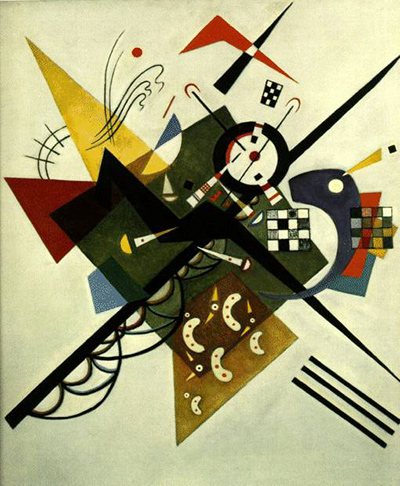
Near the end of the Russian period, Kandinsky painted In Grey (Im Grau). The Centre Pompidou owns the 1919 oil on canvas, 129 × 176 cm, and explains its earlier black-bow title. It is a large, densely worked painting whose muted ground supports floating, intersecting forms. A paper study in the same museum shows planning behind the canvas. Its scale alone disproves a claim that the whole Moscow stay produced only small drawings. The work was shown prominently in a Moscow retrospective in 1920, according to the museum’s detailed account. [9].
The museum discusses Kandinsky’s later description of the picture as the conclusion of a densely accumulated or “dramatic” phase. That is a retrospective artist statement, useful but not a complete explanation of the 1919 object. Its earlier “black bow” wording also makes it easy to confuse with the separate 1912 Picture with a Black Arch. Their dates and objects differ. The separate In Grey article treats the canvas in detail; for this period page it shows that large-scale composition continued amid institutional duties. [9].
It would also be too tidy to say In Grey is the last expression of one style followed at once by geometry. MoMA observes a broader shift from Kandinsky’s pre-war expressionist language toward cooler forms during the Russia years, but the surviving works do not obey a strict annual switch. Cityscapes, watercolours, preparatory sheets and major canvases overlap. Looking at medium and object date before applying a period label gives a more reliable account of change. [10]; [9].
Departure and what the Moscow years leave us
Kandinsky left Russia for Berlin in December 1921. The move was followed by a 1922 appointment at the Bauhaus in Weimar; the two dates should not be collapsed into one. The Centre Pompidou describes difficult artistic and material circumstances before his departure, while the MoMA chronology establishes the institutional sequence and travel. A new German setting did not simply restore the Munich years. Kandinsky entered a school with workshops, teaching obligations and different colleagues. The Bauhaus-years route in this cluster will take up that next phase. [2]; [4].
The Moscow interval survives in objects distributed among collections. A Lenbachhaus window view, a Tretyakov city painting, a Milan watercolour study and a Pompidou oil illuminate different parts of the same years. Their ownership records answer distinct questions about material, scale, date, preparation and later custody. They also warn against filling a gap with the nearest familiar reproduction. The Russian years are neither an absence nor a single style between better-known phases. They show an artist adapting the means of making and presenting art while his city, household and institutions changed around him. [5]; [7]; [8]; [9].
Kandinsky artworks directory
Frequently Asked Questions
The First World War began in August 1914, and Kandinsky, a Russian citizen in Germany, had to leave. He travelled through Switzerland and was back in Russia by late 1914. The move ended his Munich working setting but did not end his artistic activity. [1]; [3].
No. Oil painting decreased sharply in some years, especially 1915, while he continued making watercolours, drawings and reverse-glass work. In 1916 he made city views and Moscow I; In Grey is a large 1919 oil. [7]; [9].
No. The Lenbachhaus owns Zubovsky Platz, a 1916 window view, oil on canvas mounted on cardboard, 41.8 × 45.8 cm. Moscow I is a separate 1916 oil in the State Tretyakov Gallery, documented by the Guggenheim at 51.5 × 49.5 cm. [5]; [7].
MoMA’s exhibition chronology dates the marriage to Nina Andreyevskaya to 11 February 1917. Their Moscow household then lived through the revolution and later moved to Germany in 1921. [2]; [5].
From 1918 he worked with IZO and taught; in 1919 he directed the Museums of Painterly Culture; in 1920 he joined INKhUK and taught at Vkhutemas; in 1921 he helped found the Russian Academy of Artistic Sciences. These were different organisations and roles, not one continuous job title. [1]; [2].
No. Centre Pompidou dates In Grey to 1919 and records a related former black-bow title. The 1912 Picture with a Black Arch is a separate pre-war work. Similar title words do not make the objects interchangeable. [9].
Discussion
Which Moscow-period object most changes your view of these years?
Name a dated work, its medium and one visible feature before interpreting it.
Reader Insights
Compare the 1916 window view with the documented 1919 oil In Grey.
How did housing, materials and institutions shape what could be made?
Which object record separates a study from its lost finished painting?
Join the Conversation
Share a close observation anchored to a dated Russian-period work.
References
- MoMA, Kandinsky artist essay. War return, museums, INKhUK and later Bauhaus. View source.
- MoMA, Kandinsky: Compositions catalogue and chronology. Personal and institutional dates, 1921 departure. View source.
- Centre Pompidou, Politiques de l'art Moscow overview. Return, works on paper and state institutions. View source.
- Centre Pompidou Kandinsky monograph. Medium breadth and selected Russian-period works. View source.
- Lenbachhaus, Zubovsky Platz, 1916. Object facts, CC0 image, apartment and window series. View source.
- Kunstmuseum Den Haag, separate 1916 Zubovsky view. Distinct version. View source.
- Guggenheim teaching materials, Moscow I. 1916 Tretyakov painting and period context. View source.
- Italian Ministry of Culture, 1916 Composition study. Study for lost Picture with Two Red Spots. View source.
- Centre Pompidou, In Grey, 1919. Large oil, studies and title history. View source.
- MoMA, Kandinsky: Compositions exhibition. Broad Russian-period formal change. View source.
- Tretyakov Moscow. Red Square. View source.