Neuilly, new forms and the work of 1933–1944
After the Bauhaus dissolved in 1933, Wassily and Nina Kandinsky moved to France. They arrived in the Paris area in December and settled in Neuilly-sur-Seine in January 1934. The eleven years that followed were neither a simple retreat from public life nor an epilogue to the geometric painting of Dessau. Kandinsky continued to paint, draw, write and exhibit. His pictures increasingly brought small, mobile forms into contact with coloured fields, grids and broader structures. War later restricted travel, supplies and daily life, but he kept working into 1944. [2]; [1]; [4].
The image above is Parties diverses (Various Parts), a 1940 oil in the Lenbachhaus on long-term loan. Distinct coloured areas hold forms that can look organic, constructed or playful. Its firm divisions make it a useful reminder that Kandinsky did not discard organisation when he explored softer, more creature-like shapes. One painting cannot summarise the entire French period; it can, however, help a reader test broad claims about “biomorphism” against an actual object. The Lenbachhaus record supplies the work's date, medium, dimensions and explicit CC0 image status. [9].
Watch: Wassily Kandinsky
Five museum videos about Kandinsky’s art, sources of inspiration and the relationship between colour and music.
Vasily Kandinsky: Around the Circle
Curator Megan Fontanella introduces Kandinsky and the Guggenheim collection.
Watch on YouTubeAt a Glance
- Move:The Kandinskys left Germany after the Bauhaus's closure and reached the Paris area in December 1933.
- Home and studio:They settled in Neuilly-sur-Seine in January 1934, using the largest room of their apartment as a studio.
- Art:Large oils, watercolours and drawings combined geometric structure with mobile, sometimes biomorphic forms.
- Key works:Composition IX (1936), Dominant Curve (1936), Composition X (1938–39), Parties diverses (1940) and Sky Blue (1940).
- Citizenship:Wassily and Nina became French citizens in 1939.
- War and death:They took temporary refuge in Cauterets in 1940, returned to Neuilly, and Kandinsky died there on 13 December 1944.
Contents
- From the Bauhaus to Neuilly
- Exhibitions and a changed network
- Biological-looking forms and actual pictures
- Composition IX and its 1939 acquisition
- Dominant Curve and 1936 variation
- 1937 confiscations and international reception
- Citizenship, Composition X and the approach of war
- Parties diverses : divided fields in 1940
- Sky Blue and the 1940 disruption
- Working under occupation
- The final year and the Paris-period legacy
- Frequently asked questions
- References
From the Bauhaus to Neuilly
The Bauhaus's final Berlin phase ended amid National Socialist pressure in July 1933. Kandinsky and Nina subsequently left Germany. Centre Pompidou's chronology records a December move to an address in Neuilly-sur-Seine, followed by a more settled arrangement at the start of 1934. Calling the period “Paris” follows common art-historical usage, but their apartment was in Neuilly, just outside the city proper. This is not a minor geographical point: the home was a working place, a social address and the setting for much of the late painting. [2]; [1].
The Centre Pompidou exhibition guide says Marcel Duchamp suggested the apartment building. The largest room became Kandinsky's studio, overlooking the Seine and an industrial suburb. The account presents a domestic setting that carried some Bauhaus furniture and habits into a new city. Its walls and working space were arranged deliberately. Yet the relocation changed the institutional basis of Kandinsky's life: he was no longer teaching at a school every day. The new work had to find audiences through galleries, collectors and publications. [3]; [1]; [12].
The move is sometimes narrated as if Kandinsky arrived without connections. He had already entered Parisian artistic circles through Christian Zervos and Cahiers d'Art, according to the Pompidou object essay, and had participated in abstract-art associations before settling there. The relationships did not guarantee broad French acclaim or a comfortable income. They did provide routes for exhibitions, introductions and discussion. A precise account can hold both facts: an internationally known painter was able to work with some important galleries while remaining at a distance from the city's dominant public taste. [12]; [1].
Exhibitions and a changed network
In 1934 Kandinsky exhibited in Milan and at Cahiers d'Art in Paris. The gallery Jeanne Bucher later provided further Paris exhibitions, including one in 1936 and another in 1942. These dates come from Centre Pompidou's chronology and archive description. They show continued public activity rather than complete isolation. They do not make every year equally successful. An exhibition's existence, its critical reception and an actual sale are different kinds of evidence. [2]; [1].
The Paris circle included artists and writers with whom Kandinsky did not always share a programme. The Pompidou essay mentions Joan Miró, Hans Arp, Christian Zervos, André Breton and visitors from the former Bauhaus world. Their contact helps explain how a painter associated with abstraction could encounter Surrealist imagery and new debates over the relation of art to nature. Contact is not proof that any single artist supplied the design of a particular Kandinsky figure. It is a context for asking how he adapted earlier formal concerns to a new visual environment. [12]; [10].
Kandinsky also continued to explain his art in writing. MoMA's chronology notes the 1938 article “L'Art concret” in XX Siècle. His use of “concrete” emphasised that a painting's own forms and colours had reality; it should not be confused automatically with every later movement that used the same word. The term helps us understand why biological resemblance in a picture need not turn the picture into an illustration of an amoeba, embryo or specimen. The forms could allude to living processes while remaining constructed elements of an artwork. [4]; [12].
Biological-looking forms and actual pictures
Museum accounts often call the shapes of Kandinsky's Paris work “biomorphic.” Some resemble cells, larvae, small organisms or silhouettes imagined from microscopy. The Guggenheim notes his interest in natural-science illustrations and organic specimens; Centre Pompidou links the Paris corpus to images from biology. Those sources support a history of visual interests. They do not identify every shape as a literal organism or establish a one-to-one scientific source for each painting. A work's title, surface, date and composition must be examined before assigning a specific meaning to a form. [8]; [5].
The new forms did not arrive as a total break from the Bauhaus. Circles, gridded areas, diagonals and careful relations among visual elements persisted. What changed was the relative prominence of softly outlined, varied and apparently animated marks. The Lenbachhaus describes Parties diverses as holding tiny lively structures in an artificial system of divided colour fields. The painting visibly sets a densely marked brown area beside a pale central field and a tall purple zone. The eye can move among these areas before deciding whether any individual mark resembles a creature. That organisation is as important as the resemblance. [9].
“Paris style” is therefore a useful period label and a poor substitute for looking. The small inhabitants of a 1940 painting do not all behave like the forms in a 1936 canvas. Some late work remains strongly structured, some feels light and floating, and some balances contrasting zones. Kandinsky's earlier interest in the effects of colour and shape continued, but the French years gave those interests different scales, textures and associations. A chronological set of objects reveals variation better than a single claim that he exchanged geometry for nature. [5]; [9].
Composition IX and its 1939 acquisition
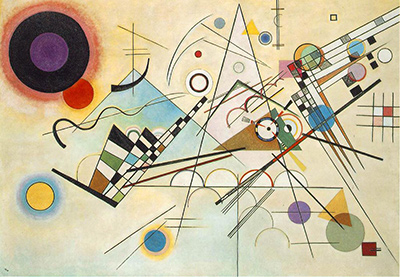
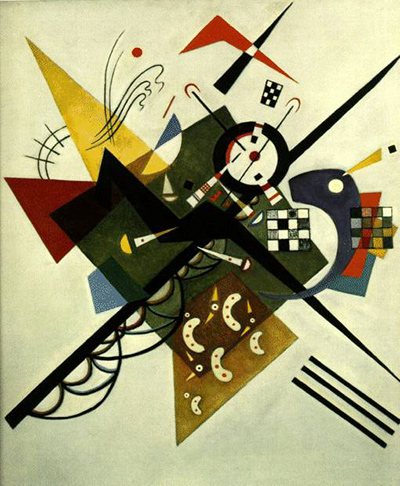
Kandinsky completed Composition IX in February 1936, according to MoMA's chronology. Centre Pompidou records the oil at 113.5 × 195 cm and notes its earlier title L'Un et l'Autre (One and the Other). Broad diagonals cross a field populated by much smaller motifs, including organic-looking shapes, geometric figures and a chequered area. The painting thus resists a simple “soft Paris forms” description. Its strict bands and little floating signs make different visual demands. [4]; [6].
The owner record states that Composition IX was the only Kandinsky painting to enter a French museum during his lifetime. The French state bought it in 1939. A separate 1936 graphite and ink study in the museum demonstrates preparation, but the study is not the oil and its dimensions and surface should not be transferred to the finished canvas. The purchase proves a specific act of public collecting; it should not be stretched into a claim that his work had become universally accepted in France. Centre Pompidou's account of the difficult sale underlines the gap between recognition and reward. [6]; [7]; [14].
The numbered title connects this French painting to a long-standing series of ambitious works, but a number alone does not make all the Compositions stylistically alike. Compare its rigid diagonals and compact motifs with Composition VIII of 1923 and Composition X of the later Paris years. Dates and individual object records matter more than a presumed recipe for a series. The original title L'Un et l'Autre also suggests that Kandinsky considered a different wording before placing the picture within the numbered group. [6]; [4].
Dominant Curve and 1936 variation
The Guggenheim dates Dominant Curve to April 1936, only a short time after Composition IX. It describes pastel hues and forms that recall microscopic life. The institution relates these motifs to Kandinsky's interest in natural sciences and proposes readings of rebirth and regeneration against an increasingly threatening European political situation. The biological similarities are visible suggestions; the more symbolic interpretation belongs to the museum's reading, not to a label attached to each form by Kandinsky. [8].
Putting the two 1936 paintings beside each other is more revealing than treating one as the inevitable next step after the other. Composition IX uses assertive diagonal bands and a multiplicity of small forms. Dominant Curve organises another set of shapes around a sweeping curve and paler palette. Their shared date shows that Kandinsky could test different balances within the same working period. One was bought by the French state in 1939; the other entered the Guggenheim collection by a different route. Ownership histories should not be blended merely because both paintings are important examples of Paris-period abstraction. [6]; [8].
His work on paper also deserves attention. Studies and drawings can document a developing arrangement or stand as finished experiments. The Centre Pompidou holds a distinct 1936 study for Composition IX, for example. It identifies graphite and India ink on paper, not oil. Such records help resist the tendency to narrate the late years only through a handful of large canvases. Kandinsky continued to investigate forms at different scales and in different materials. [7]; [5].
1937 confiscations and international reception
The National Socialist campaign against modern art continued to affect Kandinsky after he left Germany. MoMA's chronology states that 57 of his works were confiscated from German museums in 1937 and that some were included in the Entartete Kunst exhibition in Munich. “Confiscated” and “displayed” name different events: the figure 57 should not be presented as the number shown in that exhibition. These actions damaged public collections and the work's German institutional setting. They also help explain the political precariousness behind the French years. [4]; [2].
The same year brought a Kandinsky exhibition in Bern and a Paris exhibition on the development of independent international art, according to the Pompidou chronology. A London exhibition followed in 1938. These events demonstrate that official rejection in Nazi Germany did not end the circulation of his work elsewhere. They do not cancel the losses from confiscation or the difficulty of finding secure support in France. Geography and institution have to be named when describing “reception”: what happened in a German museum, a Swiss exhibition and a Paris gallery was not one uniform response. [2]; [4].
Nor should every formal change in a painting be explained directly by political events. A 1937 work with small organic marks may be made under threatening circumstances; those circumstances do not identify the marks as portraits of danger or hope. The museum's interpretation of a specific canvas can be discussed as an interpretation. Exact object facts—date, material, provenance and visible arrangement—provide a firmer starting point. [8]; [2].
Citizenship, Composition X and the approach of war
Wassily and Nina Kandinsky became French citizens in 1939. Centre Pompidou's chronology places the naturalisation in July, before the declaration of war in September. Some institutional accounts disagree about the precise year of his earlier German naturalisation, so the significant, consistently documented point for this page is the 1939 French change. Citizenship affected the couple's practical position in France; it did not make the political situation in Europe secure. [2]; [1]; [4].
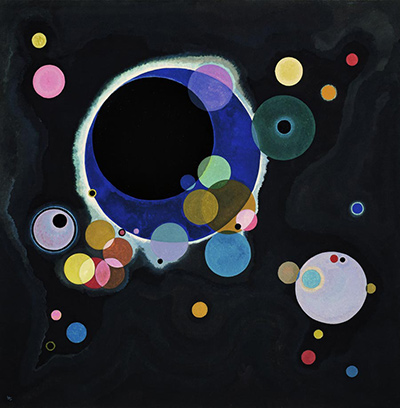
Around the turn of 1938–39 Kandinsky completed Composition X. The painting's black ground and floating forms differ sharply from the diagonal bands of Composition IX. MoMA's chronology places the work across December and January. It is tempting to read the black as a direct omen of war; such a reading needs evidence beyond the sequence of dates. The painting can first be discussed through its actual formal contrasts and its place in Kandinsky's continued exploration of how differently coloured elements act on a field. [4]; [5].
The two late Compositions also demonstrate why the French decade is more than an appended chapter to the Bauhaus. Kandinsky retained an interest in planned large-scale organisation but changed the character of the field, the apparent weight of the marks and their relationship to one another. An artist can carry questions forward without repeating one visual answer. Those continuities and differences are best tested by works whose dates and collections are securely identified. [6]; [4].
Parties diverses : divided fields in 1940
The Lenbachhaus dates Parties diverses to 1940 and lists an oil on canvas measuring 89.5 × 116.4 cm. The work is held there on long-term loan from the Gabriele Münter and Johannes Eichner Foundation. Its three large vertical areas have different colours and densities. Within them are smaller patterned shapes, bands and fine marks. The right area is purple and relatively open, while the left is darker and denser. The central pale area contains forms that can feel both manufactured and living. These are observations of the reproduced painting, not names of species or a claim about a coded narrative. [9].
The museum's essay interprets the painting as a play between organic-looking details and an artificial, balanced structure. Its title can be translated “Various Parts,” but the precise French title should be retained in an object caption so it is not confused with another Kandinsky work. The canvas's colour zones prevent the small figures from becoming a random swarm. They make relationships across the picture's halves possible. Calling it merely biomorphic misses the divisions; calling it merely geometric misses the variety inside them. [9].
The image used on this page comes from the Lenbachhaus's explicitly CC0 object record. That clear reuse statement applies to the exact museum image copied for the splash. It does not establish reuse permission for every photograph of Kandinsky, nor for a different museum's image of another work. The image is a deliberate period illustration, not an attempt to upgrade every artwork route. Readers who want the work's materials and ownership details can follow the source record directly. [9].
Sky Blue and the 1940 disruption
Centre Pompidou owns Sky Blue, an oil of 1940 measuring 100 × 73 cm. Its blue ground carries an assortment of vividly coloured small forms. The museum connects the painting to Kandinsky's visit to Joan Miró in Varengeville-sur-Mer and to the visual freedom of the late period. It also cautions against amusing ourselves by cataloguing the little beings one by one: the blue field and the whole pictorial arrangement matter. The Miró association is a documented artistic contact and museum interpretation, not proof that the picture is simply Kandinsky imitating a Miró canvas. [10].
The German invasion of France in 1940 altered life sharply. The Kandinskys went to Cauterets in the Pyrenees during the exodus and early occupation, then returned to the Paris area by the end of August, according to Centre Pompidou's chronology. They subsequently lived under the restrictions of the occupation. It would be inaccurate to say they never left Neuilly during the invasion. Equally, the temporary journey should not be made into a permanent relocation. His 1940 pictures belong to a year with changing circumstances, not one static household condition. [2]; [10].
The contrast between the open blue of Sky Blue and the partitioned structure of Parties diverses illustrates two paths within the same year. Both contain small, unusual forms. Their grounds and organisation change how those forms are experienced. One may suggest movement in a wide space; the other sorts figures through coloured compartments. Neither should be converted into a direct emotional diary of 1940. The dated works and their owners' interpretations provide a more precise basis for comparison. [10]; [9].
Working under occupation
The Centre Pompidou archive portrays the Neuilly years as relatively withdrawn, but “withdrawn” is a comparison with the Bauhaus and earlier circles, not a statement that nobody visited or that no exhibition occurred. Jeanne Bucher exhibited Kandinsky again in 1942. The museum's account of Accord réciproque describes difficulty obtaining painting materials and a reduced visitor circle during the war. These details help explain changed working conditions without implying an absolute end to artistic activity. [1]; [11].
Centre Pompidou's detailed chronology identifies Tensions délicates, painted in June–July 1942, as Kandinsky's last large-format work. That wording matters: “last large-format work” is not the same as “last work of any medium.” He continued to draw and make smaller works thereafter. Other owner accounts discuss late canvases and working material with different emphases. A broad claim that Kandinsky stopped making art in 1942 would erase the documented continuation into 1944. [2]; [4]; [11].
Even under constraint, the art does not resolve into one wartime style. Black grounds, pale fields, compartmented structures and cellular forms all appear in the later work. Colour and form remain active choices. The temptation to read every cheerful shape as defiance, or every dark background as despair, turns a painting into an illustration of a historical mood. War is essential context, but the object still asks to be looked at as a made arrangement of surfaces, marks and intervals. [5]; [10]; [9].
The final year and the Paris-period legacy
Kandinsky became ill in 1944 but continued working for some months. Institutional chronologies differ slightly in how they date the last work sessions; both MoMA and Centre Pompidou record activity in that year. He died at home in Neuilly-sur-Seine on 13 December 1944, after the liberation of Paris. Nina Kandinsky remained crucial to the preservation and eventual distribution of his studio's works and papers. The Centre Pompidou fonds now holds a major body of those materials, so the period can be studied through more than a few familiar paintings. [4]; [2]; [1].
The French years matter because Kandinsky kept testing the relationship between a painting's large order and its smallest elements. Composition IX makes a field of diagonals and floating signs; Dominant Curve places biomorphic suggestions within a sweeping arrangement; Parties diverses divides a surface into several artificial environments; Sky Blue spreads small forms across a luminous ground. These are different answers to ongoing questions. The political and domestic chronology helps situate them, but no single event explains them all. [6]; [8]; [9]; [10].
To study the period, begin with a dated object and its owner record. Ask what it is made of, what can be observed directly, where it was shown or acquired and how a museum interprets it. Then compare another object from the same year or a different part of the decade. That method makes room for both continuity with Kandinsky's earlier work and the real changes of the Paris years. It also keeps his final decade in view as a substantial period of invention, rather than a short afterword to the Bauhaus. [5]; [13].
Kandinsky artworks directory
Frequently Asked Questions
He and Nina left Germany after the Bauhaus's 1933 closure and arrived in the Paris area in December 1933. They settled in Neuilly-sur-Seine in January 1934. Neuilly is a suburb, though “Paris years” is the usual period label. [2]; [3].
It describes forms that resemble living shapes such as cells or small organisms. Museums connect the Paris works to Kandinsky's interest in biological images, but the resemblance does not identify every mark as a particular species or a fixed symbol. [5]; [8].
Yes. Composition IX and Dominant Curve were made in 1936, Composition X around 1938–39, and Parties diverses and Sky Blue in 1940. He also made drawings and watercolours. [6]; [8]; [9].
MoMA records 57 works confiscated from German museums in 1937. Some appeared in the Entartete Kunst exhibition; 57 is the confiscation figure, not the exhibition count. [4].
No. During the exodus they stayed temporarily in Cauterets in the Pyrenees, then returned to the Paris area by late August 1940. They remained in Neuilly during the subsequent occupation. [2].
Discussion
Which Paris-period object most changes your view of these years?
Name a dated work, its medium and one visible feature before interpreting it.
Reader Insights
Compare the divided fields of Parties diverses with the open blue of Sky Blue.
How did Neuilly housing, gallery networks and wartime materials shape the work?
Which object record distinguishes a preparatory study from its canvas?
Join the Conversation
Share a close observation anchored to a dated Paris-period work.
References
- Centre Pompidou, Kandinsky archive fonds. Household, gallery network, citizenship and death. View source.
- Centre Pompidou, detailed chronology. 1933–44 dated events, exhibitions and work. View source.
- Centre Pompidou, exhibition guide. Neuilly apartment and wartime account. View source.
- MoMA, Kandinsky: Compositions chronology. Major paintings, confiscations and 1944. View source.
- Centre Pompidou, English Kandinsky monograph. Period analysis and media breadth. View source.
- Centre Pompidou, Composition IX. 1936 oil and 1939 purchase. View source.
- Centre Pompidou, study for Composition IX. Distinct drawing. View source.
- Guggenheim, Around the Circle press kit. Dominant Curve and biological associations. View source.
- Lenbachhaus, Parties diverses. 1940 object facts, CC0 image and interpretation. View source.
- Centre Pompidou, Bleu de ciel. 1940 Sky Blue and Miró connection. View source.
- Centre Pompidou, Accord réciproque. Occupation and later work. View source.
- Centre Pompidou, untitled drawing essay. Paris networks, atelier and terminology. View source.
- Lenbachhaus, Klee and Kandinsky. Broad Paris-period comparison. View source.
- Centre Pompidou curator on the painting. View source.