Kandinsky’s life and work in dates
Kandinsky's career did not move in a straight line from landscape to abstraction. The Russian-born artist studied law before moving to Munich; made prints, small scenes, landscapes and large canvases; returned to Moscow during the First World War; taught at the Bauhaus; and continued to change his work after settling near Paris. This timeline links the dates to the places and works that make them useful. It distinguishes the year a book appeared from the years it was written, and the date of a painting from the later history of a group with a similar name. 1, 2
The dates below follow institutional chronologies and individual object records. Where a museum identifies a span, such as 1908–09, the span is retained. Where accounts differ on an incidental exact year, the event is placed within its established period without presenting a disputed date as settled. Follow the linked artwork pages for a close reading of one object; the biography tells the longer life story. 1[1]
Watch: Wassily Kandinsky
Five museum videos about Kandinsky’s art, sources of inspiration and the relationship between colour and music.
Vasily Kandinsky: Around the Circle
Curator Megan Fontanella introduces Kandinsky and the Guggenheim collection.
Watch on YouTubeAt a Glance
- 1866:born in Moscow.
- 1896:moves to Munich to pursue art after law studies.
- 1908–09:Murnau landscapes and experiments in independent colour; Blue Mountain.
- 1911–13:the Blue Rider, writings, music and the large pre-war Compositions.
- 1914–21:war and return to Russia; Moscow works and cultural institutions.
- 1922–33:Bauhaus teaching in Weimar, Dessau and Berlin.
- Late 1933–44:Paris/Neuilly, late paintings and works on paper.
Contents
- 1866–1895: Moscow, study and a change of vocation
- 1900–1907: School, Phalanx and travel
- 1908–1910: Murnau and the approach to abstraction
- 1911–1914: Music, the Blue Rider and large compositions
- 1915–1921: Moscow, works on paper and institutions
- 1922–1933: Bauhaus teaching and changing geometry
- Late 1933–1944: Neuilly and the final work
- After 1944: Why the collections are spread across museums
- Frequently asked questions
- References
1866–1895: Moscow, study and a change of vocation
1866 — Birth in Moscow. Wassily Kandinsky was born in Moscow. His childhood also included time in Odessa, a city that reappears in accounts of his early formation. Music, drawing and a strong awareness of colour were part of his education, but the later paintings should not be treated as the inevitable outcome of a childhood anecdote. The value of the date is to place his early years in the Russian Empire, before his later German and French settings. 1, 2
1885–1895 — University and law. Kandinsky enrolled in law studies in Moscow in 1885. He undertook university work and moved towards an academic career before choosing art. The Centre Pompidou chronology records a dissertation in 1893 and his refusal of a teaching position in 1895. The familiar story of a lawyer who suddenly became an abstract painter skips the intervening decades of training, figurative work and experimentation. His legal education is a biographical fact; it should not be turned into an unsupported explanation for every grid or geometric form he later painted. 1[3]
1896 — Munich. He moved to Munich, an international artistic centre, to learn painting. This is the beginning of his sustained professional formation in art, not the date of his first abstract work. His change of career was consequential because it gave him teachers, peers, exhibition opportunities and a base from which to travel. The following years included conventional study and the formation of independent groups. 1
1900–1907: School, Phalanx and travel
1900–01 — Academy and Phalanx. Pompidou places his entry to the Munich fine-arts school in 1900 and the founding of Phalanx in 1901. Phalanx combined an art school and exhibitions. It belongs to the early Munich period and should not be confused with the Blue Rider circle of a decade later. Early prints, including woodcuts, show how image-making for paper mattered beside painting. A print could compress a rider, house or figure into a few decisive shapes long before a canvas ceased to describe a visible scene. 1, 3
1902–07 — Münter and journeys. Kandinsky met the artist Gabriele Münter in 1902. They became close collaborators and travelled in Europe and North Africa; he spent about a year in the Paris area in 1906–07. Münter was an artist in her own right, not merely a witness to his development. The travels widened his encounters with contemporary art, but his small paintings and prints still dealt with places, figures and stories. The early rider painting dates to 1903: its title anticipates a later association, yet the Blue Rider group did not exist in 1903. 1, 2
1903 — The Blue Rider. The painting's date is especially easy to misuse. It shows a rider moving through a landscape; it is not a poster, manifesto or record of the group founded in 1911. View it beside the later Blue Mountain to see both the persistence of the rider motif and the change in how strongly colour reshapes a landscape. This comparison is more informative than assigning the 1903 image to a movement that had yet to form. 2[2]
1908–1910: Murnau and the approach to abstraction
1908 — Murnau. A summer in Murnau in the Bavarian Alps marks a turning point in Pompidou's chronology. Kandinsky worked amid a circle that included Münter, Alexej von Jawlensky and Marianne von Werefkin. Houses, mountains and streets remained recognisable, but high colour, simplified contours and broad patches began to carry more of the picture's structure. This did not happen to every work in exactly the same way. A landscape could still be a record of place while testing how far colour might depart from local appearance. 1, 2
1908–09 — Blue Mountain. The Guggenheim dates Blue Mountain to 1908–09. Three riders cross beneath a blue mountain between large red and yellow trees. Its physical subject is legible, yet the colour fields organise the experience more forcefully than ordinary perspective does. This object must not be conflated with the different 1909 painting Berg in the Lenbachhaus. The paired dates indicate the Guggenheim's cataloguing of this specific canvas, not a period label to paste onto other mountain images. 4[4]
1909–10 — Association and Marc. In 1909 Kandinsky helped establish the Neue Künstlervereinigung München, or New Artists' Association of Munich. The organisation gave experimental artists a way to exhibit but also exposed disagreements about what an exhibition should include. Pompidou records his meeting Franz Marc in 1910. Their later Blue Rider project grew from this active, contested network; it did not appear in isolation. Kandinsky was also working on ideas that eventually entered Concerning the Spiritual in Art, although drafting and publication belong to different dates. 1, 2
1911–1914: Music, the Blue Rider and large compositions
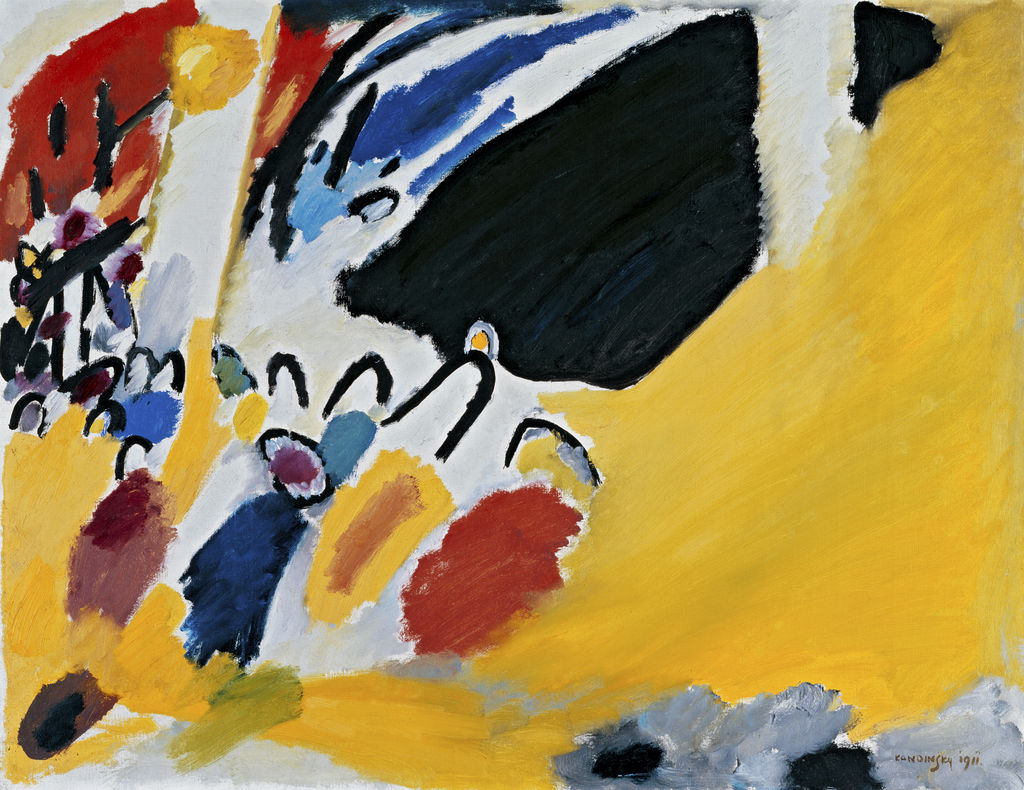
January 1911 — Schönberg concert. Kandinsky attended a Munich concert of Arnold Schönberg's music on 1 January and began a correspondence with the composer. Impression III (Concert) belongs to this encounter. The painting does not diagram a score. Its grand piano, audience and yellow field show Kandinsky searching for a pictorial response to the event, with colour and line doing work beyond description. A direct experience of music and an exchange of ideas are well supported; the stronger claim that he literally saw sounds requires separate evidence. 1, 5[5]
1911 — Der Blaue Reiter. Kandinsky and Marc developed the Blue Rider initiative after a rupture with the New Artists' Association. The name covered exhibitions, an almanac and a cross-disciplinary conversation rather than a single visual formula. Münter and other artists belonged to this setting. Its chronology matters because the circle was short-lived before the First World War dispersed its members. It also matters because its activities joined Kandinsky's pictures to music, folk art and other image traditions without making all participating artists interchangeable. 1, 2
1911–12 — A treatise and an almanac. The first edition of Concerning the Spiritual in Art appeared in December 1911, although it bears a 1912 date. The Blue Rider Almanac appeared in 1912, though planning and a cover study began before then. Kandinsky's terms “impression”, “improvisation” and “composition” offered ways to describe different starting points and degrees of preparation. They are useful when looking across Impression III, the Improvisations and a large Composition, but they should not be used as a simple ladder in which each new title leaves representation entirely behind. 1, 8
1913 — Composition VII. Kandinsky made Composition VII during a particularly concentrated pre-war year. Its large surface and dense interaction of line and colour can feel spontaneous, yet the work sits within a process of studies and revisions. A timeline can place it next to the books and exhibitions; the individual artwork page should explain its preparations and visual organisation. The same year saw the publication of his autobiographical Reminiscences in German. 1
1914 — War and departure. With the outbreak of the First World War, Kandinsky left Germany, first for Switzerland and then for Russia. The Munich and Murnau years came to a close. This geographic break affected his networks, access to works and materials; it was not a clean stylistic line after which all previous questions vanished. Works from the following Moscow years include city views, studies and watercolours as well as public cultural activity. 1
1915–1921: Moscow, works on paper and institutions
1915–16 — A different scale of work. The circumstances of war and relocation changed what Kandinsky could make. Pompidou stresses the strength of drawings and works on paper from the Moscow period. A 1916 watercolour known on this site as Composition is a study for the lost Picture with Two Red Spots, not the missing finished painting itself. The distinction is essential: a surviving preparation can reveal a design decision while not standing in for a work whose surface cannot be examined. His Zubovsky Platz returns to a Moscow setting with a different visual problem. 1, 6[6]
1917–20 — Nina and cultural work. Kandinsky married Nina Andreyevskaya in 1917. After the revolution he took part in the creation of artistic institutions; Pompidou records his work for IZO in 1918, alongside teaching in Moscow studios. A short biography may call this period “administrative”, but the label alone hides the interdependence of teaching, theory and making. Nor did institutional work mean that painting and drawing stopped. The range of media is one reason museum collections of Moscow-period works on paper matter so much to the history of the artist. 1
1921–22 — Germany again. Kandinsky left Russia at the end of this period and took up a position at the Bauhaus in 1922. The dates can be stated without forcing the journey into a single instant: departure, settlement and beginning to teach were related but distinct events. The move placed him in a school whose workshops, theatre, architecture and design encouraged fresh questions about how elementary visual relations might be taught. 1
1922–1933: Bauhaus teaching and changing geometry
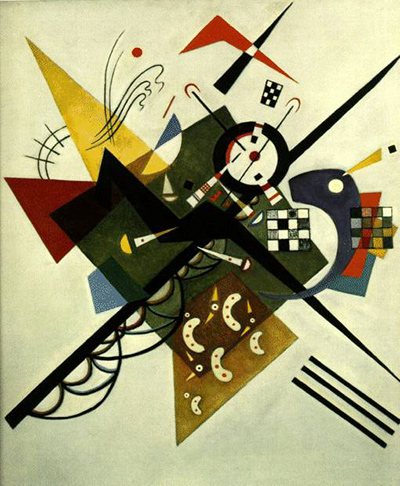
1922 — Weimar. At the Bauhaus in Weimar, Kandinsky taught while continuing to make paintings and works on paper. His 1923 Composition VIII offers a useful comparison with 1913's Composition VII: circles, lines and angled forms seem more distinctly separated across a broad field, but the picture is still arranged for visual tension, not solved like a diagram. The school was founded in 1919; Kandinsky's own Bauhaus teaching began in 1922. 1, 7[7]
1925–26 — Dessau and a book. The Bauhaus moved to Dessau in 1925. Kandinsky published Point and Line to Plane in 1926, formalising questions about the behaviour of elementary marks and their relation to a pictorial field. The book drew on earlier thought as well as his teaching situation. Several Circles, also 1926, is a good visual partner: repetition does not make the circles identical, and their relations to a dark ground help set rhythm and depth. The book is a guide to his inquiry, not a secret code from which every painting can be mechanically decoded. 1, 7
1920s–early 1930s — Variety within the school years. The work of this period ranged from spare sheets to large canvases. Some pictures emphasise sharp geometry; others retain soft colour transitions, uneven edges or uncertain space. The change from Murnau landscapes is substantial, yet it should not be reduced to a switch from emotion to mathematics. His letters and later comments indicate how intensely he regarded the life of apparently austere forms. Compare On White II, Several Circles and a smaller work on paper before assigning the entire decade one look. 1
1932–33 — Berlin and closure. The school moved from Dessau to Berlin in 1932 and closed in 1933. Kandinsky's long teaching relationship with the Bauhaus ended. Institutional chronologies differ on the exact year he acquired German citizenship, so that contested year is omitted here; it is not needed to understand the sequence of school moves, closure and relocation. 1
Late 1933–1944: Neuilly and the final work
Late 1933 — Near Paris. Kandinsky and Nina moved to Neuilly-sur-Seine, near Paris, after the Bauhaus closed. The new setting changed his social and professional circumstances again. It did not erase his interest in line, colour or a composed surface. Later forms can appear more organic, small and floating, yet large compositions and geometric features remained part of the decade. A date of relocation is a useful anchor, not an instruction to divide the oeuvre into two sealed styles. 1[8]
1936–40 — Late canvases. Composition IX is dated 1936; Composition X followed in 1939; Sky Blue belongs to 1940. Viewed in sequence, these works show how unreliable a single label such as “biomorphic” can be. Their grounds, motifs and degrees of density differ. In 1939 Kandinsky became a French citizen, according to Pompidou's chronology. This fact places the final years in a life shaped by repeated changes of country as well as repeated artistic reinvention. 1
1942–44 — Last works and death. Pompidou records a final large canvas in 1942 and a subsequent concentration on smaller works on cardboard. Kandinsky died on 13 December 1944. His last years should not be read backwards merely as a fading of the monumental pre-war paintings: changes of size and support offered different ways to arrange forms, and the work remained deliberate. The date closes the artist's life; it does not close the history of his images, which passed through different studios, collections and exhibitions. 1
After 1944: Why the collections are spread across museums
The afterlife belongs outside the lifetime sequence. In 1957 Gabriele Münter gave a major group of Kandinsky works and related material to Munich; that gift helps explain the Lenbachhaus collection. Nina Kandinsky's later bequest brought the contents of the Neuilly studio into the Centre Pompidou's holdings. The Guggenheim also became a major collecting and exhibition centre for the work. These collections let readers reconstruct paths that war, departure and separation had once interrupted. Their holdings are sources for specific objects, not interchangeable authority for every version of an image. 1, 2
For a route through individual works, start with the artist overview, then compare an early rider, a Murnau landscape, a pre-war Composition, a Moscow sheet, a Bauhaus painting and a late Paris work. The timeline gives those objects a shared historical frame. Their individual pages supply the precise title, medium, version and visual evidence that a date alone cannot carry.
Kandinsky artworks directory
Frequently Asked Questions
He moved in 1896 to pursue art after his university and legal work in Moscow. The move began a period of training and experimentation; it was not the year he made an abstract painting. 1
No. The painting The Blue Rider dates to 1903. The group associated with Kandinsky and Franz Marc formed in 1911. Their shared name makes it important to distinguish the object from the later artistic initiative. 1, 2
The first edition appeared in December 1911 but bears a 1912 date. Kandinsky had worked on the text earlier. The publication date and the printed year therefore describe the same first edition. 8
His Bauhaus teaching began in 1922 in Weimar. The school moved to Dessau in 1925 and Berlin in 1932, then closed in 1933. The Bauhaus itself was founded earlier, in 1919. 1
No. The 1914–21 period includes important drawings and watercolours, some paintings, writing and cultural work. The relative scarcity of large canvases should not be mistaken for an absence of art. 1
Kandinsky and Nina lived in Neuilly-sur-Seine near Paris from late 1933. He continued to make art there until near his death in December 1944. 1
Discussion
Which date in Kandinsky’s career changes how you understand a particular work?
Name the work and tell us which dated event helped you see it differently.
Reader Insights
Compare one work before 1914 with one made after Kandinsky’s return to Russia.
What changes when you place a work beside its city, institution or collaborator?
Which date or version would you want an object record to clarify?
Join the Conversation
Share an observation anchored to a specific work and date.
References
- Centre Pompidou, “Vassily Kandinsky”: biography, works and chronological landmarks. View source.
- Lenbachhaus, “The Blue Rider”, and Kandinsky collection person record. View source 1 · View source 2.
- MoMA, Kandinsky in the German Expressionism collection. View source.
- Solomon R. Guggenheim Museum, Kandinsky teaching materials, including Blue Mountain. View source.
- Lenbachhaus, Impression III (Concert) object record, GMS 78. View source.
- Italian Ministry of Culture catalogue, 1916 Kandinsky study in Milan. View source.
- Solomon R. Guggenheim Museum, Kandinsky teaching materials. View source.
- Solomon R. Guggenheim Museum, Vasily Kandinsky: Around the Circle press kit, biographical chronology. View source.