Teaching, painting and the changing school
Wassily Kandinsky joined the Bauhaus in Weimar in 1922, three years after the school was founded. He arrived with a mature body of painting and writing, as well as experience in Russian cultural institutions. At the Bauhaus he taught students to examine relationships among colour, line, shape and composition while continuing to make independent art. His eleven years with the school crossed three locations: Weimar, Dessau and, briefly, Berlin. Those changes shaped his duties, working spaces and colleagues. [1]; [3].
The picture above, Nachdruck (1926), is an independent watercolour and ink work in the Lenbachhaus. Its interacting arcs, circles, straight lines and areas of colour make an apt companion to a discussion of Kandinsky’s Bauhaus years. It is not a diagram lifted from his 1926 book Point and Line to Plane. Looking closely at an actual work also keeps the account from reducing eleven years of teaching and painting to a slogan about geometric shapes. [7]; [6].
Watch: Wassily Kandinsky
Five museum videos about Kandinsky’s art, sources of inspiration and the relationship between colour and music.
Vasily Kandinsky: Around the Circle
Curator Megan Fontanella introduces Kandinsky and the Guggenheim collection.
Watch on YouTubeAt a Glance
- Appointment:Kandinsky joined the Bauhaus in Weimar in summer 1922; the school had opened in 1919.
- Weimar teaching:Wall-painting workshop, 1922–25, alongside form and colour instruction.
- Dessau teaching:Analytical drawing, abstract elements, colour seminars and, from 1927, a free painting class.
- Publication:Point and Line to Plane appeared in 1926 as a Bauhaus book.
- Selected paintings:Composition VIII (1923), Yellow-Red-Blue (1925) and Several Circles (1926) belong to different moments of the school period.
- School moves:Weimar to Dessau in 1925; Dessau to Berlin in 1932; the Bauhaus dissolved in July 1933.
Contents
- Arrival in Weimar, 1922
- Wall painting and the built environment
- Form and colour as teaching questions
- Composition VIII and the Weimar paintings
- Yellow-Red-Blue before the move
- Dessau: a new school and household
- The 1926 book and work on paper
- Several Circles and the range of abstraction
- Painting class, stage work and colleagues
- The “Wassily chair” and attribution
- Dessau's closure and the Berlin ending
- Frequently asked questions
- References
Arrival in Weimar, 1922
The Bauhaus was established in Weimar in 1919 under Walter Gropius. Kandinsky did not help found it or teach its first classes. He had spent 1914–21 largely in Russia, making art and taking on roles in museums, education and artistic research. After leaving Russia in December 1921, he returned to Germany. The Bauhaus invitation brought him to Weimar in 1922. The distinction between the school's founding year and Kandinsky's arrival matters: its early workshops and curriculum were already evolving when he entered them. [13]; [16]; [1].
The appointment linked a well-known painter to a school that asked artists, craftspeople and designers to teach together. Kandinsky brought earlier questions about visual form, perception and the relation of painting to music. He also had to turn those questions into lessons for students whose eventual work might be in a workshop, an interior or a building rather than on a canvas. The Bauhaus account identifies both his workshop leadership and his teaching of form and colour. These were related responsibilities but not the same task. A wall-painting student might need to think about architectural surfaces and materials; a class on abstract elements could isolate how a line or colour operates within a composition. [1]; [2].
His earlier treatise Concerning the Spiritual in Art was published before the Bauhaus. It did not suddenly become a school manual merely because Kandinsky accepted the appointment. Yet his persistent concern with the expressive possibilities of visual elements gave continuity to his teaching. At the Bauhaus he developed more systematic diagrams, exercises and categories while continuing to argue that form and colour could act on a viewer. The move from a painter's manifesto to classroom analysis was a change of setting and method, not a complete renunciation of the earlier work. [6]; [12].
Wall painting and the built environment
Kandinsky headed the Bauhaus wall-painting workshop from 1922 to 1925. The workshop's remit was wider than hanging a painting on a wall. Students considered the coloured treatment of architectural spaces and objects, and early projects ranged across practical settings. Kandinsky's role should be described as teaching and directing this workshop, not as personally painting every surface produced by its students. Records of workshop output require individual attribution. His successor Hinnerk Scheper led the workshop from 1925 to 1933, so products of the later years cannot automatically be assigned to Kandinsky's direction. [2].
That separation is especially useful when images of Bauhaus interiors or wallpaper circulate without context. The school made work collaboratively and across years. A coloured room may demonstrate the school's interest in spatial colour, but the object's date, designer and workshop phase determine its relation to Kandinsky. Bauhaus wallpaper associated with the workshop from 1930 belongs to the later Scheper period, not to Kandinsky's Weimar workshop leadership. The existence of wall-colour teaching does not make every Bauhaus surface a Kandinsky work. [2].
An important 1922 commission or installation outside routine class exercises further shows how Kandinsky carried painting into space. Centre Pompidou discusses his wall designs for the Juryfreie exhibition in Berlin. These large mural panels brought abstract forms into an architectural display context. They were not ordinary easel paintings, and their relationship to later reconstructions has its own history. The project makes the wall-painting question concrete: a shape has to work at room scale, in sequence and in relation to the viewer's movement. It should not be confused with an illustration from a textbook. [12].
Form and colour as teaching questions
Kandinsky's teaching asked students to isolate visual elements and then examine their relationships. A point, a line and a plane could each be treated as more than geometry on paper: placement, pressure, direction and adjacency changed the effect of an element. Colour introduced further questions of contrast and association. The Bauhaus teaching account describes analytical drawing as a way to observe and organise a subject clearly, alongside classes on abstract form and colour. The exercises were methods of investigation for students, not recipes guaranteed to produce a successful design. [1]; [6].
The familiar triangle, square and circle paired with yellow, red and blue requires care. In 1923 Kandinsky asked Bauhaus students which primary colour best matched each basic shape. The frequently repeated triangle-yellow, square-red and circle-blue correspondence is associated with his theory. The Bauhaus source also records Oskar Schlemmer's sceptical response. A classroom survey and a teacher's hypothesis do not prove that viewers everywhere perceive the same fixed pairings. It is more useful to ask what the exercise made students notice: the ways in which colour, contour, area and expectation interact. [1]; [6].
Kandinsky sometimes described his investigation with the language of science. That language conveys a wish for systematic comparison and a teachable account of visual effects. It does not establish a timeless perceptual law. His categories were also tied to his own painting experience and expressive aims. Keeping those levels distinct lets the reader appreciate the seriousness of the inquiry without treating every assertion as experimental fact. Schlemmer's criticism is evidence that the ideas were debated within the school itself. [1]; [6].
Composition VIII and the Weimar paintings
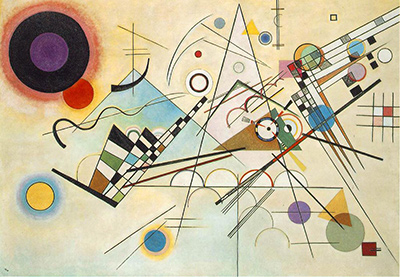
Teaching did not replace Kandinsky's independent painting. His 1923 Composition VIII belongs to the Weimar period and offers a major example of his changing visual language. Circles, diagonals, arcs and angular forms move across a pale field; their arrangement can look precise without reducing the painting to an illustration of a single lesson. The Guggenheim dates the oil to 1923. MoMA's chronology places it amid Bauhaus work. A reader can compare its controlled geometry with the more turbulent pre-war compositions, but no one class exercise explains the entire canvas. [10]; [13].
The term “geometric” can obscure differences among the paintings. In Composition VIII, a wide pale ground leaves intervals between many sharply defined marks. The work is structured by both concentration and open space. A circle may be emphatic because of its size or contrast, while another is almost a minor punctuation. Kandinsky's classroom attention to elements makes this way of looking fruitful, but it does not license a claim that the painting is an official Bauhaus diagram. Its scale, colour and timing belong to an autonomous oil. [10].
The 1923 school exhibition also placed Bauhaus work before a wider public. In that setting, students' workshop production, architectural aims and the work of masters could be seen together. Kandinsky's paintings were one part of a complex institution. His success as a painter did not mean all Bauhaus instruction promoted his personal style. Colleagues used different methods, and the school changed direction over time. It is more accurate to trace his own duties and objects than to make him the source of a single Bauhaus look. [1]; [17].
Yellow-Red-Blue before the move
The large Yellow-Red-Blue is dated by Centre Pompidou to March–May 1925. The painting was made while the Bauhaus was still in Weimar, before the school's move to Dessau later that year. This simple chronology prevents a common error: its strong geometric forms are not evidence that it was produced in the new Dessau buildings. The museum records an oil on canvas measuring 128 × 201.5 cm. [9]; [3].
The picture's title names three primary colours, but a title is only the start of looking. Centre Pompidou describes a contrast between a clearer geometric left side and a darker, more fluid right side. Painted signs meet without resolving into one tidy grid. A reader familiar with Kandinsky's theory might look for repeated associations between colours and forms, yet the painting also includes exceptions, layers and unexpected encounters. Its complexity challenges any reading that uses a three-shape chart as a key to every mark. [9].
Kandinsky's Point and Line to Plane appeared in 1926, after Yellow-Red-Blue was painted. The later book can help articulate questions already active in his practice; it cannot be cited as a published instruction that he followed in March 1925. This distinction between an evolving inquiry and a finished publication is central to the Bauhaus years. Painting, discussion, lesson preparation and writing overlapped, but the dated objects must still be placed in their proper order. [6]; [9].
Dessau: a new school and household
Political pressure in Weimar led the Bauhaus to move to Dessau in 1925. The school entered a new setting with buildings, workshops and opportunities for interaction among teaching, production and design. Kandinsky's role changed: the Bauhaus account associates his Dessau teaching with analytical drawing, abstract form and colour seminars, rather than continued leadership of the wall-painting workshop. Hinnerk Scheper took over that workshop. It is therefore misleading to present his eleven Bauhaus years as one unchanged workshop appointment. [1]; [2].
Kandinsky and Nina lived in the Masters' Houses at Dessau, in the paired house associated with Paul and Lily Klee. The Bauhaus Dessau Foundation records the Kandinsky and Klee households there from 1925 to 1932 and describes colour schemes in their interiors. The houses place an artist's daily life beside the design ambitions of the school. Still, an interior colour decision in the residence is not interchangeable with an oil painting or a student's workshop object. Each belongs to a different setting and attribution chain. [5].
Klee and Kandinsky were friends and colleagues, but their art and teaching should not be fused into a single programme. Both examined relationships between visual elements, and both taught students who worked beyond easel painting. Their closeness offers a reason to compare methods and results, not to assume that a Klee work illustrates Kandinsky's colour propositions. The Bauhaus was a meeting place for such productive differences. [5]; [16].
The 1926 book and work on paper
Point and Line to Plane was first published in 1926 in the Bauhaus book series. It develops Kandinsky's language for elementary pictorial forms, their movement and their relationships to a surface. The text is linked to his teaching, but it is neither a record of every classroom exercise nor a neutral scientific manual. The Lenbachhaus notes its connection to Concerning the Spiritual in Art and its more methodical approach. Later editions exist, so the date printed on a particular digitised copy should not be mistaken for the original publication year. [6]; [8].
The book asks the reader to pay attention to relationships that may otherwise pass quickly: where a line begins, what its direction implies, how an angle changes tension, and how an element responds to the surrounding plane. Such analysis can sharpen a reading of both a painting and a design. It does not mean the viewer must decode a fixed secret message. Kandinsky was exploring possible expressive values of form, not issuing a universal dictionary in which every circle always says the same thing. [6]; [1].
The Lenbachhaus Nachdruck image used above was also made in 1926. Its title might suggest a printed sheet in English, but the museum catalogues a watercolour and black ink work on board. It is an independent object, not a photographed spread from Point and Line to Plane. The page for the book discusses that distinction in detail. Here the image is useful because it shows how circles, arcs, a square, straight marks and translucent colour can coexist in a particular work. The specific placement and touch are part of the object; a general lecture on shape cannot replace looking at them. [7].
Several Circles and the range of abstraction
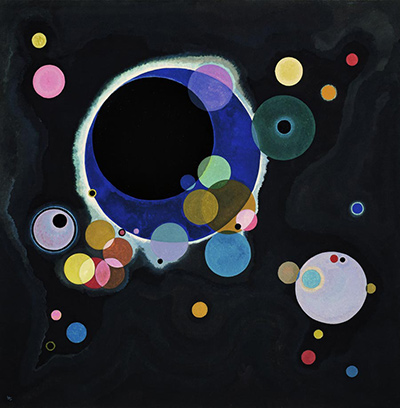
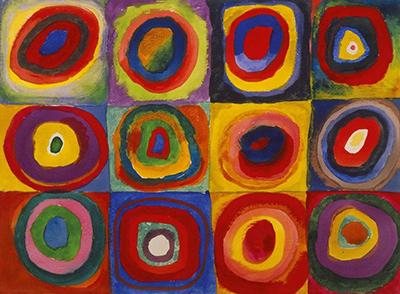
Kandinsky made Several Circles in January–February 1926, according to the Guggenheim. A group of discs and rings appears against a dark field, with differences in size, colour, translucency and edge. The circles can invite astronomical associations, but the museum's account treats the work as an exploration of pictorial relationships rather than a labelled map of the sky. It was made in the Dessau period, unlike the Weimar Yellow-Red-Blue. [11].
The painting is an antidote to the claim that Bauhaus geometry always meant a flat diagram. Some discs seem to glow or overlap; the black ground becomes active in the intervals among them. A transparent layer changes a colour's apparent strength. The material effect of glossy and matte passages matters. A person may use Kandinsky's teaching questions to inspect these choices, but the work's sensory presence exceeds the terms of a basic exercise. The question is what these specific circles do together, not whether every circle in the artist's oeuvre has the same meaning. [11].
The sequence from Composition VIII through Yellow-Red-Blue to Several Circles reveals a shift in emphasis without a single straight line of development. Each work has a distinct scale, ground, balance and relationship among its forms. They were made under different school conditions and at different moments of Kandinsky's writing and teaching. Grouping them as “Bauhaus paintings” helps establish a period, but it should not erase object-specific choices. [10]; [9]; [11].
Painting class, stage work and colleagues
From 1927 Kandinsky led a free painting class at the Bauhaus. This gave autonomous artistic practice an explicit place alongside studies meant to inform design and workshop work. The Bauhaus teaching account also describes more advanced theory instruction under Hannes Meyer. These changes show an evolving curriculum. Kandinsky was not simply repeating his 1922 lessons unchanged through the decade, and the school was not a static institution under one director or one goal. [1].
His interests also crossed media. A Bauhaus centenary programme documents Kandinsky's abstract stage presentation of Mussorgsky's Pictures at an Exhibition in Dessau on 4 April 1928. Forms, light, sequence and music meet in a timed experience rather than a single framed canvas. The stage work fits his long interest in relationships among the arts, but it is a distinct theatrical project. Its existence does not prove that every Kandinsky painting depicts a particular piece of music. [15]; [12].
The school's collective setting helped ideas travel through students' later practices. Gunta Stölzl, for instance, studied with Kandinsky and Klee and developed the weaving workshop's teaching. Her textile designs and curriculum remain her own work. The relation is influence through education and exchange, not transfer of authorship. That distinction applies more generally to Bauhaus students whose objects may show careful attention to colour and form without becoming Kandinsky designs. [18].
The “Wassily chair” and attribution
The tubular steel B3 chair is often called the “Wassily chair.” It was designed by Marcel Breuer, not by Kandinsky. Its later name is associated with Kandinsky, who admired or used the design, but the name should not override the designer's attribution. A reader encountering the chair in a Bauhaus summary may understandably think Kandinsky designed it; the Bauhaus Kooperation's object history identifies Breuer. This small correction illustrates a broader rule: school affiliation and personal association are weaker evidence of authorship than an object record. [14].
The same caution applies to photographs of interiors, murals and student exercises. Some are by Kandinsky; some are by colleagues or students; some survive in later reconstructions. A familiar motif or the word “Bauhaus” in a caption is insufficient. This page uses the rights-cleared Lenbachhaus Nachdruck for its main image and discusses other objects through their source records. Images credited to estates, artists' rights organisations or photographers have not been treated as freely reusable. [7]; [1].
Dessau's closure and the Berlin ending
The Bauhaus's institutional geography changed again in 1932. After a local National Socialist political victory, Dessau closed the school on 30 September. Under Ludwig Mies van der Rohe, it continued as a private institution in Berlin-Steglitz. A police and SA search in April 1933 sealed the premises; the faculty decided to dissolve the school in July. The 1933 end belongs to the Berlin phase, not to a final year of normal teaching in Dessau. [4]; [3].
Kandinsky's affiliation therefore lasted to the school's dissolution, but the conditions of the last months differed sharply from those of Weimar and Dessau. Political coercion closed teaching space and dispersed colleagues. He and Nina later moved to France, beginning another phase of work. It would make the history too simple to say that the Bauhaus ended because Kandinsky changed style, or that its closure instantly ended his art. The event was institutional and political; his painting continued afterward. [4]; [12].
The Bauhaus years leave both teaching records and a varied body of art. His classes gave students ways to break a visual problem into parts; his own paintings kept testing how those parts might act together. The workshop, the book, the stage and the canvas did not all serve one function. Following the dates and objects shows a teacher adapting to a changing school and an artist making work beyond any classroom formula. [1]; [6]; [12].
Kandinsky artworks directory
Frequently Asked Questions
He joined the Bauhaus in Weimar in summer 1922. The school was founded in 1919, three years earlier. He remained affiliated through its Dessau and Berlin phases until the school dissolved in 1933. [1]; [3].
In Weimar he led the wall-painting workshop and taught form and colour. In Dessau his instruction included analytical drawing, abstract elements and colour seminars. From 1927 he also led a free painting class. His duties changed as the school changed. [1]; [2].
No. Kandinsky proposed relationships among primary shapes and colours and surveyed students in 1923. The Bauhaus account records criticism from Oskar Schlemmer. The pairings are important to the history of his teaching, but a survey and theory do not establish a universal law of perception. [1]; [6].
No. Centre Pompidou dates the painting to March–May 1925, while the Bauhaus was still in Weimar. The move to Dessau took place later in 1925. [9]; [3].
No. Marcel Breuer designed the B3 tubular steel chair. “Wassily chair” is a later name associated with Kandinsky; it is not a designer credit. [14].
Dessau closed the school on 30 September 1932. It continued in Berlin-Steglitz, where the authorities searched and sealed it in April 1933. The faculty dissolved the Bauhaus in July 1933. [4].
Discussion
Which Bauhaus-period work most changes your view of these years?
Name a dated work, its medium and one visible feature before interpreting it.
Reader Insights
Compare Composition VIII with the 1926 work Several Circles.
How did the move from Weimar to Dessau change teaching and work?
Which object record establishes authorship for a Bauhaus design?
Join the Conversation
Share a close observation anchored to a dated Bauhaus-period work.
References
- Bauhaus Kooperation, Kandinsky's teaching. Appointment, curriculum, colour survey and painting class. View source.
- Bauhaus Kooperation, wall-painting workshop. Kandinsky and Scheper leadership. View source.
- Bauhaus Kooperation, school chronology. Weimar, Dessau, Berlin dates. View source.
- Bauhaus Kooperation, Berlin phase. 1932 closure and 1933 dissolution. View source.
- Bauhaus Dessau, Masters' Houses. Kandinsky and Klee households. View source.
- Lenbachhaus, Point and Line to Plane essay. Book, theory and critique. View source.
- Lenbachhaus, Nachdruck (1926). Main image object and CC0 rights. View source.
- Kunstmuseum Den Haag, 1926 Point and Line to Plane. First-edition date. View source.
- Centre Pompidou, Gelb-Rot-Blau. 1925 Weimar painting. View source.
- Guggenheim, Composition VIII. 1923 painting. View source.
- Guggenheim, Around the Circle press kit. Several Circles date and material discussion. View source.
- Centre Pompidou, Kandinsky monograph. Murals, Music Room, later move. View source.
- MoMA, Kandinsky: Compositions catalogue. 1922 Weimar and 1923 painting. View source.
- Bauhaus Kooperation, Breuer B3 chair. Designer attribution. View source.
- Bauhaus Kooperation, Pictures at an Exhibition programme. 1928 stage work. View source.
- Centre Pompidou study for On White II. View source.
- MoMA Bauhaus exhibition checklist. View source.
- Bauhaus Dessau on Gunta Stölzl. View source.