 by Tom Gurney
Tom Gurney BSc (Hons) is an art history expert with over 20 years experience
Published on June 19, 2020 / Updated on July 28, 2026
Email: tomgurney1@gmail.com / Phone: +44 7429 011000
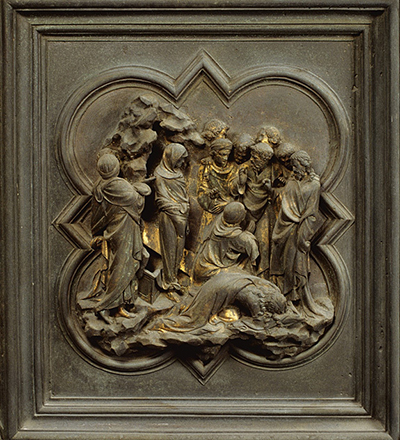
In Lorenzo Ghiberti's Raising of Lazarus, the miracle is made visible through witnesses. Lazarus emerges wrapped from a dark tomb at the left, Christ addresses the event near the centre or right, and kneeling and standing figures form a ring of responses. Recognition travels across the crowd through posture and gesture.
Contents
- Position and chronology
- Tomb and emergence
- Christ's command
- A spectrum of witnesses
- From darkness to recognition
Position and chronology
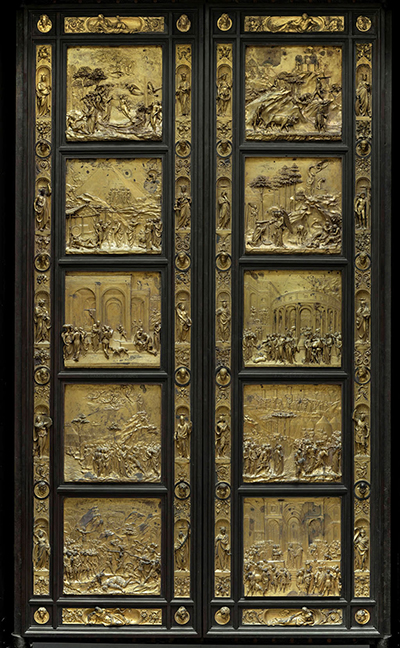
The panel is on the left leaf of the North Door, paired with the Transfiguration. Both concern revelation of Christ's identity, but their structures differ: the Transfiguration separates apparition above from apostles below, while Lazarus emerges within a shared human space.
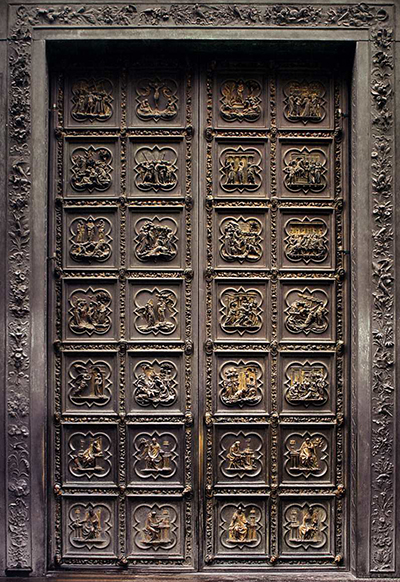
The North Door dates from 1403–1424. The original is displayed in the Museo dell'Opera del Duomo and a copy stands outside on the Baptistery. Opera del Duomo reports the Lazarus panel within a proposed phase around 1415–1420, following Krautheimer's stylistic reconstruction rather than an individually documented date.[1][2]
Tomb and emergence
The cave or tomb opening occupies the upper-left area. Its darkness provides a visual origin for Lazarus's return. The wrapped figure is recognizable not only through burial cloth but through the surrounding bodies that turn toward him.
John 11:1–44 gives the complete narrative route. The relief selects the climactic emergence and compresses the larger story into tomb, command and response.[3]
Christ's command
Christ stands apart enough to direct the event but remains part of the crowd's space. His gesture establishes a line of authority toward Lazarus. The distance between them is filled by witnesses rather than left empty.
This arrangement prevents the miracle from becoming a private exchange. It is publicly seen, and the observers' reactions help the viewer interpret what has occurred.
A spectrum of witnesses
Some figures kneel, others stand, lean or turn. Their different heights create a sequence of responses around the central action. The crowd does not recoil chaotically as in the Temple expulsion; it gathers into attention.
Overlapping bodies produce depth while keeping the scene compact. The viewer discovers the miracle through the same visual process as the witnesses: locating the emerging figure, following gestures and recognizing the source of command.
From darkness to recognition
Begin at the tomb opening and identify Lazarus. Follow the nearest heads and hands outward, then locate Christ and trace his gesture back across the crowd. Finally, compare kneeling and standing responses.
The panel's distinctive achievement lies in making belief or amazement social and bodily. The dark tomb and wrapped figure establish the impossible return, but the surrounding witnesses give it consequence. A useful onward comparison is the Resurrection: there Christ himself rises above sleeping guards, whereas Lazarus returns into a dense community already awake to the event.
Discussion
Ghiberti rewards slow looking: relief, gilding, narrative structure, workshop practice and conservation evidence can all change how a work is read.
Join the Conversation
Have an observation about Raising of Lazarus, a source to add, or a comparison that sharpens the reading? Share it below.