Music, painting and abstraction in Kandinsky’s work
Music offered Wassily Kandinsky a way to think about painting beyond the faithful description of objects. A musical work can build relationships among sounds without showing a landscape or a person. Kandinsky asked whether colour, line and form could act with comparable independence on a canvas. This was an analogy about artistic means, not a claim that every patch of paint translates a particular note. His interest took several forms: writing on the differences between the arts, listening and responding to Arnold Schönberg, organising the Blue Rider almanac’s music material, and imagining a stage work that joined colour, movement and sound. [2]; [4].
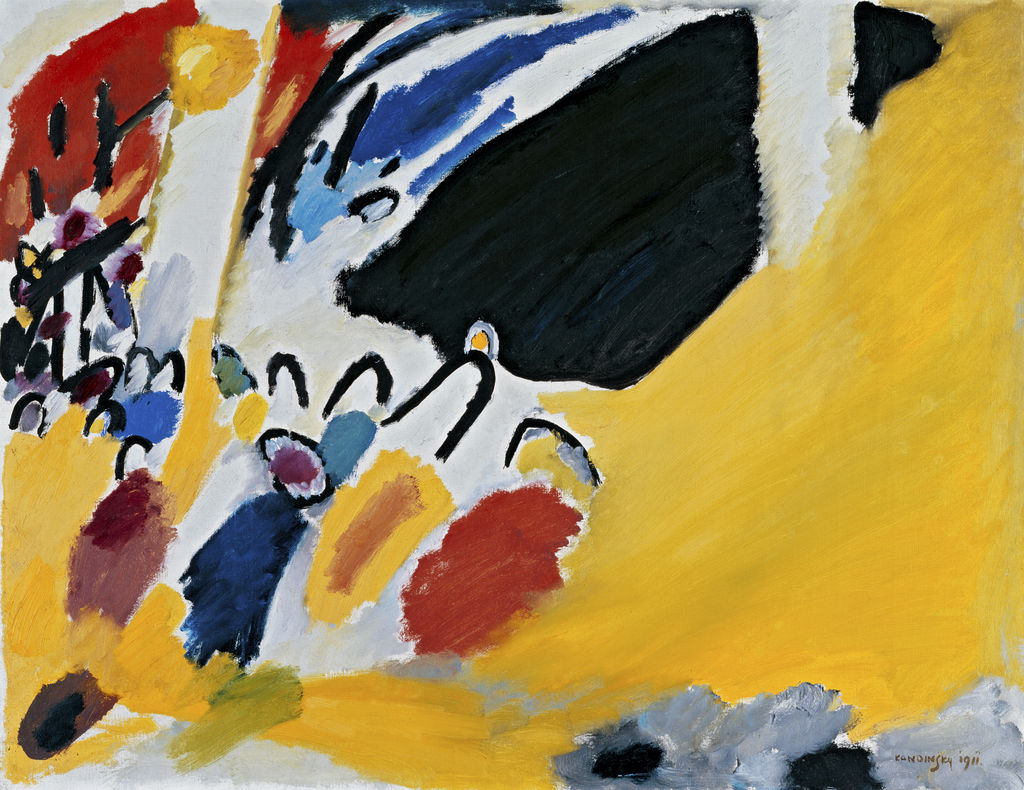
The painting shown above, Impression III (Concert), is a documented response to a Munich concert on 2 January 1911. It still contains the shape of a grand piano and an audience, even as yellow colour takes on a force of its own. That makes it an especially useful starting point. Kandinsky’s move toward abstraction was a longer process, however, and his musical thinking cannot be reduced to a single evening or a diagnosis of synaesthesia. [3]; [6].
Watch: Wassily Kandinsky
Five museum videos about Kandinsky’s art, sources of inspiration and the relationship between colour and music.
Vasily Kandinsky: Around the Circle
Curator Megan Fontanella introduces Kandinsky and the Guggenheim collection.
Watch on YouTubeAt a Glance
- Core question:how can painting organise colour and form without depending on recognisable subject matter?
- Documented event:Schönberg concert, Munich, 2 January 1911; Kandinsky and Franz Marc attended.
- Key painting:Impression III (Concert), 1911, oil on canvas, Lenbachhaus GMS 78.
- Primary writing:Über das Geistige in der Kunst, first issued at the end of 1911; Sadleir’s English translation appeared in 1914.
- Shared projects:1912 Blue Rider almanac music essays and Kandinsky’s stage text The Yellow Sound.
- Important limit:a colour–sound analogy is not proof of a clinical sensory condition or a one-to-one painting of notes.
Contents
- What music gave the painter
- The concert of 2 January 1911
- An exchange across two arts
- The Blue Rider and music in print
- Does “synaesthesia” explain the work?
- Looking with, and beyond, the analogy
- Frequently asked questions
- References
What music gave the painter
In Concerning the Spiritual in Art, Kandinsky observes that music usually does not need to reproduce natural appearances to communicate. For a painter dissatisfied with copying what the eye sees, this offered a model of expressive freedom. He points to rhythm, repeated colour, construction and movement as possibilities for painting. Yet he warns against superficial borrowing: one art has to learn how another uses its means, then discover what belongs to its own medium. The difference matters as much as the resemblance. Music unfolds over time; a painting can present its relationships together on a bounded surface. [2]; [1].
The keyboard comparison in the colour chapter is widely quoted. Kandinsky imagines the artist arranging colour so that the viewer responds inwardly, just as a player uses keys to set strings vibrating. In Sadleir’s 1914 English, the eye is compared to hammers; the later circulating version “eyes are the harmonies” is inaccurate. The metaphor is about the artist’s decisions and the viewer’s response, not instructions for converting each hue into an exact pitch. For the wording and its context see the Quotes guide and book guide. [1].
Kandinsky also used musical names for three kinds of painting: impressions, improvisations and compositions. The distinctions invite comparison among an external sensory starting point, a more direct inner impulse and a more consciously developed arrangement. The Museum of Modern Art notes their role in the 1911/12 book. A title does not tell us how quickly a picture was painted or whether all recognisable forms are absent. The actual canvas, studies and catalogue record have to answer those questions. [10].
The concert of 2 January 1911
The event behind Impression III was a programme of Arnold Schönberg’s music in Munich. The newer bilingual Lenbachhaus text dates it to 2 January 1911 and places Franz Marc among Kandinsky’s fellow listeners. The Philharmonie de Paris lists the first and second string quartets, three piano pieces of opus 11 and five songs. The programme matters because it was not a performance of one unnamed work that can simply be equated with the painting. It brought different works and forces together over an evening. [4]; [5].
Kandinsky sketched soon after hearing the concert, according to the Arnold Schönberg Center, and made the painting shortly afterwards. It condenses an experience rather than reconstructing a stage view. The black shape high in the composition recalls the lid of a grand piano; below are dark arcs that suggest listeners. Yellow spreads across much of the field and changes the weight of those remaining objects. The Lenbachhaus owner record gives the work’s material and size—oil on canvas, 78.4 × 100.6 cm—and describes the piano and audience. The black and yellow are visible facts about this painting; claiming that one area “is” a particular chord would require evidence the sources do not supply. [3].
Schönberg’s music at this point challenged conventional tonal expectations and the familiar pull toward a key centre. Kandinsky recognised a parallel with loosening painting from the duty to imitate objects. These were related artistic questions, not identical technical solutions. A recurring error is to call the January 1911 programme “twelve-tone” music. Schönberg’s twelve-tone method came later, in the 1920s; the Schönberg Center explicitly treats that development as independent of Kandinsky’s Bauhaus visual language. An older Lenbachhaus object essay uses the anachronistic phrase, while the museum’s newer wall text describes the early music in terms of atonality. Here the dated programme and later scholarship govern the musical terminology. [6]; [4].
An exchange across two arts
The encounter became a correspondence. The Arnold Schönberg Center’s letter database records Kandinsky writing to the composer on 18 January 1911 and Schönberg replying on 24 January. In the January letter, Kandinsky identifies the independent life of voices in Schönberg’s compositions as close to what he was trying to find in painting. That is stronger evidence of a conceptual connection than a later guess about what a colour “sounded like” to him. The letters also show two artists speaking from different practices. They did not form a single joint system for music and painting. [6]; [11].
Schönberg was also a painter. His visual work appeared in the first Blue Rider exhibition, and he contributed writing to the 1912 almanac. Their exchange therefore was not simply a painter looking to a composer as a distant ideal. Each could see the other’s effort to challenge habits of form and expression. The Schönberg Center traces the friendship and its later disagreements, including a serious political rupture in the 1920s. The later conflict should not be retrojected into the positive early 1911 letters, but it prevents a romantic claim that they always shared one position. [6].
The painting and the letters answer different questions. The painting preserves an object-like piano and abstracting yellow field. The letter establishes Kandinsky’s stated interest in the independence of voices. The dated concert anchors both in an encounter. Together they support a careful story of artistic dialogue. None proves that a particular musical phrase equals a particular brushstroke. For the canvas, sketches and owner history in more detail, see the Impression III (Concert) artwork page.
The Blue Rider and music in print
Kandinsky and Franz Marc’s Der Blaue Reiter almanac did more than mention music in passing. The Lenbachhaus’s bilingual account says that eight music contributions were initially planned and four essays appeared in the final 1912 book. They were by Schönberg, Thomas von Hartmann, Nikolai Kulbin and Leonid Sabaneyev. The almanac also carried sheet music by Schönberg, Alban Berg and Anton von Webern. This is material evidence of an editorial project that set modern musical thought beside visual art. Its contributors had different ideas; the almanac was a meeting place, not a single jointly signed theory. [4].
Kandinsky’s essay on stage composition argued that existing theatre had not gone far enough in joining the arts. The same almanac first published his stage text Der Gelbe Klang (The Yellow Sound), which imagined colour, light, dance, sound and music working together. Thomas von Hartmann composed music for the project. MoMA’s Kandinsky: Compositions catalogue says it was not produced during Kandinsky’s lifetime. This distinction matters: publication of a scenario and score is not evidence that audiences saw a staged 1912 performance. [4]; [7].
The stage project widened the question beyond a painting compared with music. A viewer could experience changing light, colour, movement and sound in sequence. Centre Pompidou has compared Kandinsky’s Yellow Sound with Schönberg’s stage work Die glückliche Hand, while stressing that their aesthetic solutions differ. A cross-art connection need not erase those differences. It is more useful to ask what each artist makes visible or audible through the constraints of a particular medium. [8].
A related project is Klänge (Sounds), Kandinsky’s book of prose poems and woodcuts. MoMA describes its musical title and the way print images and words interact, while the Prints guide follows its object and publication evidence. Its existence broadens Kandinsky’s interest in the meeting of arts beyond the Schönberg concert, but it should not be collapsed into The Yellow Sound: one is an illustrated book, the other a stage text with intended sound and movement. [9].
Does “synaesthesia” explain the work?
Museums sometimes call the meeting of sound and colour in Kandinsky’s work “synesthetic.” In an art-historical sentence, the word may mean an analogy or a deliberate combination of senses. It can also name a neurological condition in which one kind of sensation regularly evokes another. Those meanings should not be silently treated as interchangeable. The dated concert, letters and book establish that Kandinsky thought across the arts and described colour through sound. They do not by themselves establish a clinical diagnosis or a stable private mapping of particular notes to hues. The Guggenheim’s teaching material says he is believed to have had synaesthesia, which is a qualified modern interpretation, not direct medical evidence. [12]; [4].
His own writing offers a better way to proceed. In the 1911/12 book he proposes that colours and forms can affect a viewer, and he repeatedly compares those effects with musical sound. He also distinguishes the arts’ material conditions. A listener receives music over time; a viewer encounters a whole canvas and then moves attention across it. That distinction lets us describe visual rhythm without pretending to hear an actual score from the painting. Musical terms such as “harmony” and “dissonance” can sharpen observation of contrast or repetition, provided their use is explained as interpretation. [1]; [2].
Looking with, and beyond, the analogy
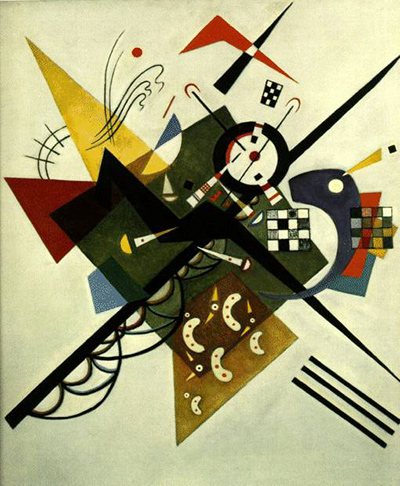
Start with what a work shows. In Impression III, the piano and listener shapes keep the concert visible, while yellow alters the scene’s spatial and emotional force. In the 1913 Colour Study, repeated cells let colour relations change without depicting a performance. In the 1923 Composition VIII, circles, diagonals and other forms create a more geometric field. These works have different materials, purposes and dates. Calling all three “musical” is only useful if the comparison identifies a specific relation—rhythm, repetition, contrast, movement or independence from depiction—in each one. [3]; [13]; [14].
The comparison also has limits. A musical work’s duration, performance and sound are not present in a stationary oil painting. A canvas’s pigment, texture, edge and simultaneous visual field do not belong to the same process as a quartet. Kandinsky knew that both connection and difference mattered. Read his music analogy as a challenge to painting’s obligation to represent, then return to the exact object. Its museum record establishes date, medium and dimensions; the theory can suggest questions about relations within it. The book guide supplies the longer textual context, while the artist timeline shows how these projects fit into his career.
One useful test is to ask which part of a comparison comes from a source and which is our own act of looking. The concert programme and correspondence can establish that Kandinsky encountered Schönberg’s music and saw a parallel between independent musical voices and painting. The Lenbachhaus record can establish the painting’s title, medium, date and dimensions. Saying that its yellow field feels like a sustained sound is a viewer’s metaphor: it may help describe the field’s breadth, but it should be labelled as interpretation. This distinction leaves room for another reader to notice a different rhythm without disputing the documented event. It also keeps later works from being forced into the same musical pattern merely because their titles are Compositions.
Kandinsky artworks directory
Frequently Asked Questions
Yes. The Lenbachhaus dates the Munich concert to 2 January 1911 and catalogues the painting as a 1911 oil. The Arnold Schönberg Center says Kandinsky sketched that night; the finished painting followed. [4]; [6].
No. Schönberg’s twelve-tone method came later. The 1911 programme is better described through its challenge to established tonality and its use of dissonance. An older museum description uses the later term anachronistically; the dated programme and Schönberg Center clarify the chronology. [5]; [6].
No source used here identifies a single note or chord for the yellow field. It can be read as Kandinsky’s forceful visual response to the concert, but the black piano, audience shapes and colour relations are part of the whole painting. [3].
They exchanged letters and participated in the Blue Rider network, but worked in distinct media and did not produce a single jointly authored theory of colour and music. Schönberg contributed to the almanac and exhibited paintings. [6]; [4].
MoMA’s catalogue says no. Its text first appeared in the 1912 Blue Rider almanac, with music composed by Thomas von Hartmann for the stage project. Publication and staging are different events. [7]; [4].
His writings and work establish deliberate sound–colour analogies, but they do not on their own prove a neurological diagnosis. Some museum educational material says he is believed to have had the condition; that remains a qualified interpretation. The paintings can be discussed precisely without relying on it. [12].
Discussion
How does a documented musical encounter change your reading of a particular work?
Name the work and passage, then describe the connection.
Reader Insights
Compare the concert painting with a later Composition without assigning notes to colours.
Which relation in a painting seems rhythmic, and what makes you say so?
What evidence would clarify a claim about Kandinsky and music?
Join the Conversation
Share an observation anchored to an edition and a specific artwork.
References
- Wassily Kandinsky, Über das Geistige in der Kunst insbesondere in der Malerei, German 1912 edition. Primary argument on music and painting. View source.
- Wassily Kandinsky, Concerning the Spiritual in Art, Michael T. H. Sadleir translation, 1914. Historical English version. View source.
- Lenbachhaus, Impression III (Konzert) object record. Material, date and object description; its musical terminology is cross-checked against later sources. View source.
- Lenbachhaus, 2021 bilingual Blue Rider wall text. Concert, almanac and stage material. View source.
- Philharmonie de Paris, Kandinsky exhibition research. Concert programme. View source.
- Arnold Schönberg Center, Kandinsky/Schönberg exhibition account and letter database. Encounter and correspondence. View source 1 · View source 2.
- MoMA, Kandinsky: Compositions catalogue. The Yellow Sound and von Hartmann. View source.
- Centre Pompidou, Schönberg/Kandinsky stage-work programme. Comparison with important differences. View source.
- MoMA, Blue Rider essay. Klänge and cross-art context. View source.
- MoMA book record. View source.
- Center’s bilingual excerpts. View source.
- Guggenheim teaching material. View source.
- Lenbachhaus Colour Study. View source.
- Guggenheim Composition VIII. View source.