The Blue Rider circle, its exhibitions and almanac
Der Blaue Reiter (“The Blue Rider”) names an artistic circle, two exhibitions and an almanac associated with Munich in 1911–12. Wassily Kandinsky and Franz Marc edited the book, but the project reached well beyond two painters. Gabriele Münter helped organise the first exhibition; artists with different practices, nationalities and views appeared in its galleries and pages. Its common ambition was to make room for an art that could express more than outward appearances. That ambition did not produce one fixed Blue Rider style. The group’s short working life makes its catalogue, artworks and publishing choices especially valuable evidence of what its participants actually did. [1]; [2].
The image above shows Kandinsky’s 1912 colour woodcut cover for the almanac, held by the Lenbachhaus. Its rider, horse, blocky lettering and blue-black print make the name visible, but a book cover is only one part of the story. The 1903 Kandinsky painting The Blue Rider is a separate artwork made eight years before the editorial circle formed. The recurring rider motif links Kandinsky’s early painting, prints and later project; it does not prove that the 1903 canvas alone supplied the group’s title. [6]; [10].
Watch: Wassily Kandinsky
Five museum videos about Kandinsky’s art, sources of inspiration and the relationship between colour and music.
Vasily Kandinsky: Around the Circle
Curator Megan Fontanella introduces Kandinsky and the Guggenheim collection.
Watch on YouTubeAt a Glance
- What it was:A loose Munich-based circle that organised exhibitions and edited a cross-disciplinary almanac, with stylistic diversity rather than formal membership rules.
- Predecessor:The Neue Künstlervereinigung München (NKVM), founded in early 1909, brought several future participants together.
- First exhibition:Galerie Thannhauser, Munich, 18 December 1911–3 January 1912; around fifty works.
- Second exhibition:Galerie Hans Goltz, Munich, from February 1912; a large show of works on paper, including Paul Klee and Alfred Kubin.
- Book:Der Blaue Reiter almanac, edited by Kandinsky and Franz Marc and published by Piper in May 1912.
- End and afterlife:Exhibitions toured until 1914; the First World War dispersed the circle. Gabriele Münter’s 1957 gift later made the Lenbachhaus a major centre for its study.
Contents
- Before the Blue Rider: Munich and Murnau
- A split and a new exhibition
- The second exhibition and works on paper
- The almanac as an editorial argument
- Kandinsky’s rider, cover and painting
- A circle wider than two editors
- What the Blue Rider meant by freedom
- War, dispersal and the works’ survival
- Frequently asked questions
- References
Before the Blue Rider: Munich and Murnau
Kandinsky’s Blue Rider years grew out of shared work that began earlier. In Munich he had organised artists and taught, while Münter, Alexej von Jawlensky and Marianne von Werefkin became close artistic colleagues. The four worked together around Murnau in 1908. Paintings from those years show intense colour, simplified forms and landscapes that are still recognisable. Looking at this period only as a prelude to pure abstraction would hide what these artists learned from one another and from the places where they worked. Their experiments were not identical; the sense of a conversation is part of the history. [1]; [8].
The Neue Künstlervereinigung München, usually shortened to NKVM, was founded in early 1909. It provided a means to exhibit modern work publicly and to assemble artists who did not share a single local training. Lenbachhaus traces the Blue Rider circle to this predecessor. Calling the later project an abrupt invention by Kandinsky alone misses the earlier exhibitions, disagreements and friendships that made a new venture possible. Nor should the NKVM be reduced to a failed version of its successor. Its broader network included artists whose paths through the 1911 split differed, especially Jawlensky and Werefkin. [2]; [1].
The Murnau and Munich works also warn against a tidy march from representation to abstraction. Münter’s interiors and landscapes, Marc’s animals, Jawlensky’s heads and Kandinsky’s riders use recognisable subjects in different ways. Colour and simplified shape could carry a spiritual or emotional aim while still depicting a person, horse or village. The later Blue Rider programme accommodated such variety. A reader should not test a work for group relevance by asking whether every object has vanished from it. [8]; [2].
A split and a new exhibition
During 1911 Kandinsky and Marc were already planning an almanac called Der Blaue Reiter. Their dissatisfaction with the NKVM intensified. Lenbachhaus reports that the jury for the association’s third exhibition rejected a nearly abstract Kandinsky work in December. Kandinsky, Marc and Münter then resigned and quickly mounted their own show at Galerie Thannhauser in Munich. This sequence matters: the publication project was in preparation before the exhibition and the rejected painting did not create the entire idea overnight. The first exhibition’s full title referred to the “editorial board” of Der Blaue Reiter, making the book project visible before the book existed. [1]; [3].
MoMA’s exhibition chronology dates the first show to 18 December 1911–3 January 1912. Lenbachhaus describes around fifty works by artists chosen for an open, pluralist programme. The catalogue listed 43 works and seven more appeared outside it, according to its later reconstruction. Kandinsky, Marc and Münter were present, alongside August Macke, Heinrich Campendonk, Robert Delaunay, Henri Rousseau, Arnold Schoenberg, Elisabeth Epstein and others. This is a record of exhibited work, not an official roll of permanent members. The artists’ media and affiliations were varied; the show itself was the clearest public statement of their willingness to put them side by side. [9]; [3].
The attempt at international reach had limits. Lenbachhaus notes that relatively few artists living outside Germany ultimately took part in that first project, despite the editors’ efforts; Delaunay and the Burliuk brothers were among the more visible exceptions. That gap between a stated international ambition and the actual first roster is worth keeping in view. It is better evidence than either celebrating the exhibition as fully global or dismissing the ambition as empty. Later tours brought Jawlensky and Werefkin into Blue Rider displays, showing how the circle changed as the work travelled. [3].
The second exhibition and works on paper
A second exhibition followed at the Galerie Hans Goltz in Munich from February 1912. Lenbachhaus describes it as an extensive display devoted to works on paper, with Paul Klee and Alfred Kubin now participating. A detailed museum reconstruction counts 315 works and identifies Klee, Münter, Kandinsky and Kubin among the prominently represented artists. Its title included “Black and White,” a graphic-arts category rather than proof that every watercolour or drawing lacked colour. The shift in medium enlarged what visitors could see: prints, drawings and small sheets could sit together without the hierarchy imposed by a room of major canvases. [1]; [11].
Works on paper were central to Kandinsky’s practice, not just minor rehearsals for oil paintings. The woodcut in particular gave him hard edges and flat areas suited to a rider, a hill or a fragmentary sign. MoMA connects the medium’s flattened perspective and reduced forms to experiments that led toward abstraction. Yet a print may also be an independent object, and a page printed for a book does not automatically represent a sketch for a canvas. The second show and almanac deserve attention as material ventures in their own right. [8]; [3].
The exhibition widened the circle’s public appearance without fixing its edges. Klee’s seventeen drawings at the second show, for example, establish his participation there; they do not justify projecting him back into the first December 1911 roster. Jawlensky and Werefkin had helped form the earlier Munich and Murnau network, but Lenbachhaus distinguishes their later involvement in touring exhibitions from the immediate resignation of Kandinsky, Marc and Münter. These distinctions make the history more intelligible than a single list of names labelled “founders.” [8]; [1].
The almanac as an editorial argument
After lengthy preparation, Der Blaue Reiter appeared in May 1912 from the Munich publisher Piper. Kandinsky and Marc edited it. It was not a conventional exhibition catalogue or a manual telling every painter to use a single palette. Its reproductions placed modern European art alongside older work, folk art, objects from outside Europe and art associated with children. Texts by artists, composers and critics argued for new possibilities in painting and music. The range was itself an editorial claim: artistic value need not be assigned by academy, nationality, period or medium alone. [1]; [5].
The book’s method also raises questions for a present-day reader. Placing objects from different cultures beside European avant-garde works can challenge a narrow art history, but it can remove them from their own makers and contexts. Lenbachhaus’s later interpretation explicitly considers the group’s global collecting and looking within the colonial period. A useful account can acknowledge both the editors’ opposition to academic ranking and the unequal conditions under which many non-European images were obtained, reproduced and explained. Calling the almanac simply “universal” would bypass that history. [4].
Kandinsky’s text and Marc’s writings give the project its well-known spiritual vocabulary. In Kandinsky’s account, an artwork could arise from “inner necessity”: the painter’s choices should answer a need within the work rather than merely imitate an external object. Such language was not a recipe or an agreement that every contributor shared the same beliefs. A reader can test the pluralism by comparing a Marc animal, a Münter interior, Kandinsky’s increasingly unstable landscape forms and a Schoenberg musical contribution. They address related questions while retaining marked differences in subject and medium. [1]; [8].
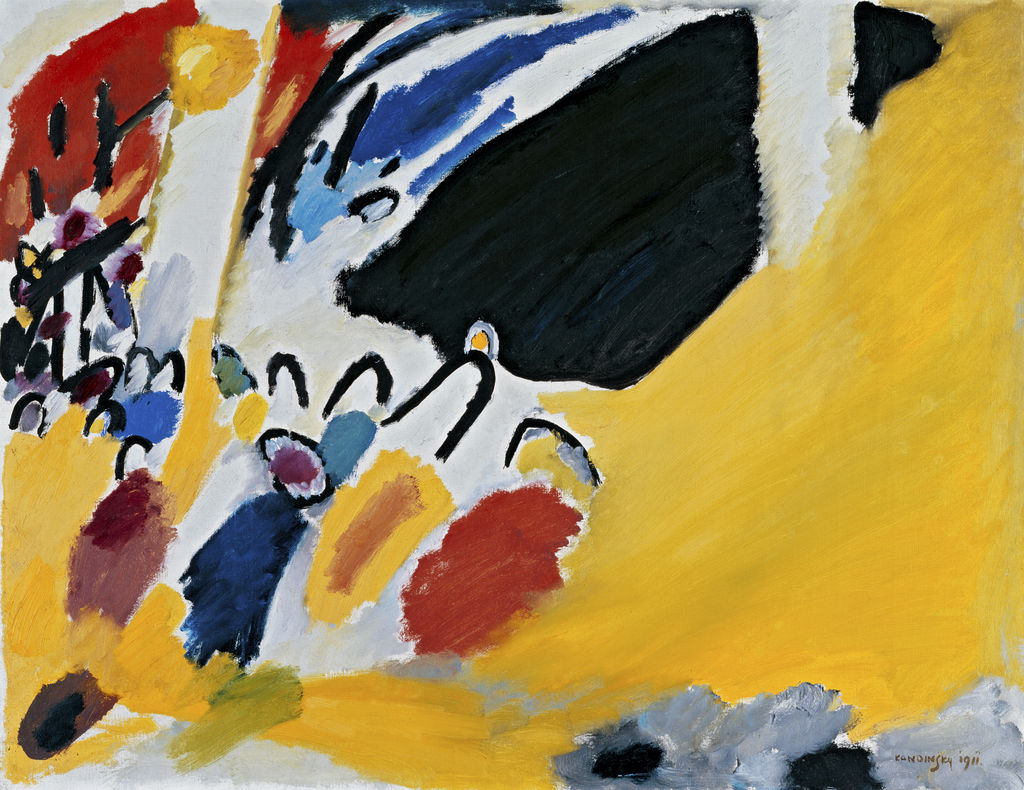
Music was part of the printed argument, not a decorative metaphor added afterward. The almanac included essays and scores; Kandinsky also explored combinations of visual art, sound and stage action in The Yellow Sound. His response to a Schoenberg concert in January 1911 provides a dated example of the artistic exchange, while Impression III (Concert) is one of the resulting paintings. The music and abstraction guide follows those relationships more closely. They help explain why an editorial project could involve composers and images in the same publication without reducing a painting to an illustration of a specific tune. [3].
Kandinsky’s rider, cover and painting
The rider had appeared in Kandinsky’s art long before May 1912. His 1903 The Blue Rider remains a landscape with a small mounted figure. Later horse-and-rider images tend to fragment or simplify the scene. MoMA treats the motif as a recurring sign in Kandinsky’s paintings and prints and describes Picture with an Archer of 1909 as a stage in that development. That continuity helps explain why the motif was available for an almanac title and cover. It does not establish a one-to-one line from the 1903 painting to the project’s name; MoMA records the editors’ account as a conversation about blue, horses and riders. [10]; [8].
The Lenbachhaus catalogues the cover reproduced above as a 1912 colour woodcut on strong paper, 31.8 × 23.1 cm, inventory GMS 321. A frontal rider and horse fill the main field, while the word “Blaue” is set vertically on the binding and the title is repeated beside the figure. Its rough black shapes and muted blue printing give a forceful image with few means. The visible letters identify it as a designed cover; the object record gives its material and date. We should not confuse it with the separate 1911 woodcut for the almanac in the same museum, whose stronger blue and alternative lettering show another stage of the design. [6]; [7].
This cover can be read as a meeting of image and publishing. The block outlines make the mounted figure graspable at book scale; the typography makes the title part of the image rather than a caption attached later. Blue is significant in the project’s name and the visible print, but assigning it one precise universal meaning would overstate the evidence. Kandinsky’s Concerning the Spiritual in Art guide explains his own colour arguments, and the colour and form guide compares them with dated works. A cover can introduce those questions; it cannot settle every contributor’s intention. [6].
A circle wider than two editors
Kandinsky and Marc receive much attention because they edited the almanac and articulated influential theories. Their roles are documented, but a two-man account distorts the shared work. Münter was among those who left the NKVM and mounted the first exhibition. Her paintings and works on paper appeared within the movement’s activities; MoMA explicitly calls her a crucial collaborator in its founding. She later preserved a large group of Blue Rider works, donating more than a thousand to the Lenbachhaus in 1957. That gift shapes which objects can be studied together today. It should not cause her own artistic contributions to be described only as caretaking. [8]; [2].
Werefkin and Jawlensky were central to the earlier shared summers and the NKVM. They did not immediately follow Kandinsky, Marc and Münter out of the association, a distinction Lenbachhaus and MoMA both preserve. Their subsequent works entered Blue Rider touring displays. Macke contributed to exhibitions and the almanac and helped secure financial support through his family network. Campendonk appeared in the first exhibition, while Klee and Kubin joined the second. Elisabeth Epstein’s inclusion in the first show is easy to miss when later summaries repeatedly name only the best-known artists; the historical exhibition list records her. [1]; [3]; [8].
The differences among these people matter formally. Marc’s animals are neither disguised Kandinsky landscapes nor merely illustrations of a doctrine. Münter’s simplified rooms and villages use direct, strong colour while keeping a visible world. Klee’s drawings make line and small-scale invention central. A Schoenberg work enters through music rather than painting. The movement is easier to understand as a set of working relationships, exhibitions and editorial juxtapositions than as a trademark look applied to everything each participant made. [8]; [2].
What the Blue Rider meant by freedom
A Blue Rider work need not be wholly abstract. Lenbachhaus says the circle gave equal room to abstract and representational forms when artists followed an inner artistic need. In that sense freedom meant freedom to choose a form adequate to a work, not an order to abandon all recognizable subjects. Kandinsky’s heavily worked Composition V and a Marc animal painting can therefore take part in the same venture without looking alike. MoMA’s account likewise connects a shared spiritual ambition with multiple kinds of image making. [4]; [8].
This makes the word “movement” useful but imprecise. The group had editors and exhibitions, not a fixed register that all historians reproduce identically. Its first exhibition, second exhibition, tours and publication contain overlapping but different sets of names and works. A modern label that treats every person associated with it as a founder, or every exhibited painting as an example of Kandinsky’s theory, erases those differences. When dating a claim, ask which activity it belongs to: work in Murnau, NKVM membership, the December 1911 display, the second show, the almanac or a later tour. [1]; [3].
The almanac’s internationalism also needs that precision. Its editors drew from a wide range of cultural sources, and the exhibitions brought together artists with connections across Europe. The first show nevertheless represented only part of that intended range. The inclusion of non-European art in the book was a significant challenge to European academy hierarchies, while the treatment of those objects was conditioned by colonial collecting and selective presentation. These are historically connected facts, not a single verdict that can be read off a cover. [1]; [4].
War, dispersal and the works’ survival
The first exhibition travelled beyond Munich, and Blue Rider activity continued through tours and related displays until 1914. The outbreak of the First World War broke the collaboration. As a Russian citizen Kandinsky had to leave Germany; Marc and Macke were killed in the war. MoMA identifies August 1914 as the point at which the Blue Rider dissolved. The short active period should not be stretched into a formal association continuing through Kandinsky’s later Bauhaus and Paris years. Those phases belong to his subsequent career, however much he carried forward artistic questions first sharpened here. [8]; [4].
The surviving artworks have their own later history. Gabriele Münter safeguarded work from the circle, and her 1957 donation of more than a thousand pieces formed a major part of the Lenbachhaus collection. Because that group of objects remained together, viewers can compare designs, paintings and prints without assuming that the best-known canvas represents the whole project. A present-day museum collection is also a record of preservation and gifts, not a transparent map of every activity in 1911–14. The almanac and exhibition lists remain essential companions to it. [2].
A practical way to explore the Blue Rider is to start with one dated object and one dated public event. Compare the 1912 cover with the 1911 exhibition list, then with a Münter painting or one of Klee’s drawings in the second show. Note whether the source is an owning museum’s object record, a historical catalogue, an artist’s own argument or a later museum interpretation. The differences reveal how much the enterprise depended on editing, collaboration and the physical media of art. The name “Blue Rider” becomes clearer when attached to those acts, rather than treated as a code that can decode every colour in a painting. [6]; [3].
Kandinsky artworks directory
Frequently Asked Questions
All three uses occur, but they refer to different things. Kandinsky painted The Blue Rider in 1903. A loose artistic circle organised exhibitions under the Blue Rider name from late 1911. Kandinsky and Marc edited an almanac with that title, published in May 1912. A date and medium will usually tell you which one is meant. [1]; [6].
The painting precedes the project and belongs to Kandinsky’s recurring rider imagery. It is not secure evidence that this one canvas directly named the movement. MoMA relates the almanac title to Kandinsky and Marc’s conversation about blue, horses and riders. The earlier motif helps explain the choice without being the sole documented source. [10].
Kandinsky and Franz Marc were the almanac’s editors, and Gabriele Münter joined them in resigning from the NKVM and organising the first 1911 exhibition. A wider circle grew from earlier Munich and Murnau work, including Jawlensky and Werefkin, and through later shows. There was no single fixed membership roster. [1]; [8].
No. Lenbachhaus describes a pluralist project in which abstract and representational works could both arise from an artist’s inner necessity. Marc’s animals and Münter’s interiors still depict subjects; Kandinsky’s work ranged through different degrees of recognisability. [4]; [8].
It combined images and texts across periods and media, including European modern art, folk and non-European work, children’s art, writings by painters and composers, and music. Its wide juxtapositions expressed the editors’ challenge to narrow academic categories; they also need to be read in the colonial context of how some objects were collected and represented. [1]; [4].
Discussion
Which exhibited work best shows the range of the Blue Rider circle?
Name the work, its date and the exhibition or book where it appeared.
Reader Insights
Compare the 1912 almanac cover with the first exhibition’s range of artists.
How did works on paper change the second exhibition’s scope?
Which record distinguishes an object from the later movement story?
Join the Conversation
Share an observation anchored to a dated exhibition or specific artwork.
References
- Lenbachhaus, The Blue Rider group history. Formation, split, exhibition rosters, almanac and tour chronology. View source.
- Lenbachhaus, Der Blaue Reiter collection album. NKVM predecessor, group scope and Münter’s 1957 gift. View source.
- Lenbachhaus, 2021 bilingual exhibition wall texts. First and second shows, catalogued works and tours. View source.
- Lenbachhaus, 2021 Blue Rider collection booklet. Pluralism and the colonial context. View source.
- Lenbachhaus, 2024 almanac labels. Book publication and cross-media scope. View source.
- Lenbachhaus, Kandinsky’s 1912 almanac cover, GMS 321. Object details and CC0 image. View source.
- Lenbachhaus, 1911 almanac woodcut, GMS 320. Related but distinct print. View source.
- MoMA, German Expressionism: Der Blaue Reiter. Artists, objects and First World War ending. View source.
- MoMA, Kandinsky: Compositions catalogue. First-show dates and touring chronology. View source.
- MoMA, Picture with an Archer. Rider motif and name-story context. View source.
- Lenbachhaus 2021 exhibition text. View source.